Does a Pride flag mean EVERYONE is welcome?

A Facebook friend shared the following post from a Conservative Rabbi:
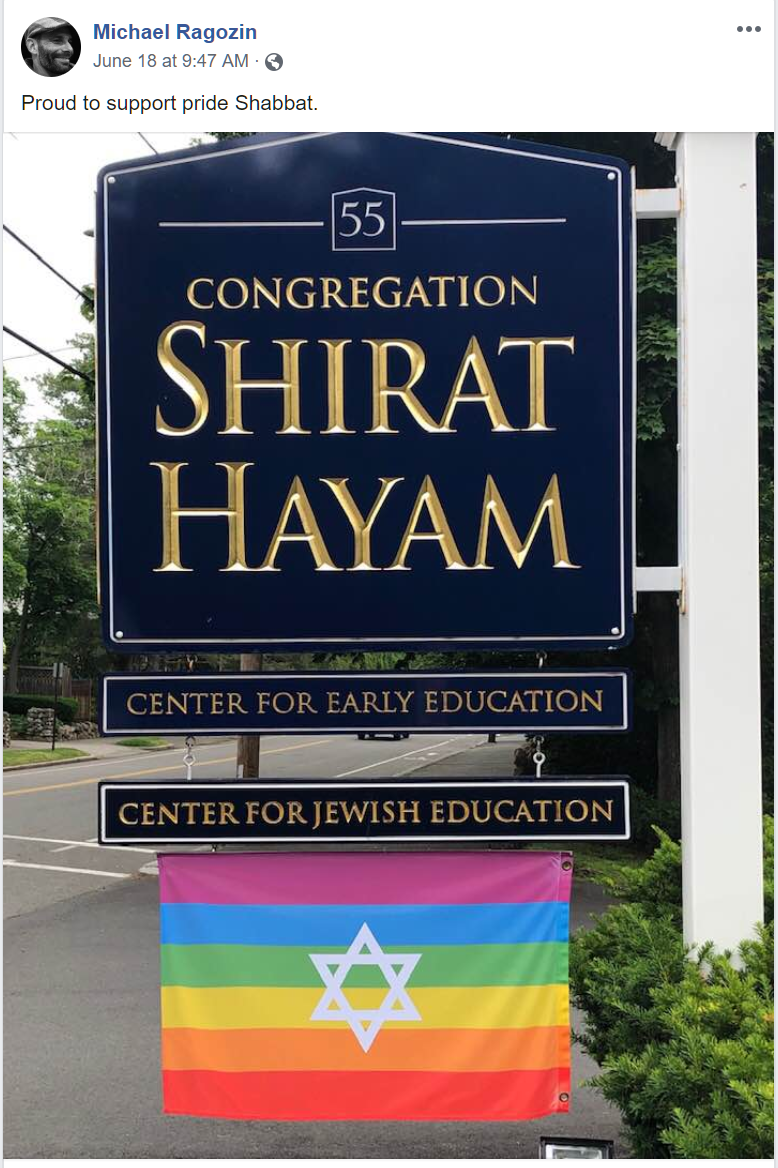
(i.e., a prime spot for a Black Lives Matter sign (in a nearly-all-white town, of course, with restrictive zoning to keep it that way) was taken up with a different victim group’s banner)

He added “We stand for radical hospitality. EVERYONE is welcome!”

Of course, I had to ask “Would someone who advocated for strict adherence to Leviticus 18 and 20 be welcome?” (see Wikipedia for “Orthodox Judaism generally prohibits homosexual conduct”)

There was a bit of back and forth, leading me to suggest an update: “everyone who agrees with us is welcome”

A righteous congregation member replied “Do you mean to suggest that the hypothetical conservative people you reference would be unable to respect that others have different moral perspectives from them, and would make a scene harassing others, causing them to be asked to leave?”

I refined the question: Okay, so the hypothetical person comes to the “EVERYONE is welcome” temple wearing a T-shirt reading “Follow Leviticus 18/20” on the front. On the back is “Outlaw abortion after a heartbeat can be heard”. On the head of this person is a red MAGA hat. The person is carrying (not on Shabbat, I hope!) Tefillin in a Trump Hotel laundry bag in one hand and a Reelect Trump 2020 tote bag in the other hand. Will this person be just as welcome as a person wearing a rainbow T-shirt?

A sincere congregation member: I imagine such a shirt might prompt conversation, and as long as all parties engaged in conversation in good faith, I have trouble believing Mr. T-Shirt Man (as I’m now thinking of him/you) would be asked to leave.

I asked how this would be different from a Catholic Church putting out a “Stop abortions now” (an issue on which Americans disagree) and saying “EVERYONE is welcome,”

The righteous response: a key difference is that the Catholic Church promotes a moral code that is anti-abortion, and presumably could even excommunicate members who have abortions. Therefore, such signage would be hypocritical. It seems that perhaps you are perceiving there are “two sides” that are mirrors of one another, but there are crucial differences between a Catholic or Evangelical church that says “abortion is immoral” and are working to criminalize abortion—but still say “all are welcome” — and a Jewish Temple or, say, a UU church that sees abortion as a medical procedure between a women and her doctor (but not going around and foisting the procedure on others) and welcomes all comers. The former groups are trying to control / legislate others’ behavior, but the latter groups are not.

I pointed out that the LGBTQ banner was sometimes unfurled in order to control and coerce others, e.g., preventing Chick-fil-A from opening restaurants, forcing the Colorado baker to make a same-sex wedding cake, or boycotting Israel (maybe they’d rather visit one of the anti-Israel countries in which homosexual acts are punishable by death?).

Me: Circling back to the original post, would your temple be equally welcoming to the Colorado baker who was the subject of the Supreme Court case as you would be to someone wearing a Provincetown Pride T-shirt? If not, it is inaccurate to say that EVERYONE is welcome!

Congregation Member 1: exerting pressure on corporations to change their practices is not the same as legislating the elimination of human rights for certain groups of people. Apples and oranges.

Congregation Member 2: you seem to say above that a flag representing “[Jewish] gays are welcome,” is a point of view?

Readers: What do you think? Does hanging a pride flag signal adherence to a political point of view and therefore tend to exclude people who don’t agree with that point of view (e.g., Orthodox Jews, observant Muslims, Catholics, etc.)? Or is it legitimately characterized as an “EVERYONE is welcome” sign?

Full post, including comments


MIT Chemistry Discovery: Immigration is Oxygen

From MIT President Rafael Reif, “Letter to the MIT community: Immigration is a kind of oxygen”:

For those of us who know firsthand the immense value of MIT’s global community and of the free flow of scientific ideas, it is important to understand the distress of these colleagues as part of an increasingly loud signal the US is sending to the world.

Protracted visa delays. Harsh rhetoric against most immigrants and a range of other groups, because of religion, race, ethnicity or national origin. Together, such actions and policies have turned the volume all the way up on the message that the US is closing the door – that we no longer seek to be a magnet for the world’s most driven and creative individuals.

What kind of folks are currently streaming over the border and claiming asylum? Brilliant architects and future Ph.D. electrical engineers:

In May, the world lost a brilliant creative force: architect I.M. Pei, MIT Class of 1940. Raised in Shanghai and Hong Kong, he came to the United States at 17 to seek an education. He left a legacy of iconic buildings from Boston to Paris and China to Washington, DC, as well on our own campus. By his own account, he consciously stayed alive to his Chinese roots all his life. Yet, when he died at the age of 102, the Boston Globe described him as “the most prominent American architect of his generation.”

Thanks to the inspired American system that also made room for me as an immigrant, all of those facts can be true at the same time.

And now for the chemistry lesson…

In a nation like ours, immigration is a kind of oxygen, each fresh wave reenergizing the body as a whole. As a society, when we offer immigrants the gift of opportunity, we receive in return vital fuel for our shared future. I trust that this wisdom will always guide us in the life and work of MIT.

Apparently oxygen is no longer a source of corrosion, fires, and toxicity!

Full post, including comments

Don’t use Facebook Messenger if you’re a criminal

I’m reading The Last Stone, by the journalist behind Blackhawk Down.

The book concerns an extended family of degenerates and criminals and their involvement in the kidnapping and murder of Katherine and Sheila Lyon back in 1975. This was a cold case that was reopened in 2013.

[one suspect] would often hitchhike out to Hyattsville, another edge city northeast of Washington, in the district’s other Maryland suburban county, Prince Georges. His father, Lee, and stepmother, Edna, and many other members of Lloyd’s large extended family lived there, clustered around his grandmother’s house. They were part of what has become known as the Hillbilly Highway, the migration of largely Scotch Irish Appalachian families to northern cities after World War II. Many of these families retained the insularity, habits, and dialect of their native region.

Parents, aunts, uncles, and cousins of the suspect were all themselves suspected. Few of them were upstanding citizens:

Teddy Welch made little sense as the kidnapper, but his story afforded a glimpse into the curious Welch family. What the detectives found shocked them. The abuse that Lloyd had suffered in his father’s house and Teddy had suffered in his was not an aberration. It was the norm. Few family members had escaped it. Fathers beat and raped their children, brothers terrorized and raped their sisters and cousins. Alcohol, drugs, and violence colored every relationship. It was not much of a stretch to see teenage Lloyd and perhaps even Teddy as pawns enlisted by the older, more practiced predators in their family. The clan had two branches, one in Hyattsville, Maryland, and the other five hours south on a secluded hilltop in Thaxton, Virginia, a place the locals called Taylor’s Mountain. Here the family’s Appalachian roots were extant, even though some of its members had gradually moved into more modern communities in and around Bedford, the nearest town.

The Welch family, with its country ways, lived shoulder to shoulder with city dwellers seeking affordable housing close to jobs inside the beltway. The clan had sunk its roots here wide and deep, with enough Welches, Overstreets, Dooleys, Esteps, and Parkers to fill Magruder Park when they gathered for a reunion. If they had a look, it was generally pale and blue-eyed, with small pinched features in a broad face. Their men were scrawny and their women wide.

Taylor’s Mountain and Hyattsville may have been radically different places, but the family was the same in both. Its mountain-hollow ways—suspicion of outsiders, an unruly contempt for authority of any kind, stubborn poverty, a knee-jerk resort to violence—set it perpetually at odds with mainstream suburbia. Most shocking were its sexual practices. Incest was notorious in the families of the hollers (hollows) of Appalachia, where social isolation and privation eroded social taboos. The practice came north with the family to Hyattsville. Here, where suburban families had turned child-rearing into a fetish, some adults in Lloyd’s immediate family exploited their offspring and ignored barriers to incest. It was not uncommon for Welch children to experiment sexually with siblings and cousins.

Criminal behavior rarely warranted family censure, much less a report to the police. Indeed, the more shocking the conduct, the stronger the impulse to hide it. Protecting the family from outsiders was more important than protecting its members, including children, from each other. And the Welch women, often victims, were its fiercest guardians.

The police used phone taps, but also got into Facebook Messenger.

Otherwise, Connie seemed uninterested. She offered this single memory and that was it. She repeated that she had little or nothing to do with Lloyd or any of the other members of his immediate family. But the squad found something different on her Facebook account. Connie was conferring frequently with her Maryland cousins about the case. Soon after she was questioned, she wrote to Teddy’s wife, Stacy, about what she had been asked and what she had said. She also phoned Pat and Dick’s daughter Patricia Ann. She later wrote on Facebook to another cousin, Patricia Ann’s daughter, Amy Johnson, and explained that her story was, in part, meant to absolve her uncle Dick. “I called Pat last night to let her know I talked to police,” she wrote. “I know Dick did not bring him [Lloyd] down. He walked down with his pregnant girlfriend. That’s for having our back.”

In one of her Facebook exchanges with her cousin Amy, Connie confided, “My biggest fear is that my last family member Henry was part of it on the mountain.” She had told the grand jury that her brother often hung out with Lloyd when the latter visited. When asked how Henry might have been involved, she said, “Henry wouldn’t murder the child. He wasn’t in Maryland. I meant help bury it. If he helped bury the bodies on the mountain.” “Why do you think Henry would bury the bodies on the mountain?” “Because his momma would tell him to do it. We always did what Momma told us to do.”

If the family had used an encrypted messaging system, they might have escaped justice!

[Separately, the book provides support for the idea that criminality is heritable. It didn’t matter that this family ended up in the D.C. suburbs, surrounded by good-hearted social welfare policies and a fountain of tax dollars collected from folks in the Midwest, Florida, Texas, and California. If this family is anything to go by, the 3rd and 4th generation descendants of the Central Americans who come to the U.S. because of their involvement in violent criminal gangs will themselves be involved in violent criminal gangs.]

Full post, including comments

New York Times is the new Penthouse Forum for AARP Members?

A tale of an encounter in a department store dressing room with a rich famous guy in which both man and woman had to keep silent for fear that the dozens of nearby department store workers, including security personnel, would hear. For folks who were born well before the Internet porn revolution, that would be the summary of a letter to Playboy or Penthouse Forum (and ultimately the subject of scholarly analysis).

What’s different this time? The New York Times is competing with Playboy and Penthouse and the female in the story is 76 years old (but might have been as young as 52 at the time, still two years over the age of eligibility of membership in AARP).

What are we to make of the media interest in this tale?

Related:

Update: This is the top story in New Yorker magazine’s daily email:

The dressing room encounter turns out to be related to the undocumented:

I imagined that undocumented families would be openly and cruelly persecuted in America, and that there would be plans of mass raids and internment, and that as this was happening I would not be rioting in the street as I ought to but depressively checking things off my Google Calendar to-do list and probably writing a blog post about a meme. What I didn’t imagine, though—and what actually occurred last week—is that a respected and well-known writer would accuse the President of raping her, and that I would be so sad and numb, after years of writing about Trump’s many accusers, after watching Brett Kavanaugh get confirmed to the Supreme Court in the face of credible sexual-assault allegations, that I would not even have the courage to read the story for days.

… public figure accusing the President of rape is news. Even though Carroll is at least the twenty-second woman to accuse Trump of sexual misconduct, she is only the second to accuse him of rape. (The first was Ivana Trump, who later downplayed her story.)

(not mentioned is that Ivana Trump was an alimony and child support plaintiff at the time and a failure to attempt to use the domestic violence parallel track in a U.S. family court is typically a sign of poor legal advice; Plaintiff Ivana “downplayed” the story once she got the cash she was seeking)

If the President had ever convincingly espoused ideas of respect for people who are not like him, or of equal rights for women, it’s possible that he would be held accountable for his actions. Instead, he promised mass campaigns of cruelty against undocumented immigrants, and he is delivering. He said that he grabbed women by the pussy, and many women—twenty-two, so far—explained that, yes, he did that, or something like it, to them. Carroll’s essay—exceptional, devastating, decades in the making—has made me consider how hard it is to understand right away that you’ve been exhausted into submission, especially when submission and endurance feel inextricable.

The writer seems very concerned about the undocumented, but has she offered any concrete assistance to them? A room in her Manhattan apartment?

[On Facebook today, I saw a non-Jew holding a placard reading “End Family Separation. End Detention Camps. The Jewish Community Says This is a Moral Emergency.” I had to restrain myself from responding with “But not such a serious emergency that any of the members of the Yale Jewish Community would offer to shelter a migrant in their own houses?”]

Full post, including comments

Should Trump offer migrant children to those decrying the concentration camp system?

My Facebook feed is alive with the righteous condemning the U.S. government’s parking migrant “children” (some could be 25-30 years old as long as they say that they are under 18?) in concentration camps.

Would it make sense for the Federales to track down these folks and offer them the opportunity to host one or more migrant children in their own house?

In my experience, the offer of an actual migrant is typically refused by those who say that they welcome migrants. Here’s a recent interaction with a guy on Facebook who has a house large enough to share:

  • Him: Refugees need help now, not later. The basics. These are among the most vulnerable people in the world. I come from a family of refugees, and for my birthday let’s make their lives a little easier. [Fundraising link to the Hebrew Immigrant Aid Society, the tax dollar-funded organization that enraged the guy who shot up the Pittsburgh synagogue (filled with Jews who may have disagreed with the current HIAS mission of bringing non-Jewish low-skill immigrants to the U.S.)]
  • Me: If you want to shelter a refugee family in your house for at least one year, and pay for their food and health care (so US taxpayers don’t have to), I will be happy to fund their airfare from Kabul, Beirut, or wherever else in the world you find these new Americans.
  • Him: this is a private charity [yet it is primarily taxpayer-funded!], not a political position. Donate or don’t. There is an abrasive black and white false dichotomy that you propose: Either take personal responsibility for an entire family of refugees or you’re a hypocrite. Bullshit! There are limits to what I am willing to do to help others, including refugees. That doesn’t mean that there is something wrong with doing something, even modest, to help the cause.
  • Me: Would you be willing to take one refugee for a year in your home? Masshealth will sell a comprehensive health insurance policy for $3/month if your refugee doesn’t work and I think he or she would also be entitled to food stamps. Remember that any refugee who is not sheltered in an existing house will be exacerbating what is already considered a critical shortage of affordable housing (caused by Trump, says HuffPost).
  • Him: I don’t think you understood my point at all. Is there any amount of money you personally would part with to help out a refugee?
  • Me: Yes! My standard offer is to fund airfare from Kabul, Beirut, or wherever else. So that’s about $2,000 per refugee. I also offered to pay $50,000 to charter a plane to take a caravan of refugees from Mexico to Canada (whose Prime Minister offered to take anyone rejected by the U.S.).

Readers: What do you think? Would the folks complaining about migrants being subject to crummy room and board be silenced if they were offered migrants to host?

Related:

Full post, including comments

A 7th grader wishes Happy Birthday to Donald Trump on Instagram

A friend’s 7th grader wished a Happy Birthday to Donald Trump on Instagram. This prompted some private messages with her classmates at our mostly-righteous-thinking public school.

Exchange 1 (some punctuation inserted):

  • He is not a leader he is a criminal
  • He’s the president. Why isn’t he in jail if he’s a criminal?
  • Because no one is brave or smart enough to arrest him.
  • So you’re calling Hillary dumb? Are you saying the Democratic Party shouldn’t be voted for because they aren’t smart enough or brave enough?
  • Hillary is not a rapist, racist, or ripping families apart at the border!

[When this girl grows up enough to have children, a Massachusetts family court will be happy to give her a substantial 23-year cash reward for ripping her own family apart…]

Exchange 2 (with a Jewish girl):

  • Disgusting
  • What’s the problem with Trump? Why don’t you have something against Obama?
  • Because Obama isn’t racist or a rapist.
  • Trump’s daughter converted to orthodox judaism. Isn’t that good?
  • U didn’t deny that hes a rapist. We may have the same religious but that doesn’t mean anything.
  • He’s not a racist. Where’s your proof?
  • In all of the women speaking out about what he has done.
Full post, including comments

Elizabeth Warren’s student loan forgiveness idea is flawed…

… because it doesn’t go far enough!

Economists have found that most of the benefits of subsidized federal student loans went to colleges, which used the money to overpay administrators (how do we know they’re overpaid? look at the quit rate!).

Colleges seem to charge students however much they think a family can cough up. When the Feds added guaranteed and/or subsidized loans, colleges just raised their prices. Students did not receive a better education because they paid more. The extra money was used for more administrative bloat and higher salaries for existing administrators.

Instead of merely forgiving student loans that haven’t yet been paid off, what would be fair is if the government admitted this was a welfare scheme for universities and, in addition to forgiving unpaid loans, refunded all payments made under these ill-advised programs.

Readers: Is it time to admit that the government helped universities fleece American families and give back the stolen money?

Related:

Full post, including comments

Mexican democracy worse than Trump dictatorship

“How Trump’s Tariff Threat Could Outsource the Asylum Crisis to Mexico” (New Yorker) is kind of interesting. During Donald Trump’s election campaign and for the first year or two of his administration, nothing regarding immigration could fairly be described as a “crisis.” Yet now that Trump has been in office for a while, there is actually a “crisis.”

We are told by our media that the U.S. under Dictator Trump is one of the most oppressive environments ever created on Planet Earth. Refugees are separated from children, interned in concentration camps, sexually assaulted, and sometimes killed.

What could be worse than that? Day to day life within the area governed by our southern neighbor, the democracy of Mexico!

In theory, if not always in practice, the migrants returned under Remain in Mexico will have a chance to petition for asylum in the U.S. But, by the definition of a safe third-country agreement, asylum seekers travelling through Mexico would no longer be allowed to make their case to American authorities. By default, Mexico would become their final destination. Such a scenario would be highly controversial for legal and humanitarian reasons. For one thing, such an agreement is premised on the assumption that Mexico is a “safe” country in which migrants can seek asylum, even though the country has a well-documented history of mistreating migrants in its custody and of unlawfully turning them around at its southern border.

Doesn’t this sound like prejudice?

Related:

Full post, including comments