Why do robot alarmists and universal basic income advocates support expanding immigration?

Happy July 4th! We’re independent as a nation so in theory we get to decide what kind of nation we want to have. Today I want to understand an apparent logical contradiction.

A bunch of my Facebook friends fall into a category that I call “robot alarmists.” They believe that computers and robots are getting so sophisticated that at least half of the current American workforce will be unable to find any job at all. Thus they support a universal basic income (“UBI”). Here are some example posts:

Some variant of [universal basic income] is inevitable if civilization is to survive the invention of robots. However, there is a much deeper flaw here: the notion that consumerism itself can continue forever. It can’t, at least not with 10 billion humans trying to live like Americans.

Bring on the robotax 🙂 Since robots stand to boost profit at the expense of labor (what else is new?!), it stands to reason that buying a robot should be heavily taxed, with the proceeds going to the unemployed.

Labor shortages have been predicted since I was in college and here we are, short on jobs and money, but long on billionaires and robots. Even if they’re right, all it means is more demand pressure on creating robots to fill those jobs.

This is how they take over our world: it’s just too damn convenient, efficient and profitable to use them. And of course we will keep improving them because that makes them faster, better, cheaper yet! Until one day they break the tether and run… [over an article on a gas leak robot]

The only option left once you give all the jobs to robots… [over an article on UBI]

Because we just HAVE to go faster! And replace humans with robots. Right? Or is there some other logical reason why we NEED faster computers? I’m not coming up with any [over an article on microprocessor trying to stay on the Moore’s Law curve]

Central to the case for a UBI is the way it would help prepare us for a world in which the new technological revolution, driven by artificial intelligence and robotics, will, over time, transform the nature of work and the type and number of jobs. [UK Labour politician]

I would be more worried about about a collapse in the job market if I could find someone reliable to weed our yard for less than 3X the federal minimum wage or someone skilled in carpentry at less than 6X. But let’s assume that these folks are sincere. They believe that in the reasonably near-term, our society’s wealth will come from the robots that some citizens and corporations own plus from the labor of an elite group of workers who do things that robots cannot do.

Why do the same people then support current U.S. immigration policy and advocate for an increase in the number of immigrants on the same terms? The U.S. immigration system is not targeted at people with elite skills, high education levels, and high income in whatever country they’re living in now. Thus we are going to be bringing in people who cannot read and may not be able to speak or understand English. If the average American’s income will just be whatever robots produce divided by the total population as a universal basic income (minus any costs to administer the government handouts, of course), what would be the value to current U.S. citizens of increasing the denominator?

Suppose that the goal is humanitarian relief. Citizens of Syria, Afghanistan, and other countries do not have a good life in their home countries. We will bring them to the U.S., give them a universal basic income, and they can be happy going to Disneyland every day. If that is the goal, however, wouldn’t it make a lot more sense to give a larger number of designated unfortunates a smaller “universal basic income” (“universal sub-basic income”?) that would enable them to live comfortably in a lower-cost-of-living part of the world?

In short, in the old days the argument used by advocates of immigration is that they would grow our economy (and tax base) by working. Today, however, the people who argue that we will have a vast surplus of human labor continue to advocate for immigration and a larger population of the humans most of whom they believe will be economic parasites of either robots or exceptionally skilled humans. How does that make sense?

Full post, including comments
Good chess set for a family?

Chess nerds: What’s a good chess set to give to a family with an 8-year-old child who is learning? The “club” boards seem to have letters and numbers in addition to the standard squares. Are those necessary or helpful for someone who is learning? I don’t remember having that when my dad was teaching me how to play.

If the pieces are wood, is it more common to have the black pieces actually be black? Or just a dark brown?

The sets at Amazon seem to be mostly pretty cheap/crummy. I want to buy something that could potentially last a lifetime but at the same time is not so expensive that it has to be protected from children. The family doesn’t live in a McMansion so the set should fold up (i.e., the board should fold up and store the pieces).

[Separately, is learning and playing chess obsolete now that we live in a world of ever more sophisticated computer- and video-games?]

Full post, including comments

Informal sperm donor

From the New York Post: “Professor who donates sperm in city bathrooms has sired 22 kids.”

Some excerpts:

The 6-foot-2 CUNY Kingsborough math professor [Ari Nagel] has served as a sperm donor for dozens of locals, siring 22 kids over the past 12 years with 18 women of various backgrounds.

He will also offer his services in his home near Downtown Brooklyn, but mama wannabes are often more comfortable meeting in public.

Once a location is chosen, Nagel will go into the bathroom, pleasure himself while watching porn on his iPhone — “You can’t connect to Target Wi-Fi if you’re connecting to a porn site, so I use my cell service,” he says — and ejaculate into an Instead Softcup, a type of menstrual cup.

He then delivers the specimen to the woman, who goes into the ladies’ restroom and inserts it into her cervix.

Without the explicit legal protections afforded to sperm banks, what about post-conception litigation?

The first five women he worked with successfully sued him for child support, and nearly half of his paycheck is garnished for his offspring.

“I don’t know what’s more surprising: that five sued or that 17 didn’t,” Nagel says. “They were all well aware there was no financial obligation on my part. They all promise in advance they won’t sue.”

(Under New York family law, he actually should have lost close to 100 percent of his paycheck to the five plaintiffs. Assuming one child per mother, the first plaintiff would receive 17 percent of his pre-tax income, the second woman to sue would get 17 percent of the 83 percent remainder, etc. Due to the fact that child support is not deductible from income, Professor Nagel would quickly get to the poverty line from a combination of child support orders and federal, state, and city income taxes. Assuming that he starts with $100,000 per year, the first plaintiff gets $17,000 per year, the second $14,110, the third $11,711, and the fourth just $9,720 per year. The professor is now left with $47,458 of pre-tax income but close to $40,000 of that would go to pay taxes. The fifth plaintiff ought to get $8,068 but in theory the system is not supposed to reduce a defendant below the poverty line. Note that it may not be accidental that the first five women sued. Due to the difference in cash values assigned to children under New York law, the sixth and later women don’t have a claim worth pursuing against Professor Nagel. So it would be more accurate to say that 100 percent of the people who could have sued him and gotten something actually did sue.)

Related:

Full post, including comments

Health care inflation in Boston

“Possible Nurses Strike At Brigham And Women’s Hospital Averted” gives some insight into how much we’ll be paying for health insurance going forward:

On wages, the 52 percent of Brigham nurses who are not yet at the top step for seniority would see a 17 percent rise in wages during the three-year contract. Nurses who are at the top step, meaning they’ve been at the Brigham for 18 years or more, would see a 4.5 percent increase over three years.


Full post, including comments

Cessna’s answer to the Pilatus PC-12

Cessna has released a few more details regarding its big single-engine turboprop (the Pilatus PC-12, designed almost 30 years ago, is currently the only game in this town).

Pilots will use a standard Garmin G3000 avionics suite and enjoy a modern GE engine with FADEC (Cessna press release). Fuel efficiency and speed are a little better than on the PC-12. The pressurization system is a vast improvement, with a 6,130′ cabin at 31,000′ (compare to 10,000′ inside when it is 30,000′ outside for the PC-12). This should cut fatigue substantially on long flights. Is it actually bigger inside than the PC-12? I asked the PR folks and they responded with “The cabin will feature a flat floor and will be the largest in this segment with a width of 63 inches and a height of 58 inches.” (Pilatus claims a width of 60 inches and a height of 58 inches.) Flying says that the new plane will cost at least $4.8 million, meaning that it will be nearly the same out-the-door price as a PC-12 in “executive” configuration (i.e., not just basic commuter airline seats). The standard Pilatus configuration holds 8 in the back plus 2 pilots up front. Cessna’s holds just 6 in the back. From a practical standpoint Pilatus is thus a “two-family” airplane while the Cessna is a “one-family” plane; for business trips either should be fine because it is rare for more than 6 people to need to go to the same destination.

If the cabin noise is substantially lower than in the PC-12 this will likely be a much better family airplane due to the (a) less-punishing noise, (b) lower cabin altitude, (c) simpler engine and familiar-to-most-GA-pilots avionics. For charter operators and two-pilot crews, a used PC-12 at $2-3 million should be the winner due to the larger cabin, greater seating capacity, lower acquisition cost, and reduced business risk due to the long-certified design (which has its flaws, of course, but they are well-known and quantifiable).

Full post, including comments

Prince and Donald Trump

Prince was a remarkable person, one of the most successful human beings ever. His intelligence and drive freed him from the financial and have-to-go-to-work or have-to-take-care-of-kids constraints that most of us live with, but they also brought him temptations that most of us will never know. Despite his conquest of the music world, Prince apparently succumbed to drug addiction.

What does that have to do with the political candidate that so many people love to hate? Donald Trump was born into a level of wealth that most of us cannot imagine. By maintaining civil relations with his father he could probably have sat on the beach his whole life, never making a decision more challenging than which Club Med would be nice this time of year. Certainly he had the money and leisure time to be an alcoholic, a prescription drug addict, or a street drug addict. Instead of taking on the responsibilities of marriage and children, he could have followed in the footsteps of one of our richest Bostonians, a man roughly Trump’s age, whose reasonably-appropriately-aged girlfriend surprised him by returning early from a trip to Newport and discovered him in bed with two 22-year-olds from Craigslist. (She looked to me for sympathy after this incident and I responded with “There may not be a shortage of guys who would do that if they were billionaires.”)

As Bill Burr notes in this video, starting around 6:30, most of us can’t know what it is like to be tempted at this level. He says “How can I judge these guys? I can barely handle the temptations of Facebook.”

The worst that the Trump-haters at the New York Times could dig up about The Donald is “Crossing the Line: How Donald Trump Behaved With Women in Private,” in which he purportedly asks a woman to wear a bathing suit (even that part may not be true). Ancient Romans certainly would have expected a lot more depravity from anyone with wealth and power (and maybe modern Romans too? See Silvio Berlusconi.)

I’m not a Trump fan and, given that I vote in Massachusetts, it isn’t worth my time to educate myself regarding the merits of any national political candidate. But I do think that Trump deserves credit for not succumbing to temptations that the rest of us can’t imagine.

Shorter version of the above: Most Americans can’t handle the temptations presented by going into a casino. Trump apparently managed to avoid the temptations presented by owning a casino.

Related:

Full post, including comments

Girls Scouts and Aviation

In preparing for a Girl Scout camping trip I researched the organization, founded in 1912. It turns out that the Girl Scouts had an aviation badge available from 1916 to 1920 and then began a serious Wing Scout program in 1941 (Wikipedia). Until the 1980s the Girl Scouts sponsored programs in which girls would study toward FAA pilot certificates and would get backseat time in a United Airlines jet and front-seat time in light aircraft.

Girls’ wings have been clipped for the 21st century, however. A local troupe began to arrange an event with a local flight school, according to the owner. Eventually it was discovered that the national organization prohibits any Girl Scout activity involving any airplane smaller than a scheduled airliner. (Interested parents can still get kids a ride, and possibly some stick time, as Young Eagles, however.)

Full post, including comments

A U.S. growth industry: imprisoning Americans for nonpayment of child support

“NY court approves extended jail for child support non-payments” describes a decision that loser parents under the winner-take-all New York family law system can now be imprisoned for multiple years at a time, not just for six-month stretches. There are some interesting statistics in the article:

Federal data show that unpaid child support has risen over the past 30 years from nearly $3 billion to more than $115 billion nationally, Garcia wrote.

(Note that the time period selected roughly coincides with the introduction of child support guidelines that gave certainty to the profits that could be obtained from winning custody of a child and made out-of-wedlock children just as profitable as children of a marriage. (See the History of Divorce chapter.))

Court orders to pay child support cannot be discharged in bankruptcy and there is no statute of limitations for non-payment. There are also high interest rates attached to unpaid child support (a state-by-state list; it is 9 percent in New York). So this should continue to be a growth industry for both government-run and for-profit prisons (as well as for the child support enforcement and judicial bureaucracy that results in obtaining the prison sentences).

Full post, including comments

The texture of Handout Nation

“The Hell of Applying for Government Benefits” is an Atlantic article worth reading. There are all kinds of numbers regarding the Handout Nation that we’ve built (see The Redistribution Recession for example), but what does it feel like when a taxpayer tries to get her hands on some of the benefits that she has been funding?

Also worth checking out, from the same magazine, is “The Unconscionable Difficulty of Getting Health Insurance for a Newborn”:

New York’s Child Health Plus (CHP) program predates the Affordable Care Act but has been absorbed into it and is now available via various providers, such as Empire Blue Cross Blue Shield. … What no one told me is that CHP is not obligated by the state to backdate coverage of qualified newborn infants so as to guarantee them health insurance from their first day of life.

Full post, including comments

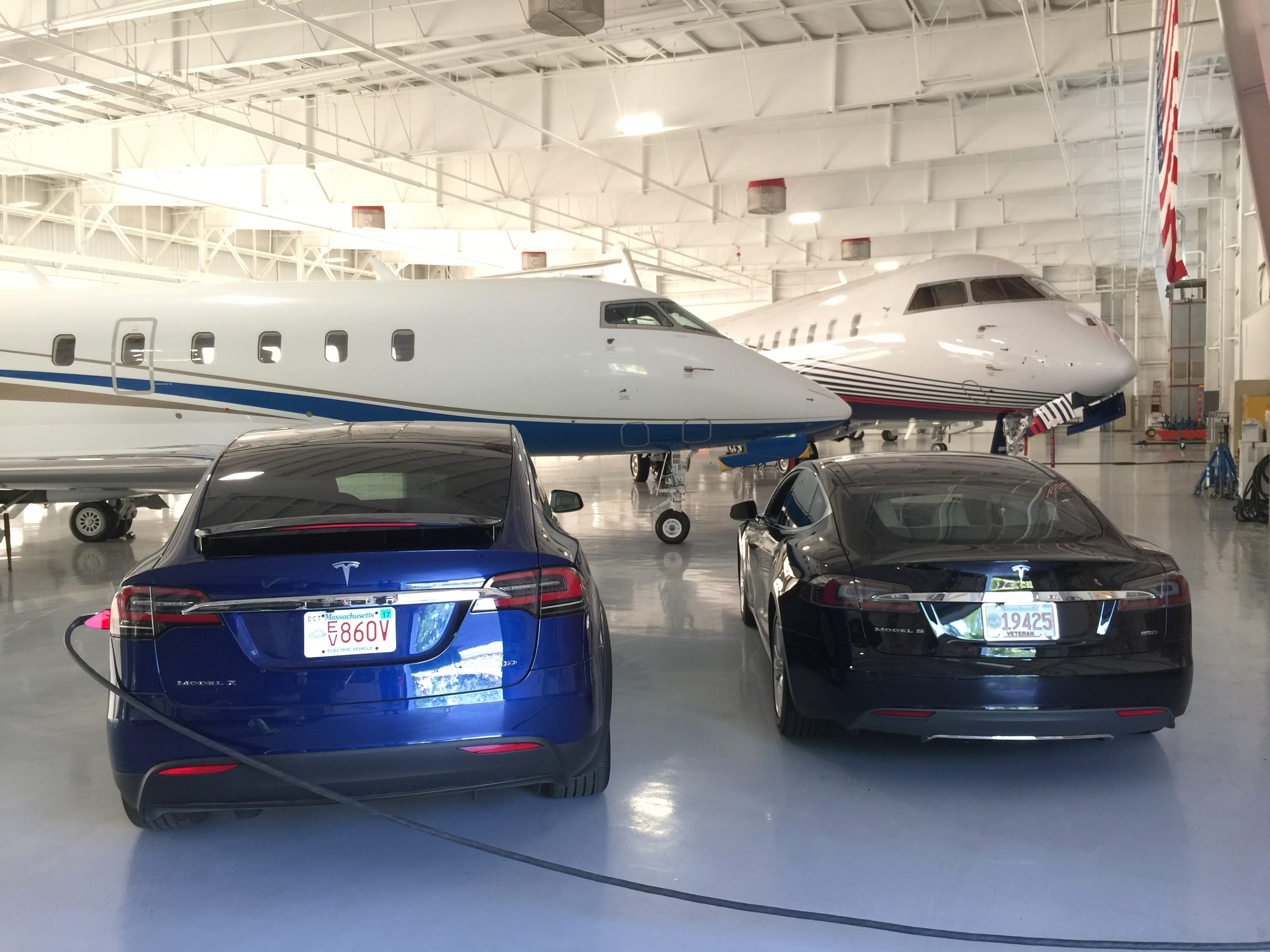
Smug, Rich Bastard for a Weekend (Tesla X review)

I decided to spend a weekend saving the planet by stealing a Tesla X and driving it around the Boston suburbs. I am absolutely certain that generations from now, people will look back on this weekend, and our family’s trip to a Panipuri party in Newton, as the moment when the rise of the oceans began to slow and our planet began to heal.

Here are some impressions of the healing process.

The tires may be the first thing that you notice when up close to the “Tess-U-Vee”. They’re about the right size for a mid-sized front-end loader.

The windshield is crazy huge, extending up to become a sunroof. Unfortunately this leads to the need for a pop-in sunshade that, if you’re a 6′ tall driver, results in a line across the natural view forward. The expansive windshield also leads to a thick A pillar that blocks the driver’s view of cars coming toward an intersection from the right. This is the worst forward blind spot that I have ever experienced in a vehicle. Driving south into the afternoon sun on a clear day most of the windshield is slightly obscured by a reflection of the grid in a fabric on top of the dashboard.

Highway driving is not especially quiet. Car and Driver says that they measured just 65 dBA, but the road and tire noise seem louder. It is not as quiet as a luxury car; closer to a Honda Odyssey. Ride quality on the roads of Massachusetts (whose condition would lead a German or Dutch road maintenance crew to commit suicide out of shame) was good, but not cushy/luxurious. Perhaps, as with monster gas-powered SUVs, the huge tires and offroad capability have impaired the vehicle’s bump-absorbing ability. A good reminder that we are still in the Model T suspension era rather than the era of active suspension (see also Levant Power).

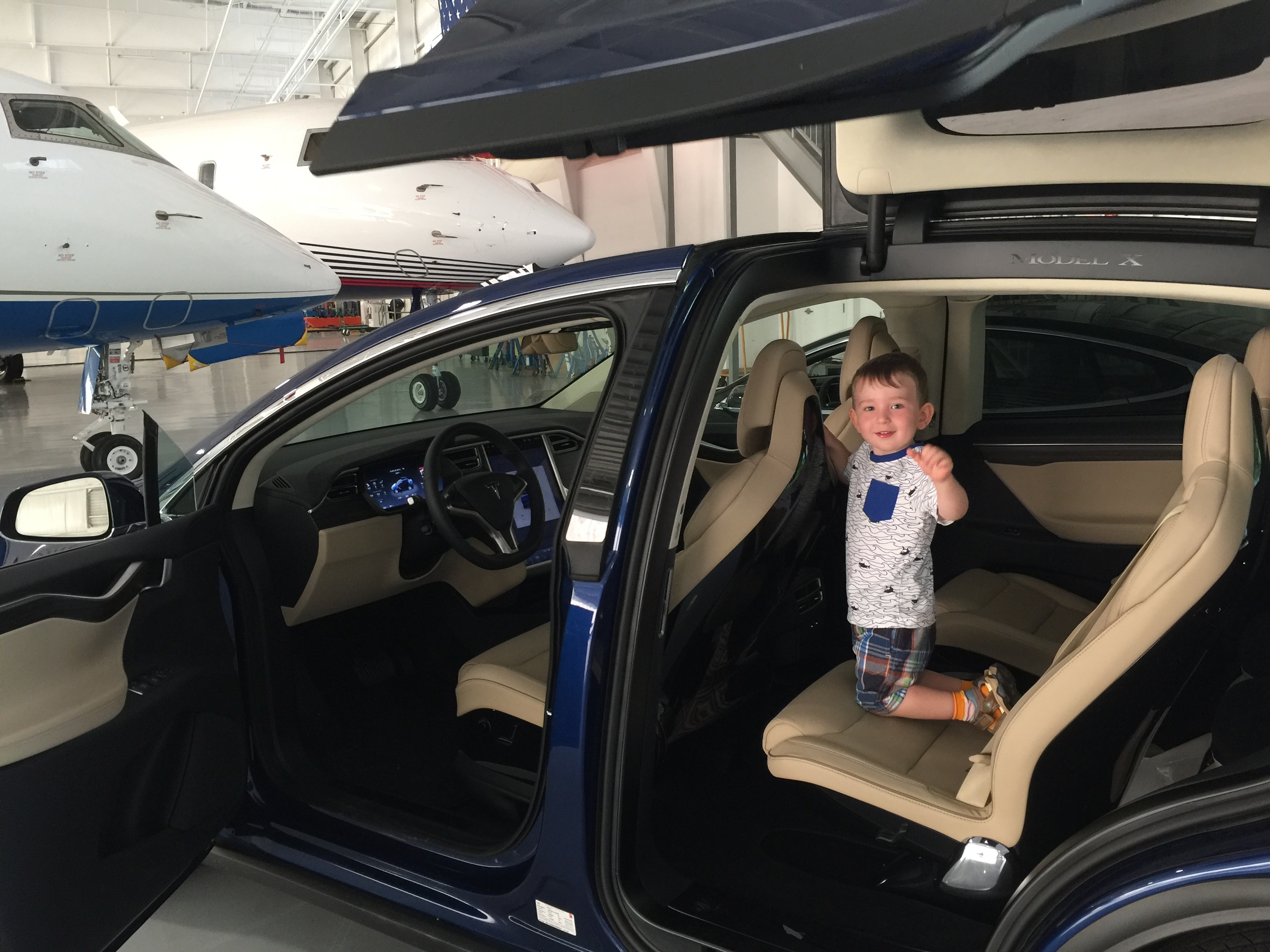
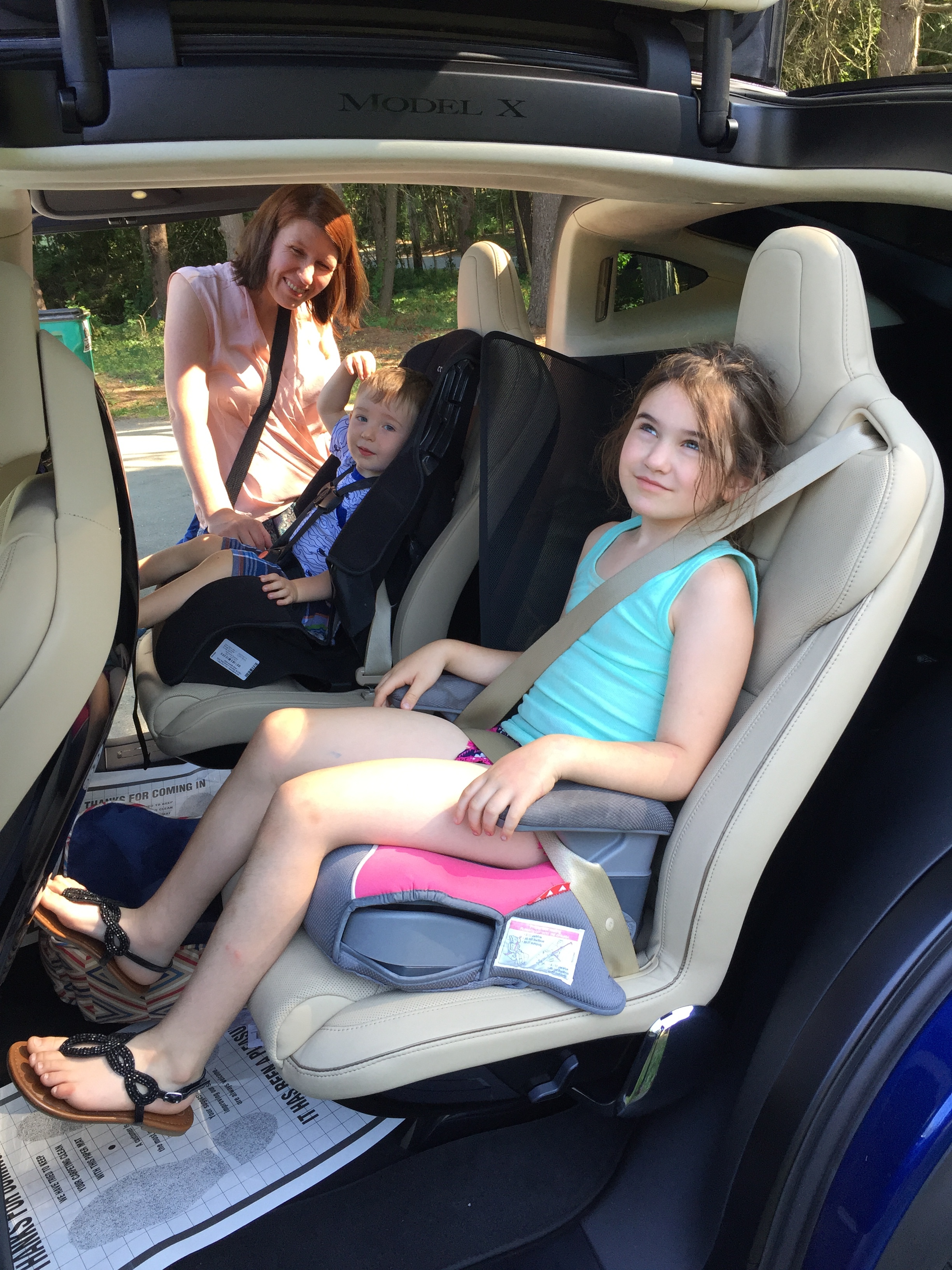
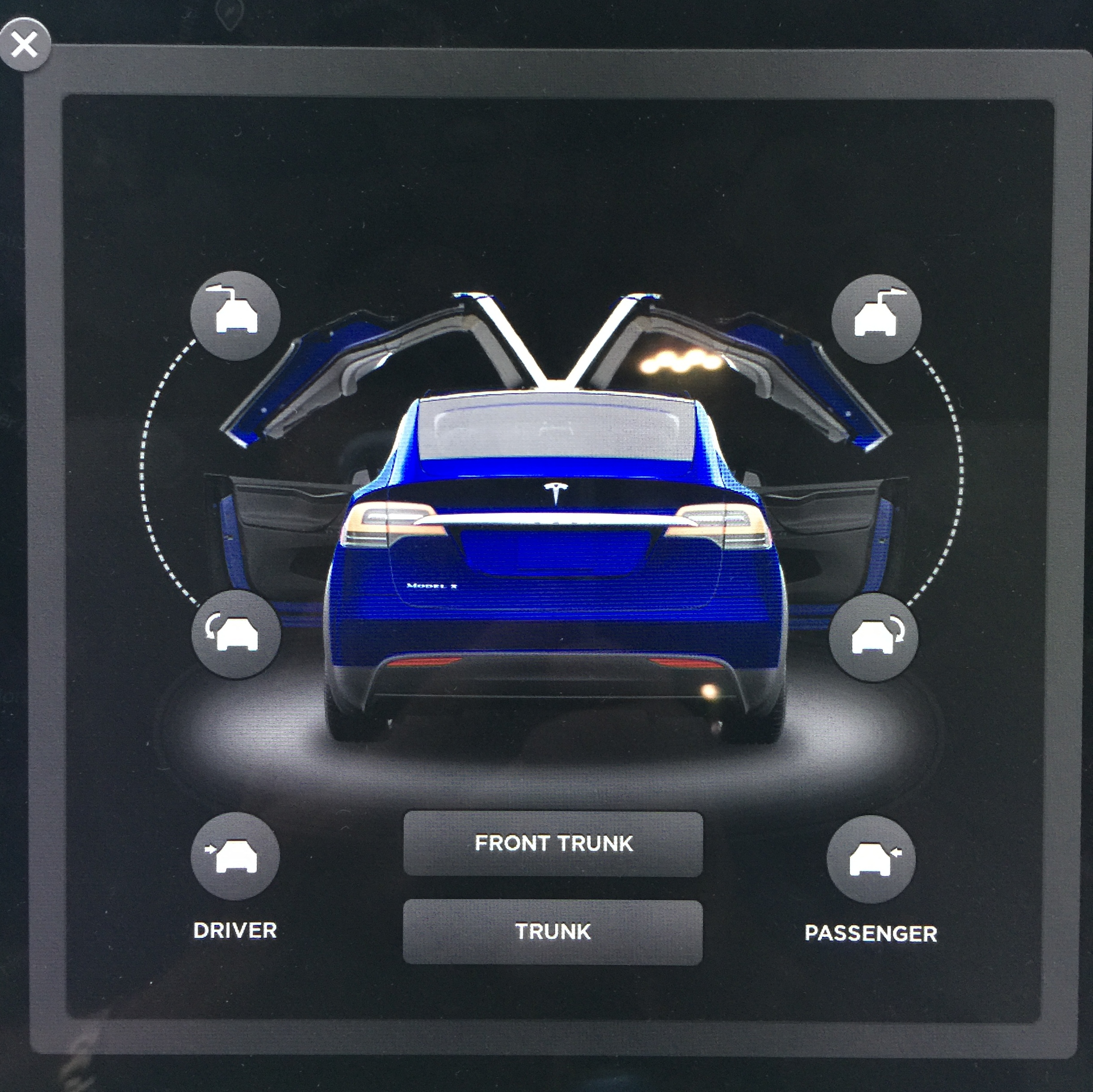
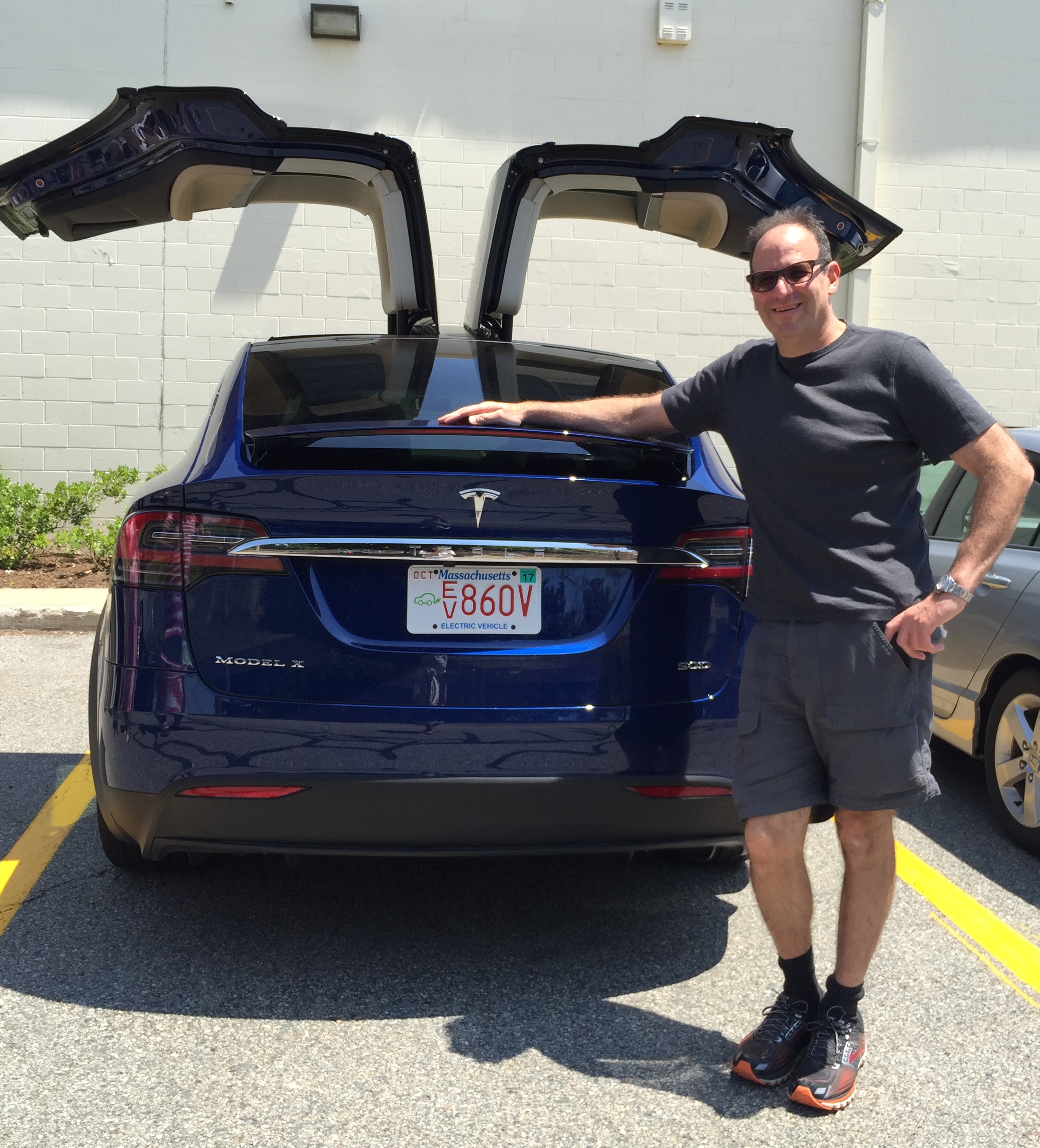
The falcon-wing doors were entertaining for the kids, but domestic senior management hit her head on them a few times. Perhaps one day Tesla will invent a middle door that slides back toward the rear of the vehicle, thus providing completely unobstructed access to the middle seats. Speaking of middle seats, they are slightly narrower than standard booster seats. This makes it challenging for a child to fasten his or her own seatbelt due to the fact that the booster seat covers the receiver.

The monster touch screen in the middle is only moderately intuitive. There is a navigation system branded Tesla/Google and also a Google Maps page. What is the difference? Why do we need both? The owner’s manual is available on the screen, but it is buried behind a lot of clicks (you have to go to “settings” first). There is way too much detail for in-car reading. A PDF version is available online. The phone integration is more impressive. Just as you’d expect when you purchase an expensive device bristling with computer systems you can use your phone to unlock the car, drive it, see where it is parked, etc. With the keyfob in my pocket, me in the driver’s seat, and the vehicle rolling down the highway, the Tesla got upset every 20 minutes or so and displayed a distracting “key not inside” warning. This would go away after a few seconds.

The autosteering feature works but doesn’t inspire confidence. It seems to start turning to follow the road just a split-second later than a human driver would. This is unnerving, at least at first. You need to keep your hands on the steering wheel at all times during autosteering, yet not crank the wheel hard enough to generate what the car thinks is an actual steering input (thereby disconnecting autosteer). I found this to be about the same amount of effort as simply driving. The cruise control for speed, on the other hand, works beautifully.

Acceleration would probably have been amazing if only we could have cleared roughly 1,000 other vehicles from I-95 and I-90 and tested it out. A Citroen 2CV has ample power for the driving that we are actually ever able to do within 60 miles of downtown Boston. Anecdotally, a friend with an Aston Martin says that the Tesla X, even without “ludicrous mode,” is much faster. What if you like to sip a drink while sitting in traffic? You can push back the central armrest pads to reveal two cupholders, but after that you have nowhere to rest your right arm. The Tesla X is not optimized for the drive-through to the same extent as a minivan.

The real-world summer-time range seemed as though it would be about 200 miles (against 257 claimed). If you assume that you never want to let it get below 30, this is a car that can go 170 miles between charges. While I was showing off the vehicle at a party a Nissan Leaf owner said that she gets only about 60 miles of range in a car advertised as having 100 miles: “I had to stop and charge three times going down to Providence in the winter,” she explained. (Each charge takes 30 minutes; it is roughly 50 miles one-way from Boston to Providence.)

As with other SUVs, cargo capacity is limited compared to a minivan. The Honda Odyssey can hold five people in the front and a couple of full-size bicycles, perhaps with front wheels detached, in the back. I think it would be a challenge to get even one bike into the back of the Tesla X and the central seating would be compromised.

What does it cost to save the planet? The 90D Tesla X that I drove had a six-seat interior, the autopilot software upgrade, and a few other options. This worked out to $110,000 retail (would have been over $130,000 as a “P90D” higher-performance model). Is it worth it? If you have $110,000 that you don’t need… sure, why not? It is a good conversation-starter. On the other hand, a $30,000 minivan offers roughly the same level of comfort with a lot more interior room, seating for 8, and more practical doors. With the leftover $80,000 you could buy an airworthy IFR-certified six-seat airplane, e.g., an older A36 Beechcraft Bonanza. Alternatively, you could plant a lot of trees for $80,000! What about saving money by not buying gasoline? The additional sales tax on a Tesla in Massachusetts would be 6.25 percent times $80,000 = $5,000. That’s enough to buy 2100 gallons of gas at current prices, which will power a minivan through roughly 50,000 miles. So even if you had planted an electricity tree in your backyard and recharged your Tesla for free, the extra sales tax alone makes the purchase decision economically irrational. On the fourth hand, most of our economy would shut down if people didn’t buy things for irrational reasons…

Full post, including comments