According to the New York Times, Ellen Pao is one of the most qualified workers in the United States. She is also nearly ubiquitous in the media. And the U.S. labor market is supposedly tight, especially for high-skill workers. Ms. Pao’s last full-time job was in July 2015. Why haven’t we heard about Ms. Pao being snapped up by another venture capital firm or being hired to exercise her unique skills on behalf of another enterprise?
[Ms. Pao was a “luncheon keynote” speaker on December 10 here in Boston at the Massachusetts Conference for Women. She was part of “A Conversation on Workplaces that Work” and characterized as “entrepreneur, investor and writer”.]
Readers: What happened to Reddit after Ms. Pao’s departure? Has the company done better or worse under the new management? Is the site better or worse from a user’s perspective? (I’m assuming that the collapse of Internet advertising and the rise of Facebook imposes a generally negative trend on sites such as Reddit, independent of who is CEO.)
Related:
the awesome PC-24 that the Kleiner Perkins partners could have bought for themselves if they hadn’t had to spend what is likely to have been $10+ million defending against Ms. Pao’s lawsuit
Kirk Kerkorian died in June, but the battle over his estate rages on.
The court-appointed guardian of the daughter of Kerkorian’s ex-wife last month petitioned the Los Angeles Superior Court to revoke the admission of the late Nevada casino magnate’s will to probate.
The court’s website shows the revocation petition was filed Nov. 23, the same day Lisa Bonder, Kerkorian’s ex-wife, filed a $1.3 million creditor’s claim against Kerkorian’s estate. Mynewsla, a website, says Bonder seeks unpaid child support.
…
Kira Kerkorian is the child of Bonder, a onetime tennis pro to whom Kerkorian was married for 28 days in 1999. Kerkorian thought he’d fathered the girl until Bonder revealed Hollywood producer Steve Bing was the father. A security guard working for Kerkorian nabbed dental floss from Bing’s trash to get a DNA sample.
Kira Kerkorian is 17; she’ll turn 18 March 9. …
Bonder’s child support fight with Kerkorian has lasted 13 years already. In 2002, she demanded $320,000 in monthly child support for then-4-year-old Kira; a judge granted $50,316 per month. The Associated Press reported that Kerkorian in December 2010 agreed to pay more than $10 million in back child support plus $100,000 a month for Kira, of whom he’d grown fond.
The AP said in the 2010 settlement, Kerkorian agreed to provide $100,000 a month until Kira turns 19, or graduates from high school, is no longer a full-time student or no longer lives with her mother full time. After that, the settlement says, the child support would drop to $50,000 a month.
Mynewsla says Bonder’s claim states the $50,000 monthly payments were to run from July 2016 through June 2017 and were made from July through November. Therefore, according to the claim, Kerkorian’s estate should receive a $500,000 credit, leaving a $1.3 million balance.
Note that the extent to which Lisa Bonder is also getting child support revenue from Steve Bing is unclear due to the fact that it wasn’t litigated. Under California’s child support formula, Kira should have yielded a strong cashflow for her mother, though there was a competing claim against Bing from Elizabeth Hurley (Telegraph). [Despite these brushes with the family law system, Bing still has enough left for a personal Boeing 737, though, according to Wikipedia.]
My neighbors and I all promise to lose 10 lbs during the Thanksgiving/Christmas season. How is this different than this weekend’s climate agreement described by the New York Times as “landmark”?
“Leaders Move to Convert Paris Climate Pledges Into Action” quotes one of the assembled bigshots saying “Today, we celebrate. Tomorrow, we have to act.” Is that distinguishable from me saying “At this evening’s party I can have a few extra plates because tomorrow I am going to eat very lightly”?
Another attendee is quoted as saying “we have to make sure our national contributions are aligned with what the scientists tell us we need to be doing.” Isn’t that like me saying “I have to make sure that my eating and exercise in 2016 are aligned with what the fitness instructor says to do”?
The article: “The Paris Agreement’s provisions will not kick in until 2020.” Me: “My diet starts right after Fred and Beth’s awesome New Years party.”
Related:
Video of Barack Obama: “President Obama said the historic agreement is a tribute to American climate change leadership.”
I went to see Spectre, the latest James Bond movie. The opening scene is well worth the price of admission, even before the aerobatic Bo-105 helicopter comes on screen. The feeling of immersion in a Day of the Dead festival in Mexico city is a tremendous artistic achievement. How did they make it look as though the helicopter were doing maneuvers over the heads of the crowd? According to this article, they did it by… flying maneuvers over the heads of the crowd (maybe not the loops and rolls, though!).
I have to love any movie that starts and ends with helicopters. Consistent with other Bond movies, checklists and laborious starting procedures are not featured. Maybe in a FADEC world we will get to see Bond actually start a helicopter! Airplane pilots will appreciate seeing the Britten-Norman Islander used to chase cars.
My companions for the film were two adult friends and their 12-year-old son. The father said afterwards that he thought that the 12-year-old shouldn’t have been allowed to see the movie, partly due to the fact that it suggested that James Bond would have sex with women he had only recently met. Discussing this the next day at lunch, the assembled group of adults concluded that we would be conducting a natural experiment: If a few years from now the boy says that he wants to have sex with an attractive young woman, we will know that it is because he watched the movie. This observation did not cheer up the father.
Separately, a friend emailed this on the same weekend:
“You know, those are just lines of code, not actual people.”
— [10-year-old] responding to his friend’s comment about the dead bodies/skeletons in a multiplayer game they are playing on Xbox live
Dumb question for readers… (spoiler alert!): Why was there value to Spectre in gathering electronic surveillance data? Our own government agencies can’t do that much with the data streams, apparently; how could criminals use surveillance data to make money? Steal credentials for transferring funds?
Considering buying a house? Here’s a tale from the Department of How to Turn a Small Problem into a Fatal Problem: the erratic temperature control in our IKEA-brand oven finally got on my nerves enough to arrange service. The range is made by Whirlpool in Italy so it was Whirlpool who showed up. The technician got excited about a loose trim piece as the source of the temperature fluctuation and took the range away from the wall to facilitate reattachment. Then he put it all back and tested the oven and discovered that the temp was still not regulated properly. So he ordered some parts and left. A few hours later we began to think “this gas smell is a little too strong to be accounted for by a two-year-old playing with the knobs.” So it was time to call the emergency number for National Grid. They had to show up after dark, pull the range away from the wall again, and tighten the connections so that they were no longer leaking.
Here’s a wrap-up of items from the National Business Aviation Association 2015 convention in Las Vegas…
The convention opened with a presentation on how great business aviation is. The most compelling speaker was Dierks Bentley, who has been working his way up from the Cirrus to a light jet while simultaneously singing country songs about old pickup trucks. He introduced himself with a video in case anyone in audience “sadly doesn’t listen to country music.” How did he get to where he is? He talked about working harder than anyone else, which included dropping personal plans to “play any gig”. He currently tours 150 days per year and using a personal airplane lets him spend extra nights at home, drop the kids at school, go to the gym, etc. This does raise the question of carbon footprint for the music industry. One might have expected the footprint to go down with the improvement in ease of electronic access to music. I can listen to Bentley right now on Rhapsody so why does he need to come to Boston? And if he does come to Boston, now it will be in a point-to-point jet ride from Nashville, rather than on a diesel-powered bus that covers 20 cities for the same amount of fuel.
And with that, the event opened with a convention center full of booths and a static display area at the nearby Henderson, Nevada airport.
SJ30 new panel
The crazy capable, actually certified, incredibly small SJ30 had flown in. Six are out there flying, including one owned by Morgan Freeman. You can go from Las Vegas to Hawaii and enjoy sea level cabin pressure at 41,000′ or get over powerful storms at 49,000′. The interior is only about half the size of a comparably priced airplane.
Gulfstream had every model on static display. It was theoretically possible to tour a G650 in the same sense that it is theoretically possible to go to the hippest club in Los Angeles. People were in line, but it wasn’t the real line. Salespeople and their VIP clients would show up every 10 minutes and jump the queue so that the visible line almost never moved.
Honda is finally getting their little jet out the door, 12 years after the first flight and about five years later than planned. Unfortunately it is a terrible fit for the “go big or go home” world that general aviation has become. There are only about 100 orders for the plane, according to one of their salespeople at the show. If they want to make money they will need to stretch this into something the size of a Phenom 300.
How about getting some car-like features in an airplane? A read-out of tire pressure in the cockpit is apparently too much to hope for, but SmartStem was there with a handheld tire pressure reader that talks to a sensor inside each tire. What does it cost? About the same as a reliable used car.
Speaking of car-like features, how about some system integration and self-management for subsystems? Above are some photos of Bell’s certified-in-2008 429 helicopter. This is a single-pilot IFR helicopter. I.e., you’re flying this helicopter in the clouds and something goes wrong. This will almost certainly result in the autopilot disconnecting itself. Now you must have your hands on the controls but you’re also supposed to be running checklists and flipping all of these switches? More importantly, what happens to all of this horizontally-mounted switches when you spill your drink? And where do you put the iPad? (And what if you want to see these switches in the event of smoke in the cockpit? You would need something like EVAS, shown at NBAA. Another good reason for automatic systems to make triage decisions when stuff fails.)
Speaking of iPads… the major avionics manufacturers gathered for a seminar to talk about the glorious future. The high-level message was that certification times are stretching out due to regulatory authorities being busy with drones and generally becoming more cautious. This results in new systems, such as CPDLC, being “obsolete before they are launched.” By the time the world’s aircraft are fully complaint with the U.S. ADS-B mandates and the European FANS mandates, it will be possible to establish 100 Mbits/second Internet via satellite to all aircraft, at which point nobody would have wanted all of this primitive stuff. The avionics world is now working on establishing a barrier between the certified stuff in the panel and the innovative stuff on the iPad. They’ve pretty much given up on significant innovation for software that has to be FAA-certified and thus an increasing amount of a pilot’s attention will be directed toward non-certified apps on a tablet (Apple is the dominant choice of tablet hardware/software).
Regulatory compliance was a huge theme in the conference (the sign above was about 5′ tall, celebrating a booth owner’s capabilities). A tutorial session on “Emerging Regulations” was scheduled for 3 hours, twice as long as a session teaching people how to fly their Gulfstreams to China for the first time. About as many vendors showed up whose job was somehow to smooth out the path through regulation as showed up to present an innovative product.
Las Vegas is always a good window into the future of America. The monorail was designed to be run without drivers, but they still employ a lot of humans because they can’t manage the security risks without guards on platforms. Passengers are bombarded with loud radio-style advertisements in between every stop. The city hasn’t quite recovered from condo fever. Despite there being at least six conventions in town I was able to rent a magnificent one-bedroom apartment (balcony, master bathroom the size of a Cambridge studio apartment and containing enough marble to entomb a Communist leader, Sub-zero fridge, etc.) next to the MGM Grand for $200/night. As noted in the photo above, a lot of folks in the building can be special and have a “penthouse”. They had put a huge amount of effort into making sure that a wide selection of TV channels was available everywhere, but hadn’t been able to handle the challenge of providing a fast or reliable WiFi network, however.
Was there an intersection between the gambling-drinking-sex side of Las Vegas and NBAA? I didn’t see booths stuffed with showgirls or jet salespeople offering to hire escorts (Sports Illustratedcovers this world in a unique way). I had dinner with the staff of a jet charter operator. The younger guys all went off to the Crazy Horse gentleman’s club at 11 pm while the owner, his wife, and I decided that it was time for us to collapse.
I had a “Press” badge and people asked what I wrote about. If I included comparative family law among the states in the list, there was about a 30-percent chance that the person would respond with a story or comment. Some of the respondents were women whose partner was being tapped for child support: “I refer to her as ‘the Parasite’, which used to upset my stepdaughter but there is just no other word that works.”; “Well, we hate her but what can we do about it? It is like having cancer that never quite kills you.” Most of the respondents were men, the dominant demographic at the show. About a third had been defendants in lawsuits related to out-of-wedlock births, e.g., following a casual encounter. A third had been divorce lawsuit defendants. A third had been observers of a friend or relative being targeted, e.g., in an abortion retail transaction. Here were some representative comments: “It drove me crazy until I realized that there was nothing that I could do for my son. The money that I had tried to invest in his college education went to pay the lawyers. The time that I had tried to invest in him was blocked by court order. The money that I would have invested in him from my income went to pay for my ex-wife’s vacations with girlfriends and boyfriends. Maybe 10 percent of the child support checks trickled down to my son. When I gave up and stopped trying to invest, that’s when I was no longer in conflict with my ex-wife or the family court system.”; “Wherever jets are parked there will be pussy workers.”; “Eventually I began to admire her for being clever enough to earn money without going to work.”; “Putting 1000 miles between me and the state where I lost everything was the only good decision I can remember making. I was a lot happier once I stopped paying taxes to support the judge who took my kids away. The every-other-weekend schedule was ridiculous and you’re fooling yourself if you think you’re still a parent at that point.”; “The aviation industry and the pussy industry are symbiotic.”; [from a German] “If you open a German tabloid in any typical week you’ll read about a woman who divorced her rich husband and was so upset about the end of the marriage that she had to move with the kids to New York or Los Angeles. Really it is about trying to get a U.S. court to take over and order child support at U.S. rates.” (maximum child support revenue in Germany is much less than what can be earned from working a W2-style job); [from a European immigrant to the U.S.] “I tell the younger guys in our operation that, unless they’ve had a vasectomy, all sex in the U.S. can be commercial sex. The only question is whether they’ll pay from their wallet the same night or from their bank account over the next 18 years.”
Do you remember the 1970s fondly? If so, AdaCore was there promoting its Ada programming tools to avionics companies that need something more reliable than typical JavaScript. Was it supersonic passenger travel that you remember more fondly than Ada? It’s coming back for you and seven friends: the $120 million Aerion (Bernie Sanders nose art optional). Flexjet has ordered 20 of these, hoping to accept delivery in 2023.
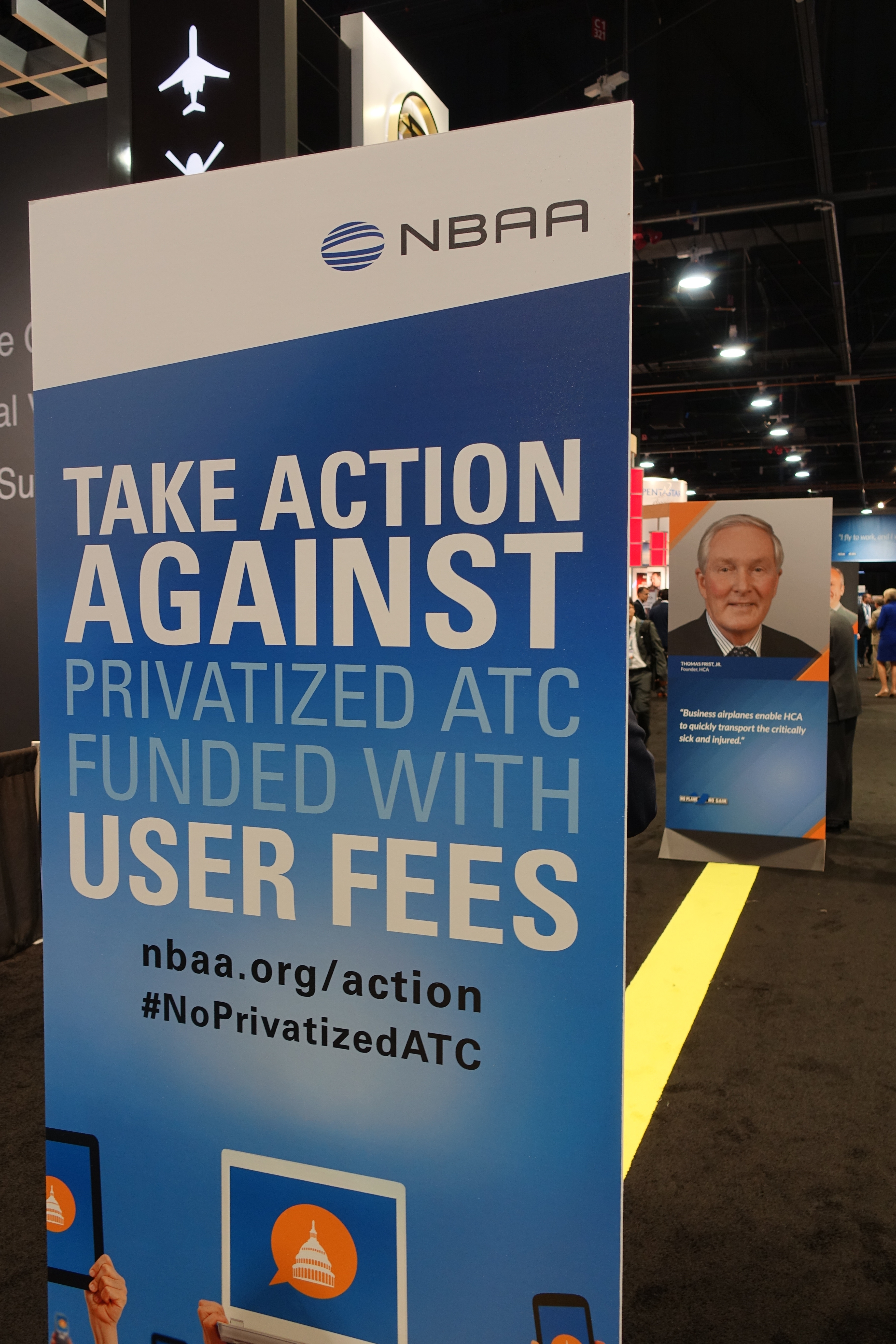
Signs throughout the conference exhorted participants to fight proposals to turn over the government-run air traffic control system to a private monopoly that would then extract fees for for each flight (the current system is funded by taxes on aviation fuel and on airline tickets). Whenever Americans try to do something like this it does, a combination of cronyism, complacency, and incompetence seems to result in a worst-of-all-possible-worlds outcome in terms of price and service (see also the U.S. health care system!). Evidence of what a debacle might ensue is provided by the ADS-B system. The system has been in development for decades and has cost taxpayers more than $6.5 billion (AOPA). The U.S. DOT shows about 200,000 aircraft registered in the U.S., so that’s $32,500 per aircraft for a system that won’t be fully operational until 2025. Aircraft owners will have to pay between $10,000 and $400,000 per aircraft to comply with ADS-B requirements, so let’s call it a median of $50,000 per aircraft in tax and private funds as setup costs and an unknown amount of annual operating costs for all of the ground stations. What has the incredibly slow-moving private avionics industry managed to do in the meantime? Satellite Internet boxes for airplanes are now available for about $20,000 for speeds of 100 kbps. How fast is ADS-B by comparison? It doesn’t seem to have enough bandwidth to transmit weather reports for all U.S. airports, the way that the 15-year-old XM-based weather system can. The FAA researchers who presented a “weather in the cockpit” seminar couldn’t answer the question about the bandwidth but explained that their colleagues on the show floor probably could. Why can’t it do what XM did 15 years ago? “That program was awarded to a contractor and they just do the bare minimum of what the contract requires in terms of running ground
Americans were arguing about race-based college admissions at the Supreme Court this week.
Colleges talk about their commitment to diversity, but this commitment is tough to see. There are plenty of 35-year-olds with no college degree and a different perspective on life than an 18-year-old, yet elite schools make no attempt to find those 35-year-olds so as to get people of diverse ages into classrooms together. Nor do most schools make a real effort to get students from other countries, except those who can pay substantially more in tuition than the average American student. (There are probably plenty of Syrians, for example, who would be delighted to be issued four years of student visas and financial aid. It seems safe to predict that they would have no trouble earning a Bachelor’s in Arabic Studies from the typical U.S. school.)
I’m wondering if there isn’t a simpler explanation for the persistence of sorting college applicants by skin color. Imagine what would happen to the employees of the admissions office if affirmative action were eliminated and students were admitted on the basis of test scores and high school grades. The sorting process could be done by a free computer program, e.g., Open Office or Google Spreadsheets. The verification process could be done by workers in India to check to make sure that the test scores and high school grades were authentic. People who currently earn above-market wages would be unemployed.
What do readers think? Are the bureaucratic interests of college employees part of the motivation for running race-based college admissions?
“National Park Service $100,000 Job Opening. Skills Required: Large Format Photography” highlights what might be the world’s only open position for someone who loves the smell of fixer and stop bath. If you apply within the next few days you can get paid for using a view camera! (at least as long as film is still available)
I bought a Samsung U32D970Q 4K monitor to replace a 2560×1600 pixel HP monitor on my Windows 10 desktop computer.
Short review: Was blind but now I see.
Long review: I was concerned that Windows 10 and the seven dwarf applications that I typically use wouldn’t handle the high pixels-per-inch well, but it turned out to be trivial to install the monitor. I left the computer running, unplugged the old monitor, plugged the new monitor in via DisplayPort, and Windows automatically (a) adjusted the screen resolution to the new monitor’s native resolution, and (b) scaled up the fonts used for itself and nearly all application programs (exception: Canon’s crummy CaptureOnTouch scanner software, which now would make a good companion to Derek Zoolander’s mobile phone).
Text looked a little fuzzy at first, consistent with reviews that I had seen on the Web about this being a “BGR” pixel pattern instead of “RGB.” I went into the ClearType control panel and clicked on the sharpest-looking text options in each of five screens. Then everything was completely turned.
Text now seems clearer than before. The brightness and contrast is excellent. 4K video content and high-res DSLR pictures look great.
I’m hopeful that this monitor, for which I paid $950, will be good on a height-adjustable desk. Due to the fact that it is designed for use in portrait as well as landscape mode, the stand provides for a 5-inch range of height adjustments. Thus the keyboard-to-monitor separation can be significantly larger when used at a standing height (the Ergo Desktop Kangaroo provides a 6.5-inch keyboard-to-monitor adjustment range). The downside of the flexible stand is that it is… flexible. The monitor moves a bit as I type and all desk vibration is amplified.
Samsung includes all of the cables that you would ever need, including one to bridge the PC to the 4 USB ports on the monitor (a USB 3.0 hub).
I considered the Dell UP3216Q, but it is a lot more expensive and doesn’t have the range of height adjustment with its included stand.
The monitor has no speakers, which I don’t mind, and no camera, which is upsetting because the clean appearance will be ruined if you hang a webcam over the top (does anyone have a good idea for mounting a desktop webcam? Top of the monitor seems like a bad location (captures top of head). Bottom of the monitor also seems bad (captures chin).