My April/May sojourn in Boston was plagued by traffic jams far worse than anything I remember from our pre-coronapanic life there. Mobility for the Righteous is seriously compromised by a road network that was substantially completed circa 1970 for a population of 4 million and is now being used by a population of 5 million, each of whom is more likely to own a car (registered motor vehicles per 1000 Americans has gone from 534 to about 875 today) and each of whom is more likely to use a car than to ride public transit (MBTA ridership among people who call themselves environmentalists remains roughly 25 percent below 2019 levels). I didn’t do any trips during traditional rush hour, but still was slowed to a crawl except after 8:30 pm.
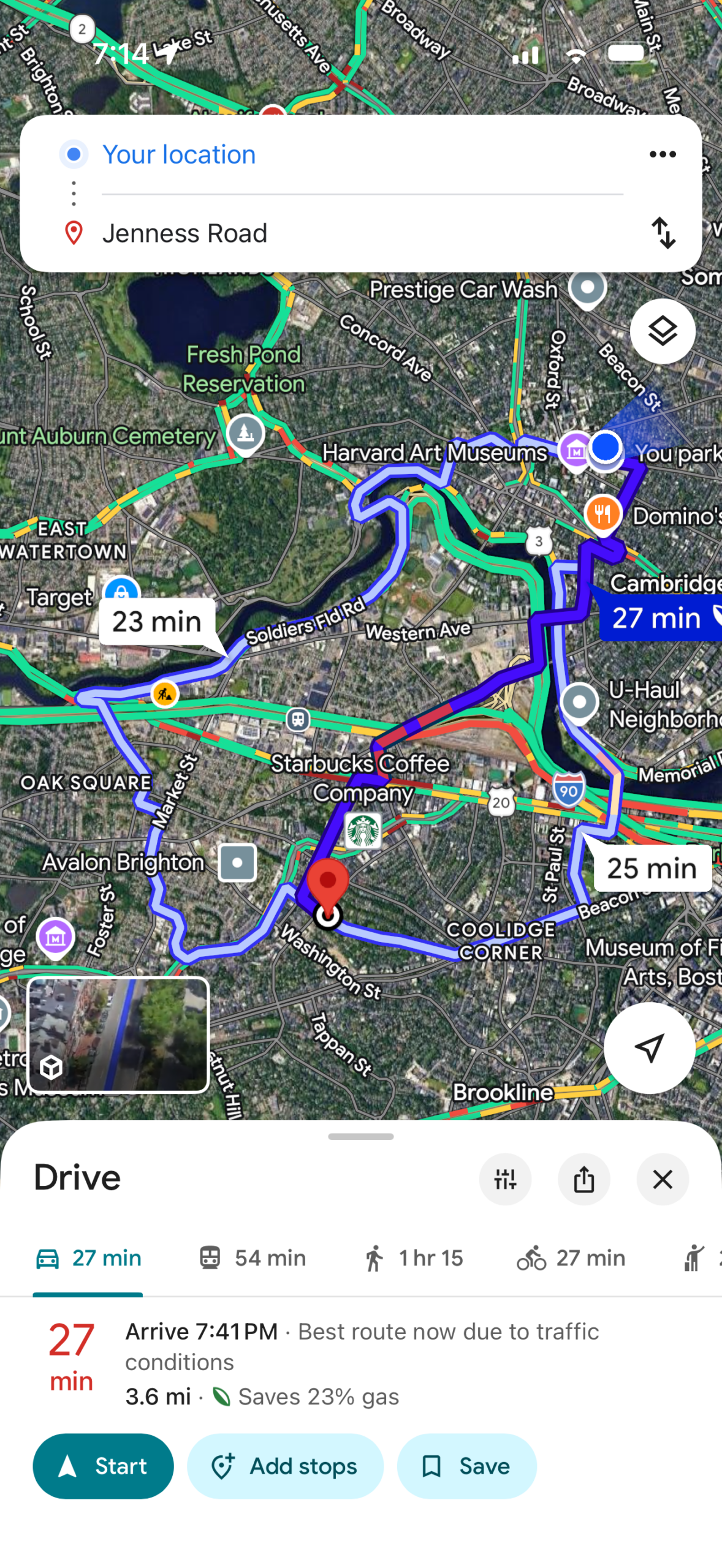
Here’s a 7:14 pm 3.6-mile route that Google expects will take 27 minutes, i.e., less than 8 miles per hour.
I wasted more time in traffic during this 10-day trip that I do in a year in and around Jupiter, Florida (that includes West Palm Beach, a reasonable-sized city, and Stuart, a small city). Bostonians who experience this every day remain passionate supporters of open borders and, thus, of population growth (growth without regard for available resources is usually called “cancer”!).
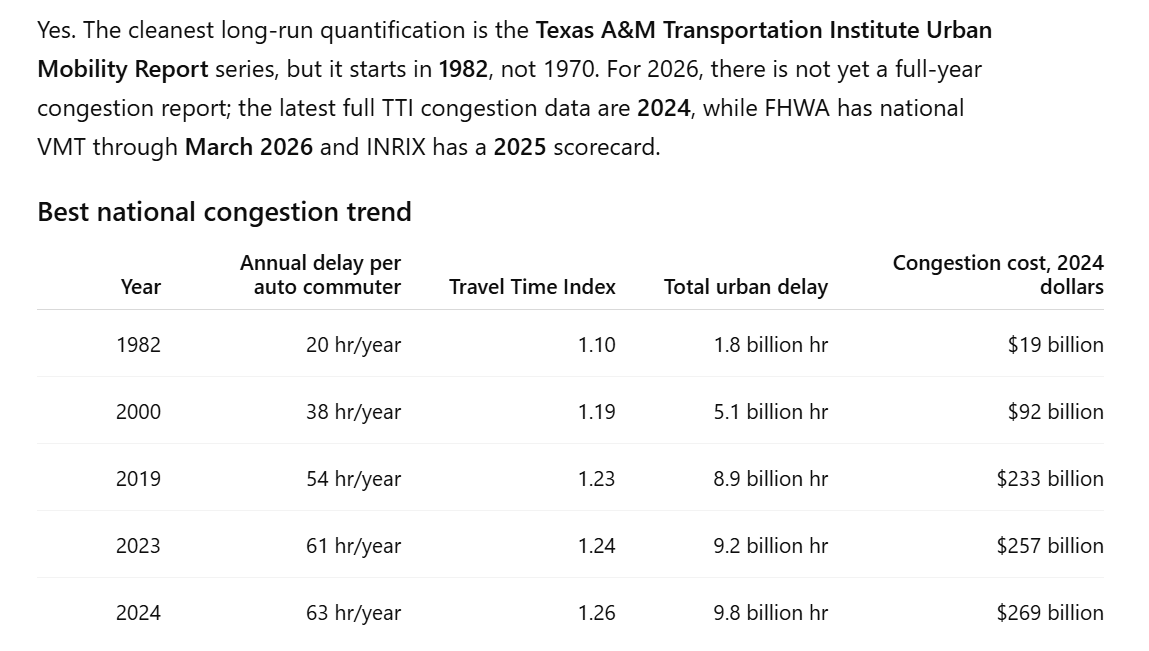
I’m wonder if Americans in general and Bostonians in particular have been lulled into complacency regarding traffic jams because their cars are so much more comfortable than cars in 1970, when traffic flowed much more freely:
I couldn’t rise to the local level of traffic jam tolerance, unfortunately, because I had borrowed my neighbor’s 12-year-old Mini, which lacked functional air-conditioning. I was literally stewing while sitting in long lines at red lights. The manual transmission was occasionally fun, but was mostly an annoyance in stop-and-go 3 mph traffic.
(I don’t think traffic in Boston will be solved by robot cars. Unlike in Florida, the typical intersection lacks dedicated left and right turn lanes. Unlike in Florida, the major roads can’t be widened. Unlike in Florida, the typical urban street in Boston/Cambridge is actually getting narrower over time as four-lane roads turn into two-lane-plus-two-bike-lanes roads.)
Loosely related, people who live in Cambridge want their local government to “fight the Trump administration” rather than try to reduce traffic congestion:
Also, the MBTA is adding elevators to a subway station. It will take three years:
Three years is how long it took the Chinese to build an 800-mile 200 mph train from Beijing to Shanghai. This includes the world’s longest bridge. Up to 800,000 people per day use the train.
> Also, the MBTA is adding elevators to a subway station. It will take three years:
I imagine the hazmat removal process for that dirty concrete platform will take at least a year. Damn, man, you walked on that? Eww.
Probably vengeance commuting. A lot more jobs are on site than before 2020 & a lot more influencers are hyping their office & commute.
What prompted you to drive around in Cambridge traffic in a 12-year-old un-air-conditioned Mini?
Two layers of stupidity prompted me. I was spending 10 days and over $10,000 fixing up my old condo that had already been sold in “as is and with all random furniture and crud” condition. More satisfying than giving money to a nonprofit at least. Second layer was the car lives directly in front of the apartment so I didn’t have to travel to Hertz or pay Hertz the post-Bidenflation rates (also, the Mini would have been a fun car to drive if not for the massive traffic jams all over Boston all the time).
Philip, I am disappointed in you. If our brothers in Afghanistan can figure out how to retrofit AC into a taxi car, I would have expected someone with an MIT education, like yourself, to come up with a solution for the 12-year-old Mini that you drove.
@philg Does the Mini have a name? All Mini owners give their car a name / pet-name / nick-name, though they’re sheepish to admit it to non-owners.
>> I was literally stewing while sitting in long lines at red lights.
> All Mini owners give their car a name / pet-name / nick-name,
Stew?
Lil Stewie Cooper, likes to go shopping with his mommie, Candice Beemer 530e at Cambridge Mall. (Candice swings by Weed ‘n’ Things to get some funny cigarettes, while Stewie waits outside as per Massachusetts law, eyeing the BIPOC honeys.)
“Little Stuart Rifkin likes to go shopping with his mother.” — Elaine, Seinfeld
lol Sounds like Cars 4: Cambridge Mayhem, coming to theaters this November.
“In a world of the Righteous left, overpopulated with immigrants, crummy old houses with overhead electrical service, and dirty train platforms…Scarecrow needed a brain, the Tin Man needed a heart, The Cowardly Lion needed courage…Stewart Cooper needed an air conditioner.”
“Only one man could give them all what they needed: a wizened old expat engineer from Right Coast Institute of Technology, an expert in cybernetics, synthetic organs, alcohol distillation (liquid courage), and HVAC — Dr. Phil.”
“You’ve always had an air-conditioner Stew Cooper, it just needed to be refilled with R-134a!” as Phil’s TA buffed wax off the racing stripe (oxidized from acid rain and a $1M condo not having a garage).
lulz Needs a white Honda Odyssey named Moby, a G-Wagen named Dieter, and an Acura NSX. (True story: I had a green Porsche 911 named “Kermit”).
Cars: The Wizard of CLOS (Lisp joke).
“Here’s a 7:14 pm 3.6-mile route that Google expects will take 27 minutes, i.e., less than 8 miles per hour.”
I’m over 60 y/o and I can run that distance in considerably less time.