Medium Format Emperor Has No Clothes (Leica S reviewed by DxOMark)

Have you been wondering what it would be like it you had $50,000 to spend on a serious professional camera system and could give your consumer-grade Nikon to a teenager? DxOMark delivers an unsentimental review of the Leica S. The Leica turns up such bad numbers that one is forced to ask if the people buying and using the Leica S are all suffering from Emperor’s New Clothes syndrome or if the things that DxOMark are measuring are not well correlated with perceived image quality.

Related:

Full post, including comments

Helicopter Pilot Job Market

Based on discussions with employers at Heli-Expo, the helicopter pilot job market is stable right now. Recruiters are working frantically to fill maintenance jobs with qualified mechanics, but pilots are fairly easy to find.

It is difficult for flight instructors to find jobs and the pay is minimal, reflecting the fact that this is for most people an on-the-job training position in preparation for one of the “real jobs” below.

Instructors in piston helicopters can get jobs flying sightseeing turbine machines in the Grand Canyon or Alaska as soon as they meet the 1000-hour minimum that these operators require under their voluntary safety programs. Turbine time is not necessary but a congenial personality is important. Pay works out to about $20 per hour, much of which will be spent on food and housing at the seasonal locale.

Once a pilot has an ATP certificate and 500-1000 hours of turbine time (presumably from 1-2 years flying with a sightseeing operator) he or she is ready for the emergency medical service operators (“EMS” or “HEMS”) or the offshore (to the oil and gas rigs) operators. These jobs tend to pay about $60,000 per year for VFR pilots and $70,000 per year for pilots in IFR operators (where you fly through clouds), with higher pay for those willing to live in an Arab or African country. In other words, when the rescue helicopter is called in by the fire department, the person who flies the $4-6 million machine through the dark cloudy night is earning about one third as much as the firefighter who made the phone call (LA firefighters were paid an average of $142,000 in 2013 (LA Times) but pension and other benefits are probably worth at least another $100,000 given that retirement age is 50 and benefits are 90 percent of pay).

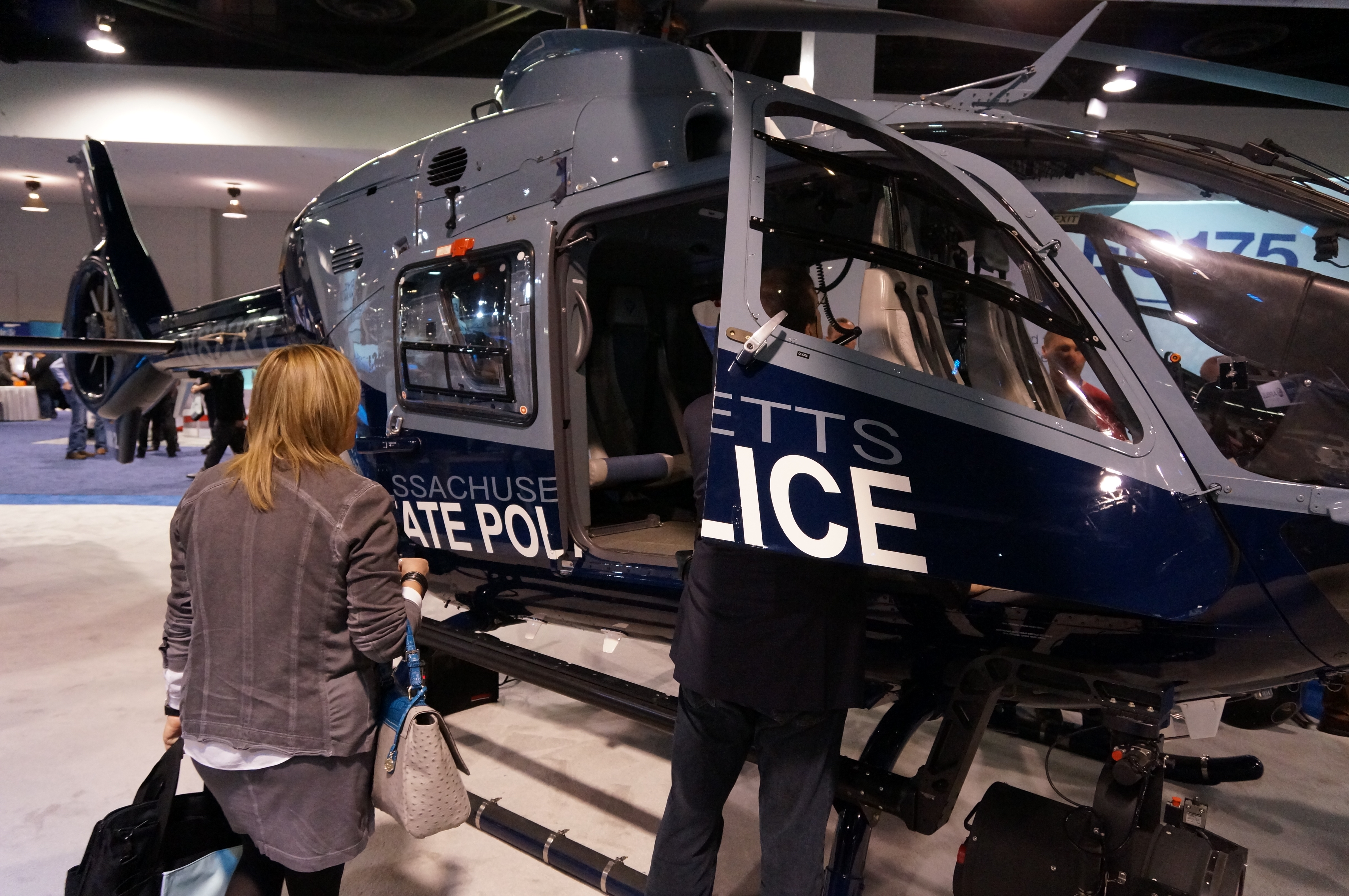
The highest-paid helicopter flying jobs in the U.S., considering the value of pensions and other benefits, are with government employers, especially state and local agencies such as police departments. These jobs also have the best working hours. However, these jobs often cannot be obtained by virtue of having flying skills and experience. One must first become a police officer and then get trained, at the local government’s expense, to be a pilot. The Massachusetts State Police is probably one of the best places for a young person to get started. Airbus Helicopters looked through all 50 states for the most lavishly equipped Airbus/Eurocopter that they could display at the show. They found their machine in a Massachusetts State Police hangar. The EC135 was flown to Los Angeles for the show and will be flown back at the end of this week. Here are some photos:

[Look at the data plate on the helicopter. If you’re a Massachusetts resident make sure to put two extra stamps on your state income tax return this year. Remember that the money is going all the way to Germany.]

Related: Government Accounting Office report on “Current and Future Availability of Airline Pilots” (February 28, 2014).

Full post, including comments

Interesting helicopter stuff (First Day of Heli-Expo)

Here are some impressions from the first day of Heli-Expo…

If you tend to carry an iPad with you on helicopter flights, the Gyronimo weight and balance performance app is a thing of real beauty and practicality.

If you’re wondering “What could be dumber than putting someone who doesn’t know how to fly a helicopter into a real helicopter?” then http://www.heliflighttrainer.com/ (site seems to be down right now) is for you. This is a standard industrial robot holding a Robinson R22 cabin with two people inside. Thus did essentially one person, Andreas Margreiter of Austria, manage to build a full-motion flight simulator. It costs in the neighborhood of $1.5 million, which is a lot more than an airworthy R22 ($150,000 average) but a lot less than a standard full-motion sim.

In an industry that is notorious for its lack of innovation, the Marenco SKYe SH09 (they could use some help from an American naming consultant) is inspiring. Some crazy Swiss people decided to go head to head with Airbus’s EC145, one of the world’s most popular helicopter. The SKYe SH09 has an all-composite body, fantastic visibility, and a single Honeywell engine (made in Canada currently but with additional production scheduled for Switzerland). It holds 8 people, including the pilot and has big doors in the back plus a safe fenestron tail rotor. So it should be ideal for medevac flights but will cost a little over $3 million instead of the nearly $6 million that people are paying for the EC145. Due to the ease of collaborating with the relatively nimble Swiss aviation authorities, the company expects European certification in 2015 with FAA certification taking an additional year (a flight school owner at the convention said “Everyone time I have to deal with the FAA I want to just take out a gun and shoot myself.”) The company has already sold 56 machines and will be profitable if it can deliver the machines ordered thus far. They are targeting production of 90 helicopters per year.

If you’re not happy with the results from sticking your smart phone up against the bubble, the designer of the Cineflex gimbal mount has come out of retirement in New Zealand with the the Shotover F1. For $350,000 plus a 4K camera and a $50,000 cinema lens, you too can make some very stable home movies from the helicopter. Don’t forget that you’ll need an A Star plus a mount to go with it; the ball is sadly much too large to fit on a Robinson (entrepreneurs: there should be a good market opportunity for a stabilized ball that can be mounted on a Robinson R44, which is much cheaper to operate per hour than turbine ships; acceptable 4K results should be obtainable with a compact camera such as the Blackmagic or maybe even some of the mirrorless systems).

Avidyne was there with some new avionics that can compete with Garmin’s GPS, radios, transponders, and audio panels. I’m not sure who is going to buy these because they are priced roughly the same as Garmin’s industry-standard products.

Pilatus was there despite the fact that they have nothing to do with helicopters. Pilatus is the world leader in turboprops, a position formerly occupied by the American company Beechcraft with its King Air (twin-engine) and single-engine military trainers. Pilatus introduced the PC-12 in the mid-1990s, which can handle the King Air’s job with just one engine. Beech decided not to invest in updating its design and slowly lost market share. Pilatus also leapfrogged Beech in making single-engine military trainer airplanes. The U.S. military couldn’t bear the idea of using an American design but they also couldn’t admit that they were going to import all of their planes from Switzerland. The solution turned out to be that Beech would assemble the Pilatus design here in the U.S. and give it the name of “Texan II”. This wasn’t enough to keep the company solvent and they went bankrupt in 2012. Now Pilatus is out to destroy what remains of the U.S. jet manufacturing business (Embraer has already out-competed U.S. companies in many categories) with their PC-24 design, due to be delivered starting in 2017. This is a 17,750 lb. twin turbojet that can operate from 2700′ runways (in theory) and operate from dirt/grass runways. It holds up to 10 people, including the two front seats, and is certified for single-pilot operation. About $9 million.

The job fair for pilots was mostly medevac operators looking for high-time pilots. Thanks to insurance companies and Medicare willing to pay $20,000 for a 15-minute flight, there are a lot of pilots getting paid to surf the Web for 12-hour shifts. (I have heard that the state of Kentucky has more medevac helicopters than the entire country of Canada, for example.) A sightseeing operator reported that it was getting tougher to find qualified candidates: “It isn’t hard to find people with 1000 hours of experience, but once you get beyond the monkey skills of manipulating the controls the average person we interview is less qualified every year. We need people who can show up prepared for an interview, who will show up to work reliably, who can interact with customers. Those are getting fewer and farther between.” (This echoed a manufacturer’s technical support manager that I talked to previously. He said that every year the mechanics who show up to be trained are less conscientious and he therefore thinks that is becoming less safe to fly in American-maintained aircraft.)

Flight schools affiliated with four-year universities are busy. A few years ago the federal government began offering veterans 100 percent payment for flight training as long as they were also getting a college degree. So instead of paying 40 percent of a low cost at an independent flight school the veteran would pay 0 percent of a much higher cost, plus have the government pay a four-year college’s tuition and his or her own housing and food expenses. One of the features of this program is that the veteran can fly in any machine operated by the school. So instead of learning instrument flying in a $250/hour Robinson R22 or $350/hour Robinson R44, the veteran might be learning in a $1000/hour Jet Ranger. I asked one school owner “Could you get a Gulfstream G-650 and rent it out for $10,000 per hour as the basic instrument trainer?” “Absolutely,” was the response. Bristow Academy in Florida is doing contract training for budget-minded foreign militaries around the world. The students learn the basics of helicopter flying in a combination of $300/hour Schweizer 300s and $1000/hour Jet Rangers before heading home to fly more complex machines. I asked how much the U.S. military spent to train beginners in Jet Rangers. It is apparently over $4000 per hour. I asked if Bristow had approached the U.S. Army offering to do for them what it was doing for the foreigners, cutting the cost to taxpayers by more than 75%. “They weren’t interested,” was the response.

Anaheim may not be considered the most attractive SoCal neighborhood by locals, but the palm trees are a welcome contrast to a Boston February. Our drive from LAX to Anaheim was painful. If anyone reading this Weblog contrives to become dictator of the U.S., please make it illegal for any phone navigation app provider not to highlight every In n Out Burger along a route. I’m staying in Disney’s flagship Grand Californian hotel (about $400 per night, including tax). Speakeasy says that my room’s wired Internet speed varies between 270 kbps and 900 kbps for download (the WiFi network is almost completely non-functional, with a staff member explaining that “Apple devices are too advanced for our network”). Here’s looking out the window from a room that Disney staff characterize as either a “garden view” or a “woods view”:

Whoever at Disney thought up the idea of calling this a “woods view” could probably come up with a much better name for that SKYe SH09 helicopter!


Full post, including comments
Bell is back in the light helicopter business

One of the most interesting announcements at Heli-Expo was by Bell Helicopter. Texas-based Bell was an important innovator in the 1950s and 1960s with the Huey and Jet Ranger, two of the most-produced helicopters ever. The company lost its low-end civilian business to Robinson and much of its high-end civilian business to Eurocopter, but remained fat and happy with U.S. military contracts. When Eurocopter (now “Airbus Helicopter”) won a 2006 competition for the next generation of U.S. Army machines with the EC145 “Lakota”, Bell seemed destined to end up as a parts and service organization for a legacy fleet.

With the announcement of the Bell 505 Jet Ranger X at $1.07 million, Bell is back in the market. If you can live with four seats, the Robinson R44 remains a much better value, but the five-seat Bell 505 is very attractive compared to the five-seat Robinson R66, notably because the Bell incorporates an idiot-proof FADEC engine, which prevents owners/operators from doing $50,000 of damage with a shut-down or start-up.

The Bell 505 gets rid of the center column that breaks up the Jet Ranger cabin. It has a flat floor, a large baggage compartment, decent rear seat leg room (if you don’t mind passengers resting their feet on the collective pitch control), and an engine exhaust mounted on the top of the machine where soot won’t stain the tail boom as much as it does on the R66 and where a child cannot drop a marble into the engine. The engine gets overhauled after 3000 hours, an advantage compared to the RR300 in the R66, which must be overhauled every 2000 hours. There is a full Garmin G1000 glass cockpit included as standard equipment.

Is it a triumph of American engineering? Sort of. The rotor system and transmission are carried over from the old Long Ranger (206L), so that’s a triumph of American engineers who were working in the 1970s. The slickest piece of technology is the engine/FADEC combination, which are both entirely French. The fuselage is a conventional design with a steel tube frame and a mostly-aluminum skin. The product manager said that a composite fuselage would have raised costs by 20 percent and provided little performance benefit.

The machine is supposed to be certified in 2-3 years, so expect one in the hangar next to yours in 2016 if everything goes perfectly.

[On further reflection, the headline should possibly read “Louisiana taxpayers and Bell enter the light helicopter business.” The state’s taxpayers are paying for the factory and handing out some additional corporate welfare to Bell so that it will employ 115 people (source). I wonder how the family-owned Robinson company, stuck paying California’s tax rates, feels about the public behemoth Textron getting a taxpayer-funded factory!]

Full post, including comments

Meet up at Heli-Expo this week? Or in San Francisco this weekend?

Dear Readers:

If any of you are combining your passions for Mickey Mouse and helicopter innovations by going to Heli-Expo in Anaheim this week, feel free to email me so that we can set up a time to meet. If you can’t afford an Airbus EC175 (Eurocopter got bored after crushing all of their U.S. competitors so they decided to waste some time, money, and effort on changing their name), the show will still be interesting because Robinson finally got approval from the FAA to install modern avionics in their products. All three Robinson models are now available with Aspen Avionics PFD/MFDs and touch-screen Garmin nav/coms.

Following Heli-Expo I am heading up to the Bay Area and would be delighted to catch up with readers there, possibly Friday (2/28) in the East Bay or Saturday (3/1) in San Francisco.

Philip

Update: The meeting will be at 1:30 pm (Pacific time) on Friday 2/28 at 1600 Shattuck Ave. (at Cedar) in Berkeley.

Full post, including comments

Slightly intelligent travel booking sites?

Folks:

Staring out at the dirty slush piles in Cambridge I am thinking it would be nice to go to the beach. Twenty years ago when people asked what good Internet commerce would be I gave them the example of a Web-based travel booking site. Here’s how I said that it would work….

Inputs:

  • where you live
  • when you want to go
  • what kind of vacation you want to take (beach, learning, hiking, skiing, whatever)
  • rough price range

The system would then scan the airline and hotel databases (which existed back then though they weren’t Web-accessible in the first years of the Web) and find a place that

  • you could get to on a non-stop flight for a reasonable cost
  • where hotels were available at a reasonable cost on those dates

I touted the advantages of my system: “Instead of you just picking a handful of places that you can think of, possibly overlooking some where hotels and flights are practically empty, the system will search all of the possibilities.”

Did anyone ever build my fantasy travel booking/searching site? If not, why not?

Full post, including comments

Why does it make sense for Comcast and Time-Warner to merge?

Folks:

I’ve been reading about the proposed merger of Comcast and Time-Warner (example from The  Guardian). Comcast is the monopoly Internet supplier here in Cambridge, Massachusetts. They provide a sluggish service that no tech enthusiast in Romania, Latvia, Israel, South Korea, or Japan would pay for (see Figure 15 in this Akamai report). If they have enough money to pay investment bankers, management consultants, etc., wouldn’t they be better off improving their service in order to compete with Time-Warner and Verizon? Could it really cost more to offer Latvian-grade Internet to American consumers than to merge two cable monopolies?

[Alternatively, if Comcast can’t figure out how to deliver Latvian-grade services to Americans at a reasonable cost, maybe it would make more sense to merge with a Latvian cable/phone/Internet provider?]

Related: This BBC article on broadband costs worldwide; it turns out that Latvians pay very little for their luxurious Internet service.

Full post, including comments

What is going wrong at the Sochi Olympics?

Folks:

I’ve been watching some of the Sochi Olympics on television. They don’t talk about any of the athletes having trouble sleeping, getting food, or getting to the events. All of the technical infrastructure seems to be working. In the lead-up to this Olympics there were all kinds of articles (example; one about homeless journalists; one comparing Putin to Hilter) about what a disaster they were going to be. What if anything is going wrong in Sochi? Is there any evidence that the overall festival is running more or less smoothly than previous Olympics? The only negative that I have seen as an American TV viewer is a surprising number of empty seats at events such as figure skating (potential explanation but the most obvious one seems to be that these Olympics are being held far from any population center, e.g., a 25-hour train ride from Moscow or two-day drive).

Full post, including comments

NPR: Americans are ignorant; Employers should hire us

A friend pointed out an NPR story titled “1 In 4 Americans Thinks The Sun Goes Around The Earth, Survey Says”:

In the same survey, just 39 percent answered correctly (true) that “The universe began with a huge explosion” and only 48 percent said “Human beings, as we know them today, developed from earlier species of animals.”

Just over half understood that antibiotics are not effective against viruses.

As alarming as some of those deficits in science knowledge might appear, Americans fared better on several of the questions than similar, but older surveys of their Chinese and European counterparts.

In other words, Americans are, from the perspective of NPR reporters, woefully ignorant. But at the same time NPR talks about employers’ unwillingness to hire certain Americans as though it were a problem that could easily be solved with simple top-down directives from Washington, D.C. (example story).

Is there not an inconsistency here? If we are as ignorant as NPR says we are, why would employers be lining up to hire us, even with the pressure that NPR considers appropriate for politicians in Washington, D.C. to apply?

Related: August 8, 2010 posting asking whether unemployed = 21st century draft horse

Full post, including comments

A friend’s Sony A7r review

I lent out a Sony a7R and 35mm and 55mm lenses to a friend who is a very accomplished conventional DSLR photographer. Here’s what he had to say…


I was very excited to try the Sony having been impressed by the overwhelming flood of positive reviews and sample images. At first touch I hated the camera. Coming from a Nikon DSLR, I found the layout confusing and nothing worked the way I thought it should. I couldn’t adjust the focal area without digging deep into the menu. The front and rear dials, which I thought should control aperture and speed respectively, didn’t seem to do anything, and all the photos I took were out of focus. I tried reading the manual, but this was akin to following the instructions of an autistic pedant. The manual mentions every dial and menu option without ever explaining how to use the damn thing. I found some intelligible comments and reviews online and eventually was able to configure the camera enough to make it somewhat useable without too much head-scratching (and slapping).

If your subject is willing to stand still you will be hard pressed to find a better pairing. Set the camera to aperture-priority, open the lens as wide as it will go, ignore ISO, and have fun. If your subjects are mobile 13-month-old boys, load your gun and shoot yourself.

The sample images below were captured in RAW and imported into Lightroom, mainly for slight cropping. Portrait: 1/250 f2.0 ISO 800. Black and white: 1/60 f1.8 ISO 1250.

[Philip says: This is consistent with my experience. I think it is a great camera for landscape photographers who like the 35mm and 55mm focal lengths and who are hiking in the mountains. (Ignoring the sage advice of the 8×10 view camera photographer Edward Weston: “Anything more than 500 yards from the car just isn’t photogenic.”)]
Full post, including comments