DxOMark weighs in on the megapixel wars

The folks at DxOMark have a new measurement, Perceptual Megapixel. This purports to boil down the information from modulation transfer function (MTF) graphs into a number. It proves that a camera with an enormous number of pixels isn’t all that useful unless you have an amazingly high quality lens and, probably, have locked the camera/lens down to a tripod. Folks who have a 20 megapixel camera and a $200 kit lens might be better off simply capturing at 6-10 megapixels. See, for example, a test of a Nikon superzoom lens in which 6 perceptual megapixels was all that could be extracted (third party superzooms came in at 4 or 5 megapixels). This is the resolution that Kodak selected for its consumer PhotoCD system back in the early 1990s.

Summary: the electrical engineers have pushed sensor resolution far beyond the capability of any optics that ordinary consumers are willing to purchase and carry.

[Separately, one of the first tests done using this metric shows that the $900 Sigma 35/1.4 lens dramatically outperforms both Canon’s $1300 equivalent and an $1800+ Zeiss manual focus lens. (The failure of prestige names to dominate objective tests is not new. I remember years ago a European photo magazine did optical bench tests of 50mm lenses and concluded that the $100 to $200 Canon and Nikon 50/1.8 lenses outperformed Zeiss and Leica lenses costing up to $2000. If memory serves, the magazine selected the Nikon 50/1.8 as the best lens overall, considering the balance of sharpness and distortion.)]

Full post, including comments

Profit opportunity if women earn less than men?

Saturday’s New York Times carried an article “How to Attack the Gender Wage Gap? Speak Up”, pointing out that women earn only a fraction of what men are paid. The Times cites some numbers: “77 cents for white women; 69 cents for black women. The final dollar — so small that it can fit in a coin purse, represents 57 cents, for Latina women.”

While for the non-profit organization described in the article this is seen as a problem, a profit-minded business owner might see this as an opportunity. Why not find an industry with mostly male employees, offer jobs at 57 percent of the current wages in that industry, attract an all-Latina workforce, and crush the competition with labor costs that are a fraction of those in the rest of the industry?

It seems odd to me that this business strategy is never described by folks who decry wage disparities among groups. At a party the other night I met a young man who is in law school and hopes to, upon graduation, do “public interest” work. He cited the statistic that women get paid only 74 percent of what men earn for exactly the same work. He said that he had gone to “socialist summer camp” as a child and still believed in most of the tenets that he had learned, e.g., that corporations are soulless profit-seeking machines who would destroy society in pursuit of the last dollar. He cited Walmart as an example of the worst possible enterprise. I asked “Couldn’t Target then destroy Walmart simply by hiring an all-female workforce and undercutting Walmart on costs? Consumers don’t usually check to see who works at a big box store before buying paper towels on sale.” His explanation was that otherwise heartless capitalists are generous when it comes to men. In order to perpetuate the patriarchy they are happy to pay a 30-percent premium in order to have a man in a job that a woman would do equally well at a lower wage. This seems potentially plausible for managers in government who can steal from taxpayers in order to indulge whatever favoritism they might wish to use in employment. It also seems potentially plausible for managers and board members at public companies who can steal from shareholders and pay people more than a market wage (see Bob Nardelli at Home Depot and Michael Eisner at Disney, for starters!). But it is tougher to explain why an individually-owned or family-owned business would do this. Would you steal from your children in order to pay a man $100,000 per year to do a job that a Latina would do for $57,000 per year?

[Separately, does this wage gap exist in other countries? Foxconn is frequently pilloried as among the world’s most evil enterprises, enslaving workers in order to fatten Apple’s profit margins by making iPads at the lowest possible cost. Yet http://news.cnet.com/8301-13579_3-57406751-37/apples-supply-chain-a-portrait-of-a-foxconn-factory-worker/ says that about 65 percent of Foxconn’s factory slaves are men. If women would do the work for less, why hasn’t Foxconn figured that out?]

Full post, including comments

How much will one part of ObamaCare cost? Results from a random controlled experiment

I attended a talk today at MIT by Amy Finkelstein, an economics professor who led a $20 million research study of a group of poor people in Oregon who were randomly assigned either to receive Medicaid or not (paper). Oregon had enough money to do for some of its poor able-bodied adults what ObamaCare will do for all poor able-bodied Americans: give them Medicaid (unlimited river of money as long as it is handed over to the world’s most expensive health care industry; I pointed out in my health care reform article that Americans could have a free house, free cars, free children, and free college education for those children if they cut their health care spending to what Mexicans spend). Oregon did not have enough money for everyone and therefore decided that the fairest way to allocate coverage was to let people apply and then give out coverage by lottery. It was an almost perfect random experiment, except that the program was limited to those who bothered to fill out the paperwork to apply (possibly sicker than average).

The study included actual checkups for thousands of participants, hence the enormous cost.

The conclusion was that Medicaid increased hospital use by about 30 percent, outpatient medical care by about 35 percent, and total spending by 25 percent. Finkelstein noted that advocates for expanding health insurance often predict that use of hospital emergency rooms will decrease when everyone is insured. That turned out not to be true in Oregon. The insured and uninsured used emergency departments at hospitals at roughly the same rate.

An unexpected result was the recipients of the Medicaid card reported themselves to be about 30 percent happier than before, a result equivalent to having doubled their income. As they did not measure all that much healthier this may be partially explained by a feeling of security that they won’t have to deal with the nightmare of being an uninsured individual in an American health care industry that exists to serve insurance companies, not individuals.

Finkelstein closed by noting that this result should not be too surprising. The introduction of Medicare in the 1960s resulted in an enormous increase in hospital usage and then a huge boom in hospital construction.

So if Americans as a whole behave the same as the survey group in Oregon, health care spending on approximately 20 million Americans should go up by 25 percent (Medicaid already consumes about half a trillion dollars every year, about the same as the GDP of Argentina, Belgium, or Norway). We may get some value for that money, though, as these people will be walking around with big grins.

[Note that the study proves Malcolm Gladwell  more or less dead wrong. In 2005 he wrote a New Yorker article about how health care was different than anything else people buy. Providing insurance would not increase demand. The “moral hazard” that applied to every other kind of insurance did not exist for health insurance. Related: see my analysis of Gladwell’s Outliers.]

Full post, including comments

Dumb question of the week: Why do CF cards cost more than SD cards?

I’m getting ready for a trip to Israel and Jordan so it is time to buy a memory card. My Canon digital camera takes either CF cards or SD cards. It seems to write and read much faster with the CF cards so that would be the natural choice except that 128 GB CF cards at Amazon are $300-700 (name brands; I don’t want to trust my images to “Komputer Bay”) while 128 GB SD cards at Amazon are $96-$136. What’s different about the innards? I don’t think it is the package that makes a CF card expensive because an 8 GB CF card sells for as little as $15.

[Separately we get to the question of why a 256 GB SSD costs $191 at Amazon but Dell charges $300 to upgrade a to-be-built laptop from a 128 GB drive to a 256 GB SSD. The mechanical hard disk market seems almost perfectly rational by contrast.]

Full post, including comments

What do the high wages of house cleaners and nannies say about the reliability of economists?

Our most distinguished economists and government experts tell us that the U.S. has an unemployment crisis. There are millions of high quality workers out there who cannot find jobs. Paul Krugman here speculates that employers have colluded to pay workers less. Yet in situations where an average consumer becomes an employer, the labor market looks very different than how it is described by our brightest minds.

Suppose that you want to hire a house cleaner. This is a job that requires only very basic skills and training. English fluency is not required and the job may be competently performed by a recent immigrant. You might think that you could hire someone for the $9.45/hour figure cited in this article on the 2012 labor market (average wage for a young high school graduate). But in fact you will be paying closer to $25 per hour. Similarly, being able to take care of a child is a common skill and does not require English fluency yet good luck finding a nanny for less than $17-25 per hour.

Are the experts wrong or is the market experience wrong? How is it that people who know that they can’t find a reliable house cleaner or nanny for less than $17-25 per hour can sit down and read, without skepticism, complicated theories about a “skills gap” or a conspiracy theory or that great quality workers are sitting idle?

[At the other end of the labor market, this Bloomberg.com article chronicles California’s public employees, including “Mohammad Safi, graduate of a medical school in Afghanistan, collected $822,302 last year [working as a prison psychiatrist], up from $90,682 when he started in 2006, the data show.”]

Full post, including comments

Wall Street Journal versus New York Times describing jobs numbers

The government reports that the U.S. economy added 146,000 jobs in November. The New York Times headline says that “Job Growth is Steady” and then cheerfully notes, in the first paragraph, that this figure was “well above the level economists had been expecting”. The Wall Street Journal describes the same facts with a summary paragraph beginning “Employers added jobs at a slow pace in November.”

[Neither paper enables its readers to compare the numbers easily to the number of jobs one would expect to be created in response to a larger population (a country with 311.5 million people should have more jobs than a country with 3 million people!). Perhaps this is because it is tough to find agreement on a number. http://www.economicpopulist.org/content/how-many-jobs-are-needed-keep-population-growth covers the diversity of numbers put forward. http://www.cepr.net/index.php/blogs/beat-the-press/how-many-jobs-do-we-need-teaching-arithmetic-to-economists makes a fairly compelling case that the correct number is 90,000 jobs per month. Back in 2006 people were debating between 110,000 per month and 150,000 per month (see http://economistsview.typepad.com/economistsview/2006/11/what_level_of_j.html ). http://www.zerohedge.com/article/monthly-non-farm-payrolls-have-grow-121000-month-2011-just-keep-population-growth cites Congressional Budget Office figures of 121,000 jobs per month from 2011 declining to 110,000 in 2012. If we accept that there are about 15 million Americans out of work (the BLS says 12 million but we know that they like to kick people out of the labor force in order to make the numbers seem less alarming), we can then figure out how long it would take for those folks to get jobs. The most optimistic scenario is 146,000 minus 90,000 = 56,000 jobs per month that will not be snapped up due to population growth. That gets rid of unemployment after 268 months (22 years). If we use the CBO numbers, it will take 35 years. If we take the old Wall Street number of 150,000 then there is no hope for reducing real unemployment. (We should probably adjust the 15 million figure downward a bit to account for the fact that some unemployment is inevitable due to job changes, moves, etc. Vibrant economies such as Singapore that don’t offer payments to the unemployed have rates of 2-3 percent. Therefore we have only about 11 million people who are unemployed for longer than normal and the 22- and 35-year figures should be reduced by about 25 percent.)]

[January 4, 2013: A jobs report came out today showing that 155,000 jobs were added in December, actually more than the number the New York Times, above, called “steady”. This time the headline is “U.S. Continues to Add Jobs at Slow Pace”.]

Full post, including comments

British performing radical experiments with income tax rates

An English friend alerted me to the fact that the British have been changing their income tax rates every year or two recently, thus providing some interesting data on the effects of such changes. The top income tax rate started at 40 percent (sounds high, but I am not sure that they have the same state and local income tax that we have in the U.S.; perhaps this 40 percent rate was pretty similar to what someone in California might pay, for example). In 2010 the top rate was increased from 40 to 50 percent and the number of people reporting incomes over 1 million pounds fell from 16,000 to 6,000. Now the rate will be set at 45 percent and the number of high income taxpayers is going up to 10,000. (Source: Daily Mail)

I was kind of surprised at the sensitivity of collections (which went down with the rise in rates) to these changes. In America we have been taught that people in Europe and the U.K. love to pay taxes to support a welfare state.


Full post, including comments

DxO Mark reviews smartphone cameras

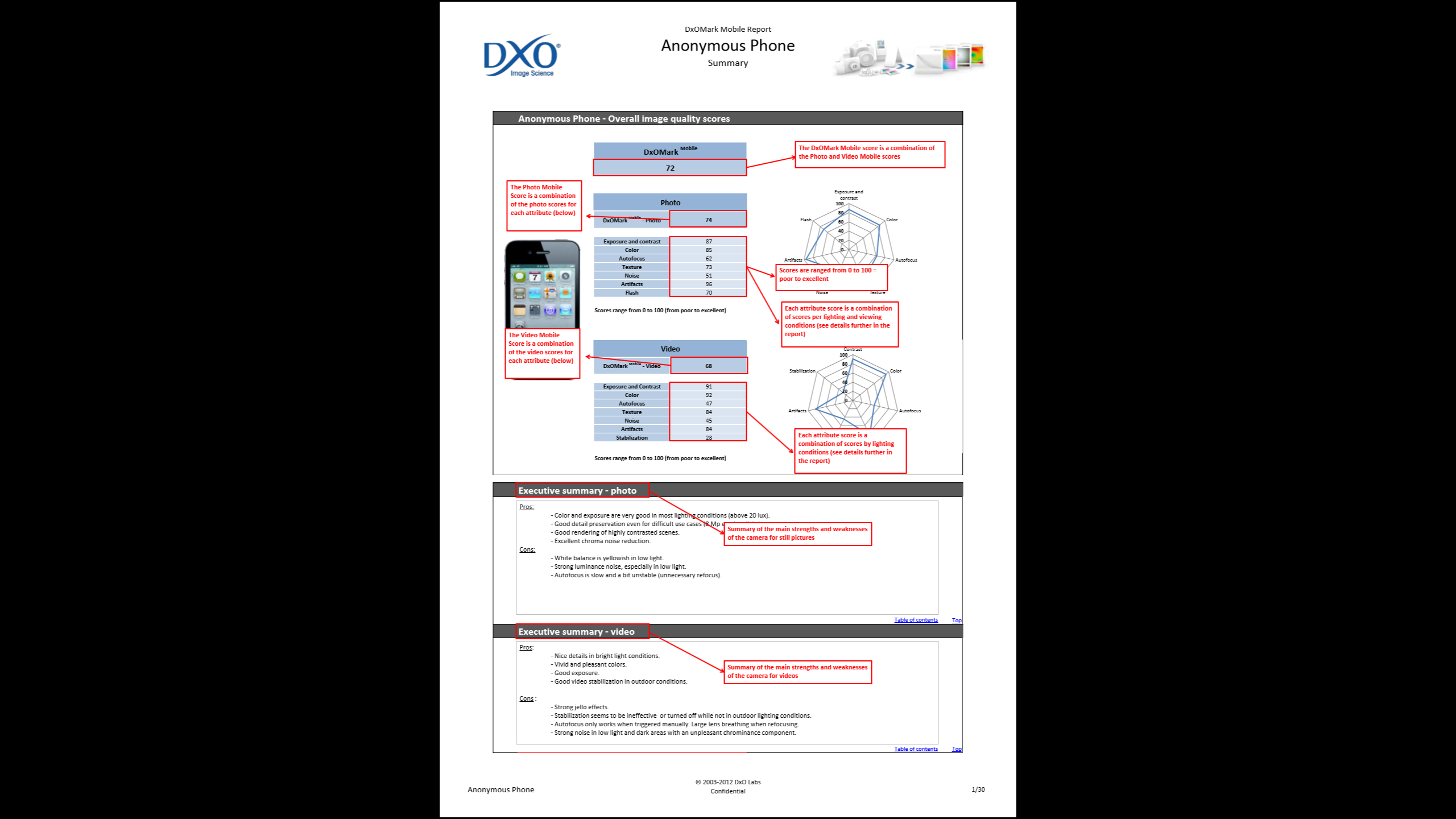
Having founded photo.net back in 1993, it has long surprised me that there is no “photo.net for camera phones”. DxO Mark has begun to put up some objective tests that are interesting, though they don’t capture the practicalities of using camera phones. The tests show that the Nokia PureView camera, which averages 41 megapixels of crummy noisy data, crushes the competition in low light (i.e., the indoor conditions where most people want to take pictures). The Samsung Galaxy S III is a distant second in the noise department. Yet worse (though not by much) in low light are the latest Apple products, iPhone 5, iPhone 4S, and iPad 3, all of which offer similar performance.

(Recent tests on the same site show that Canon continues to lag in sensors. The Powershot G15 is absolutely crushed by the Sony RX100, admittedly $200 more expensive. Canon either needs to improve its technology or buy DxO and shut down their web site!)

Full post, including comments

Christmas gift for someone you hate: Windows 8

Suppose that you are an expert user of Windows NT/XP/Vista/7, an expert user of an iPad, and an expert user of an Android phone…. you will have no idea how to use Windows 8.

What are the best features of Android? A permanently on-screen Back button. A permanently on-screen Home button. Neither of these are present on the Windows 8 “tablet screen”. Every app developer implements the “Back” feature in a manner and location of his or her own choosing (Microsoft apps seem to put a big arrow on the top left of the screen; other developers used the bottom left; many screens do not have a Back option at all).

What is the best feature of iOS on the iPad? A permanent hardware Home button. It isn’t as convenient as going “Back” on Android but at least it facilitates re-navigating to wherever you were. The closest thing to a full-time Home button in Windows 8 is the “windows” key on the keyboard (but the whole idea is that the keyboard is not always available/required).

What is the best feature of Windows XP/Vista/7? Click right on an object to get a context-dependent menu of useful functions. Android copied this feature: touch and hold an item in order to get a context-dependent menu of options. The Windows 8 tablet interface lacks this interface standard.

Microsoft has had since October 2008 to study Android. It has had since June 2007 to study iPhone. It seems as though they did not figure out what is good about the standard tablet operating systems.

One thing that Android and iOS do not address is how to handle the requirement of offering a legacy Xerox Alto-style mouse-and-windows environment. Microsoft here integrates the tablet and the standard Windows desktop in the most inconvenient and inconsistent possible way. Due to the desperation of the average consumer to watch television at all times on all devices, the typical computer screen is fairly wide. One would think therefore that it would be possible to use traditional applications in the left-hand two-thirds of the screen while running a tablet environment on the right-hand one-third of the screen. Windows 8 does not allow this. It is either the old Windows XP desktop or the new Android-like tablet environment. As far as I can tell they cannot be mixed except that a tablet app can be set to appear in a vertical ribbon on the left or right edge of the screen.

A reasonable user might respond to this dog’s breakfast of a user interface by trying to stick with either the familiar desktop or the new tablet. However, this is not possible. Some functions, such as “start an application” or “restart the computer” are available only from the tablet interface. Conversely, when one is comfortably ensconced in a touch/tablet application, an additional click will fire up a Web browser, thereby causing the tablet to disappear in favor of the desktop. Many of the “apps” that show up on the “all apps” menu at the bottom of the screen (accessible only if you swipe down from the top of the screen) dump you right into the desktop on the first click.

Confused about how the tablet apps work and want to Google for the answer? You go to a Web browser in the desktop interface and can’t see the tablet interface that you’re getting advice on how to use. Keep your old Windows 7 machine adjacent so that you can Google for “How to use Windows 8” on the old computer and have the pages continuously visible.

The only device that I can remember being as confused by is the BlackBerry PlayBook. I would find this machine a lot more useful if it simply ran Android as a sub-environment and did so in the right-hand third of the screen. Comments from those who love Windows 8 would be especially appreciated.

To end on a high note, some of the supplied apps are wonderful, e.g., the Bing Finance app. Swiping back and forth on a 27-inch screen is a great way to get a comprehensive picture of a lot of information quickly. (Of course, this would be equally true if one had a similar app on a 27-inch Android tablet… it is just that there aren’t any high-res 27-inch Android devices of which I am aware.)

[This article is based on using Windows 8 on what may be the best current hardware: Dell XPS One 27 computer with a quad-core i7 CPU, 16 GB of RAM and a solid state hard drive accelerator ($2600). I will try to write a bit about the Dell hardware in a subsequent posting. The screen is beautiful. The supplied keyboard is tiny, as if made for a clown. The display tilts down easily, making it easy to get up from one’s chair to read a web page while standing.]

[Separate issue: Given how misguided the whole design of Windows 8 seems to be, why have tech journalists given it basically positive reviews? My theory is that journalists love anything new, different, and complicated. Windows 8 is all of those things.]

[December 6, 2012 update: A reader asked a question about DxOMark’s camera phone testing procedures. I went to the DxO site downloaded a PDF. Given the wide aspect ratio of the 27″ monitor, I expected to read the PDF in one window while typing my thoughts about it in the browser. From Google Chrome, I opened the PDF document and was immediately zapped into the Metro interface’s “Reader” app. My browser was gone. Although the screen is easily wide enough to display two pages simultaneously, the software elected to show just one page at a time, surrounded by massive black bars (see screen capture below). Instead of looking at a text entry box and the PDF simultaneously I would have to go back and forth between screens, trying to remember what was on each. I tried the same series of steps in Microsoft Internet Explorer and the result was the same.

Now I understand why Jakob Nielsen calls this “Microsoft Window”. (I would bet that this behavior can be fixed by installing the traditional Adobe Reader software, but that leaves open the question of why Microsoft shipped the operating system with this behavior as the default. Wouldn’t this typical use case of downloading a PDF and then wanting to view it while, say, typing an email have come up?]

Full post, including comments

Working parents will be flung off the fiscal cliff?

A friend call me this morning as she pushed her four-month-old baby in a stroller. She had cut back to 4 days per week and hired a 40-hour/week nanny to cover her four 8-hour days plus commuting time. Given the cost of the nanny, the cost of commuting, and the reduction in her salary to $90,000 per year, the after-tax spending power boost she achieved by working was less than $15,000 per year. She did not like the nanny, local day care centers were all booked up, and her husband makes a good income, so she quit her job and will stay home with the baby.

I’m wondering if the tax and regulation changes for 2013 will cause more two-income families to cut back to one income. Higher tax rates will reduce the after-tax income of the second working parent. Higher tax rates for businesses and individuals will increase the cost of day care or nanny care. Increased regulations on business and increased sales and property taxes will increase the cost of running a day care center, thus increasing prices to consumers. Where my friend might have netted $15,000 per year after tax in 2012 she would face an after-tax benefit of perhaps only $10,000 per year in 2013.

It seems to me that the economic shrinkage from higher tax rates could be larger than forecast because people are not factoring in two-income households where one parent’s after-tax income is not much higher than the cost of child care. An unmarried adult who cannot navigate the welfare system has no choice but to work, but a married working parent is constantly evaluating the relative merits of staying home with the kids versus bringing home that second paycheck.

Comments from readers who are in two-income households with children under 5 would be especially appreciated.

Full post, including comments