Happy National Home Improvement Month for readers who, like me, have been dumb enough to buy rather than rent. Also, Happy National DIY Day.
Previously, on this blog:
- What does it cost to maintain a house to a like-new standard? (In 2023 prices, I came up with about $40,000 per year to maintain a house that costs $1 million to construct, i.e., about 4%)
- Is U.S. immigration policy a form of animal hoarding? (the U.S. is unaffordable for the 350 million humans already here, which is why we need to open the border and bring in more humans)
- U.S. population has doubled and housing construction has remained constant (“A final possible answer is that we are living in shabby old houses … Why wouldn’t we have at least the same ratio of housing starts to population size that we had in 1960 before we began to be enriched by migrants?”)
This month in the Wall Street Journal, “The Typical U.S. Home Is 44 Years Old—And Needs Tons of Work”:
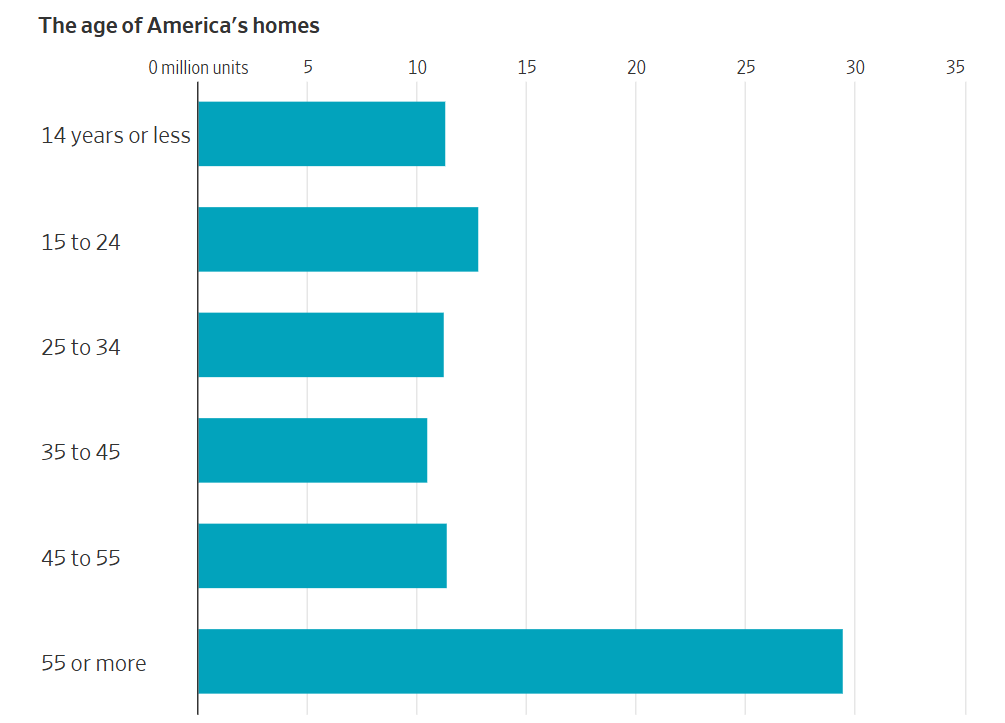
More recent new construction hasn’t replaced America’s graying housing stock, meaning the age of the median home is a record 44 years, according to the Harvard Joint Center for Housing Studies.
The cost of home maintenance, even after accounting for broader inflation, has jumped. Structural repair costs grew by about 14.1% in real terms between 2022 and 2024, according to the Federal Reserve Bank of Philadelphia. Plumbing jumped by 23.6%. The increase reflects the rising cost of individual parts and labor, and the larger size of necessary repairs.
This is on top of the rising costs of home insurance, property taxes and homeowners association dues, which are making it prohibitive for many to simply own a home, not to mention buy one.
The newspaper says “it [is] prohibitive for many to simply own a home, not to mention buy one” and at the same time tells us that the U.S. should have increased immigration, i.e., more demand for a relatively fixed supply of houses.
Our shabby/old house by Palm Beach County standards is 23 years old and that puts us in the top 25 percent of home youth:
Getting close to my 4% number:
Financial advisers traditionally suggested setting aside 1% of a home’s value annually for upkeep, but many now argue that isn’t enough. While 1% may cover routine upkeep, 2% to 3% provides a more realistic cushion for expected maintenance, home-improvement projects and unexpected repairs, particularly for older homes, said Angie Hicks, co-founder of home-services company Angi.
The Americans who were most eager to lock themselves into their homes during coronapanic will now bear a heavy burden:
Forty-nine percent of all improvement spending is now for necessary replacements like HVAC that owners can’t delay, said Rachel Drew, director of Harvard’s Remodeling Futures Program. The financial burden is particularly heavy in regions like the Northeast, where homes tend to be older.
Speaking of old, the article highlights the inability of folks in the Northeast to adapt to changed circumstances:
Mindy and Joseph Mevorah own an 88-year-old colonial [“more than 3,500-square-foot”] in Sands Point, a New York City suburb with plenty of old homes that is often considered an inspiration for “The Great Gatsby.” The house is due for a new coat of paint, a task they know to approach with caution. … “A new brick next to an old brick would look terrible,” said Joseph, 66. … The Mevorahs have stayed in their home for 29 years … They have a pool that could be a draw for future grandchildren. … When replacing their copper gutters a few years ago, they considered switching to aluminum, which would have been cheaper, but ultimately stuck with copper to preserve the home’s integrity. After all, they expect to be there for many years to come.
A 66-year-old in Florida whose kids were grown wouldn’t stay in a 3,500-square-foot wreck of a house. The Floridian would recognize that different kinds of real estate are suitable for different phases of life and likely move to a condo or small new house.
Circling back to the immigration theme… how can end-of-career financially comfortable Americans who struggle to afford house maintenance imagine that the U.S. can afford to house tens of millions of additional welfare-dependent low-skill immigrants?
> The Floridian would recognize that different kinds of real estate are suitable for different phases of life and likely move to a condo or small new house.
I’ve heard Millenials and GenZ complain that Boomers in general want to “age in place” in their giant McMansions, so maybe Floridian Boomers are more savvy? The young’uns not having jobs that even pay the lower-middle class wage live at home and act as passive-agressive enablers.
https://bestlifeonline.com/cities-lower-middle-class-news/
HVAC is becoming an Achilles heel in home ownership. The refrigerants keep getting phased out, ours uses R-410A which is being phased out after a few years for being a greenhouse gas. Our new A/C units are about 10% as reliable as the old ones, we had a TXV go out after 1 year — and it is one of the best rated brands, made in the U.S.
I like renting and letting someone else worry about all the headaches. However, you do lower your chances of ever owning, unless you buy during a downturn. Finding a professional, non-slumlord leasing company is challenging. We liked renting from individuals, but they kept selling the house out from under us. A colleague once told me his best neighbors were illegal aliens, because they were so quiet — to avoid INS. Of course this was the ’90s and they weren’t so entitled back then. You have to remember Phil, they pack em in tight and bend the 2+2 rule (2 per bedroom, plus 2 in the living room) — factor that into your density calculations. If they aren’t worried about immigration law, why would they be worried about honoring their lease and local regulations?
I was looking up at the roof this morning, checking for squirrels. I turned around and one of them was watching me, I would swear he was smiling.
@Ordinary: re renting.
With retirement 1 to 3 years away, I’m seriously considering selling my FL sf home and renting an apartment, condo, or sf home in an active, upscale, well-maintained, guard-gated 55+ community. Just yesterday, I looked at a well-located, brand-new, 55+ apartment complex. It looked great. Price for a large 1 b/r start at $1800. Attached villas w/ 1-car garage start at $3000. Though, I’m concerned it won’t looks so great after 10 years or so, and management will start to cut corners on maintenance.
It is odd that Americans have been sold on the idea of home ownership rather than renting from someone with the expertise and ability to take advantage of economies of scale in e.g. hiring tradesmen, buying insurance, purchasing appliances, mowing the lawn, maintaining the swimming pool & that the tax code encourages this behavior. The argument is that by owning you build “equity” and thus financial independence. That argument only works if you don’t understand the concept of an “opportunity cost,” that instead of investing in a diversified cross section of the US economy you sink most of your wealth into one asset that is subject to the vicissitudes of that one asset. And instead of owning growth you own a fungible piece of property that is essentially indistinguishable (except in your mind) from lots of other pieces of property. Go figure.
jdc: Yes, so many bad things about homeownership for the economy, e.g., having a low-interest mortgage or being underwater on equity can discourage people from moving from a failing part of the U.S. to a rapidly growing part. I’m addicted to light, though, so I can tolerate a corner apartment but love a structure with light from all four sides. This means either a building with a small footprint or a single-family house. It would be great if someone would build a professionally managed complex of 4-story buildings with a 2500′ footprint. Then each family could have the same space as a conventional single-family house, but with some economies from just one roof for four dwellings. Alternatively, a high-end full-service rental complex of single-family houses. The latter exists, I believe, in some 55+ communities. The headline price is high, though, so it looks unattractive compared to owning if you don’t put a dollar value on your time going back and forth to Home Depot, trying to fix stuff, etc.
“It is odd that Americans have been sold on the idea of home ownership rather than renting from someone with the expertise and ability to take advantage of economies of scale in… ”
It’s not odd. Owning (partially) insulates you from absolutely brutal housing inflation driven by:
1) Broken municipal politics. Obstruction to building in general. A vote block (boomers) with a vested interest in keeping prices high.
2) Broken federal politics. Ponzi-Scheme funding for all entitlements that pretty much necessitates a rapidly increasing population. For whatever reason, the people that make up that population are treated as fungible.
I realize things aren’t quite as bad in the US, but in Canada, renters are facing cost-of-living inflation that’s ridiculously higher than that of homeowners. Taking advantage of economies of scale by renting only works if rental stock grows in line with population growth, which hasn’t been the case in Canada for a decade +.
I would have thought that the mantra of getting young people into “the trades” and eschewing college over the last decade would have paid off with lower costs for everyone. If there’s 40 capable tradesmen for any given maintenance task within 5 miles of each other, many of them young, they couldn’t charge as much (despite the promoted blessings of $120,000+ starting annual wages, like how college was marketed before?) and so house maintenance costs would decrease, right? But perhaps the trades pipe dream is not turning out with intended results. Or is the amount saved on labor from competition due to the trades push irrelevant compared to other factors, such as cost of materials, litigation etc?
The problem here on the west coast is that “the trades” might be a ticket to a middle-class income, although most of them face a lot of competition from low-wage workers, but a middle class income won’t really buy you a middle-class lifestyle. The 90th percentile carpenter makes about 80k. I think a 25 year old tech marketer makes about that much. (at least they did, pre-ai). In any case, 80k/yr isn’t getting you much in coastal California.
Considering that, at least on the coasts, immigrants seem to do all the house maintenance, we seem to be in a bit of a pickle. Obviously, if we can get demand down, the cost of housing should go down, but if nobody is building or maintaining it, we will just be in the same spot in 20 years.
Never had any immigrants, except myself, working on my house. Once I hired a contractor to asphalt a long driveway, he hired illegals. Despite cost-saving measure he moved his business out of the area. I of course have seen illegals doing house maintenance elsewhere, but they did work that did not require much qualifications. Work that required skilled labor, such as marble -tiled floor, were sound failures requiring repairs and rework, when it was handled by a dude who hired illegals.