As an index fund investor, I used to (indirectly) buy stocks that had been public for a while and only of companies that made a profit. The rules have apparently been tossed so now I will be a(n indirect) SpaceX shareholder. NYT:
Nasdaq, the exchange where SpaceX plans to list its stock, announced a rule change in May to allow “fast entry” into the Nasdaq-100 index by large private companies like SpaceX that go public.
Others followed. FTSE Russell recently altered its methodology, which will result in listing SpaceX in its indexes within a week of its going public.
The changes mean a large swath of index funds — which millions of Americans own in their retirement funds, pension plans and personal portfolios — are poised to hold SpaceX shares soon after the company goes public. Anthropic and OpenAI, the artificial intelligence start-ups that are planning to go public this year, would also land in index funds quickly, potentially exposing everyday investors to more financial risk whether they like it or not.
“It’s historically unprecedented,” said John Polonis, a former Wall Street lawyer who worked at J.P. Morgan and now offers financial analysis on social media. “You can try to reorient your retirement accounts to avoid funds invested in A.I. companies, but most people aren’t going to be doing that. They’re kind of left out in the dust here.”
Is there any integrity left on Wall Street?
One index provider has declined to budge. On Thursday, Standard & Poor’s said it would not change its criteria for inclusion in the S&P 500, one of the most-followed indexes, meaning SpaceX will not be eligible for inclusion until at least mid-2027. Standard & Poor’s said it had determined that exceptions to its rules “should not be granted solely based on market capitalization.”
What’s the long-term value estimate for this company? Humans cluster in metro areas, thus making fiber Internet and cell towers better than Starlink for most of us. ChatGPT: “roughly 75–85% of people worldwide who have at least a global middle-class/consumer-class standard of living live in urban, suburban, or peri-urban areas. I’d use 80% as the best single-number answer.”
SpaceX has the best rocket tech, but unless you’re Iran and want to kill infidels worldwide how many rockets do you need? Maybe the answer is military use of space rather than sending up packages that will rain down on the enemies of the righteous? But military equipment for use in space is incredibly expensive and takes forever to develop and build. Does a cheaper launch capability matter for the U.S. Department of War?
Elon says space makes sense for data centers, but I have a tough enough time maintaining the computer on my desk. If we want solar power and cheap land why isn’t Arizona, a Texas ranch, or central Florida a more sensible location?
How about the value of going to Mars? If a spaceship could accelerate continuously and indefinitely at 1g and decelerate at 1g how long would it take humans to get to Mars from Earth, all the while experiencing Earth-like gravity? Prof. Dr. ChatGPT, PhD Physics says 2-5 days. That would be an awesome tourism business. But, of course, SpaceX has no technology like that.
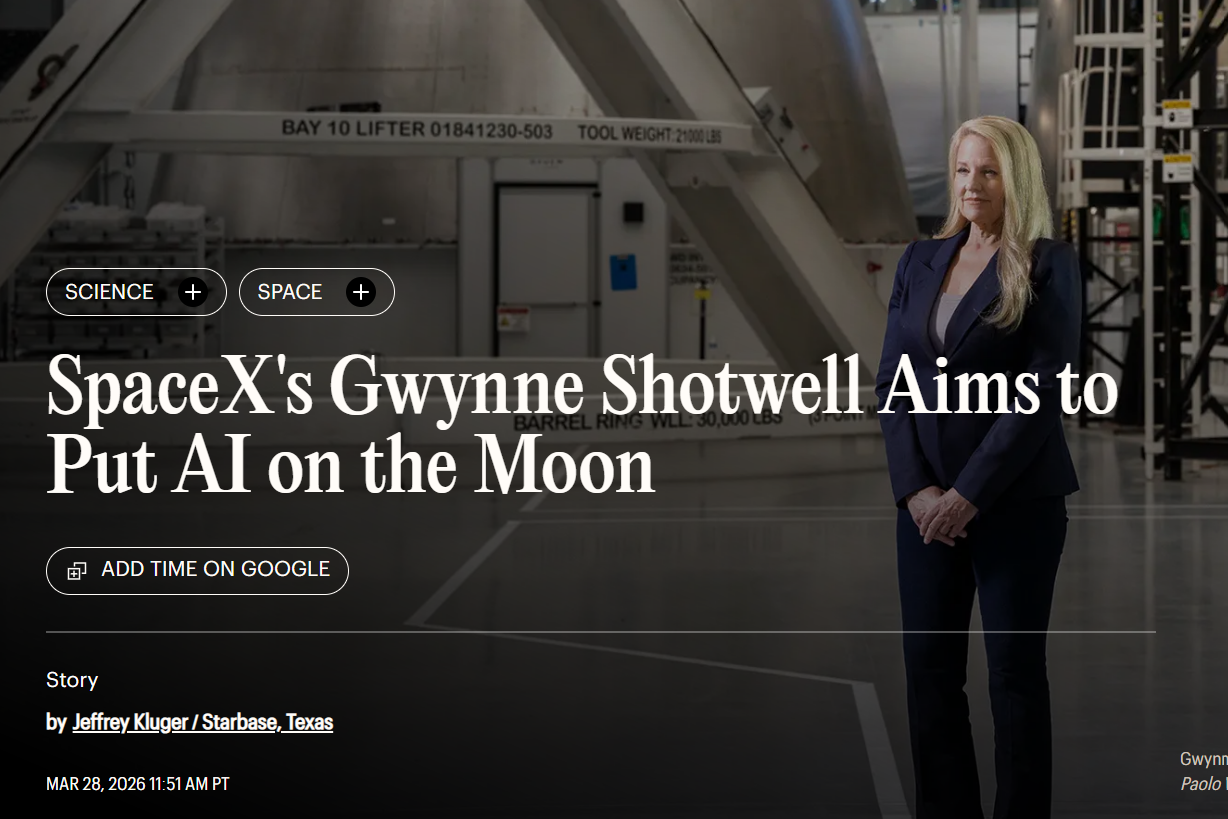
Perhaps the answer to the orbital-level valuation for SpaceX is that the company is run by a woman and we’re informed that female-led companies outperform their male-led peers. TIME:
Readers: What will SpaceX be worth five or ten years from now (in 2026 dollars)? What will have been seen as the main driver of value?
I’ll go first… because I believe in efficient markets, SpaceX in five years will be worth its IPO price plus 4% real return annually (about 21% over the IPO price). A narrow majority of the value will be from Starlink. (Note that this is like a probability expectation. I’m pretty sure that something dramatically good or dramatically bad will happen to SpaceX, but I can’t predict which is more likely and therefore my guess is right at the center. Analogous to the expected value of a coin flip game for $1 being $1 even though we know it will either be $0 or $2 and can’t be $1.)
A professional investor friend says that SpaceX would be a good buy at the IPO price because of the high percentage of retail purchases. “These retail investors come back in and support the price even after the inevitable post-IPO slump,” he said. “The more retail the better, contrary to previous prevailing wisdom.” If he had access to a large bock of SpaceX at the IPO price and without a lock-up, he would buy the block and sell it after a few days (i.e., right when a lot of index funds will be buying!).
“SpaceX IPO Is Said to Be More Than Four Times Oversubscribed” (Bloomberg, June 10):
SpaceX’s initial public offering has attracted demand for more than four times the available shares, according to people familiar with the matter, ahead of the Elon Musk-led rocket, satellite and artificial intelligence firm stopping taking orders.
SpaceX’s IPO is set to price June 11 and trade the following day. The company is offering 555.6 million shares at a fixed price of $135 each, which would raise about $75 billion, and value it at about $1.8 trillion.
I’m confused by the above. It says “set to price June 11” and the article is dated June 10. How was the price of $135/share already known on June 10? Separately, if the offering is oversubscribed by 4X, doesn’t that suggest the price is being set way too low? What about the duty to protect SpaceX’s existing shareholders by not giving away shares at such a low price that there are 4X as many buyers as shares? To avoid this abuse of shareholders, Google did a Dutch auction at its IPO (Google AI)
Google’s historic August 2004 Initial Public Offering (IPO) famously utilized a modified Dutch auction instead of the traditional wall street underwriting process. In this method, instead of investment banks setting a fixed price, individual and institutional investors bid directly on how many shares they wanted and the price they were willing to pay.
This is explained in “How I Did It: Google’s CEO on the Enduring Lessons of a Quirky IPO” (Harvard Business Review) by Eric Schmidt:
In mid-August the bidding began, based on our published expected IPO price range of $106 to $135 a share. … There weren’t a lot of orders, and to be frank, we wondered if we’d made a mistake in choosing an auction-based approach. The offers that did come in were at or below the low end of the range we’d anticipated. When the bidding period ended, it was clear that we weren’t going to be able to sell all the shares we had planned to sell in the price range we wanted. I met with the board to discuss whether we should delay our IPO and hope to get a higher price later. Our underwriters believed that we could close the IPO with a price around $80 to $90 a share if we reduced the number of shares for sale—a disappointing outcome. In the end we decided to close the IPO for a number of reasons, the most important being that it was time to put this chapter behind us and get back to running our business. So on August 18 we agreed to price it at $85 a share.
Perhaps this is the answer. Google expected to get more via an auction and got less. See also “Google shares took off, but the auction didn’t” (CNBC, 2014):
The rationale was simple: Take the short-term gains away from Wall Street and big money and give at least some ownership to the many consumers whose obsessive use of the search engine had allowed it to grow from a garage start-up into a multibillion-dollar phenomenon in half a decade.
But instead of pioneering a new formula for IPOs, with investment banks and big investment shops ceding control to the issuing companies and a wider universe of investors, the Google deal remains a historical anomaly.
Experts offer up two main explanations. The first is that auctions are risky. Banks get paid handsomely (7 percent of the offering amount is typical) to sell a deal to their clients, and in the process make sure prospective investors understand the business, competitive landscape and the state of the market. Through that work, they find what investors are willing to pay, so companies can be fairly confident that there’s adequate demand at the set price. An auction, meanwhile, is more like an investors’ Wild West.
The second reason is that Google’s offering wasn’t a real auction, but more of a hybrid. After all, there was clearly enough investor demand to price the stock at closer to $100, because that’s where the stock opened, but at the last minute lead underwriters Morgan Stanley and dropped it to $85. The low end of the expected range had been $108.
David Golden, a banker at JPMorgan, one of the many banks that served as an underwriter for the IPO, said the big investors decided just before the offering that without a reduction in price, they’d wait until the stock started trading and buy it on the open market rather than pay $100 a share or more in the IPO.
“Lo and behold, it was set at $85 a share, which built in a 15 to 18 percent profit that banks like to deliver to big institutional investors and that investors like to receive,” said Golden, who is now a managing partner at Revolution Ventures in San Francisco. Institutions “want to know that when they’re buying risky, illiquid securities, they’re going to have a built-in gain.”
Index funds are only index funds until they’re not. The fed is probably going to have to go to 4.25%, whether they like it or not. 10 year treasuries are 4.5% before taxes. Rather silly for anyone to hold on to a stonk yielding 4%.
FYI, you would have been well served to read the S-1 filing (on Edgar) because it addresses and answers many of your questions. You would have been much more informed about SpaceX’s businesses, and hence it would have made for a much more informed blog post. Maybe have a read and get back to us.
Answers: Everything in a typical S-1 is a lie intended to shield the underwriters and company from lawsuits! https://www.sec.gov/Archives/edgar/data/1181412/000162828026036936/spaceexplorationtechnologi.htm doesn’t seem to be an exception.
Here are some notes from my reading…
“Our mission is to build the systems and technologies necessary to make life multiplanetary, to understand the true nature of the universe, and to extend the light of consciousness to the stars.” is the first substantive line. How does life being multiplanetary make money for investors? That’s still anyone’s guess. The S-1 doesn’t say anything about anyone having offered to pay even 1 penny to be boosted into a Mars colony.
Example risk: “Our business strategy depends on successfully designing, developing, and deploying our products and services, as well as related platforms, infrastructure, and other strategic initiatives, at an unprecedented scale, which presents significant execution, cost, and timing risks”
Nothing about “Having a data center in orbit might turn out to be vastly more expensive than having one in Arizona next to a solar array and, therefore, stupid.”
It says that they might buy Cursor for $60 billion (it is that much better than Antigravity?).
It says “government space spending in 2024 totaled approximately $77 billion” but not if that was just to pay for launches or if the $77 billion also included buying the satellites and other gear flung up into space.
To the question about fiber vs. space-based Internet, they say “With fixed broadband connections projected to reach two billion by 2030 according to Ericsson, and terrestrial expansion often economically unfeasible in remote and challenging regions, only space-based systems can deliver truly global, ubiquitous, high-throughput coverage capable of supporting this explosive growth in data demand.” They don’t put any numbers on how many people live in “remote and challenging regions” and if those people have any money.
In short, the S-1 doesn’t answer any of the questions in the original post!
To back up the “stupid human read” that I did of the S-1 (comment above), I fed the S-1 to ChatGPT and it says that there is nothing in the document that supports the valuations that SpaceX is being sold for. The S-1 enables an investor to compute some ratios, e.g., “At the IPO valuation, that is roughly 95× 2025 revenue and 268× 2025 adjusted EBITDA.”
No stock can be worth 95 times revenue in the long run so we are back to the questions of the original post, not answered in the S-1: what part of SpaceX’s business can grow so large that the current valuation will be 5 times revenue, thus opening up the possibility of an investor making a profit buying in at the current valuation.
“No stock can be worth 95 times revenue in the long run so we are back to the questions of the original post, not answered in the S-1: what part of SpaceX’s business can grow so large that the current valuation will be 5 times revenue, thus opening up the possibility of an investor making a profit buying in at the current valuation.”
I guess you won’t find out the answer (be it yes or no) anytime soon since you didn’t spend a few minutes reading the S-1!
If you are so skeptical on the valuation, why not sell your index funds today to avoid a major loss because it is likely to be one of their largest holdings?
Answers: You might want to re-read the original post. I wrote “SpaceX in five years will be worth its IPO price plus 4% real return annually” as my personal prediction as to the value. It’s not terrible to have a portfolio component that returns 4% real annually (8-12% nominal dollar growth, depending on what inflation metric you believe).
I’m mystified as to why SpaceX is worth its IPO valuation of $1.77 trillion (ish) and would be curious to know why/how it grows into that valuation, but that’s not being “skeptical on the valuation”.
The other area where you could benefit from re-reading the original post is to note that SpaceX won’t be part of the S&P 500 (total market cap: about $67 trillion) for quite some time yet and, therefore, it wouldn’t make sense to sell the most familiar index fund even if one had a letter from God promising that SpaceX would go bankrupt in the next year.
“I’m mystified as to why SpaceX is worth its IPO valuation of $1.77 trillion (ish) and would be curious to know why/how it grows into that valuation.”
Not to beat a dead horse, but if you read the S-1 and some of the other IPO materials that are widely available you would not be mystified (you would be able to make a credible argument either way that you want to own it or short it). You say you are buying “lots” of the stock but are disavowing the advice of your investment advisor (ChatGPT)!
Answers: You may wish to reread the original post. To the extent that I become a buyer of SpaceX it will be purely due to an index fund that I own buying SpaceX. If you reread the above comment, which quotes from the S-1, you will see that I did read the S-1 (that reading, however, will not have any influence on my indirect purchases of SpaceX stock, however, since it will be index funds doing any buying).
But, as I mentioned you could have sold the index fund to avoid the potential for a large loss that your investment advisor (ChatGPT, whom you have quoted on valuation) has foretold. Call me confused.
Answers: You may wish to reread the original post and the comment regarding ChatGPT’s analysis of the S-1. (ChatGPT did not say that SpaceX was overvalued. It said only that the S-1 does not provide information useful for determining SpaceX’s value.)
(Even if SpaceX were going into the S&P 500 right now at $1.77 trillion in value and the true long-term value turns out to be $0 it still wouldn’t make sense for a typical long-term investor to sell the S&P 500 out of a taxable account in order to buy the S&P 500 minus SpaceX because the capital gains tax would be larger than the loss avoided from SpaceX going to $0.)
If you are really interested in how SpaceX is being valued, check out “The Dean of Valuation” Professor Damodaran of NYU Business School, who has done valuations and will probably update.
Thanks, jdc. https://www.cnbc.com/2026/06/07/dean-of-valuation-aswath-damodaran-is-not-buying-spacex-too-richly-priced.html is from June 7, but I can’t find a paywall-free version.
https://www.wsj.com/business/what-the-dean-of-valuation-thinks-elon-musks-spacex-is-really-worth-bfe8061c is actually kind of rosy:
The professor of corporate finance at NYU’s Stern School of Business estimates SpaceX’s equity value at around $1.3 trillion.
Damodaran constructed his own valuation model by valuing each of SpaceX’s three business segments. He used estimates of the size of each unit’s market, and of SpaceX’s likely share of it. He also incorporated an estimated target operating profit margin for each of those segments.
————-
It actually sounds like a buy based on this guy saying he’s not buying any! If we assume that the true value is $1.3 trillion right now (i.e., assume that the professor is correct), but retail enthusiasm will inflate this by 4X then the currently expected IPO valuation of $1.77 trillion is less than half of what the stock will be worth in a few months.
jdc,
FYI, Damodaran is much like Jim Cramer (widely ridiculed by most knowledgeable folks in the investment community). His trademark: “always wrong and never right.”
For good humor, ask one of the AIs to pull up all of his Tesla stock price “valuations” over the past 15 years (or any of his many other “valuations”). He’s always wrong because he just guesses on a growth rate and plugs it into a one-line DCF formula. His guessed growth rates have no substance or thought to back them up because he never bothers to look at the underlying businesses (all about getting on CNBC TV or other venues).
This is his model for your peruse: https://aswathdamodaran.blogspot.com/2026/06/a-weeks-ago-i-assessed-value-of-spacex.html
From a quick look, he assigns roughly 600B to Starlink, 150B to launch, 300B to xAI, and 300B to other businesses that we don’t know yet but Elon will make up one day, just like humanoid robots from cars. How reasonable are these numbers?
150B for the launch portion sounds reasonable to me, this is like a Boeing (174B market cap) or a Lockheed Martin (126B market cap).
600B for Starlink sounds like a bit much as philg explained in the post. My optimistic valuation is Verizon (200B) + AT&T (150B) = 350B.
xAI was alright but is now imploded and way behind the leaders. I don’t see how they would be worth 300B. If you question whether Cursor is worth 60B then I would say that is the most reasonable part of xAI’s valuation.
Overall, I put the total at roughly 700B. After the 4X multiplier that philg applies, we arrive at 2.8T. This is my prediction for SpaceX (not that I am buying any).
Here’s an analysis of spacex’s prospectus. Summary: they expect most future revenue will be from products that don’t currently exist, and 93% of their market is AI software (Grok currently has 3% marketshare),
Interesting analysis but it does not give me good indicator whether to buy Space X shares or not. Usually Philip’s advise negatively correlates with individual stock performance and thus serves as a good trading indicator.
A northern farmer wants to know whether coming winter will be cold and inquires village shaman. Shaman has no idea but says it is going to be cold. The shaman visits a meteorologist at a local weather station to double-check whether coming winter is going to be cold. The metorogist has no idea but looks out the window and sees the said farmer going to the woods with large horse-drawn cart to prepare firewood. The meteorologist believes in practical knowledge of locals and replies that the winter is going to be cold
perplexed: In this case, though, my advice (the best guess, above) is that SpaceX at the IPO price will be an average-performing long-run investment. What is the trade that you’d do contrary to that? Go both short and long SpaceX simultaneously?
Philip, because I like to pay contract fees? Your advise indicates wait and see, and I likely will be participating through ETFs that I hold anyway. The complement to your advise would be not being in the tech etf/index fund markets at all, not really an option.
Also, I put sarcasm opening and closing html tags around my first paragraph in the post and old joke html tags around my second paragraph. They were stripped from the comment.
Update from the world’s smartest people: https://www.nytimes.com/2026/06/11/technology/spacex-valuation-skeptics.html
If SpaceX does go up 4X and stays up, this article will be Krugman “fax machine” gold!
Krugman, incidentally, says that he was correct in disparaging Internet as Fax Machine 2.0.
https://www.nytimes.com/2023/04/04/opinion/internet-economy.html
“See the great productivity boom that followed the rise of the internet? Neither do I. … Maybe the key point is that nobody is arguing that the internet has been useless; surely, it has contributed to economic growth. The argument instead is that its benefits weren’t exceptionally large compared with those of earlier, less glamorous technologies.”
Although I hate to argue with a Nobel laureate such as Prof. Krugman, I find it tough to believe that he is correct retrospectively regarding Internet. We couldn’t get help from our AI overlords if we had no Internet. We wouldn’t be addicted to our smartphones, either, I guess, so maybe that is why our productivity is low. On the third hand, maybe the goal of any normal human is to be addicted to his/her/zir/their smartphone.
Just this evening I ordered some HVAC filters and a washing machine drum cleaner from Home Depot for delivery tomorrow. That wouldn’t have been practical before Internet (yes, it was possible to order from paper catalogs and make phone calls, but could gig delivery services have operated?).
@philg
> I hate to argue with a Nobel laureate such as Prof. Krugman
Technically he’s not a Nobel laureate, because their is no Nobel prize in economics. Ignoble economists made up their own award, the “Sveriges Riksbank Prize in Economic Sciences in Memory of Alfred Nobel” (not to be confused with real sciences?). Its funded by Sweden’s central bank, not the Nobel estate.
https://removepaywalls.com/5/https:/www.cnbc.com/2026/06/07/dean-of-valuation-aswath-damodaran-is-not-buying-spacex-too-richly-priced.html
Thanks, ZM. It’s interesting that SpaceX could be considered more of an AI company than a rocket/satellite company. SpaceX doesn’t have much competition in space, but other than NVIDIA it is tough to say who the winners of AI-as-a-business will be!
“Thanks, ZM. It’s interesting that SpaceX could be considered more of an AI company than a rocket/satellite company….”
Hmmm…their AI strategy was covered extensively in the S-1, which you “read.” And also extensively in all the other IPO materials that were widely available.
The S-1 buries the “AI as a principal consumer of capital” story. Is it listed third in the opening pages (Space page, then Connectivity (Starlink), then AI). It’s sort of there in the mission statement: “Our mission is to build the systems and technologies necessary to make life multiplanetary, to understand the true nature of the universe, and to extend the light of consciousness to the stars. To do this, we have formed the most ambitious, vertically integrated innovation engine on (and off) Earth with unmatched capabilities to rapidly manufacture and launch space-based communications that connect the world, to harness the Sun to power a truth-seeking artificial intelligence that advances scientific discovery, and ultimately to build a base on the Moon and cities on other planets.”
In “Why this matters now”, AI isn’t mentioned in the first paragraph: “For the entirety of its existence, human civilization has lived on a single celestial body: Earth. The current paradigm, in which human civilization is confined to one planet, exposes humanity to existential threats that are unpredictable and uncontrollable on a planetary scale. These threats include naturally occurring catastrophic events—such as asteroid impacts, volcanic activity, or solar fluctuations—as well as man-made global conflicts. Geological and astronomical records indicate a non-zero probability of extinction-level events occurring over periods measurable in millions of years. Reliance on a single planetary home constitutes a single point of failure and carries existential risk with a probability of one that must be solved. By moving beyond the only home we have ever known, we ensure species-level redundancy and that the light of consciousness will not be tied to a single planet subject to the inevitable hazards of a harsh and vast universe. We do not want humans to have the same fate as dinosaurs. We want to give them a reason to look ahead with excitement, with the prospect that we are entering an age of abundance with an endlessly prosperous and exciting future.”
Answers: It sounds as though you are the smartest person in the room here and the only one capable of truly reading the S-1. Maybe you can enlighten us with your own prediction of SpaceX’s value in five years based on the intellectual superiority that you possess?
The way I see it, when people invest in SpaceX, they are not investing in the company as it exists today—they are investing in Elon Musk’s vision of where it could be tomorrow.
Whether you like him or not, Musk has a track record of turning hard and impossible ideas into real products, often faster and at lower cost than many established competitors. SpaceX has changed the economics of space launches through reusable rockets and has built the world’s largest satellite internet network through Starlink. Today, no other company is operating at the same scale in either area.
Tesla’s story is more complicated. BYD has now surpassed Tesla in global EV sales, and Tesla has faced declining deliveries for two years now. However, Tesla remains at the forefront in autonomous driving technology, energy storage, and charging infrastructure. You can thank Trump for killing renewables for Tesla falling behind.
SpaceX is what Apple was during its resurrection under Steve Jobs, except it operates in industries measured in trillions of dollars: transportation, energy, communications, AI, and space. As such, investors buying SpaceX stock are really betting on Elon Musk’s ability to deliver the next big thing.
Let’s be honest: if it weren’t for SpaceX, the US wouldn’t be talking about returning to the Moon anytime soon. Nor would Ukraine have had access to the level of battlefield communications and data connectivity that Starlink has provided.
Whether you love Elon or hate him, his track record of turning crazy ideas into reality is what makes SpaceX such a company to invest in.