Alan Greenspan died this week at 100. Let’s look back at Alan Greenspan Explains Modern Economics, my 2009 review of his fall 2007 book (i.e., he wrote it just as the U.S. subprime collapse was beginning).
Here’s a cautionary for folks like me with portfolios that are 100% invested in SpaceX:
One interesting story sheds light on the limitations of government economic forecasts. A booming economy and stock market swelled federal tax collections so much that there were unheard-of federal budget surpluses during the final years of the Clinton Administration. The non-partisan Office of Management and Budget, in the first half of 2001, predicted that federal budget surpluses would grow year after year. Everyone was trying to figure out what the Feds would do once they’d paid off 100 percent of U.S. long-term debt. Would there be massive tax cuts? Would the U.S. government start buying hard assets in other countries, the way that sovereign wealth funds from China and the Arab countries do now? Everyone in the government, including Greenspan, was shocked when the surpluses evaporated almost overnight. The forecasters hadn’t figured out that a sagging stock market would mean an end to collecting capital gains tax.
It looks as though Greenspan was prescient regarding the issue that has propelled socialists and “super-progressives” into political power here in the U.S. recently.
Greenspan sprinkles the book with discussions about income inequality. Greenspan says that as an economy becomes more productive, the returns to having good skills and being smart will increase (Gregory Clark has some statistics in Farewell to Alms showing the opposite; the returns to skilled labor in England fell and unskilled laborers were the biggest beneficiaries of economic growth). He thinks that the minimum skill level necessary to be productive in the U.S. is now far above what the graduates of our pathetic public school systems are capable of. He thinks it would be politically infeasible to turn our schools from unionized employee paradises into centers of educational excellence. With only dumb young Americans as a labor source, the U.S. economy will stagnate. His solution to continued economic growth is therefore a massive expansion of immigration of smart, well-educated, highly skilled workers from other countries. (Note that Chinese schools on average don’t have to be better than U.S. skills; we just need to attract immigrants from among the millions of Chinese who are better educated than the U.S. average.) Greenspan opposes our current immigration system, which does not give much weight to an immigrant’s potential as a worker.
It seems that Alan Greenspan didn’t realize that Somali immigrants had built Minneapolis and Boston, as their respective mayors now inform us. We can also look at this part of the book as an example of how little effect on policy even the most powerful Washington insiders can be. Greenspun was Chairman of the Fed. He had access to every member of Congress and four presidents. He presumably did tell these lawmakers “Hey, you should really put in IQ, education, working age, health, and income requirements on every immigrant and eliminate the U.S. asylum system so that you don’t just import needy humans into a massive welfare state.” What was the effect? The politicians doubled down and and then tripled down on low-skill immigration, oftentimes of people too old to work and guaranteed to need taxpayer-funded everything (e.g., automatic green cards for 75-year-old parents of new U.S. citizens, who might themselves be aged 50 or 60).
Perhaps we can give Greenspan credit for predicting our Age of AI and Robots (the perfect time to be importing low-skill humans!)?
Various portions of the book are sprinkled with Greenspan’s enthusiasm about technology and what it can do for productivity growth. He is basically optimistic about the future because humans will figure out how to do more with less. Like any good economist, he hedges his predictions of a prosperous 2030 here in the U.S. The main risks that he sees are Islamic terrorism and a resurgence of protectionism that would undo the benefits of globalization (you won’t find Greenspan showing up to protest a WTO meeting!). The main challenge that he sees is funding Medicare and Social Security, which are currently pay-as-we-go (i.e., Ponzi schemes). Despite increased immigration, taxes will rise to crushing levels and benefits will fall. The Europeans will be in even worse shape because they don’t have as much immigration. Greenspan does not address the issue of why a group of citizens would wish to pack their country with double the number of people in order to pay for their retirements. He puts no value on living in an uncrowded place with reasonable real estate prices and traffic.
(I don’t give him credit for predicting the impending insolvency of Social Security, which was obvious from them paying out benefits to the very first recipient that were 1000X what she’d paid in via taxes. Maybe I can give myself credit for predicting that immigration between 2009 and now would doom Americans to UNreasonable “real state prices and traffic”?)
Speaking of real estate prices, New York Times today (example of “When the market gives you an answer that you don’t like, declare market failure”):
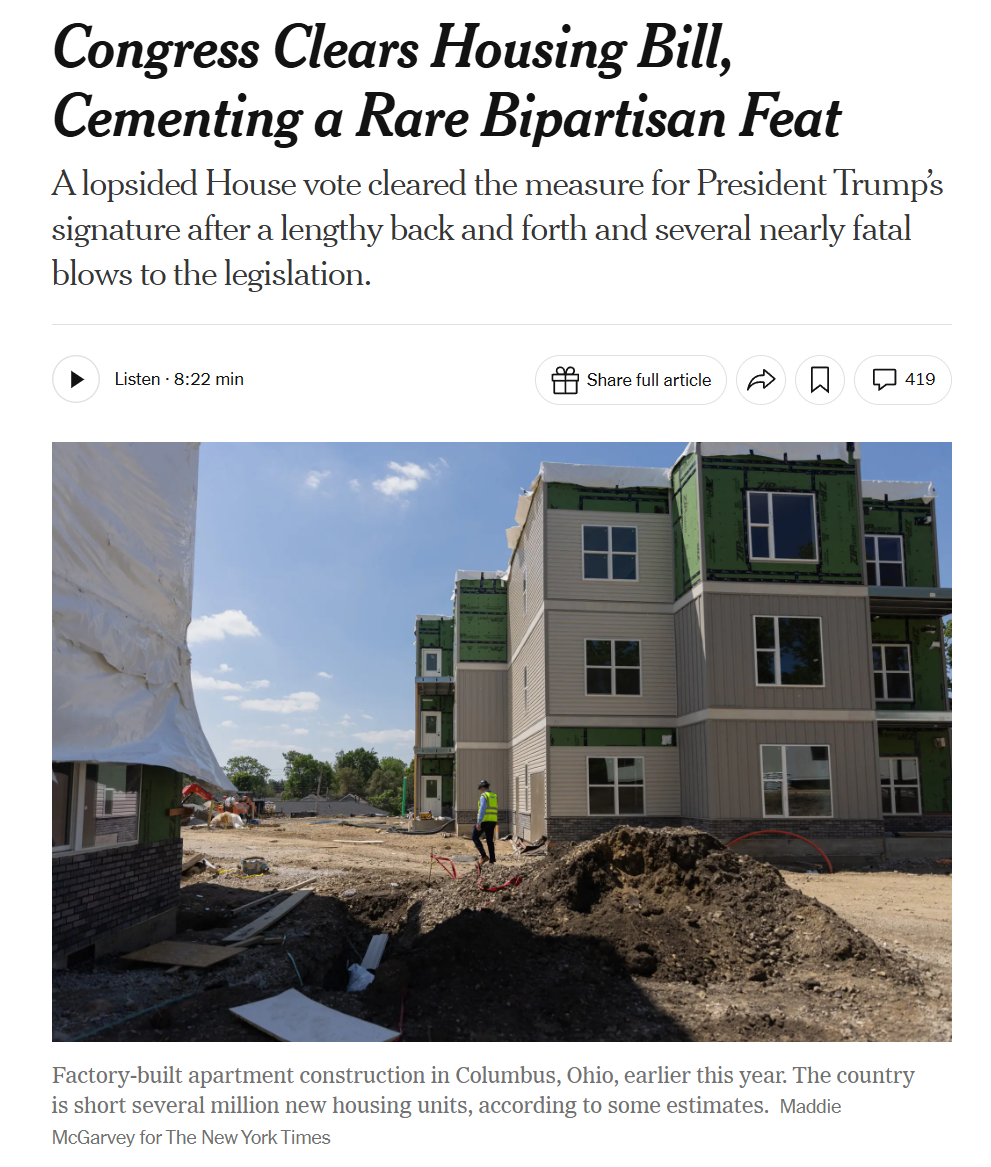
Excerpts:
“We’re in a full-blown housing crisis,” Senator Elizabeth Warren of Massachusetts, the top Democrat on the Banking, Housing and Urban Affairs Committee, said in an interview. “Home prices are sky high, rent is through the roof. The median age of a first-time home buyer is at an all-time high. So the pressure to move was almost irresistible. This bill got through because it is big.”
Chief among the sticking points was a provision to check institutional investors, which had been crafted in negotiations among White House officials, Senator Tim Scott, the South Carolina Republican who leads the Banking Committee, and Ms. Warren.
The measure prohibits corporate entities from owning more than 350 existing single-family homes, although it does not require them to sell homes purchased before the measure became law. A stricter proposal that would have required investors to sell single-family homes built explicitly as rentals after seven years was dropped; it had prompted a backlash by home builders and affordable housing advocates, who feared it would discourage new home construction.
I can’t figure out how this is Constitutional. Most of what the federal government does is allowed, despite contradicting the Framers’ intent, because of the Commerce Clause:
[The Congress shall have Power] To regulate Commerce with foreign Nations, and among the several States, and with the Indian Tribes;
Suppose that a corporate entity in the Mamdani Caliphate buys 351 houses in Buffalo, NY in order to rent them out via Section 8 to noble asylum-seekers from the world’s various dysfunctional societies. How is that an example of interstate commerce “among the several states”? Let’s assume that the corporation is a New York corporation based in New York and that 100% of its employees are New York State residents. The houses are all in New York State. It would be physically impossible for one of these houses to be sold for use in, e.g., the Islamic Republic of Michigan. Regardless of the merits of the law, how can the federal government do this? Why doesn’t it have to be a state-by-state decision?
The commerce clause has basically doomed us and the Supreme Court is to blame for Wickard v. Filburn.
I agree with your proposals that, given we only live in a pretend-federal system, we should just go all the way and centralize licensing for lawyers, doctors, academics and eliminate other onerous state regulations and let DC handle all of that. God knows that the price I pay for a movie ticket in Alabama is the same as the price I pay in DC, ignoring the various junk fees that are tacked on to it.
Maybe the Wickard v. Filburn argument for housing as a federal matter is that if all houses in Indiana were wiped out by a meteor then the people who survived would buy houses in Illinois. Thus, the Indiana housing market has a “substantial economic effect” on the Illinois market.
Isn’t the fact that they are renting them to Section 8 enough for it to be a federal issue?
Or the fact that they are buying these houses (ultimately) with 0% funny money loans from the Fed?
TD: You raise a good point. If the federal government is ladling out welfare in every state then maybe all commerce is interstate. But also that pushes the question up level: where in the Constitution does it say that the federal govenrment can ladle out welfare in every state? Can a low-income or no-income resident of Nevada be sold to a buyer in California or vice versa?
Most of us discovered the Greenspun blog while searching for Greenspan in the 90’s. Surprised Greenspun saw Donald Trump in real life but not Greenspan. Greenspan & Greenspun needed to get together.
Looks like people of NY are happy with their choice (Mamdani Caliphate):
”
Since April, the mayor’s favorability has gone up. Now sitting at 45-34%[statewide], it shows an increase from April, which Siena reported as 43-40%.
In NYC in particular, his favorability is much higher. The poll reported that his rating is now 58-26%, from 56-34%.
The poll also revealed that one of the most important issues to NY state voters is the cost of living crisis — a pillar of Mamdani’s campaign last year.
Siena pollster Steven Greenberg said in the release.
“A majority or large plurality of Democrats, Republicans, independents, upstaters and downstaters, men and women, young and old, Black, Latino or white all say that cost of living is the most important issue. At least 72% of each of those groups of voters say cost of living is one of the two most important issues.”
On Thursday, after the poll was taken, a key vote was passed to freeze the rent for up to two years in rent-stabilized apartments, another signature Mamdani campaign promise.
Around one million apartments fall under the freeze.
”
https://www.usatoday.com/story/news/2026/06/26/mamdanis-favorability-rating-jumps-in-latest-poll-what-to-know/90705790007/?utm_source=firefox-newtab-en-us
Ivan: I’m shocked that it took this long for politicians to discover the cheat code of winning 80% of votes by promising that 20% of voters will pay for 100% of the costs of running government. Ayatollah Mamdani is kind of a genius, but there were also smart people in 1920s. As soon as the Constitution was amended (1913) to allow federal income tax, why didn’t we almost immediately get into a situation like we have today? I guess the same question at the local level. Why didn’t at least 51% of Americans vote to have zero property tax for 80% of properties and hit the remaining 20% with sufficient taxes to fund all of local government?