Even an antique house like ours (2003) here in Florida comes with an A/V cabinet (example from Leviton), the natural home of routers, switches, etc. because this is where all of the Cat 5 cables (Cat 5e in our case; Cat 6, obviously, for newer houses (6A is stiffer and maybe builders wouldn’t want to use it?)) to wall plates end. The Florida Power & Light grid has amazing uptime, but our epic afternoon thunderstorms do cause 1-2-second power hiccups. That’s enough time to force a 5-minute reboot of our cable modem (still in an Xfinity coax ghetto here). Having failed to find what I expected to be a wallet-sized lithium-ion-based UPS, I set the cabinet up initially with a CyberPower lead-acid-based uninterruptible power supply (UPS) of absurd weight and capacity given the use case:
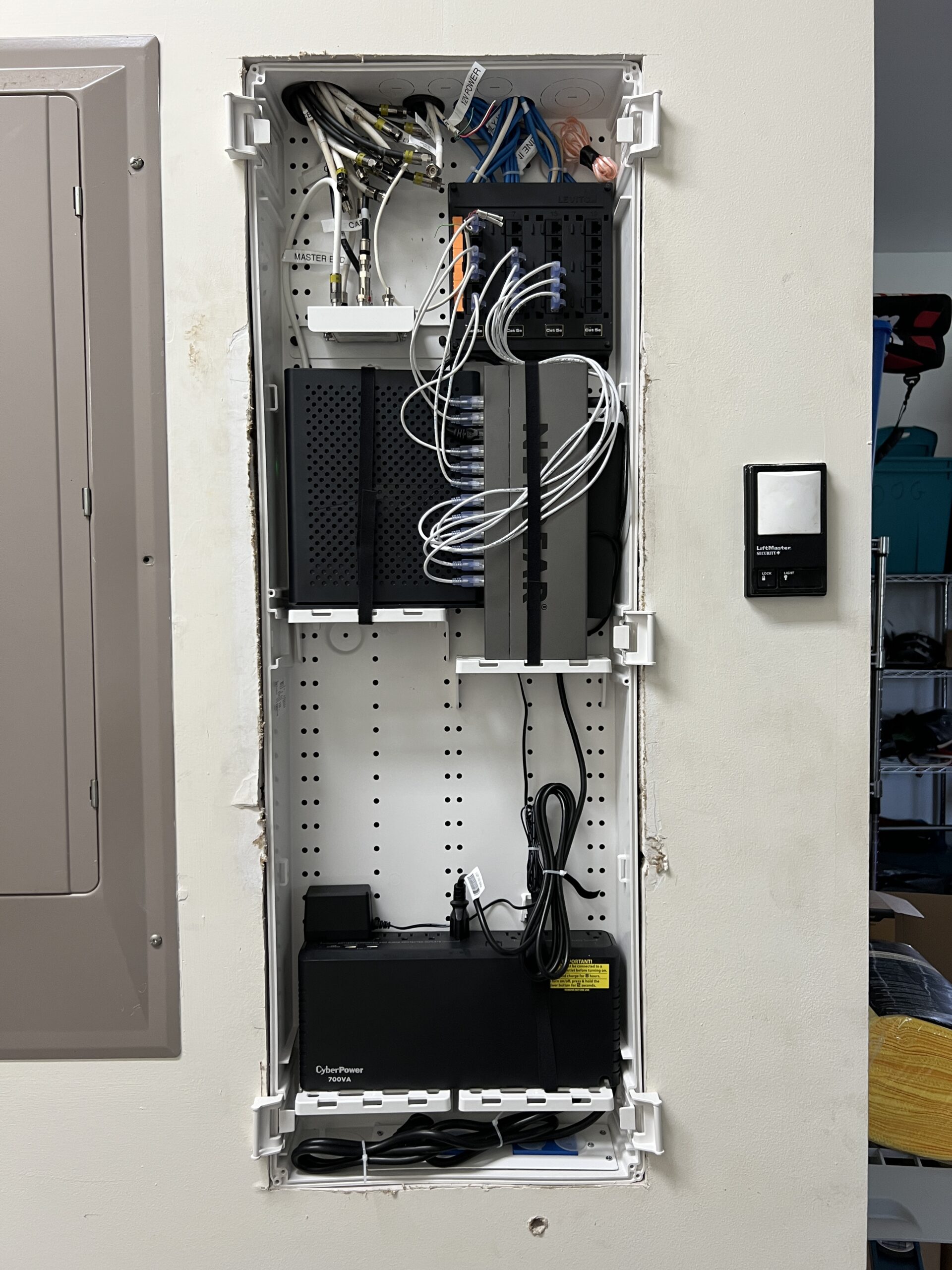
The CyberPower began to shut down randomly, despite the low load. Replacing the battery didn’t help. CyberPower did not want to offer a warranty replacement. Another summer arrived and we had a couple of power glitches. I found that Liebert, the storied manufacturer of machine room AC, introduced the Vertiv PUL-350LVT back in May 2026. This costs about $142 at Amazon and can handle 210W, which seemed potentially insufficient given that the Netgear GS116PP PoE switch by itself can supply 183W of output. Due to the lack of a lead-acid battery, the weight is just over 3 lbs. I used a Tapo P110M smart plug to see what the total draw from the cabinet was (cable modem, Omada router, Netgear PoE swtich) and it turned out to be just 72W steady-state (I rebooted most of the Omada access points at the same time and power consumption did not spike). The UPS will keep our home on the Internet for over 10 minutes, therefore, in the event of a serious FPL problem.
Tangent Alert! Maybe we should buy Vertiv stock? No matter who wins the AI and data center wars, Vertiv/Liebert will have to be paid! They’re like Levi’s for gold miners, right down to the 2SLGBTQQIA+ passion:


The company also seems to admit that it doesn’t pay employees fairly:

Why is there “work we need to do to improve”? If Vertiv/Liebert pays employees what they’re worth, what would be an improvement? (paying some employees more than they’re worth?) If Vertiv/Liebert does not pay employees what they’re worth, what stops them from adjusting pay right now?
But I digress…
Returning to the question of lithium-ion to sit behind the small boxes that are critical to home happiness…. so far it works! (I bought it at Amazon, set it up in a few minutes, and simulated a brief outage by unplugging it a day after the install.) The only unknown unknown unknown is what happens if there is a 20-minute outage, the batteries die completely, and then power is restored. Will this thing turn itself back on? When initially plugged into the mains, it did not come on without me pressing and holding the button.
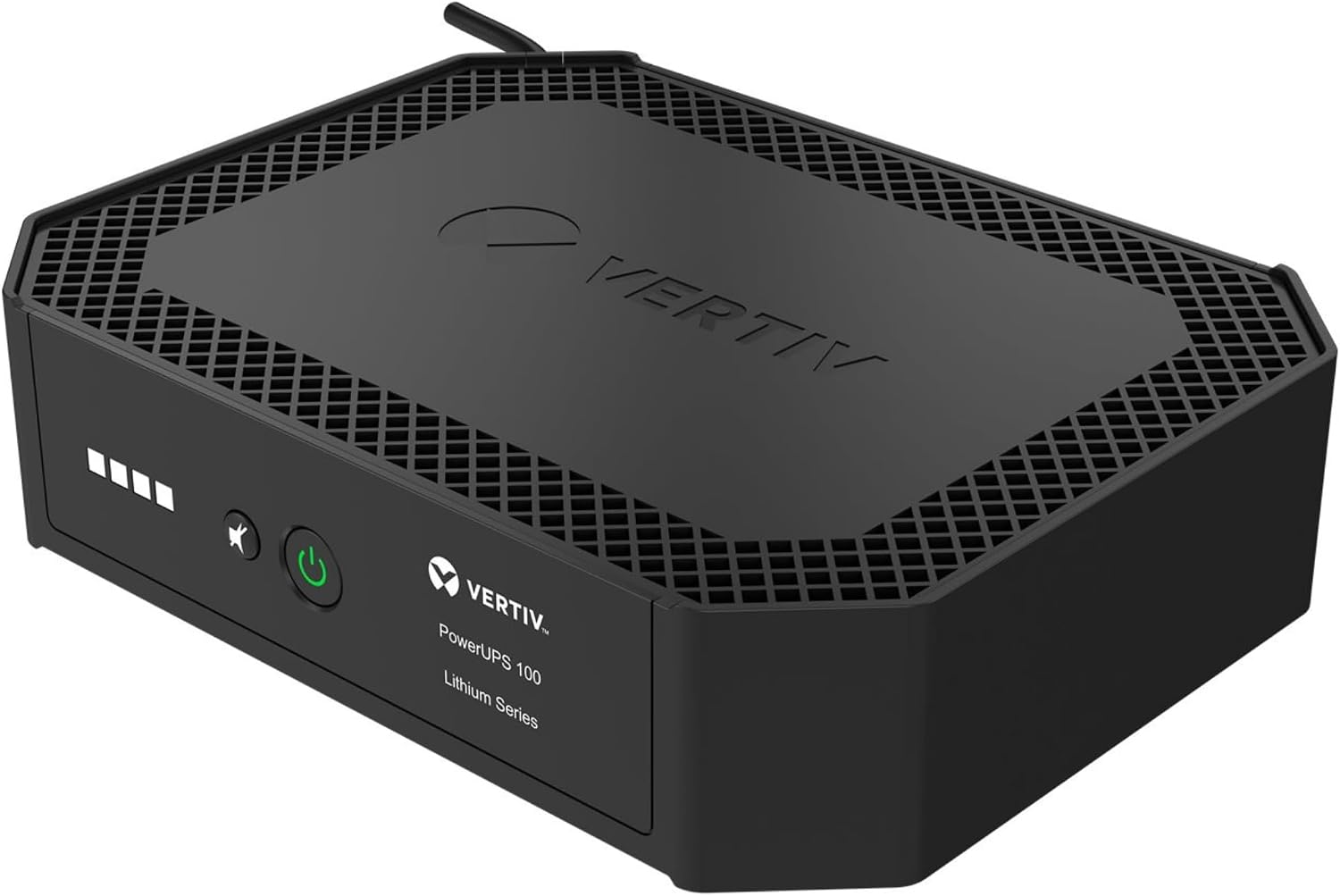
What would be nice to have? How about a small light lithium-ion UPS for a desktop PC with a standard 750-1000W power supply? Instead of the lead-acid monsters designed for max runtime, this would have enough battery for only a 1-minute outage and then a 2-minute orderly shutdown if the outage persisted. Let’s assume kind of a worst-case draw of 1000 watts for all three minutes, which is essentially impossible (GPU-intensive processes would be shut down shortly after the first minute). This could be accomplished with a 12.8 V 10 Ah LiFePO₄ battery, I think, that weighs only 2.7 lbs. and costs $60. It’s about 6x3x4″ in size, though, so my dream of having the UPS built into the PC power supply might not be achievable. (On the third hand, maybe the dream IS achievable. The power supply can have a small LiFePO₄ battery. If mains power dies, the power supply can pull power from the GPU after 5 seconds in order to give the motherboard/CPU/any hard drives another 55 seconds and, then, if the grid is still dark, sufficient time for an orderly shutdown. Maybe the unexpected disappearance of the GPU would cause an LLM or video game to crash, but that’s unlikely to leave any files corrupted.)
Ridiculous to still be throwing away 20% of the capacity converting 12V to 120V & then back to 12V. Surprised China can’t produce even an ATX module that takes backup 12V directly from a battery. Are we supposed to make something ourselves?
> an antique house like ours (2003) here in Florida
Chinese drywall vintage, nice to hear that it is still standing and not been scraped.
Have you thought about picking up a Cybertruck for cheap, parking it up on blocks on the lawn, and using it as a whole house battery?
https://futurism.com/advanced-transport/cybertruck-biggest-flop-automotive-history
> Powershare allows you to draw power directly from Cybertruck to power your home or the grid.
https://www.tesla.com/powershare/
FYI
Prompt: “What percentage of houses built in florida in 2003 contained Chinese drywall?”
ChatGPT: “Probably very few—well under 1% statewide, and likely close to zero for homes completed during most of 2003.”
Wikipedia said it affected homes 2001-2009, but their sterling NPR reference said 2004-2009. Most were during the housing boom after some hurricane in Florida. I was surprised when ChatGPT said today that many homes were remediated with new drywall and copper, not scraped to the ground and rebuilt. Wouldn’t the sulphur smell permeate everything? Seems like something that would have to be disclosed anyway.
https://en.wikipedia.org/wiki/Chinese_drywall
Our house was built in 2006 in an affected region, which we purchased used. I trusted their disclosure, but verified by taking off electric outlet covers, etc., and looking for copper corrosion. Also verified the drywall by looking at the manufacturer info on the back in the attic — born in the U.S.A! (Congrats Bruce Springsteen, on your recent ACLU award — not.) It really was a big mess of a problem for many people, though.
NH > Can you give a short analogy between Chinese drywall and A.I.?
ShatGPT > Bad Chinese drywall was “looks fine at first, but later it causes hidden damage.” AI can be similar: the model/product may seem fine when deployed, but if it’s trained/evaluated poorly, it can create downstream harms only after it’s integrated.
NH> Also both smell like rotten eggs.
ShatGPT> Yeah, that too. [farts]
Both my lead-acid UPS need new batteries, but why bother? After half an hour everything will abruptly shut down anyway because apparently Sony (PS5) and Apple (Mac Mini) can’t figure out how to detect that the UPS has come on and perform an orderly shutdown. Both seem to be happier just scolding me for not safely shutting down my machine. I don’t really care about the PS5, but surely Apple’s file system should be smart enough to avoid being in a non-recoverable state (California?) when the power goes out. And if it is, then why bother scolding me?
> non-recoverable state (California?)
heh, funny
> If mains power dies, the power supply can pull power from the GPU after 5 seconds in order to give the motherboard/CPU/any hard drives another 55 seconds and, then, if the grid is still dark, sufficient time for an orderly shutdown.
I have used apcupsd on Debian for APC UPS and it has a bunch of options, and scripts you can run. You can do software optimizations as well, in addition to the built-in ones:
https://wiki.debian.org/apcupsd
> Why is there “work we need to do to improve”? […]
I think the catch with those small LiFePO4 is that the BMS won’t let you pull enough current to run the UPS under load. The one you’ve linked to is only 10A continuous discharge, so maybe 100 W max if your UPS is very efficient? 80 W might be more reasonable.
Check this out https://www.pilaenergy.com/
I replaced a cyberpower lead acid ups with one of these anker lifepo4 units. It been working great and the phone ap is nice for monitoring. $600 of the shelf at bestbuy. May have enough output to be double duty to power your fridge on a prolonged outage emergency.
https://www.ankersolix.com/products/s2000-portable-power-station
Could you plug the cable box into a separate power supply of its own? Also I would connect cable modem to a laptop through a port converter and add the TV as a second monitor for the laptop. In addition to plugging the TV into a power supply of its own. It does not answer your question but it mostly worked for me, until I stopped to test one of power supply’s regularly. After I replaced it it keeps working. Consider adding a Generac gas-based electric generator for anything more serious. I would not do solar/large lithium ion batteries, they are a huge fire hazard in hot climate.