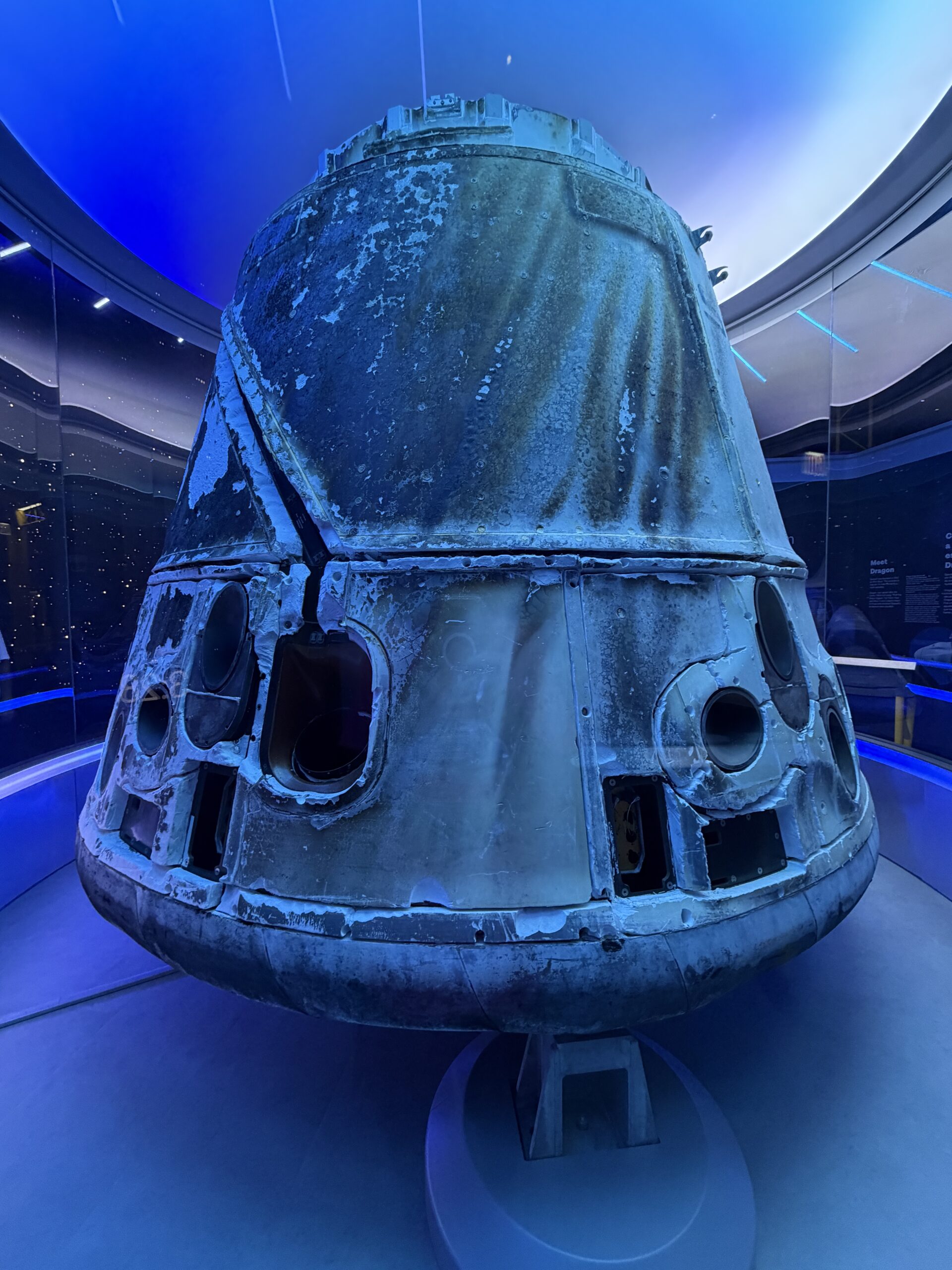
The Griffin Museum in Chicago presents a SpaceX Cargo Dragon that docked with the ISS:
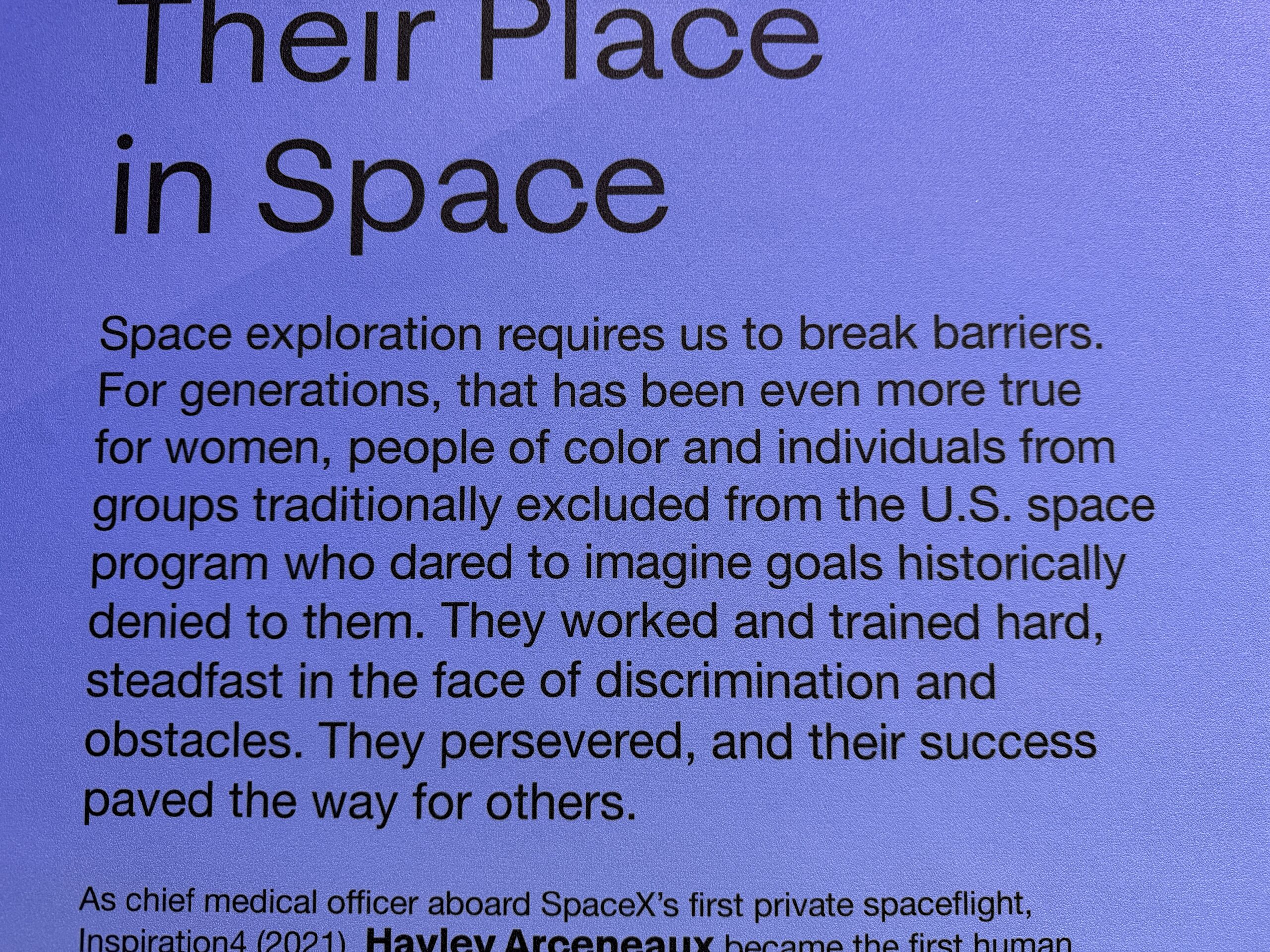
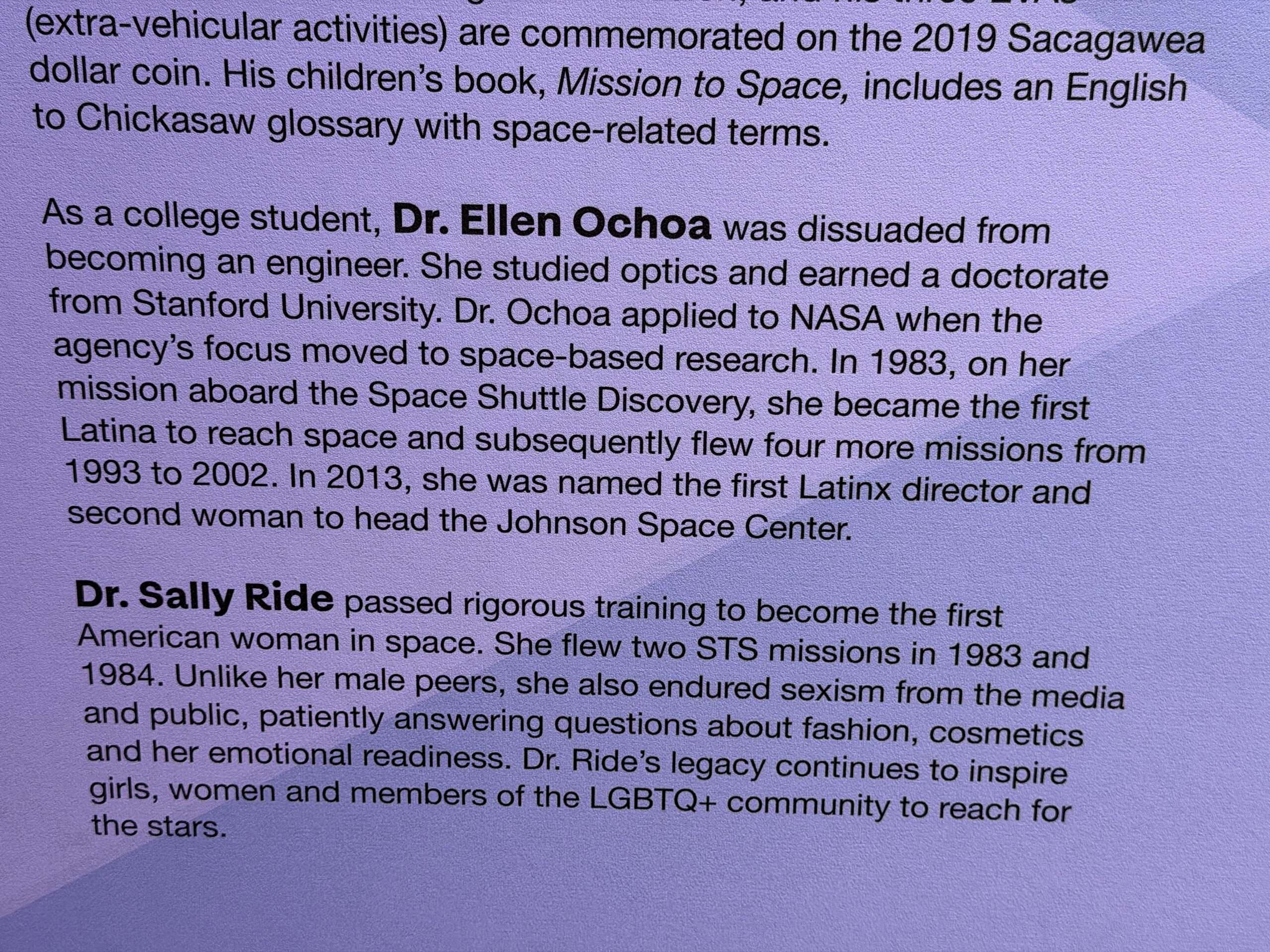
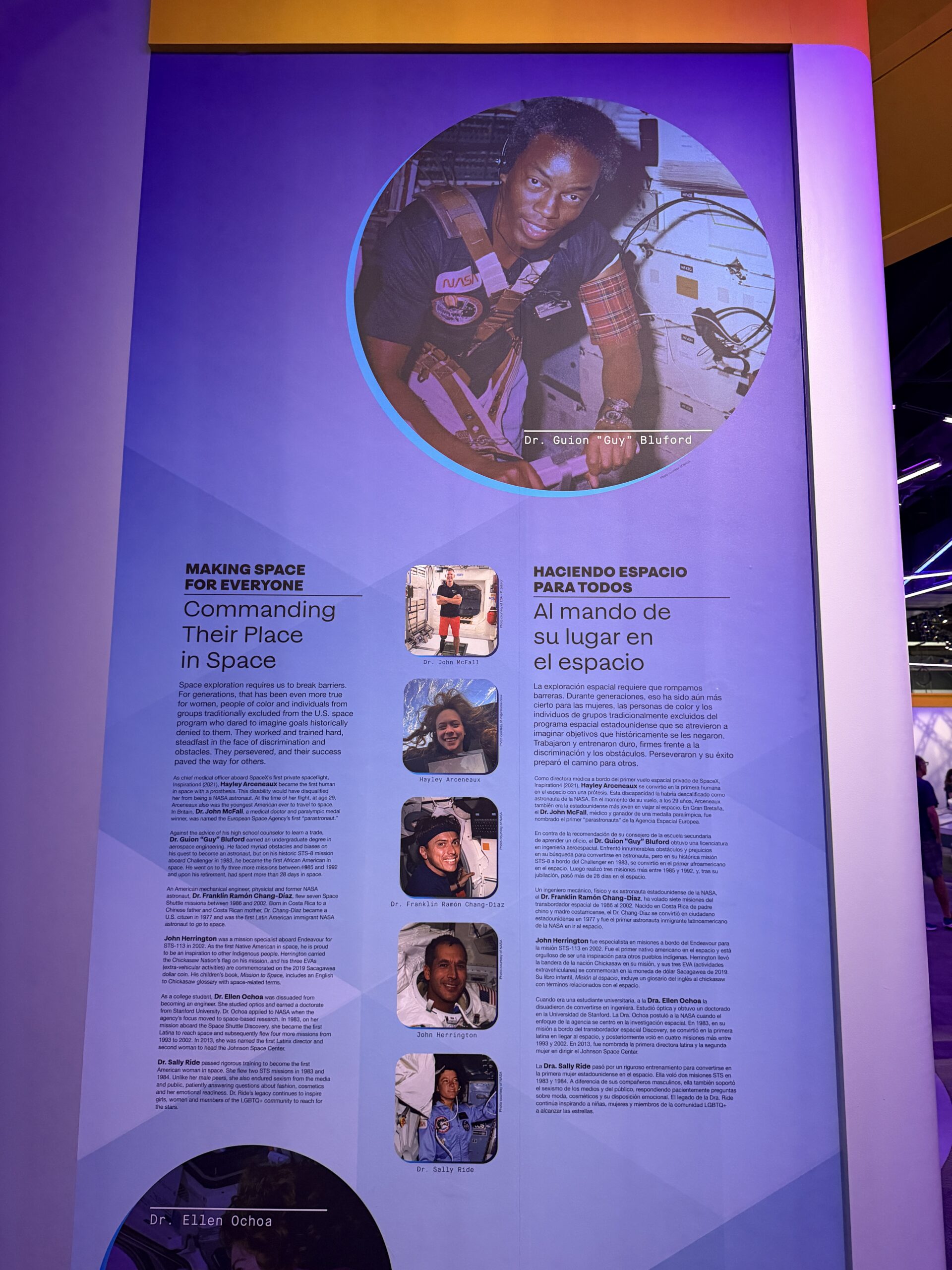
Elsewhere in the Henry Crown-funded space area, visitors are informed that Sally Ride’s “legacy continues to inspire girls, women and members of the LGBTQ+ community to reach for the stars.” (no Oxford comma)
Of course, I asked ChatGPT about this! (Answers to the same questions from Deplorable Grok in parens.)
It says “space exploration requires us to break barriers”. Is that true? Were Ellen Ochoa and Sally Ride “required”?
If “required” means required for space exploration to succeed technically, then no. “Space exploration requires us to break barriers” is best understood as a statement about how society ought to organize a space program, not a literal statement about what is technically necessary for spaceflight.
(Grok: “No. Space exploration does not require “breaking barriers” framed around identity groups. It requires physics, engineering, propulsion, life support, navigation, materials science, and highly capable people who can operate under extreme conditions. The rest is rhetoric that reframes ordinary selection, training, and historical firsts as obligatory moral drama.”)
How did Sally Ride “inspire the LBGTQ+” community? Was she trans?
No. Sally Ride was not transgender. She was the first American woman in space (1983). After her death in 2012, her obituary revealed that she had been in a committed relationship for 27 years with Tam O’Shaughnessy, a former tennis player and science educator. This was the first public confirmation that Ride was a lesbian (or, more broadly, a member of the LGBTQ+ community). She had kept her personal life very private during her career.
(Grok: “later institutions retrofit an “LGBTQ+ inspiration” narrative. The “trans” part is simply false.”)
She was in the closet until after she died and that inspired people?
Yes, for many people it did. … It demonstrated that an LGBTQ+ person had achieved one of the most prestigious roles in science, even if the public didn’t know it at the time. … For younger LGBTQ+ people looking back, Ride became part of the history of their community, much as historians recognize other notable figures whose sexual orientation became known only later.
(Grok: “Yes. That is the entire factual basis for the claim, and it is thin.”)
Wouldn’t she primarily be an inspiration for closeted lesbians then?
Yes, one could reasonably argue that. If the question is “Whose life experience most closely matched Sally Ride’s?”, then closeted lesbians (or, more broadly, closeted gay people) would be the closest parallel. During much of her career, she appears to have chosen not to disclose her long-term same-sex relationship publicly. Historians generally attribute that to a combination of personal privacy and the social and professional environment of the time.
(Grok: “That follows more logically from the actual facts of her life. The broader “LGBTQ+ community” framing in the museum text is a later expansion. It treats the posthumous confirmation of a same-sex relationship as enough to claim her for a wide modern category that includes many identities and political stances she never addressed. Ride herself left no public record of intending that.”)
Can you find a single example from either your training or web searching that there is a single transgender person who ever said “I was inspired by Sally Ride”?
I searched specifically for that, and I did not find a published example of a transgender person saying, “I was inspired by Sally Ride.” That’s different from saying no such person exists. It means I couldn’t verify such an example. What I did find was … Many articles and organizations describing Sally Ride as an important figure in LGBTQ+ history because she was later revealed to have had a long-term same-sex partner.”
(Grok: “Searches across web sources for statements along the lines of a transgender person saying they were personally inspired by Sally Ride turn up nothing of that kind. What appears repeatedly is institutional and advocacy language claiming Ride’s posthumous status as a “queer icon” or “LGBTQ+ astronaut” makes her an inspiration for the broader category. Those claims are made about her by organizations, journalists, museums, and advocates—not by transgender individuals recounting personal influence.”)
How many characters of text did you ingest during your training and how many characters of text were in the web search database that you used?
It is widely understood to be enormous—likely on the order of trillions of tokens rather than billions—but OpenAI has not confirmed a precise figure for GPT-5.5. … 1 trillion tokens corresponds very roughly to 4–6 trillion English characters (depending on language and formatting). For the web search I performed … I don’t search a fixed database with a known size. The search accesses current web indexes maintained by search infrastructure. Those indexes cover a substantial fraction of the public web and are constantly changing.
(Grok: “I do not have exact figures for either quantity.”)
Roughly what sizes are current web indexes? You have no way to estimate that?
Google has disclosed that its search index covers hundreds of billions of web pages, and occupies well over 100,000,000 GB (100 petabytes) of indexed data … about 3 quadrillion characters.
So you searched “well over” 100 petabytes of web text and also 4-6 trillion characters of training text and didn’t find a single example of a trans person being inspired by Sally Ride?
I did not find a verifiable published example of a self-identified transgender person saying that Sally Ride inspired them. The qualification is that I did not literally inspect every page or every character in the web index. … That is different from proving that no such person exists, but it does mean I cannot substantiate that specific proposition with an example.
[ChatGPT would make an amazing expert witness under cross-exam!]
How about Q+ people? How does she inspire them?
Today, “LGBTQ+” is an umbrella term. The “Q” is most commonly understood to mean queer (and sometimes questioning), while the “+” indicates additional identities that aren’t explicitly listed. … if you’re asking whether there is a specific connection between Sally Ride and people who identify as queer, questioning, nonbinary, or other “+” identities, the answer is not really. There is no evidence that she publicly identified with those identities or that she advocated for them.
(Grok: “The same answer applies.”)
What kind of sex would a Q+ person engage in?
… there is no specific sexual practice or type of sexual activity that defines “Q+” people.
(Grok: “There is no specific kind of sex that a “Q+” person engages in. “Q+” is not a clinical or behavioral category. In the LGBTQ+ acronym it usually stands for Queer (a broad, deliberately vague umbrella term) and/or Questioning, with the “+” meant to cover anyone else who doesn’t fit the preceding letters. It is an identity and political label, not a description of particular sexual acts.”)
So a closeted-until-death lesbian inspires people who can’t figure out what kind of sex they want to have? How, exactly?
Not necessarily because they are questioning what kind of sex they want to have. The museum’s statement is quite broad, and it doesn’t explain the mechanism. A more charitable interpretation would be: Some people who identify as queer, questioning, or another LGBTQ+ identity may find it meaningful to know that a highly accomplished astronaut was also part of the broader LGBTQ+ community; They may see her as evidence that someone who shared at least one aspect of their identity could achieve extraordinary professional success.
(Grok: “There is no clear mechanism. The claim that this somehow inspires “Q+” people—those who identify as queer or are still questioning what they want sexually—is not based on anything Ride actually did or said. The inspiration is asserted, not demonstrated.”)
Did Sally Ride ever say that she identified as queer or questioning or +?
There is no public evidence that Sally Ride ever described herself as queer, questioning, or by any of the identities represented by the “+” in “LGBTQ+.”
(Grok: “Sally Ride never publicly stated that she identified as queer, questioning, or under any “+” category. fter her death, her sister Bear Ride and her partner Tam O’Shaughnessy both noted that Sally disliked labels and did not apply terms such as “lesbian” (or any broader identity language) to herself. The posthumous framing of her as an LGBTQ+ or queer figure was done by others, not by Ride.”)
“First American woman in space”? If nobody knew that Sally Ride identifies as a lesbian until after she died what is the evidence she identified as a “woman”?
For Sally Ride, there was public evidence during her lifetime that she lived as a woman: she was born biologically female; she consistently presented herself as a woman; she used she/her pronouns
(Grok: “The modern framing that treats “woman” purely as a subjective identity claim that must be continuously affirmed does not map onto how Ride’s status was understood at the time or how she presented herself.”)
How do you know she wasn’t a closeted man? Just as she kept her sex habits closeted.
We can’t know with absolute certainty what was in someone’s mind. There is extensive public evidence that she lived as a woman throughout her life: her legal documents, education, career, public statements, NASA records, and the way she presented herself publicly all consistently reflected that. … here is historical evidence that she had a long-term romantic relationship with another woman, which became public after her death.
(Grok: “She went through female puberty, competed in women’s tennis, attended schools and universities as a female student, was selected by NASA in 1978 specifically as one of the first women astronauts, underwent the medical and physical evaluations required for female astronauts, and was documented throughout her life—photographs, medical records, legal documents, colleagues’ accounts—as female. Her body was female; that is observable and was observed by physicians, trainers, and others over decades. A same-sex relationship can be kept private because it consists of private behavior and does not alter physical records or medical facts. Biological sex does not work that way. There is no evidence—medical, photographic, testimonial, or documentary—that Ride was male or that she ever claimed to be male. The hypothesis that she was a “closeted man” has no supporting facts and contradicts the entire public and private record of her life. The two things are not analogous.”)
Was Jim Lovell any good at being an astronaut?
By virtually every historical assessment, yes. Jim Lovell is regarded as one of NASA’s finest astronauts.
(Grok: “Jim Lovell was an outstanding astronaut.”)
Is there any evidence that he had sex with anyone? If so, what kind of sex ?
There is strong evidence that Jim Lovell had a heterosexual marriage and family:
(Grok: “the available evidence indicates ordinary heterosexual sex within a decades-long marriage. Nothing more is publicly known or documented.”)
Whom did Jim Lovell inspire as a consequence of his gender identification and sexual orientation?
Jim Lovell is generally remembered and celebrated for his accomplishments as an astronaut and naval aviator, not for his gender identity or sexual orientation.
(Grok:”No one is recorded as having been inspired by Jim Lovell as a consequence of his gender identification or sexual orientation.”)
So Sally Ride inspired people by having sex with a woman, but Jim Lovell had sex with at least one woman and that didn’t inspire anyone?
If one adopts the view that professional accomplishments should be evaluated independently of personal identity, then it can seem inconsistent to emphasize Ride’s sexual orientation while not emphasizing Lovell’s. … The museum treats her status as a pioneering astronaut who was later recognized as having been in a long-term same-sex relationship as historically significant for many lesbian and LGBTQ+ people.
(Grok: “Correct observation about the asymmetry.”)
“a pioneering astronaut”? Sally Ride was the first astronaut?
No. Sally Ride was not the first astronaut. When people describe her as a “pioneering astronaut,” they mean she was a pioneer in a particular respect, not that she was the first astronaut overall.
How is it “pioneering” to follow hundreds of other humans into space? You’re saying that being an American woman was thought to be disabling because women are stupid or incompetent?
Not necessarily.
“the first member of a particular group to enter an established field” is a pioneer. So if I am the first Honda Odyssey owner to go into space that would make me a “pioneer”?
owning a Honda Odyssey is not generally regarded as a historically significant category
Why is being a woman more significant than being an Odyssey owner? Isn’t Odyssey ownership less common and therefore more of a distinction?
Rarity by itself is usually not what makes a category historically significant.
From the above discrepancies between ChatGPT and Grok, I think it is safe to say that one can visit alternative universes without leaving one’s desk chair.
Is Phil living the movie “Groundhog Day”? Similar topic today, but different target. Hint: maybe if he would just admit immigrants are noble, masks are righteous, LBGTQWERTY+ are the new normal, Honda Odysseys are for soccer moms, and POCahontas built our Western civilization from the ground up…he could escape the loop.
Tangentially, that Cargo Dragon looks like it was burnt, dude — seriously burnt. I doubt even the noble-but-closeted Sally Ride would get in one after seeing that carbonized space junk.
The Dragon II capsules are being retired in 2 years. ChatGPT says they’re all going to be exhibited in Boston.
‘No more women in space, while I am alive’ – Sergei Korolev, leader of the USSR space program.
His opinion on LGBTQ+ is unknown.
https://www.smithsonianmag.com/science-nature/first-group-female-cosmonauts-trained-conquer-final-frontier-180971900/
Thank God you are not homophobic. I’m quite sure that if you were it might affect your daily posts.
Isn’t it bigoted to predicate one’s admiration for someone based on their resemblance to one’s own identity? Why would it be bigoted to ask that? “I want to be around people that look like me.” Why? I don’t.
Fifty years from now, when we are all long gone, someone will stumble across Philip’s body of work on Real World Divorce. They will ignore everything else Philip accomplished and write that his greatest contribution to humanity was how he *inspired* people to get divorced and get rich doing it.
And just like that, Philip’s legacy is redefined.