We’re informed that immigrants come to the United States to work, not to enjoy our cradle-to-grave welfare state for four generations.
We’re informed by the U.S. Census Bureau that the number of foreign-born residents of the U.S. (a.k.a. “immigrants”) is down by almost 3 million. “Census Bureau Survey Shows Total Foreign-Born Down 2.9 Million” (CIS, yesterday):
since January 2025 … the government’s monthly household survey, officially called the Current Population Survey (CPS), shows an unprecedented 2.9 million decline in the foreign-born population — naturalized citizens, lawful permanent residents, long-term temporary visitors, and illegal immigrants.
Latin American non-citizens who arrived in 1980 or later account for all of the decrease. This population overlaps significantly with illegal immigrants.
Only 44 percent of the decline in the foreign-born are workers; the rest are children, the elderly, and other non-workers. This fact, along with employment gains by the U.S.-born, mitigates the impact on the labor market and may help explain why the survey of businesses does not show a dramatic decline in workers.
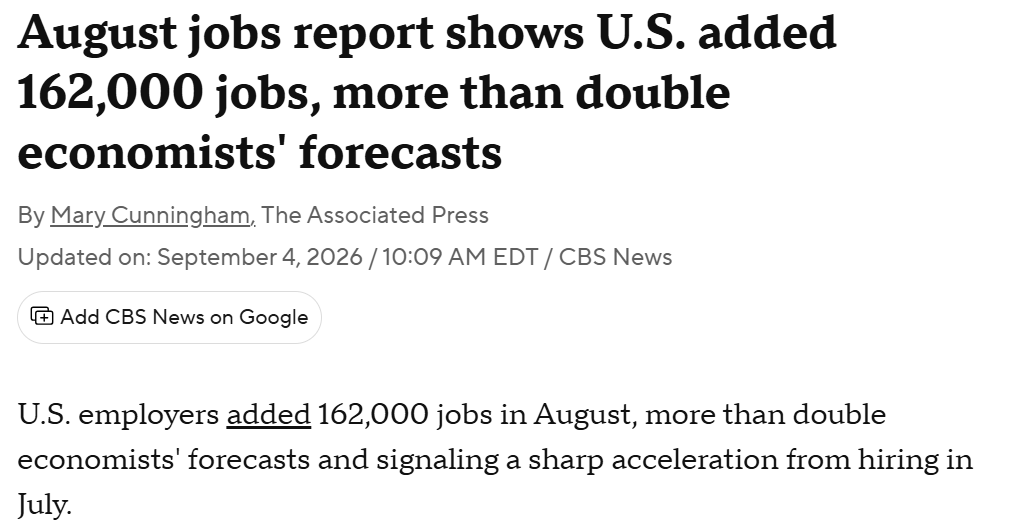
The total number of people working in the United States is up (CBS, today):
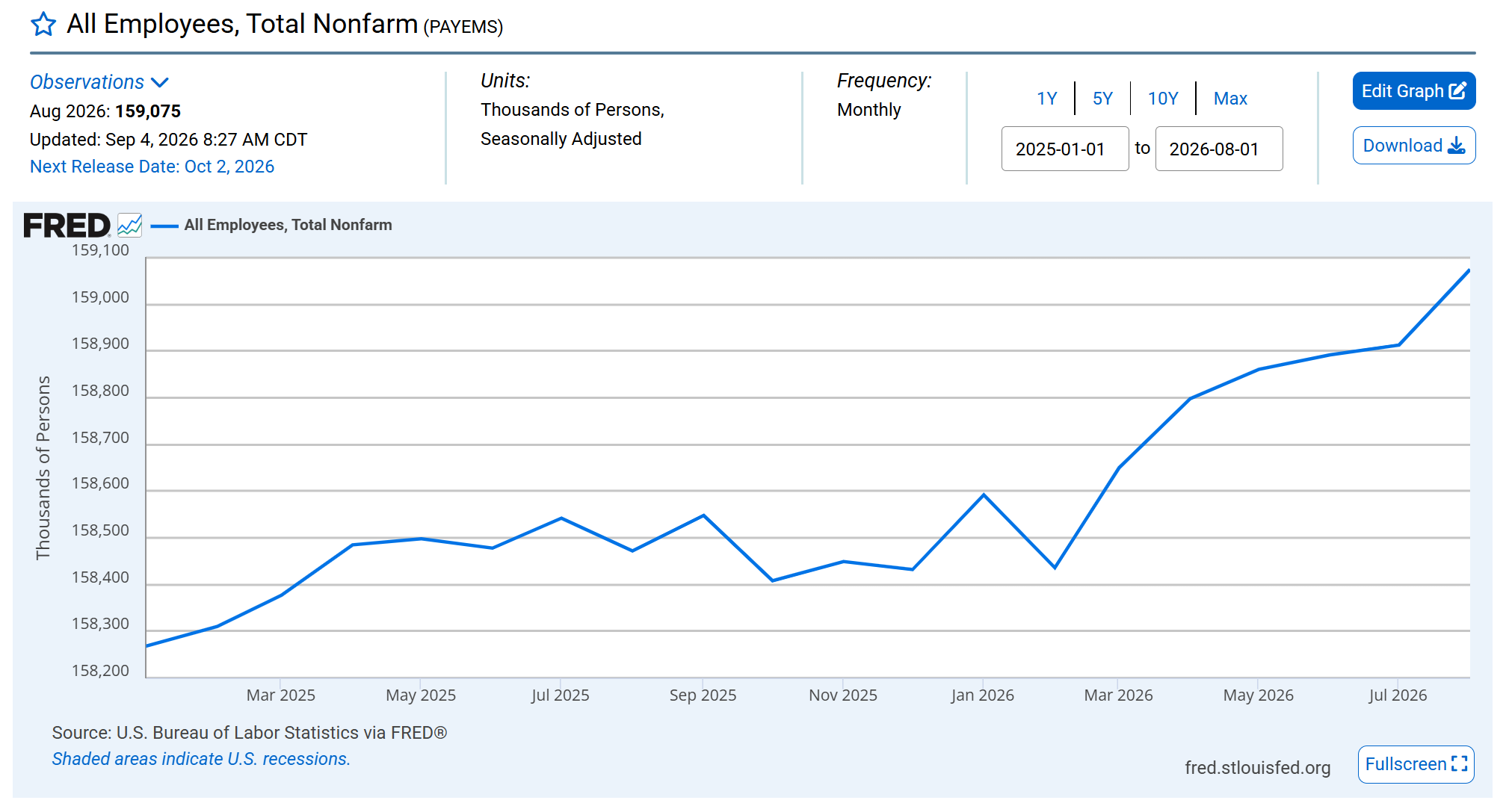
Here’s a wider picture of steady-then-increased numbers of workers as immigrants departed:
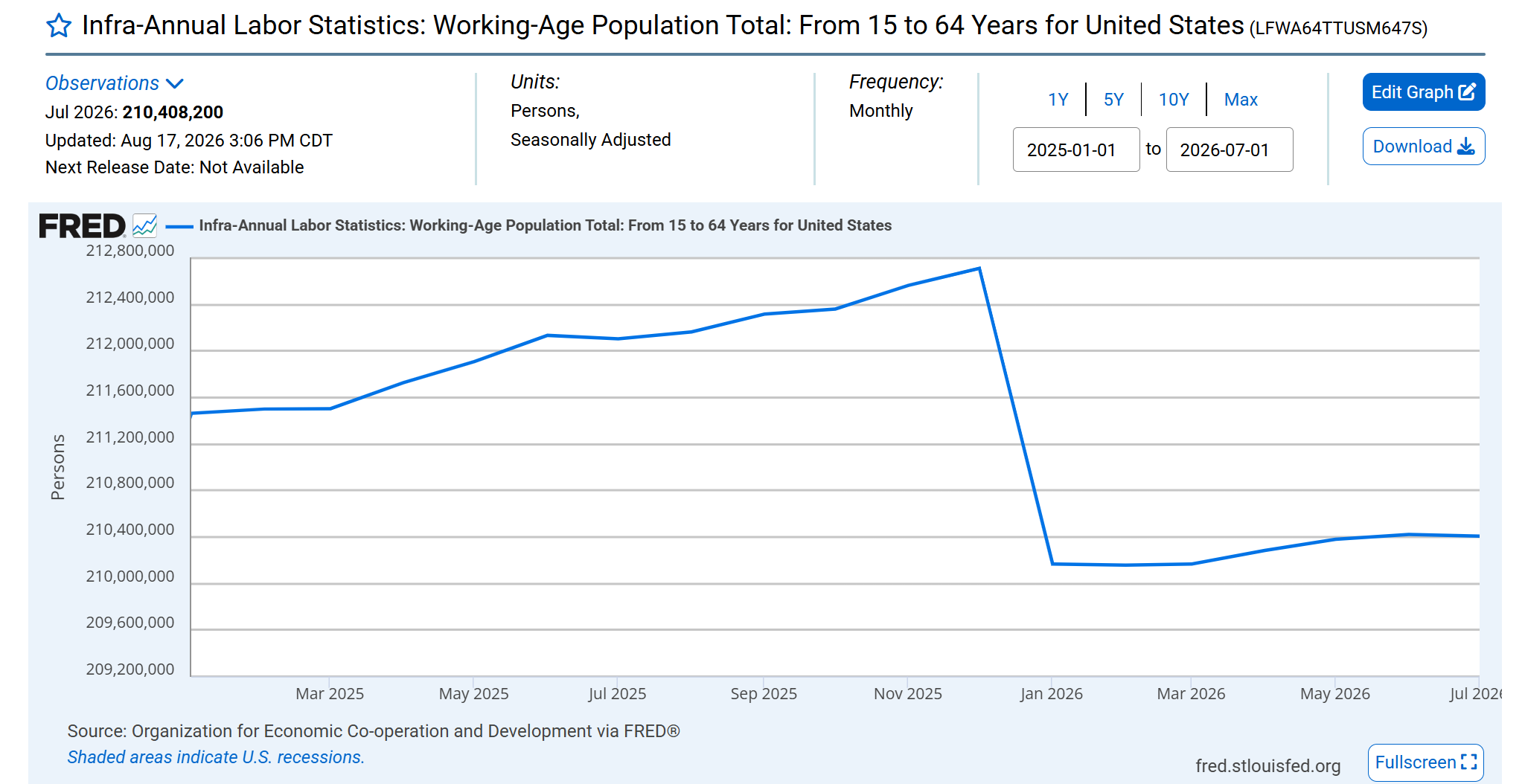
The increase doesn’t seem to have been caused by an increase in the working-age population, which is down slightly over the same time period:
How can this apparent paradox be explained?
One possible explanation is that immigrants displace the native-born in the labor force. When an immigrant with a job leaves, his or her job is sometimes taken over by a native-born American who had been sitting on the couch playing Xbox. If that were true, though, we’d see an increase in the labor force participation rate and/or a decrease in unemployment rate over the same time period, but that hasn’t happened.
Another explanation is that immigrants were working off the books and, therefore, their jobs weren’t counted in most government surveys. If this were true, we’d see a divergence in CPS data, which asks people “did you work for pay?” vs. Current Employment Statistics (CES) data, which asks employers “did you pay someone to work in at least a quasi-legal fashion?” I ran out of brain power and asked ChatGPT to resolve this possibility:
And in the particular January 2025–August 2026 comparison we just calculated, the divergence isn’t enormous once you compare the CPS consistently: CPS total employment is roughly +0.3 million, while CES payroll employment is roughly +0.8 million. So the data could accommodate some loss of informal immigrant employment, but they don’t by themselves demonstrate it.
What’s left as an explanation, given that we can’t abandon the axiom that foreign-born residents of the U.S. are the hardest workers and, certainly, are never on what used to be called “welfare”? We’re living in the Age of Miracles?
60% of deportees had criminal records. Being on welfare would be an improvement.
The people whom ICE has arrested and deported since January 2025 account for only about 400,000 of the reduction in the foreign-born population. We don’t have good stats, I don’t think, on the criminal history (beyond entering the U.S. “illegally” or overstaying a visa (not “criminal”)), of the majority of the foreign-born folks who’ve stopped enriching us.
A recent NYT article assures us that the folks ICE has been arresting are model citizens. Only 4% have violent criminal convictions, we’re told (if the migrants are in families of 4, in other words, only about 1 in every 6 migrant households contains a violent convicted criminal; a neighborhood that any of us should be delighted to live in). https://www.nytimes.com/interactive/2026/08/27/us/ice-immigrant-arrests-trump-deportation-dhs.html
The NYT is behind a paywall, but CBS claims that “nearly 60% of ICE arrestees over the past year had criminal charges or convictions”. Presumably, the NYT’s definition of “violent criminal convictions” does not include “Assault” = 10.9% .
https://www.cbsnews.com/news/ice-arrests-violent-criminal-records-trump-first-year/
An impressive 33% of adults in the USA have a criminal record. ICE should just deport everybody and start the country from scratch again.
Ibc: I wouldn’t have believed 33%, but https://www.ncsl.org/civil-and-criminal-justice/criminal-records-and-reentry-toolkit says that you’re right! (note that “record” could be an arrest, not necessarily a conviction)
ChatGPT cites some other sources and says that 25% is a better number and 15% for non-Hispanic white Americans.
Those were all manual labor while knowledge jobs continued to go away. The software RIFs are all retiring because they had such a good run in the last 10 years. Sounds like Trump is going to successfully jawbone the fed from a hike to a hold.
The large disconnect you note is almost certainly due to two things.
1) The monthly employment #s have very large error bars (+/- 122k) and are often revised significantly (e.g. in the #s reported today, the two-month net revision was +55k and the prior two-month revision was -103k).
2) The population statistics are also often revised significantly, but with a much longer lag (they make no attempt to estimate the revisions on monthly basis, so the errors can become very large before they are revised or “corrected.”
Phil, can you help me out?
Is an “immigrant” someone who invaded our country illegally (and then worked here illegally, perhaps raped and murdered U.S. Citizens, and also perhaps committed other crimes)?
I don’t have advanced degrees like you.
Honesty: I think under our current laws, passed by our wisest legislators, the answer is “yes”. As long as that person says “I want asylum because I felt unsafe in my home country” then he/she/ze/they is on track for permanent residence (at least 10 years of elaborate legal process and, if ordered deported at the end of that, leaving is also voluntary as a practical matter).
Phil, I am so glad to hear your affirmation that I am an immigrant, along with my four wives (ages 8, 9, and two at 11), all of whom I purchased in Kabul last year. Great to see that you are a member of the “big tent” Party and hence Endlessly Inclusive of folks like us who are Invaders, Child Rapists, Fraudsters, Jew Haters, Beheaders of Buttfuckers, and also Hate America and Western Civilization.
Phil, I love your Chronicling of Communism and all of the Wonderfulness it has delivered to the world (e.g. a couple hundred million people “re-educated” during the 20th century etc.).
I saw this today, and I’m worried. With the large decline in Government Socialist Party Workers in recent months, who will tell the uneducated masses what to do and when?
https://x.com/Mark_J_Perry/status/2096623339838099905
Also, Uncle Joey, who will develop deadly coronaviruses using tax dollars collected from said uneducated masses and release them into the population. And, then “cure” everyone with mass lock-downs and deadly and unnecessary vaccines? Does this mean there can no longer be Heroic Dr. Mengele’s like me going forward?