What will change for you personally as a result of yesterday’s election? (unless you’re a California, I guess, in which case the full results might not be known for a few weeks)
(The second part of this post covers the question of why it took so long for “socialism” to become popular. My best guess is that the welfare state expansion during coronapanic tipped us from “almost half the voters are dependent on government” to “more than half the voters are dependent on government or at least don’t pay for government.”)
One big change in Florida is the loss of Ron DeSantis, albeit to term limits rather than to the election per se. He was a once-in-a-generation administrative talent and I’m sure that substituting almost anyone else would inevitably result in paying more in taxes and/or getting less in services (Florida state taxes are primarily consumption taxes, e.g., the 6% sales tax, though there is a 5.5 percent income tax on C corporations that do business within the state). DeSantis was instrumental in hardening the power grid here in Florida and also in organizing and motivating amazingly swift post-hurricane restoration, e.g., of bridges, local power lines, etc. DeSantis is being replaced by Byron Donalds. I wasn’t too excited about this race because his opponent, Democrat David Jolly, wasn’t an AOC/Mamdani/El-Sayed-style Democrat. I guess Byron Donalds is preferable because he happens to be Black and it will be entertaining to see white Democrats attacking a Black man as stupid, racist, Science-denying, etc. (They already do that with Florida Surgeon General Joseph Ladapo, a Harvard M.D./Ph.D.)
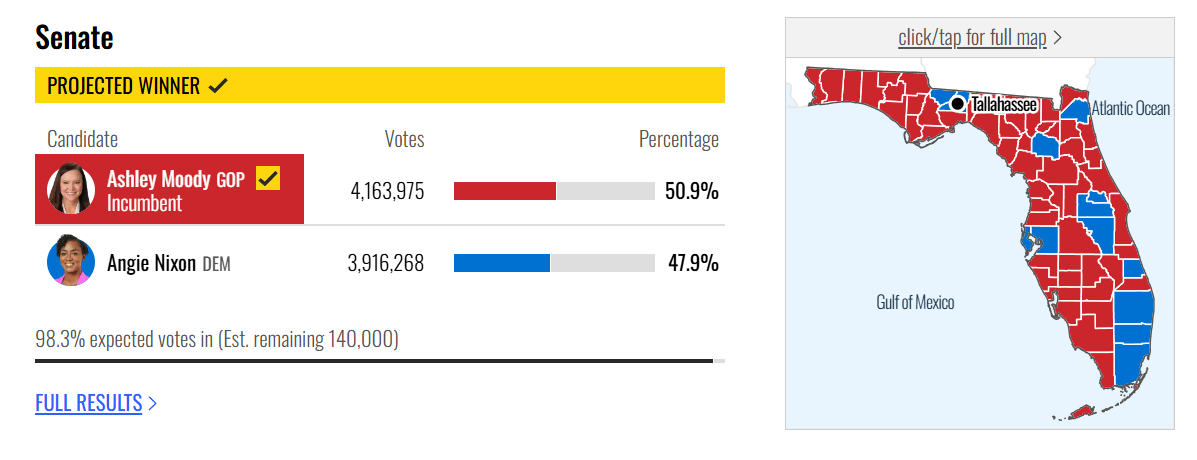
I have to say that the election results in Florida demonstrate the power of promising voters free stuff. Democratic Socialist Angie Nixon came within 1% of winning the Senate race against the perfectly pleasant Ashley Moody. Nixon is a high-income person ($270,000/year) who hasn’t paid her federal taxes or federally-guaranteed student loans and, moreover, says that she shouldn’t have to because someone with a yet-higher income should pay for her education and her government-provided services (“I don’t wanna pay it back. Education supposed to be free.”; source). Voters overwhelming approved an amendment to the state constitution to increase the homestead exemption for general property taxes, i.e., shifting the burden of local/county government to renters, seasonal residents, commercial property owners, and, generally, “other people.” The amendment puts no per-capita spending growth limits on counties and those who are entirely exempt from paying tax can vote for increased services to be paid for by “other people”. (This could conceivably save us some money because we are homeowners and year-round residents entitled to the homestead exemption, but I still voted against it and think it is a terrible idea.)
You can see from the map below that our 50/50 county (lower right, 3rd up) voted for Angie Nixon, the above-referenced “socialist” (a label that is unfair to the Soviets because under Soviet socialism every able-bodied adult was required to work):
Ron DeSantis really should get credit for all of these narrow Republican victories in Florida. DeSantis reshaped the Florida electorate by rejecting lockdowns, mask orders, and forced vaccinations. The people who moved to Florida since 2020 have been overwhelmingly Republican, so much so that this has even overpowered the nationwide reshaping of the electorate via low-skill immigration.
One strange election outcome is that people voted to shift the burden of state government away from wealthy farm owners and onto themselves. Amendment 2, which “Exempts tangible personal property used in agricultural production” passed overwhelmingly:
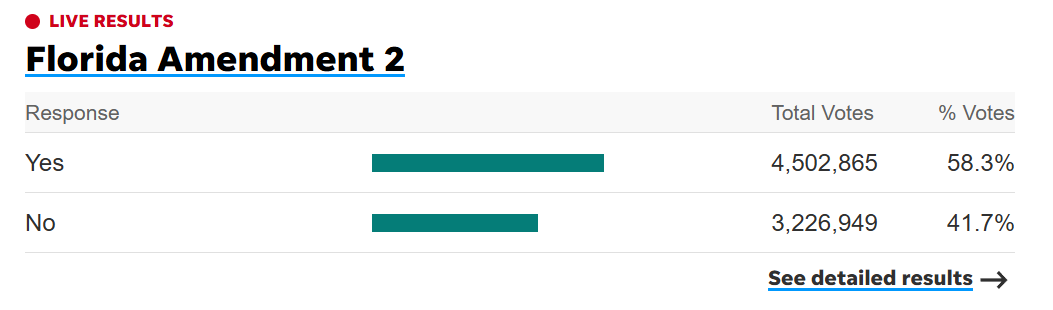
Only about 1.5 percent of Floridians work in agriculture. Maybe 0.15 percent of Floridians, therefore, actually own a farm or other agricultural business. I am deeply confused by this vote. Maybe the voters think that the tax fairy will pay when the farmers stop paying an admittedly modest annual sum? How hard is it to figure out that, aside for some tourists, the state government doesn’t have a source of money other than us?
Now that government is perceived as free (“someone else will pay”), I guess it makes sense that voters approved three Palm Beach County ballot questions that will be paid for by the property tax that they are no longer paying. One is to continue “an existing 1-mill property tax for four more years to support school safety, mental-health services, teachers and other programs” (if it is for the schools, actually, it might not be covered by the new Amendment 3 exemption). Voters also approved $280 million in bonds for parks and $175 million in bonds for new and renovated libraries. These will be paid back by property taxes that homesteaders think they won’t have to be part of.
One silver lining of Abdulrahman Mohamed El-Sayed becoming a senator is that finally my proposals to reintroduce nationwide alcohol prohibition will have a chance. (See Reintroduce Prohibition for the U.S.? (2016) and Use testing and tracing infrastructure to enforce alcohol Prohibition? (2020), for example.) Keep in mind that the Cornell Genocide wouldn’t have occurred if the U.S. had adopted Sharia law. Jane Doe/Lucy Craig wouldn’t have been guzzling alcohol as she says in her cash-seeking complaint to have done (the defendants dispute that she was intoxicated, incidentally), she wouldn’t have gone out in public without a burqa, and she wouldn’t have been at a party with men, at least not without the supervision of a male relative.
My big takeaway from the national election is confusion regarding why the cheat codes of “socialism” and Jew-hatred didn’t work for U.S. politicians until recently. Why couldn’t progressives win elections in 1960 with the same pitches that they’re using to win right now? Did the electorate change through immigration? Did Americans evolve to become more progressive as a result of increased overall prosperity? Did progressivism become an easier sell due to increased envy levels due to more people hitting spectacular levels of personal wealth? The Jew-hatred angle is also a little baffling. George Orwell noted that humans love to experience socially acceptable hate. I can certainly understand why white male Americans might hate liberal Jews (see White men correctly perceive American Jews as their enemies?), but legacy American white men aren’t the core of today’s Jew-hating groups. ChatGPT put together a list of 68 attacks by Arabs calling themselves “Palestinian” on Americans and they’re spread out over decades. In other words, there doesn’t seem to be anything special about our time and place that would make joining forces with “Palestinian” fighters more appealing today vs. 20 or 40 years ago. My best theory right now: Mitt Romney famously pointed out in 2012 that 47 percent of Americans weren’t net federal taxpayers. The welfare state was substantially expanded during coronapanic and, therefore, the majority of Americans are either dependent on the federal government or receive government services at no cost. Why would people vote against a bigger more caring government if they don’t have to pay for any of it? Can this explain the Jew-hatred as well? Maybe. Government isn’t very good at delivering on its promises. If the promised high standard of living doesn’t materialize for median voters, it becomes necessary to find a scapegoat. It would be “racism” to blame low-skill low-/no-income immigrants living in public housing or any low-income high-crime ethnic native-born ethnic group for running up the government’s welfare and police/prison tabs. But one can’t be attacked as “prejudiced” if one blames Israel (i.e., International Jewry), e.g., in the ad for Abdulrahman Mohamed El-Sayed where two native English speakers blame their inability to afford eggs and bananas on U.S. aid to Israel (about 0.05% of the U.S. federal budget, says Gemini).
I’m not surprised by the election outcome because I’ve learned that my political views aren’t widely shared (starting with the idea that Americans should have to work for 8 years before voting, returning us to the system that prevailed circa 1800 (men started work at 13 and cast their first vote at 21; there was no welfare state and, therefore, nearly every able-bodied man worked; I wouldn’t impose a gender ID restriction for a modernized version, incidentally, since there are plenty of 21st century women who work and pay taxes)). I guess I’m comforted by the fact that California is nominally run by progressives on behalf of the working class, but in fact they have taken decent care of people with money. Peasants are hit with 10% sales tax while elites don’t have to pay any state estate tax, for example. They’ll even need to find a lot of mail-in ballots to get Amendment 40 (this year’s billionaire wealth tax) over the hump.
There might be a silver lining for Florida if the federal government goes deeper into transferism. Suppose that Democrats take over Congress right now or after two more years of “socialism” pitches. They then raise federal income tax rates by 10%, e.g., from 37% to 47%. Some financially successful people who want to recover their former spending power might move to Florida in order to shed their state income tax (often around 10%) and that will boost the economy here. But this probably falls into the category of “desperate rationalization”.
Related:
- follow-up to When Harvard graduates try to use numbers (Dan Koh, Massachusetts candidate for Congress) from January 2026. Dan Koh was either innumerate or he assumed that the majority of voters NE of Boston were innumerate. Either way, he won by a huge margin.
Remember, Kamala only lost by a hair. Demographics are destiny. Find a red state to retire in or throw tea off the wharf. There is no easy or fun fix. Europe is already dead.
My world isn’t changing for now… but I imagine censorship will come back with a vengeance and then I’ll be replying here more often 😉
There are several serious issues that need discussing
One, I think the Jew hate is driven partly by globalization of social media, and partly by a critical mass of Muslims in the West. We really don’t know who is hiding behind anonymous handles, but the same mysterious propaganda pushes drove Covid lockdowns, BLM riots, Nafoids, and #MeToo, and anti-AI. China and Qatar? Every push seems to be a tailor-made narrative for chaos-maxxing.
Two, young people are hurting very badly. No good jobs, no affordable homes, high mortgage rates, few viable marriage partners. There needs to be a broader policy discussion about intragenerational issues, as one of the biggest GOP slippages occurred among young men.
I’d say more but I’ll run out of space…
I was just telling Missus Hippy this morning how Missouri’s rejection of the proposal to eliminate income tax might make me rethink the possibility of relocating there for retirement. (I know this was in their primary, but the election made me think of that proposal.) People accuse Trump of being capricious, but really the whole system is in some chaos mode. How can I plan for ~20 years of retirement, when the bases (pronounced “base ease”, more than one basis) of my economic plan can change overnight, without warning if I don’t stay glued to election results. It’s really because there isn’t a “zeitgeist of intent” for what we want to be as a country, its polarity documented ad nauseam.
This reorg we are going through does not seem like it is going to converge, if you will pardon my pessimism. Maybe the ex is right, buy an RV and park it in a portal in Florida or StateX, an ersatz but workable imitation of the “I don’t know how many houses I have” set. I remember back when it didn’t matter to my parents, imminently that is, whether Jimmy Carter or Gerry Ford or Ronny Reagan won — it didn’t factor into their relo plans. Memory being fuzzy and often wrong and nostalgically biased
I ran away from Democrats to Texas and move my businesses here and spent almost half a billion dollars on Republican candidates. What I got is a democratic governor in my home state Texas which is not good for me personally and to my businesses.
I never thought my thoughts would converge with yours, Musky, in real time. (Hint: it’s the weed brownie, bronie.) Still, cry me a river, no?
The voting in favor of Florida amendment 2 was surprisingly high, but it “did not pass”.
Your suggestion for an 8 year working period before being able to vote, makes some degree of sense, but I do not think it would be extremely effective. Improving the educational system might work better. Overall I believe a lot of voting is ruled by “apathetic ignorance”—people do not study what they are voting for and either flip a coin, just lazily go along with their social groups political memes, or don’t vote at all.