At the risk of being tarred with the “Elon Fanboy” brush, I’ve moved some cash into X Money, thus bumping the yield from 3.75% (a UBS money market) to the nice round number of 6% (for those who either make regular deposits (e.g., payroll direct deposit) or who sign up to X’s premium offering, which I did to get the Edit button (never fully delivered, incidentally; it works for original posts, but not for replies)).
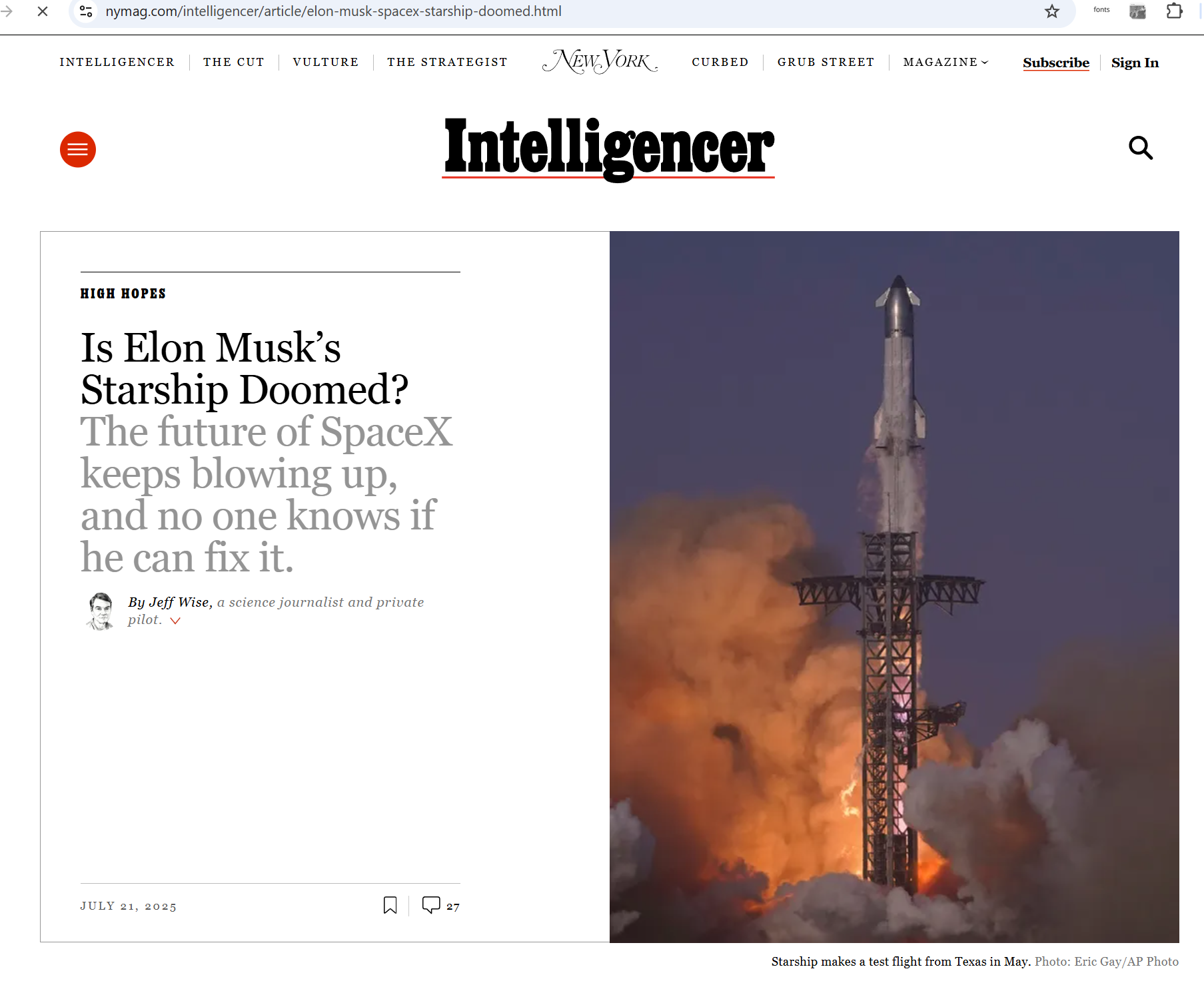
Scientific American interviewed experts and learned that Starship, financially glommed together with X money, will never reach orbit as a practical vehicle. The world’s smartest and most productive people live in New York City and they also figured out that Starship can’t work. New York magazine (“Intelligence” is literally part of the name, which tells you how much more intelligent these journalists are than the readers outside of NYC):
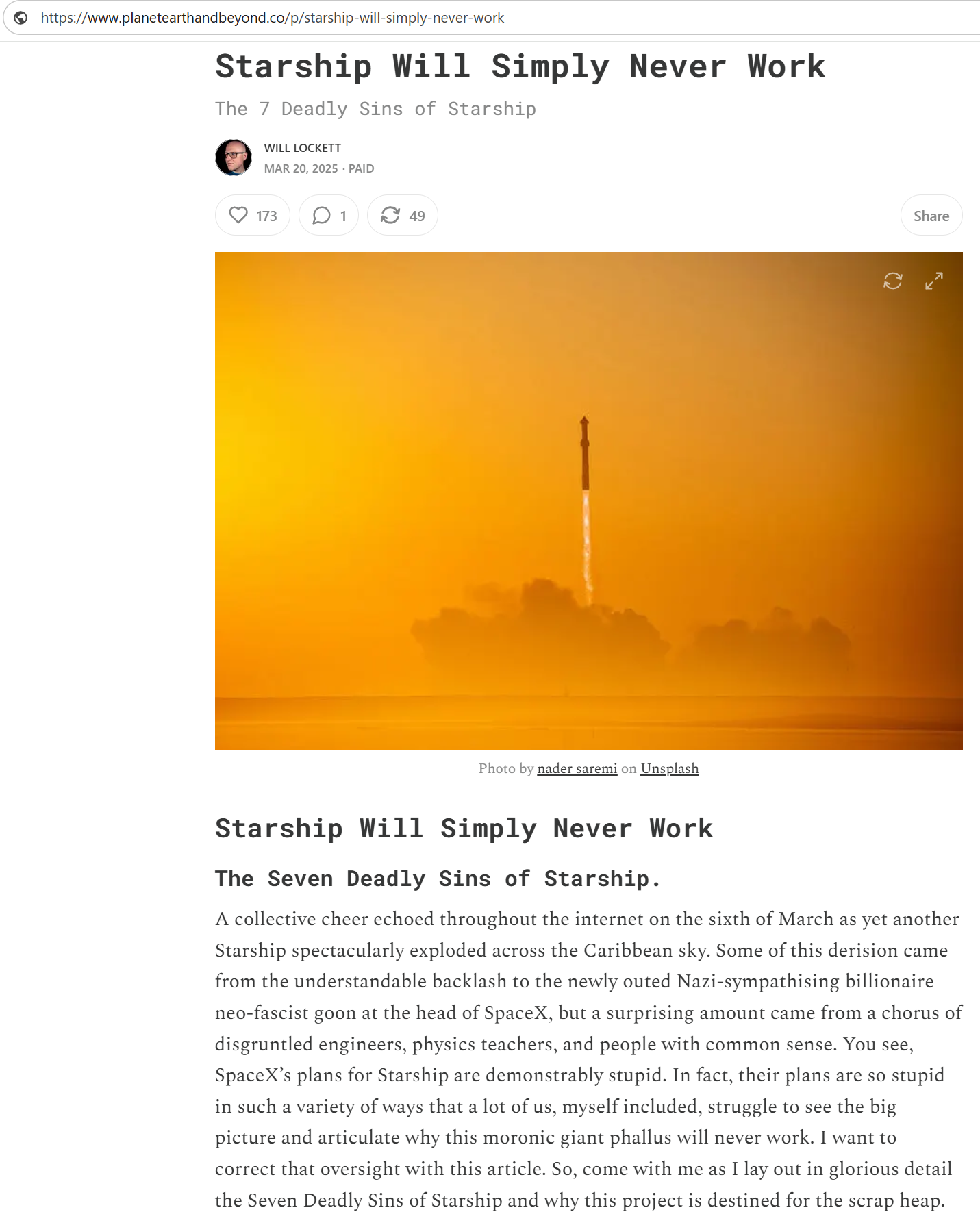
Starship is “destined for the scrap heap” according to one of the brightest engineering minds in the Islamic Republic of the UK:
What happens when #Science catches up to Elon and SpaceX? Will they run off with this money to cover their losses from Starship? Not so fast. The money lives at one or more FDIC-insured conventional banks. (If you invest more than $250,000, which is still the limit for deposits despite the raging inflation that the government says we haven’t experienced, X Money spreads the money automatically across multiple banks. The $250k limit was established temporarily during the Collapse of 2008 and then Milton Friedman (“Nothing is so permanent as a temporary government program.”) was proven correct in July 2010.)
It took only a few minutes to transfer some funds from Bank of America via the Plaid service that X Money uses to connect bank accounts. It’s a little unnerving that Plaid asks for permission to see one’s monthly statements, but I assume that everyone in China and Russia has already read these so I agreed.
There has been a political and media campaign to discredit X Money by pointing out that the main bank underlying the service, Cross River Bank, was hassled by the Federales. Example:
[Native American Elizabeth] Warren, the top Democrat on the Senate Banking, Housing, and Urban Affairs Committee, wants to know exactly when Musk plans to offer the digital tool, what banking services it will provide and whether it will issue a stablecoin. She also pushed him to divulge whether he plans to work with the fintech Cross River Bank in offering the X Money services, which she noted was the subject of a Federal Deposit Insurance Corp. enforcement action in 2023 for “unsafe and unsound practices related to fair lending.”
“Unsafe and unsound” is unnerving, to say the least! Did Cross River Bank lend to people who are less creditworthy than Bank of America, for example? ChatGPT says that the FDIC went after Cross River Bank because of the potential for the opposite behavior, i.e., restricting borrowing to those whom studies have shown are less likely to default.
The 2023 case is the one producing most of the scary current headlines about “unsafe or unsound banking practices.” It arose from a 2021 FDIC examination and concerned Cross River’s large business of originating loans through fintech partners. The FDIC said Cross River had inadequate internal controls, information systems and credit-underwriting practices for monitoring compliance with fair-lending laws, including the Equal Credit Opportunity Act and Truth in Lending Act. Cross River consented to the order without admitting or denying the allegations.
But there’s an important distinction: the public 2023 order does not say that Cross River was undercapitalized, short of liquidity, mishandling deposits, or likely to fail. Nor did that order impose a monetary penalty. The concern was that Cross River’s controls weren’t adequate to demonstrate that the enormous volume of lending done through outside fintech companies was complying with fair-lending and consumer-credit rules. The order actually required Cross River to investigate whether particular lending disparities amounted to discriminatory practices and whether remediation was warranted, rather than publicly declaring that a particular class of borrowers had already been proven to have been discriminated against.
Prompt: “What would happen if a bank doesn’t comply with fair lending? Who wouldn’t get a loan?”
In the simplest case, someone who is otherwise similarly qualified could be denied a loan—or charged more—because of a legally protected characteristic rather than because of credit risk. Under the federal Equal Credit Opportunity Act, the protected characteristics include race, color, religion, national origin, sex, marital status, age, receipt of public-assistance income, and exercising certain consumer-credit rights. Lenders can still use ordinary underwriting variables such as income, debt, credit history and collateral.
Would a bank have any rational basis for trying not to lend to the Somalis who built Boston and Minneapolis, for example?
In U.S. mortgage data, white borrowers have historically had lower delinquency/default rates than Black borrowers on average. For example, a Federal Reserve analysis of conventional first-lien home-purchase mortgages originated in 2006 found that 24.8% of Black borrowers versus 6.4% of non-Hispanic white borrowers became 60+ days delinquent within two years. Even within credit-score bands, Black borrowers had higher delinquency rates in that particular cohort; after adjusting for HMDA variables and Equifax risk score, the Black–white gap was still about 8 percentage points.
On the broader principle, though: if a prohibited characteristic such as race carries residual predictive information about default even after all the lender’s permitted variables are considered, then fair-lending law does constrain a lender from using every statistically predictive variable available. Regulation B currently says a creditor may not discriminate on a prohibited basis in any aspect of a credit transaction, including the criteria used to evaluate creditworthiness. … What they cannot do is add something like “Black borrower: +40 basis points” even if historical data showed that race improved default prediction at the margin. Consumer Financial Protection Bureau
A U.S. study using the Panel Study of Income Dynamics found that immigrants who had been in the U.S. for 10–20 years had higher mortgage-delinquency rates than otherwise similar native-born households after controlling for observed characteristics
So the headline “risk” identified by Elizabeth Warren and others was actually that Cross River Bank might not be lending enough money to people who are more likely to default. This is “unsafe and unsound”, just like it would be “unsafe and unsound” for an individual to refuse to lend to an unemployed relative.
X Money offers a debit card that sounds like it takes all of the fees that merchants pay, and some additional, and hands it back to you.

What’s an example of “up to 3%”? 0% is the fine print example, apparently. Gemini:
Peer-to-peer transfers, wire transfers, and betting/gambling. In updated terms, standard high-cost categories like utilities, wholesale clubs (such as Costco), rent/tax payments, jewelry, and university tuition have been nerfed and no longer qualify for the 3% return. On these purchases, you will earn 0%.
Complete list at https://money.x.com/en/i/cashback-rewards-terms
Another reason to be less excited about a debit card, I think, is that consumer protections are weaker, e.g., if you’re overcharged by a merchant or a merchant sells you something that is defective and won’t take it back.
I can’t keep track of the plastic cards that I already have, so I’m saying “no” so far to the debit card. I moved funds into the 6% account on September 21, 2026 and X Money shows that it is still there despite the failed launch of 52 tons of Starlink V3 satellites into orbit by Starship on September 28.
Loosely related… (SpaceX and money)
Not only is Starship unable to fly, but X Money can’t make a profit with the 30-year Treasury bond at 5.6%. This feels just like the dot-com bubble all over again, which was totally not my fault.
Wonder what happened to all the orange savings accounts from 25 years ago. Suspect the bait rate won’t last. Those of us still in job centers would have to pay state income tax for a HYSA. The Spun apparently spends enough time in FL to avoid state income tax. An IRS agent reading the blog would swear he still lived in Boston.
SpaceX stock is on a tear today +6% on the news that you are now a depositor! And, yesterday was strong too…apparently the news leaked early?
170! That’s better than the IPO price, but I wasn’t offered any at the IPO price. This does call into question one’s faith in Morningstar ($63/share implicit target): https://philip.greenspun.com/blog/2026/06/15/spacex-is-worth-63-share-according-to-the-most-expert-experts/
You could have done even better than the IPO price ($135)! It traded at $104.83 on August 3rd.
SSP: True. But if one were able to time the market like that there are a lot of better investments than SpaceX (up only around 70% from the low). How about Moderna, for example, since everyone here, I hope, likes to Follow the Science. We could have bought this manufacturer of life-saving COVID-19 vaccines for about $60 any time through mid-August 2026. Today it’s over $200.
Phil, Moderna is a stock you need to own. Trust me.
One nice feature of the X debit card is that it reimburses ATM fees. So you can use it at any ATM, and not pay a transaction fee.
What are people using ATMs for these days?
From TFA in “#Scientific American”:
“’It’s one of the biggest rockets ever. It’s, for sure, the biggest rocket that has attempted reuse,’ says Jonathan McDowell, an astrophysicist at the Center for Astrophysics | Harvard & Smithsonian, who tracks space launches in his spare time. ‘Developing a vehicle this big and launching it repeatedly ain’t easy.'”
That’s what he said. (Also Jonathan, we say “isn’t” not “ain’t”.)
I mean, do I have to explain this to everybody? Why are they quoting a astrophysicist with a dilettantish interest in rocket engineering? He probably jokes that he is “a rocket scientist”. That’s what she said…then “I don’t do that small, nerd.”
They need a quote from a badass aerospace engineer from M.I.T. who gets all the chicks. Does anyone really in the know believe that Sheldon Cooper could land a fox like Mayim Bialik> Pffff, F that, fool. Galecki probably could orbit M.B., he had copper penny game, yo.
I mean, I mean, maybe the rocket is so big it wraps around recursively and kinda looks like a spermatozoa again.
The hell it don’t (it’s OK when I do it Scientific American, I ain’t a rocket scientist):
https://philip.greenspun.com/blog/wp-content/uploads/2026/09/image-89.png
(Thx, thx, thx for the 3rd level philg, I feel like I’m commenting a whole otha level.)
Related news: the AI / SpaceX ipo finance frenzy has caused the market for exotic + sports cars to go crazy. Some prices have almost tripled in the last year. Eg: 12 year old Ferrari 458 spider last year was $150-200k, today it’s $400-500k.
https://www.autotrader.com/cars-for-sale/all-cars/ferrari/458-spider/beverly-hills-ca?searchRadius=0
Imagine being just a regular non-managerial employee of a company and yet still making enough money from just showing up to work every day for a few years that buying a Ferrari involves the same level of household budgeting consideration that a regular person would put into buying a Huffy bicycle.
Had to fact check your outro, seems your boy Nat is spreading fake news:
Gemini sez: While both projects are infamous for timelines expanding beyond original estimates, California has actually spent roughly two to three times more on its high-speed rail project than SpaceX has spent developing Starship.