Author: philg


Science is Settled: one characteristic cannot be inherited genetically
She Has Her Mother’s Laugh: The Powers, Perversions, and Potential of Heredity by Carl Zimmer says that almost everything is heritable and that genetics is the mechanism for heritability. However, there is one big exception… intelligence.
Why does this matter? The book reminds us that the idea that a lack of intelligence will render a person dependent on welfare goes back at least to the 1930s:
The Great Depression was reaching its depths when [Henry Herbert] Goddard came back to Vineland, and he blamed it largely on America’s lack of intelligence: Most of the newly destitute didn’t have the foresight to save enough money. “Half of the world must take care of the other half,” Goddard said.
The idea that intelligence could not be explained by heredity is similarly old:
[British doctor Lionel] Penrose entered the profession as a passionate critic of eugenics, dismissing it as “pretentious and absurd.” In the early 1930s, eugenics still had a powerful hold on both doctors and the public at large—a situation Penrose blamed on lurid tales like The Kallikak Family. While those stories might be seductive, eugenicists made a mess of traits like intelligence. They were obsessed with splitting people into two categories—healthy and feebleminded—and then they would cast the feebleminded as a “class of vast and dangerous dimensions.” Penrose saw intelligence as a far more complex trait. He likened intelligence to height: In every population, most people were close to average height, but some people were taller and shorter than average. Just being short wasn’t equivalent to having some kind of a height disease. Likewise, people developed a range of different mental aptitudes. Height, Penrose observed, was the product of both inherited genes and upbringing. He believed the same was true for intelligence. Just as Mendelian variants could cause dwarfism, others might cause severe intellectual developmental disorders. But that was no reason to leap immediately to heredity as an explanation. “That mental deficiency may be to some extent due to criminal parents’ dwelling ‘habitually’ in slums seems to have been overlooked,” Penrose said. He condemned the fatalism of eugenicists, as they declared “there was nothing to be done but to blame heredity and advocate methods of extinction.”
Even if a country did sterilize every feebleminded citizen, Penrose warned, the next generation would have plenty of new cases from environmental causes. “The first consideration in the prevention of mental deficiency is to consider how environmental influences which are held responsible can be modified,” Penrose declared.
The author finds some cases in which children with severe physical disorders, e.g., PKU, have impaired intelligence. From this he reminds us that it is wrong to believe that “our intelligence is fixed by the genes we inherit.” (Is that truly a comforting idea? I would have been as smart as Albert Einstein, for example, but I watched too much TV as a kid and didn’t work hard enough as an adult?)
We would be as tall as the Dutch if only we were smart enough to build a bigger government (2nd largest welfare state, as a percentage of GDP, is not enough to grow tall!):
The economy of the United States, the biggest in the world, has not protected it from a height stagnation. Height experts have argued that the country’s economic inequality is partly to blame. Medical care is so expensive that millions go without insurance and many people don’t get proper medical care. Many American women go without prenatal care during pregnancy, while expectant mothers in the Netherlands get free house calls from nurses.
How do intelligence distributions change over time, given that environment is supposed to be a huge factor?
Intelligence is also a surprisingly durable trait. On June 1, 1932, the government of Scotland tested almost every eleven-year-old in the country—87,498 all told—with a seventy-one-question exam. The students decoded ciphers, made analogies, did arithmetic. The Scottish Council for Research in Education scored the tests and analyzed the results to get an objective picture of the intelligence of Scottish children. Scotland carried out only one more nationwide exam, in 1947. Over the next couple of decades, the council analyzed the data and published monographs before their work slipped away into oblivion.
Deary, Whalley, and their colleagues moved the 87,498 tests from ledgers onto computers. They then investigated what had become of the test takers. Their ranks included soldiers who died in World War II, along with a bus driver, a tomato grower, a bottle labeler, a manager of a tropical fish shop, a member of an Antarctic expedition, a cardiologist, a restaurant owner, and an assistant in a doll hospital. The researchers decided to track down all the surviving test takers in a single city, Aberdeen. They were slowed down by the misspelled names and erroneous birth dates. Many of the Aberdeen examinees had died by the late 1990s. Others had moved to other parts of the world. And still others were just unreachable. But on June 1, 1998, 101 elderly people assembled at the Aberdeen Music Hall, exactly sixty-six years after they had gathered there as eleven-year-olds to take the original test. Deary had just broken both his arms in a bicycling accident, but he would not miss the historic event. He rode a train 120 miles from Edinburgh to Aberdeen, up to his elbows in plaster, to witness them taking their second test. Back in Edinburgh, Deary and his colleagues scored the tests. Deary pushed a button on his computer to calculate the correlation between their scores as children and as senior citizens. The computer spat back a result of 73 percent. In other words, the people who had gotten relatively low scores in 1932 tended to get relatively low scores in 1998, while the high-scoring children tended to score high in old age.
If you had looked at the score of one of the eleven-year-olds in 1933, you’d have been able to make a pretty good prediction of their score almost seven decades later. Deary’s research prompted other scientists to look for other predictions they could make from childhood intelligence test scores. They do fairly well at predicting how long people stay in school, and how highly they will be rated at work. The US Air Force found that the variation in [general intelligence] among its pilots could predict virtually all the variation in tests of their work performance. While intelligence test scores don’t predict how likely people are to take up smoking, they do predict how likely they are to quit. In a study of one million people in Sweden, scientists found that people with lower intelligence test scores were more likely to get into accidents.
IQ is correlated with longevity:
But Deary’s research raises the possibility that the roots of intelligence dig even deeper. When he and his colleagues started examining Scottish test takers in the late 1990s, many had already died. Studying the records of 2,230 of the students, they found that the ones who had died by 1997 had on average a lower test score than the ones who were still alive. About 70 percent of the women who scored in the top quarter were still alive, while only 45 percent of the women in the bottom quarter were. Men had a similar split. Children who scored higher, in other words, tended to live longer. Each extra fifteen IQ points, researchers have since found, translates into a 24 percent drop in the risk of death.
The author reports that twins separated at birth have almost identical IQs, despite completely different childhood environments. With most other personal characteristics, this would lead to the conclusion that intelligence was mostly heritable. Instead, however, Zimmer points out that if heritability is not 100 percent then it would be a mistake to call something “genetic”:
Intelligence is far from blood types. While test scores are unquestionably heritable, their heritability is not 100 percent. It sits instead somewhere near the middle of the range of possibilities. While identical twins often end up with similar test scores, sometimes they don’t. If you get average scores on intelligence tests, it’s entirely possible your children may turn out to be geniuses. And if you’re a genius, you should be smart enough to recognize your children may not follow suit. Intelligence is not a thing to will to your descendants like a crown.
To bolster the claim that intelligence is not heritable, the book cites examples of children whose mothers were exposed to toxic chemicals during pregnancy. Also examples that staying in school for additional years raises IQ (a measure of symbol processing efficiency).
Here’s an interesting-sounding study:
In 2003, Eric Turkheimer of the University of Virginia and his colleagues gave a twist to the standard studies on twins. To calculate the heritability of intelligence, they decided not to just look at the typical middle-class families who were the subject of earlier studies. They looked for twins from poorer families, too. Turkheimer and his colleagues found that the socioeconomic class determined how heritable intelligence was. Among children who grew up in affluent families, the heritability was about 60 percent. But twins from poorer families showed no greater correlation than other siblings. Their heritability was close to zero.
(Do we believe that heritability is zero because identical twins and siblings both have highly correlated IQs? Earlier in the book, the author describes how hospitals and doctors often misclassify twins.)
Buried in the next section is that this finding is not straightforward to replicate (“Why Most Published Research Findings Are False”):
If you raise corn in uniformly healthy soil, with the same level of abundant sunlight and water, the variation in their height will largely be the product of the variation in their genes. But if you plant them in a bad soil, where they may or may not get enough of some vital nutrient, the environment will be responsible for more of their differences. Turkheimer’s study hints that something similar happens to intelligence. By focusing their research on affluent families—or on countries such as Norway, where people get universal health care—intelligence researchers may end up giving too much credit to heredity. Poverty may be powerful enough to swamp the influence of variants in our DNA. In the years since Turkheimer’s study, some researchers have gotten the same results, although others have not. It’s possible that the effect is milder than once thought. A 2016 study pointed to another possibility, however. It showed that poverty reduced the heritability of intelligence in the United States, but not in Europe. Perhaps Europe just doesn’t impoverish the soil of its children enough to see the effect. Yet there’s another paradox in the relationship between genes and the environment. Over time, genes can mold the environment in which our intelligence develops. In 2010, Robert Plomin led a study on eleven thousand twins from four countries, measuring their heritability at different ages. At age nine, the heritability of intelligence was 42 percent. By age twelve, it had risen to 54 percent. And at age seventeen, it was at 68 percent. In other words, the genetic variants we inherit assert themselves more strongly as we get older. Plomin has argued that this shift happens as people with different variants end up in different environments. A child who has trouble reading due to inherited variants may shy away from books, and not get the benefits that come from reading them.
Poverty in the cruel U.S. crushes children! But, measured in terms of consumption, an American family on welfare actually lives better than a lot of middle class European families. The author praises the Europeans with their universal health care systems, but 100 percent of poor American children qualify for Medicaid, a system of unlimited health care spending (currently covering roughly 75 million people).
If unlimited taxpayer-funded Medicaid isn’t sufficient to help poor American children reach their genetic potential, maybe early education will? The book quotes a Head Start planner: “The fundamental theoretical basis of Head Start was the concept
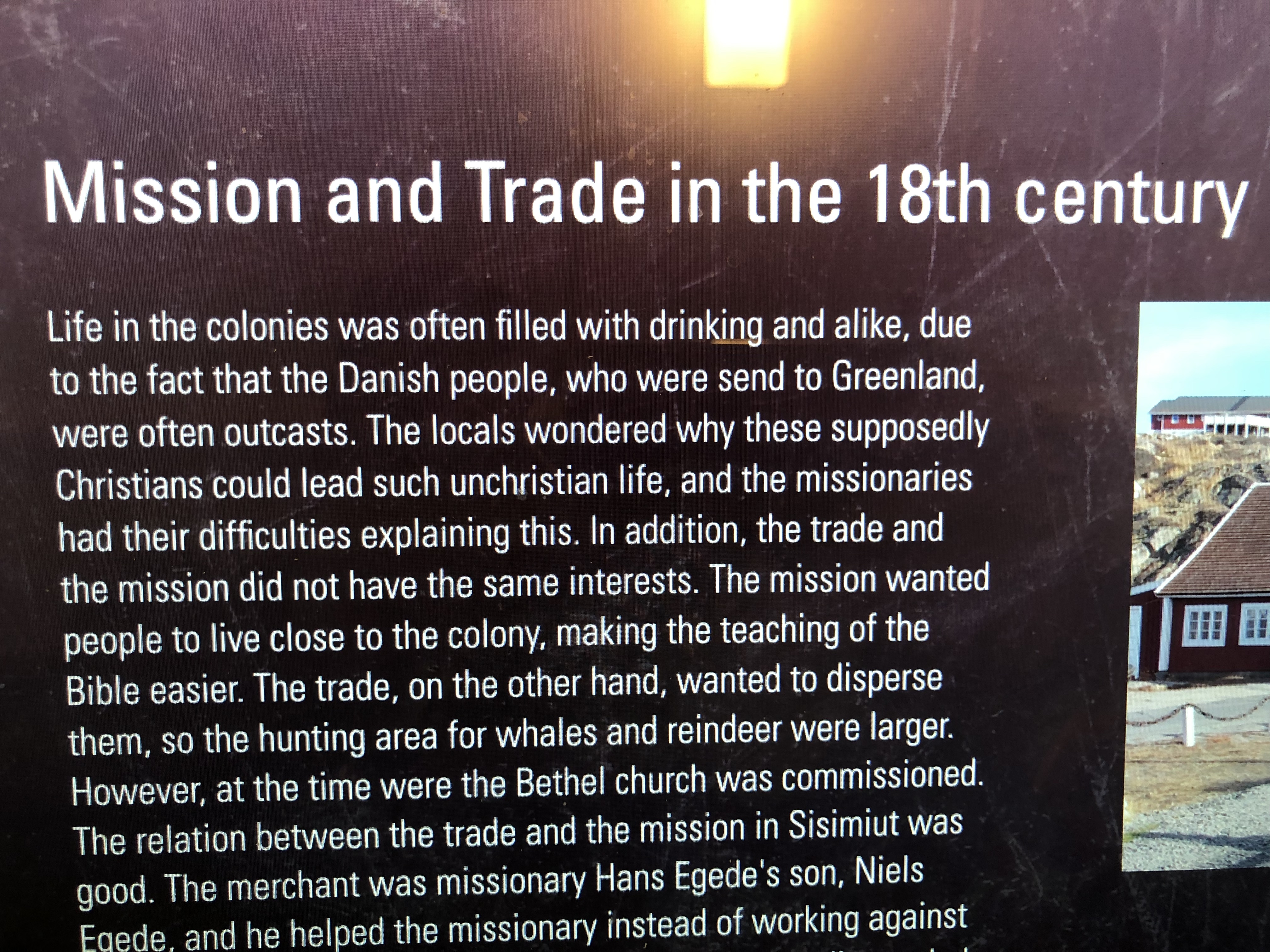
Full post, including commentsDenmark did not send their best to Greenland
Improving our dismal public schools with the dismal science
Misbehaving: The Making of Behavioral Economics, by Richard Thaler, has some potentially practical advice for improving our schools:
A good example of a domain where field experiments run by economists are having an impact is education. Economists do not have a theory for how to maximize what children learn in school (aside from the obviously false one that all for-profit schools are already using the best methods). One overly simplistic idea is that we can improve student performance just by giving financial incentives to parents, teachers, or kids. Unfortunately, there is little evidence that such incentives are effective, but nuances matter. For example, one intriguing finding by Roland Fryer suggests that rewarding students for inputs (such as doing their homework) rather than outputs (such as their grades) is effective. I find this result intuitively appealing because the students most in need do not know how to become better students. It makes sense to reward them for doing things that educators believe are effective. Another interesting result comes directly from the behavioral economics playbook. The team of Fryer, John List, Steven Levitt, and Sally Sadoff has found that the framing of a bonus to teachers makes a big difference. Teachers who are given a bonus at the beginning of the school year that must be returned if they fail to meet some target improve the performance of their students significantly more than teachers who are offered an end-of-year bonus contingent on meeting the same goals. A third positive result even further from the traditional tool kit of financial incentives comes from a recent randomized control trial conducted in the U.K., using the increasingly popular and low-cost method of text reminders. This intervention involved sending texts to half the parents in some school in advance of a major math test to let them know that their child had a test coming up in five days, then in three days, then in one day. The researchers call this approach “pre-informing.” The other half of parents did not receive the texts. The pre-informing texts increased student performance on the math test by the equivalent of one additional month of schooling, and students in the bottom quartile benefited most. These children gained the equivalent of two additional months of schooling, relative to the control group. Afterward, both parents and students said they wanted to stick with the program, showing that they appreciated being nudged. This program also belies the frequent claim, unsupported by any evidence, that nudges must be secret to be effective.
Imagine the outcry if teachers got money at the beginning of the school year, spent it on vacations, recreational marijuana, etc., and then some of them had to give the money back at the end of the year due to evidence that their students hadn’t learned much!
Full post, including commentsEuropean perspective on Trump’s China policy
This Northwest Passage cruise contains a lot of retired European multinational executives. They talked about being forced by China to set up factories in China in order to have access to the Chinese consumer market. “Trump is fighting the right battle,” one said, “though you can argue about whether he is using the right tactics. But he is the first American to try to deal with these unfair Chinese policies.”
Full post, including commentsBehavioral economics says we can beat the market
Misbehaving: The Making of Behavioral Economics, by Richard Thaler, is an interesting history of this new-ish subfield from the inside. It also contains some potentially useful guidance for investors!
Thaler points out that the rational beings on which the theories of Econ 101 rest do not exist in the real world. None of us make rational purchase decisions, for example. Aggregating a huge group of irrational people does not make our decisions somehow more rational:
the premises on which economic theory rests are flawed. First, the optimization problems that ordinary people confront are often too hard for them to solve, or even come close to solving. Even a trip to a decent-sized grocery store offers a shopper millions of combinations of items that are within the family’s budget. Does the family really choose the best one? And, of course, we face many much harder problems than a trip to the store, such as choosing a career, mortgage, or spouse. Given the failure rates we observe in all of these domains, it would be hard to defend the view that all such choices are optimal.
The book contains a good introduction to all of the big issues in behavioral economics, e.g., that people are loss-averse and also that they demand fairness (which is why we must all vote a Warren-Sanders ticket for president!).
Perceptions of fairness also help explain a long-standing puzzle in economics: in recessions, why don’t wages fall enough to keep everyone employed? In a land of Econs, when the economy goes into a recession and firms face a drop in the demand for their goods and services, their first reaction would not be to simply lay off employees. The theory of equilibrium says that when the demand for something falls, in this case labor, prices should also fall enough for supply to equal demand. So we would expect to see that firms would reduce wages when the economy tanks, allowing them to also cut the price of their products and still make a profit. But this is not what we see: wages and salaries appear to be sticky. When a recession hits, either wages do not fall at all or they fall too little to keep everyone employed. Why? One partial explanation for this fact is that cutting wages makes workers so angry that firms find it better to keep pay levels fixed and just lay off surplus employees (who are then not around to complain). It turns out, however, that with the help of some inflation, it is possible to reduce “real” wages (that is, adjusted for inflation) with much less pushback from workers.
Speaking of fairness, note that Uber has eliminated its “surge pricing” annotation. When the price is higher than usual, customers see a higher quoted price, not a screaming “surge pricing” banner. Restaurants and theaters would rather have a long waiting list than charge a market-clearing price. A chef is quoted as saying that he didn’t want to charge so much that customers would leave feeling that they’d been overcharged.
Stock markets are irrational and predictably irrational as far as Thaler and colleagues are concerned. Companies shouldn’t pay taxable dividends, for example, when they can buy back shares and compensate investors with a higher stock price:
Shefrin and Statman’s answer relied on a combination of self-control and mental accounting. The notion was that some shareholders—retirees, for instance—like the idea of getting inflows that are mentally categorized as “income” so that they don’t feel bad spending that money to live on. In a rational world, this makes no sense. A retired Econ could buy shares in companies that do not pay dividends, sell off a portion of his stock holdings periodically, and live off of those proceeds while paying less in taxes. But there is a long-standing notion that it is prudent to spend the income and leave the principal alone, and this idea was particularly prevalent in the generation of retirees around in 1985, all of whom had lived through the Great Depression.*
Gambling on the ponies is irrational. Betting on the even-money favorite will return 90 cents on the dollar. Betting on the longshot will return 14 cents and the returns get worse at the end of the day. Surely professionals investors are not as dumb as folks who gamble at the track? Thaler summarizes research suggesting that investors are actually just as dumb!
Thaler says that the equity premium (excess returns of stocks compared to bonds) is higher than it should be, even after economists pointed out that the equity premium is too high. The idea that professional investors are irrational is an old one, going back at least to Keynes:
Keynes thought markets were more “efficient,” to use the modern word, in an earlier period at the beginning of the twentieth century when managers owned most of the shares in a company and knew what the company was worth. He believed that as shares became more widely dispersed, “the element of real knowledge in the valuation of investments by those who own them or contemplate purchasing them . . . seriously declined.” … Keynes was also skeptical that professional money managers would serve the role of the “smart money” that EMH defenders rely upon to keep markets efficient. Rather, he thought that the pros were more likely to ride a wave of irrational exuberance than to fight it. One reason is that it is risky to be a contrarian. “Worldly wisdom teaches that it is better for reputation to fail conventionally than to succeed unconventionally.”
The simple “value investing” idea put forward by Benjamin Graham, i.e., buy stocks with a low P/E ratio, continued to work 50 years after its conception:
It was not so much that anyone had refuted Graham’s claim that value investing worked; it was more that the efficient market theory of the 1970s said that value investing couldn’t work. But it did. Late that decade, accounting professor Sanjoy Basu published a thoroughly competent study of value investing that fully supported Graham’s strategy. However, in order to get such papers published at the time, one had to offer abject apologies for the results. Here is how Basu ended his paper: “In conclusion, the behavior of security prices over the fourteen-year period studied is, perhaps, not completely described by the efficient market hypothesis.”
Both the best companies and the worst tend to revert to the mean:
Finding evidence of mean reversion would constitute a clear violation of the EMH. So we decided to see if we could find that evidence. Our study was simple. We would take all the stocks listed on the New York Stock Exchange (which, at that time, had nearly all of the largest companies) and rank their performance over some time period long enough to allow investors to get overly optimistic or pessimistic about some company, say three to five years. We would call the best performing stocks “Winners” and the worst performers “Losers.” Then we would take a group of the biggest Winners and Losers (say the most extreme thirty-five stocks) and compare their performance going forward. If markets were efficient, we should expect the two portfolios to do equally well. After all, according to the EMH, the past cannot predict the future. But if our overreaction hypothesis were correct, Losers would outperform Winners. Such a finding would accomplish two things. First, we would have used psychology to predict a new anomaly. Second, we would be offering support for what we called “generalized overreaction.” Unlike the Kahneman and Tversky experiment in which subjects were overreacting to measures of sense of humor when predicting GPA, we were not specifying what investors were overreacting to. We were just assuming that by driving the price of some stock up or down enough to make it one of the biggest winners or losers over a period of several years, investors were likely to be overreacting to something. The results strongly supported our hypothesis. We tested for overreaction in various ways, but as long as the period we looked back at to create the portfolios was long enough, say three years, then the Loser portfolio did better than the Winner portfolio. Much better. For example, in one test we used five years of performance to form the Winner and Loser portfolios and then calculated the returns of each portfolio over the following five years, compared to the overall market. Over the five-year period after we formed our portfolios, the Losers outperformed the market by about 30% while the Winners did worse than the market by about 10%.
Can the non-behavioral economists fix this? No! says Thaler.
The efficient market hypothesis could be reconciled with our results if the Loser stocks had high betas and thus were risky according to the CAPM, and the Winner stocks had low betas, meaning they were less risky. … By whatever measure one used, “value stocks” outperformed “growth stocks,” and to the consternation of EMH advocates, the value stocks were also less risky, as measured by beta.
The practical advice from the book is to buy value stocks and small cap stocks. A portfolio of “blue chip” large cap stocks would be almost certain to underperform in the long run (see GE!).
Can we get good advice for day-to-day trades from economists? Nobel laureate Paul Krugman predicted a dramatic and persistent stock market depression after the Trumpenfuhrer was sent to the Reichstag in November 2016. Nobel laureate Bob Shiller predicted a stock market crash in 1996, according to Thaler. The S&P 500 was 1,050 when they sounded the doom horn. The stock market did crash starting in 2000. It fell from 2,100… to about 1,150. In other words, if you’d gone short in 1996 and then perfectly timed the bottom of the stock market in 2002 you still would have lost money (plus another 3 percent per year in dividends that you’d have had to pay out). Thaler credits Shiller with prescience and says he was too early, but does not point out that Shiller was actually wrong based on the numbers.
Real estate seems to be one of the most irrational of all markets.
My conclusion: the price is often wrong, and sometimes very wrong. Furthermore, when prices diverge from fundamental value by such wide margins, the misallocation of resources can be quite big. For example, in the United States, where home prices were rising at a national level, some regions experienced especially rapid price increases and historically high price-to-rental ratios. Had both homeowners and lenders been Econs, they would have noticed these warning signals and realized that a fall in home prices was becoming increasingly likely. Instead, surveys by Shiller showed that these were the regions in which expectations about the future appreciation of home prices were the most optimistic. Instead of expecting mean reversion, people were acting as if what goes up must go up even more. Moreover, rational lenders would have made the requirements for getting a mortgage stricter under such circumstances, but just the opposite happened. Mortgages were offered with little or no down payment required, and scant attention was paid to the creditworthiness of the borrowers. These “liar loans” fueled the booms, and policy-makers took no action to intervene.
In other words, it seems likely that the short trade that made John Paulson a multi-billionaire will work during the next bubble.
A fun corner of the book is a discussion of office allocation in a new building for the economists at University of Chicago:
Full post, including commentsTwo other rules of interest: offices could not be traded and, after one senior faculty member inquired, the deans emphatically ruled out the possibility of buying an earlier draft pick from a colleague. This ruling, and the fact that the school decided not to simply auction off the draft picks, reveals that even at the University of Chicago Booth School of Business—where many favor an open market in babies and organs—some objects are simply too sacred to sell in the marketplace: faculty
How to party with Hollywood Stars and Supermodels
Billion Dollar Whale is a fascinating story by two Wall Street Journal reporters. The “whale” is a pudgy Malaysian-Chinese guy named Jho Low. Aside from making friends with Arabs and stealing from Malaysian taxpayers, the authors don’t credit Mr. Low with any skills. Is that an obstacle to partying with movie stars and beautiful women?
Low rented a suite of rooms that cost $100,000 per month. The flashy new resident showed up at the building in a convoy of black Cadillac Escalades with a retinue of security, and he paid for a number of other apartments in the building for his entourage, which included Hamad Al Wazzan, his wealthy Kuwaiti friend from Wharton. Long-term residents complained about the bodyguards and the ostentation, but that was exactly Low’s aim: to show he had arrived. He began to spend eye-popping amounts, running up a $160,000 bar bill at Avenue, a new club in New York’s Chelsea district, on a single night during fall Fashion Week in 2009. On another occasion, Low sent twenty-three bottles of Cristal to actress Lindsay Lohan’s table when he spotted her during a night out in Manhattan.
It’s a little-discussed secret that even the biggest movie stars take payment to attend events, and Low began to seek out the managers of top actors, or pull on the Strategic Group’s network of club promoters, to get celebrities to his parties. The rumor that Low was a billionaire with unlimited funds made him an attractive person to know. Even for DiCaprio, one of the world’s top-paid actors, with a sizable fortune of his own, the scope of Low’s purported wealth was alluring. The night at the Palazzo in October 2009 was just the start of many parties the actor would enjoy with Low.
Robert De Niro, Charlize Theron, Swizz Beatz, Alicia Keys, and Jamie Foxx become some of the regulars as well.
Where do all of these folks hang out?
It was Fleet Week in Saint-Tropez, and the world’s superyachts vied for berthing space at the town’s marina. In July and August, the resort on the French Riviera, centered around a warren-like medieval old town of ochre-colored houses and old churches, is heaving with the world’s richest people. They flock to the town for parties on yachts and in the town’s bars and the daytime carousing at the clubs on nearby Pampelonne beach.
The most illustrious of all is Les Caves du Roy, a fixture on the world party scene since the 1960s. Every inch of the club, situated in the basement of the Hotel Byblos, just a few hundred meters back from the port, is covered in gold. There are golden columns, which end in waves of fluting, a parody of the Corinthian style meant to evoke champagne bursting from a bottle. The dance floor is golden, as are the tables on which are perched gold leaf–covered cocktail bowls.
Once there, Low spends 2 million euros on Champagne.
His friends also know how to party:
In Abu Dhabi, Al Qubaisi wore the traditional emirati cloak and head covering, and had a family home, a sprawling villa, where his wife and four children lived. But like many rich emiratis, he conducted a different life overseas. At his villa on the Côte d’Azur, with Bugattis and Ferraris parked outside, he partied with models, and he had a younger Moroccan wife in Paris. When abroad, he traded in traditional emirati dress for tight-fitting T-shirts, including one with a montage of images of Al Pacino’s Tony Montana from the 1983 film Scarface. Once, when an executive showed up to Al Qubaisi’s mansion in France to discuss business, he answered the door wearing a skimpy swimsuit, while women in bikinis lingered in the background.
There is still time to appreciate art:
A few weeks after the Wolf of Wall Street premiere, Low, posing as Eric Tan, sent DiCaprio a $3.3 million painting by Pablo Picasso as a late birthday present. The oil painting—Nature Morte au Crâne de Taureau—was accompanied with a handwritten note. “Dear Leonardo DiCaprio, Happy belated Birthday! This gift is for you,” it read. Then, Low told a Swiss gallery that was storing a $9.2 million Basquiat—a collage entitled Red Man One—to transfer ownership to DiCaprio. The order, made in a letter also signed by DiCaprio, indemnified the actor from “any liability whatsoever resulting directly or indirectly from these art-work.” The actor also got a photograph by Diane Arbus—cost $750,000—from Low. In private, DiCaprio was happy to accept these gifts. On the red carpet, he was in a more philosophical mood. Some critics of the film—including voting members of the Academy who heckled Scorsese at an official screening ahead of the Oscars—complained it glamorized Jordan Belfort’s fraud and was more likely to spawn financial malfeasance than serve as a cautionary tale. DiCaprio had carefully prepared his retort. “This is an indictment of all of Wall Street. But it’s an indictment about something that’s in our culture, this incessant need to consume and this incessant need to obtain more and more wealth with complete disregard for anyone except yourself,” he told one interviewer.
Political donations lead to invitations to hang out (and take selfies) with President Obama and family at the White House.
What about sex with supermodels?
Miranda Kerr, the Australian supermodel, walked in. She had come from a formal event and was wearing a ball gown, at odds with the atmosphere in the down-to-earth eatery. With her soft brown curls, iridescent blue eyes, and trademark dimples, the thirty-year-old was instantly recognizable, … After winning an Australian modeling competition, aged only thirteen, she had eventually moved to the United States, where she became a Victoria’s Secret model. In 2013, she earned $7 million, making her the second-best-paid female model in the world after Gisele Bündchen, and offers kept piling up—from H&M, Swarovski, Unilever—to promote products. But a supermodel’s earnings aren’t enough to launch a major business, and Kerr was interested in what Low had to offer. She had tired of modeling and was looking to transform herself into an entrepreneur. The next morning, she had a package of KORA products couriered over to Low’s apartment in the Time Warner building. Back in October, Kerr had divorced actor Orlando Bloom, with whom she had a three-year-old son,
Kerr explained her priorities:
“Simple things, like, you know, a fresh bouquet of flowers makes me really happy, watching the sun rise or the sun set,” she told one interviewer.
Low apparently did not realize that a floral bouquet would be sufficient:
A few months later, he would buy Kerr yet more jewelry, a $3.8 million diamond pendant, making a grand total of over $8 million to acquire the supermodel’s affections.
The $8 million is just for a rental, as it turns out…
Kerr had split with Low after the first stories about him began to emerge in early 2015. In May 2017 she married Evan Spiegel, the billionaire founder of Snapchat, cutting all ties with Low.
More: Read Billion Dollar Whale
Full post, including commentsNorthwest Passage cruise begins
I’m praying for global warming to end… on September 11, on which date I hope to be stepping off the ship that I boarded this morning in Greenland (soon to be our 51st state? Atlantic says that citizens there consume roughly the same amount in aid from Denmark as Federal welfare $$ spent per resident of New Mexico, i.e., $10,000 per year per person).
Here’s our planned route (from Hurtigruten):
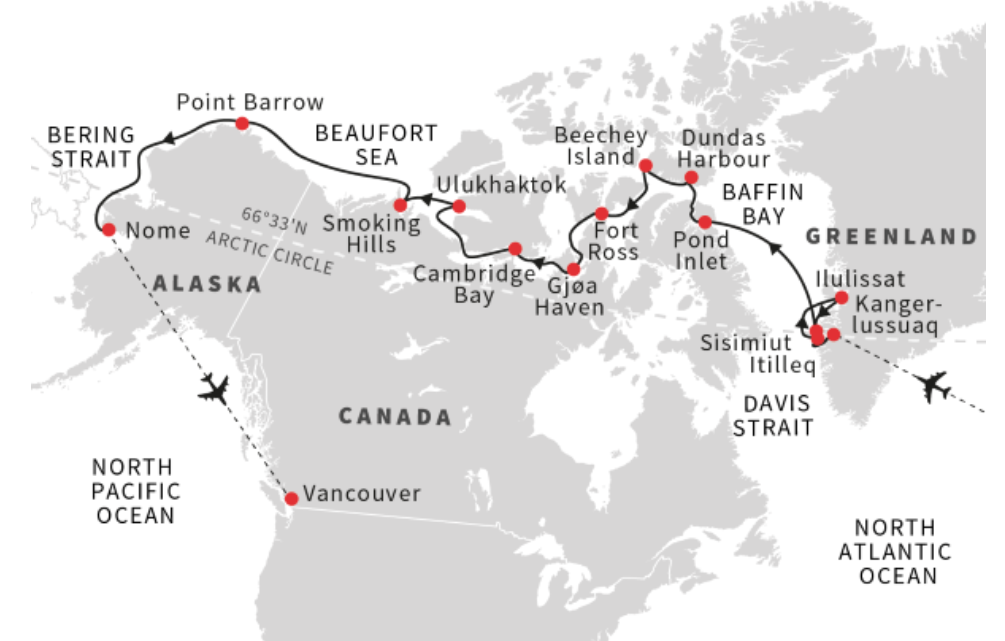
I will try to post a bit to Facebook and/or this blog, but Internet access may be tenuous. So that the site does not go dark, I’ve scheduled a bunch of non-topical postings to appear once/day.
Full post, including commentsMajestic equality between Democrats and Republicans
Anatole France famously noted “In its majestic equality, the law forbids rich and poor alike to sleep under bridges, beg in the streets and steal loaves of bread.”
I’m recently back from Seattle, a city controlled by and populated by righteous Trump-hating Democrats. They are fulsome in their expressions of support for the vulnerable, especially the homeless, who have literally nothing. The only thing that stops them from funding homes for these homeless individuals is their refusal to reduce their personal consumption of new cars, vacation trips, morning avocado toast, etc.
What’s the result? Next to my $325/night gleaming new hotel (Hyatt Regency), itself adjacent to the gleaming new office towers of the Amazon HQ(1?), a woman was begging on the sidewalk, a 5-year-old child in her arms, just as one might see in India. The nearest Bank of America promised safety for the LGBTQ, but couldn’t insure its own safety without a Latin American-style armed guard next to the front door (he in turn was wearing a bulletproof vest).
Walking around downtown at sunset, I passed a homeless person settling down in a building alcove every few minutes.


Given the apparent lack of any assistance other than kind words, thoughts, and prayers that these folks are getting from Democrats, is it fair to say that their life experience would be the same if everyone in Seattle were tomorrow replaced by Republicans? If so, does that show a “majestic equality” between nominally different political philosophies?
Related:
Full post, including commentsReligious dogma of the Church of Trump Hatred
A Facebook friend’s post:
The upcoming US election is unlike any other. … This is not a normal election. This is a national emergency. It cancels the usual rules. … [some ideas for what Democrats should do] … Then, once the gross course correction is attained, away from the Trump course of authoritarian, corrupt, nationalistic, lie/propaganda/fear/polarization based government, we can go back to deciding how liberal or conservative our policies on 100 matters should be.
Right away from this coastal elite Democrat, scornful of religious Americans who accept dogma uncritically, we can see Millenarianism:
the belief by a religious, social, or political group or movement in a coming fundamental transformation of society, after which “all things will be changed”
Of course, I couldn’t resist a simple question:
How has the stock market done during this 2.5-year “national emergency”?
I.e., why wouldn’t investors take 60 seconds to sell U.S. stocks and buy non-U.S. stocks, rather than stick around for the “national emergency” and see whether Dictator Trump would confiscate their assets, just as other dictators have done in the past? Why would foreigners continue to invest hundreds of billions of dollars in the U.S. (some stats)?
The answer turned out to be, ultimately, that any question regarding whether Trump being in the White House constituted a “national emergency” was “off topic”.
If we regard Trump hatred as a religion, ideas that cannot be questioned or examined rationally would be part of the dogma.
Separately, the other day I photographed stickers on an aircraft mechanic’s toolbox:



I posted them on Facebook, noting that they had come from a mechanic’s toolbox, and a guy who lives in Manhattan and draws his paycheck from the refugee industry responded with “Who gives a fuck” (a good summary of Democrats with regard to native-born guys who work hard at skilled blue collar jobs?). I think this is evidence for my Dutch friend’s observation regarding American elites, blue collar whites, and Trump’s election: “They forgot to take away their right to vote.”
Full post, including comments