Maskachusetts Democrats want social justice, but not for their children

“The parents who dared to question Newton’s educational equity experiments” (Boston Globe):

The three mothers had always voted Democrat. One had a Bernie Sanders mug on her desk. They worked in helping fields — international aid, mental health, yoga instruction. They volunteered at their children’s schools. They fit right in to suburban Newton, with its liberal leanings and vaunted public education.

(Note that may be “vaunted” simply due to high test scores and the magic of heritability; the children of parents who scored well on tests tend to score well on tests.)

It turns out there’s trouble in River City:

“At first we were just trying to understand the drastic changes that took place while no one was in school during COVID,” says one of the mothers, Vanessa Calagna. “It was like we were trying to put a puzzle together. And then we were trying to ring the alarm.”

Those changes involved a heightened emphasis on racial equity and antiracism, including a district commitment to “dismantle structures rooted in racism” and seek “more equitable outcomes for all students.”

Among the moves made in the interest of equity was an initiative by Newton’s two celebrated high schools to combine more students into “multilevel” classes. Rather than students being divided into separate classes by level, students at varying levels would learn together — even in math, science, and languages. The goal: to break the persistent pattern that white and Asian students predominated in “honors” classes while Black and Hispanic students tended to be clustered in less-challenging “college-prep” classes.

The Bernie voters get tarred as “right-wing” (not quite all the way to “far right” like Nazi Party member Elon Musk?):

In late 2022, the mothers and their allies launched a petition to create an advisory panel that would give parents more voice on academic issues, modeled after a similar Dedham committee that had been well received there. The proposal drew more than 300 signatures.
It also drew fierce opposition. The mothers and their allies found themselves portrayed online and in public as dog-whistling bigots doing the bidding of right-wing national groups.
Social media comments painted their side as “racism cloaked as academic excellence” and “right-wing activism cloaked as parental concern.”

At that four-hour-plus meeting, one speaker — a professor — compared the petition’s backers to the white women who helped perpetuate segregation and white supremacy.

Speaker after speaker declared that academic excellence and racial equity are not contradictory at all, and in fact complement each other.

Are these folks aware that there is a founded-in-1854 political party that shares their point of view? No:

As for Calagna’s trio, they identify as people with “traditional liberal values.” Calagna herself has never filled in a Republican circle on a ballot, she says.

What’s next? Aping Donald Trump in getting rid of the word “equity”!

In fact, the district’s existing tagline — “Equity & Excellence” — has become “divisive,” Nolin said.
It will soon be changed to “Where All Children Thrive.”

Summarizing all of the above… Democrats in Massachusetts want and vote for social justice, equity, etc. But they don’t want it for their own children.

Loosely related… I was riding the MBTA’s Green Line out towards Newton last month (while up in Cambridge to teach at MIT). Here’s one of the righteous who has taken the trouble to wear a mask on the train, but refuses to follow the directions and shave his/her/zir/their beard (note that he/she/ze/they sits in a seat reserved for the disabled):

Full post, including comments

Could the U.S. build enough nerd factories to replace H-1Bs?

There’s currently a debate about whether mediocre nerds should be imported into the U.S. via H-1B or only supernerds, perhaps via the O-1 visa (both of these are “nonimmigrant” visas and yet everyone who gets one seems to end up as a permanent immigrant to the United States). The main argument supporting a massive annual influx of nerds is that Americans cannot and will not do nerd work, just as Americans cannot and will not do any hard work, which is why we need a border open to low-skill undocumented migrants.

Could the U.S. grow its own nerd supply based on native-born Americans? As it turns out, I have some experience in this area! About 25 years ago, I started “ArsDigita University”, a post-baccalaureate program in which people who had non-nerd degrees could take all of the core undergrad computer science classes in a TA-supervised cooperative open office-style environment. People just had to show up for 9-5 every day for a year and they’d come out knowing pretty much everything that a standard CS bachelor’s degree holder would know. Not a “coding camp”, in other words, but traditional CS knowledge. The big differences compared to a traditional university were (1) take one course at a time, and (2) do all of the work together in one room so that it would be easy to get help from another student or a TA.

Did it work? We ran it for just one year, but as far as I know everyone who completed the program got the kind of job that someone graduating with a CS bachelor’s would get.

As loyal readers may be aware, I’ve long been a critic of the traditional four-year college/university. Simply getting rid of summer and winter breaks would reduce the time required to get a degree and begin a career to 2.5 years. 18-20-year-olds are blessed with tremendous health and energy and shouldn’t need to take nearly half the year off. Here are some examples of my previous criticisms:

If we’re going to cut back on H-1Bs, though, we might need to get a little more radical. Following the lead of the Germans/Swiss, we should try to set things up so that a high-school graduate is ready to begin work in the tech mines as an apprentice nerdlet. We can have some demanding career-oriented classes for smart kids where the goal is not to get into college, but instead to get a job at age 18 and continue to develop skills that are obtained via certificate programs with independently administered exams. These would be like the current Microsoft and Cisco certification programs, but with a much broader array of options, e.g., for having learned physics, math, data science, machine learning, etc. to various levels (Coursera maybe already does this). These certifications could also help older workers who’ve maintained their skills. Instead of showing an employer a 35-year-old transcript as evidence that physics and engineering classes were taken, an applicant could show the employer 6-month-old certifications that physics and engineering are currently understood.

I’m not sure what the argument, from an employer’s point of view, for the traditional 4-year-old college experience is. For the lucky kids who get to attend a top-100 school, it’s obviously great fun to hang out with friends, attend football games, have sex with a lot of different partners, and occasionally study. But how do these experiences make a person a more effective worker? I think the answer is “generally, they don’t”. One of my former neighbors in Maskachusetts spent about $1 million on private school and college for a child who is now working as a receptionist for an HVAC company in a city that is notable for its rich concentration of marijuana and meth stores. Plainly this is something that the girl could have done just as easily on graduation from high school, consistent with the book Academically Adrift:

At the heart of the book is an analysis of data from the Collegiate Learning Assessment (CLA), which requires students to synthesize data from various sources and write up a report with a recommendation. It turns out that attending college is a very inefficient way to improve one’s performance at this kind of task. After three semesters, the average college student’s score improved by 0.18 standard deviation or seven percentile points (e.g., the sophomore if sent back into the freshman pool would have risen from the 50th to the 57th percentile). After four years, the seniors had a 0.5 standard deviation improvement over the freshman, compared to 1 standard deviation in the 1980s.

(See also Higher Education?)

Readers: Do you think employers could be talked down from H-1B and convinced to hire American 18-year-olds as apprentices who’d spend their evenings taking in-person or online classes in advanced nerdism?

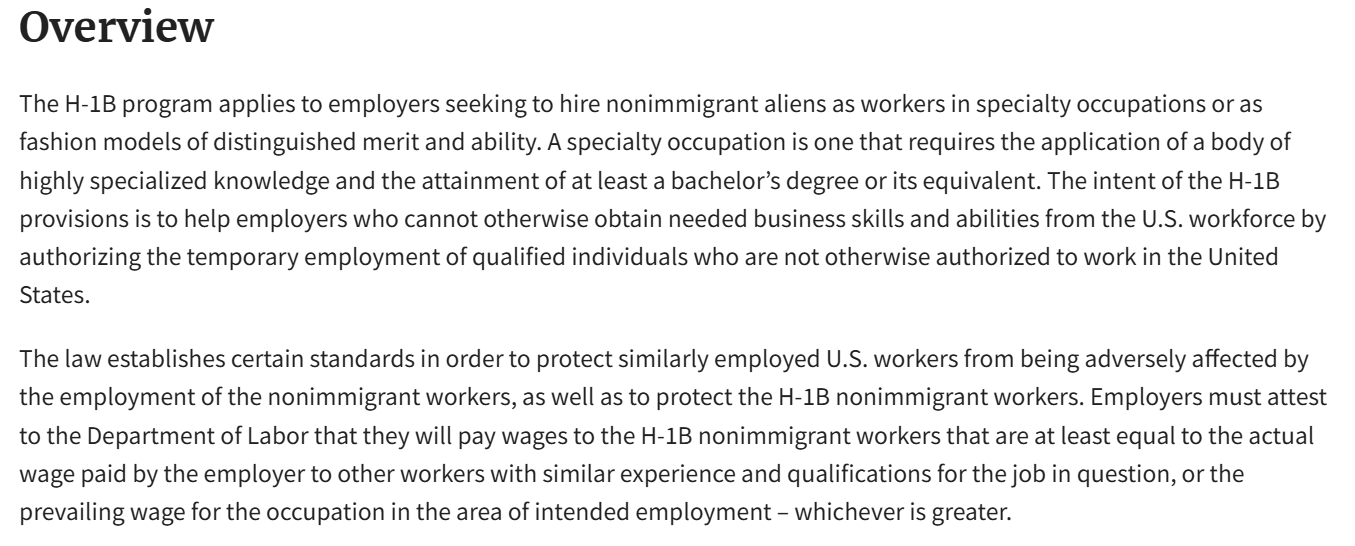
Separately, I’d love to know how COBOL-coding nerds and beautiful fashion models got lumped together:

“The H-1B program applies to employers seeking to hire nonimmigrant aliens as workers in specialty occupations or as fashion models of distinguished merit and ability

Full post, including comments

Identifying as Asian in an elite Maskachusetts school

From a friend in the Boston suburbs:

[Asian-American son] applied to be a student advisor and was turned down. He was perplexed as he has the highest GPA in the [expensive private] school of 500 students and gets along with everyone. He is a volunteer for the Special Olympics and helps people without being condescending. Everyone likes him. Even girls invite him to their birthday parties. He later found out that two of his black friends who didn’t apply got it. They said the school reached out to them and talked them into doing it, so they applied and were selected.

(Deplorable failure to capitalize Black in original. I can verify the father’s high opinion of this kid’s personality. He’s super smart, relaxed, athletic, and never brags.)

Different friend in the Boston suburbs:

guys, after several months of constant assault by [the wife], [the son] got himself a date to the prom

his sister tried everything – called him an incel

what’s the difference between [my wife] and a pitbull?

at some point, the pitbull lets go.

The future prom king is tall, fit, and looks great by my standards (i.e., is not old). I had previously asked him why he wasn’t exploring the public high school female population. He said, “I don’t agree with their value system. They say that you’re not sophisticated if you haven’t slept with at least five people before graduating high school.” I replied, “Well, if that’s all it takes then we can go down to the nearest bathhouse tonight and you can have sex with five guys in a couple of hours.” (The family has not invited me back into their home.)

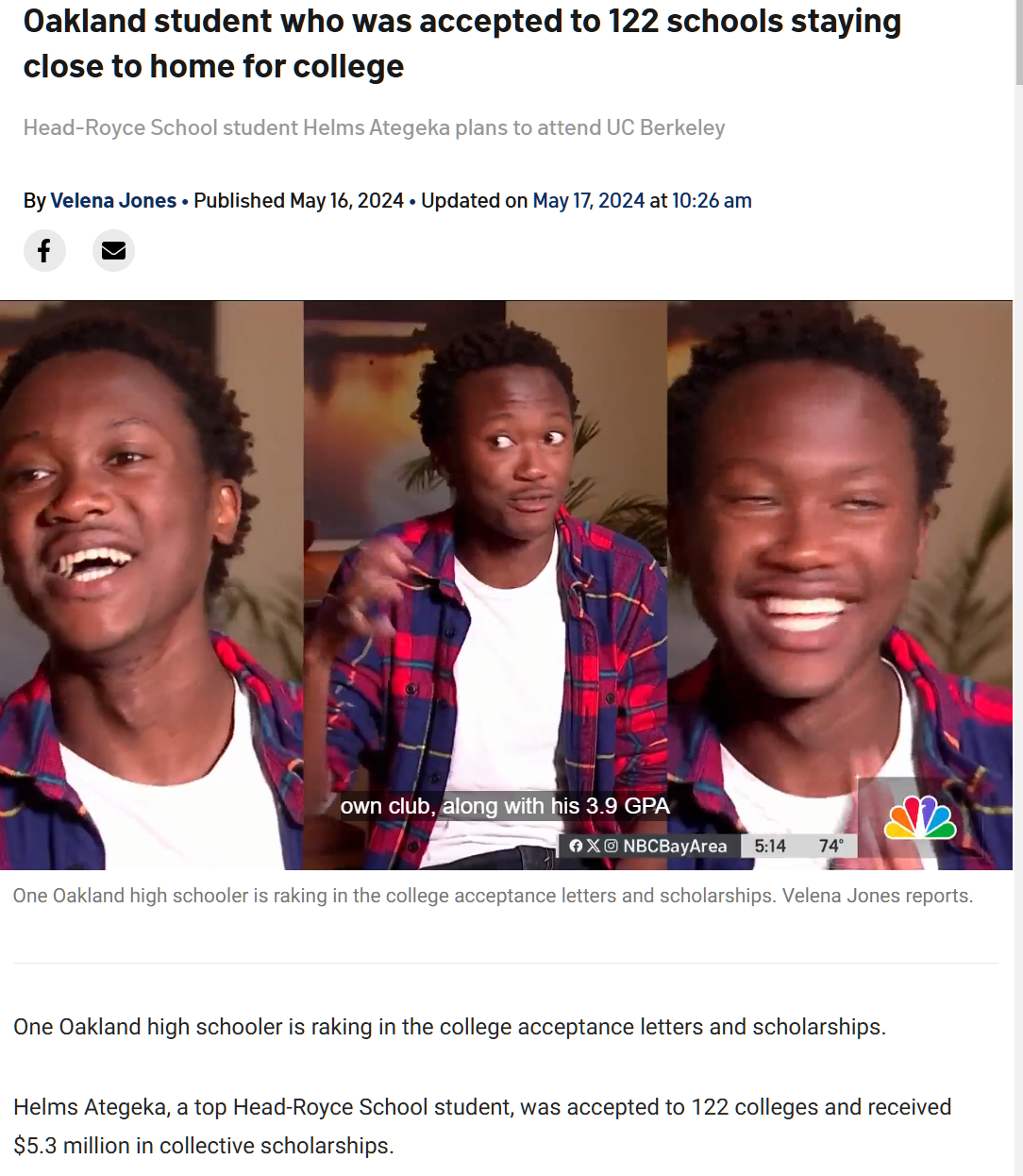
Related… (NBC)

Helms Ategeka, a top Head-Royce School student, was accepted to 122 colleges and received $5.3 million in collective scholarships.

“I feel really lucky that there are people out there, that there are institutions out there that see the value that I have to give,” Helms said.

Helms believes it was his nearly 10 extracurriculars, spanning from choir to theater to starting his own club, along with his 3.9 GPA that set him apart on paper.

Full post, including comments

Elite high school senior thesis

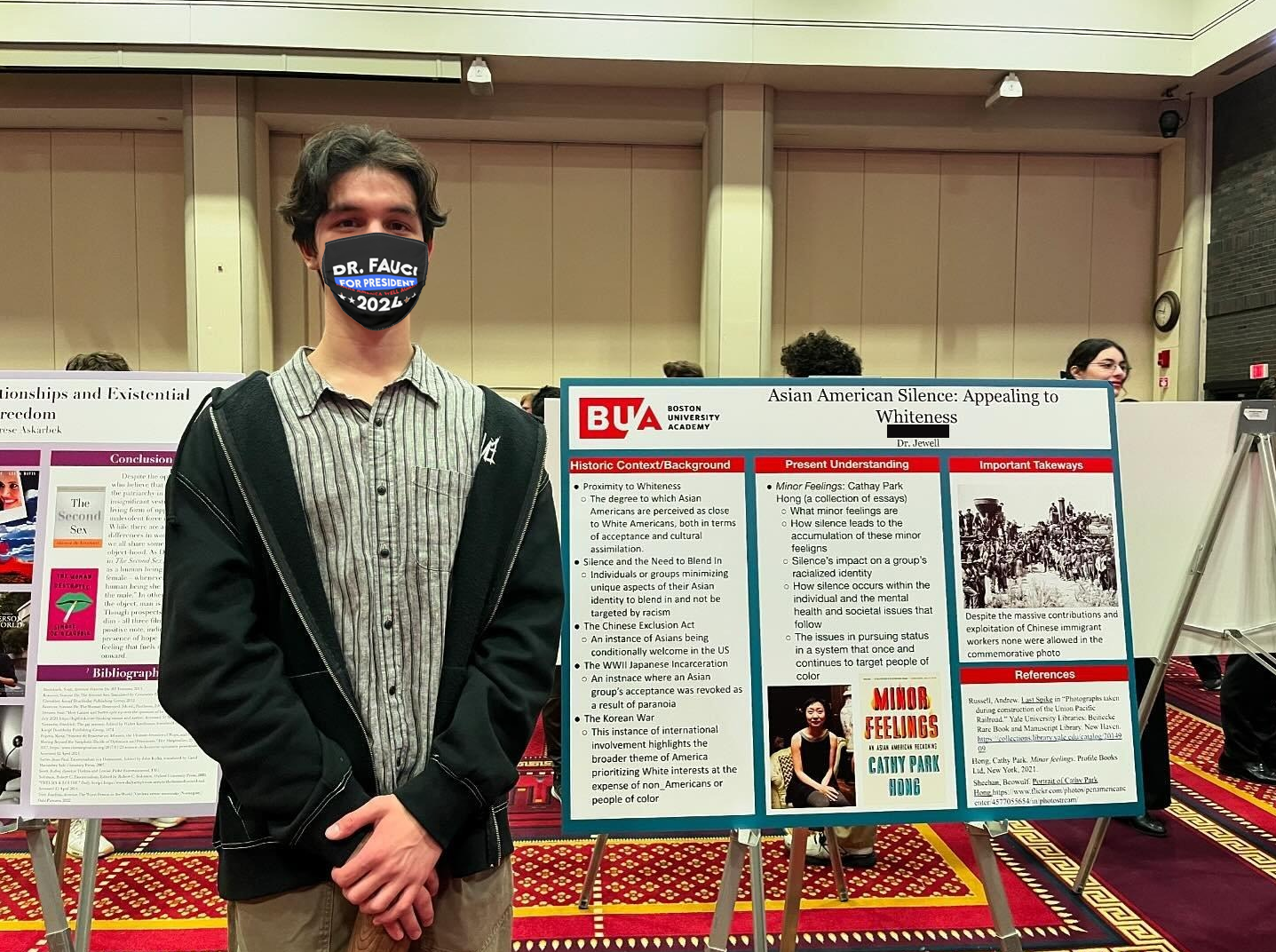
From $55,000/year (tuition alone) Boston University Academy, a senior thesis project for 2024:

To make sure that the scholar won’t be identifiable if the academic discipline of Comparative Victimhood ever wanes in intellectual prestige, I have removed his/her/zir/their name from the poster and added a fashion item.

Note that the poster on the left is all about Simone de Beauvoir, “Beaver” to Jean-Paul Sartre.

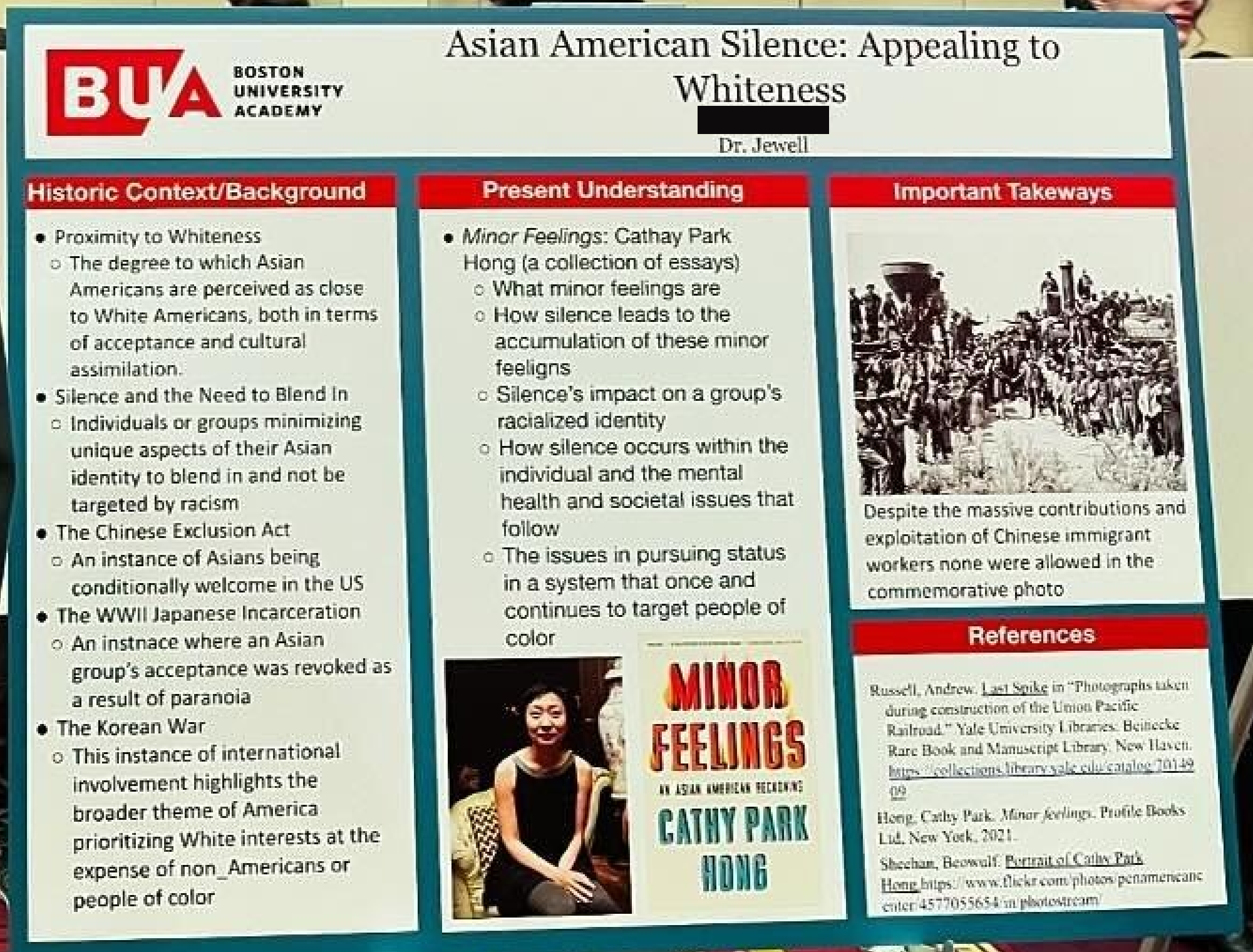
Here’s a close-up of the brilliant young person’s work, supervised by Dr. Kristin Jewell:

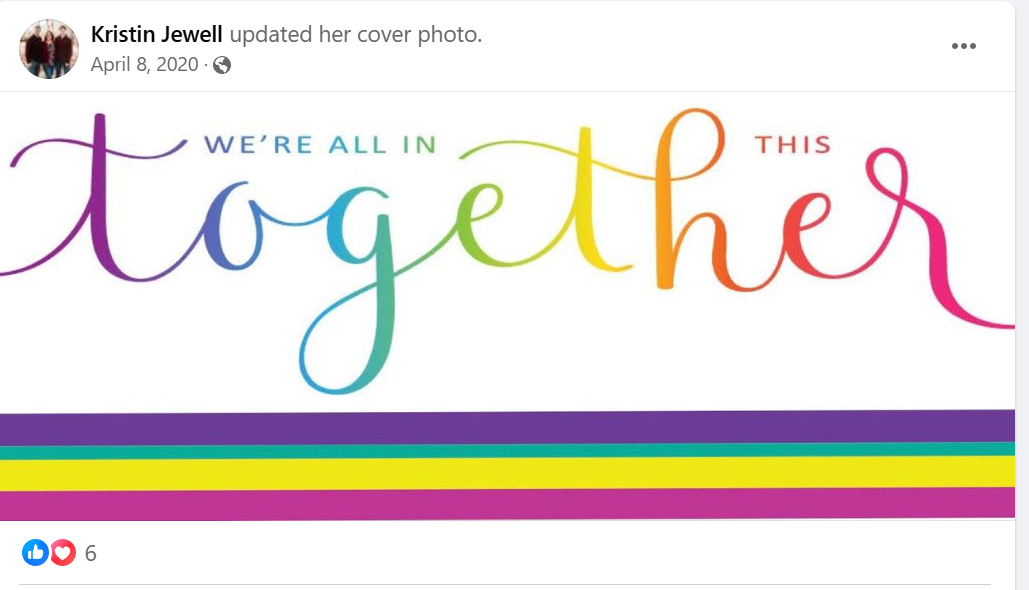
Let’s check the teacher’s Facebook page:

Let’s return to the poster…

A few unusual spellings and punctuations:

  • feeligns
  • non_American (generates warm feeligns in my Oracle RDBMS programmer’s heart)
  • instnace

A book jacket with the author’s name “Cathy Park Hong” is depicted while, above, the author’s name is spelled “CATHAY Park Hong”.

“The issues in pursuing status in a system that once [targeted?] and continues to target people of color” needs some help to qualify as Standard English?

“Despite the massive contributions [by] and exploitation of Chinese immigrant workers none were allowed in the commemorative photo” is missing a word?

Cathy Park Hong (from Cathay?) wrote about “What minor feelings are”, according to the poster. What if the minor feeling is “For $55,000/year in high school tuition, the teacher should show students how to run posters through spellcheck”?

More substantively, does the poster imply that “people of color” in South Korea (i.e., Koreans) are worse off today because the American military prevented the North Korean government from taking over what is today South Korea? Whites got a great deal because we can buy Samsung phones, sophisticated semiconductors, and Kia Tellurides while “people of color” suffer in Seoul?

Full post, including comments

Don’t let your kids take challenging classes in high school

I’ve been talking to Canadian and American friends after this latest round of college admissions and they have one message in common: Don’t let kids take honors and AP classes in high school. College admissions these days are mostly about GPA, which means that a B in AP physics is toxic compared to an A in basket-weaving. It’s also important to send kids to a high school where grading is relatively easy. From a Maskachusetts friend:

I found out that even though you need just 60% to score a 5/5 on AP Physics C, our [rich suburb public] school still applies the scale where 92+ is an A. So [my son] is scoring 80+ on the tests consistently and will end up with a B+ or even a B- and obviously will get a 5. I asked around and most schools apply the 60+ = A scale to APs. People in 3 private schools said that 70+ on AP Calc BC in their school is an A.

I’m not sure how this would work in Florida where high school kids are entitled to take college courses in actual colleges (for free and the state also pays for their textbooks). Does the college class grade end up being rolled into their high school GPA? This FAQ suggests that dual enrollment grades are weighted into a GPA the same as an AP course grade.

Also toxic:

  • applying from rich suburbs of Northeast cities
  • activities that sound elite (unless the kid is good enough at an elite sport to get admitted via athletics)

Speaking of schools, it was almost exactly four years ago (May 2020) when Donald Trump denied Science (Anthony Fauci) and said that American public schools should be reopened (which Democrat-run cities did… 10-16 months later). “Trump Pointedly Criticizes Fauci for His Testimony to Congress” (NYT, May 13, 2020):

Dr. Anthony S. Fauci, the nation’s top infectious disease expert, who had warned against reopening the country too quickly and stressed the unknown effects the coronavirus could have on children returning to school.

“I was surprised by his answer,” Mr. Trump told reporters who had gathered in the Cabinet Room for the president’s meeting with the governors of Colorado and North Dakota. “To me it’s not an acceptable answer, especially when it comes to schools.”

The president’s desire to reopen schools and businesses in order to bring back the economy has often led to public clashes over the guidance provided by Dr. Fauci, who has warned that taking a cavalier attitude toward reopening the country could invite unnecessary suffering caused by a virus scientists are still struggling to understand.

Dr. Fauci also told the Senate panel that a vaccine for the coronavirus would almost certainly not be ready in time for the new school year, and warned of the dangers of the virus to children.

“Now when you have an incident, one out of a million, one out of 500,000, will something happen? Perhaps,” Mr. Trump said, minimizing the risk to children of returning to school. “But you can be driving to school and some bad things can happen, too.”

Mr. Trump added: “This is a disease that attacks age and it attacks health and if you have a heart problem, if you have diabetes, if you’re a certain age, it’s certainly much more dangerous. But with the young children, I mean, and students, it is really just take a look at the statistics, it is pretty amazing.”

As someone who has spent a lot of time teaching probability theory, I am cheered to see that the president of the U.S. in 2020 was using it!

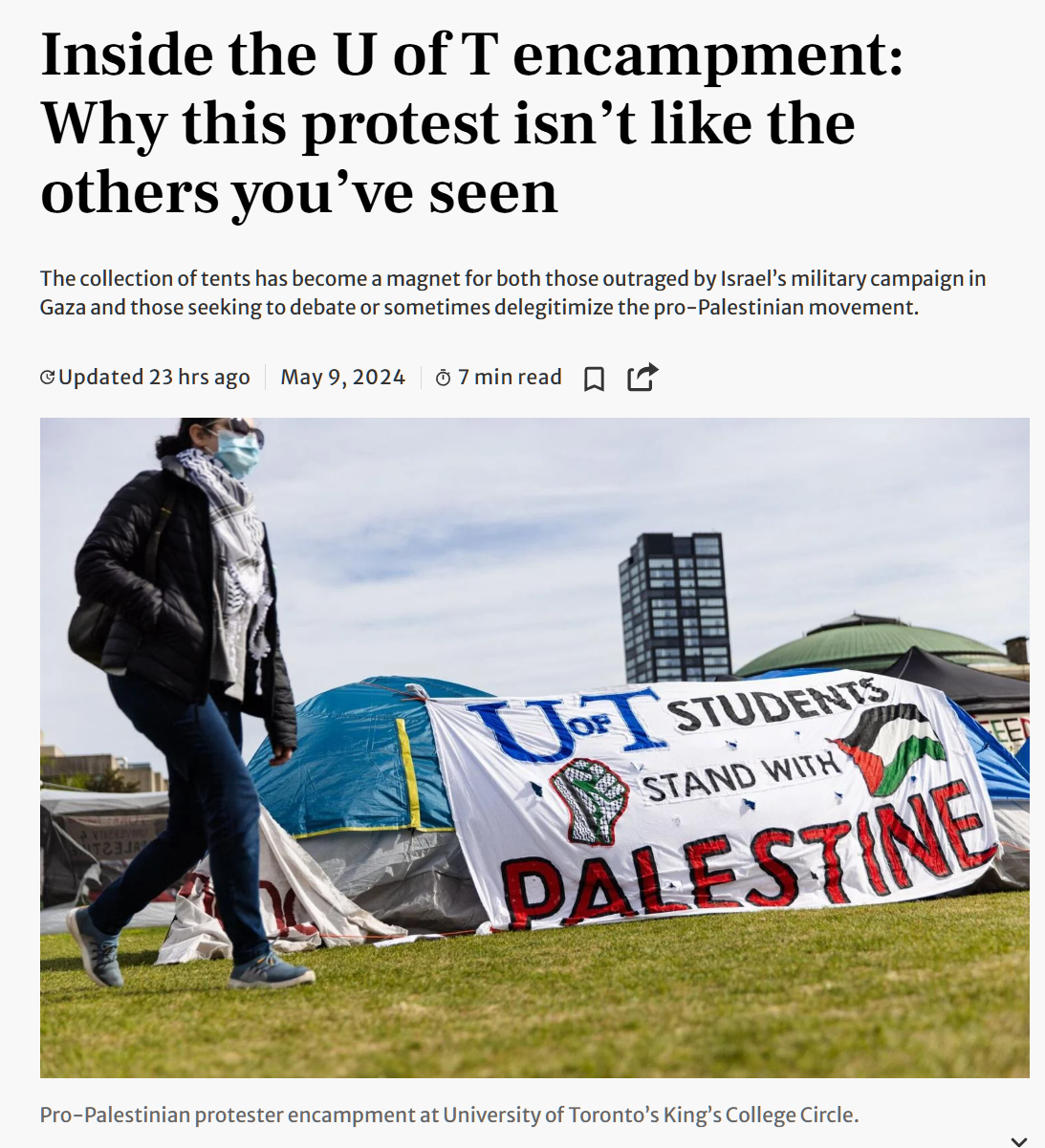
Speaking of Canada… (Toronto Star)

Full post, including comments

Schools and Science intersect to form absenteeism

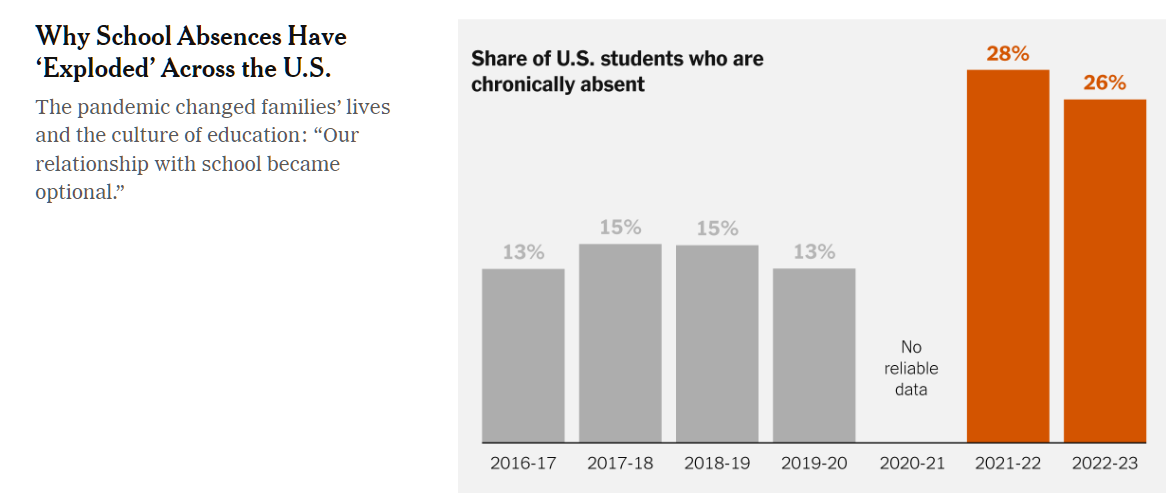
In order to protect 8-year-olds from a virus that was killing Americans at a median age of 82, Science said that it made sense to close public schools for between 3 and 18 months, depending on the degree to which Democrats controlled a city/state. (Adults continued to mix freely at alcohol and marijuana stores, on Tinder, in quickly-reopened restaurants, etc.) This was almost certain to result in premature deaths many decades from now due to the correlation between years of education and life expectancy. However, it looks like the loss of years of education has continued beyond the 18 months that schools were closed in the Cities of the Righteous. From the New York Times, March 29, 2024:

The article is primarily based on “Long COVID for Public Schools: Chronic Absenteeism Before and After the Pandemic” (American Enterprise Institute, January 31, 2024).

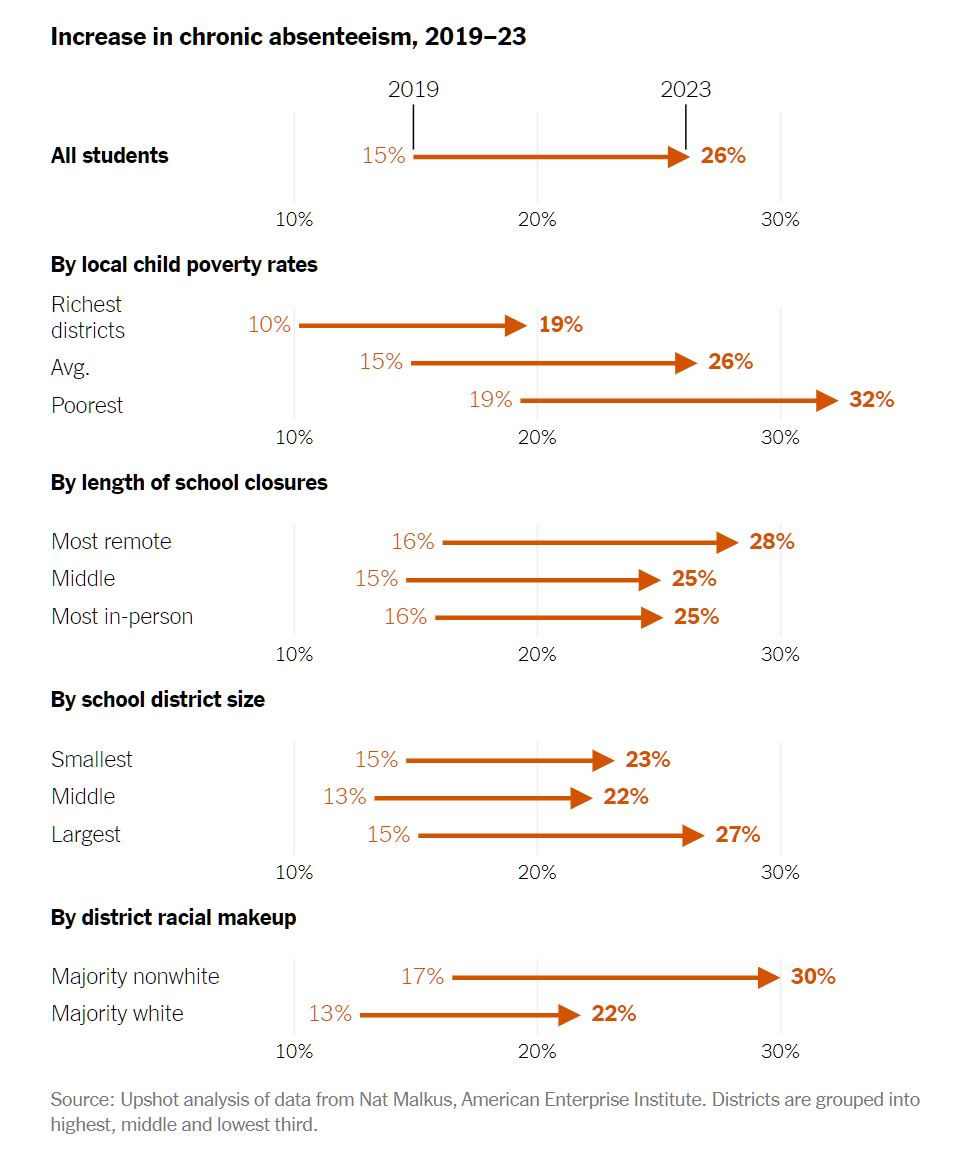
Lengthy school closures were primarily perpetrated by politicians and bureaucrats who claim that racial equity is their first priority, but it turns out that the school systems that suffered the worst long-term consequences were “majority nonwhite”:

Florida isn’t mentioned in the article, but if we dig into the underlying PDF report, it turns out that Governor DeSantis forcing teachers to return to work in the fall of 2020 was minimally helpful. Chronic absenteeism went from about 20 percent to about 31 percent in Deplorably Open Florida, very similar to Virtuously Closed New York’s numbers.

Maybe the answer is that even a few months of school closure communicates to about 10 percent of American families that school isn’t important?

Could we use Science to solve this created-by-Science problem? If half a year off school (Florida) was just as pernicious for attitudes toward attendance as 1.5 years off school (New York) maybe we should eliminate the summer break from school for at least two years to re-instill the habit of going to school every day. If unionized teachers refuse to work more than 185 days per year, we could either hire some summer-only teachers or distribute the summer days off more evenly around the calendar so that teachers worked the same number of days. We could have multiple three-week breaks during the year, for example.

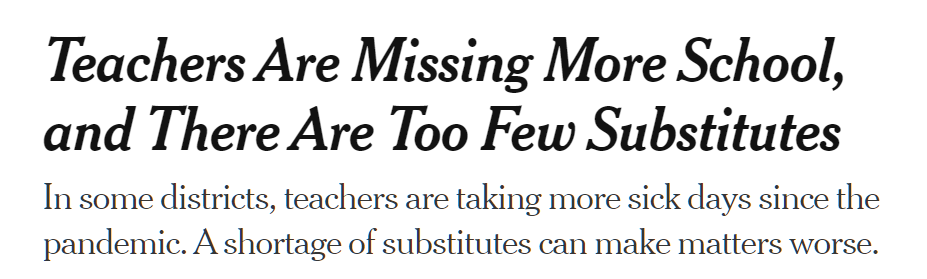
Who else doesn’t bother showing up to school since coronapanic introduced them to the joys of being home M-F with the Xbox? Teachers! NYT:

Teachers typically receive paid sick days and a small number of personal days. Over the 2022-23 school year in New York City, nearly one in five public schoolteachers was absent 11 days or more, an increase from the previous year and from before the pandemic. In Michigan, roughly 15 percent of teachers were absent in any given week last school year, compared with about 10 percent in 2019, researchers found.

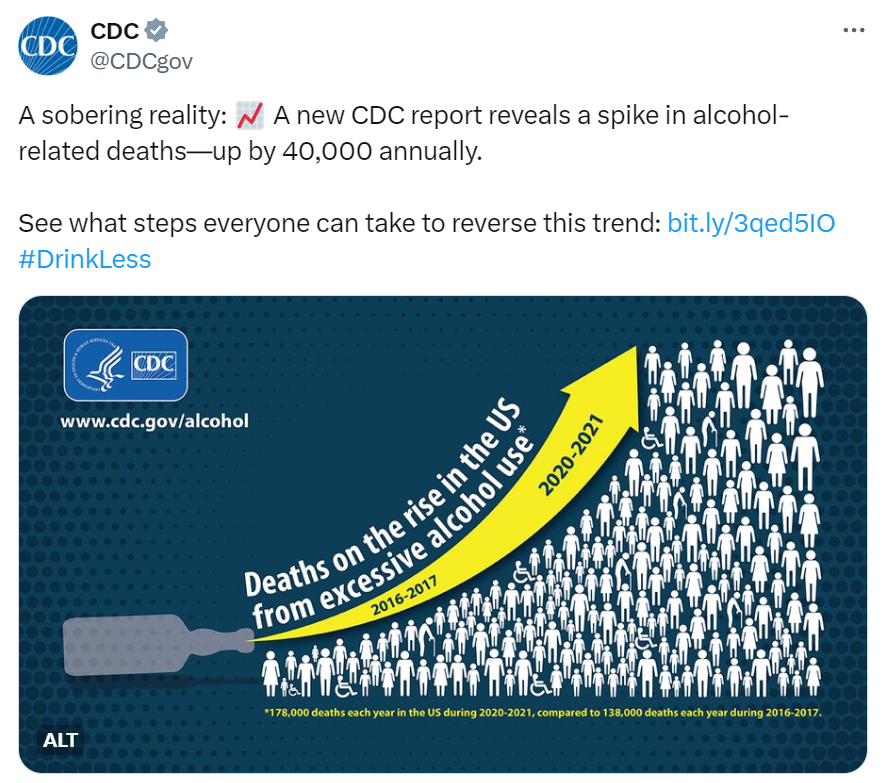
Related… from Science itself (the CDC), which said “yes” to booze and “no” to schools (and maybe the CDC itself was imbibing when it told everyone to wear cloth masks as PPE against an aerosol virus):

In the case the tweet gets memory-holed:

Full post, including comments

Covidcrats’ war on poor children, quantified

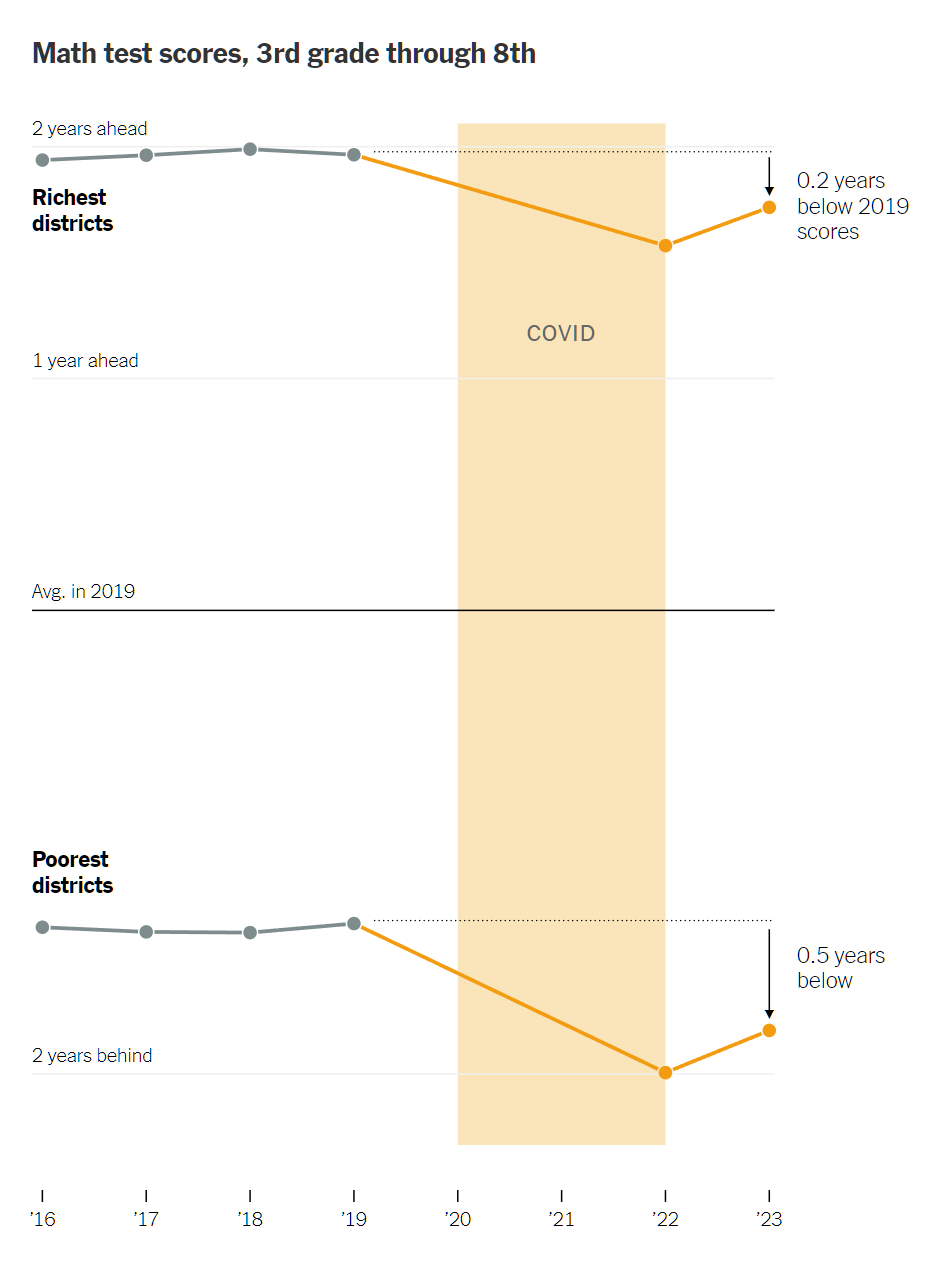
The New York Times has a story on how the coronapanic shutdowns set American K-12 students back (which is the same as killing them, by COVID standards, since people with less education tend to live shorter lives and any shortening of a life can be considered a “COVID death”). Of course, the headline is about the “surprising rebound” (every action taken by a Covidcrat was actually beneficial when viewed in the proper light).

The article has a side note that the recovery in reading ability has been weaker and then proceeds to present charts only on math test scores, where the “rebound” has been stronger. Your kids’ rebound energy may vary, depending on family wealth (like life expectancy, correlated with education). The poor kids were destroyed:

So the poor kids are now likely to have both intensified poverty and intensified ignorance as factors in shortening their lives (plus the Biden-era flood of migrants, who are correlated with unemployment and incarceration for the low-skilled native-born).

The NYT journalists and editors don’t mention what happened in the one state where school closure was limited by the governor to about 3 months: Florida. Digging into their cited data source, characterized as a “national study” and with analysis “led by researchers at Stanford and Harvard”, it appears that Florida was ignored by the academic worthies (maybe anti-Science DeSantis suppressed data?).

Sweden recently showed a decline in PISA scores, suggesting that keeping schools open is just as bad for kids as closing them.

Full post, including comments

Intersection of low-skill migration and school closure

Loyal readers are aware of my interests in the effect of low-skill immigration on American society and the passion of government bureaucrats for closing public schools in favor of an online school fraud. These intersected today in the Sanctuary City of New York. “NYC students forced to go remote as city houses nearly 2K migrants displaced by storm at their school” (New York Post):

Students at a Brooklyn high school were kicked out of the classroom to make room for nearly 2,000 migrants who were evacuated from a controversial tent shelter due to a monster storm closed in on the Big Apple.

The city made the move amid concerns that a massive migrant tent at Floyd Bennett Field would collapse from torrential rains and gusting winds — packing them instead into the second-floor gym at James Madison High School five miles away.

“There’s 1,900 people getting thrown into my neighborhood, half a block from where I live and we don’t know who they are,” he said. “They’re not vetted. A lot of them have criminal records and backgrounds and we don’t even know.”

How would Americans “vet” migrants? What do we know about who did what in various foreign countries?

“They told us we had to get everything out by 5 [p.m.],” gym teacher Robyn Levy said outside the school. “They sent us the email at 6 in the morning. I don’t know when we’ll be able to back.

“What I want to know is why here?” Levy said. “Why not send them somewhere where students wouldn’t be disrupted, where students learning wouldn’t be disrupted?”

Why indeed? If there are only 1,900 migrants and the majority of New Yorkers wanted the city to be a sanctuary for the undocumented, why can’t 1,900 spare bedrooms be found among the righteous?

Here’s what used to be a convenient runway…

Full post, including comments

White vs. Black in Maskachusetts

From a chat group with some of my friends who are still up in the Boston suburbs:

[9th grader] lost points on a grammar test today because she capitalized Black and also White when referring to groups of people. Her teacher said that only Black should be capitalized, as that is an identity – but white is just a color and doesn’t refer to a cohesive group of people.

Also:

My friend wrote a letter to the head of the private school saying they should take down the BLM-logo mural because they endorse the Palestinian attack. After much pressure, she agreed to replace it with a general message of inclusion without the BLM logo. This is what it was replaced with:

Full post, including comments

Getting into an elite college via fencing

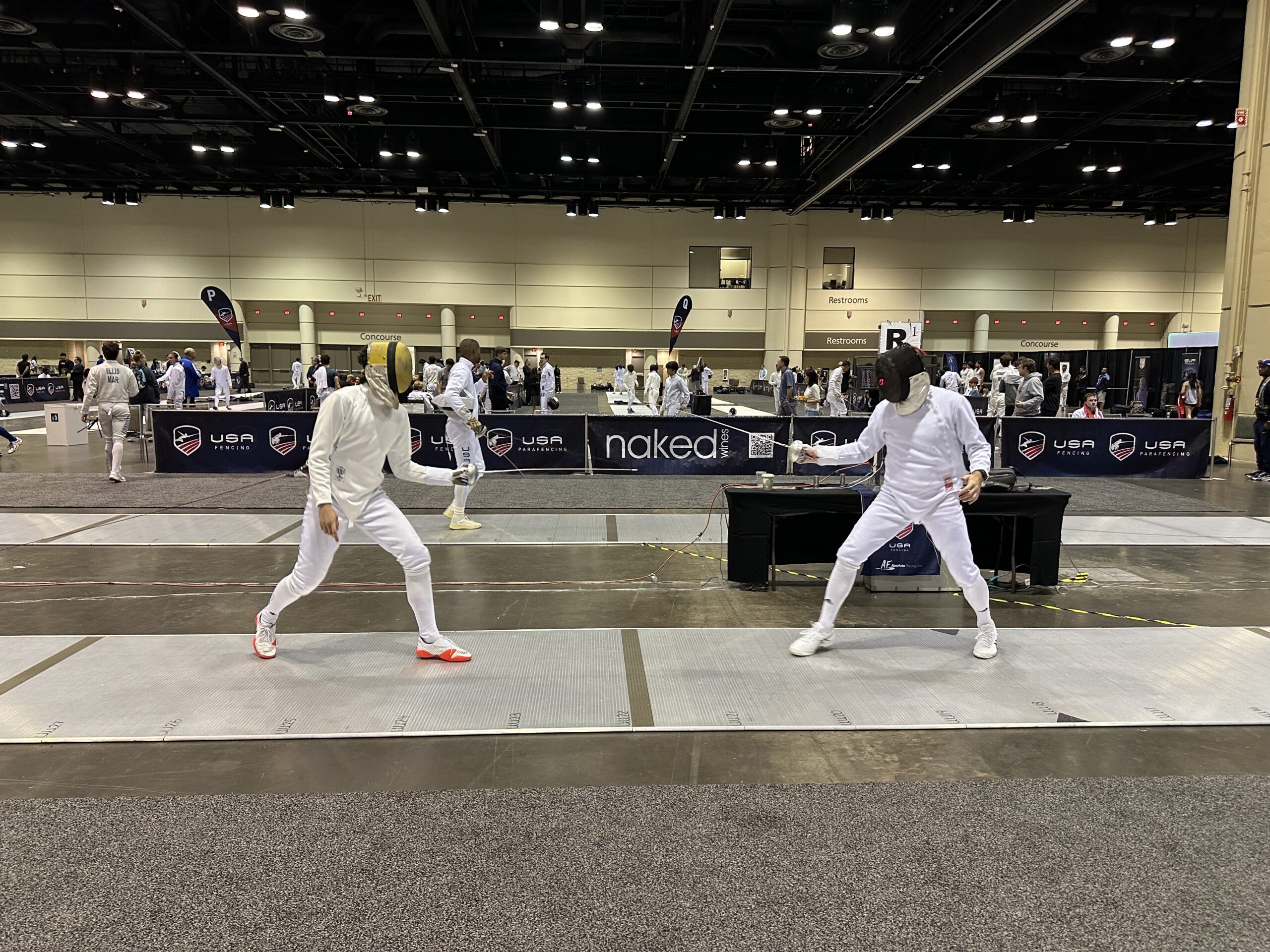
I was recently sentenced to being a spectator at the USA Fencing October North American Cup, held in Orlando’s convention center (America’s 2nd largest, after Chicago’s). In épée, one scores a point by touching one’s opponent anywhere. The tip of the sword responds to pressure. You could score a point by touching the ground or your own foot, for example. Each competitor’s épée is attached to a retractable wire tether. The competitors go back and forth on a conductive mat. If the sword tip is touched to the mat, that does not register a point (but touching just to the side of the mat, unless the ref notices, will score a point). If you think that your friend has just scored a point, having advanced dramatically with sword pointed at the opponent’s body, almost surely he/she/ze/they has just lost a point.

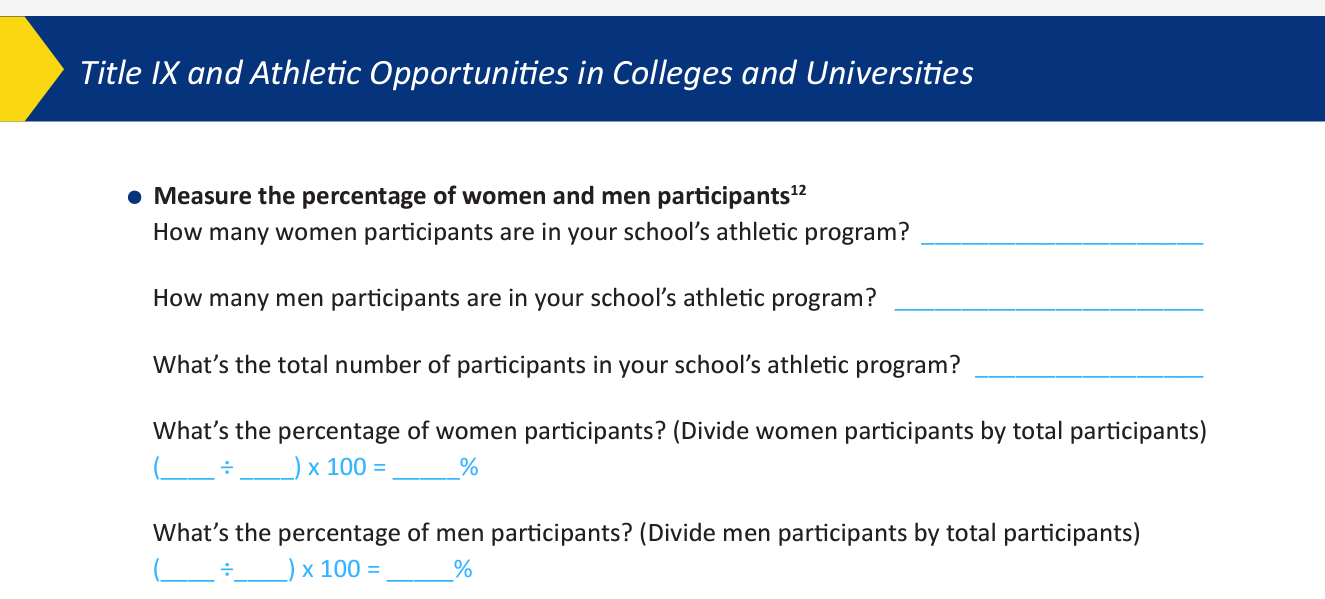
My friend refuses to accept the limitations of age and was mixing it up with college students. He was thus eliminated after a few hours. His main reason for traveling to Orlando, however, was for the kids, both in high school. The event was packed with Chinese- and Indian-American families anxious to get their cherished offspring into elite universities. What are their chances? “A boy needs to be ranked in the top 20 nationally to get into a decent college,” my friend said, “while a girl can get in by being anywhere in the top 40.” Why the difference? “A lot of colleges have women’s fencing programs, but not men’s. This is so that they can keep their Title IX balance when they have a football team, for example, for which only men are good enough.” He cited Tufts, Brown, and Cornell as examples of schools with no men’s fencing (a larger list). Here’s an excerpt of a federal form:

(Note the gender binarism on parade! Athletes count only if they identify as either “men” or “women”.)

Reflecting the sport’s center of gravity being in the Northeast, USA Fencing went all-in on forced masking and forced vaccination. They formerly required proof of Covid-19 vaccination and then proof of booster shots for the fit teenagers who were competing (at a time when the injections were not FDA-approved, but only emergency use authorized) and also for the middle aged parents who wanted to enter the venue as spectators. Everyone within the venue had to wear a basic mask and competitors had to wear masks under their fencing masks. Coronapanic was great for my friend’s kids. While their competitors lost a year due to fencing clubs being shut down, they were being trained in their 3-car garage by their dad, a world-class fencer in his youth. (Coronapanic also helped their relative academic ranking. Their education continued uninterrupted while comparatively poor kids in big Democrat-run cities lost 12-18 months.)

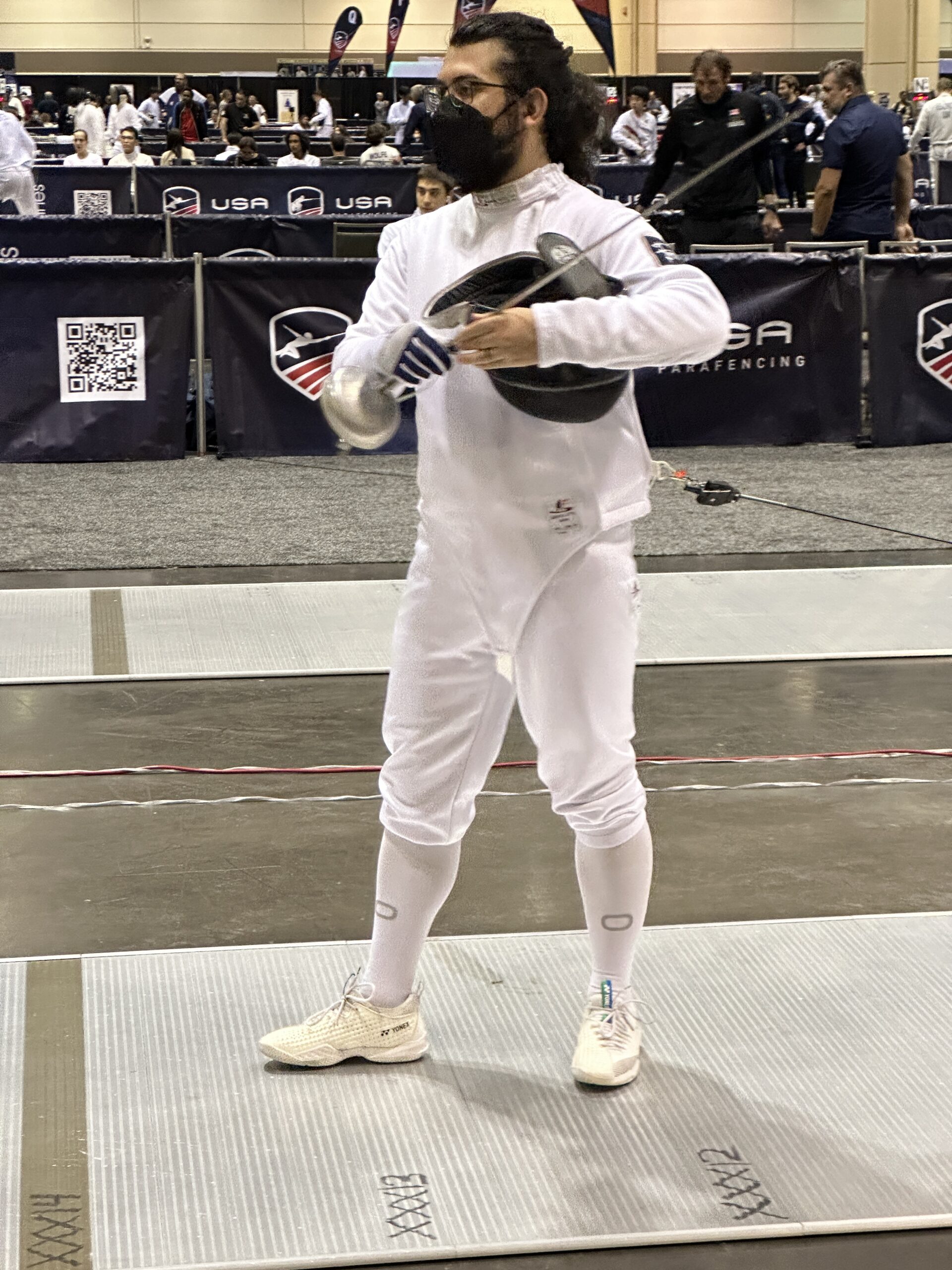
Despite masks now being optional, I was able to find an example of dressing to defend oneself against a virus armed with a sword:

Note that #Science told this fencer to wear a full beard in addition to the (now-voluntary) mask.

Although everyone at the competition whom I met resided in the U.S., those who were immigrants from foreign countries would usually have a country affiliation other than “USA” on their back, e.g., “MAR” for Morocco (Maroc). Players from The Country That Shall Not Be Named were required to sign papers denouncing Vladimir Putin and the Russian military in order to compete. They would then appear without a country affiliation on their backs.

Circling back to the college admissions angle, think about the parental investment required for this gambit: years of driving to a local fencing club several times per week and weekends devoted to competitions multiple states away. All in hopes that one’s son can reach the Top 20 or that one’s daughter can reach the Top 40. Note that a non-Asian athlete will usually have an advantage over an equally-ranked Asian fencer. Coaches have found that a lot of the pushed-hard-through-high-school Asian kids quit fencing early in their college careers, saying “my parents want me to focus on getting into medical school.” The non-Asians have been more likely to stick with the sport.

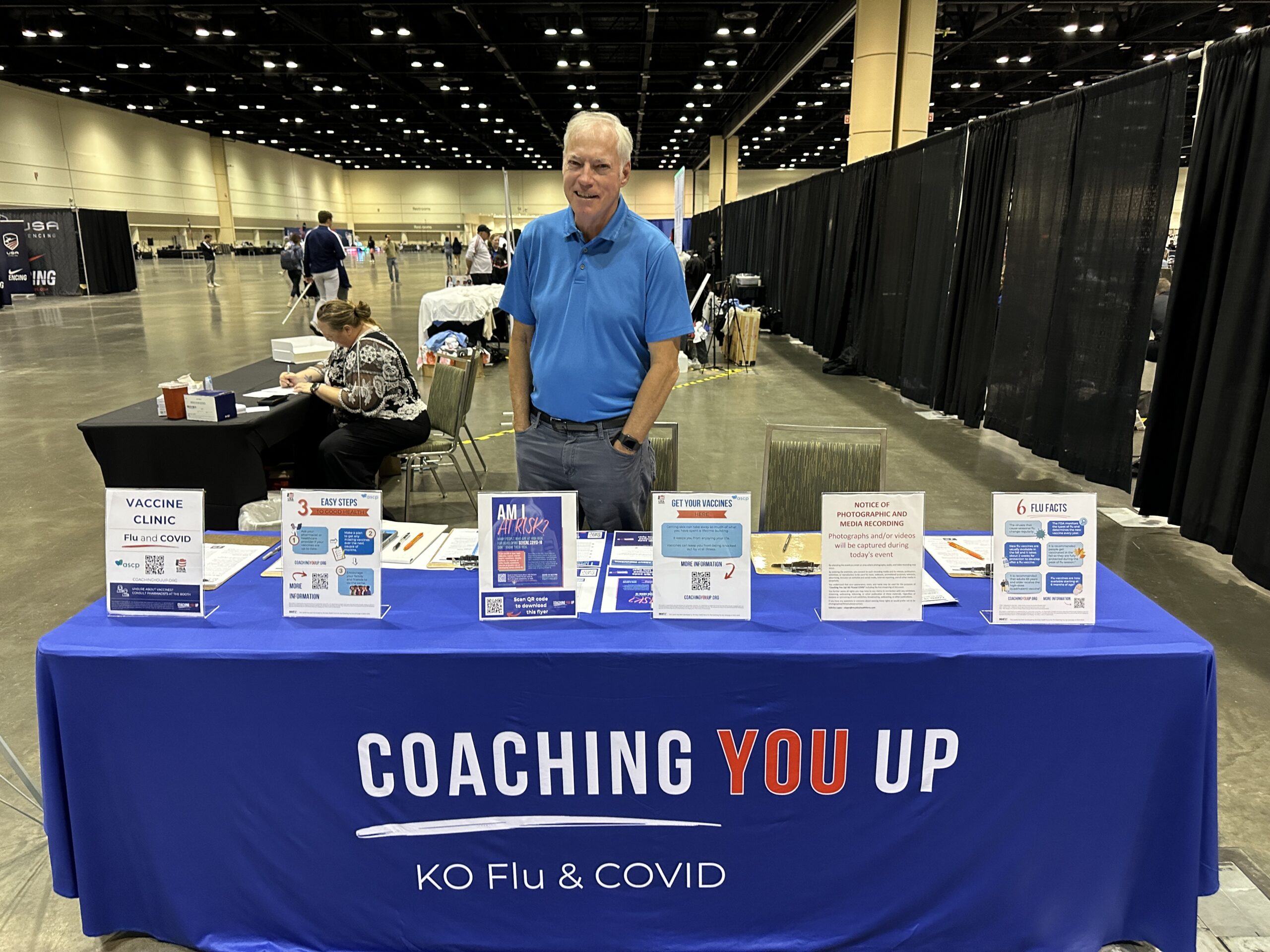
How about getting your flu and Covid-19 vaccines at the event? Nothing could have been easier. The event had been going for about 16 hours when I stopped to check. Given a crowd of people with a track record of doing absolutely anything that the government tells them to do, the pair below had injected… two people (one every 8 hours).

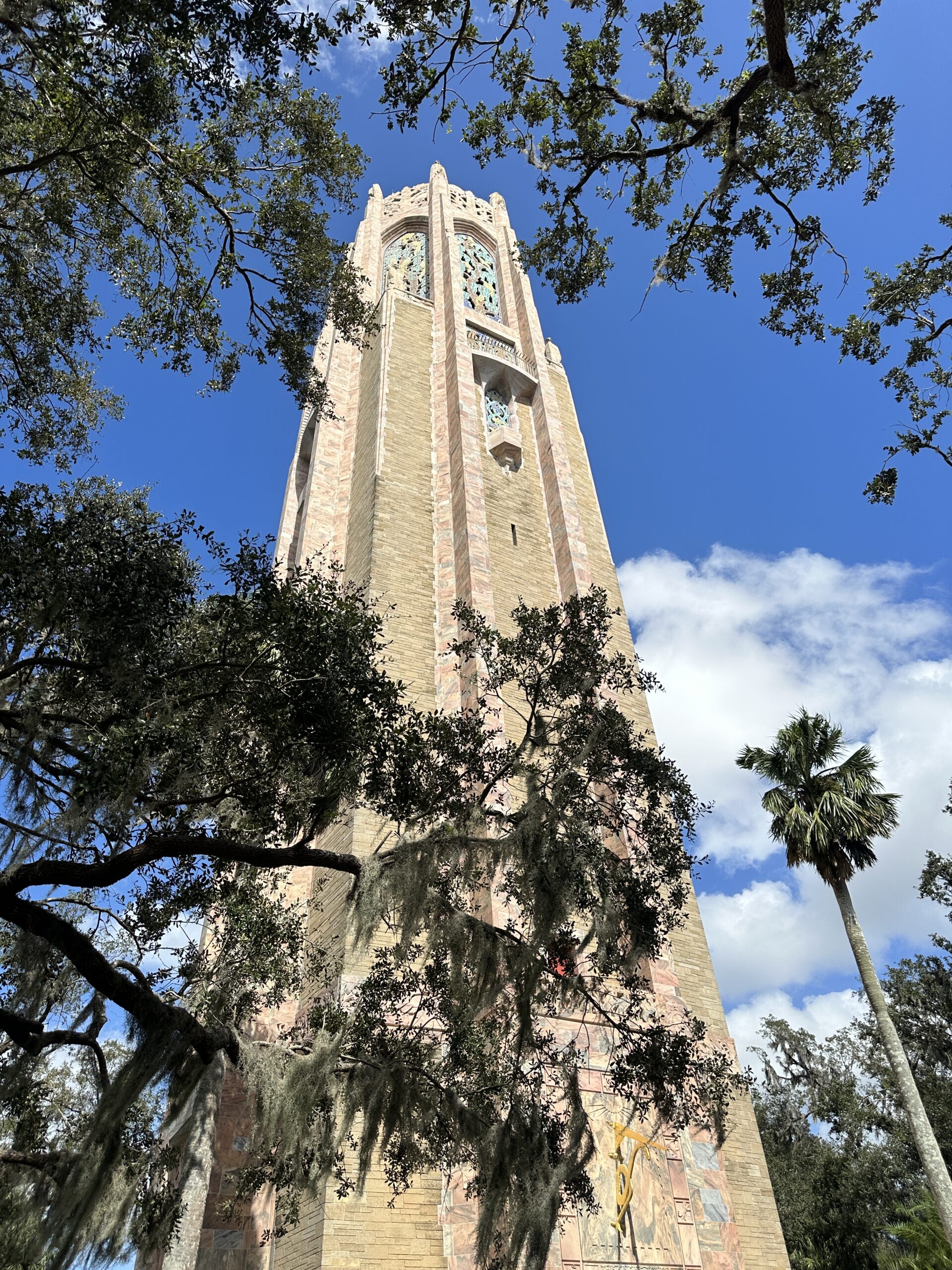
What else was happening? I stopped on the way up at Bok Tower Gardens, a truly magnificent

We were staying at the Hilton next to the convention center, so I took my friend, pumped full of Advil, to SeaWorld across the street as a cultural experience.

You can celebrate Pride together with Shamu:

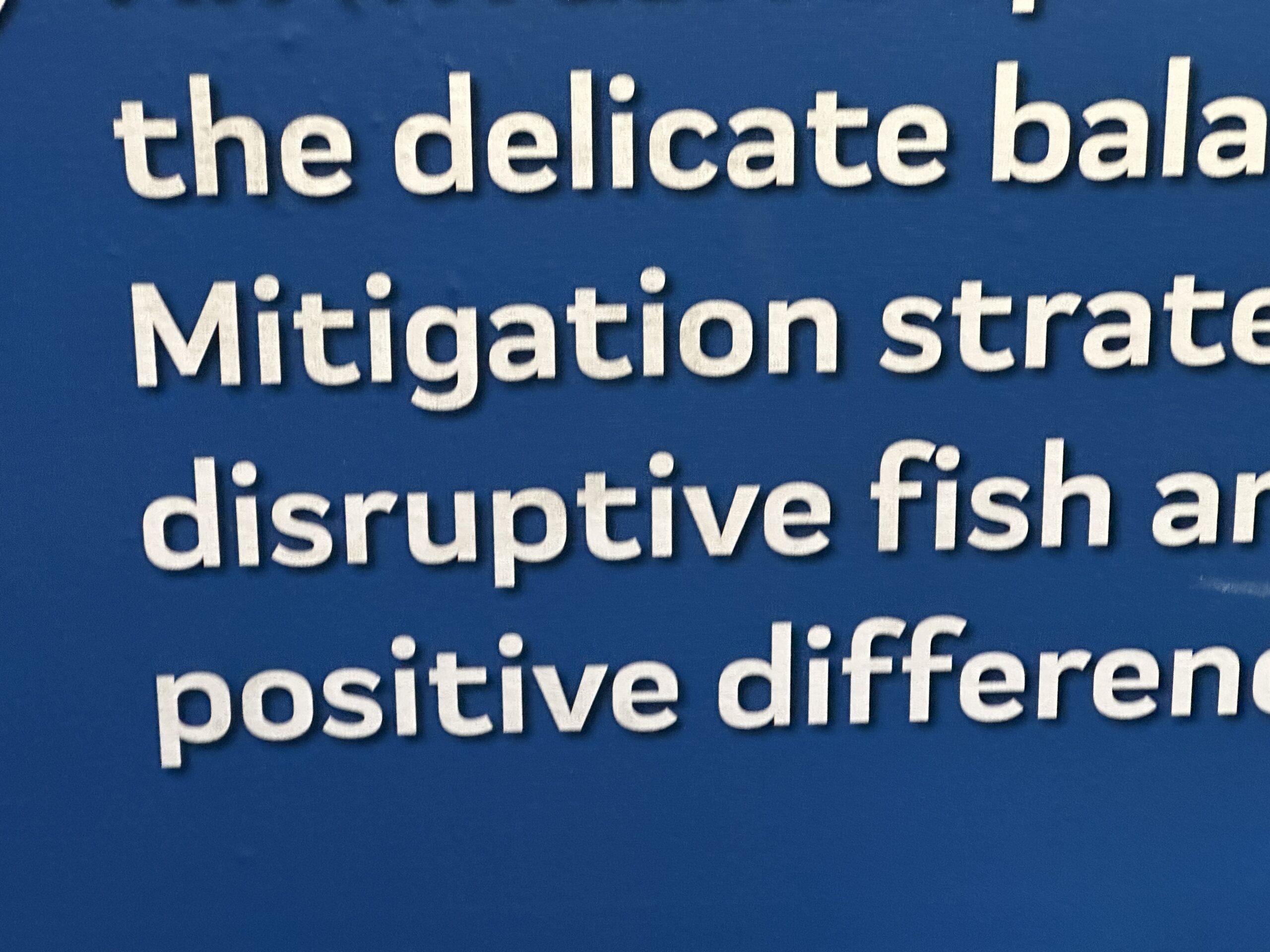
SeaWorld reminds visitors that immigrant lionfish are “disruptive” and the term “non-native” is used in a pejorative manner.

(I’m not sure that it can be blamed on the mass immigration of lionfish, but Interstate 4 between Disney World and Orlando was subject to traffic jams at all hours of the day and night (e.g., at 10 pm). Congested as the roads are with 2.7 million people in the metro area, the population is expected to grow by 75 percent between now and 2060.)

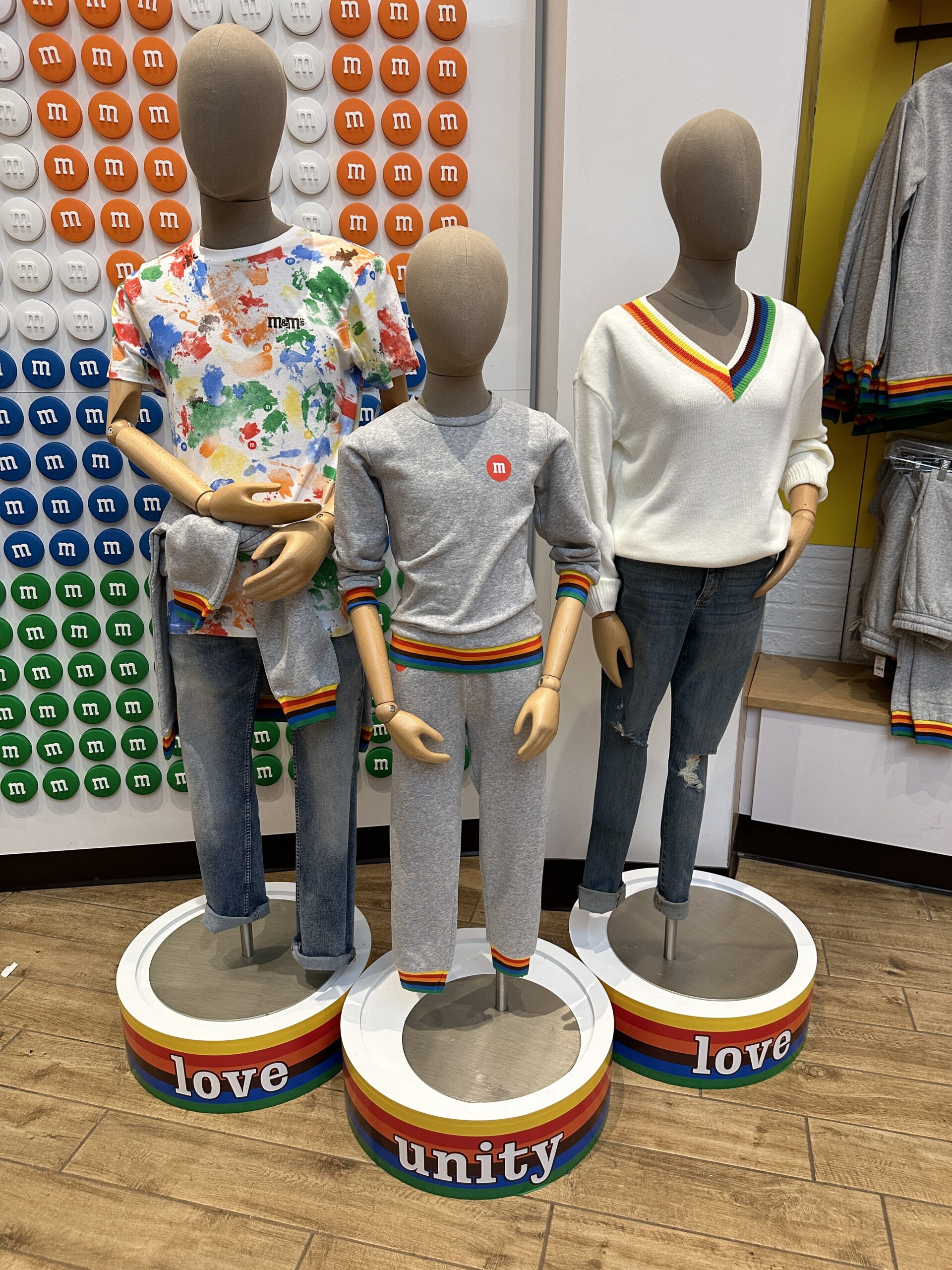
I also took my fencing friend to Disney Springs. The M&M store:

Full post, including comments