An F/A-18 pilot comments on the F-15s shot down by Kuwaitis

A friend last seen in Top Gun slows down to 25 mph (across Florida by EV) and Overheard at Oshkosh (“I’ve met 120 of the 30 people who flew in the first Top Gun movie.”), regarding the three F-15s shot down by a Kuwaiti crew in an F/A-18. (Not in quote style for readability)

[in response to how could it have happened] A large percentage of our jet losses in that region have been friendly fire. In fact I think nearly all except during the gulf war.

Tons of reasons it happens from the shooter side. From the aircraft side often the defensive systems may be off, and you are focused on getting in to land/deconflict in the terminal area. You don’t assume your own team is going to light you up.

In the recent destroyer shooting down a U.S. jet. Another jet was targeted and was in mostly disbelief assuming the missile was going after something else. So even if your RWR went off you might just assume it is aimed at something else you don’t see. Since the ships are certainly interrogating air targets with their radars and might shoot SMs, hopefully with a clear lane, while there are friendly planes up still.

[in response to a discussion of why some of the F-15 pilots were injured] Momentum mostly

First the seat fires and in a two seat model the other person will say eject 3 times then pull. You hope in that brief moment you get into the proper ejection position (lower legs back, thighs on seat, back against seat, shoulders square, head neutral and back). If not, anything out of place is going to have a large amount of acceleration very quickly which causes injuries (eg broken femur from the seat accelerating first then hitting your leg that wasn’t on the seat).

Then all of those out of place
Items, arms included have major flail damage risk. If it’s a controlled ejection because of a mechanical issue you can minimize the speed and angle for ejection. In this case not so much most likely. So your arm that may have been hanging off to the side now has the momentum issue and maybe hit something on the way out, and then may be exposed to 300 knots or more wind suddenly.

People commonly get knocked out but wake up in the chute. The rest of the other injuries are mostly from the ejection, the flail injuries, or a bad parachute landing fall.

[in response to a question about how it was possible for the Kuwaits to misidentify three F-15s at fairly close range] Could happen but yea something seems off here.

May have felt panic that 3x mig-29 or whatever he thought it was, was also breathing down their neck. I assume this was also after missiles landed or maybe nearly landed so tensions were already high.

I think this falls in the category of don’t attribute to malice what can be contributed to incompetence. My guess is basic human error/training/skill.

But I also don’t know the details. I assume by now people know most of what needs to be known. Either way that pilot is riding the bench for a while.

Would be interesting to understand if they were declared hostile and if so by who[m!]. The hostile declaration and what the positive ID requirements were would be interesting to know. I assume details will come out.


Loosely related….

Very loosely related (aviation and war)…

The above related to CNN’s coverage of some anti-Islamophobia activists in Manhattan:

Full post, including comments

Don’t kill your enemies if you want to win a war (NYT)

Curtis LeMay: “I’ll tell you what war is about, you’ve got to kill people, and when you’ve killed enough they stop fighting”

New York Times, regarding the untimely death of Ali Larijani, the guy who’d been running Iran: “Israel’s Killing of Ali Larijani Could Allow Military to Tighten Grip on Iran … had a reputation for acting as a bridge between hard-line figures in the armed forces and more moderate political factions”.

If that wasn’t clear enough for communicating how foolhardy the idea of killing the enemy is as a warfighting technique, the NYT ran a second article explaining that killing the enemy “can backfire” (i.e., will backfire).

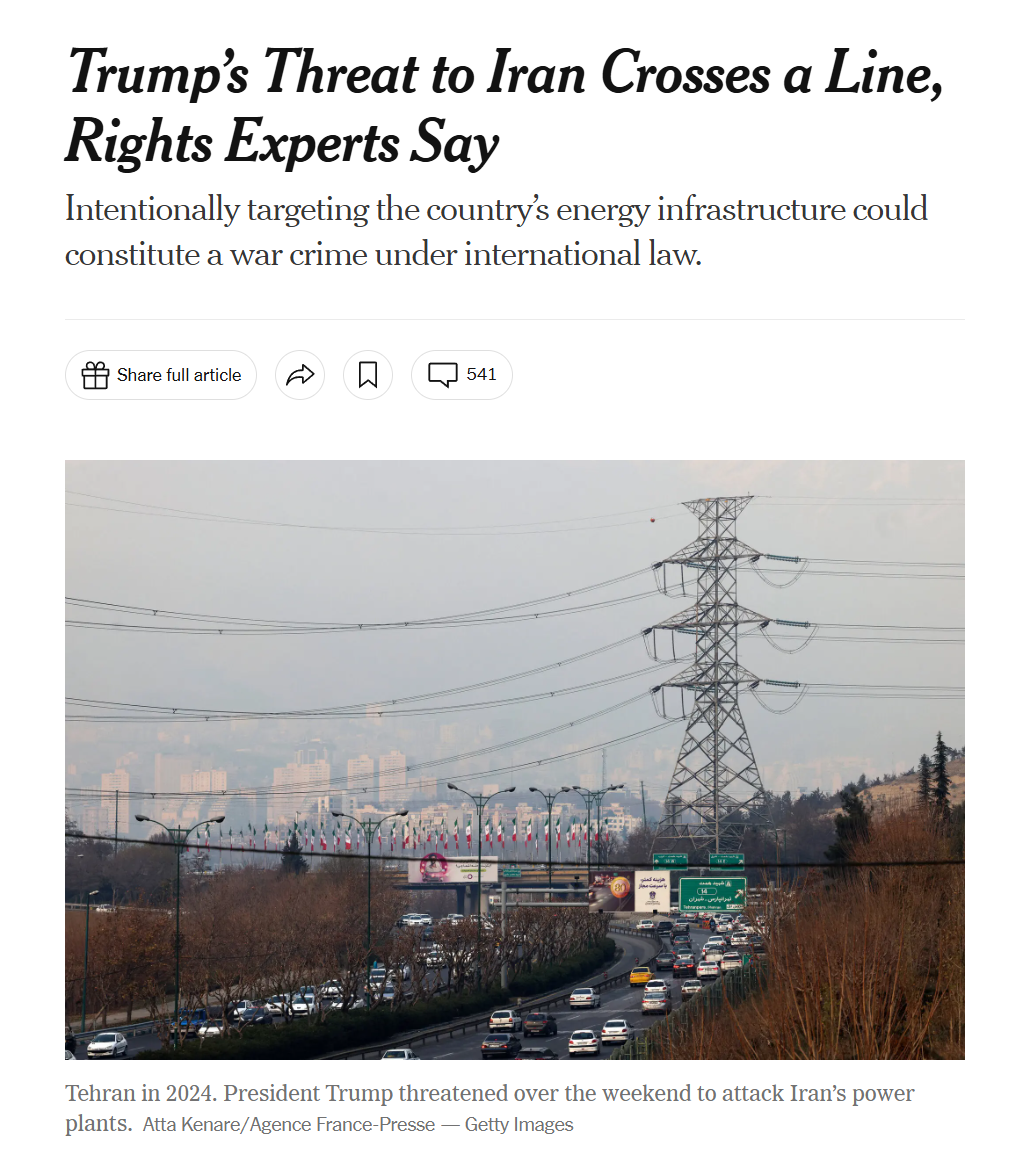
(The Iranians retaliated per usual by launching missiles at civilians in Tel Aviv. One odd feature of this war is that the Iranians complain that it is against the laws of war when the U.S. kills some civilians by mistake while at the same time the Iranians mostly attack civilian targets, e.g., in Israel or the Gulf Arab states. Similarly, folks in the West don’t complain that Iran attacks civilians, but point out that if we were to shut down Iran’s weapons factories by disabling oil production and electric power generation that would be a war crime because civilians also benefit from oil sales and electric power.)

The New York Times doesn’t explain its rationale for why killing the enemy is a sure way to lose a war, but maybe it follows logically from Islam being the Religion of Peace. If Muslims are by definition peaceful then killing a Muslim such as Ali Larijani reduces the amount of peace in the world.

A good companion piece, from state-sponsored PBS: don’t be concerned about the four Islamic jihads waged domestically in the first two weeks of March (Ayman Mohamad Ghazali trying to kill 140 preschoolers in Michigan, Mohamed Bailor Jalloh killing Lieutenant Colonel Brandon Shah, an Army helicopter pilot, in Virginia, Emir Balat and Ibrahim Kayumi throwing bombs in Manhattan, and Ndiaga Diagne killing Texans). Islamophobia is the real problem here in the U.S.

Screenshot
Full post, including comments

Iran war progress analysis from Al-Jazeera

While a lot of Americans, including the New York Times, seem enthusiastic about the idea that the U.S. is losing the war against Iran, Al-Jazeera publishes a perspective from a professor in Doha… “The US-Israeli strategy against Iran is working. Here is why”:

“When you look at what has actually happened to Iran’s principal instruments of power – its ballistic missile arsenal, its nuclear infrastructure, its air defences, its navy and its proxy command architecture – the picture is not one of US failure. It is one of systematic, phased degradation of a threat that previous administrations allowed to grow for four decades. … An arsenal built over decades, dismantled in days … The campaign has moved through two distinct phases. The first suppressed Iran’s air defences, decapitated its command and control, and degraded its missile and drone launch infrastructure. … The second phase, now under way, targets Iran’s defence industrial base: missile production facilities, dual-use research centres and the underground complexes where remaining stockpiles are stored. … Iran now faces a strategic dilemma that tightens every day. If it fires its remaining missiles, it exposes launchers that are promptly destroyed. … Much of the criticism of the US-Israeli campaign focuses on its costs while treating the status quo ante as if it were cost-free. It was not. … Closing the strait was always Iran’s most visible retaliatory card, and always a wasting asset. About 90 percent of Iran’s own oil exports pass through Kharg Island and then the strait. … The question is not whether the strait reopens but when and whether Iran retains any naval capacity to contest it. … the endgame is visible in the operational phasing, even if the rhetoric obscures it. The objective is the permanent degradation of Iran’s ability to project power beyond its borders through missiles, nuclear latency and proxy networks. … the critics are making a different error: They are treating the costs of action as if the costs of inaction were zero. They were not. They were measured in the slow accretion of a threat that, left unchecked, would have produced exactly the crisis everyone claims to fear: a nuclear-armed Iran capable of closing the Strait of Hormuz at will, surrounded by proxy forces that could hold the entire region hostage indefinitely.”


I’m not sure if Muhanad Seloom is correct, but the fact that A-10 Warthogs are now operating in Iran suggests that he is. Speaking of the Hog, here’s a photo from the 2024 Stuart, Florida air show:

Prof. Seloom seems to assume that the Islamic Republic stays in power and that the U.S. stops its regular bombing runs, thus giving Iran the opportunity to rebuild its military:

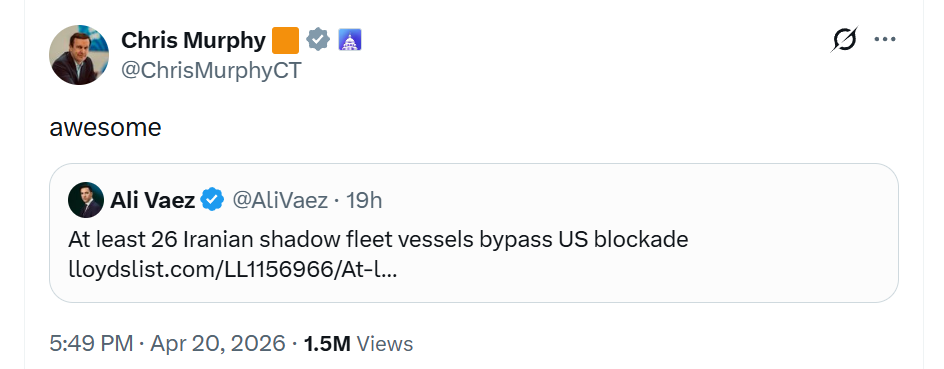
No one is proposing to occupy Tehran. The question is what happens when the bombing stops, and here the critics raise a legitimate concern, which Murphy articulated concisely after a classified briefing: What prevents Iran from restarting production?

Maybe the answer is that there are some adversaries who are indifferent to being bombed and, therefore, you have to keep bombing them every few days indefinitely, e.g., use satellites and drones to see if they’ve managed to rebuild some military capability and, if so, take it out immediately. Wait for a new leader to show up in public and drop a missile on his head. Certainly you can’t let the enemy rebuild its air defenses.

Full post, including comments

We are being absolutely crushed by Iran (NYT)

Let’s have a look at the New York Times right now. Every story on the front page seems to be about a failure of U.S. military. Russia is winning. We stole some oil tankers and that’s actually costing us money instead of making us money. Missiles are falling in northern Israel. Maybe we’re firing some missiles at Iran from Bahrain, but they certainly aren’t hitting anything. We’re suffering an “oil shock” like in the bad days of the 1970s.

Let’s compare to a random day in the middle of our involvement in World War II. The British-spec’d P-51 hadn’t come into action yet so we were losing B-17 bombers and crews at a ridiculous rate. Nonetheless, the focus of the stories was on the enemy’s losses, not our own.

This is the first time that I can remember when more than half of Americans seem to be invested in the idea that the U.S. is doomed to lose a war.

(I personally believe that our best option for winning is to use bombs to (1) disable Iran’s oil production and export infrastructure, and (2) disable Iran’s electricity generation. Without money from selling oil, the Islamic Republic won’t be able to do too much that we don’t like. Without electric power, Iran won’t be able to produce a lot of sophisticated weapons. (Yes, they can use generators for some stuff, but that’s not the same as plugging a massive factory into the power grid.))

Full post, including comments

Our war on Iran has been less destructive to Iran’s economy than the Biden-Harris administration was to the U.S. economy?

“In Tehran, hope for change turns to panic: ‘They are turning the country into ruins'” (NBC):

Prices on basic goods have ramped up about 10% since the war started, residents say.

In other words, all of the military might that we’ve thrown at Iran has done less damage to their economy than the Biden-Harris administration did to ours? See below, for the 21 percent inflation that working and saving Americans suffered.

(Why only “working and saving Americans”? The Americans who were wise enough to choose the welfare lifestyle of public housing, Medicaid, SNAP, and Obamaphone didn’t suffer since they received most of their spending power in kind rather than in cash and their SNAP benefits were automatically adjusted for inflation at official rates.)

Full post, including comments

Why are Climate Change alarmists also Strait of Hormuz alarmists?

If you believe in climate change, shutting down the Strait of Hormuz is the best thing that ever happened to Mother Earth because it reduces fossil fuel supply and, thus, reduces CO2 emissions from burning fossil fuel. Bizarrely, however, people and organizations who’ve been reliable climate change alarmists describe the closing of the Strait of Hormuz, and the resultant obstruction of oil and gas exports, as a catastrophe. Example from today’s New York Times:

Here’s CNN. For a Follower of Science, the headline should be “Key method of destroying our planet shut down” and high oil prices should be welcomed as a spur to conservation. Instead, we learn that high oil prices should be “fixed” (i.e., oil should be cheap enough to burn in a profligate Earth-destroying CO2-emitting-as-fast-as-possible manner) by Trump and that the strait being closed is a bad thing.

An Obama-generation Democrat in 2022 says that he wants to make it illegal for people to purchase gasoline or, at least, the cars that burn gasoline. This will be an “important climate change policy”:

A few years later, Gavin Newsom is excoriating Trump for causing an increase in the price of the product that he thinks should be outlawed because use of that product is harmful:

Here’s a representative young Democrat saying, in July 2025, that we need to take climate change seriously:

Here is the climate change alarmist, less than a year later, saying that gas prices should be lower so that people can afford to buy and operate that 12 mpg SUV:

Full post, including comments

Does Iran’s indifference to being bombed highlight how dangerous they would have been as a nuclear power?

The leaders of the Islamic Republic of Iran have been indifferent to everything that the infidels have thrown at them. Their leaders have been killed. Their infrastructure is being degraded. New York Times:

Across Iran, more than 90 million people are trapped between two terrifying realities. American and Israeli leaders, whose bombs are razing ever more parts of their infrastructure, have called on Iranians to use this as an opportunity for liberation. And their rulers, determined to cling to power, have threatened more bloodshed against whoever dares answer that call.

A week after the U.S.-Israeli strikes that killed Iran’s supreme leader, Ayatollah Ali Khamenei, Mr. Trump expressed his desire to play a role in selecting the country’s new leader — perhaps from the very authoritarian system that he has urged Iranians to rise against. The authorities responded by appointing the dead leader’s son, Mojtaba Khamenei, a hard-line cleric, as the successor.

For days, American and Israeli bombardments have pulverized Iranian military, intelligence and police sites across the country. And yet, there is no clear indication of a collapse in the government’s deeply entrenched and ideologically motivated security forces.

Apparently, Iranian leaders don’t mind being martyred and they certainly don’t seem to care if their subjects suffer. Does this highlight how dangerous Iran would have been with nuclear weapons mounted on ballistic missiles? (the NYT said it would take them about “a decade” to build a significant number of nukes plus delivery missiles) How do you deter a nuclear power if the rulers of that power don’t care what happens to themselves or the country that they’re ruling?

Loosely related…

Full post, including comments

New York Times Iran Vibe

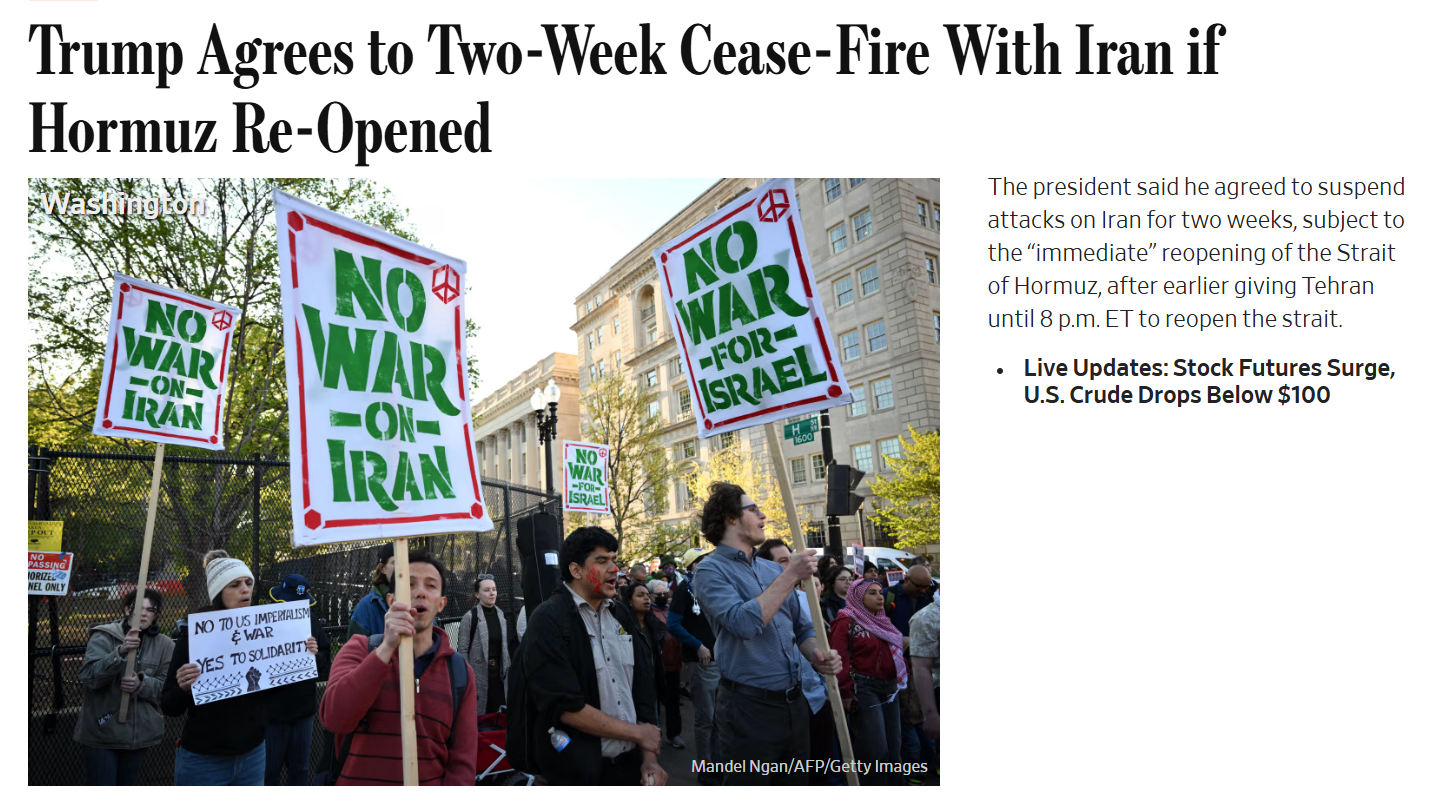
It’s been a week since the U.S. attacked the peace-loving leaders of a peaceful Islamic theocracy. Let’s look at some of the wartime propaganda.

Sunday, March 1, a day after the hated dictator launched airstrikes while poolside in Palm Beach, the deaths of most of Iran’s senior leaders was just slightly more important than the second most important story: the Jeffrey Epstein saga. 93 million Iranians were without leadership for the first time since 1979, but also why didn’t the hundreds of U.S. government lawyers across multiple administrations manage to prosecute more of Jeffrey Epstein’s elite friends? (We know that it can’t be because it wasn’t actually criminal for Larry Summers to try to have sex with a 43-year-old or for Prince Andrew to be introduced to a 26-year-old female in a jurisdiction where the age of consent was 16.)

Today, the stories all seem to be reminding readers that Donald Trump is incompetent and mindlessly aggressive. Here’s part of the NYT front page in which Trump refuses to compromise while the Iranians are reasonable (apologizing):

CNN assembled PhD experts to do a “forensic analysis” and they concluded that war is damaging to infrastructure:

NYT, today, says that attacking Iran is pointless and, by implication, only a moron would order such an attack:

Also from today, the NYT says that only an incoherent (stupid) person would consider killing folks who chant “Death to America” while building nuclear bombs and ballistic missiles to deliver them to American cities:

The peaceful people of Lebanon, who declared war on the Zionist entity, never recognized the State of Israel, supported the October 7 attacks by Hamas (80%; 60% support among Lebanese Christians; 32% wanted to bravely attack Israel to help their brothers, sisters, and binary-resisters in Gaza), and continue to fire projectiles at Israeli civilians are sadly forced to flee their homes because of Jewish aggression:

(The Israeli attacks on Beirut actually do confuse me. The Israelis told the Lebanese to evacuate and then bombed some empty buildings. How does that reduce Hezbollah’s ability to fight? The apartment buildings weren’t being used as forts.)

Another sympathy-provoking story from Lebanon. Merely because they declared war on their neighbor and refused to accept any peace treaty over a 75-year period, some Lebanese can’t sleep comfortably in their own beds:

Trump is far worse than Vladimir Putin (March 6): “Mr. Trump has demonstrated a willingness to disregard international norms and engage in foreign adventurism by fully exploiting Washington’s might.”

From March 3, perhaps it would make sense to prevent a nation of 93 million people from building nuclear weapons and ballistic missiles that could deliver them anywhere in the world, but not if 900 people are killed:

(Comparison to the Bad Old Days: The U.S. killed 100,000 residents of Tokyo on March 9, 1945 and rendered 1 million homeless.)

In a politically diverse discussion group on Facebook, a passionate Democrat posted about 20 times about rising oil prices. In other words, Donald Trump has now convinced Democrats to support Islamic theocracy and also cheap fossil fuels for maximizing climate change. (Greta Thunberg has similarly been posting in support of the Islamic Republic of Iran; you’d think that at least she’d be happy that oil prices are higher and, therefore, that consumption will be lower.)

My own social media post on how Donald Trump has caused suffering on the home front:

Full post, including comments

If attacking Iran is a disaster for the U.S., why is the stock market slightly up?

This is my last morning in Berkeley, California. Support for the Islamic Republic of Iran is almost universal here. Nearly everyone shares the New York Times perspective that Trump’s attack on the noble legitimate leaders of Iran was reckless and exposes the U.S. to risks almost as bad as climate change. Certainly there was no imminent threat from some guys chanting “Death to America” and working on nuclear bombs and ballistic missiles. At dinner last night I asked a local, “Have you checked the stock market? If we’re in serious trouble, the market should be down.” She replied that she hadn’t checked, but was sure that there had been a market crash.

The Google shows that the market is about where it was a week ago.

How about oil?

Anyone who loaded up on oil on Friday is up 10 percent, but with standard leverage of 10:1, the lucky (or well-informed) trader has doubled his/her/zir/their money.

Loosely related, a favorite tweet regarding the fighting in and around Iran:

What else are Bay Area lifelong Democrats excited about? One friend wasn’t interested in the Iran war because he’s working to stop the construction of roughly 180 units of affordable housing that would be 2 miles from his house. (I’m also against this, of course, but likely for different reasons. A limited supply of taxpayer-subsidized housing results in a violation of the 14th Amendment’s Equal Protection Clause. 180 people will enjoy low rents for brand new units. Perhaps 5,000 nearby people with exactly the same income will be forced to pay high market rents for crummy older apartments. In what world can this be considered “equal” treatment by the government?)

Another friend was passionate about not straying too far from the 4th Street restaurant where we’d dined. She believed that we would become victims of crime if we walked away from the brightly lit main blocks. I pointed out that it wasn’t a great advertisement for 70 years of lavishly funded progressive government if Berkeley, in fact, had dangerous neighborhoods. (My local friend says that she often sees broken glass in parking spaces, evidence of prior break-ins.)

Separately, check out the “Living Wage” bump of 6 percent over the menu prices for this kosher meal.

Full post, including comments

Theodicy question: Why didn’t Allah protect the Islamic Republic of Iran from attack by infidels?

Infidel rogue states (U.S. and Israel) were recently successful in killing many of the leaders of the Islamic Republic of Iran. If Allah is omnipotent and benevolent, how was it possible for infidels to achieve this apparent military victory over a nation that follows the Koran and Hadiths?

Is the answer that those recently killed were martyrs to a larger cause and that their successors will build Iran into a stronger and more dominant nation?

Ayatollah ChatGPT isn’t tremendously helpful. Excerpts:

Iran’s interpretation of Islamic law is shaped by centuries of Shīʿī jurisprudence and legal reasoning (fiqh), not just direct literal verses from the Qurʾān or ḥadīth.

Islamic theology emphasizes that God’s wisdom (Hikmah) transcends human understanding. What may seem unjust or inexplicable from a human standpoint may be understood only in a larger spiritual context — especially one that includes the afterlife and final judgment, which humans do not see.

Related:

Flashback to 1979 New York Times, “Trusting Khomeini”:

Part of the confusion in America about Iran’s social revolution involves Ayatollah Ruhollah Khomeini. More even than any third‐world leader, he has been depicted in a manner calculated to frighten.

The news media have defamed him in many ways, associating him with efforts to turn the clock back 1,300 years, with virulent anti‐Semitism, and with a new political disorder, “theocratic fascism,” about to be set loose on the world.

… there are hopeful signs, including the character and role of Ayatollah Khomeini.

To suppose that Ayatollah Khomeini is dissembling seems almost beyond belief. His political style is to express his real views defiantly and without apology, regardless of consequences. He has little incentive suddenly to become devious for the sake of American public opinion. Thus, the depiction of him as fanatical, reactionary and the bearer of crude prejudices seems certainly and happily false.

In looking to the future, Ayatollah Khomeini has spoken of his hopes to show the world what a genuine Islamic government can do on behalf of its people. … Despite the turbulence, many nonreligious Iranians talk of this period as “Islam’s finest hour.” … Iran may yet provide us with a desperately‐needed model of humane governance for a third‐world country.

Full post, including comments