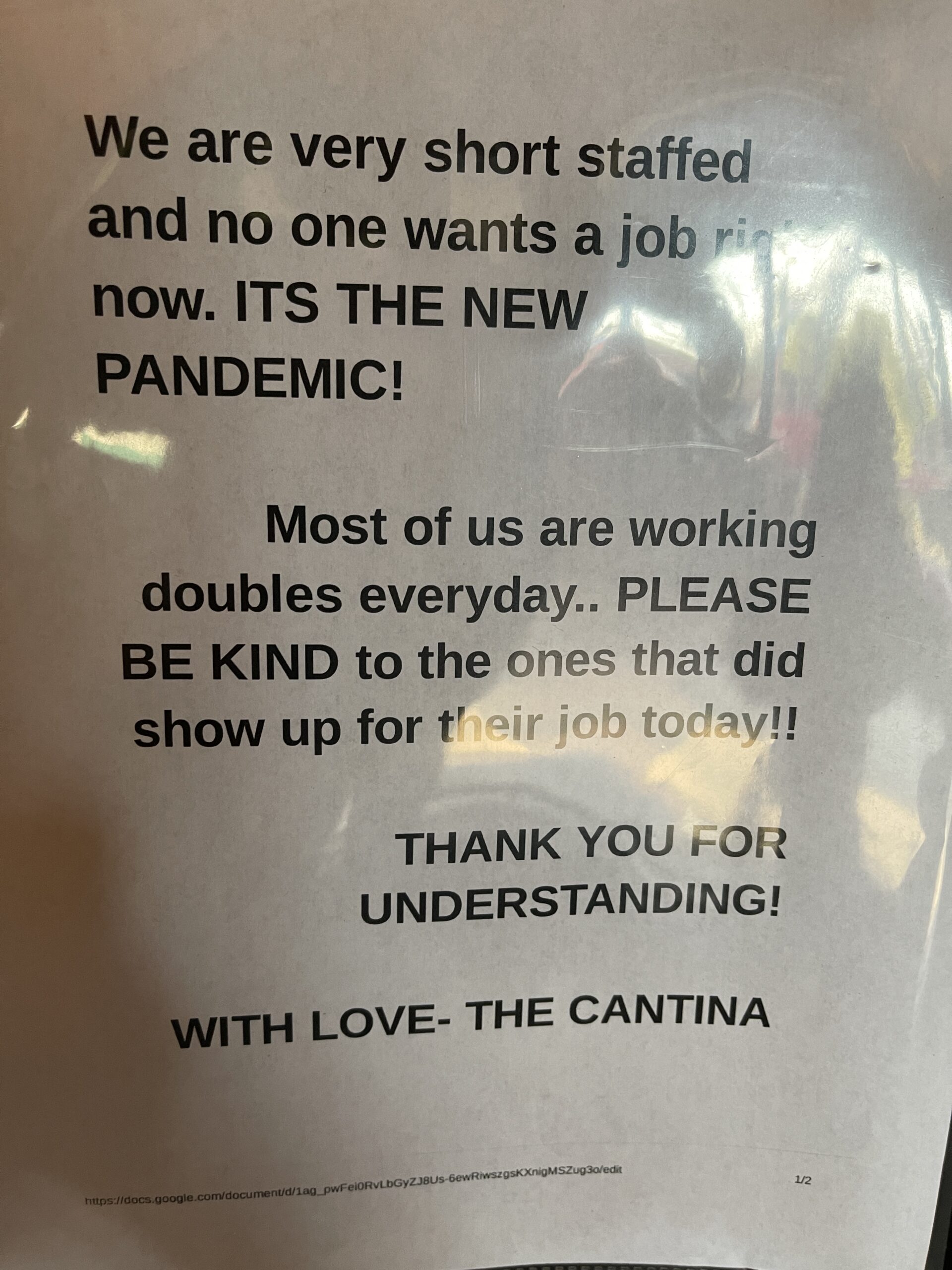
We are very short staffed and no one wants a job right now

“Biden and Republicans Spar Over Unemployment as Job Gains Disappoint” (NYT):

The president said he saw no measurable evidence that a $300 federal boost in unemployment benefits was hurting the labor market, amid criticism from conservatives and business groups.

From a Mexican restaurant in Asheville, North Carolina (Biltmore Village, actually) last month. The sign on the door: “We are very short staffed and no one wants a job right now. … ITS THE NEW PANDEMIC! Most of us are working doubles everyday.. PLEASE BE KIND to the ones that did show up for their job today!!”
Is it better elsewhere in the nation? A friend owns a multi-state chain of restaurants. April 30, 2021 email from him:

It’s impossible to hire people right now. The people that want jobs and want to work have them. Everyone else is happy to collect unemployment, which, apparently, can still pay you damn close to what you were making pre pandemic. We post applications and get piles of responses. None show for interview. Turns out you have to approve you ‘applied’ not ‘interviewed to keep the checks flowing.

Anecdotally, it has been difficult to get Ubers and drivers say that their peers have quit to collect unemployment, welfare, etc. Uber XL pays enough to compete with Uncle Joe and therefore it is usually easier and quicker to get an Uber XL (minivan or pavement-melting SUV). We used Uber around Atlanta in mid-April and it was often slow to get any kind of ride, but 10 minutes faster to get an XL than a regular UberX. Example from a downtown location where, pre-coronapanic, you’d expect a regular Uber to be available in 2 minutes, not 12:

We’re currently fixing up a house in order to sell it. There are a lot of tradespeople happy to work, but only if paid in cash. They say that they don’t want to upset their unemployment benefits.

The New York Times did an analysis of the $600/week supplemental dole a year ago (“Workers in more than half of states will receive, on average, more in unemployment benefits than their normal salaries”):
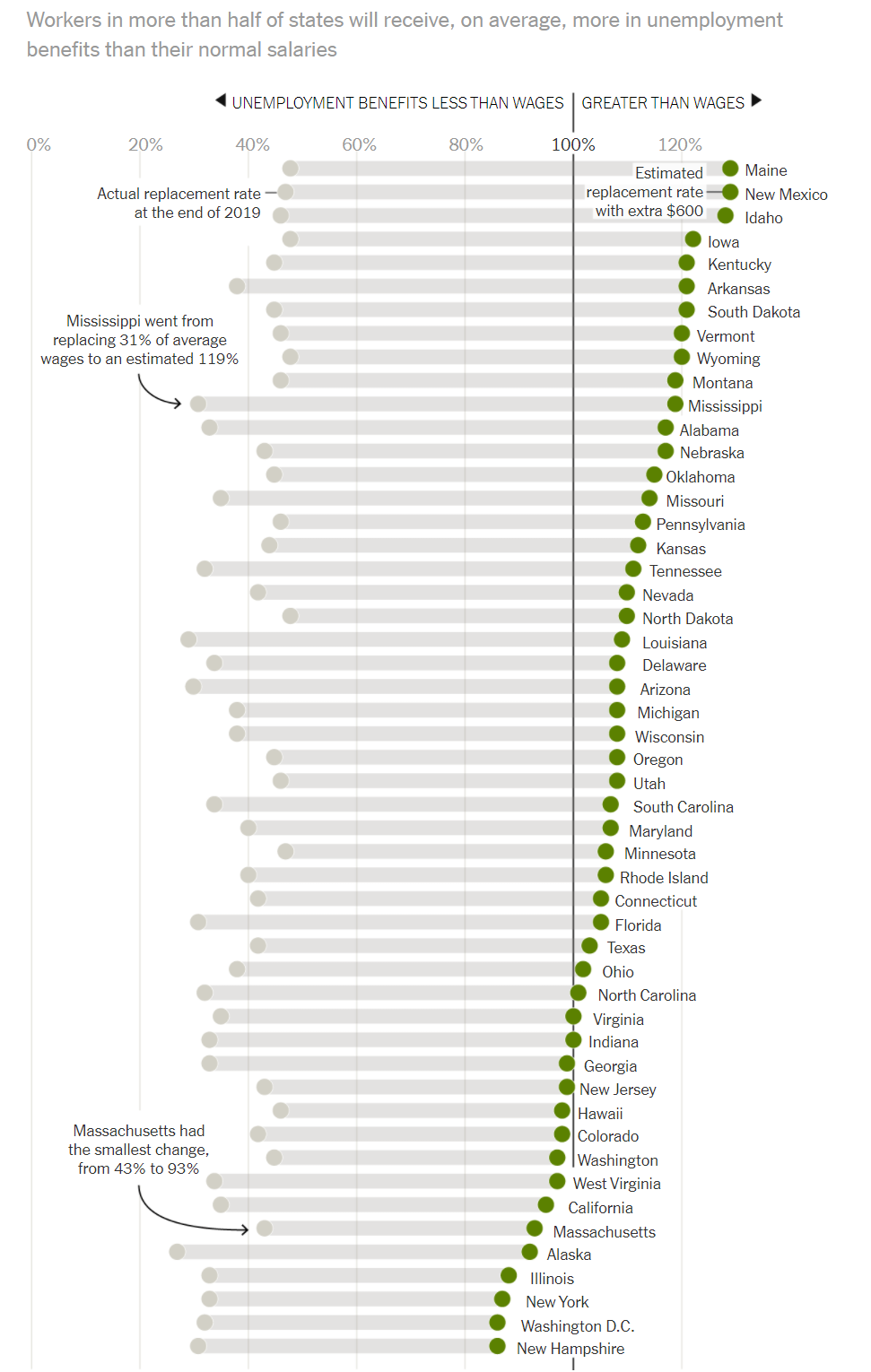
Now that the supplemental dole has been cut to $300 per week, in theory working should pay a little more than not working. In practice, though, the American collecting unemployment can do some work for cash and end up with a higher spending power. Also, not working might be a lot more fun than working, depending on the job. Maybe at $300/week plus the standard unemployment check the overall lifestyle is better even if spending power is a little lower. If the unemployed person’s slightly lower reportable income results in lower prices for means-tested housing and means-tested health insurance, spending power might actually be higher.

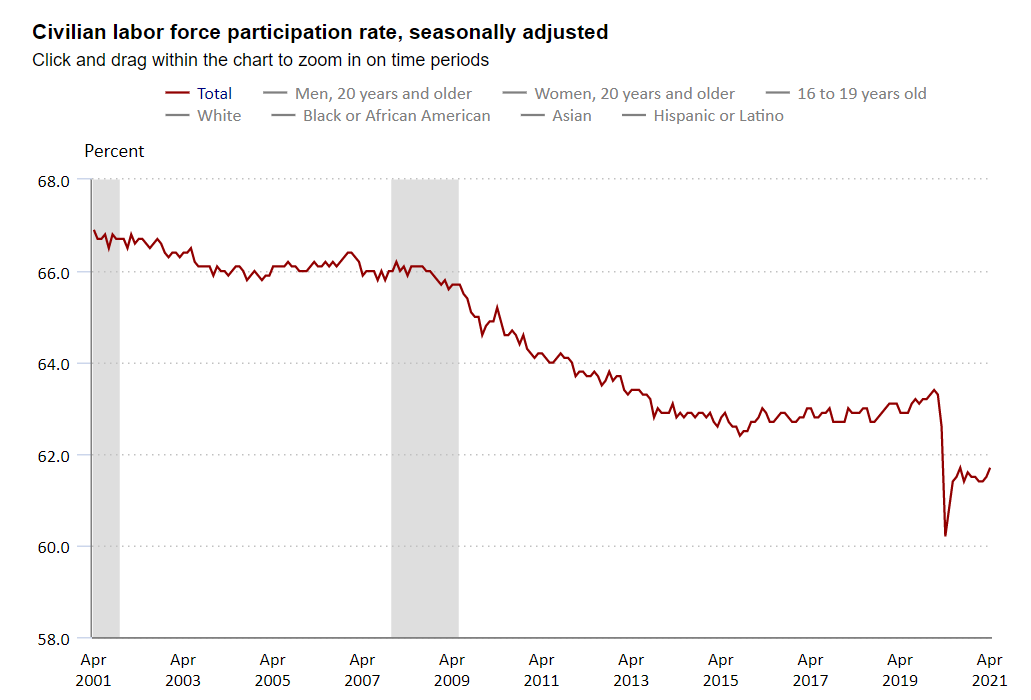
What does the Bureau of Labor Statistics have to say? Americans have been increasingly averse to work starting in 2009 (see also Book Review: The Redistribution Recession):
Related:

Full post, including comments

Discrimination against Asians not working as well as hoped

Happy Asian Pacific American Heritage Month! (official U.S. government web site on the subject) This is when non-Asian American say-gooders get to lump together nearly 5 billion disparate people under the all-look-same doctrine. Folks who grew up next door to Idi Amin in Jeddah, Saudi Arabia can celebrate their kinship with folks who grew up on Mangareva.

Let’s look at a story from last month… “Only 8 Black Students Are Admitted to Stuyvesant High School” (NYT):

Once again, tiny numbers of Black and Latino students received offers to attend New York City’s elite public high schools.

Only 9 percent of offers made by elite schools like Stuyvesant High School and Bronx High School of Science went to Black and Latino students this year, down from 11 percent last year. Only eight Black students received offers to Stuyvesant out of 749 spots, and only one Black student was accepted into Staten Island Technical High School, out of 281 freshman seats.

Over half of the 4,262 offers this year went to Asian students. … The percentage of Black and Latino enrollment at Stuyvesant, Bronx Science and Brooklyn Technical High School has hit its lowest point in the city’s recorded history in the last 10 years, a trend that has accelerated during the last several years in particular.

The city’s new chancellor, Meisha Porter, called on the state to eliminate the exam in a statement Thursday. “I know from my 21 years as an educator that far more students could thrive in our specialized high schools, if only given the chance,” she said. “Instead, the continued use of the Specialized High School Admissions Test will produce the same unacceptable results over and over again.”

[Ronald S. Lauder, the billionaire cosmetics heir] and his partner in the initiative, former Citigroup chairman Richard D. Parsons, promised to shower test preparation companies with money to better prepare Black and Latino students for the exam.

Despite over $750,000 spent on test prep over the last two years, most of which was funneled to existing nonprofit programs across the city, their plan has not made a dent in the numbers.

Discrimination against Asians is legal (see Students for Fair Admissions v. Harvard) and Asian success is, as the top NYC school bureaucrat says, “unacceptable” to non-Asians, yet the comparatively unintelligent non-Asians can’t seem to get their discrimination dials set correctly.

Given that attending college doesn’t help the average person learn (see my review of Academically Adrift), I wonder if discrimination against Asians will drive them to learn so much prior to age 18 that employers will hire them straight from high school. Isn’t that how professional sports sometimes work? The best players are hired before college graduation, right?

Related:

Full post, including comments

Coronaplague in the Seychelles proves Dr. Jeff Goldblum’s theories?

From Coronaplague in India proves Dr. Jeff Goldblum’s theories?:

I wonder if this proves what Dr. Jill Biden, M.D.’s colleague Dr. Jeff Goldblum said: “Life Finds a Way.” The non-Chinese Wuhan-edition coronavirus was perhaps not a good fit for hosts in India, which is why, adjusted for population size, not much happened during Coronawave #1 (TIME: “health experts had predicted that India, with a population more than four times the size of the U.S., would quickly become the world’s worst-hit country”). But now the virus, with approximately 30,000 base pairs, has evolved.

From Wednesday, “Island paradise with highest vaccination rate reports world’s biggest COVID surge” (Yahoo News UK):

The Seychelles has suffered the world’s biggest surge in coronavirus cases – despite nearly 70% of its population having received a vaccine.

On Monday, the latest date for which figures are available, the archipelago’s seven-day case rate per one million people was 1,480, the highest in the world. It compares to the Maldives, the second highest, with 827 cases per million.

This comes despite 69.19% of people on Seychelles having at least one dose of a vaccine.

Health minister Peggy Vidot said: “Despite all the exceptional efforts we are making, the COVID-19 situation in our country is critical right now with many daily cases reported last week.”

Seychelles, with a population of about 98,000, currently has 1,068 active cases.

The BBC has reported the country’s news agency as saying a third of those active cases are among people who have received two vaccines.

Why is this interesting to those of us who aren’t planning to visit the Seychelles? I think it is a good window into what life in the Shutdown States (e.g., Maskachusetts, New York, California) will be like this coming winter. Everyone will be vaccinated and therefore the successful strain of SARS-CoV-2 will be whichever one can work its way around a vaccine-stimulated immune system.

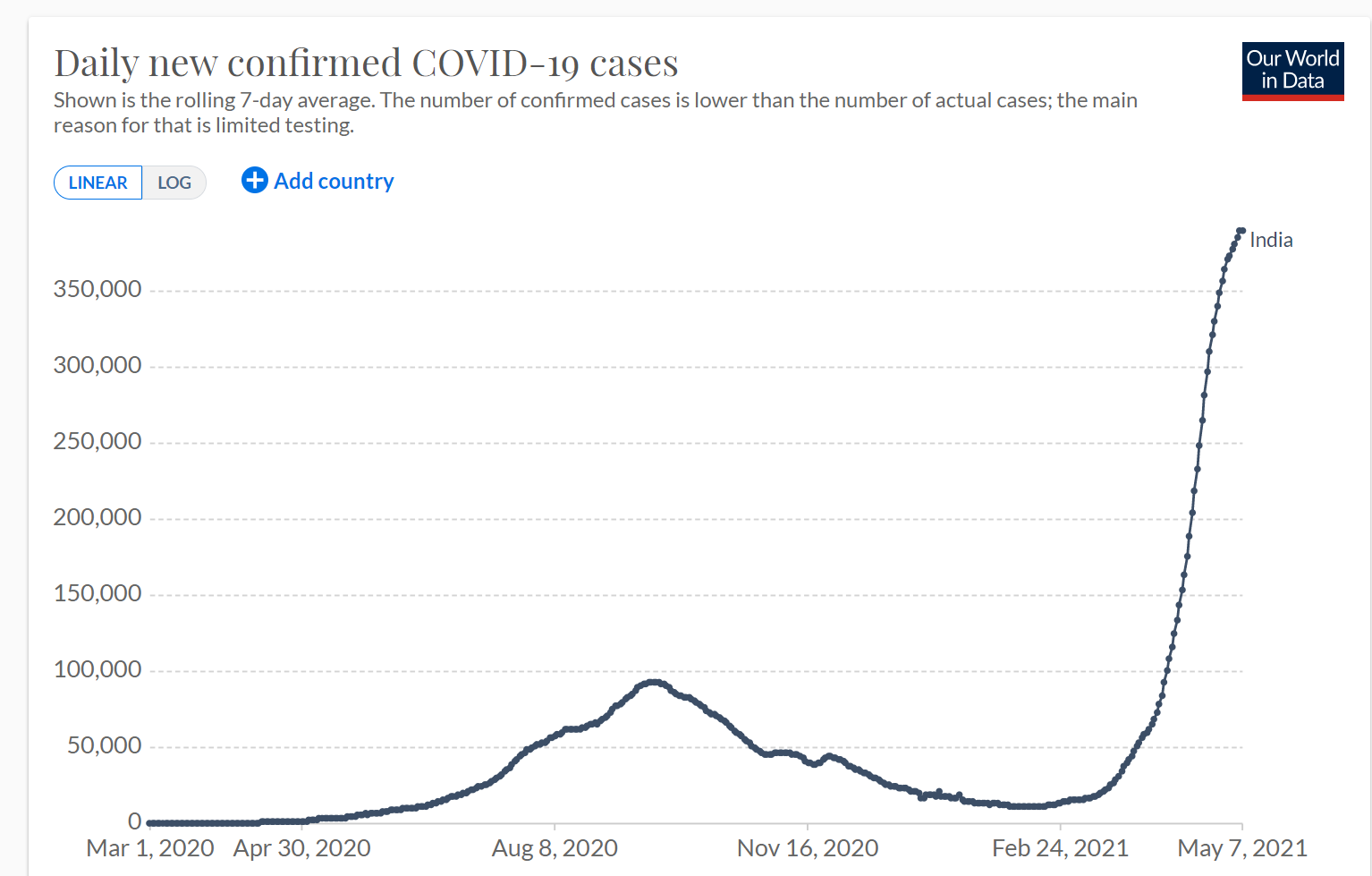
Speaking of India, it does look as though the trend is following Farr’s laws (bell curve) and that the curve is flattening (either through heroic government and human efforts, if you think humans are smarter than viruses, or because this is how viral infections have worked for the past 3.5 billion years):

My latest thinking about coronaplague is that the Vietnam Wars, viewed from the American perspective, continues to be the best analogy. Technocrats in public health bureaucracies and state governors (except in FL and SD!) assure us with facts, figures, and charts that victory is within reach. We can be a few months away from victory for 10-15 years.

Full post, including comments

Why not tiered real estate commissions?

From this blog in 2005:

People who sell $1 million condos often complain that paying a 6 percent standard (read “fixed by collusion” among realtors) commission is too much ($60,000 for what might only be a few days of work). Economists who have studied the real estate market, however, find that in some ways the commission is too low because realtors don’t work very hard to sell clients’ houses compared to their personal houses. In other words they sell a customer’s house relatively cheap so that it will sell quickly rather than work for many weeks to get the best price and 6% of the extra.

Why haven’t we seen anyone propose a commission structure that says the realtor gets a 25% commission… but only on the amount above the assessed value of the property? Your typical $1 million NY or Boston apartment is assessed at maybe $850,000 and could be sold for that price with almost no effort in a few days so the commission paid on such a sale shouldn’t be more than $1000. If a realtor could sell the place for $1.2 million via clever marketing, however, she should be entitled to a fat commission.

In the intervening 16 years, various Internet services have made it easier for owners to sell their own houses. We can assume that realtors add value, since most people still do hire realtors, but they’re adding value on top of an easy-to-establish base, e.g., 10 percent below the Zillow Zestimate. Presumably a “for sale by owner” (free) listing on Zillow could easily sell a house at 90 percent of its Zestimate. (5 minutes of marketing effort!) If so, the structure that would align sellers’ interests with agents’ interest is a commission that was 0 percent of the first 90 percent of expected value and 15-25 percent of the sales proceeds above that.

How can it still be case that an agent who does a terrible job, selling a house for 95 percent of its value, gets paid almost as much as an agent who does a superb job, selling a house for 115 percent of its value?

This is the kind of question I am pondering as we declutter and pack up for Jupiter, Florida!

Full post, including comments

Soundproofing for an air conditioner/heat pump (success story)

We had a Princess and the Pea situation in our house in which a moderately quiet A/C condenser next to a bedroom was deemed too loud, especially when clicking on. This is a high-end Carrier-built unit, so it is somewhat louder than a Japanese split-system, but quieter than almost anything else U.S.-built.

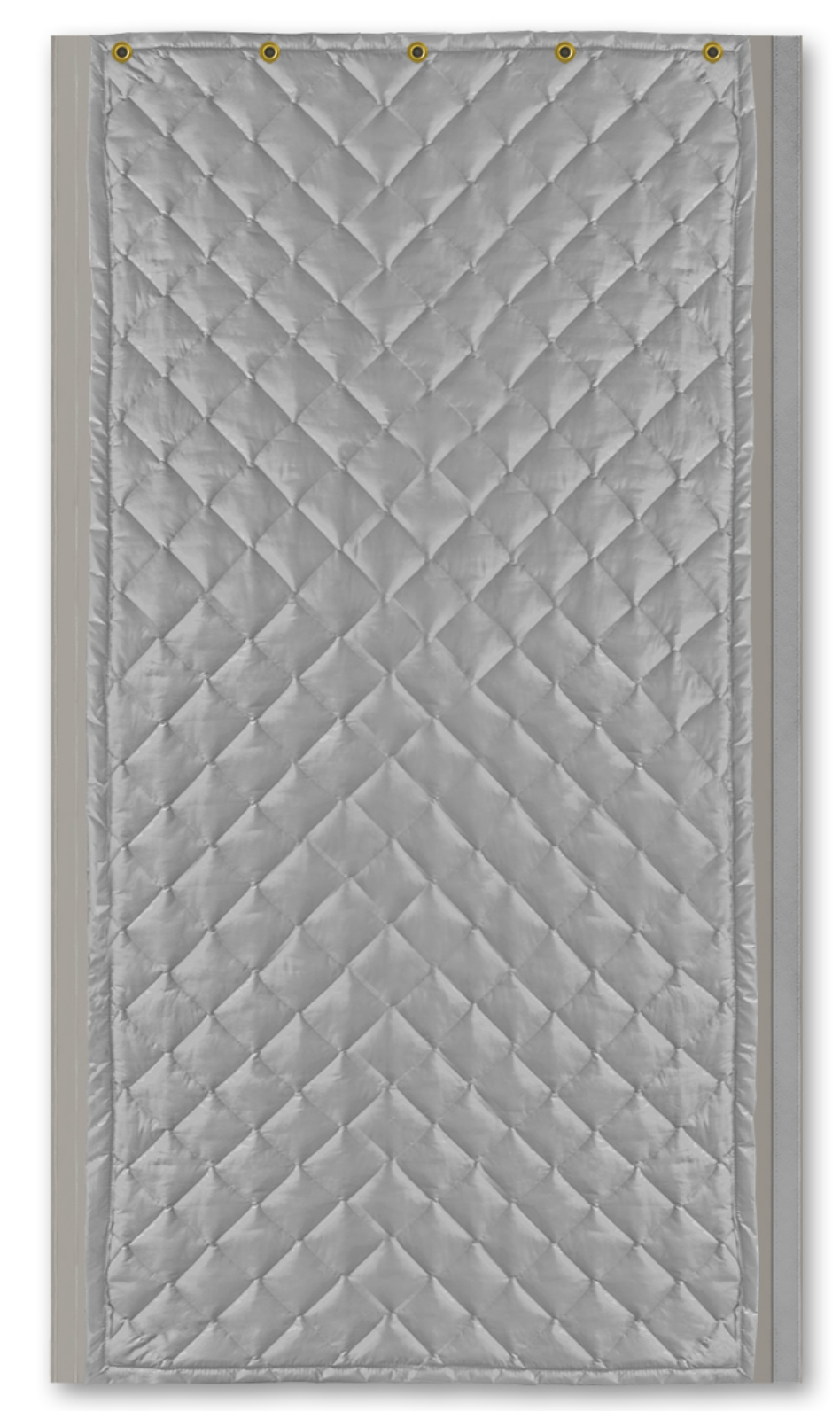
We were able to eliminate the annoyance with a blanket from Acoustical Solutions that we hung on the wall adjacent to the condensers (quilted part facing the A/C unit; smooth part against the wall). We also wrapped one that was roughly the same height as the condenser around the side so as to block transmission to a window. It would be a lot more attractive it we built a wooden hutch around it, but it is highly functional just hung on a metal fence U-post (less than $10 from any hardware store).

We bought the ABBC-13 two-inch thick “AudioSeal” blankets, one 96″x54″ (custom made to have the grommets on the long side) and one 54″x54″. Total cost, including shipping and Maskachusetts sales tax, was $890. We’ve had them outdoors through one New England winter and they still look good.

Leaving this here in case anyone is searching for a similar solution.

Full post, including comments

Portuguese stocks or Lisbon real estate for the next five years?

At least to judge by our media, the U.S. is embroiled in white v. Black, white v. Asian, white v. Latinx, and hetero cisgender v. LGBTQIA+ fights. We’re also adding $trillions in debt, welcoming millions of new welfare-dependent citizens, and instituting dramatic changes in government (every day we hear a new and exciting idea for a bigger more powerful central government!). It seems like a good time to ensure that children have the option to study, work, and live in Europe. The Europeans bumped up against the limits of how much government could be responsible for and don’t seem anxious to go back to the 1970s.

There is no way to predict whether Portugal, Italy, Germany, France, or Sweden will be a better place to live than the U.S. in 2030, but keeping only a U.S. passport is essentially a bet that the U.S. will be a better place to live than anywhere in the E.U. Would we want to make that bet?

Portugal operates a “golden visa” program in which folks who purchase real estate (500,000 euro) or invest in Portuguese stocks and bonds (1 million euro) can obtain citizenship after five years of periodic visits (roughly one week per year) and demonstrating a reasonable command of the language. After a passport is obtained for one or both parents, children can then get Portuguese citizenship as well. Then they can hang out in the wonderful Azores or the historic cities of the mainland and wander at will among the rest of the EU nations.

The most obvious place to purchase real estate is Lisbon, but the property market could be vulnerable to a crash since it has been pumped up by all of the other folks purchasing real estate to meet golden visa requirements. There are some developers who promise to pay 3-5 percent as an annual return for anyone who buys an apartment in one of their buildings, but obviously they won’t be paying if they run out of money after a collapse.

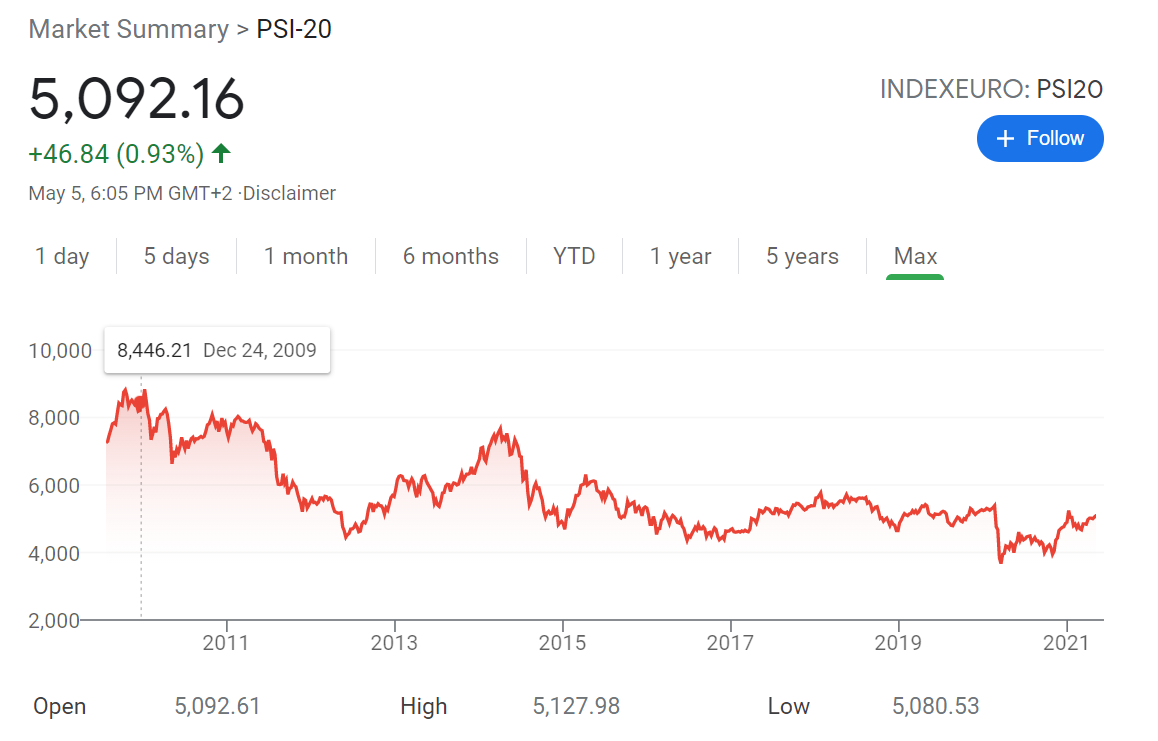
I’m wondering if it is safer and simpler to purchase Portuguese stocks, of which there are only 56 currently trading on Euronext Lisbon. The PSI-20 consists of the 20 largest stocks. A March 2021 Factsheet shows a P/E ratio of about 18 and a dividend yield of 3.63 percent. The big components seem to be energy companies and utilities, retail, and a bank (i.e., fairly conservative investments and maybe not a terrible hedge against U.S. stocks). The PSI-20 does not have a great track record. It is a good thing that there are dividends because the price is quite a big lower than it was in 2010:

I’ve never liked real estate as an investment, especially for a foreigner. You have to trust a city, a neighborhood, a developer, a building, etc. But folks in countries that have had a lot of economic ups and downs love real estate! They also like bonds, but right now yields are minimal (see “Portugal Sets Precedent with Near-Junk Bonds That Yield Nothing” (Bloomberg, December 2020))

European readers: What do you think?

American readers: send me an email if you want to copy this idea. I have found some attorneys that seem reliable (referred by a major international bank). There are some ways to do this with a capital stake of only about $350,000.

Related:

  • “Former Google CEO Eric Schmidt applies to become Cyprus citizen, along with his wife and daughter…” (Daily Mail), i.e., the Biden advisor won’t suffer too badly if his advice to President Biden doesn’t work out
  • “Golden visas to be scrapped for Lisbon and Porto” (starting in 2021): S… the PS parliamentary group decided it was time to address the galloping property speculation that golden visas have generated, as well as try to dynamise ‘poorer regions’ where people could do with increased job opportunities.
  • “Call to rent out vacant golden visa homes” (March 13, 2020): In the motion signed by the BE councillor in Lisbon, Manuel Grilo, to which Lusa had access and which should be presented on 12 March, in a private meeting of the municipal executive, it is defended that the municipality urges the Government “to proceed with the survey of vacant properties acquired in connection with the granting of gold visas”. In addition, and under the current legal framework, “the requisition mechanisms for public purposes must be considered in order to reinforce the housing supply in the municipality and, in such cases, define the obligation for these properties to be leased, within the scope of the Affordable Income Programme”. (If the U.S. government, via the CDC, can order an eviction moratorium for more than a year surely the Portuguese government could issue regulations around how these apartments are to be rented.)
Full post, including comments

Psychology of Shutdown Karenism

A Facebook friend (she’s around 30 years old) psychoanalyzes those who love COVID shutdowns:

Maybe the reason people born in the 60s-90s are the biggest pro-lockdown people is that it was the “grounded generation,” where parents trying to limit or stop corporally punishing their children instead would keep them indoors, only doing necessary activities, until they’d learned their lesson — longer time periods when the misdeed was larger.

All the “fun spreads the virus” crazytown rules that people have accepted with absolutely no scientific basis for their efficacy, from curfews to live music bans to hair salon closures, align very well to what your parents would stop you from doing when you were grounded.

There’s a lot of free-floating guilt in our society and very little way to dislodge it effectively. Perhaps many of the most devoted lockdowners felt, in their heart of hearts — whether they realized it or not — like humanity needed a good grounding and to not come out until we’d changed our attitude, mister.

Her friend (actually named “Karen”!):

Yes. I think this is absolutely spot on.

From Elizabeth:

And so much of it is about making people change their attitude. People who wear masks that say “I’m only wearing this because I have to” still get treated like shit, as though they weren’t wearing masks at all. Because they dare to disagree with the status quo. It’s not enough to wear the mask… you have to love it too.

Laurel:

Hmm younger generations get banned from specific gadgets ie phone or PlayStation, so they’re being primed to associate entertainment media access with compliance.

The psychology industry has so far provided more literary interest than practical assistance and the above is certainly consistent with that history going back to Freud. (I.e., the above might not be right, but I thought that it was interesting to contemplate.)

Full post, including comments

CIA Officer: My existence is not a box-checking exercise

“I am perfectly made” and “My existence is not a box-checking exercise”:

(Note that I disagree with this Twitter user’s comment, “I think it’s safe to say the contemporary American left has failed.” First, I don’t think politics in the U.S. is supported by any coherent philosophy and therefore there is no “left” or “right”. Second, to the extent that checking victimhood boxes is associated with “left”, this ad would be evidence that the contemporary American left has succeeded.)

Full post, including comments

Why do governments have to steal vaccine rights? Why not print more money to buy them?

“Taking ‘Extraordinary Measures,’ Biden Backs Suspending Patents on Vaccines” (NYT):

The Biden administration, siding with some world leaders over the U.S. pharmaceutical industry, came out in favor of waiving intellectual property protections for coronavirus vaccines.

The United States had been a major holdout at the World Trade Organization over a proposal to suspend some of the world economic body’s intellectual property protections, which could allow drugmakers across the globe access to the closely guarded trade secrets of how the viable vaccines have been made. But President Biden had come under increasing pressure to throw his support behind the proposal, drafted by India and South Africa and backed by many congressional Democrats.

If we’re comfortable with borrowing and spending $trillions (i.e., printing money) every few months during coronapanic, why not print a little more money and buy, rather than steal, the rights to the vaccines that we think should be free and open-source? Surely there is some price at which at least one of the vaccine makers would sell voluntarily. Pick the one that is easiest to manufacture, buy the formula, put it on a web site, and pay the inventors additional $$ to help anyone who wants to make it.

From earlier today, “Federal judge vacates CDC’s eviction moratorium” (The Hill): A federal judge on Wednesday vacated a nationwide freeze on evictions that was put in place by federal health officials to help cash-strapped renters remain in their homes during the pandemic. … “The question for the Court is a narrow one: Does the Public Health Service Act grant the CDC the legal authority to impose a nationwide eviction moratorium? It does not,” Friedrich wrote [full text].

Same question for that one. Why did the government, which can print as much money as it wants to (and where such printing has no cost, according to an MIT economist), need to steal from individual landlords? If the CDC wanted everyone to have a rent holiday, why didn’t the CDC pay the rent with borrowed/printed money?

Related:

Full post, including comments

Automotive evidence of people escaping to Florida

From a late April trip, our Hertz rental. Note the California plates, evidence that a modern-day Joad family escaped California’s lockdowns and 13 percent state income tax via a one-way trip:

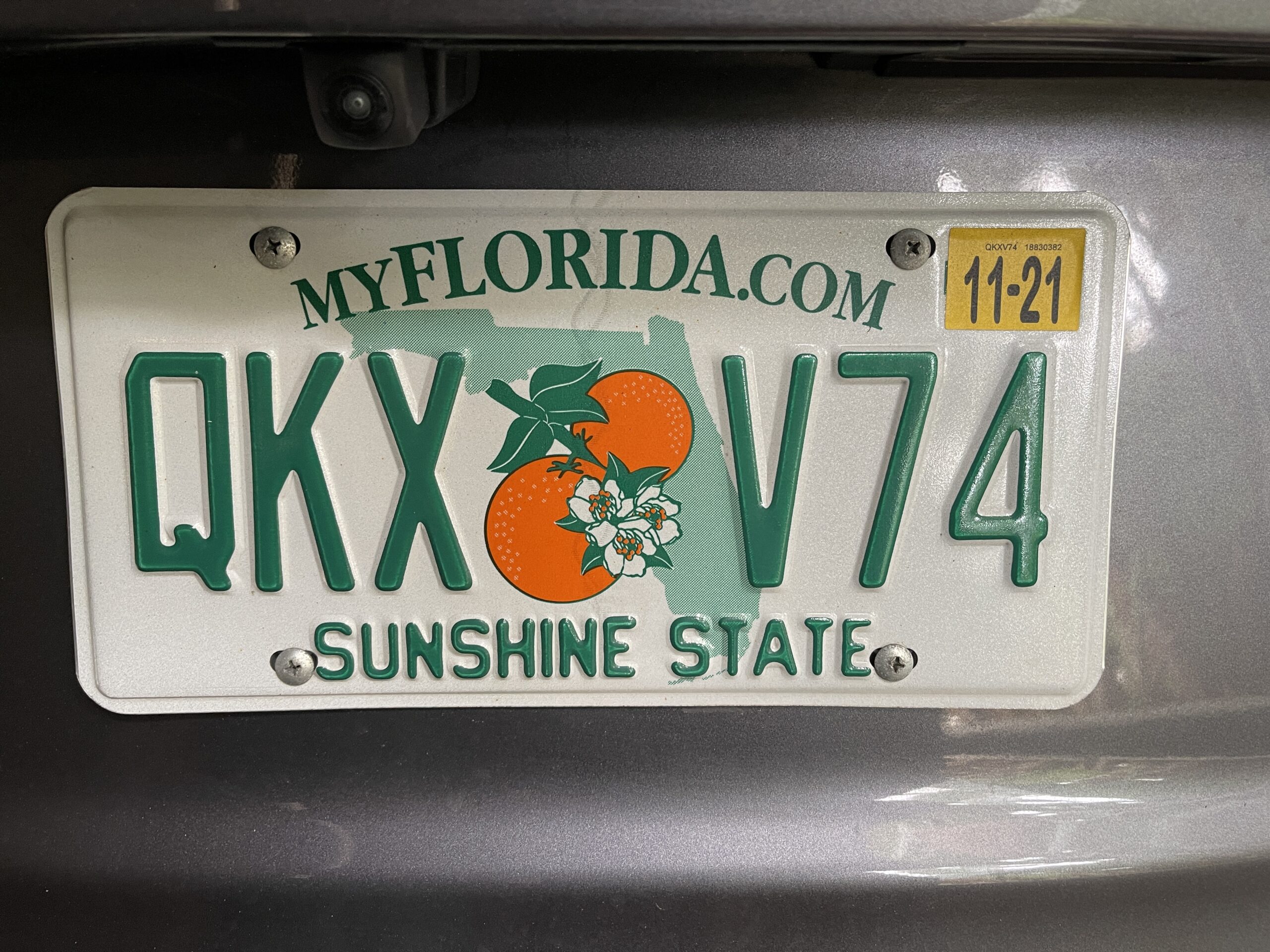
It was common to see cars with insignia relating to dealers in New England or New York and Florida plates, indicating a permanent move. Example:

Separately, Matty’s Gelato (Juno Beach, near Ivanka Trump’s new house in Jupiter, Florida) is great!

Related:

Full post, including comments