Trump impeachment status?

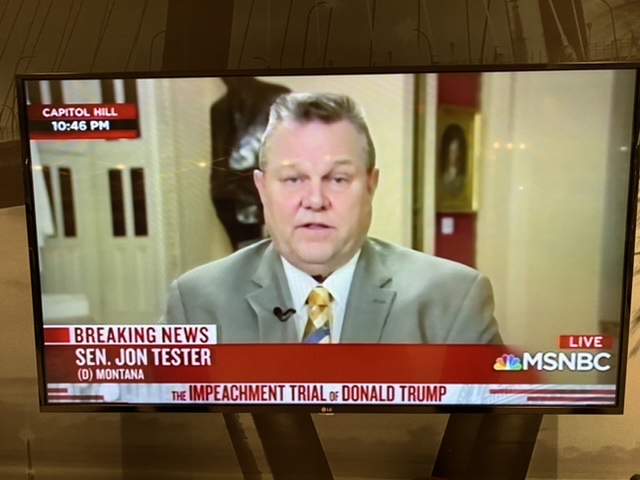
Although the New York Times and CNN bravely spoke truth to power in China by covering the Trump impeachment intensively (not leaving any space in their respective China editions for coverage of unrest in Hong Kong, for example), the stories that they ran assumed that the reader already knew the crimes of which the hated dictator was guilty.

Now that I’m back from China…. what is the status of the Trump impeachment? (now in its fourth year as measured by the time that my Facebook friends first began discussing the process as it applied to Donald Trump)

For voters whose interests Trump represents (i.e., the people who actually did vote for him), has anything been uncovered in this process that would give them a reason to prefer a Democrat as President?

[Separately, some business people in China told me that they thought Trump was pursuing the correct (for Americans) trade policy on China: “The tariffs were long overdue and China had it coming,” one said. They shared the perspective of the European multinational business executives we met on our Northwest Passage cruise, i.e., that China had been maintaining unfair trade barriers and policies for decades.]

Full post, including comments

Is ingesting plastic actually fine for our health?

“Those fancy tea bags? Microplastics in them are macro offenders” (Guardian) says that excessively rich and/or pretentious people who drink tree from nylon bags are ingesting a lot of plastic (bonus: they’re also trashing the environment by consuming way more in energy and materials than folks who drink tea made from paper tea bags).

One local source for ingestible plastic is Tea Forté. Customers of this high-cost brand have been getting massive doses of plastic, far above what the turbine-powered helicopter moms fear kids might get from eating food cooked in a Teflon pan (example paranoia: “I do like to back up my points with scientific studies, but often it takes many years for a complete and acceptable study to make useful conclusions. With something like Teflon cookware, there are lots of vested interests so it could be a few more decades before valuable health information is known.” (i.e., we can predict Earth’s temperature 100 years from now, but 63 years of history with Teflon pans is not enough to say anything definitive; it is complicated by the fact that companies are getting insanely rich selling $10 pans at Target and using the profits to corrupt academic science)).

Have the drinkers of these fancy plastic-packaged teas done the required experiment for us? Their bodies might be half plastic by now and yet they aren’t dying off at an extraordinary rate.

Full post, including comments

Who will buy the Tesla Cybertruck?

While I was in China, Tesla introduced its 6-seat Cybertruck. At $40,000 for the 2WD version, it does not seem overpriced (and the 4WD version at $50k with 16″ of ground clearance would have the potential for good off-road performance, right?). Operating cost here in Massachusetts (22 cents/kwh electricity) should be about the same as a gas-powered mid-sized car, maybe 7 cents per mile? Practicality with the locking bed cover (standard?) should be good, except for parking.

There is the image question. With today’s Teslas, one expects the driver to emerge and deliver a lecture on climate change, the merits of Elizabeth Warren, unions (except at Tesla itself), and a larger government, etc. What would the image be of someone who drives what looks like a high school kid’s first SolidWorks project?

How did they pick the name? This is for people who used to say “I’m using the Interweb”?

How are they going to deliver this car at $40-50k profitably? Isn’t stainless steel expensive?

Related:

Full post, including comments

What are Asians at Harvard doing while whites and blacks sing Kumbaya?

Back in September, from the VP for Alumni Affairs and Development at Harvard:

As the academic year begins at Harvard, I wanted to share with you this welcome message that President Bacow sent to the campus community earlier today.

Underneath, a message from El Presidente Larry Bacow:

Some of my reading this summer took me deeper into Harvard’s history by way of personal anecdotes and recollections, and I wanted to share with you an observation about the role of the University made in 1957 by my predecessor Nathan Pusey… “it is possible to think of Harvard as a kind of island of light in a very widespread darkness…”

The guy with a free house in Harvard Square and a job that requires a Ph.D. then bravely advocates for open borders:

Since May, the obstacles facing individuals ensnared in the nation’s visa and immigration process have only grown. Various international students and scholars eager to establish lives here on our campus find themselves the subject of scrutiny and suspicion in the name of national security, … Although our nation to this day still struggles to make good on its founding ideals, countless people from different parts of the world have long looked to its shores with hope—for the chance to learn, for the chance to contribute, for the chance to live better and safer lives. My father and my mother were two of them, and they taught me that this country is great because it opens its doors wide to the world.

Not just as a university president, but as the son of refugees and as a citizen who deeply believes in the American dream, I am disheartened by aspects of the proposed new criteria for people seeking to enter our country. They privilege those who are already educated, who already speak English, and who already have demonstrable skills.

While sitting in his university-owned rent-free mansion and earning over $1 million per year running the non-profit organization, he’s not afraid to compete with Hondurans who lack education, the ability to speak English, and any demonstrable skills!

Now that we’re a little deeper into the semester, Dr. Bacow has pivoted. To alumni on November 21:

Today, I am pleased to announce the formation of a new university-wide initiative on Harvard and the Legacy of Slavery, which will build on the important work undertaken thus far, provide greater structure and cohesion to a wide array of university efforts, and give additional dimension to our understanding of the impact of slavery. This work will allow us to continue to understand and address the enduring legacy of slavery within our university community.

Second, the initiative will concentrate on connections, impact, and contributions that are specific to our Harvard community. Harvard has a unique role in the history of our country, and we have a distinct obligation to understand how our traditions and our culture here are shaped by our past and by our surroundings—from the ways the university benefitted from the Atlantic slave trade to the debates and advocacy for abolition on campus.

Can a single university live up to both the September and November letters simultaneously? Why does an immigrant from Asia, for example, care about what whites and blacks were doing in the U.S. back in the 1700s? (and what happened to concern for the Native Americans? Dr. Bacow’s mansion is sitting on land stolen from the Wampanoag. Didn’t the university benefit more by stealing from Native Americans than from enslaving Africans?)

Are the messages consistent? In “Yes, Immigration Hurts American Workers,” Harvard professor George Borjas concluded that the benefits of low-skill immigration to high-skill wealthy Americans such as Dr. Bacow come primarily at the expense of low-skill American workers, including “many blacks” who may be descended from slaves: “Somebody’s lower wage is always somebody else’s higher profit. In this case, immigration redistributes wealth from those who compete with immigrants to those who use immigrants—from the employee to the employer. … The total wealth redistribution from the native losers to the native winners is enormous, roughly a half-trillion dollars a year.” If Harvard is in the vanguard of institutions advocating for lower wages for African-Americans (by allowing employers to replace them with immigrants; the September email), how can it also be in the vanguard of institutions trying to “address the enduring legacy of slavery” as Dr. Bacow proposes in the November email?

More concretely, if white and black students at Harvard get together to sing “Kumbaya,” what do the Asians and Asian-Americans (who all look same) do?

Related:

Full post, including comments

Possible explanation for media enthusiasm for middle class welfare

American newspapers are tireless advocates for what are essentially middle class welfare programs: affordable housing, Medicare for all, etc. These proposals won’t help the poor, all of whom are already eligible for taxpayer-funded housing, taxpayer-funded health care (Medicaid), taxpayer-funded food (SNAP), and a taxpayer-funded smartphone.

This union-authored study of pay at the Washington Post may provide some insight:

For the 290 salaried male newsroom employees working at The Post, the median salary is $116,065. For the 284 salaried female newsroom employees, it is $95,595.

(Separate question: if women are less expensive to employ and work just as effectively, why does a profit-oriented guy like Jeff Bezos hire any men at all?)

In other words, it turns out that the folks who author the news in D.C. are earning close to the income limit for affordable housing for a family of 4 in D.C. If they get a pay raise they end up in the slavery zone for an American: not rich enough to afford a decent apartment in a nice area, not poor enough to qualify for any subsidies. The result is an apartment in Rockville or a house in Frederick and 2-3 hours of daily commuting.

So it is possible that they advocate for a planned economy and lavish middle-class handouts for purely altruistic reasons, but this advocacy is also consistent with their personal situation.

Related:

Full post, including comments

Liberal arts colleges running out of woke white men?

The financial struggles of New England liberal arts colleges have been in the news lately. “Marlboro planning to give campus and endowment to Emerson College” describes the end of 73 years of operation in Southern Vermont. “Can small liberal arts colleges survive the next decade?” (Christian Science Monitor)

A friend who has worked at the highest levels of college governance said that these bastions of righteousness in which white males are blamed for most things are having difficulty recruiting white males. Why does that matter? “Once the men stop attending,” he noted, “then women don’t want to enroll.”

Marlboro has a 56-percent female student population (US News), which is right at the national average (“Why Men Are the New College Minority” (Atlantic)). Hampshire College, whose stress is profiled in the CS Monitor, is at 62 percent female (collegefactual.com).

A teacher at Marlboro:

He brings an intersectional lens grounded in social justice praxis to the classroom and is passionate about racial, gender and LGBTQ justice and issues of representation in film. Brad believes that the Western film canon is essentially a survey of what bell hooks calls “the imperialist white-supremacist capitalist patriarchy.” Any creative work that we do must reckon with this history of oppression, extract from it what serves us, and dismantle and discard what does not.

Hampshire College’s Commitment to Diversity:

At Hampshire diversity encompasses multiple and intersecting identities including but not limited to race, class, ethnicity, gender, gender expression, sexual orientation, religious expression, physical and mental abilities, military and veteran status, and political expression.

We aspire to foster an inclusive community of individuals who share a commitment to all forms of anti-oppression, social justice, respectful discourse, and engagement.

It doesn’t sound as though a white male wearing an MAGA hat would be considered welcome (“respectful”) diversity! Thus, these schools are fighting over the handful of young men who are (a) rich enough to pay tuition for a non-vocational degree, (b) sympathetic to the idea that they are perpetrating abuse of women, minorities, etc.

One could argue that a liberal arts college whose male-female ratio is right at the national average of 44-56 should be doing fine. However, consider the female customer. Why should she pay 3-4X the price of a state school if the gender ID ratio is no better (from her point of view) at the expensive liberal arts college?

Related:

Full post, including comments

Self-made rich bastards: don’t leave all your money to charity

One self-made moderately rich friend (lawyer/entrepreneur) related that he’d told his daughters that their expenses would be paid through college, but after that they were on their own. He and his (nurse) wife would be spending all of the money that they’d earned on luxury consumption, extra leisure time, etc. They expected their daughters to achieve comparable levels of success to what the parents had achieved.

Another self-made rich guy (specialist physician/health care business executive that the plaintiffs of Massachusetts neglected to mine out) said that he was going to leave all of his money to a charitable foundation that he’d set up and was passionate about. “My daughter is 28, lives in an apartment with her boyfriend, and says that she doesn’t want to have children or own a house or car.”

To the doctor, I wrote the following:

Pew talks about the trend toward later births, but constant total fertility (i.e., American women have the same number of kids as before, but later in their lives). If your daughter does have kids, she will need an inheritance!

Due to population growth, it costs a minimum of $1 million to live in a decent neighborhood anywhere in the U.S. and surely this price will rise as the population trends toward 400 million (via immigration, if not high fertility). Young people today are extremely unlikely to have the kind of success that you and I had. I was Class of ’82 at MIT. 50% of applicants got in. When I was growing up, any dentist who worked full time could afford a house on the beach near a big city (e.g., Cape Cod if he or she lived in MA). Now the lot alone would be $3 million. Hardly anyone in crowded societies, e.g., Europe or China, can afford a comfortable lifestyle without a big input from parents.

See this nytimes article. Young folks today are living in what were garages to hold the cars of people our age.

His response:

I was also admitted to MIT in 1980 and it didn’t seem that difficult to get in. I bought my first house in 1984 and always had career possibilities that exceeded the cost of living. It’s definitely a different world.

Readers: What do you think? Is it reasonable to tell children “You have to make it on your own because I did”? A friend who is active in the MIT alumni organization told me that he learned that the current average applicant to MIT is as qualified as the average admitted student for his class (1999). If not, how much money should one leave a child in order to put them in the same relative position in U.S. society that those of us born in the 1960s have enjoyed?

(Separately, if you do leave children money, make sure that it is in a discretionary trust that is difficult for a child support or alimony predator to attack. Otherwise, there is at least a 50 percent chance that the money put aside for your children will end up in the hands of a plaintiff stranger.)

Full post, including comments
Baseball fans throng an art museum

I happened to be in downtown Washington, D.C. on the same day as somewhere between 500,000 and 1 million Nationals fans gathered to celebrate the recent World Series victory. The parade ended with a bunch of activities right next to the National Gallery of Art, which was my intended destination. I was fearful that the museum (free admission) would close early to avoid being overwhelmed, but the guards told me that they would be open the usual hours.

The sculpture garden was closed against the mob:

Maybe fans would want to come into the museum, use the luxurious restrooms, and see the Rembrandts before the parade started?

Vermeer proved equally popular:

Also a special exhibition:

Maybe the crowd outside wasn’t as big as expected, a Trump inauguration tempest situation?

My favorite part: a 2-year-old throwing, batting, and running bases.

What else were they avoiding? An interesting show on pastels, whose rising popularity in the 18th century turns out to have been driven by a technical innovation (plate glass) and globalization (English traveling to Italy):

The museum features a painting related to the latest news about older guys paying young women to have sex:

The painting is from 1520.

Speaking of current events, Matisse weighs in the Gillette v. Dorco shaving question:

While waiting for the crowds on the Metro to abate, I also ducked into the National Museum of American History. From the professional historians at the Smithsonian and the images that they selected I learned that war is primarily a female endeavor:

The path to peace, therefore, would be to persuade Americans who identify as “women” to give up the warpath.

For fans of CRTs:

If you miss the San Francisco scenery:

Or yearn for the American Dream:

Full post, including comments

Coastal elite hatred of Trump voters explained…

… by a member of the coastal elite.

On a recent trip to Washington, D.C., we had lunch with a highly educated highly paid person who expressed hatred of Donald Trump and the kind of people who would vote for him. She has a law degree and works for a government agency managing a team of attorneys who process “civil rights complaints” against the agency. What constitutes a civil rights complaint? “It is almost always an employee suing the agency for race, sex, or some other kind of discrimination,” she explained. “I don’t do any of the litigation myself, but only manage the attorneys who do. It isn’t fulfilling or meaningful, but it lets me attend all of my kids’ school events.”

One thing that she hated about Trump was his withdrawal from the Paris agreement (the same Wikipedia article notes that none of the big countries that have agreed to the agreement have actually delivered on their pledges). She described her own practice of trying to reuse plastic wrap and belief that if everyone did that it would result in a significant reduction in fossil fuel use and CO2 emissions. (She lives in the suburbs and drives everywhere in a private gasoline-powered vehicle, consistent with “study finds climate change skeptics are more likely to behave in eco-friendly ways than those who are highly concerned about the issue”.)

She was yet more passionate on the subject of immigration. Trump was obstructing her ability to hire immigrants, e.g., to maintain her suburban yard. “They’re doing jobs that Americans won’t do,” she pointed out.

Her lobbyist husband had dangerous libertarian tendencies that she had tolerated thus far. However, she believed that he would vote for Donald Trump if Elizabeth Warren were to be nominated by the Democrats. “I would have to divorce him,” she noted seriously and without mentioning that the well-being of her two young children was being factored into her decision.

(As the lower earning spouse, she would likely come out as the winner of the winner-take-all contest set up by Maryland family law, so divorce for her would mean little change in spending power and she’d have significant blocks of time completely free for Tindering among the righteous while the Warren-resisting father cared for the children.)

I tried to gently point out that a lot of the people who voted for Democrats happened to be those who benefited from a larger government. Thus, they might be said to be voting their pocketbook just as they accused Trump voters of doing. She replied that, when voting, she thought only of her children and the future of the planet rather than herself.

After the lunch party broke up, a fellow attendee (also a senior government worker and a voter for Democrats) and I discussed this woman’s perspective. We agreed that she simply did not like having to share the U.S. with the kind of fellow citizen who would vote for Donald Trump. Her beef was not actually with Trump, whom she agreed is merely doing what he promised to do, but rather with her fellow citizens who were and are Trump supporters.

Full post, including comments
Pilot shortage partly due to ADHD diagnosis epidemic?

One of my students recently was a 30-year-old who struggled for 14 years before getting an FAA medical certificate. He’d been diagnosed with ADHD as a young teenager (like 13 percent of young people who identify as “boys”), this diagnosis had to be disclosed by law to the FAA Aviation Medical Examiner, and the FAA wasn’t ready to see him serve as a required crewmember.

ADHD diagnoses are up dramatically. Obviously this can’t account for all of the pilot “shortage” (from the perspective of employers; any time salaries have to be raised is an emergency situation), but I wonder if it accounts for at least some of it.

[The ADHD diagnosis rate for girls is not relevant statistically since pilots who identify as “women” are only about 6 percent of the total population. Various explanations for this, but certainly it is not necessary for a woman to work as an airline pilot to have the spending power of an airline pilot. From the Real World Divorce Massachusetts chapter:

“There are a lot of women collecting child support from more than one man,” Nissenbaum noted. “I remember one enterprising young lady who worked as a waitress at Boston’s Logan airport. She targeted three airline pilots, had a child by each of them, and back then was collecting $25,000 in tax-free child support from each pilot. Of course, instead of serving food and beverages, she did have to care for those children.”

Perhaps just as compelling is that a mother who works as an airline pilot may lose custody of what had been her children in the event of a separation from the father(s). A lot of U.S. states award custody based on the “historical primary caregiver” standard and an airline pilot, like a deployed member of the U.S. military, is an almost automatic loser of the war to be seen as “historical primary caregiver”.]

Another area where a lot of potential pilots might be disqualified is drunk driving. The bjs.gov site shows 840,000 arrests of “males” for DUI (278,000 for “females”) in 2014, the most recent year available. A friend of a friend was arrested for DUI after a college party and it was practically impossible for him to get his FAA medical back. He’d actually been in a professional pilot training program. He most certainly was not an alcoholic, but unless he went into all kinds of treatment programs for alcoholics, he was never going to be able to fly. He gave up.

Maybe the DUI problem will sort itself out in a few more years when the glorious age of self-driving is upon us. But ADHD as an effective disqualification for a pilot is worrisome because the condition is vague and subjective and the chance of being diagnosed with ADHD varies by school and state. From “Are Schools Driving ADHD Diagnoses?”:

As the ranks of kids diagnosed with ADHD in this country continue to swell—to 12% of school-age children and as many as 20% of teenage boys, according to the CDC’s latest count—it becomes more and more urgent to look at what forces might be driving this phenomenon. … a child in Kentucky is three times as likely to be diagnosed with ADHD as a child in Nevada. And a child in Louisiana is five times as likely to take medication for ADHD as a child in Nevada. Most of the states with the highest rates of diagnosis and prescriptions for medication are in the South, with some in the Midwest; most of the states with the lowest rates are in the West or Northeast.

Specifically, Drs. Hinshaw and Scheffler’s team found a correlation between the states with the highest rates of ADHD diagnosis and laws that penalize school districts when students fail. … What the team found is that in states that enacted these measures early, within a couple of years rates of ADHD diagnoses started going up, especially for kids near the poverty line.

When I interviewed for a job at a Delta Airlines subsidiary we were given a “cognitive skills” test that measured the ability to multi-task and handle challenges in the face of distraction. Maybe the FAA could authorize some testing centers to bless would-be pilots who had been tarred with the ADHD brush rather than relying on physicians to sound the all clear.

Full post, including comments