Elizabeth Warren’s student loan forgiveness idea is flawed…

… because it doesn’t go far enough!

Economists have found that most of the benefits of subsidized federal student loans went to colleges, which used the money to overpay administrators (how do we know they’re overpaid? look at the quit rate!).

Colleges seem to charge students however much they think a family can cough up. When the Feds added guaranteed and/or subsidized loans, colleges just raised their prices. Students did not receive a better education because they paid more. The extra money was used for more administrative bloat and higher salaries for existing administrators.

Instead of merely forgiving student loans that haven’t yet been paid off, what would be fair is if the government admitted this was a welfare scheme for universities and, in addition to forgiving unpaid loans, refunded all payments made under these ill-advised programs.

Readers: Is it time to admit that the government helped universities fleece American families and give back the stolen money?

Related:

Full post, including comments

Mexican democracy worse than Trump dictatorship

“How Trump’s Tariff Threat Could Outsource the Asylum Crisis to Mexico” (New Yorker) is kind of interesting. During Donald Trump’s election campaign and for the first year or two of his administration, nothing regarding immigration could fairly be described as a “crisis.” Yet now that Trump has been in office for a while, there is actually a “crisis.”

We are told by our media that the U.S. under Dictator Trump is one of the most oppressive environments ever created on Planet Earth. Refugees are separated from children, interned in concentration camps, sexually assaulted, and sometimes killed.

What could be worse than that? Day to day life within the area governed by our southern neighbor, the democracy of Mexico!

In theory, if not always in practice, the migrants returned under Remain in Mexico will have a chance to petition for asylum in the U.S. But, by the definition of a safe third-country agreement, asylum seekers travelling through Mexico would no longer be allowed to make their case to American authorities. By default, Mexico would become their final destination. Such a scenario would be highly controversial for legal and humanitarian reasons. For one thing, such an agreement is premised on the assumption that Mexico is a “safe” country in which migrants can seek asylum, even though the country has a well-documented history of mistreating migrants in its custody and of unlawfully turning them around at its southern border.

Doesn’t this sound like prejudice?

Related:

Full post, including comments

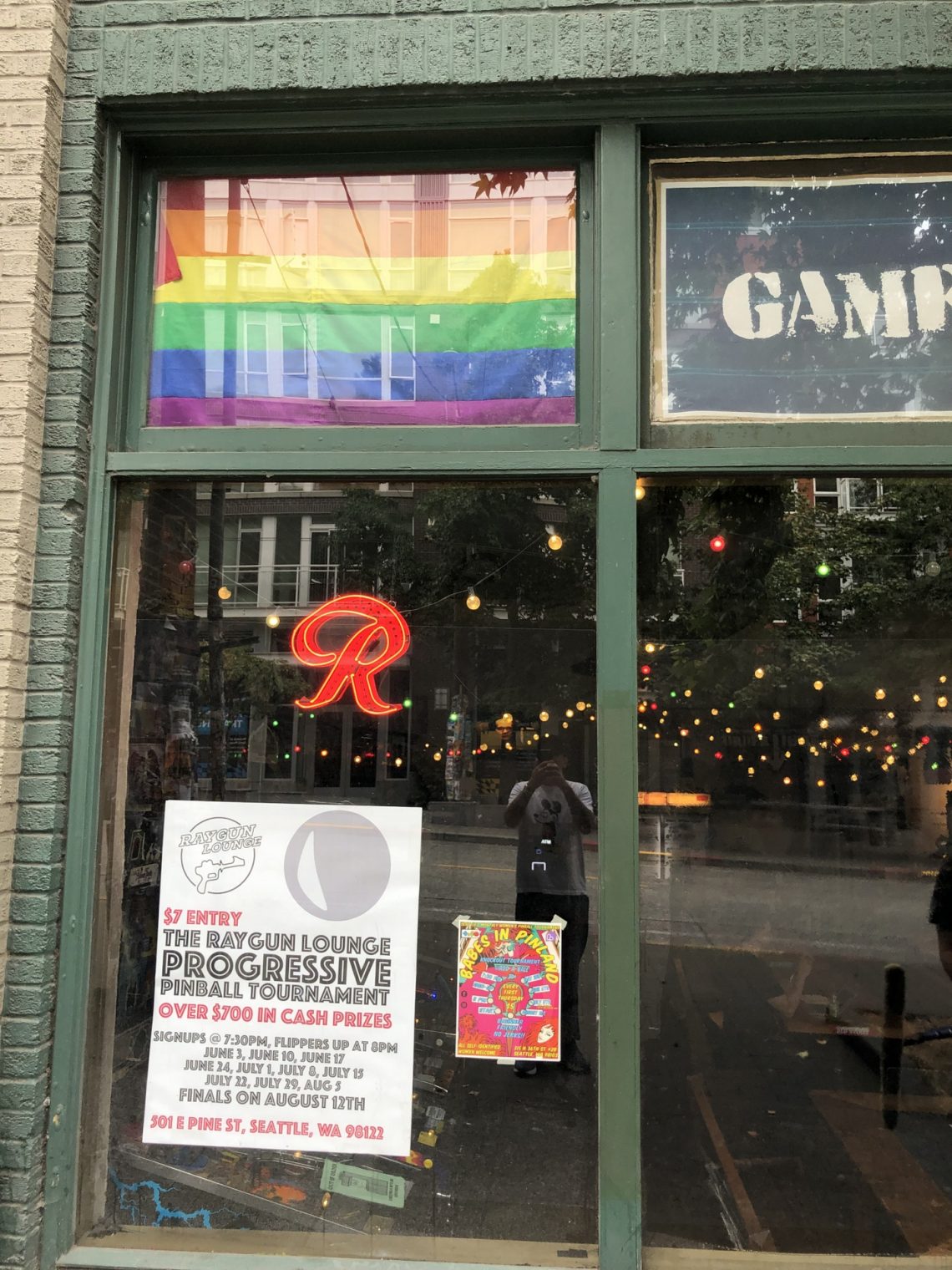
Zillow welcomes me to the gayborhood

A recent email from Zillow:

We’re marching at Pride 2019 to show our support for the LGBTQ+ community. Because home is more than just an address — it’s the place you belong.

Live where you love

Gayborhoods are often in high demand — but they don’t always carry a high price tag.

We believe all people should live in a world where they feel valued, supported and like they belong.

[Do they want Trump-loving anti-abortion anti-immigration gun-loving Americans to feel “valued, supported, and like they belong”?]

The featured Gayborhoods have a percentage of same-sex couples ranging from 2.3 percent to 7.6 percent:

Zillow explains how they found these: “Census tracts and groupings with the highest percentages of same-sex couple households were matched to the neighborhood that best contained them.”

We are informed by our best minds that between 10 and 20 percent of Americans are gay (Smithsonian reporting on research by National Bureau of Economic Research).

Admittedly not every household contains a couple, but if the 10-20 percent figure is correct, shouldn’t a neighborhood with only 2.3 percent same-sex couples be considered a Straightborhood?

Finally, what percentage of American homes these days are “the place [the occupants] belong”? Does someone who has moved from the other side of the U.S. for school or work “belong”? A person who votes contrary to the prevailing political doctrine in the neighborhood? An undocumented immigrant who can be deported at any time by the not-yet-abolished ICE?

Full post, including comments

Is Irish GDP misleading?

Based on GDP per capita, Ireland is substantially better off than the U.S. It is ahead of Switzerland and Norway, though not within sight of Singapore or Qatar.

Yet the observed lifestyle in Ireland does not seem lavish or gold-plated as it does in Switzerland. A “national road” (comparable to a state highway in the U.S.) will be the width of a North Carolina dentist’s driveway. There is no shoulder and a dirt embankment or hedge will be flush to the edge of the pavement, which is also the edge of the travel lane (see “no shoulder”). Houses are smaller than in the U.S. and systems for central and water heating, etc., seem to be more primitive (one huge plus: no mosquitoes and therefore no screens on the windows!). Public transport infrastructure is better than the U.S., but nowhere near the Russian standard (commuter rail every 15 minutes!). The country does not seem to live any wealthier than southern England, for example.

Costs for labor-intensive items, such as car or aircraft maintenance, are comparable to what people pay in the U.S. and much lower than in Switzerland. Hotels and restaurant prices are also reasonable, especially when you consider that taxes and service are included.

I spoke with several Irish guys who are frequent travelers to the U.S. They think that Ireland is a better country overall, especially for young people, due to the fact that citizens come out of university debt-free and into a strong job market. So they aren’t impressed with our infrastructure, apparently. Thanks to the cold/wet climate, nearly everyone in Ireland can afford to live close to the ocean. Oceanfront property prices are approximately 1/10th of what one might pay in Florida, for example, despite the fact that the Irish property will typically be high enough above sea level (on the rocky shore) to survive quite a bit of sea level rise. (Below, a statue in Cobh that commemorates the first person to immigrate to the U.S. through Ellis Island, but when the future was plainly brighter for a young person in the U.S.)

Our government investigators are the best (look at how the Mueller investigation, in only two years, figured out that older Americans were paying younger Americans to have sex and that Americans sought to avoid paying tax!) so I hesitate to doubt the CIA’s published GDP numbers. However, the facts on the ground don’t seem consistent with the higher-than-Switzerland purported GDP-per-capita.

The Financial Times seemed to agree with this back in 2016: “Multinationals obscure real state of Ireland’s economy; Bloated GDP data blamed on difficulty of measuring their activity.”

The good news is that, whatever the actual level of GDP per capita, Ireland is growing nicely, though property prices are not yet back to their peaks (a real estate developer told me that prices for completed structures, as opposed to undeveloped land, are now roughly where they were at the 2008 peak, but that’s in nominal dollars, not inflation-adjusted).

Full post, including comments

Europeans who don’t want to go back to Europe because it is “violent”

At a recent barbecue I talked to a couple of Europeans, one from France and one from Romania. They’re living in Massachusetts now. Would they want to return to live in Europe? “No,” said the Romanian. “It is too violent.” The French woman agreed.

How was that possible? Doesn’t the U.S. have a near-monopoly on violence, at least if we are to believe our media? The answer was “no.” They both thought that their countries were ripe for essentially a civil war between the native Christian population (of which they had been part) and the immigrant Muslim population. They thought that large parts of their respective countries were already unsafe for non-Muslims and that the problems would become dramatically worse in the near future.

They also appreciated America’s service-oriented economy in which the customers usually is a priority. “You think that the French hate Americans because of the way you get treated in shops,” said the former Parisienne, “but they treat us the same.”

They considered the cost of living in Europe to be dramatically higher than the U.S., even more than could be explained by the VAT (consumption tax). “I have a friend who is a nurse and her husband is an architect,” said the French woman. “They live just above what we would consider the poverty line.”

What was good about Europe? “The vacations, the ability to relax and enjoy life, the social contacts.”

Related:

Full post, including comments

Would it make sense for cities to hire homeless relocation concierges?

From the Los Angeles Times, “Councilmen weigh legal action, saying other cities are pushing homeless into L.A.”:

Councilmen Mike Bonin and Joe Buscaino called Wednesday for City Atty. Mike Feuer to explore “legal steps” that L.A. could use to compel those cities to comply with a federal court decision on homelessness and sidewalk camping in Boise, Idaho. The proposal, they said, would stop nearby cities from pushing homeless people into L.A. city boundaries.

The U.S. 9th Circuit Court of Appeals ruled last year that homeless individuals may not be held criminally responsible for sleeping on government property when no alternative shelter is available.

Bonin, whose council district touches Santa Monica, Culver City and El Segundo, said he believes many cities in the region are not complying with that decision.

“Instead of allowing people to sleep on their sidewalks, they are encouraging people, or compelling people, to move to the city of Los Angeles to do that,” he said.

I’ve occasionally wondered in these pages why people who are homeless in a place with a cold and/or wet climate, e.g., Seattle, do not relocate to Santa Monica. Readers have put forward various theories about the challenges faced by the homeless. The LA Times article shows that at least some cities are eager to see homeless residents move to other places (but they also want to provide sanctuary to undocumented low-skill immigrants?).

Would it make sense for cities to hire concierges for their homeless populations? The concierge El Segundo, for example, would organize luxury bus tours of nearby California cities, would know the best places to camp out and receive services in each of those places, etc. Instead of an arms race of hostility, seeing which city can make life miserable for the homeless, try to facilitate their moves.

[The article also contains a comparison of homeless to trash that, had Donald Trump made it, would have been newsworthy:

Councilman Jose Huizar and several colleagues called for increased enforcement, fines and rewards, along with the expansion of a program that allows homeless and formerly homeless individuals to work on cleanup crews.

“I have long said that downtown Los Angeles needs an emergency, triage-like response when it comes to addressing homelessness,” Huizar said in a statement. “But that is also true for the amount of trash that is illegally dumped on our streets.”

]

Readers: What do you think? Cities already provide a lot of services to the homeless. Why not a concierge to help with moving?

Full post, including comments

Schick razor blades: too sharp?

Happy Father’s Day!

This seems like a good time to wrap up the razor blade test inspired by Gillette’s Toxic Masculinity ad.

Side-by-side testing with multiple subjects and some female perspectives revealed that the Dorco Pace 7 is superior to Gillette’s latest and greatest 5-blade cartridges.

What about Schick? The present company is the result of a merger with Wilkinson Sword, the inventors of the modern razor blade. So they should know more about making blades per se than anyone else.

After testing the Schick cartridges that are compatible with Gillette handles and the Schick Xtreme 5 Pivot Ball system, my conclusion is that Dorco Pace 7 remains superior. The Schick blades may actually be sharper and possibly therefore better for certain skin types. At first it seems that the razor isn’t working because, unlike with Dorco and Gillette, there is no feeling of tugging. However, stubble is removed from one’s face so plainly the blades are working. I ended up preferring the Dorco and finding it easier to control.

Related:

Full post, including comments

Solar panels failing after six years

Why let the amateurs at the power company generate and deliver power in exchange for a monthly subscription fee when you can go into the power generation business yourself?

A local friend (and MIT PhD in EECS!) put solar panels on his roof six years ago, responding to the massive government handouts on offer at the time (thanks, fellow Massachusetts taxpayers!). Roughly half of the panels have now failed, casualties of squirrels, UV light, etc.


Given the rising cost of labor (a bundle of wages and health care expenses), will it turn out that America’s big rooftop solar experiment was a colossal failure from a total lifecycle cost perspective?

Already it seems to me that single-family homes are unaffordable for a typical family because the cost and challenge of bringing contractors in to maintain all of the systems has been growing every year. Adding an electricity generation plant on the roof makes this problem worse.

Related:

Full post, including comments