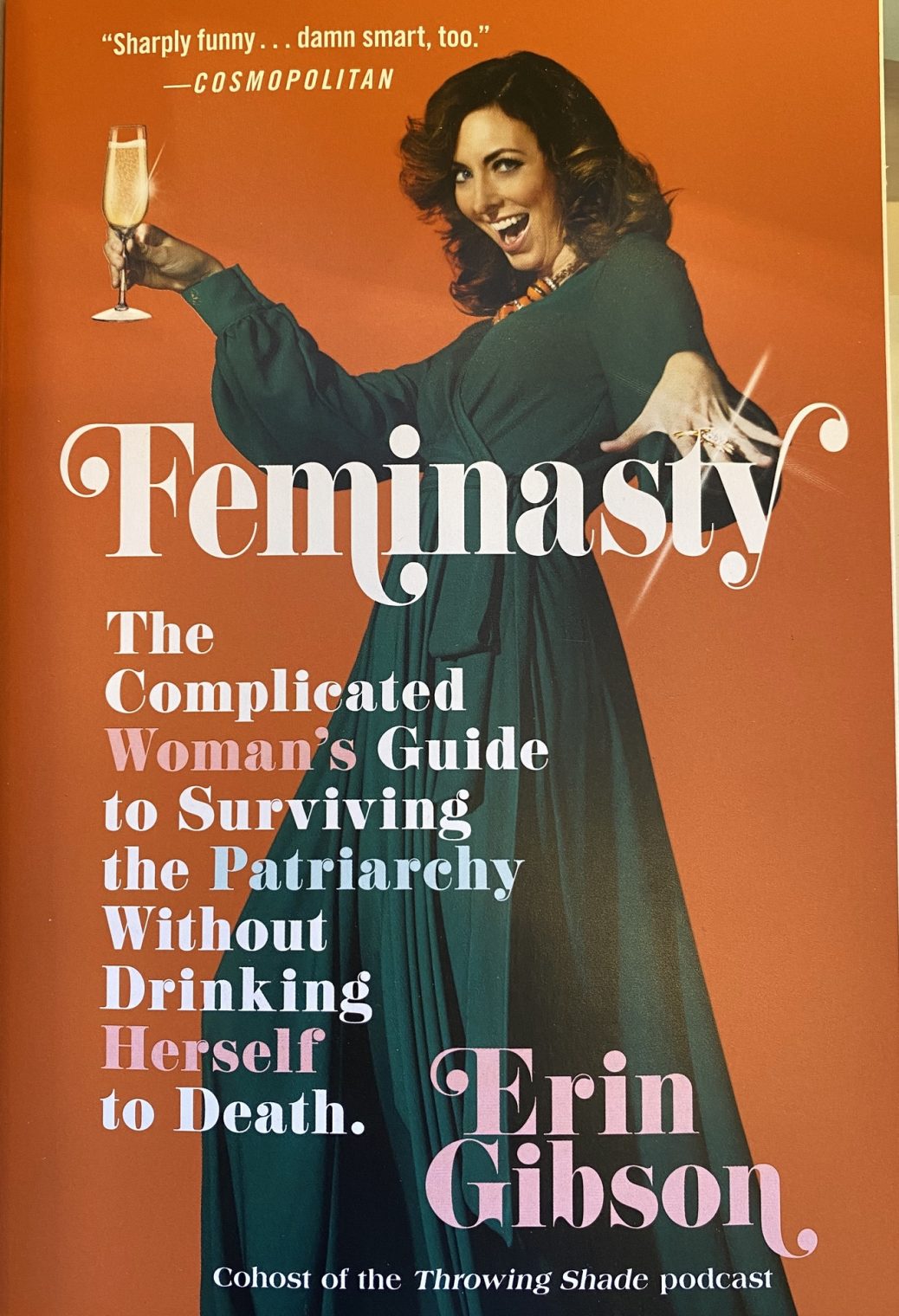
In “Americans don’t read the world’s best literature?” I wondered about why so few Amazon shoppers were reviewing Olga Tokarczuk and Peter Handke, Nobel Literature recipients for 2018 and 2019.
Olga Tokarczuk was slightly less unpopular on Amazon so I read Flights first. The book mixes modern travel with some imagined old corpse preservation techniques related to modern-day plastination. A sampling:
Anyone who has ever tried to write a novel knows what an arduous task it is, undoubtedly one of the worst ways of occupying oneself. You have to remain within yourself all the time, in solitary confinement. It’s a controlled psychosis, an obsessive paranoia manacled to work, completely lacking in the feather pens and bustles and Venetian masks we would ordinarily associate with it, clothed instead in a butcher’s apron and rubber boots, eviscerating knife in hand.
Wikipedia: As far as I can tell, this is mankind’s most honest cognitive project. It is frank about the fact that all the information we have about the world comes straight out of our own heads, like Athena out of Zeus’s. People bring to Wikipedia everything they know. If the project succeeds, then this encyclopedia undergoing perpetual renewal will be the greatest wonder of the world.
Every human body deserves to last. It is an outrage that it’s so fragile, so delicate. It is an outrage that it’s permitted to disintegrate underground, or given to the mercy of flames, burned like trash. If it were up to Blau, he would make the world differently: the soul could be mortal—what do we need it for, anyway—but the body would be immortal. We will never learn how diverse the human species is, how unique each individual, if we are so quick to condemn bodies to destruction, he thought. In the past, people understood this—but they lacked the means, the methods to preserve. Only the wealthiest could afford embalming. But today the science of plastination was developing very fast, perpetually perfecting its methods. Anyone who wanted to could save his body now, and share its beauty, its mystery, with others. Here is the wondrous system of my muscles, the sprinter would say, the 100-meter world champion. Look, everyone, at how this works. Here is my brain, the greatest chess player would cry. Ah, these unusual two grooves, let’s call them “bishop twists.” Here is my stomach, two children emerged from here into the world, the proud mother would say. So Blau imagined it.
The book was published in Polish back in 2007. Sex between professor and student was not something that would be front page news:
He arranged his personal life neatly, unproblematically. He felt decidedly better living alone; he quelled his sexual urges with his students, whom he would first feel out by inviting them for coffee. He knew it wasn’t allowed, but he was operating on the sociobiological premise that the university was his natural hunting ground, and that these women were, in the end, adults who knew what they were doing. He looked good—he was handsome, clean-cut, clean-shaven (from time to time he let his beard grow out, keeping it neat, of course)—and they were curious as magpies.
On what it means to be born into the world’s default language:
There are countries out there where people speak English. But not like us—we have our own languages hidden in our carry-on luggage, in our cosmetics bags, only ever using English when we travel, and then only in foreign countries, to foreign people. It’s hard to imagine, but English is their real language! Oftentimes their only language. They don’t have anything to fall back on or to turn to in moments of doubt. How lost they must feel in the world, where all instructions, all the lyrics of all the stupidest possible songs, all the menus, all the excruciating pamphlets and brochures—even the buttons in the elevator!—are in their private language. They may be understood by anyone at any moment, whenever they open their mouths. They must have to write things down in special codes. Wherever they are, people have unlimited access to them—they are accessible to everyone and everything!
On humans who imagine that they can “make a difference”:
In Australia, everyone in the environs would come out onto the seashore when the news was circulated that yet another disoriented whale had run aground. In shifts, people would charitably ladle water over its delicate skin and try to convince it to go home. Older ladies dressed like hippies would maintain that they knew what they were doing. Apparently all you had to do was say, “Go, go, my brother,” or, if need be, “sister.” And, with your eyes shut tight, transfer some of your energy into it.
All day, little tiny figures would mill about the beach, waiting for high tide: let the water take it back. Attempts would be made to fasten nets to boats and drag it out by force. Yet the great beast would soon become dead weight, a body indifferent to living. It’s no surprise people would begin to call it “suicide.” A small group of activists would appear in order to argue that animals ought to be allowed to simply die, if they so wished. Why should the act of suicide be the dubious privilege of mankind? Maybe the life of every living being has its own set limits, invisible to the eye, and once those have been crossed, life just runs out, on its own. Let that be taken into consideration for the Declaration of Animal Rights being drafted in Sydney or in Brisbane at just that moment. Dear brothers, we give you the right to choose your death.
Suspicious shamans would come down to the dying whale and perform rituals over it, followed by amateur photographs and thrill-seekers. A teacher from a village school brought her whole classroom, and the children were tasked with drawing “The Whale’s Farewell.”
… Although there have been instances of people managing to save the whales. In response to the great and dedicated efforts of dozens of volunteers, these whales would take deep breaths and head back into the open sea. Their famous fountains could be seen springing joyfully up toward the sky, and then they would dive down into the depths of the ocean. The crowd would break into applause.
A few weeks later they’d be caught off the coast of Japan, and their gentle, pretty bodies would be turned into dog food.
She loves airplanes almost as much as we do:
The plane takes off painlessly, on time; so once more the miracle has happened, of a machine as big as a building slipping gracefully out of earth’s grasp, soaring gently up and up.
The author was 45 years old in 2007. That’s a young mother in wealthier U.S. neighborhoods, but Tokarczuk was writing about the experience of middle age:
In the last few years she has realized that all you have to do to become invisible is be a woman of a certain age, without any outstanding features: it’s automatic. Not only invisible to men, but also to women, who no longer treat her as competition in anything. It is a new and surprising sensation, how people’s eyes just sort of float right over her face, her cheeks and her nose, not even skimming the surface. They look straight through her, no doubt looking past her at ads and landscapes and schedules.
On the death, from head injury and stroke, of a college professor leading a tour in the Mediterranean:
But the crimson inner ocean of the professor’s head rose from the swells of blood-bearing rivers and gradually flooded realm after realm—first the plains of Europe, where he’d been born and raised. Cities disappeared underwater, and the bridges and dams built so methodically by generations of his ancestors. The ocean reached the threshold of their reed-roofed home and boldly stepped inside. It unfurled a red carpet over those stone floors, the floorboards of the kitchen, scrubbed each Saturday, finally putting out the fire in the fireplace, attaining the cupboards and tables. Then it poured into the railway stations and the airports that had sent the professor off into the world. The towns he’d traveled to drowned in it, and in them the streets where he had stayed awhile in rented rooms, the cheap hotels he’d lived in, the restaurants where he’d dined. The shimmering red surface of the water now reached the lowest shelves of his favorite libraries, the books’ pages bulging, including those in which his name was on the title page. Its red tongue licked the letters, and the black print melted clean away. The floors were soaked in red, the stairs he’d walked up and down to collect his children’s school certificates, the walkway he’d gone down during the ceremony to receive his professorship. Red stains were already collecting on the sheets where he and Karen had first fallen and undone the drawstrings of their older, clumsy bodies. The viscous liquid permanently glued together the compartments of his wallet where he kept his credit cards and plane tickets and the photos of his grandkids. The stream flooded train stations, tracks, airports, and runways—never would another airplane take off from them, never would another train depart for any destination.
She’s a little more interested in dead bodies and plastination than I am, but I think that I can understand why she was awarded the Nobel Prize and would read more of her work.
Peter Handke, quoted in the Guardian:
I am a writer, I come from Tolstoy, from Homer, from Cervantes. Leave me in peace and don’t ask me questions [about political views]
After struggling to get through two of his books, I don’t see the parallel with these earlier authors (and don’t forget that Homer is not the author of the Iliad and the Odyssey; it was another Greek with the same name). Tolstoy, Homer, and Cervantes packed in a lot of plot and action. Handke’s books are short, but nonetheless the ratio of words to plot is high. Maybe they are more engaging in the original German, but there does not seem to be anything beautiful or clever about the language. The righteous attack Handke for his political heresy (e.g., PEN America), but I haven’t seen anyone say “Unless you have a Ph.D. in German literature you probably won’t enjoy these books.”
Readers: Were any of you brave enough to try out these authors?
Full post, including comments