Virtual reality and augmented reality: the technologies of the future

Part of our Austin experience was visiting the virtual/augmented reality lab at Capital Factory. Folks there have decided that the best current VR hardware is the HTC Vive. They aren’t in love with the much-hyped Oculus, but have it available to demo.

We did a 3D drawing game, browsed around in Google Earth, and played a first-person space-themed shooting game with the Vive. With Oculus, I played Angry Birds.

The good news is that we didn’t get sick, even flying around in Google Earth. On the other hand, I would rather have just covered the walls with more TVs for a more immersive experience.

I asked the folks running the lab for their theory on why VR hasn’t caught on. They cited the cost, noting that a complete HTC Vive rig is about $600. Yet that’s nothing compared to what hardcore gamers spend.

Readers: What do you think? Is it fair to say that “VR/AR is the technology of the future, and always will be”?

Full post, including comments

Generation Wealth

The movie Generation Wealth is currently streaming on Amazon. I loved the director’s previous The Queen of Versailles, so decided to give this one a try.

The movie is a mishmash of the director’s family history (retired parents and teenage children get a fair amount of screen time), musing regarding modern-day materialism, and interviews with people whose lives have been affected by parental or personal earnings.

One interesting character is Florian Homm, a fugitive from U.S. justice due allegations of fraud while running a hedge fund, resulting in investor losses of up to $200 million. He is back in his native Germany, which supposedly refuses to extradite its citizens (would that be true for an accused murderer or is it that they won’t extradite for a financial crime?). The filmmaker interviews Homm’s adult son and the son’s girlfriend for an all-around perspective.

Another interesting subject is a New Yorker who works on Wall Street. She refuses to consider the idea of marrying a lower-income man (a prudent policy in light of New York State’s winner-take-all family law) and explains that the pool of available men is thus quite small. At around age 40 she does find an old rich guy to marry and goes through exotic fertility treatments and the hiring of a surrogate. He eventually leaves her for a younger woman (i.e., the 70-year-old found a 30-year-old sex partner).

Kacey Jordan was featured as someone who went from minimum wage to high-paid porn star and then back to minimum wage. There was plastic surgery during this journey, which is another theme of the movie. Lauren Greenfield, the director, follows a bus driver “single mom” to Brazil for a life-changing investment in plastic surgery.

One interesting aspect is that the born-in-1966 Greenfield follows her classmates from a rich kids’ private high school into their adult lives.

The movie takes some swipes at Donald Trump and his supporters (they’re exposed as crass idiots!) and also takes a variety of standard 21st century feminist positions. Yet the filmmaker’s own life story contradicts the feminist complaints. Her college boyfriend-turned-husband is the person cited for maximum encouragement and facilitation of her career. He urges her not to quit in the early days when she’s discouraged and he takes care of an infant child while she travels to Asia on an assignment.

The central thesis is poorly supported. The film shows people today saying things about money-obsessed Americans that the film also shows people saying in the 1990s. Do we know that people didn’t have similar things to say in the 1970s about young Arab royals or circa 1900 about the children of industrialists? The world is richer so maybe there are just more rich kids running around.

One idea that does seem worth exploring is whether people are now less likely to aspire to be like their richest neighbor. The film says that, due to increased availability of media, Americans aspire to be like the rich crazy spenders that they see through electronic media. I wonder if this can be true. As the population booms and jobs are concentrated in a handful of cities, the realistic trajectory for a young American is a 2BR apartment shared among 4 people. Do the occupants of that crammed apartment look at an 8,000-square-foot house in Beverly Hills as a realistic aspiration?

My big take-away from the movie is that sending kids to a fancy private school is risky. Teenagers with a lot of unearned money to spend are not the best role models.

Full post, including comments

Folks who identify new victims can’t figure out why the old victims are forgotten

“‘Women Here Are Very, Very Worried’: Afghan women used to be championed by almost everyone. Now they’re all but forgotten.” (nytimes):

It was once a prominent and bipartisan cause: the liberation of Afghan women from the tyranny of the Taliban.

These women were championed by an array of strange bedfellows: feminists like Eleanor Smeal, celebrities like Lily Tomlin and stalwarts of a conservative administration like Laura Bush and Dick Cheney.

In the early days of the invasion, the world heard vivid stories of the changes the war had brought. Women could walk freely outside their houses and put on makeup; girls could go to school. It was a narrative that helped buoy public support for the fight in Afghanistan and deflect criticism about American empire.

Nearly two decades later, Afghan women are all but invisible to an American public thoroughly weary of the war.

My comment:

A lot of new classes of victims have been discovered right here in the U.S. since 2001. For example, the NYT was recently running stories about Federal employees victimized by getting 35 days of paid time off in exchange for a delayed paycheck (one of my friends is a senior FAA employee; he said that he enjoyed his vacation trips to Arizona and Europe during the shutdown). Human sympathy and attention are not unlimited. If paid-late-for-not-working Federal employees are front-and-center victims then Afghan women cannot be front-and-center victims.

Example: “As Shutdown Drags On, Some Step Up to Help Unpaid Federal Workers”:

Predictions of pain that had been theoretical, or theatrical, in shorter shutdowns are now a reality for around 800,000 federal workers, scattered through states red and blue.

“The public does not realize the impact that a shutdown has on the F.B.I. or on our families,” a bureau official wrote in an email this week to supporters of the nonprofit Society of Former Special Agents of the FBI.

Readers: What do you think? Is there something special about women in Afghanistan, or is it simply that the victims of 2001 must yield mindshare to the victims of 2019?

Full post, including comments

Jussie Smollett case shows how much faith Americans have in government officials

If a prosecutor had disliked Jussie Smollett for any reason, he could have been tried for 16 felony counts and been sentenced to as much as 64 years in prison (CBS).

The prosecutor, however, decided that $10,000 and two days of community service would be appropriate (i.e., 0 days in prison rather than more than 23,000). See this AP story in the New York Times:

Defense attorneys said Smollett’s record was “wiped clean” of the 16 felony counts related to making a false report. The actor, who also agreed to do community service, insisted that he had “been truthful and consistent on every single level since day one.”

“I would not be my mother’s son if I was capable of one drop of what I was being accused of,” he told reporters after a court hearing. He thanked the state of Illinois “for attempting to do what’s right.”

I think that this illustrates how much faith Americans have in their government, being willing to vest decision-making over whether this guy would spend the rest of his life in prison or walk free after paying over a few hours of wages (he gets paid more than $100,000 per episode of a TV show).

I don’t think that Europeans live with this kind of unpredictability or subject to the personal whims of government officials. Smollett’s alleged actions would be matched up as closely as possible with something in the big code book(s) and the appropriate punishment looked up.

[The situation in family law is analogous. European countries tend to have straightforward rules, e.g., “the mother will always win custody of minor children” (Denmark) and limits on profitability for both plaintiffs and attorneys (Germany). Contrast to a classical U.S. state, such as Massachusetts, where a child support plaintiff who had sex with a dermatologist could end up with (1) larger after-tax profits than the earnings of a primary care doctor plus 50%-100% custody of the resulting child, (2) profits capped at $1 million (23 years times $40,000) and half-time or primary custody, (3) 0-49% custody of the child and zero revenue. Much of this would be entirely unpredictable until there was a judge assigned to the case (see our statistical study of Middlesex County Probate and Family Court for how dramatic the judge-to-judge variation can be). From the Washington State chapter:

What if a case doesn’t settle? “My main concern with the courts is that lack of consistency from judge to judge,” says DeVallance. “I have two cases with similar facts. In Case 1 Dad has a shared parenting schedule. In Case 2 Dad has supervised visitation [his children can see him only in a facility run by social workers]. The only difference is the judge that was drawn in each case. I could take the exact same facts and make the exact same argument in front of five judges and get five different rulings. This is such a challenge for family law litigators because clients come to us asking for advice.”

The Washington State lawyer’s comments were consistent with what we heard from attorneys around the U.S., except in the handful of states with 50/50 shared parenting presumptions. It costs hundred of thousands of dollars in legal fees just to find out where a judge’s personal biases and prejudices will fall.]

Readers: Why would we give single individuals so much discretion? Is it because we think that Americans are uniquely talented and therefore individual Americans, in this case prosecutors, must be exceptionally capable? The same reasoning behind the often-expressed belief that Americans will play an important role in solving global challenges, such as reducing atmospheric CO2? (Our best engineers can’t make a safe airliner, but the Germans and Chinese will look to us for guidance when they’re building solar cells, windmills, and CO2 vacuums?)

Related:

Full post, including comments

Transgender solution to the Boeing 737 MAX problem

How to handle the public relations challenge of operating a new two-pilot two-jet-engine airliner with a safety record far worse than that of a 50-year-old single-pilot piston-engine plane such as the Cessna 402 (when used in airline service)? United Airlines seems to have found a way. From a friend on Facebook:

I ❤️ #United #LGBTQ #nonbinary

(Over a link to “United Becomes First U.S. Airline To Offer Nonbinary Gender Booking Options”)

What did the database programmers at United accomplish?

The U.S. airline will offer multiple gender options for customers booking flights, including M (male), F (female), U (undisclosed) and X (unspecified). United added that the title “Mx.” also will be available for travellers to select.

The gender option chosen by the passenger must correspond “with what is indicated on their passports or identification” in order to satisfy the Transportation Security Administration, United said. Anyone regardless of identification can choose the title “Mx.”

For whom can this work as a practical option, then?

More and more states have added gender options on identification. Oregon, California, Arkansas and Washington state currently offer a third gender option on birth certificates, while Washington, D.C., offers a third gender option on driver’s licenses. Most recently, the New York City Council announced it will offer “X” as a gender category for people who don’t identify as female or male.

What about for international travel? The U.S. Department of State offers a helpful page for those transitioning from one officially recognized “sex” to another. On the other hand, it seems that male/female are the only options. From “Victory! State Department Cannot Rely on its Binary-Only Gender Policy to Deny Passport to Nonbinary Intersex Citizen”:

The State Department denied Dana’s passport application because Dana could not accurately choose either male or female on the passport application form, and the form does not provide any other gender marker designation.

This is the second time Zzyym has won against the U.S. State Department for denying them a passport. In November, 2016, the same district court found the State Department had violated the federal Administrative Procedure Act and ordered the department to reconsider its binary-only gender policy.

The State Department doubled-down on its discriminatory male-or-female-only policy to deny Zzyym a passport, leading to today’s ruling.

So the nonbinary traveler making a domestic connection before an international flight would need a reservation with two genders: X for the domestic leg to correspond to the driver’s license and M or F for the international leg to correspond to the passport.

Backing up a bit… if the airline’s record must correspond to the gender stated on the passenger’s ID, did United have any choice but to task its database programmers with this project? Wouldn’t every airline have to invest in updating its systems to the modern world of gender-on-a-spectrum if the governments issuing IDs are changing their policies? So the PR folks at United are possibly even more brilliant for getting positive press for an expensive IT project that they were forced into doing.

Related:

Full post, including comments

Germany reparations at 200% of GDP were unpayable; national debt of 200% is no problem

An Economic History of the World since 1400 by Donald J. Harreld takes the conventional view that the reparations Germany was obligated to pay following World War I were so large that they forced the company into an economic death spiral. The professor says that Germany was to pay $30 billion over a 70-year period that this was roughly 2X the German national income (a book that I reviewed in 2011 puts the number at 83 percent of GDP) at the time. Germany could “never hope to pay” this amount and the debt made World War II more likely.

The lectures also say that Germany made things worse by printing money to meet government expenses. [Though the Germany government stopped making reparations payments in 1933 after Hitler was elected.]

What are Americans’ best ideas in the econ department lately? Pushing government debt from its current 106 percent of GDP (already more than the Germans owed, according to the 2011 book) up and over 200 percent so that we can pay for things we want such as the Green New Deal. At the same time we will apply Modern Monetary Theory so that we can simply print more dollars whenever we need to buy something. (I like this idea, but I think it would work even better if we ask Zimbabwe to print Zim Dollars to pay for the stuff that we need/want. They’re already doing a lot of printing so if we send them some paper and ink they shouldn’t mind printing more.)

The professor himself seems unaware of this apparent contradiction. He is a Big Government, Keynesian Spending, and Welfare State enthusiast. He does point out the Keynes said that governments should spend less during boom times and that modern governments never implement this part of the theory. But he never explains why it is obvious that Germany could never pay an amount comparable to its GDP while it is simultaneously obvious that modern Welfare States can meet their debt and entitlement obligations (closer to 500 percent of GDP for the U.S. when you add in Medicare and Social Security; see this 2010 chart in the New York Times in which Greece owed 875 percent total while the U.S. was at 500 percent (i.e., the U.S. owes 5 years of GDP)).

Separately, the professor notes that the U.S. and Germany had the longest and deepest economic depressions during the 1930s and pursued similar economic policies:

The two countries hardest hit by the Great Depression were the United States and Germany—countries that hadn’t left the gold standard. And both Germany and the United States adopted several practices to stabilize their domestic economies in the 1930s that were amazingly similar. … Both countries used similar strategies to combat unemployment and poverty in their populations, including poor relief and public works programs. Both governments also set up work camps for young men from rural areas, primarily to keep them from migrating to the industrial workforce.

Countries such as England that relied on market economics came out of the Depression much faster, according to the class.

Related:

Full post, including comments

City rebuilding costs from the Halifax explosion

Catching up on 2017 must-reads for Bostonians, I recently enjoyed The Great Halifax Explosion: A World War I Story of Treachery, Tragedy, and Extraordinary Heroism by John U. Bacon.

The main story is familiar, but worth retelling.

All explosives require two components: a fuel and an “oxidizer,” usually oxygen. How destructive an explosive is depends largely on how quickly those two combine. With “low explosives,” like propane, gasoline, and gunpowder, it’s necessary to add oxygen to ignite them and keep them burning. If a fire runs out of oxygen, it dies. Another factor is speed. The rate of the chemical reaction, or decomposition, of low explosives is less than the speed of sound, or 767 miles per hour. In contrast, a “high explosive” combines the fuel and the oxidant in a single molecule, making each one a self-contained bomb, with everything it needs to create the explosion. To ignite, a high explosive usually requires only extreme heat or a solid bump. Once started, the dominoes fall very quickly, ripping through the explosive material faster than the speed of sound.

“She had a devil’s brew aboard,” Raddall states of the Mont-Blanc, a perfect combination of catalysts, fuel, and firepower. The ship’s manifest included 62 tons of gun cotton, 250 tons of TNT, and 2,366 tons of picric acid, the least understood of the chemicals on board, but the most dangerous.

After the shipwrights had so carefully built the magazines, hermetically sealing each compartment, and the stevedores had packed it all systematically, the French government agent operating out of Gravesend Bay received a last-minute order from his superiors in France to pack what little space remained on Mont Blanc with urgently needed benzol, an unusually volatile fuel, the latest “super gasoline.” The stevedores followed orders, swinging 494 barrels containing 246 tons of the highly combustible accelerant into a few unused spaces belowdecks, on the foredeck, and at the stern, where they stacked the fuel three and four barrels high and lashed it with canvas straps, a somewhat slapdash approach compared to the thoroughness with which the shipwrights had built the magazines. When the crew walked past the drums on deck, they could smell the unmistakable reek of the benzol. With the final addition of the benzol, Mont Blanc now carried an impressive array of the most dangerous chemicals known to man at that time. While benzol can’t match the pure power of gun cotton, TNT, or picric acid—all high explosives—what the stevedores probably didn’t know when they stacked the barrels of benzol on deck was that the airplane fuel needed only a spark to ignite, while picric acid doesn’t explode until it reaches 572 degrees Fahrenheit, and TNT does not detonate until it reaches 1,000 degrees. But by making the last-minute decision to store most of the fuel on the deck and the TNT and picric acid below, the crew had unwittingly constructed the perfect bomb, with the easy-to-light fuse on top, and the most explosive materials trapped in the hold below.

Canada had a much larger stake in the war than did the U.S.:

Halifax sent 6,000 sons to the Great War, roughly a quarter of its male population. It seemed almost every home had sent a brother, a husband, a father, or a son. The Great War drained the town of its able-bodied young men and left behind women, boys, girls, and men too old or infirm to fight.

One question worth pondering is why more people didn’t chicken out and escape to the U.S. They knew what the trenches were going to be like:

When fresh recruits got to Halifax, they frequently made a beeline for any place that sold alcohol, where they met soldiers who had been recently discharged, were on leave, or were about to head back to the trenches. They told the recruits stories so horrifying that they might have been tempted to think they were exaggerating. The experienced soldiers knew the average infantryman lasted only three months before getting wounded or killed, so they were determined to make the most of their time on the safe side of the Atlantic. Their hard-earned fatalism fostered a devil-may-care disposition and all the elements that came with it, including scores of prostitutes from across Canada and bootleggers so fearless that they set up shop in the downtown YMCA—which was probably not what the YMCA’s benefactor, Titanic victim George Wright, had had in mind when he wrote his will. During the war years, Halifax experienced a spike in venereal disease and out-of-wedlock births. Local orphanages had to expand.

The Mont-Blanc makes it from New York to Halifax without incident, but before the sailors can go to the YMCA for a drink, there is a low-speed collision with another ship. The author describes the impact that resulted in the explosion as entirely the fault of the Imo‘s captain and pilot (see Wikipedia for a quick summary, but I highly recommend this part of the book). More than 10,000 people were killed or wounded. The book covers this staggering tragedy, but this post is about the physical destruction and the estimated cost of rebuilding:

The explosion destroyed 1,630 buildings and damaged 12,000 more, leaving some 25,000, almost half the population of Halifax-Dartmouth, without adequate housing and dangerously exposed to the elements.

After the fires had been extinguished and the wounded tended to, Colonel Robert S. Low assembled an army of carpenters, masons, plumbers, and electricians to rebuild the city, which had incurred more than $35 million in damages in 1917 U.S. dollars, or $728 million today.

It cost only $728 million to rebuild a whole section of a city. Our town will soon spend $110 million to renovate/rebuild a school that can hold only about 600 students. I talked with a guy recently who is involved in a $1.5 billion project to create 2,700 “affordable” apartments here in the Charlestown section of Boston (story). That’s $555,555 per apartment (less than 1,000 square feet on average) on land provided for free (city already has a housing project on the same footprint). Presumably these will be higher quality than whatever was built in Halifax in 1918.

[Note: poor people who are selected by the housing ministry to move into one of these apartments would actually be rich almost anywhere else in the world if they could only get their hands on the $555,555 capital cost as a direct grant instead of as an in-kind service! If they could also get their hands on the monthly operating cost and combine that with interest on the $555,555 they would be able to enjoy, without working, a middle class or better lifestyle in many of the world’s beach destinations.

How about folks who work at the median wage? That’s about $23/hour in Massachusetts (BLS) or $46,000 per year. NerdWallet says that someone earning this much in MA can afford a $258,500 house if he or she has saved $60,000 for a down payment, has a top credit score, and spends $0/month on food and other non-housing expenses. Zillow says $274,416 on a nationwide basis. So a dual-income couple in which both partners earn the median wage wouldn’t be able to afford one of these units without a taxpayer subsidy, even if land were free and the unit were sold at zero-profit construction cost. The U.S. has apparently become a society in which Americans can’t afford to live like Americans!]

Maybe costs are lower up in Canada? Yes, but only a little:

Instead of drifting back into another long sleepwalk, Halifax has been accelerating, spending $11.5 million in 1955 to build its first bridge across the channel, another $31 million to build the second, right over the Narrows, and another $207 million in 2015 to raise the first bridge a few meters so container ships could get all the way to a dock in Bedford Basin. The city has spent $350 million to build a boardwalk along the bay and $57 million for a shiny new library downtown, an architectural centerpiece CNN judged to be the ninth most beautiful library in the world.

How about some other costs? A survivor of the explosion gets “$100 to enroll at the University of Michigan in 1919”. That’s $1,500 in today’s money, less than 1/30th of current tuition. He marries an American (same word “marriage” used, but really a different activity in those days before no-fault divorce):

Shortly after that invitation, Barss asked Helen to marry him. She said yes, but asked him to keep it between them until February, “so that if either of us wanted to get out of the deal, no one would be hurt.” Further, if Barss’s professors found out he was getting married, which med school students were forbidden to do, he could be expelled. “My father liked Joe & asked if he were a Republican or a Democrat,” Helen wrote. “He said he was a Canadian and voted for the man—Father said ‘If you ever live here and have anything or hope to have anything, you’ll be a Republican in self defense.’

Maybe it is good that this guy died before Elizabeth Warren and Alexandria Ocasio-Cortez proposed their latest tax plans!

I found the numbers in the book sobering. If we wear down the infrastructure that we have or if perhaps it is destroyed for some reason, it doesn’t seem as though we could afford to rebuild it.

More: Read The Great Halifax Explosion: A World War I Story of Treachery, Tragedy, and Extraordinary Heroism

Related:

Full post, including comments

Maybe we love war so much because we tell ourselves that we’re good at it

After reading World War II at Sea: A Global History you won’t accept media reports of military success uncritically. Some examples:

The Americans, too, inflated their achievement in the Coral Sea. Headlines in the New York Times insisted that American bombers had sunk no fewer than seventeen Japanese warships, including “the certain destruction of two aircraft carriers, one heavy cruiser, and six destroyers.” The papers were initially silent, however, about American losses, reporting only that they were “comparatively light.” In fact, American losses in the Coral Sea were heavier than those of the Japanese, and the loss of the Lexington in particular, representing as it did one-quarter of the nation’s available strike force in the Pacific, was especially worrisome. At the moment, however, the public was hungry for good news, and the Navy Department did not discourage the national celebration.

The Battle of Savo Island was a humiliating defeat for the Allies. With the exception of Pearl Harbor, it was the worst defeat in the history of the United States Navy. It was so bad that, like the Japanese authorities after Midway, the American government kept the outcome an official secret. Based on the official navy briefings, the New York Times reported on August 18: “An attempt by Japanese warships to hamper our landing operations … was thwarted. The Japanese surface force was intercepted by our warships and compelled to retreat before it could take under fire our transports and cargo vessels.” While technically accurate, it was also deliberately misleading.

When there was an actual success to report, of course, the stories were more accurate (even then, however, missteps that wasted lives tended to be omitted).

Maybe we think that we’re great at war because our government and media tell us that things are going our way even when we’re losing?

See also the Vietnam War.

Full post, including comments

What did we spend and what did we learn from the Mueller Investigation?

My Facebook friends are talking about the Mueller Investigation recently wrapping up (Wikipedia page on Special Counsel investigation (2017-2019)). Samples:

We don’t need investigative journalism or the Mueller report to implicate Trump. The evidence is already out in the open.

If you are wondering why Muller’s office issued no more indictments before releasing their report and thinking this lack of indictments somehow clears Trump and family read this thoughtful analysis of what may actually be Muller’s strategy. [link to a speculative article]

James Comey weighs in, leaving out an obvious, galling point. There is already more than enough evidence right now to indict and convict “Individual 1.” No doubt Mueller is surveying a Kanchenchunga of offenses. Mr. Trump’s top goons are already doing time in jail. It is a grotesque travesty of justice that the head of the operation — the unindicted coconspirator — instead gets to pretend to be president. With his well-cooked books, there is little question that Mr. Trump would be in jail and should be jail, right now, were it not for an idiotic Department of Justice policy that shields the president. The situation is so bad that many regard Mr. Trump’s clinging to office as the only way he can stave off jail time. He really has no exit path, other than trading his wardrobe for an orange jumpsuit. Didn’t think it through.

My favorite:

Can’t wait to wrap my eyes around the Mueller report–but I haven’t been doing much heavy reading lately. Would any of my comic artist buddies on my friends list consider adapting it to a graphic novel?

Is there good data on what this two-year investigation cost taxpayers? In addition to the direct expenditures, I think the cost in lost productivity from Americans posting about it on Facebook has to be many $billions.

(Back of the envelope: 150 million adult Americans who care about politics. Average of 1 hour spent talking or listening on this subject. Median wage $20/hour. Total: $3 billion.)

Wikipedia describes the purpose of the investigation:

counterintelligence investigation of the Russian government’s efforts to interfere in the 2016 presidential election. According to its authorizing document, which was signed by Deputy Attorney General Rod Rosenstein on May 17, 2017, the investigation included any possible links or coordination between Donald Trump’s presidential campaign and the Russian government as well as “any matters that arose or may arise directly from the investigation.”

The page says that they indicted a handful of Russians living in Russia for alleged crimes related to the above (falsely claiming that some young Democrats wanted to raise taxes on the successful, expand central planning of the economy (e.g., through higher minimum wages and other constraints on employer-employee relationships), make welfare programs more generous, and boycott the Jews of Israel?). That’s like Abraham Lincoln freeing all of the slaves… who lived in the parts of North America that he did not control.

What about people living in the U.S. that could actually be prosecuted, as a practical matter? How many of those were indicted for colluding with Russia?

If we can get these two numbers we can divide to get the cost per indictee!

Full post, including comments

Empress of the Seas Cuba and Haiti cruise review

This review is based on a December 9-17, 2018 trip from Miami to Havana, Cienfuegos, Grand Cayman, and Labadee, Haiti.

See https://philip.greenspun.com/blog/2019/01/03/cuba-tourism-cruise-ship-versus-hotels/ for some thoughts about seeing Cuba by ship versus land tours.


By virtue of having qualified as U.S. government-authorized providers of “people to people” tours, the cruise lines are able to operate in Cuba legally. Due to their scale and efficiency (world labor market!), the result is far cheaper than what land-based tour companies are able to offer. The basic rooms-with-windows on Empress of the Seas for our departure were going for less than $800 per person ($100/day) including all fees.

Empress of the Seas is the smallest and oldest ship in the Royal Caribbean inventory. Wikipedia says that she was launched in 1989 and holds 1,840 passengers. Piers in most Cuban ports circa 2018 were not capable of handling larger ships, which is why this smaller and less profitable ship was in use (see https://philip.greenspun.com/blog/2018/12/26/cruise-o-nomics/).

The basic cabins on Empress are truly closet-sized. We paid $3,070 for a “suite” that is more like the size of an ordinary “room” on a new ship. The bathroom was tiny (way too small for a tub, for example). It was worth it for the balcony. We spent another $2,000 or so on shore excursions, Internet connectivity (intermittent and sometimes slow), drinks (not on the unlimited “alcohol misuse disorder” plan!), etc.

The crew likes to surprise passengers with decoration:

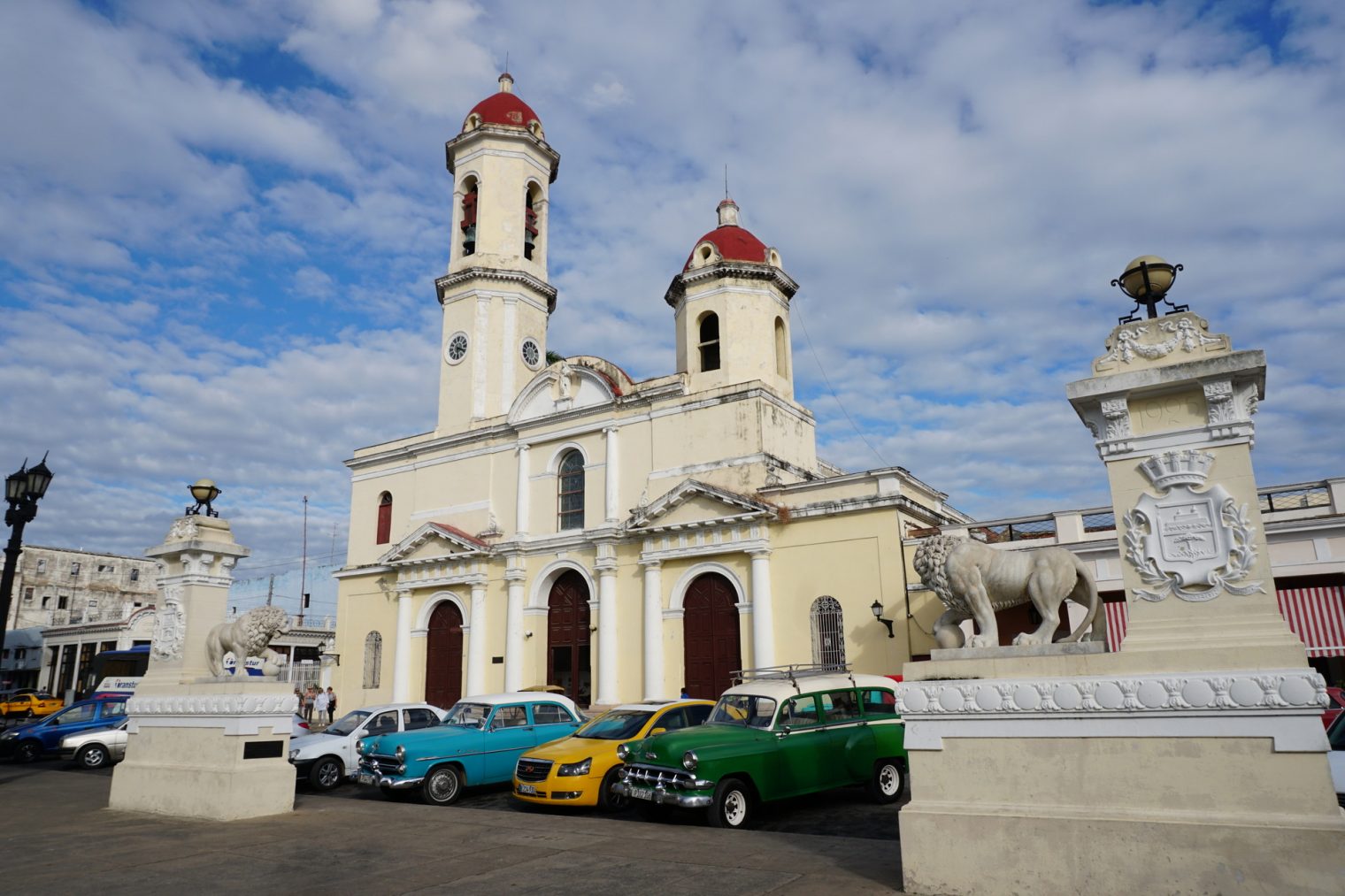
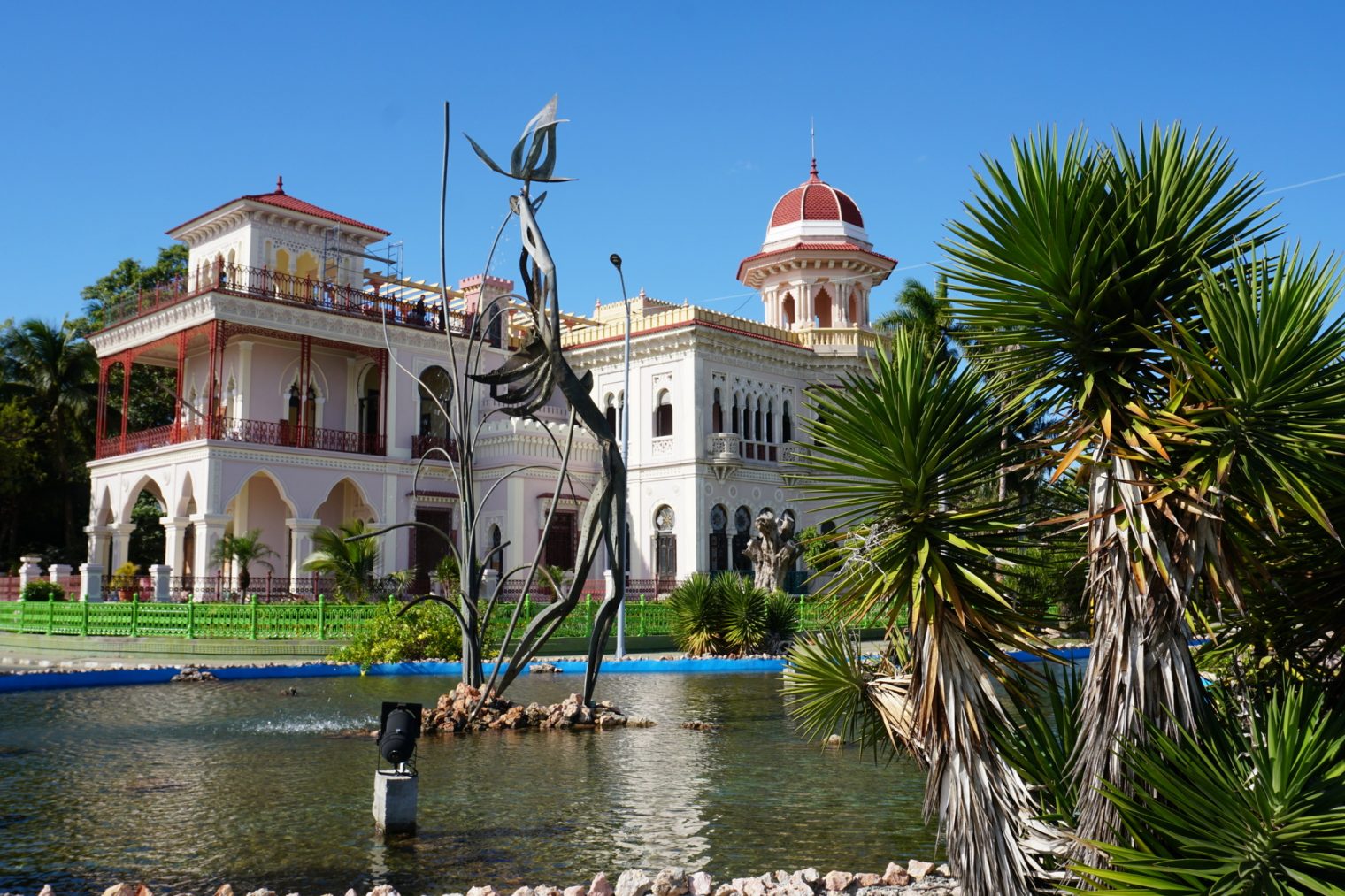
Shore excursions typically entailed 1-1.25 hours of “line up and wait” before we were actually on a tour bus and headed to the first destination. Passengers are called to the theater, check in with their tour tickets, are assigned number/sticker, and then wait for 45 minutes until the number is called. The guided tour of Havana was interesting and the guide spoke excellent English. The tour in Cienfuegos was struggling for reasons to exist, on the other hand, and our guide struggled with English and organization. We did enjoy the botanical garden, but it would have made more sense just to walk around the UNESCO World Heritage downtown on our own (may not be legal, technically, but there are no practical barriers to doing this; passengers self-certify that they will buy an organized tour of some kind, but there is no enforcement). Cienfuegos receives many fewer tourists and therefore has many fewer people hustling to make a buck off tourists. This makes it a more relaxing environment for sightseers than Havana.

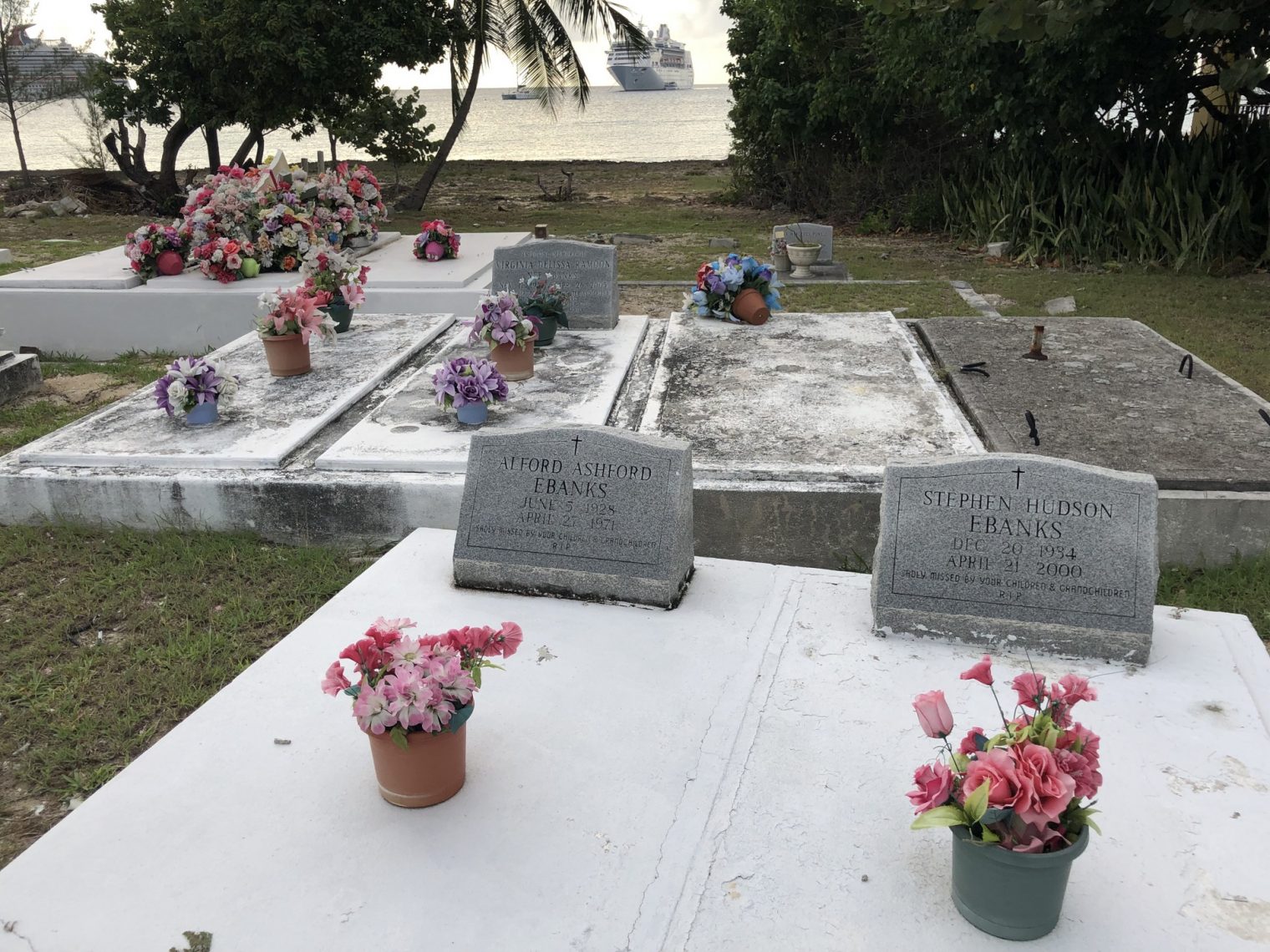
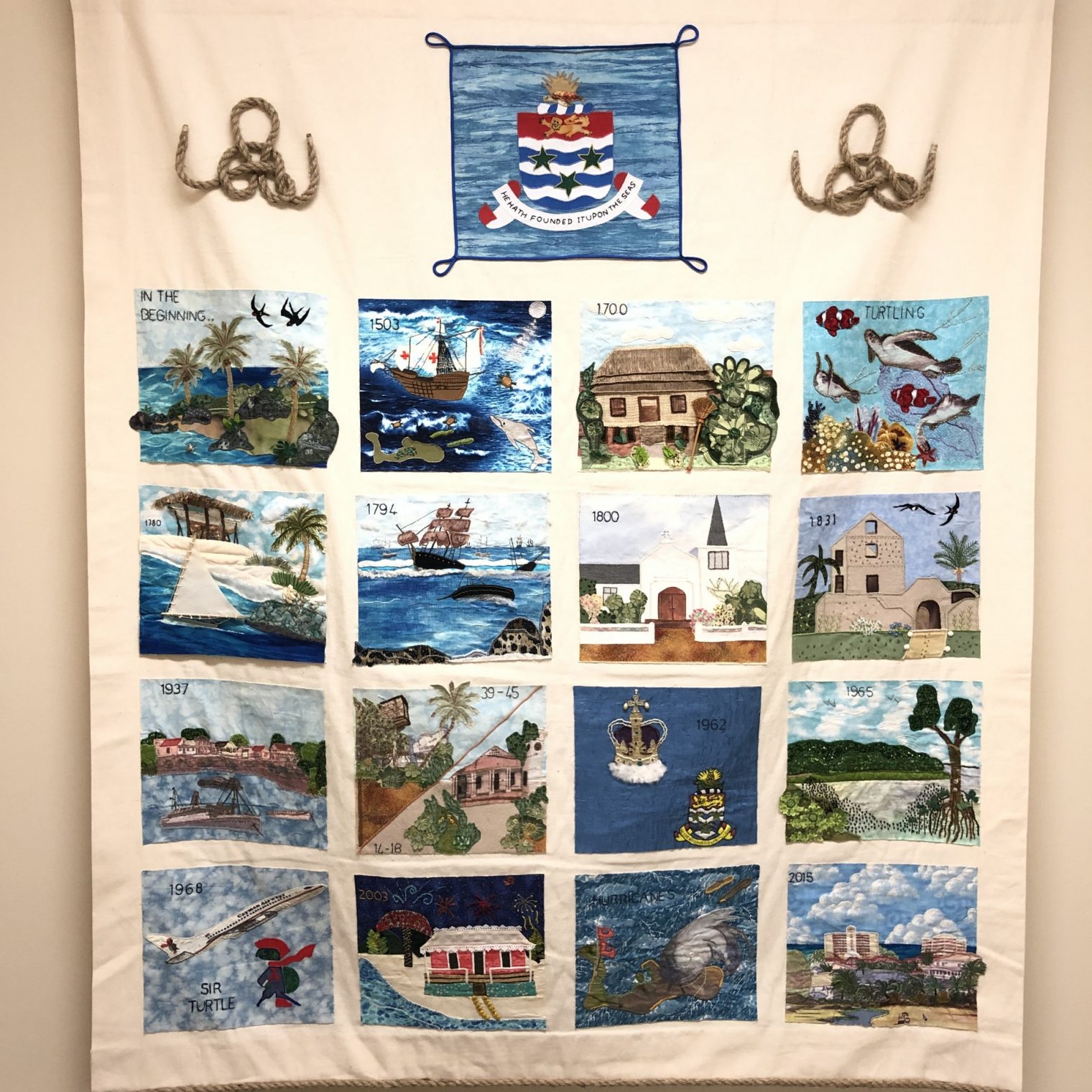
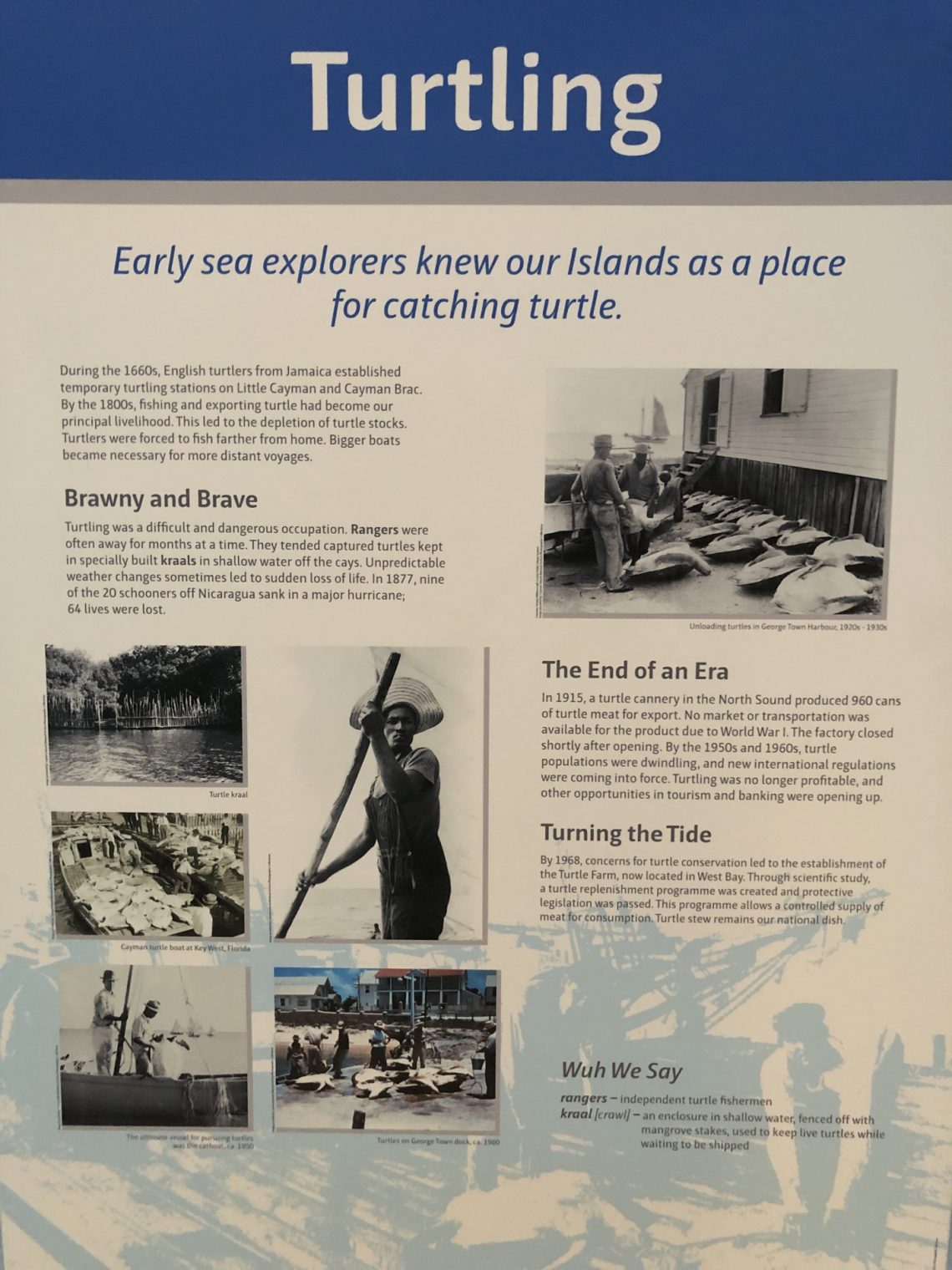
Grand Cayman has the strip malls and traffic jams of Greater Miami, but without the art, architecture, culture, and music. The local museum is interesting (the history of the Caymans is mostly the history of killing all of the sea turtles) and Seven Mile Beach is a nice walk and perfect for swimming. Snorkeling and Sting Ray City strips were canceled the day that we were there due to several days of high winds and associated heavy surf.

It was nice to see a strip mall sign feature the Chabad center next to a tattoo and piercing parlor (see “Why Does Judaism Forbid Tattoos?” on the Chabad.org site). However, I would be much more enthusiastic about returning to Cuba than going back to Grand Cayman. (Luca, on the beach inside the Caribbean Club hotel, was a great place to hang out for a long lunch and swim before or after.)

We loved Labadee, Haiti and I wrote about it separately in https://philip.greenspun.com/blog/2019/01/21/labadee-port-guide/

Out of our 7 full days on the ship, 3 of them were spent entirely at sea. Cruise lines love sea days because they pay no port fees and collect revenue from their shops and casinos, which cannot be operated except when in international waters. I got a high-quality reasonably-priced haircut on one of the sea days and managed to get in 10,000+ steps/day walking around the promenade deck.

The Serenade of the Seas (see my Baltic cruise review) had a beautiful spacious gym with wonderful sea views. Unfortunately, the Empress of the Seas has a small gym that feels like an afterthought. It is tucked up in a balcony above a lounge/bar.

As on Serenade of the Seas, the kitchen cannot make a donut, roll, or loaf of bread with anywhere near the competence of an average American supermarket. I ended up eating no bread for the entire journey and came back having lost a pound or two. Coffee is not up to the usual Dunkin Donuts or Starbucks drip standard. Food in the main dining room is mediocre. The specialty steak house food was excellent, as was the service and the ambiance. As described in https://philip.greenspun.com/blog/2019/01/01/new-years-wish-national-and-global-unity-via-more-cruise-ships/ the lack of assigned seating in the main dining room led to a lot of interesting mixing among passengers. Royal Caribbean’s main strength seems to be HR. Nearly all of the staff were friendly and seemed happy to be helping tourists enjoy their vacations. The restaurant folks were strong on hospitality and presentation.

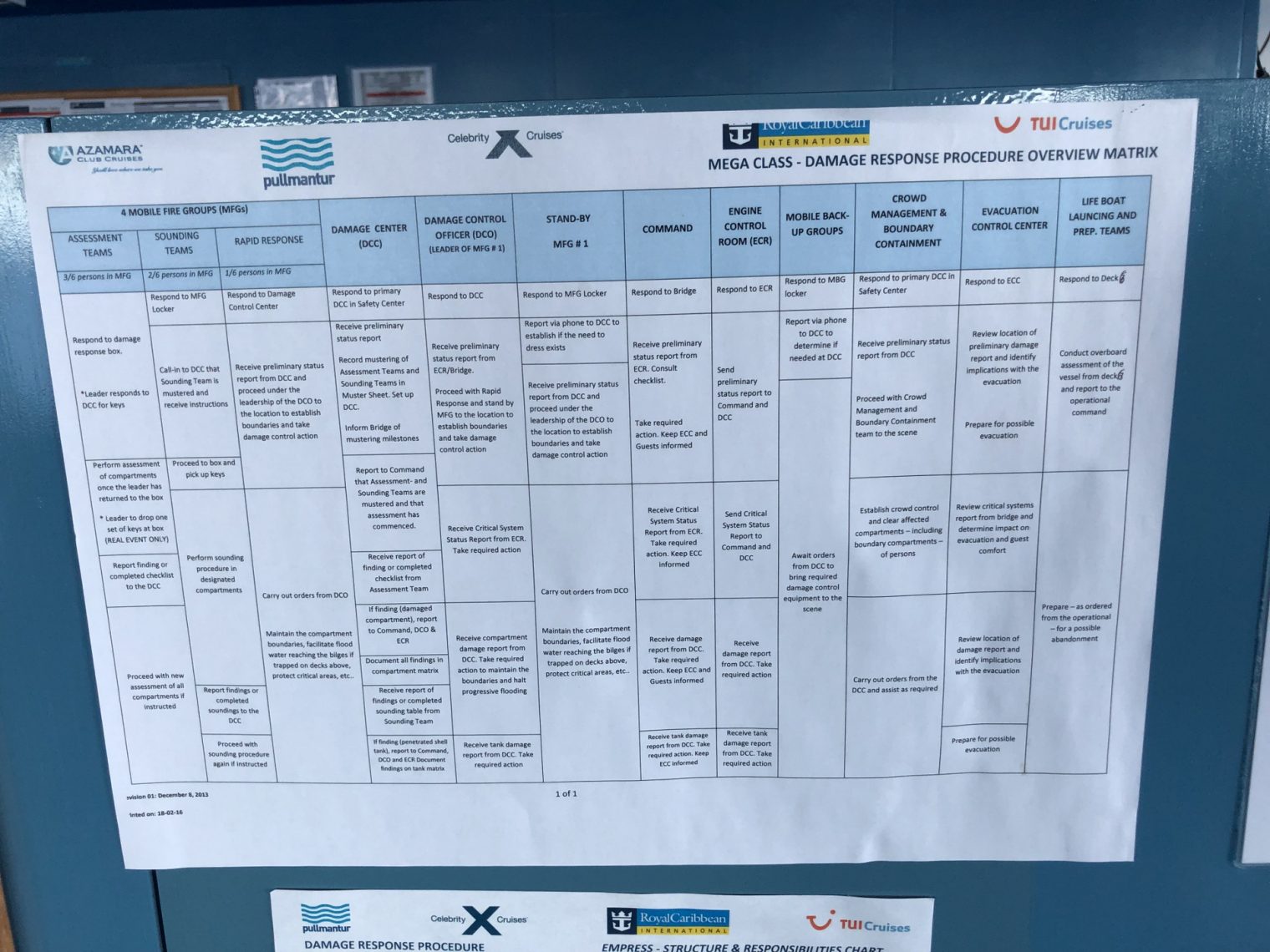
The bridge tour was awesome. Maybe it would have been better if one passenger hadn’t asked whether a screen was dedicated to avoiding collisions with U.S. Navy vessels…

On-board entertainment was at least pretty good on about half the nights, though you have to like pop, ballroom, and Broadway. Olga played the piano for us in the dining room:

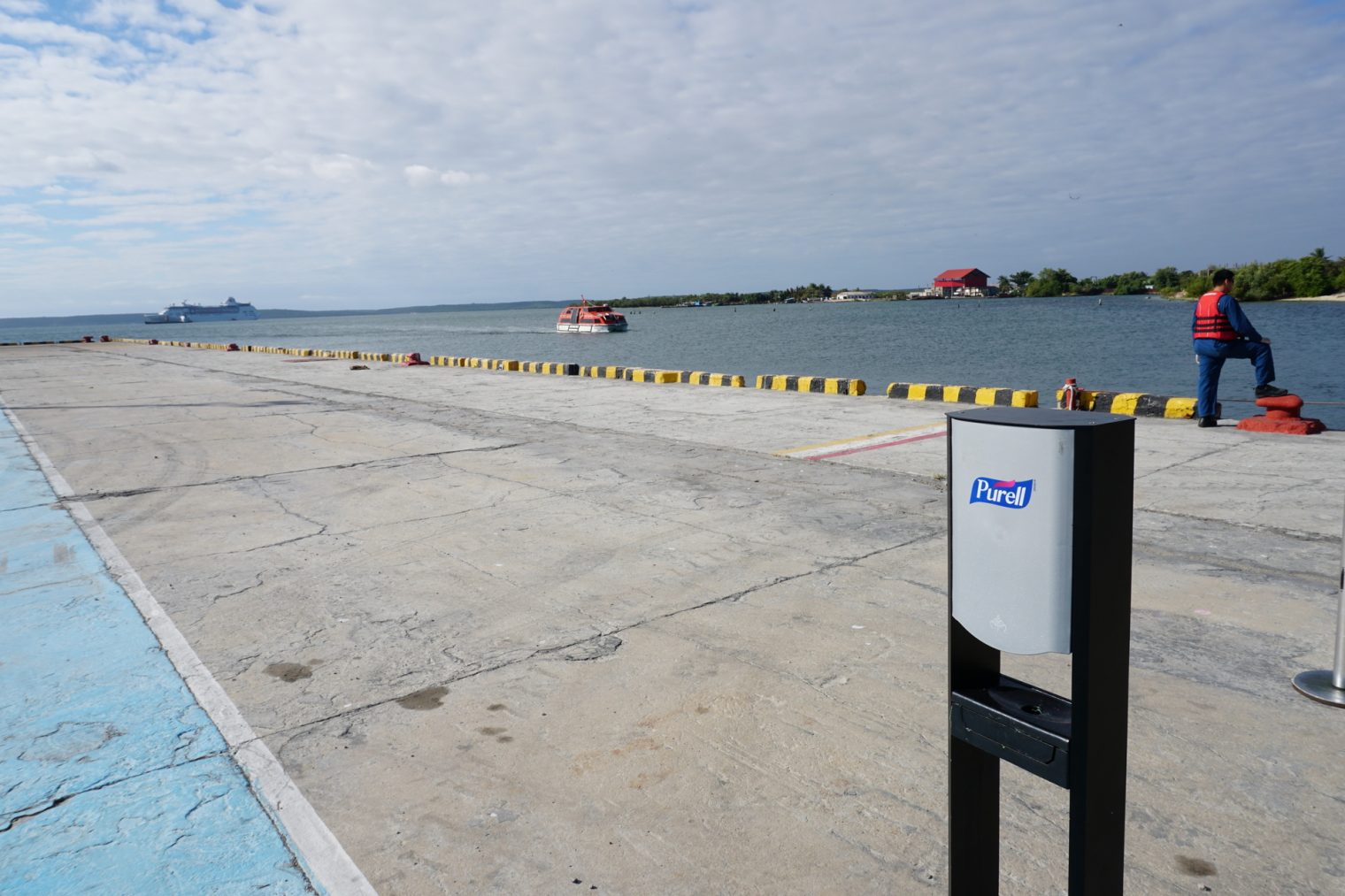
Security screening never caused a delay of more than 2 minutes and usually less. At Cienfuegos we got in and out of the port via the ship’s tenders, of which there are two. This resulted in a 20-minute line to get back on board. At Grand Cayman we used 200-person tenders run by the port itself, but they didn’t go very often. I got to the tender about 40 minutes before the “last call for a tender” time and ended up sitting on the tender for 40 minutes before it cast off. (First two photos below show one of the ship’s tenders in Cienfuegos and also that you want to be reincarnated as the Purell salesperson for the Royal Caribbean account. Second two are from Grand Cayman and show the port’s tenders.)

Returning to Miami involved 45 minutes of “hurry up and wait” followed by an astonishing U.S. Immigration and Customs experience. Having come from Cuba and Grand Cayman, potentially with suitcases stuffed full of contraband materials, we merely showed our passports to a smiling officer and then walked out to the pier.

Recommended hotel in Miami: Hyatt Centric, South Beach.

Recommended art museum in South Beach: Wolfsonian, for its Art Deco collection.

(Before deciding to abuse shareholders with looting via stock options and decades of stagnation in stock price, GE sold light bulbs to honor Ahura Mazda, the God of Zoroastrianism!)

Summary: It was a great trip, a good value, and a nice introduction to Cuba.

Related:

Full post, including comments