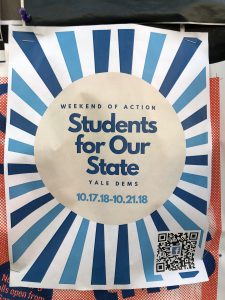
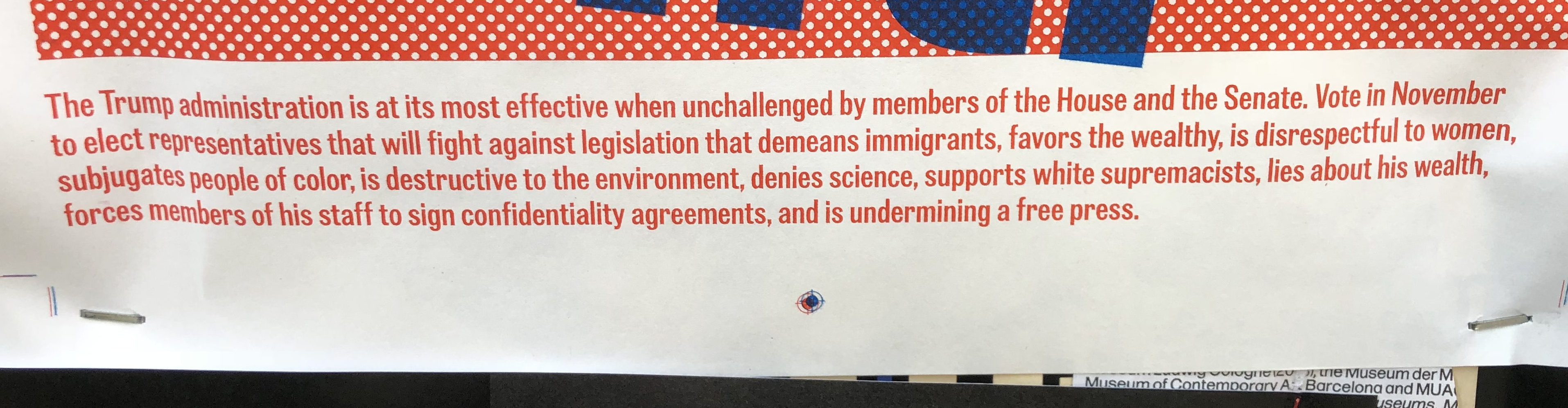
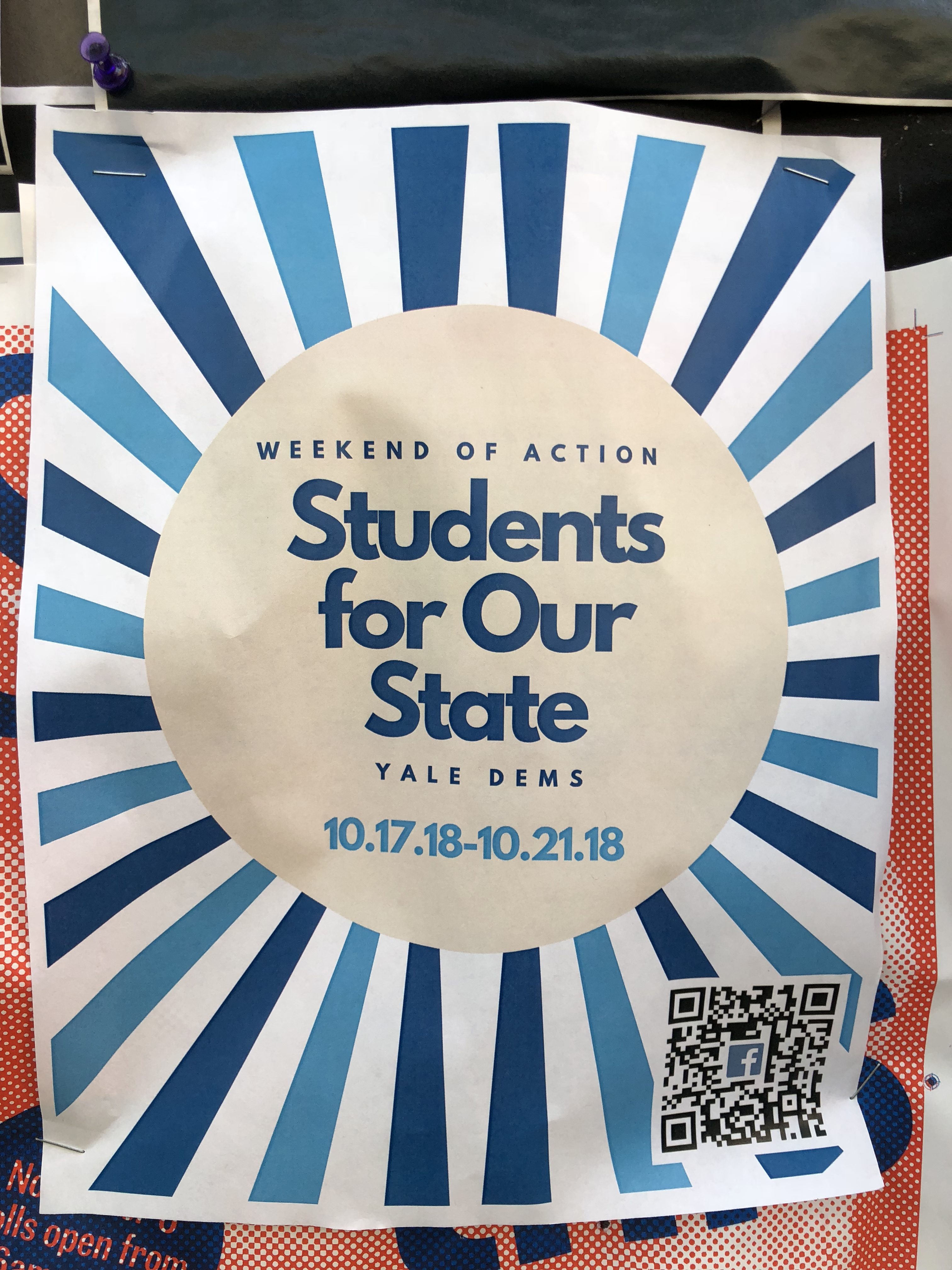
An East Coast Aero Club customer from Switzerland wanted to burn up some Cirrus SR20 time. So it was off to KHVN and the Yale University Art Gallery. Walking around the campus we saw signs preparing Yale students for the upcoming election. I posted the following on Facebook:
Students at a school that costs more than $73,000 per year are upset at the idea of a political party that “favors the wealthy”…
(You’ll have to click on the images to really see them; WordPress is not nearly as smart as Facebook about image display.)
My friends immediately jumped to Yale’s defense. The school gave huge discounts to the poor. I agreed that this was great, but pointed out that only 2.1 percent of Yale undergrads come from bottom-quintile families (nytimes) and also that the school apparently created poverty because 7.8 percent of graduates fell into this bottom quintile for income: “Maybe it is time to re-think some of those majors!”
I then added the following:
The Yale students are upset because Trump is “disrespectful to women”. But if they respect women, why wouldn’t they save a ton of money and attend University of Connecticut, where a higher percentage of faculty is female? (CollegeFactual says that 62 percent of teachers at U. Conn are female; the corresponding number at Yale is only 56 percent) “The ratio of male to female faculty at Yale is above average.” Yale students want to respect women faculty at other schools rather than at their own? Or Yale students respect women in general, but, compared to students at other universities, they prefer to take classes taught by men?
The Yale students say that Trump “subjugates people of color” (unlike the Yale students who call 911 whenever there is a sighting… (nytimes)) and “supports white supremacists”. Did Trump ever name one of his buildings after a white supremacist? The NYT reports that Yale named a college after “one of the 19th century’s foremost white supremacists” (nytimes). And, apparently, blackface was a common Halloween costume at Yale until recently (TIME).
A fellow Facebooker pointed out that Calhoun’s name had been replaced by Grace Hopper’s (sacred female computer nerd). So Yale should be off the hook because they supported white supremacy only for a few hundred years and stopped in 2017.
A thoughtful friend:
I’m not sure why you think the two notions are mutually exclusive. Why can’t one be well off, or from a family that’s well off, and still support a party that strives to represent people equally, as opposed to lobbying to protect wealthy people from, say, paying less than their fair share of taxes?
My response:
Sure. In the same way that a person can put a “I want to help the poor” bumper sticker on the back of a $70 million Gulfstream or $120,000 Mercedes. If these folks actually did care, though, why are they consuming so much personally rather than giving money to the poor. Why do they need to wait until Robin Hood is elected before they stop spending it all on themselves?
If these kids cared about the non-wealthy, wouldn’t they use their $300k in Yale expenses to fund 15 poor people to graduate from state schools? (And then use their academic smarts to get a full ride at a high end university with merit scholarships.)
Separately, I happened to be at the Providence, Rhode Island airport during Brown University’s parent weekend. The PVD ramp was clogged with heavy personal jets, including a Gulfstream G650. The folks working at the FBO said that fueling bizjets for parents visiting their 91-percent very liberal or liberal children made it the airport’s busiest weekend. By noon on the Sunday they had already sent 22 families off in their private jets.
From a coastal elite venture capitalist friend on Facebook:
When these 5,000+ migrants inevitably arrive at the US / Mexico border and begin to force their way across, what if we rallied 10,000 Americans who value refugees to stand peacefully at the border between them and whichever armed military division Trump brings out to stop them, as an act of civil disobedience?
His virtuous friends cheer him on:
Count me in if you organize people/dates/locations. Or if you need a $$ contribution to help make it work.
I highly recommend supporting Al Otro Lado. They helped with previous refugee caravans and do exactly this work fighting for the right to seek asylum. They particularly fight border patrol at the Tijuana crossing refusing to let people even present themselves for asylum. … Basically, the administration is trying to eliminate asylum entirely.
I’ll go
I gave my standard reply
The good news for these able-bodied ambulatory folks is that they are entitled to free housing, free food, free health care, and a free smartphone as soon as they arrive (“The Contracting States shall accord to refugees lawfully staying in their territory the same treatment with respect to public relief and assistance as is accorded to their nationals” — Article 23 of the UN Convention and Protocol Relating to the Status of Refugees). But how is it fair to those who are too sick, too old, or too disabled to make the trip? If we are truly good-hearted, shouldn’t we put an Airbus A380 on the Honduras/Boston route to bring in 1,000 elderly wheelchair-bound refugees daily? Surely folks in Massachusetts will do a better job caring for these unfortunate souls than will the cold-hearted Trump voters of Texas.
The elite post-gooder (not really a “do-gooder” since he hasn’t done anything to help the migrants yet):
in my opinion it’s only their human right to be able to enter when someone here does have housing or work to offer them.
Me:
Your notion of rights of refuge conditional on “work to offer them” is at odds with the UN convention to which the U.S. is a signatory. There is no requirement for a refugee to work, any more than there is a requirement for a native-born American to work. And if you want to make this conditional on housing, then you would accept no immigrants at all. The U.S. needs 7.2 million more apartments and houses just for the lower-income residents who are already here. See https://nlihc.org/press/releases/9493
Him:
there’s tremendous demand for labor and plenty of housing availability if you just look beyond major metro areas. Why else do you think they all want to come here? No one really becomes happy by living on welfare or in shelters for long. People generally want pride of providing for themselves. And this is where there are plentiful jobs, especially if we get rid of the misguided minimum wage laws.
I pointed out that, regardless of wanting “pride of providing for themselves,” roughly 73 percent of immigrants from the countries that are contributing to the current caravan actually were collecting welfare in 2012 (source). Also that there does not seem to be a tremendous demand for unskilled since states raising minimum wage results in a reduced number of employed low-skill workers (2015 economic study).
Him:
I don’t understand your last point at all. Of course increasing the minimum wage drops employment levels, that’s basic economics. I personally want to see a repeal or at least a major rollback of minimum wage laws, less welfare, and more immigration which will keep wages low, and therefore further decrease the cost of locally produced goods and services and make their local consumers better off. I also generally want to see lower wages in the US and higher wages in places like Honduras. That would make the world better in my opinion and would ultimately reduce the need for caravans. More open borders is consistent with more free markets, in addition to being more just. I do however see the short term dilemma this philosophy poses for democracy. The ultimate answer is less power in the nation, more at the very local level, and also more at the world level, but this is a very long term ambition.
So the Bostonian’s plan for helping Hondurans requires only that the 50+ million Americans currently on welfare (Census 2015) make a huge financial sacrifice and also that blue collar workers in the Midwest accept reduced wages.
It is tough to understand why a blue collar Midwestern might be skeptical of the coastal elite’s commitment to his or her interests…
I think it is time to plan a new Bahamas/Caribbean trip. The last one was in 2003 in a Diamond DA-40 (write-up). Back then I wrote “The bible of Caribbean flying is the Bahamas & Caribbean Pilot’s Guide by John and Betty Obradovich.” This has been taken over by AOPA and split into two hardcopy books ($80/year for the latest versions) and/or two apps ($80/year for updates). They try to get the new versions out on October 15 of each year.
The guides are good on the basic stuff that you’d find in the FAA Chart Supplement (AF/D): runway length, fuel availability, phone numbers. They add information on nearby hotels, restaurants, and activities, plus some overview information on each island. They’re weak on some critical details for planning stops, e.g., what does it actually cost to stop for two nights in a light single-engine plane? Phone numbers are included, but not the email addresses that a pilot trying to plan would likely prefer. As with a lot of other resources in aviation, the guides assume that you already know what you need to know, i.e., that you’ve already decided which airports to visit. If you know that you want to fly the island chain, but aren’t sure where to stop and don’t have time to make dozens of phone calls, it might be better to let an experienced handler such as Air Journey plan the trip ($795) because they’ll know which airports/countries not to stop in. (See “Is it possible to build an app whose job is to use another app?” for how ForeFlight and Garmin Pilot have the same issue.)
[Wishlist for the guides: (1) fee grid for every airport showing quickturn and 2-night stop all-in fees for light singles, light twins, and single-engine turboprop, (2) a section with suggested itineraries for people who don’t know where they want to go. The suggested itineraries would include airports with reasonable fees and nearby pleasant hotels and/or attractions.]
Turks and Caicos may get scratched due to $300 in fees for an overnight (or a lot more if on a weekend of after hours!). The 100LL price at MBPV is quite reasonable, though.]
I thought that it would be fun to stop on the way back in Cap Haitien. The AOPA guide says “cattle and people have unrestricted access to the airport”. From a Pilatus pilot: “I have 18 landings in Haiti. In my opinion, going to Cap Haitien would be stupid, very stupid. There is no security for your plane, and not much to see. I’d rather be out of Haiti thinking about going to Haiti, than be in Haiti, worrying about getting out. If you really need Haiti in your logbook, I would consider Jacmel, but I wouldn’t go there either. As I was told before my first flight there ‘Remember that Haiti’s business is poverty’. The last time I was there, I did a short field takeoff on departure [from a super long runway] to get the F### out of there!”
The Caribbean is one of those places where it vaguely does make sense to fly yourself around in a light airplane. There are no highways linking the desired stops!
Related:
Caribbean Flying Adventures (recommended by folks on BeechTalk), a $40/year service that also runs some escorted tours
Folks: As you may have noticed, as of today this 15-year-old blog is now integrated into my regular philip.greenspun.com server. Can you please test signing up for email alerts, commenting, and anything else that you might have done on the old (Harvard) server?
Thanks in advance!
Philip
——— squawks so far
“Your blog title comes across as “s Weblog” in my reader.”
Joseph Stalin supposedly said, “A single death is a tragedy; a million deaths is a statistic.”
I’m wondering if the death of Jamal Khashoggi proves Stalin right. Like other big nation-states, Saudi Arabia has done a lot of arguably bad stuff over the years. A few examples of things that might upset Americans:
There was minimal media coverage about the Saudis being involved in wars or terrorist acts that killed thousands. Why the blanket coverage and demands for action in response to the death of Jamal Khashoggi?
[Separately, is the U.S. in a position to complain about the Saudis eliminating someone they didn’t like? Don’t we blow up guys in Afghanistan, Pakistan, etc. with drones? That’s not exactly due process.]
The debate over Halloween costumes began late last month when the university’s Intercultural Affairs Committee sent an email to the student body asking students to avoid wearing “culturally unaware and insensitive” costumes that could offend minority students. It specifically advised them to steer clear of outfits that included elements like feathered headdresses, turbans or blackface.
In response, Erika Christakis, a faculty member and an administrator at a student residence, wrote an email to students living in her residence hall on behalf of those she described as “frustrated” by the official advice on Halloween costumes. Students should be able to wear whatever they want, she wrote, even if they end up offending people.
The decision to air a rerun of “Megyn Kelly Today” came two days after the host suggested, during an on-air round-table discussion, that it was appropriate for white people to dress in blackface as part of their Halloween costumes.
Ms. Kelly apologized in an email to her NBC colleagues hours after making those remarks. On Wednesday, she delivered an on-air apology in the opening minute of her 9 a.m. show — “I’m Megyn Kelly, and I want to begin with two words: I’m sorry.”
But her demonstrations of contrition did little, it seemed, to improve her standing with her colleagues or superiors at the network. At a midday meeting of NBC News staff members on Wednesday, Andrew Lack, the chairman of the news division, did not mention her apologies and said, “There is no other way to put this, but I condemn those remarks.”
Settle for More, a book by Ms. Kelly in which she complains that she had to run away from sexual attacks by the elderly Roger Ailes about whom she said, in 2016, “I really like working for Roger Ailes” (Variety)
A bunch of towns that, in 2016, voted in favor of legalizing recreational marijuana statewide (results) have then held town meetings where, by a 2/3rds majority, more or less the same people voted to ban marijuana-related business in their particular town. At a recent town meeting, Lincoln became the latest in the roster of towns that support legalized marijuana (or did as of 2016), but think that other towns in Massachusetts are better-suited to hosting marijuana-related businesses.
Effectively, then, a lot of people voted for expansion of marijuana-related enterprise who won’t be directly affected by the law. Should there be a rule that if a town votes for something statewide it can’t then ban it locally? Or if it wants to reserve the right to ban something locally then it can’t vote on the statewide question?
If you’d like to learn what pilots learn, and enjoy the bracing air of a Boston winter, join us in January for MIT Course 16.687. The dates are Jan 22-24, 2019 and it is all-day every-day.
One interesting aspect of Understanding Russia: A Cultural History (course by Lynne Ann Hartnett, a professor at Villanova) is how modern and familiar the ideas of the Bolsheviks are. After the October Revolution, for example, Prof. Hartnett talks about women gaining the rights to on-demand abortion and on-demand divorce (what today is called “unilateral” or “no-fault” divorce). The rate of abortion quickly grew to exceed the rate of live births. The divorce rate in the Soviet Union became the highest in Europe. Unlike in the U.S., no-fault divorce did not come with the need to hire a lawyer and litigate in a courtroom (see Real World Divorce). The wife could go to City Hall, fill out a form, and her now-ex-husband would be informed of the divorce via mail (“postcard divorce”). [Unlike in the U.S., though, there was no possibility of an alimony revenue stream following a no-fault divorce; women in the early Soviet system were considered capable of working to support themselves and if they wanted extra spending power from a man’s income they had to get it through a voluntary arrangement.]
The professor also cites paid maternity leave and state-run day care as early Soviet programs.
Radical thinkers today like to talk about reconceiving state-run education as a lifelong process rather than merely K-12. The Soviets were there 100 years ago! Prof. Hartnett talks about how lifelong education was an explicit goal and the Soviets quickly organized programs for both peasants and factory workers.
I wonder what percent of the positions taken by a modern American politician might have been anticipated 100 years ago by the Bolsheviks. It would be an interesting exercise to line up what our current leaders say and promise to what the Bolsheviks were saying and promising.
Separately, the lecture series adds a data point to how present-day academics think about capitalism and the market. Prof. Hartnett does not seem to be a fan of Marxism-Leninism due to its reliance on violence to keep the population in line. However, when talking about pre-revolutionary Russia, with its 7 percent annual economic growth (like China today), she describes factory workers as “underpaid.” There does not seem to be any evidence of collusion among employers and state intervention in the economy was minimal compared to modern welfare states. Thus, it seems likely that the workers were earning a market wage. Due to the ample supply of labor this might have resulted in “low paid” workers, but to the modern American academic “low paid” seems necessarily to imply “underpaid” (unfairly low wage).
I was chatting with a friend who is a Harvard graduate and a tenured professor at a big American research university. He asked for my opinion of the Harvard admissions race discrimination trial. I said that “As long as they are availing themselves of the river of Federal cash subsidies from the Department of Education, I think they have to comply with the Fourteenth Amendment. If they want to throw a race-based party then they need to do it without collecting tuition from students who are getting Federal student loans and grants.”
His response was to ask whether administrators shouldn’t fight against the nearly-all-Asian university that a purely merit-based admissions policy might produce. I said “Taking the long view, Chinese civilization is probably the world’s most successful and the Chinese intellectual tradition the strongest. Chinese universities have been more or less all-Asian. So if Harvard’s mission is academic excellence, what’s wrong with mostly Asian students?”
His personal view was that administrators should engage in racial discrimination, but that they should do so “gently.” He described a “non-gentle” year in his own (rather technical) department in which three sought-after non-white non-Asian women were accepted to graduate school. A dean had come down on the unlucky faculty and taken them to task for their non-diverse cluster of nerds. Despite special treatment, including an expensive investment in tutoring, two out of the three favored minorities failed out within two years. The experience of watching these students struggle and fail did not sour my friend on the idea of race-based discrimination, apparently contrary to the Constitution. Instead, he wanted the dials turned down slightly so that people admitted on the basis of their race or sex were less likely to fail.
I’m kind of surprised that few Americans seem to take the Fourteenth Amendment seriously. Justice Brett Kavanaugh, for example, faced no media criticism for talking about how proud he was that all of his law clerks were female. Why did people accept the idea of a federal official, part of whose job was enforcing the Fourteenth Amendment, being happy that all of his employees were of one race or sex?
“What Is Harvard Trying to Hide?” (Politico): Harvard’s documents also showed that while applications from “Chicano,” “Puerto Rican,” “Native American” and “Black” applicants were directed to readers from those groups, the other entry on that list was framed differently: “Blue Collar Asian. Harvard officials said the sole Asian-American admissions officer at the time, Susie Chao, sought to read all the applications from Asian-Americans whose parents had a blue-collar background and many of those from wealthier families. Applicants from other ethnic minorities generally got a minority reader regardless of the family’s background, the records showed.