LA Times trashes Robinson Helicopters

“Danger spins from the sky: The Robinson R44, the world’s best-selling civilian helicopter, has a long history of deadly crashes” (LA Times):

It is the world’s best-selling civilian helicopter, a top choice among flight schools, sightseeing companies, police departments and recreational pilots.

It also is exceptionally deadly.

Robinson R44s were involved in 42 fatal crashes in the U.S. from 2006 to 2016, more than any other civilian helicopter, according to a Times analysis of National Transportation Safety Board accident reports.

That translates to 1.6 deadly accidents per 100,000 hours flown — a rate nearly 50% higher than any other of the dozen most common civilian models whose flight hours are tracked by the Federal Aviation Administration.

Robinson points out that the flight hours reported to the FAA are likely undercounted (e.g., if an owner/operator gets sick of onerous annual surveys and tosses them into recycling… not that I know of anyone that irresponsible…)

I’m not surprised that an owner-flown $400,000 R44 is twice as likely to be involved in a fatal accident than a professionally-flown $3 million Airbus AStar.
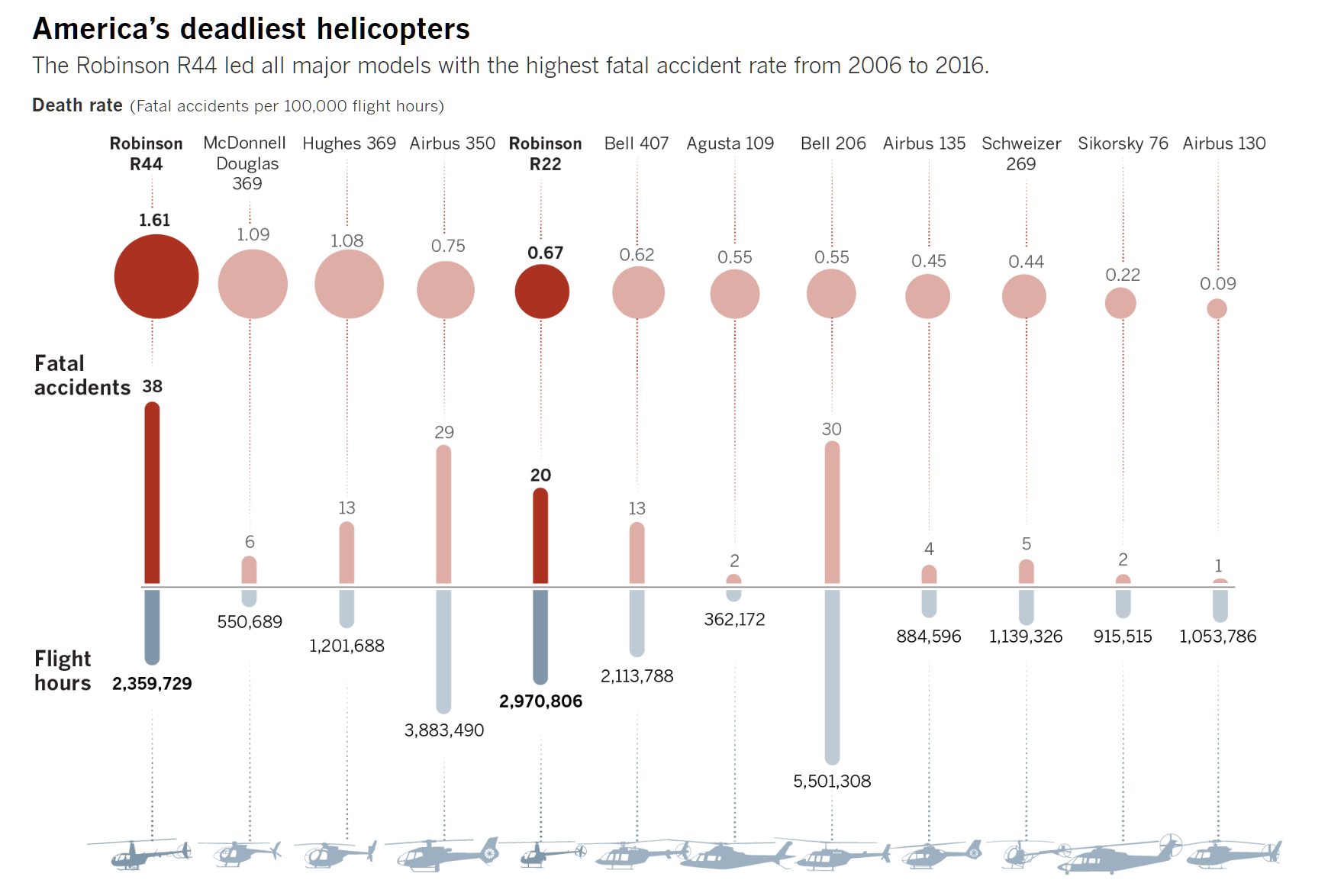
Having been an instructor in the Robinson R22, however, I’m shocked that the fatal accident rate for this $200,000-ish (rebuilt) flight school mule is comparable to that of a $3+ million Bell 407 (i.e., less than half the rate for the much-more-forgiving R44). I guess this shows the advantage of being in the training environment, in which encountering bad weather is much less likely than when an aircraft is used for transportation. Alternatively, you could say that this shows the safety advantage of a two-pilot crew. A higher percentage of R22 hours are student and instructor rather than a single pilot. (The Schweizer 269‘s accident rate is even lower; this is a machine that is essentially exclusively used for training.)

Here’s a cited accident that would have been much less likely to occur with two pilots on board:

Take the case of Jim Bechler, an Orange County attorney who had piloted Robinson helicopters for more than 30 years and bought a new R44 in 2008. He was flying home from a business meeting near Temecula when he stopped to refuel at Corona Municipal Airport.

Minutes later, as the helicopter lifted off with 40 gallons of fuel in its tanks, its rotor blades clipped a metal canopy over the fuel island. The R44 flailed briefly, dropped a few feet to the pavement and burst into flames.

(This also shows the tragic backwardness of certified human-occupied aircraft compared to $500 drones. A consumer drone wouldn’t fly itself into an obstacle as described above.)

Given the numbers, the LA Times could have cast the story as “local company makes an inexpensive helicopter that is remarkably safe when flown by two pilots”. The story’s focus on mast bumping does not make sense. The statistics in the article show that the Bell 206, which has a two-bladed rotor system subject to mast bumping, has a lower rate of fatal accidents than the Bell 407, whose 4-bladed rotor system isn’t at risk.

Personally I would like to see robot copilots for both helicopters and airplanes.

Full post, including comments

Folks who vote for a larger Welfare State should also discourage the teaching of evolution?

I’ve been enjoying The Great Trials of World History and the Lessons They Teach Us, by Douglas Linder, a professor at the University of Missouri–Kansas City School of Law.

One of the trials covered is the familiar Scopes Trial, in which ignorance is pitted against Science.

Professor Linder highlights that one of the reasons William Jennings Bryan was against the teaching of evolution in schools, however, is that he was an advocate for equality and was fighting against attempts to discourage unsuccessful Americans from breeding, e.g., in the Eugenics movement.

I wonder if Jennings Bryan would be perplexed by the situation today in which advocates for a larger Welfare State, which encourages maximum reproduction by the least successful Americans (by providing free housing, health care, food, and smartphones on condition that they have children), are simultaneously loud advocates in favor of teaching evolution in schools.

Readers: Why do people who advocate for maximizing the percentage of Americans who are descended from those who never worked also enjoy rooting out the handful of American Creationists and calling them stupid? Shouldn’t folks who advocate maximum fertility among those on Welfare want to downplay a biological theory that says children will closely resemble their parents?

Full post, including comments

Mid90s Movie

The life of a software expert witness involves quite a bit of “hurry up and wait.” Thus did I recently find myself in Easton, Pennsylvania waiting for things to move in the Federal Courthouse. After roaming the strip mall to find treasures for the kids, I spent an evening watching Mid90s.

Rotten Tomatoes doesn’t rate movies for wokeness, so maybe I can add that this movie should get a 40/100 on the wokeness scale. Positive: the only intelligent, wise, and ambitious youth in the movie happens to be African American. Negative: A 13-year-old enagages in sex acts with a woman of 17 or 18. The older sex partner is the initiator and therefore it is unclear if the encounter can truly be described as “consensual.” Certainly the 13-year-old does not explicitly say “yes.” Unlike the kids who’ve had sex with teachers recently, he is not damaged to the tune of $millions by this experience and, in fact, seems proud of it and happy to have had it. Definitely not in sync with our modern (enlightened/woke) thinking about youth sex.

The movie is primarily about this 13-year-old who is curiously undamaged by his sexual encounter. He is not loving life at home. The 36-year-old Mom started having sex with a long list of random guys beginning in the mid-70s. Two of the sexual encounters resulted in pregnancy and childbirth so the 13-year-old has a violent 18-year-old half brother. The mom’s sexual encounters with strangers have been reduced in frequency recently, but the 18-year-old reports that noise from these events would often disturb his sleep when he was young.

(Mom has enough money to sustain a middle-class LA lifestyle, but it is unclear if this is due to wages from work or child support from the biological fathers of the two boys. Her boys were born prior to the formulaic child support guideline system (history) so it may be the case that she didn’t get a lot of money out of them and/or that she didn’t have sex with men with sufficiently high income (California provides for unlimited child support revenue for single mothers who select high-income defendants; see this calculation of what Ellen Pao could have made by having sex with her boss).)

The 13-year-old escapes the half-brother and the mom by hanging out with older skateboarders, all of whom are burnouts except for the African American (see above). The stunts are pretty awesome and, I think, done by the actors themselves (but maybe Hollywood magic is hard to detect?). The movie is strong on teenage life before the helicopter parenting age. Adults don’t interfere too much with tribal activities and are seldom even seen.

There is a dramatic car crash in the movie, which makes me like it less. It is a cheap way to generate drama. One thing that I love about Sideways, for example, is that nothing unusual occurs. The filmmakers have to work harder to make the audience care. At the opposite end of the spectrum are movies where a main character becomes paralyzed or is diagnosed with a terminal illness. Mid90s is closer to Sideways, but not as pure in its rejection of the easy way to audience hearts.

Recommended.

Full post, including comments

Immigrant Nobel laureates

A Facebook friend with a Ph.D. in Physics posted the following as her status:

All six US science Nobel prize winners this year are immigrants.

Last year, all six US noble [sic] prize winners were also immigrants.

I’m sharing this in case you still think “immigrants are ruining America.”

As part of my campaign to be defriended by everyone, I responded with

Did they all arrive in the same caravan from Honduras or was it six separate caravans?

I then pointed out that nobelprize.org shows 2018 U.S. winners having been born in exotic locales such as Pittsburgh, Norwalk, and New York City. But I helpfully supplied a video from an immigrant Nobel laureate in Physics (he won in the 1970s). Her response:

You can’t possibly feel threatened by 5K women and youth.

Me:

let’s maybe not encourage the caravan women to apply for the Nobel in Literature (see “The ugly scandal that cancelled the Nobel prize”)

One find: Wikipedia says that George Pearson Smith (immigrated to the U.S. from Norwalk, Connecticut) is a “a strong supporter of the Boycott [Israel], Divestment and Sanctions movement”. Now that he is stuffed with Nobel cash, let’s see if he will give up his house to the Native American tribe from which the land was stolen!

Full post, including comments

Boeing 737 MAX 8 crash, clear tech details

“What the Lion Air Pilots May Have Needed to Do to Avoid a Crash” (nytimes) contains a lot of good cockpit photos and illustrations explaining the combination of manual and automatic flight controls that likely played a role in the recent Boeing 787 MAX 8 crash (see https://philip.greenspun.com/blog/2018/11/11/boeing-737-crash-is-first-mass-killing-by-software/ ).

If it sensed a stall, the system would have automatically pushed up the forward edge of the stabilizers, the larger of the horizontal surfaces on the plane’s tail section, in order to put downward pressure on the nose.

To counter the nose-down movement, the pilot’s natural reaction would probably have been to use his yoke, which moves the other, smaller surfaces on the plane’s tail, the elevators. But trying that maneuver might well have wasted precious time without solving the problem because the downward force on the nose exerted by the stabilizer is greater than the opposite force the pilot would be trying to exert through the elevator, said Pat Anderson, a professor of aerospace engineering at Embry Riddle.

“After a period of time, the elevator is going to lose, and the stabilizer is going to win,” he said.

(The same guy gave an interesting lecture this summer; see “Transitioning to electric flight (lectures at Oshkosh)”.)

The pictures show a mix of 1950s (the big trim wheel), 1980s (the switch-controlled trim and trim interrupt), and 1990s (the MCAS layered on top that puts in heavy trim silently).

My comment on the NYT piece:

I sometimes fly the Pilatus PC-12, a simple 11-seat turboprop. Its stall-protection system was designed in the early 1990s. There are two angle-of-attack (AOA) sensors, one on each wing. There are two computers, each one of which is connected to a single AOA sensor. Only if both AOA sensors show a stalling angle of attack (“nose too high”) AND both computers agree THEN there will be a “stick push”. Thus there could never be a nose-down push due to a single bad AOA sensor. In the unlikely event that both sensors and/or computers went haywire at the same time, there is a “pusher interrupt” switch right on the yoke (“stick”). So the pilot need not hunt for an out-of-sight and never-previously-used switch.

It sounds as though Boeing engineered something that relies on just one sensor.

Plainly the Pilatus-style system would not have interfered with these 189 souls making their way safely to the destination. I wonder if a simple voice annunicator on top of the Boeing system would have also saved the passengers and crew. If it had said “trimming down, trimming down” into the headsets, the pilots would have known to direct their attention to the trim and trim interrupt switches.

Full post, including comments

“Marriage and alimony are acceptable, but being single and letting a guy give you things is not”

“How to Date a Lot of Billionaires” (nytimes, 11/10/2018):

The Matharoo sisters never intended to become a cautionary tale about the perils of social media influence. They were born and raised in Toronto, by middle-class parents who had immigrated from India. The sisters’ lives changed abruptly 10 years ago, when Jyoti, fresh out of college, met a Nigerian petroleum magnate.

“He’s not a rapper with expensive watches,” said Jyoti. “It’s generations and generations of money.”

He flew both sisters on private jets to France and Greece and eventually to Nigeria, a destination they did not disclose to their strict parents. Upon landing, a convoy of Mercedes-Benz G-Class S.U.V.s drove them to his home, a heavily marbled mansion with a pool and a litany of servants. Kiran lazed away poolside while Jyoti accompanied her lover to Kuala Lumpur, Malaysia, to play polo with a prince.

“It all happened so fast,” Jyoti said. “There wasn’t even a moment for us to be like, ‘Is this really happening?’”

Within a few months, she said, he bought her a condominium in Toronto and began giving her a monthly $10,000 stipend so she would not have to work.

This affair was not to be a forever love, though. Over the years, the sisters globe-trotted with a succession of paramours. In particular, both sisters traveled frequently to Nigeria and said that dating wealthy men there was easy. “Once they find out you have a sister, it’s over,” Kiran said. “We don’t find them. They find us.”

Neither would say exactly how many billionaires they had dated. “If you say more than one, you’re automatically considered a gold digger,” said Jyoti, though she admitted that the number is higher than one. “I’m attracted by the power of who they are, what they do and what position they are on the Forbes billionaire list.”

In the explicitly amoral societies of the U.S. and Canada, others would like to adopt this lifestyle:

The Matharoos also said they have been inundated with messages from women asking for guidance on finding a billionaire sugar daddy. “Surely you can shed some tips on how to become a kept woman who is still doing her thing,” read a typical message sent to Kiran’s Snapcha[t].

(The Times journalist and editors helpfully include some of the sisters’ best tips in the article.)

Yet a U.S. government agent suggests disapproval:

Recently Jyoti arrived at the Toronto airport with a plane ticket to Houston, only to find herself interrogated by United States customs officials.

“They were grilling me, like, ‘So, are you a prostitute? When was the last time you had a boyfriend,’” she said. “I said, ‘I didn’t know being single was a crime.’ I was so mad. Then I started crying.”

One sister correctly points out that a quickie marriage to a high-income target, followed by a family court-ordered cash stream, and/or getting pregnant and harvesting profitable child support (or selling the abortion; Canada offers unlimited child support and legal abortion, therefore lending itself nicely to this means of earning a living), wouldn’t lead to any uncomfortable questions at the border:

“Marriage and alimony are acceptable, but being single and letting a guy give you things is not,” Jyoti said. “You have to own it. I don’t feel like I’m a piece of property.”

Related:

Full post, including comments

Women suing Dartmouth demanding damages sufficient to send every Dartmouth student to University of New Hampshire

“7 Women Accuse Dartmouth Professors of Sexual Abuse in Lawsuit” (nytimes):

Seven women are suing Dartmouth College for sexual assault, harassment and discrimination they say they experienced from three prominent professors who, according to the suit, turned a human behavior research department “into a 21st-century Animal House.”

For over a decade, the professors — Todd Heatherton, William Kelley and Paul Whalen — “leered at, groped, sexted, intoxicated and even raped female students,” according to the court papers, which were filed Thursday in federal court in New Hampshire.

The lawsuit, which seeks $70 million in damages…

There are approximately 4,300 undergraduates at Dartmouth. In-state tuition at University of New Hampshire is $18,500 per year (source). At rack rates, therefore, 4,300 students would pay $79.5 million at UNH. Assuming only a modest amount of financial aid, then, it would cost less to send all 4,300 of these undergrads to UNH than the amount of damages that was inflicted on these seven women.

Full post, including comments

H-1B program means that MIT graduates aren’t special anymore?

I got the cold shoulder from a couple of aviation companies when I invited them to come speak and demo in our three-day FAA Ground School class at M.I.T. Maybe it is Boston’s typically miserable January weather that is putting them off, but I wonder if the main reason for the lack of interest is the ease of recruiting skilled foreigners via the H-1B visa program (created in 1990).

In the 1980s, companies that needed nerds would flock in-person to MIT, a rich source of a scarce resource. Companies would organize presentations about what they did and why it was interesting and then invite audience members to apply for jobs. Certainly it was unusual for a company to turn down an invite to show up and get in front of 70 young folks studying Electrical Engineering and Computer Science and Aeronautical Engineering.

Readers: What do you think? Is on-campus recruiting suffering in the H-1B age?

Full post, including comments

The Amazon HQ2 deals show how to implement a planned economy?

I’m wondering if the Amazon HQ2 deals show how to implement a planned economy without having to acknowledge that one’s country has transitioned away from the market.

Planned Economy v1.0: It is illegal for anyone to operate a business without approval from a government ministry. Government experts decide which companies can operate, from which locations, and engaging in which businesses.

Planned Economy v2.0: Set up tax rates that are, by global standards, punishingly high. It is therefore impractical to do business if a company must pay the headline rates. Government experts decide that certain companies, in certain locations, and engaging in certain activities, can operate with tax rates that are closer to global norms.

We’re not quite to this point, but with a few upward tweaks of the tax rates I think that we could be.

Related:

Full post, including comments

Surveillance Nation

“The Subway Bomber’s Journey to 42nd Street, Captured on Camera” (nytimes, November 5, 2018) is a little shocking for showing just how many security cameras are running in our cities these days.

There is a lot of speculation on why crime is less prevalent today compared to 30 or 50 years ago. I wonder how much of the credit for this reduction can be claimed by the developers of the integrated circuit. Now that cameras and memory are almost free, maybe criminals know that it is tough to get away with crime (though plainly Akayed Ullah did not expect to get away with his actions and did not regard what he was doing as a “crime”).

Related:

Full post, including comments