We’re not at war with Cuba, as far as I know, and Cubans don’t chant “Death to America” while building advanced weapons. Nonetheless, we’ve supposedly prevented Cubans from getting oil and, thus, generating electric power. From state-sponsored NPR… “How the U.S. oil blockade is taking a high toll on everyday Cubans”:
For millions of Cubans, daily life has turned into a desperate struggle. Earlier this week, Cuba was forced into a nationwide blackout after months of the U.S. effectively choking off oil shipments to the island from Cuba’s allies. The country continues to experience rolling blackouts. And meanwhile, President Trump continues to float the idea of taking over the country. But amid negotiations with the U.S., Cuban officials say they don’t intend to go anywhere.
(According to the U.S. Department of State, NPR is simply lying, but that isn’t relevant for the purposes of this post. Let’s assume that NPR Is telling the truth.)
Trump-hostile media outlets complain that U.S. policy toward Cuba is cruel, but not that it is a “crime” or a “war crime” (NYT example).
The most obvious way to reduce the Islamic Republic of Iran’s long-term military power is to disable the country’s oil industry and electric power generation. Without money from selling oil, the Islamic Republic wouldn’t be able to rebuild weapons factories. Without a surplus of electric power, the Islamic Republic wouldn’t be able to run its weapons factories.
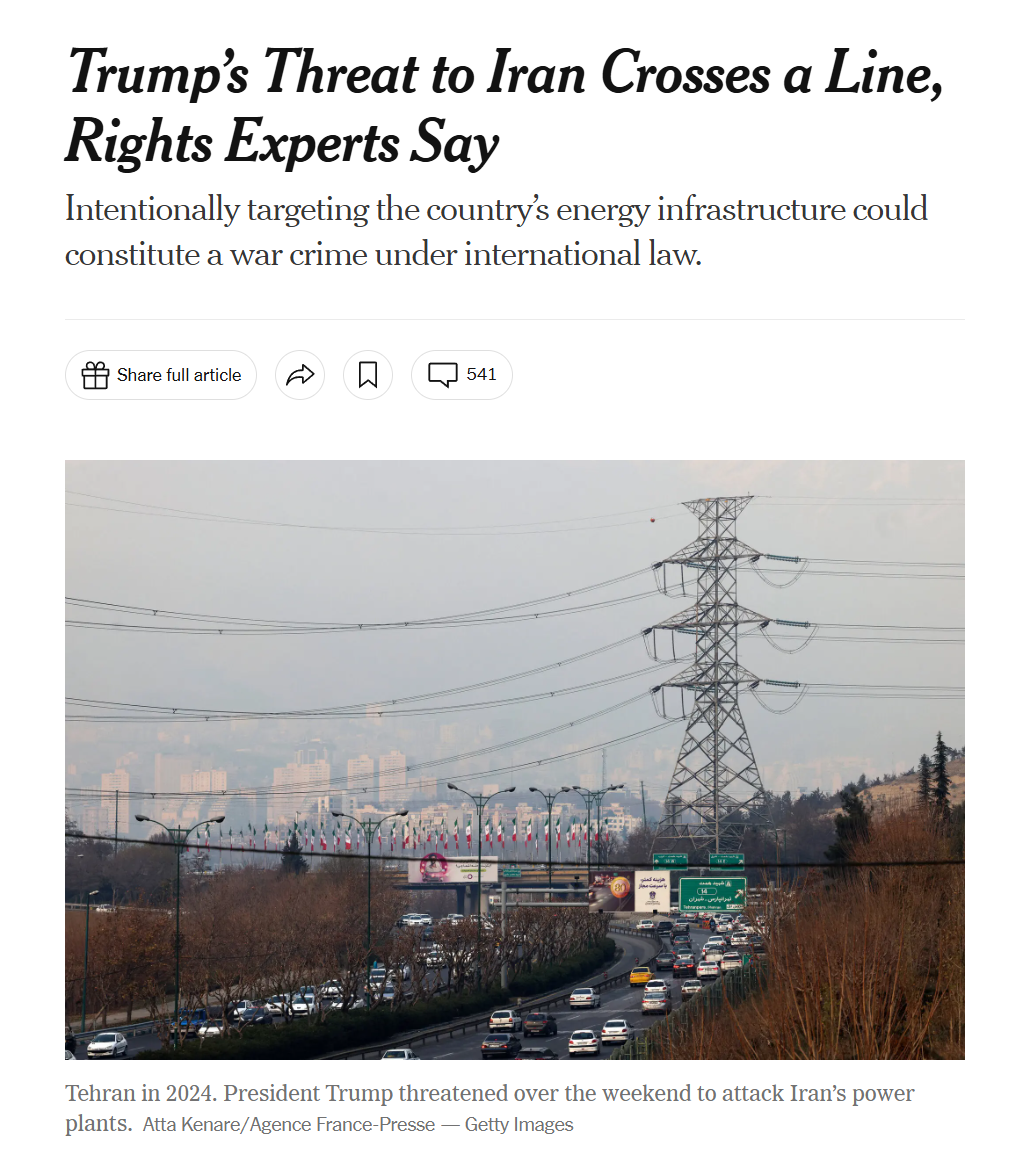
The same newspaper that implies it was not a crime for us to disable Cuba’s electric power says that it would definitely be a “war crime” to do anything to harm our actual enemy, Iran. NYT, March 24, 2026:
Intentionally targeting the country’s energy infrastructure could constitute a war crime under international law.
Here’s another mystery… “Iran Moves to Formalize Toll Plan in Strait of Hormuz” (NYT):
Tehran has effectively closed off the critical waterway, turning back container ships on Friday, and Iranian lawmakers are considering whether to charge fees to pass.
The Islamic Revolutionary Guards Corps said Friday that it had turned back three container ships attempting to enter what it described as a designated corridor, declaring that “the Strait of Hormuz is closed” and warning that any unauthorized traffic would face “severe action,” according to a statement carried by Fars.
We’ve been told that the U.S. has sunk the entire Iranian navy and also that A-10 Warthogs are patrolling the Strait of Hormuz. How is Iran able to operate military naval vessels, even boat-sized, that can “turn back” a ship? Maybe the answer is that Iran is radioing the ships and threatening them with drones or missiles?
“War crimes” are okay if they target political adversaries. Even Salt Lake City turns off the water if it doesn’t like the customer.
https://www.sltrib.com/news/2026/03/24/utah-ice-warehouse-could-face/
Iran has antiship missiles that keep US fleet at a distance. They hide it in tunnels and US and Israel are bombing those facilities. Yesterday Israeli strikes were focused on them.
Even UAE helicopters hunt Iranian suicide drone boats, it means that Iranian coastal air defenses are suppressed.
If it gets to the point of attrition war in the Strait of Hormuz I am sure we will bomb all military and military-industrial complex related targets. Power delivery to an armament manufacturing facility is such a target. I recently read about graphite bombs, the make mess of power transmission.
Surprised the world has been able to live normally on petroleum reserves as long as it has. 50 years ago, no-one would still be on the road by now. The drone & mine threat is still something US has no defense against. The range from the coastline is too short for any existing countermeasure to shoot down a drone in time. US has no mine sweeping capability. It was outsourced to Europe & they’re trying to remane neutral.
Suspect we’re going to be paying some sort of reparations in order to get the oil flowing again. It may not be $2M per ship but enough for Iran to rebuild. It feels like Germany after WWI. Trump will phrase it as less reparations than it could have been, of course.
The easiest solution would be a tense truce where both sides agree to stop bombing and allow trade to resume.
However the mosaic strategy deployed by Iran makes future investment in the Gulf untenable, from Qatar LNG to Dubai to Neom City. I’m not sure folks grasp the unintended consequences of drone warfare. The GCC may have to declare war or at least support regime change just to restore investment.
US Navy still has mine-sweeping capability. Mines are a minor threat comparing to anti-ship missiles. Those missiles can be launched only from the shores since they are sea-skipping.
Short range drones can be and are being intercepted, re Hezbollah vs Israel
If remaining mullahs do not agree to Trump’s demand they will soon loose their shore.
What would prevent Iran from retaliating by destroying the Gulf states’ infrastructure if its own infrastructure were damaged? And would such destruction really restore free passage through the Strait of Hormuz?
Anon: Your question is interesting, but doesn’t directly address the original post’s topic of why it is a “war crime” to take away Iran’s electricity, but not a “war crime” to take away Cuba’s.
Let’s try to answer your question anyway… What would stop Iran from destroying infrastructure in other countries? Iran running out of missiles! (Also, Iran’s passion for killing Israeli civilians; they’ve launched a lot of missiles at civilian neighborhoods in Israel, which doesn’t accomplish anything militarily.) If they don’t have oil revenue or electric power, I don’t see how they can make more missiles and eventually they’ll run out of the ones that they’ve stockpiled.
https://www.nbcnews.com/data-graphics/iran-war-drones-missile-strikes-military-attack-capabilities-rcna263382 has some charts of the Iranian missile/drone attacks. It doesn’t look like they have a lot of inventory remaining. On the other hand, regardless of their inventory level I think it still makes military sense to try to prevent Iran from building any more weapons. As noted in the original post, the only way that I can think of to do that is to take away the inputs (oil and power).
To be clear, I fully support the goals of Israel and the US in this war. What I question is whether those goals can be achieved. As for war crimes, there’s a quote that likens discussing war crimes in wartime to talking about speeding tickets at the Indy 500.
Iran does not appear to be running out of missiles. They seem relatively inexpensive to produce, and Russia can keep them supplied via shipments across the Caspian Sea. A key issue is that Iran does not need to prevail in a conventional sense, it only needs to maintain the ability to disrupt the Saudis from shipping oil through the Strait of Hormuz and going to the opera.
ChatGPT says it costs Iran at least $1 million to produce each missile and $5-8 million for the newer/better ones. So the Islamic Republic has spent $billions on missiles and they could do this only because their economy has generate economic surpluses that they’ve chosen to spend on military. If we shrink the Iranian economy, the Islamic Republic won’t have as much to spend. ChatGPT:
Without oil revenue and without a functioning electric grid, Iran’s missile production would collapse to very low levels, though it might still manage limited, improvised output for a while.
Here’s why, broken down realistically:
⚙️ 1) Missile production is extremely energy-intensive
Modern missiles require:
Metallurgy (steel, aluminum, composites)
Precision machining
Electronics fabrication
Chemical processing (solid or liquid propellants)
All of those depend heavily on continuous electricity:
Factories, machine tools, and clean rooms require stable power
Chemical propellant production uses large industrial mixers and controlled environments
👉 If the national grid is gone:
Large-scale production stops almost immediately
Only small workshop-level fabrication remains possible
2) Oil isn’t just money—it’s industrial input
Even if Iran didn’t export oil, petroleum is critical for:
Missile fuel precursors (especially for liquid-fueled systems)
Plastics, resins, and composites
Lubricants and industrial chemicals
Also, oil/gas powers most of Iran’s electricity:
About 80% of Iran’s electricity comes from natural gas
👉 So losing oil production/export:
Cuts government funding
Cripples domestic energy supply
Disrupts petrochemical inputs
Anon: I guess I agree with you that if the U.S. isn’t willing to disable Iran’s industrial base (oil production/electricity generation) then Iran can win.
Right now, the US is not only refraining from bombing Iran’s electric supply, it is also allowing Iran to export its oil (4% of the world market pre-war, 20% now). I don’t know much about the economics of missiles, far less than ChatGPT (in fact, I know nothing), but it seems, as The Economist points out, that the 0% that remains of the Iranian military machine is still able to fire quite a number of missiles and drones.
Things don’t look good.
I do not see how large missile that has to carry at least half a ton warhead for at least two thousand km and try evading intercepts can be cheaper then an interceptor missile that can have 10kg warhead and need to travel maximum 500 km. Now we are subjected to a lot of psy-ops and disinformation campaigns from both sides for different reasons; we should think for ourselves. Nobody ever gives real costs of producing secret military hardware. Prices include multi-year service contracts that are never paid at once and non-specified number of missiles. Missile technology has to be top of the line and it is cheaper to get in US/Israel then in sanctioned Iran. Real price for Iranian missile hobby is huge, a good part of Iran economy.
Only 20% of world oil travels through the Strait of Hormuz. 4% could becomes 5% with Strait of Hormuz closed out completely. I understand that Trump allowed sanction-less transactions on Iranian oil that already shipped, not on new deliveries.
perplexed: I don’t doubt that you’re right about the tech stuff, but I can’t see any rationale for allowing an enemy to get money, the essential ingredient for military power. Mali, a country of 25 million that is 95 percent Muslim, has plenty of jihadis, including al-Qaeda affiliate Jama’at Nusrat al-Islam wal-Muslimi and ISIS-Sahel. With a nominal GDP per capita of about $1,000 per year, however, they apparently don’t have any surplus money that can be used to make advanced weapons and use them to attack infidels outside of Mali’s borders. (Iran, for comparison, has a nominal GDP of about $5,000 per year, which enables the Islamic Republic load up on missiles and nuclear weapons at the same time that Iranians are able to feed themselves.)