Happy Haitian Heritage Month (invented in Boston) for those who celebrate.
It’s been almost 9 years since the Boston Public Schools began teaching a bilingual Haitian Creole-English curriculum at the Mattahunt Elementary School. The official web page says “dual language students have higher test scores and also seem to be happier in school.”
U.S. News ranks the school between 708 and 944 in Maskachusetts, out of a total of 1543 elementary schools:
Mattahunt Elementary School is a public school located in Mattapan, MA, which is in a large city setting. The student population of Mattahunt Elementary School is 512 and the school serves PK-6. At Mattahunt Elementary School, 22% of students scored at or above the proficient level for math, and 22% scored at or above that level for reading. The student-teacher ratio is 10:1, which is the same as that of the district.
It’s interesting that an elementary school can be mid-pack with 22% proficiency (i.e., 78% of students can’t handle grade-level work).
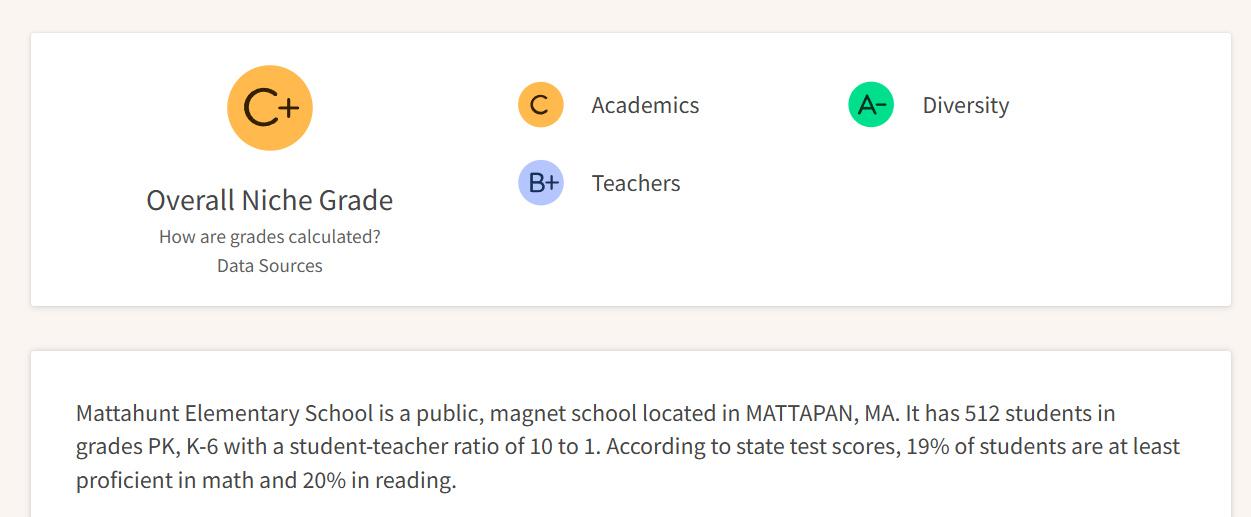
Niche says that the school deserves a C+ because it earned an A- in “Diversity” and that only 19-20% of students can handle grade-level math or English:
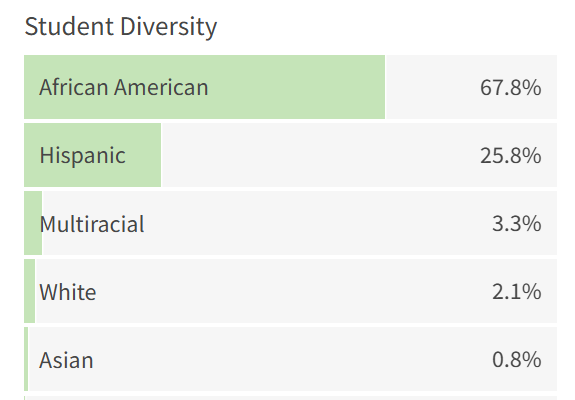
A- in Diversity means 2% white:
Recommended listening for today: Samuel Coleridge-Taylor‘s Toussaint L’Ouverture, Op. 46 (1901).
Separately, how is Haiti doing right now, 222 years after the white population was mostly exterminated?
Loosely related… “Double for Nothing? Experimental Evidence on the Impact of an Unconditional Teacher Salary Increase on Student Performance in Indonesia” (NBER 2015):
How does a large unconditional increase in salary affect employee performance in the public sector? We present the first experimental evidence on this question in the context of a unique policy change in Indonesia that led to a permanent doubling of base teacher salaries. Using a large-scale randomized experiment across a representative sample of Indonesian schools that accelerated this doubling of pay for teachers in treatment schools, we find that the doubling of pay significantly improved teacher satisfaction with their income, reduced the incidence of teachers holding outside jobs, and reduced self-reported financial stress. Nevertheless, after two and three years, the doubling in pay led to no improvements in measures of teacher effort, and had no impact whatsoever on student learning outcomes. Thus, contrary to the predictions of various efficiency wage models of employee behavior (including gift-exchange, reciprocity, and reduced shirking), as well as those of a model where effort on pro-social tasks is a normal good with a positive income elasticity, we find that large unconditional increases in salaries of incumbent teachers had no meaningful positive impact on student learning.
ChatGPT: “Individual reported salaries for experienced Boston Public Schools teachers (15+ years) are commonly in the $120k–$130k range.” (keep in mind that a teacher with 15 years of experience would be 37 years old because the job starts after receiving a bachelor’s degree and any additional degrees that boost pay can be obtained via online/afternoon/evening classes)
End game?
https://en.wikipedia.org/wiki/Haitian_Americans#/media/File:AmericaAfrica.svg
Hopefully graduates of Mattahunt will be better practitioners of vodou (is that the Haitian Creole spelling? Don’t aks me, I only speak Ebonics.):
https://en.wikipedia.org/wiki/Voodoo_(aircraft)#/media/File:Voodoo_P_51_2014_Reno_Air_Races_Gold_Champion_Sunday_AM_photo_D_Ramey_Logan.jpg
Witchcraft seems determined to make inroads into Massachusetts, despite the efforts of the Puritans (or maybe as revenge for them). I should have declared May No Internet Detox Month, speaking of voodoo, the crazy electronic kind.
You know as well as Mass public schools that the stuff about bilingualism being good is claptrap. They’re doing it to be pragmatic otherwise the kids wouldn’t learn anything at all since they don’t speak English.
Anon: What is there to learn in public school that is more valuable than English in the U.S. economy. Migrants never return to their home countries, right? Why not teach only English for a year or two and then have the migrants learn whatever else they need to learn?
@philg: “Why not teach only English for a year or two and then have the migrants learn whatever else they need to learn?”
Great idea! But then what would the Math and History teachers do?
2.1% White. Isn’t this child abuse?
My apology for not understanding, but unless a school has multiple ethnicities all equally represented, how can a school that is basically 2 ethnic groups be considered diverse?
That’s a fair point. It’s not the 60s anymore with just a two-race dynamic.
Because, Federico, in the US the term “diverse” means “not very white”. You must learn Newspeak if you want to fit in here.
There’s actually a 10:1 student:teacher ratio? And that’s true for the whole district (whatever that includes)? I’m surprised you didn’t have anything to say about this remarkable fact. It makes the outcome even more impressive.
New York City also has a super low student:teacher ratio. https://www.theatlantic.com/ideas/2026/04/new-york-city-schools-budget/686971/
These numbers aren’t great for my theory that low student:teacher ratio should result in better educations! Maybe once it is down to 1:1 my theory will be confirmed?
We must teach students languages beyond English. Honestly, all students, especially white ones, must at least be able to read languages like: Spanish, Portuguese, Haitian, Arabic, Chinese, Vietnamese, and more.
Because not knowing them will leave them completely lost in places like an ER … or, dare I say, a public school when looking at all the posters!
Funny how languages like French, German, and Italian never seem to make the list on those posters, isn’t it?