For the past couple of months I’ve been wondering here why U.S. consumers are paying more for gasoline than in 2025 (albeit still less than in 2022) if the Trump administration could simply limit exports of oil and gas to 2025 levels with a simple “it’s a war” explanation. This question is answered, to some extent, in “The World Can’t Get Enough U.S. Energy, Keeping Prices High for Americans” (WSJ, yesterday):
The Trump administration is trying to tamp down rising prices, including by waiving restrictions on trade between U.S. ports and releasing oil from strategic stockpiles. Trump said last week he supports suspending the federal gasoline tax. Gasoline prices nationally averaged $4.51 a gallon on Sunday and could keep climbing into Memorial Day weekend, the starting gun to the busy summer driving season.
The administration has said it wouldn’t impose a ban on energy exports. Energy Secretary Chris Wright said on CNBC last week that the U.S.’s economic future depends on selling its energy abroad and that this was a top item on the Trump agenda.
“We can’t be a major energy exporter to the world if we decide sometimes to stop exporting our energy,” he said.
In other words, the Trump administration is allowing Democrats, previously climate change alarmists who wanted fossil fuel prices to be higher, to harp on lower-than-2022-but-higher-than-2025 gasoline prices, possibly resulting in dramatic losses of Congressional seats in November 2026, in order to preserve the U.S.’s long-term market position.
What’s the scale?
The ports of New York, Philadelphia and Albany, N.Y., exported 174,000 barrels a day of gasoline, diesel and other petroleum products last month, according to Kpler. That is 10 times the volumes they shipped over the same period last year. Halfway through May, the pace of exports is even higher, well over 200,000 barrels a day—the highest monthly pace on Kpler’s records since 2017.
These barrels so far this month are predominantly heading to Europe, including France, Belgium, the Netherlands and the U.K., Kpler’s Smith said. Analysts say that is a sign that a shortage of refined products has spread from Asia to Europe.
The U.S. exported 2.7 million barrels of U.S. diesel, gasoline and other refined products to Australia in March, according to Kpler. Before the war broke out, exports there had been sporadic. An additional 1.8 million barrels headed to Australia in April.
I wonder if the Trump administration’s policy makes sense even for those who have a long-term perspective. If Democrats can take control of Congress maybe they will obstruct the U.S. fossil fuel industry in some other ways, e.g., with a long-dreamt-of carbon tax.
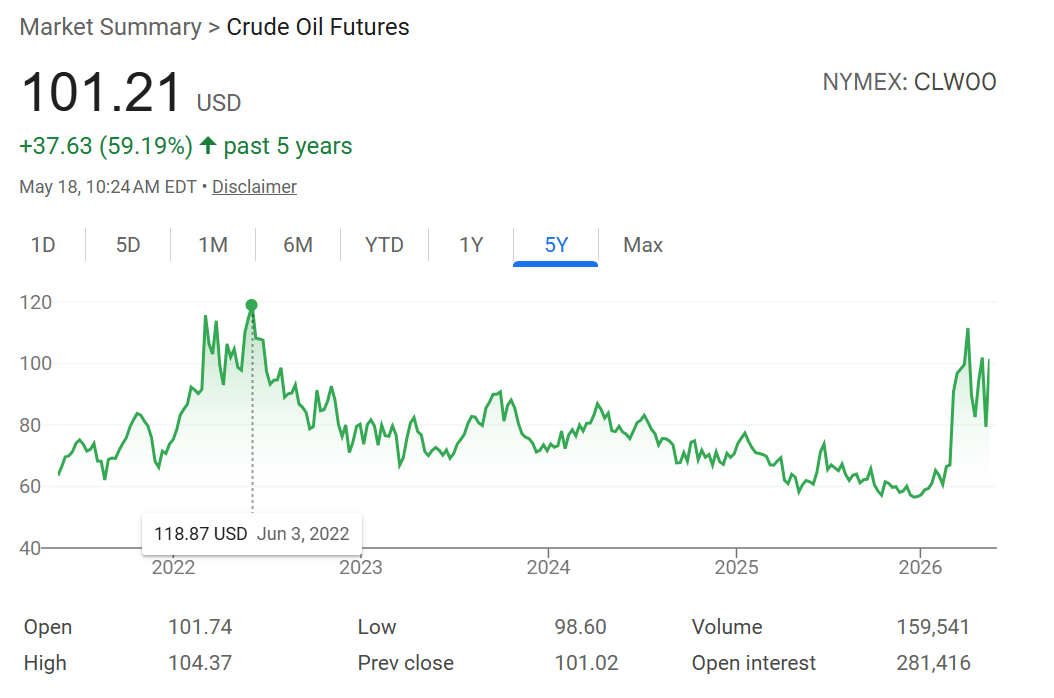
Separately, why isn’t there a lot more production in response to the higher price? The current price of oil is about 15% lower than it was in 2022 (chart below), but still much higher than it was in 2025:
Maybe it is because the market is predicting a sag down to $89/barrel by October 2026 and a further sag to $75/barrel by October 2027?
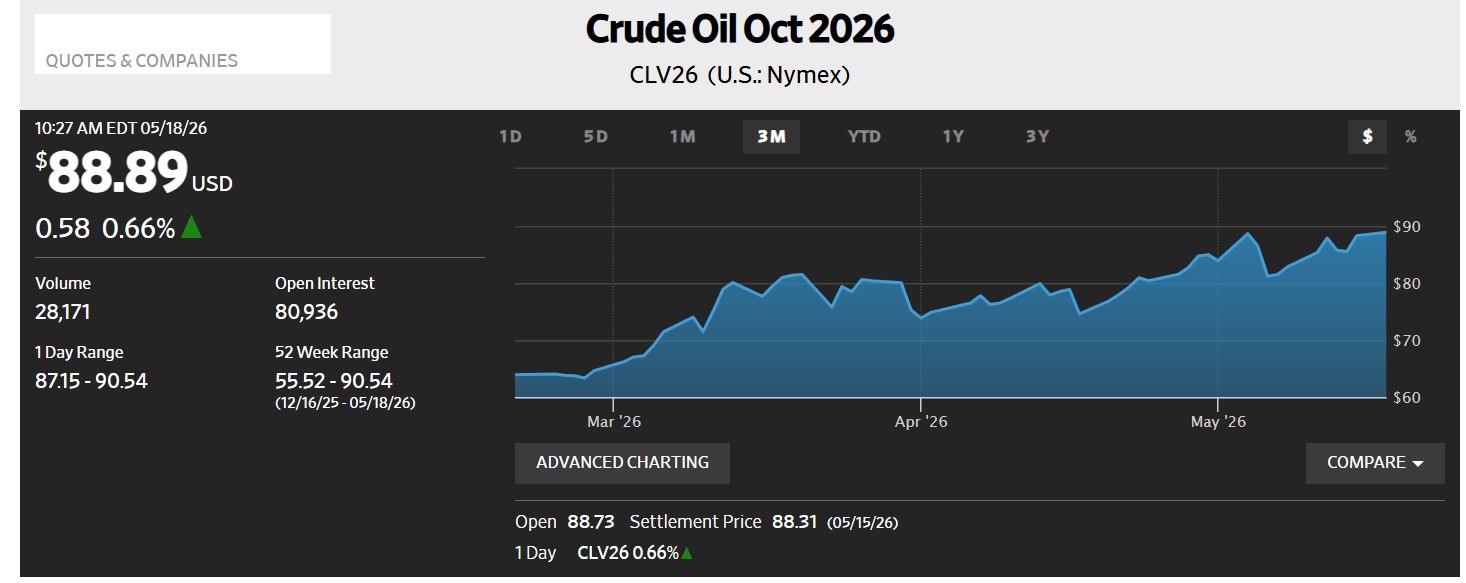
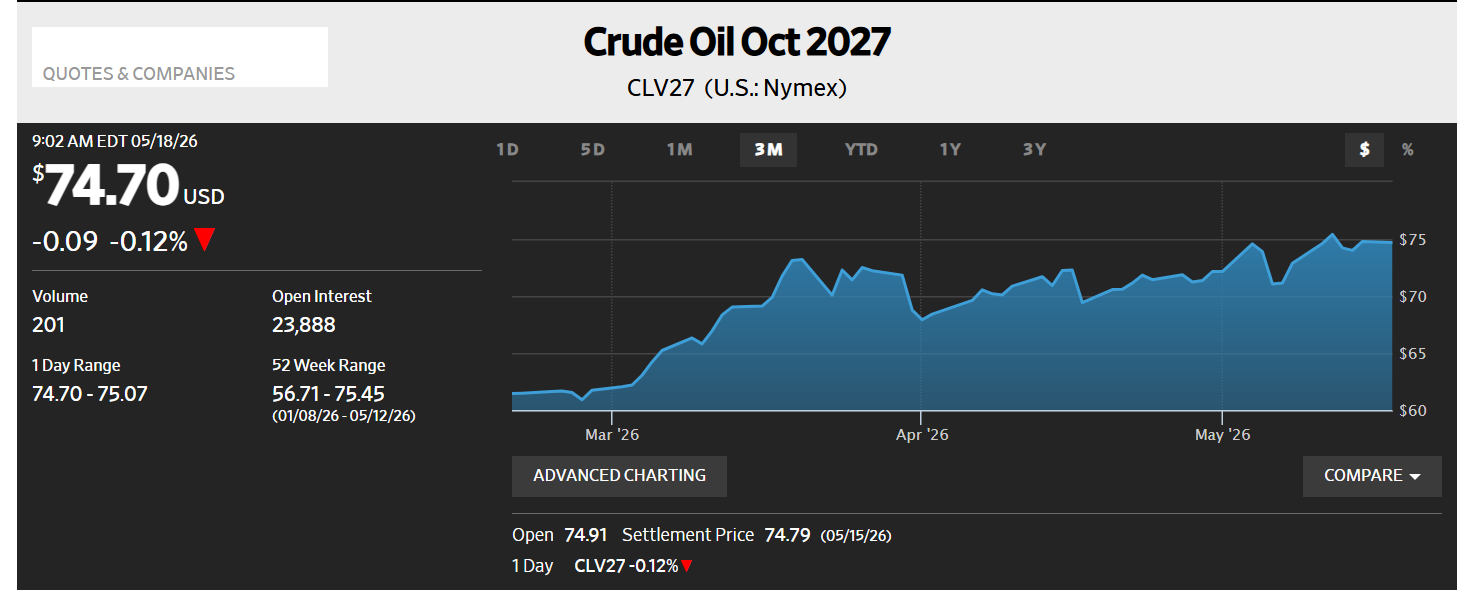
The lower chart is curious. Investors have changed their opinion of the likely cost of oil in October 2027, up from about $60 to $75. Are they expecting that we’ll still be at war? That inflation will go back to the raging 2022 levels?
> Energy Secretary Chris Wright said on CNBC last week that the U.S.’s economic future depends on selling its energy
“When you are a hammer, everything looks like a nail.” — Confucius
> Democrats, previously climate change alarmists who wanted fossil fuel prices to be higher.
“There are liars, damn liars, and politicians .” — Twain
Equally applicable to Republicans, of course. Citizens hold blame too, by refusing to isolate themselves from the variance in the price of oil. They seem to buy vehicles based on the price of oil on the date of purchase, or just big-ass ones regardless.
This is very realistic, based on our educational standards that has gone downhill since so-called “progressive” and permissive educational and child rearing methods, in parallel with helicopter parenting, became mainstream. We need data centers for the same reason, for LLMs replace human intelligence. And we have Crocks already!
The republican party has always been good to its oil industry voters. The same playbook as 2001.
I don’t think “help US oil companies” is the Trump admin’s objective. The simplest way to do that would be to disable Iran’s oil industry and let Iran retaliate by disabling the Gulf State’s industries, thus reducing worldwide supply by 15-20%.”