Europeans object to being mocked for their lack of air conditioning on the grounds that, pre-Climate Change, there were at most a few weeks per year when they would have wanted to use it. Note that this is partly due to European tolerance for a wider range of indoor temps than we spoiled Americans. They probably wouldn’t turn on A/C until their interiors were 8-10 degrees warmer than what would motivate an American to open up the WiFi thermostat app on his/her/zir/their phone.
Because of American profligacy with fossil fuels, Europe now has brutal heat waves (example from 1911; one that afflicted Paris in 1757) that make their decision to reject A/C appear stupid, but in reality they are the smart/wise ones.
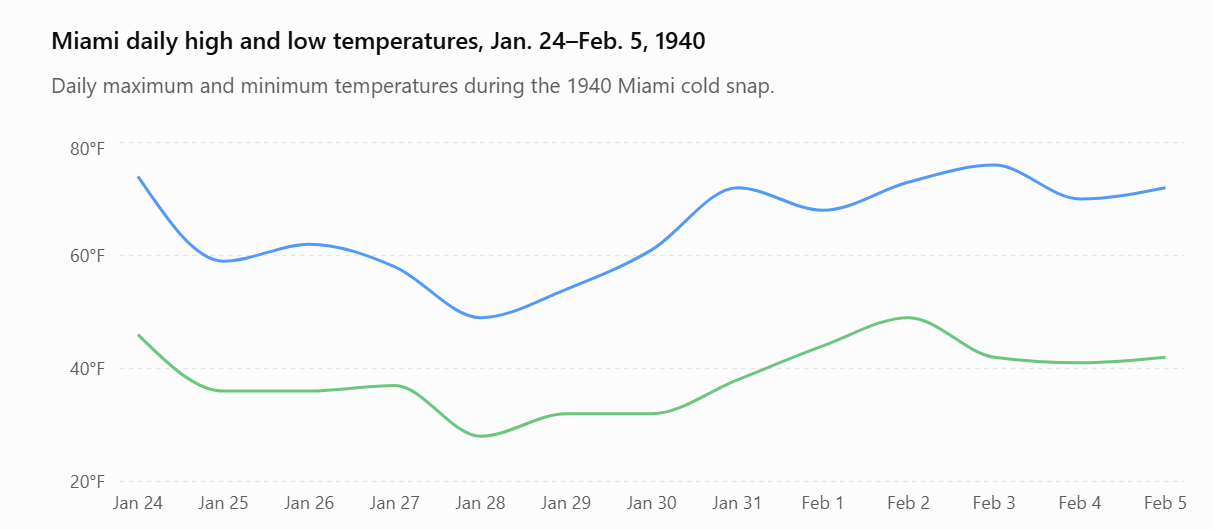
Maybe, however, there is an analogous situation here in the U.S.: should a house in South Florida be equipped with heat? Outdoor temps drop below a comfortable room temperature for only a few weeks per year, analogous to outdoor temps being higher than room temp in Europe for only a few weeks per year. Houses are well insulated in South Florida because they’re almost all new. There is no historical weather that could reduce the indoor temp of a modern South Florida house to a dangerously cold level. Just as Europeans say that they can deal with typical heat by closing shutters, opening windows, jumping in the local canal, etc., a South Floridian without heat during a severe cold weather event could dig through the closet for a sweater and long pants, use an electric blanket or mattress pad at night, etc. Here’s one of the most extreme cold events that ChatGPT managed to find for Miami, which included a low of 28 degrees:
Running heat in South Florida is incredibly wasteful because (1) it is usually a resistive “heat strip” inside the air handler (the latest houses have fully insulated refrigerant lines in both directions and, therefore, heat pump heating capability), and (2) whatever heat is added to the house will eventually have to be pumped back out using electricity for cooling.
What is the observed behavior? Every house, by code, is built with heat capability. People turn on the heat as soon as they feel uncomfortable. As noted above, the latest houses even have heat pumps, maybe due to federal government tax incentives that encourage this super-wasteful-in-south-florida investment ($thousands extra in capital that lasts 15 years to save a couple of $hundred in electricity every few years).
If Climate Change were to cause South Florida to be subjected to a Maskachusetts-style December, Floridians wouldn’t die like the stoic Europeans. Nor would they get into a brawl at Walmart over space heaters. Houses here are already equipped to handle a multi-day freeze. The damage would be limited to higher FP&L bills (still, probably much lower than in MA, though, because rates here in FL are about one-third per kWh of what my friends who’ve remained Righteous are paying!).
As noted above, we could also explain the apparent difference in preparedness as due to a difference in tolerance for discomfort, with Americans being the wimps!
Related:
- Art Palm Beach (cavernous yet nice-and-warm convention center despite record-low (for the dates) overnight freezing temps in the middle of a two-week cold spell, the most extreme since 2010)
- Posters to show solidarity with our baked brothers, sisters, and binary-resisters in Europe
The Righteous are paying triple Florida’s rates so that migrants can get subsidized need-based planet-boiling fuel oil powered electricity!
> Running heat in South Florida is incredibly wasteful because (1) it is usually a resistive “heat strip” inside the air handler (the latest houses have fully insulated refrigerant lines in both directions and, therefore, heat pump heating capability), and (2) whatever heat is added to the house will eventually have to be pumped back out using electricity for cooling.
(1) Electrical resistive heating is actually very efficient, given a kilowatt-hour of electricity. The inefficiency is at the electrical power plant, most of which are fueled by non-renewables. Many heat pumps have electrical heating as an “aux” source.
(2) Show your math. I think you are going to have to pump heat back out only if you have a gap in static heating/cooling temperatures, and even then only for a brief period. If you keep the inside temperature at a constant 76 deg. you won’t have anything extra to pump in or out — only what is needed to offset the outside temperature.
Plainly, a resistive heat strip is 100% efficient when held up to a certain light because the electric power has nowhere else to go. On the other hand, the experts who said that a saliva-soaked face rag would block out an aerosol virus say that heat pumps cost less to run than resistive: https://cleanheat.ny.gov/heat-pumps-cold-climates-expensive/ See also “We find that converting from electric resistance heat to heat pumps can cut electricity use for home heating by a little over half on average” — https://www.aceee.org/research-report/a1603
Regarding your point (2), the Florida house eventually has to be cooled so if you can collect and store some natural cooling, e.g., from a bizarre cold front, doesn’t that have to reduce the electricity use for cooling averaged over the 30 days that surround the cold period? Using heat to negate te effect of the cold outside is equivalent to saying “I’m not going to store any of this precious cold”.
I asked ChatGPT: Yes — less cooling energy will be used later if the house is allowed to coast down to 55°F instead of being heated during the cold snap. But the savings are likely modest, and the main energy savings would come from not heating, not from reducing later air-conditioning.
Think of the house as a thermal battery. If it drops to 55°F inside, then when warm Florida weather returns, some incoming heat goes into warming the walls, slab, furniture, cabinets, water, etc. back up to your usual indoor temperature. Until that happens, the A/C either runs less or does not run at all. So the later cooling load is reduced by roughly the amount of “cold stored” in the house.
The air itself stores very little cold. For your large house, even cooling all indoor air from, say, 72°F to 55°F stores only on the order of 5–6 kWh of thermal cooling, maybe 1–2 kWh of A/C electricity. The bigger reservoir is the building mass: slab, drywall, masonry, furnishings, countertops, water in plumbing, etc. Depending on construction, letting the house fall to 55°F might reduce later cooling by perhaps tens of kWh of thermal load, which might translate to maybe 5–30 kWh of A/C electricity. That is real, but not enormous compared with annual Florida cooling use.
I visited Orlando for a week one January and it was surprisingly cold. No snow, at least. The Floridians blamed it on a fluke of weather.
Central Florida, including Orlando, gets 10 degrees F hotter and 10 degrees F colder than the same-latitude coasts in the summer/winter. I was in Orlando once when the forecast called for freezing temps overnight. The local news station ran a demonstration of how to put on a hat and gloves.
I’d rather focus on reading and contributing to whatever I am a part while being in comfortable temperatures rather than sweating, and bitching about everything around me, :-).