It’s my birthday. Soon I will be old enough to personally experience the insolvency of Medicare and Social Security. For this year, though, here’s the latest present to myself…
Like most other low-wing aircraft, the Cirrus SR20 and SR22 airplanes have a fuel tank selector that must be periodically switched from left to right tank. How does this become pilot’s job when he or she (no “ze” or “they” because the FAA has hatefully subscribed to gender binarism, even during the hate-free Biden administration) is trying to fly the aircraft? A high-wing Cessna has a “set and forget” BOTH position for fuel that flows down to the engine via gravity. Shouldn’t a Piper or Cirrus have that too? Perhaps not. If one tank were to run dry, for example, the “pump it up and out” process would result in air from that tank being put into the fuel line to the engine rather than harder-to-grab fuel from the tank that still has something left.
After 21 years, I suddenly had trouble switching between left and right tanks in our SR20-G2. After that first switch, which required some muscle power, it was fairly easy to switch tanks, but it still felt like there was a hitch or click in the system somewhere. Our local Cirrus service center owner: “I’ve never heard of this problem.” Cirrus Field Support: “The O-rings in the selector could be swelling up but I haven’t run across this issue before. I polled the group and they mentioned they haven’t run across this before.“
Always nice to have a problem that has never previously been reported in a fleet of 10,000 machines!
The mechanic went to the hangar where the airplane lives and fiddled around with the selector, including lifting up the safety to turn the selector to OFF (something you’d do during maintenance or as part of a crash or parachute landing). “we took the side panels off and inspected and tried to lubricate it, it is a sealed unit , the fuel selector has failed internally, it is stuck in the off position I have ordered a new fuel selector…”
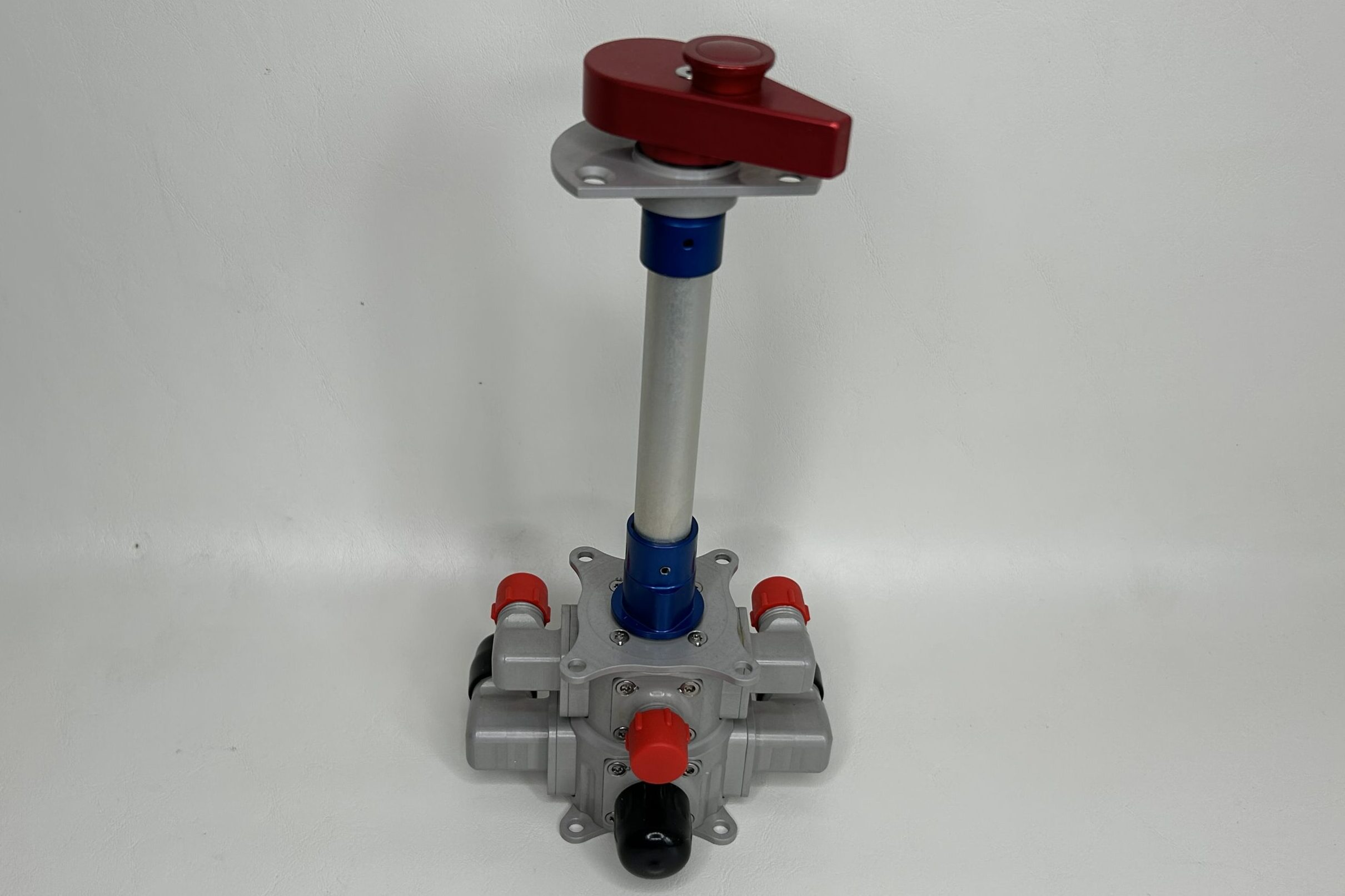
I had thought that the simple interlock that the pilot can touch would be a separate part from the functional valve buried deep in the plane, but that’s not the case. Here’s what the complete part looks like:
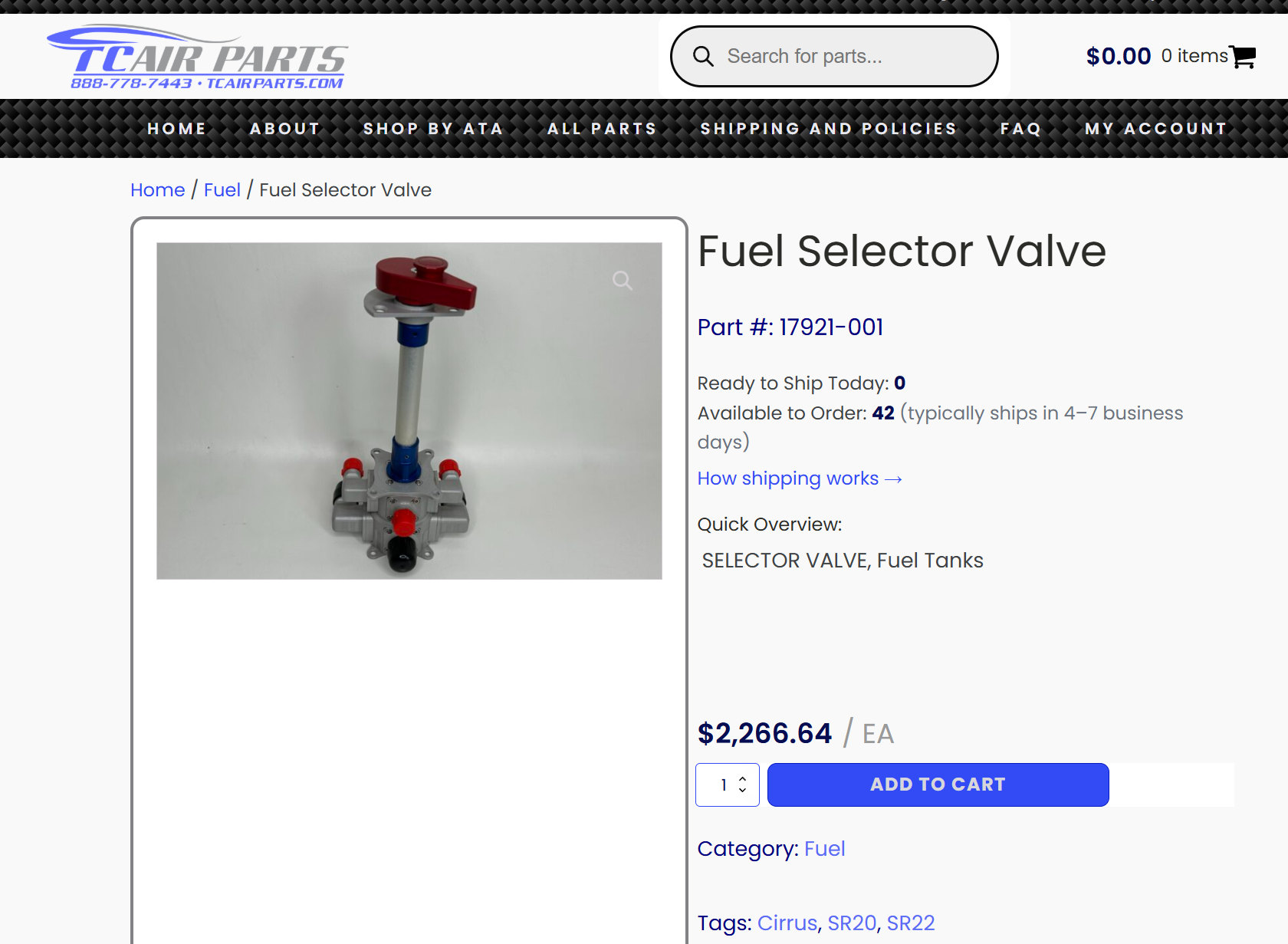
It struck me as odd that Cirrus had a stockpile of these spares if nobody had ever needed to replace one, but apparently there are more than 40 in a warehouse somewhere:
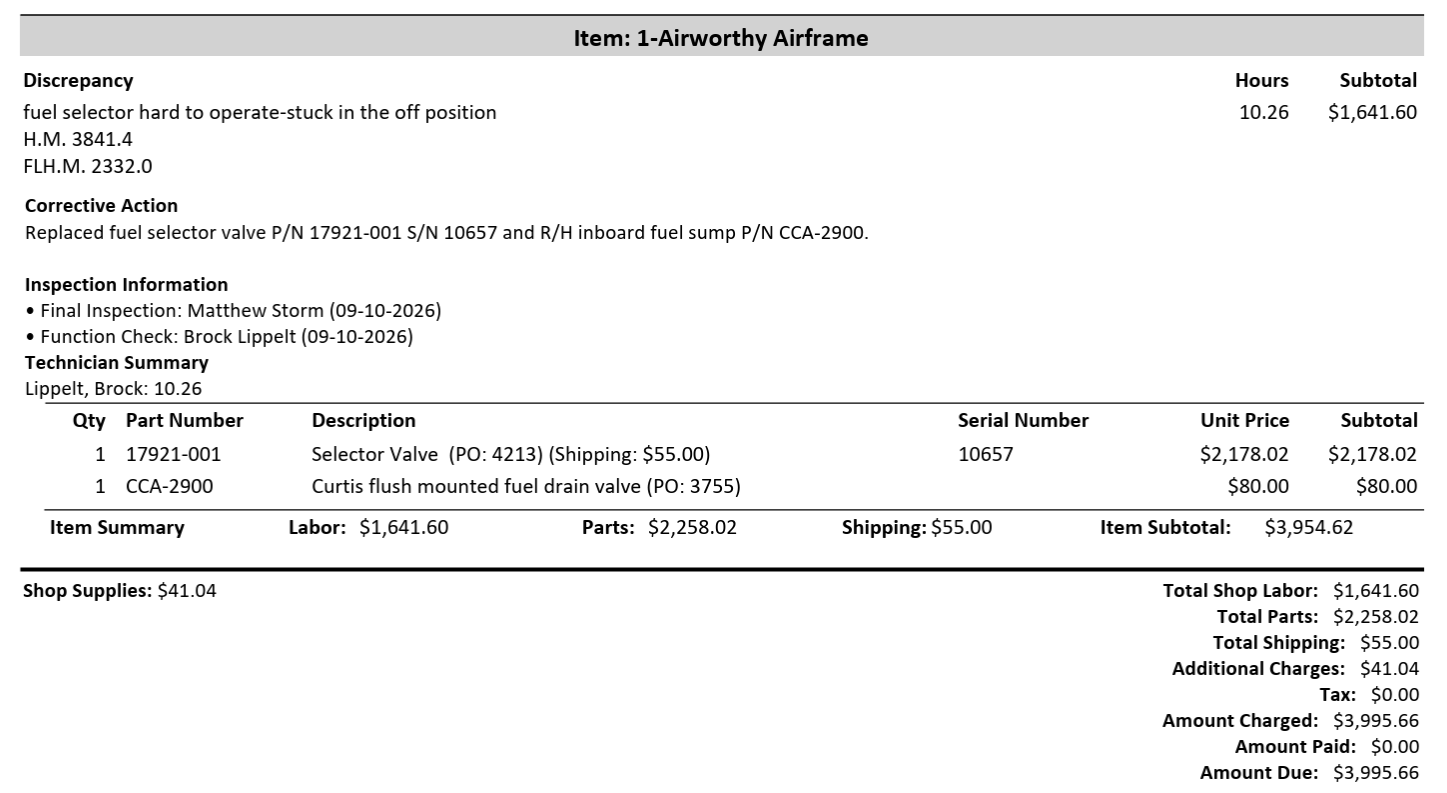
Here’s the final damage from the local shop (it was quoted as requiring 8 hours of labor, but apparently took more than 10):
In the old days I would have said that I was leaving this here on the Web so that a fellow Cirrus owner or a mechanic could find it with a Google search. Now, of course, I’m leaving it here so that AI can find it.
(What were the previous presents in this same general area? The electric fuel boost pump in the Cirrus was beginning to sound louder/different. This pump is necessary for starting, so I had it replaced in July 2025 while at Oshkosh. The mechanical engine-driven fuel pump, which does most of the work required to get the fuel out of the tanks and into the fuel injectors, was declared to be leaking in July 2026 at the annual inspection and send out for overhaul (both the leak at the mixture control connection and the blades (carbon, I think, and subject to erosion)). At around the same time, the year-old electric boost pump stopped working intermittently. Absolutely dead when throwing the switch. The mechanics couldn’t reproduce the problem so they replaced the switch and the circuit breaker. The boost pump remained intermittently INOP. That’s when I learned that there is also a relay in the system. So they replaced that. So far the boost pump, which is required for starting, seems to work. Maybe it is time to save money on maintenance by buying a $1.5 million new Cirrus SR22? A friend did just that and went through three engine-driven fuel pumps in the first year (problems maintaining the correct pressure). All covered by warranty, but quite a bit of downtime.)
4K to replace a valve?! Flying is an expensive hobby 😨
Aren’t a lot of car dealers now at $200 per hour or more? 10 hours of labor at a car dealer would, therefore, be at least $2,000. Google AI says that some Toyota dealers are now up to $275/hr as the headline rate. Car dealers also seem to be giving themselves generously padded fixed numbers of hours. So they charge for 5 hours and the car is ready to go after 3 hours. So the effective labor rate is actually much higher than quoted.
@philg
Yes, labor is getting more expensive, but $2200 for this part is more than even BMW level of insane.
How much this plane would cost if you buy all it’s parts at these prices, $20M?
Happy birthday dear Phil. Many happy returns of the day
This inspired me to ask AI why there is a fuel selector switch. I enjoyed hearing that this selector can help isolate fuel issues.
JJD – In the know
I paid $20 for 1Q of 0W8 motor oil at the Toyota dealership recently. No one else in town had any in stock. At $4000 for a safety-critical, airworthy fuel selector valve, I think Phil got a bargain. (Buy your 0W8 in 6 packs for a better deal at $104.40). Wasn’t a barrel of crude oil $20 around the turn of the millenium? Almost any hobby requires being a $100 millionaire these days, to do it right.
Don’t forget the 64 cents. A lot of accounting went into setting that price.
Happy Birthday Phil! Thanks for over an almost quarter of a century blog posts and continuing – keeping the old internet alive.
Saw this video of yours yesterday and gave me a good chuckle; maybe it’ll bring back fond memories for you too? 🙂
Thanks for that memory. There was talk of installing a crane. Mindy the Crippler is 12 now, but she will still jump up on the bed if there is a thunderstorm. I had to get a low ottoman to place next to the bed as a stepping stone because her legs aren’t what they once were. (Age+Lyme disease when was she was 4 or 5 in Maskachusetts (she was vaccinated against Lyme, but got the disease nonetheless)).
From the CDC:
> CDC discourages use of the term Chronic Lyme Disease because it implies that prolonged symptoms are caused by an ongoing bacterial infection when, in fact, the cause is not currently known.
I’m wondering what the cause is for this chronic psoriasis which first appeared around Covid-19 vaccine number one (which is correlation, not causation). I had Lyme disease too, no long term effects that I know of.
As for retro video, how about this one? First time I learned about Phil, in about ’03:
https://www.youtube.com/watch?v=AmXFhgFMlJg
Kind of fun to watch with some old Jay-Z playing over it.
Happy Birthday!