Email from Vanguard with “important information related to one or more of your holdings”:
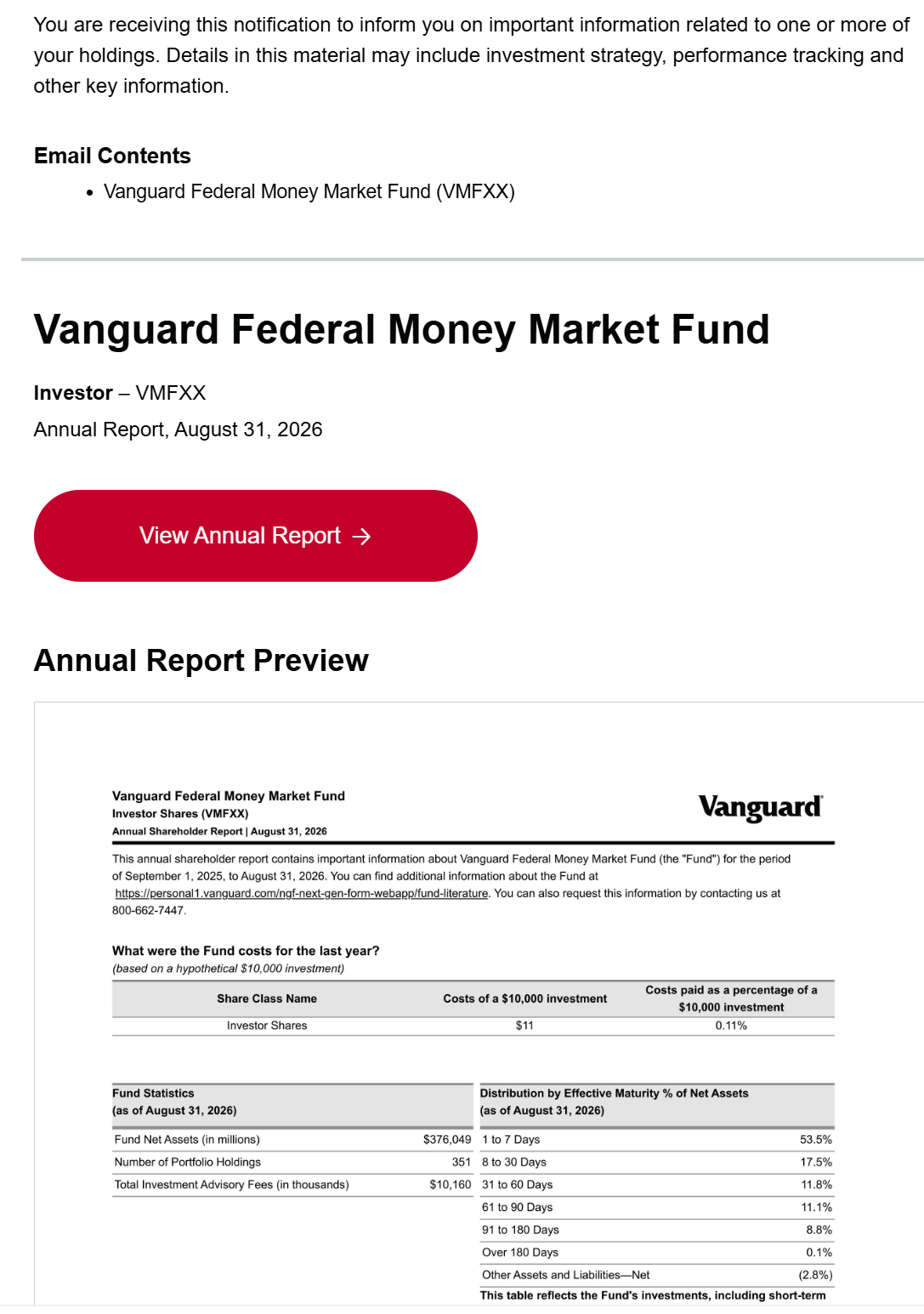
The annual report of a fund that can invest only in U.S. government short-term instruments certainly would make for fascinating/important reading. What caught my eye, however, was the expense ratio of 0.11%. That’s huge compared to S&P 500 index funds (0.015% to 0.03% expense ratio is typical). Gemini:
These are actively managed portfolios. Fund managers must constantly buy short-term debt securities (like Commercial Paper or Treasury Bills) that mature in days or weeks. Every single day, a massive volume of these securities expires, and managers must actively find and buy new ones to replace them while keeping the fund safe.
If this is truly a big part of the cost, why can’t a robot deal with the $376 billion in assets that Vanguard customers have in this fund?
I asked a friend who managed $billions on and off Wall Street about this. He said, “One reason that stock mutual funds can offer low fees is that they have the opportunity to make money by lending shares to short sellers,” and added, “When I worked at Goldman, our money market was one of the firm’s most profitable activities.” So maybe there is room for an AI-based competitor? A new direction for Binance?
Speaking of money markets, the 6% yield available from Elon Musk has been nerfed. (See Life with X Money (do you get wiped out when the world wakes up to Starship being a total failure?) from just a month ago.) A recent notice on the site says “Effective December 1, 2026, accounts that are eligible to earn 6.00% APY will earn that rate on the first $150,000 of deposits. Any amount greater than $150,000 will earn 4.00% APY.”
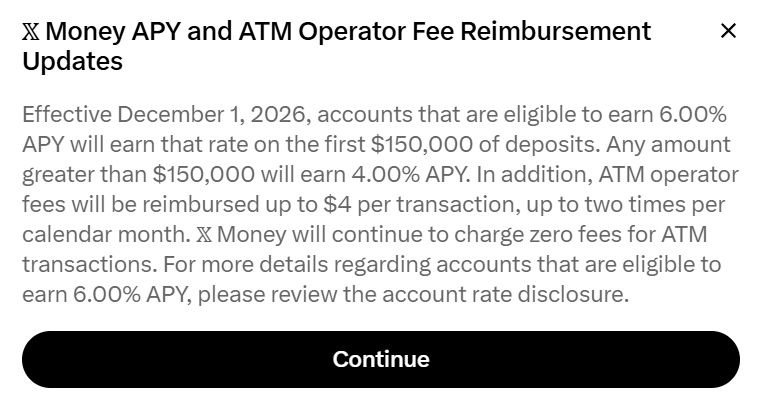
(The 4% number beats a Bank of America savings account, for sure, but it falls short of market-leading (NerdWallet has a list).)
Your friend is mistaken on stock index funds. Stock lending does often benefit equity index funds, but it is accounted for in the investment return of the fund, *not* a reduction in the expense ratio. Also, the impact is usually very small, on the order of .005-.03% for an S&P 500 index fund (slightly larger for small-cap funds).
Also, Gemini is correct in its analysis of why money-market fund expense ratios are higher.
In terms of relative profitability for the mutual fund companies, stock index funds (on average) earn more for their companies vs. money market funds except during periods of very high interest rates.
That said, your thesis that SI may be able to manage or help manage money-market funds is a good one and in fact it is being used or tested at many mutual fund companies and will almost surely result in downward pressure on overall fees going forward.