I hope that everyone’s National Estate Planning Awareness Month is going well. As the nation’s successful make their way down to Florida for “the season”, a cautionary tale from the Wall Street Journal: “Was His Home Connecticut or Florida? The Difference Is a $13 Million Tax Bill”.
A rich douche spent 5.5 months in Connecticut during his last year on this planet and that generate a huge amount of litigation over whether CT can harvest estate tax (reducing the kids’ inheritance). He could have avoided all of the drama for his executor simply by making his northern home anywhere away from the states of color in the Tax Foundation map below.

The Islamic Republic of Michigan, for example, or Live Free and Die Free in New Hampshire. Even California would have been a far better choice since elites there refuse to live their own principles by imposing an estate tax to reduce income inequality and the “generational wealth” that they decry.
A bit part of the mess seems to be that, like Marjorie Merriweather Post, the builder of Mar-a-Lago, this douche had three regular residences: FL, AZ, and CT. So he wasn’t anchored in Florida for 183 days per year.
It is all increasingly complicated when people can work anywhere and have multiple homes. The fights between states and the wealthy are playing out in an increasing number of residency audits, said Timothy Noonan, a lawyer who leads a tax residency practice at Hodgson Russ in New York City.
The trial court judge homed in on one factor: Anderson typically spent 5½ months a year from May to mid-October in Greenwich, and 3½ months from November through mid-February in Florida. He spent three months from mid-February through early May in Arizona.
The judge concluded that “ultimately, the most persuasive evidence demonstrating Anderson’s domicile is where he chose to spend his most valuable and limited resource: his time.”
The trial court concluded that Anderson’s personal, social and property connections with Connecticut and Florida were generally equal, but that the estate failed to prove by clear and convincing evidence that Connecticut wasn’t his true home.
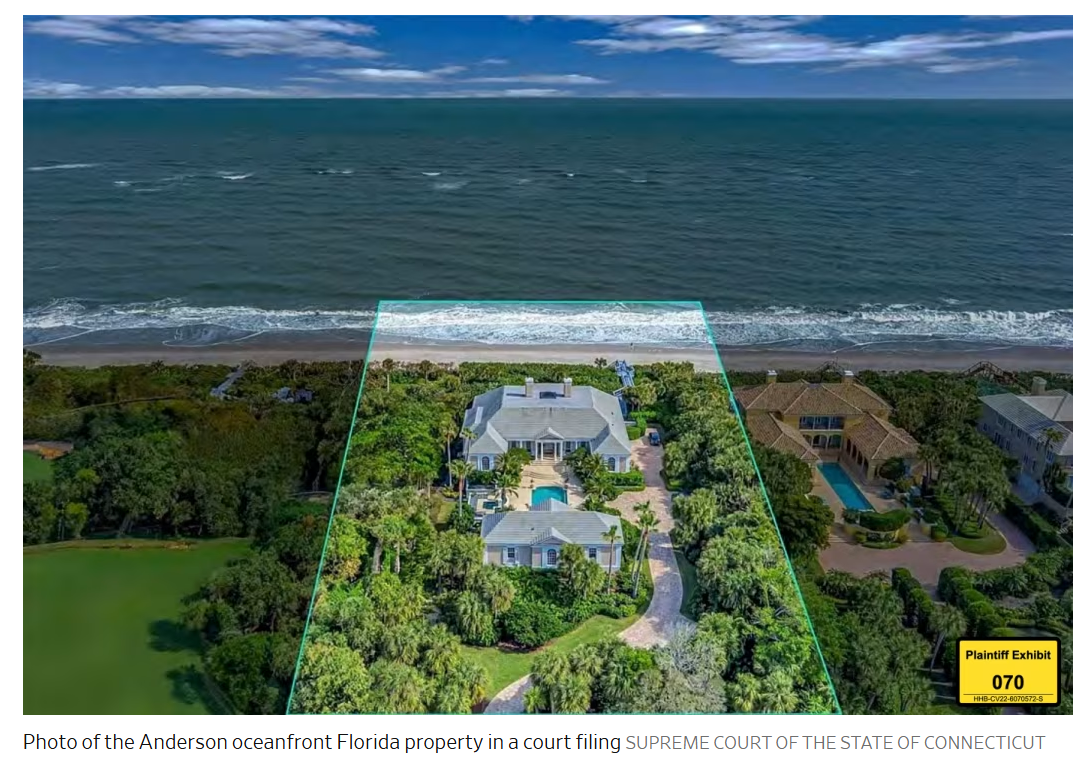
Here’s the Vero Beach place:
Estate tax is particularly hazardous. My late mother’s college friend was a passionate Democrat who avoided paying any tax to the Democrats of Maskachusetts by spending 183 days per year in her Palm Beach place. I hope that she lives forever, but what if in the last year of her life she falls ill while on a January visit to MA and then ends up staying through December in MA for continuity of medical care? MA wouldn’t have a slam-dunk case to collect estate tax, but they could certainly argue that the deceased had given up FL residence and it was time to collect 16% ahead of the kids, the ACLU, Planned Parenthood, and other beneficiaries.
Here’s an Ohio-based law firm’s web page on National Estate Planning Awareness Month showing a typical high-net-worth Ohio family (and no other client photos):

Google AI: “The median household income for Black or African American households in Ohio is approximately $42,433 to $45,800 per year, according to recent state demographic snapshots and census data. This is lower than the overall state median household income, which sits above $71,000”,
Grok: “Law firm marketing frequently uses multi-racial or Black family stock images for inclusivity branding, aspirational messaging, or to signal that services are open to everyone. It is not an attempt to accurately depict the statistical modal client. This is common across many professional-service websites and does not change the underlying demographics of who actually pays for attorney-drafted plans. In short: the image is marketing aesthetics. The typical paying customer for this service in Ohio remains a higher-wealth, usually White household.”
ChatGPT characterizes the image as “generic stock-photo family”, implying that it was chosen at random. Pressed, the AI admits that the law firm’s likely clients are rich white people. How does the image help market to those douches? “It could help if the firm thinks affluent white clients care about signals beyond “this family looks like me.” Marketing often tries to communicate things such as “modern,” “inclusive,” “welcoming,” or “serves the whole community.” Some wealthy white prospective clients may respond positively to that branding.”
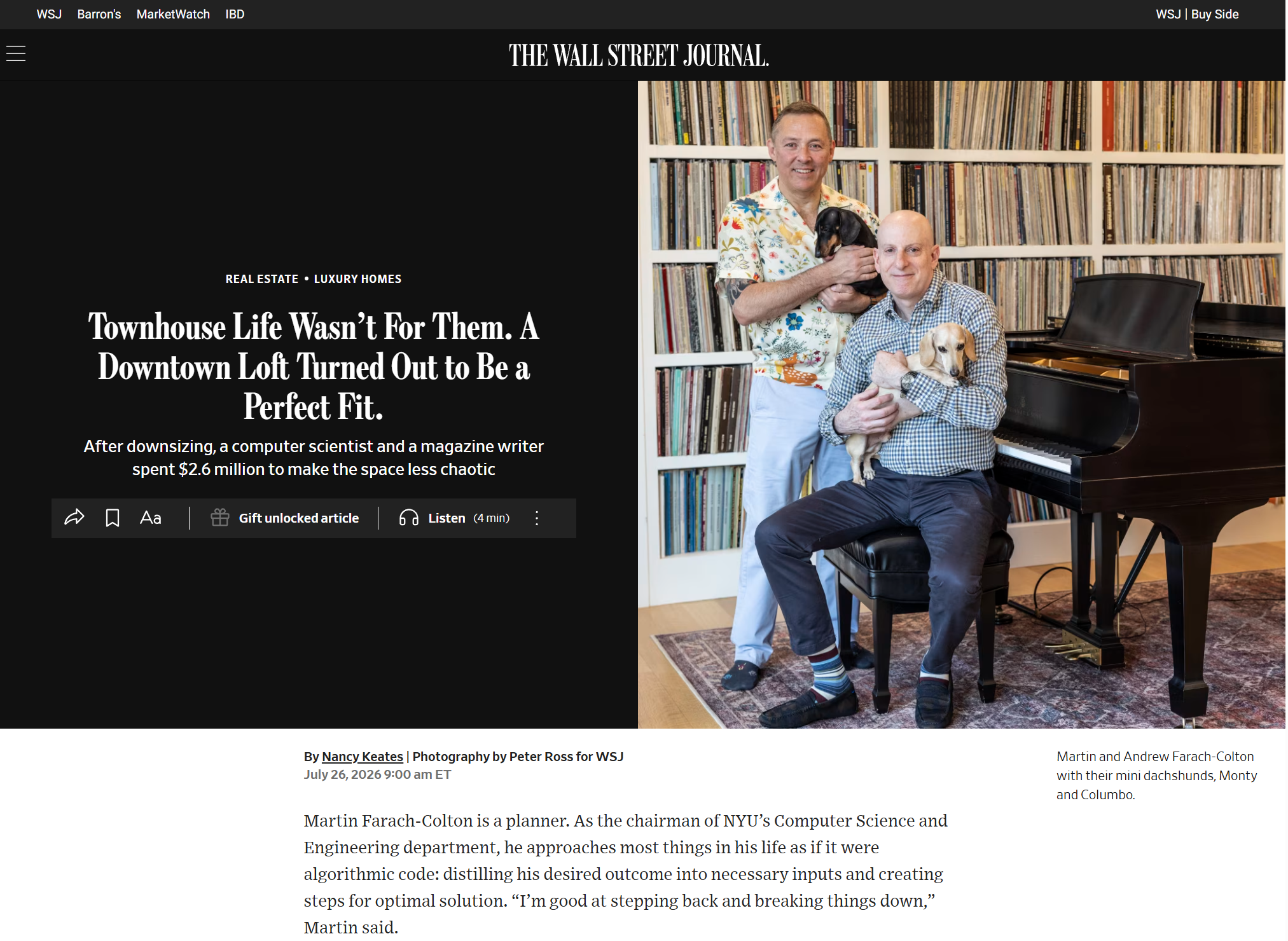
Also from the Wall Street Journal, a couple in Manhattan whose kids’ inheritance will be reduced if they don’t move…
“Kids?” you might ask if you remember anything from your high school biology class.
Martin, 60, and his husband, Andrew Farach-Colton, 63, were living in that tiny Upper West Side apartment in 1999 when they found out they would be the fathers of twins. They wanted more space, but knew they couldn’t get it in Manhattan on their salaries.
This blog is turning into a pity party for the ultra wealthy. My cousins aren’t going to get jack squat. My 90 year old aunt, solidly middle class, fell and broke her hip. The gubment immediately swept in and wanted to grab all her assets then throw her in a home. This guy managed to extract $100M + the money he wasted while alive from a fricking hospital network. I hope they investigated ways of seizing the money and giving it back to heal sick people, with the zeal they applied to my aunt. By the way, is the Conn State really free of conflict of interest in deciding this anyway. Isn’t it an interstate matter?
(The black gentleman is obviously on a budget, he had to buy a tiny, half-sized hat.)
OAG: the original post doesn’t ask the unsuccessful to pity the successful. It is advice for the successful on how to make sure that their children get at least 60% of their savings (the federal 40% estate tax can’t be avoided by moving states) rather than, e.g., only 44%. For those successful people who want Ilhan Omar and AOC to spend their savings, of course, the advice isn’t useful.