The lead plaintiff in the Bank of America lawsuit, an unidentified woman, came to the United States from Russia in 2011 when she was about 20. The lawsuit said Mr. Epstein had sexually abused her at least 100 times and coerced her into a “cultlike life,” in which she was totally dependent on him.
In 2013, Bank of America opened an account for the woman, then 22, at the direction of Mr. Epstein’s employees, even though she spoke little English and had no job or discernible source of income — all potential red flags for sex trafficking, the lawsuit said.
The two law firms representing the victims, Boies Schiller Flexner and Edwards Henderson, could be eligible to receive fees totaling 30 percent of the settlement amount, according to the court filing.
Note that Boies Schiller Flexner was Theranos’s law firm, absolutely critical to keeping the fraud going according to the book Bad Blood, and David Boeis was actually a Theranos board member (see Evaluating trustworthiness; lessons from Theranos).
So… this woman got paid to have sex with Jeffrey Epstein from age 20 to age 28. In addition to whatever she got paid at the time, e.g., via the Bank of America account at issue, she would have received about $3.5 million from JPMorgan, Deutsche Bank, and the Epstein estate. Let’s say with this latest settlement she’ll be up to $5 million, all tax-free because it will be payments for damages suffered. She says that she had sex with Jeffrey Epstein 100 times so that works out to $50,000 per sex act plus whatever Emmanuel Goldstein paid her on a current basis.
Loosely related… “[OnlyFans] proves that, when given the choice and opportunity, many women will choose to enter the prostitution industry voluntarily”
RIP to the man whose work challenged a common lie and assumption about women being forced into the porn industry.
his creation proves that, when given the choice and opportunity, many women will choose to enter the prostitution industry voluntarily…Despite having no barriers… https://t.co/R31fFZOxOg
We’re not at war with Cuba, as far as I know, and Cubans don’t chant “Death to America” while building advanced weapons. Nonetheless, we’ve supposedly prevented Cubans from getting oil and, thus, generating electric power. From state-sponsored NPR… “How the U.S. oil blockade is taking a high toll on everyday Cubans”:
For millions of Cubans, daily life has turned into a desperate struggle. Earlier this week, Cuba was forced into a nationwide blackout after months of the U.S. effectively choking off oil shipments to the island from Cuba’s allies. The country continues to experience rolling blackouts. And meanwhile, President Trump continues to float the idea of taking over the country. But amid negotiations with the U.S., Cuban officials say they don’t intend to go anywhere.
Trump-hostile media outlets complain that U.S. policy toward Cuba is cruel, but not that it is a “crime” or a “war crime” (NYT example).
The most obvious way to reduce the Islamic Republic of Iran’s long-term military power is to disable the country’s oil industry and electric power generation. Without money from selling oil, the Islamic Republic wouldn’t be able to rebuild weapons factories. Without a surplus of electric power, the Islamic Republic wouldn’t be able to run its weapons factories.
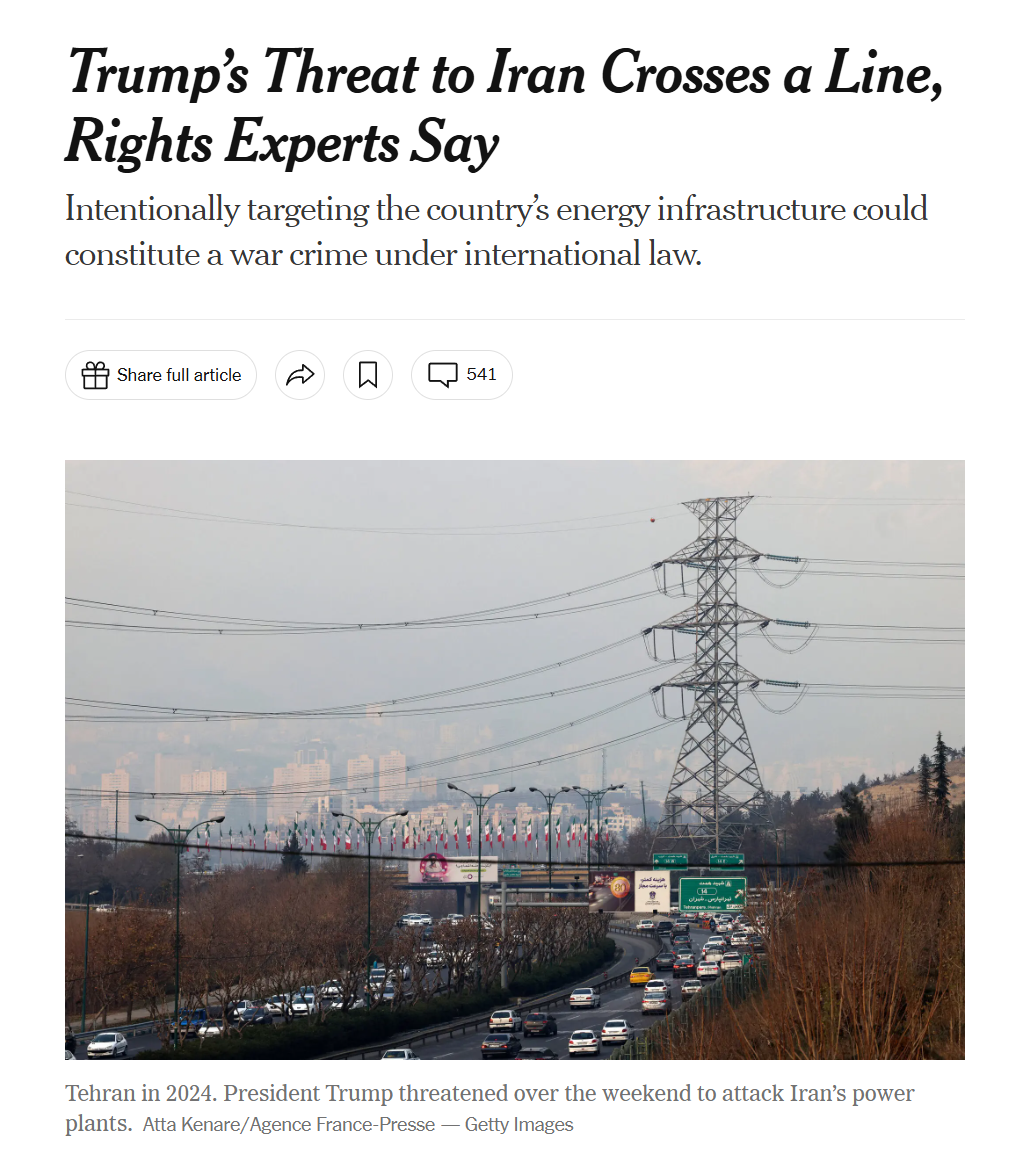
The same newspaper that implies it was not a crime for us to disable Cuba’s electric power says that it would definitely be a “war crime” to do anything to harm our actual enemy, Iran. NYT, March 24, 2026:
Intentionally targeting the country’s energy infrastructure could constitute a war crime under international law.
Tehran has effectively closed off the critical waterway, turning back container ships on Friday, and Iranian lawmakers are considering whether to charge fees to pass.
The Islamic Revolutionary Guards Corps said Friday that it had turned back three container ships attempting to enter what it described as a designated corridor, declaring that “the Strait of Hormuz is closed” and warning that any unauthorized traffic would face “severe action,” according to a statement carried by Fars.
We’ve been told that the U.S. has sunk the entire Iranian navy and also that A-10 Warthogs are patrolling the Strait of Hormuz. How is Iran able to operate military naval vessels, even boat-sized, that can “turn back” a ship? Maybe the answer is that Iran is radioing the ships and threatening them with drones or missiles?
The security line into the city administration building backed up through the door as hundreds of people filed in for a San Diego City Council meeting Tuesday. The councilmembers were scheduled to discuss whether to adopt a resolution — not a binding law, but something they described as “the lowest form of what we can do.”
The city adopted the definition of the International Holocaust Remembrance Alliance (IHRA). Dozens of countries and cities across the U.S. have already adopted it, including Los Angeles, Chula Vista and El Cajon.
It says: “Antisemitism is a certain perception of Jews, which may be expressed as hatred toward Jews. Rhetorical and physical manifestations of antisemitism are directed toward Jewish or non-Jewish individuals and/or their property, toward Jewish community institutions and religious facilities.”
Californians a random assemblage of humans from all over the U.S. and the world, proceeded to argue over this pointless non-binding vague definition (“certain perception”?):
“Don’t you f–ing touch me, that’s assault!” a man cried before the meeting had even come to order.
Increased security surrounded the room. Before the night was over, they would escort out five members of the public.
Public comment ran over four hours.
The more than 200 in-person public commenters were nearly evenly split for and against the IHRA definition, despite the concern one Muslim speaker raised that the meeting was being held during Ramadan, preventing many from attending.
“One speaker openly said, ‘Look at all the well-dressed Jews here with money in their pockets,’” she said. “At least two people were asked to be removed for their hateful outcries, with one of them causing an altercation with our incredible San Diego Police Department officers who attended to keep the peace.”
Cohen-Reeis added that one person who spoke virtually stated that Jewish children deserve to be spat upon.
Multiple speakers, who expressed opposition to the resolution, accused Israel of apartheid, genocide and ethnic cleansing.
A friend with an incandescent hatred of Donald Trump, Elon Musk, and Republicans in general bought a Tesla Y at the end of 2025 because he wanted to relax with FSD on regular trips from Boston to Manhattan. A base model RWD Tesla Y leased here in Florida, as of December 22, 2025:
With a subsidy from the working class in Maskachusetts:
(It’s a $3,500 subsidy from state taxpayers, but the lease is $3,888 cheaper over 36 months, presumably due to the time value of the $3,500 paid immediately. Note that the low price from Tesla is no longer available. As of right now, the price is up more than $100/month compared to three months ago.)
How’s he enjoying the machine, which has now gone about 4,000 miles, 94% of them on FSD? “I give it an A-,” he said, and compared it to a high-quality aircraft autopilot (he’s a rare example of a private aircraft owner/pilot who is also a loyal Democrat). The only consistent shortcoming that he has identified is that the car doesn’t get in and out of parking lots very well. He hates paying Elon Musk $110 per month ($100 for the FSD subscription plus $10/month for a required communication subscription) because he hates Elon Musk for being Trump-adjacent. On the other hand, he doesn’t want to return to manual driving. The car hasn’t been nearly as reliable as our Hondas. He has had some intermittent computer/camera problems and a rear side window actually cracked due to stress (maybe Boston’s cold weather contributed, but Tesla covered it under warranty).
Another friend in Maskachusetts is a dentist who drives about two hours round-trip every day to her practice (Medicaid is the path to max income for a dentist in MA, but most dentists don’t want to live in a Medicaid-heavy neighborhood). She also got a Tesla Y towards the end of 2025. Queried in March: “Loving fsd. Even did it in the snow.” I respect her opinion more than that of my tech friends because she’s not interested in tech.
Tesla FSD meets South Florida: I got an Uber ride home from the art museum in West Palm Beach to our house in Jupiter, a 20-mile trip. The machine was a 2021 Model 3 with 103,000 miles, owned by the driver since mid-2025. He had it set for “Hurry”. Tesla’s software was cautious when a cyclist appeared from the left and might conceivably have come into our lane. The machine handled the 6-lane local roads reasonably well, but stayed in the left lane longer than a human would have given the impending need to turn right onto a ramp (the human can override this behavior via the turn signal). FSD handled the traffic circles near our house perfectly. It came to hard stops at 4-way intersections in the neighborhood that a human driver would have turned into rolling stops. It got a little confused at the very end and tried to go into an alley next to our house (MacArthur Foundation laid out Abacoa with garages in the back). The Uber driver said that FSD is almost perfect from his point of view except that it doesn’t do well in the rain if it sees puddles. He estimates a 4:1 fatigue ratio of manual vs FSD. (Others I have talked to have said 3:1 or less.)
The car seemed to be in near-new condition despite its age and 100,000+ miles. Not sure the white fake leather seats would survive our kids…
(The puddle issue might be his car having HW3 rather than the current HW4 or the glorious HW5 that we were supposed to have now but won’t until mid-2027. Maybe this Rembrandt “scholar” is what Elon will look like when HW5/“AI5” finally ships?)
From a friend with an old Tesla 3 and a new-ish Cybertruck:
Today I tried the new new new Tesla update that almost no one has. 14.2.2.1. It was flawless [on the Cybertruck]. I forgot to worry about it as if another human was driving.
My response: “We know that it isn’t a cult because each release is “flawless” or “perfect” and then the next release is “more flawless” and “more perfect”. (Even my friends have learned to hate me, in case you were curious.) Tesla Fanboi:
No. I have told you many times FSD sucked and that is why I didn’t buy it. I have owned my Tesla for 6 years and the first time I ever said FSD was kinda good was in October, and I was today years old the first time I said it was really good.
My personal plan was to wait for HW5 or “AI5” before getting a Tesla, but now it seems that I probably won’t live to see the AI5 era. The latest slip:
A friend who lives in Switzerland owns a Model Y. The government there forced Tesla to roll back everyone’s software to 2019 and FSD is strictly illegal almost everywhere in Europe (it’s not hazardous to import tens of millions of humans from the world’s most violent and dysfunctional societies, but Tesla’s binary code is a civilization-ending threat). He recently rented a Cybertruck on Turo in Fort Lauderdale ($200+/day; pickup and return to FLL garage). He’s spent 3-4 hours per day on FSD while looking at various places to relocate his family to (he was born in the U.S.). He says There was one “phantom braking” incident on a local street where the system got confused by a shadow and braked moderately hard (he overrode this decision with the accelerator). “It probably wouldn’t have done that if there had been a car in front of me,” he noted. “Overall, it’s a game-changer for South Florida commuting and I’m sure it won’t be long before the last bugs are worked out and the system is approved for fully autonomous Cybercabs.”
In other news, my dream of a self-driving minivan might be arriving at around the same time as Tesla’s AI5 hardware. Mercedes is going to bring a pimped minivan EV, a format popular in China, to the US (Car and Driver). Unlike Tesla, Mercedes has no Nazi history, of course, so it can be purchased with qualms. The German minivan is interesting because Nazi-free Mercedes is working with NVIDIA to compete with Tesla in “full self-driving” (i.e., not self-driving because a human has to be constantly monitoring). Car and Driver tested this in January and it seems promising. Minivan leaders Honda and Toyota, by contrast, aren’t even beginning to think about a Tesla-style system. They would rather lose 100 percent of their customers than sell anything below Level 3 (full autonomy). Here’s the beautiful Mercedes minivan, showing what a luxury car company can do:
Oil collapsed to $20-25/barrel during coronapanic and Donald Trump tried to seize the opportunity to buy enough to fill the Strategic Petroleum Reserve. Exactly six years ago, from rollcall:
The last point:
Senate Democrats took credit for stripping out that money from the Senate bill, unveiled Wednesday, calling it a “bailout” for the oil industry.
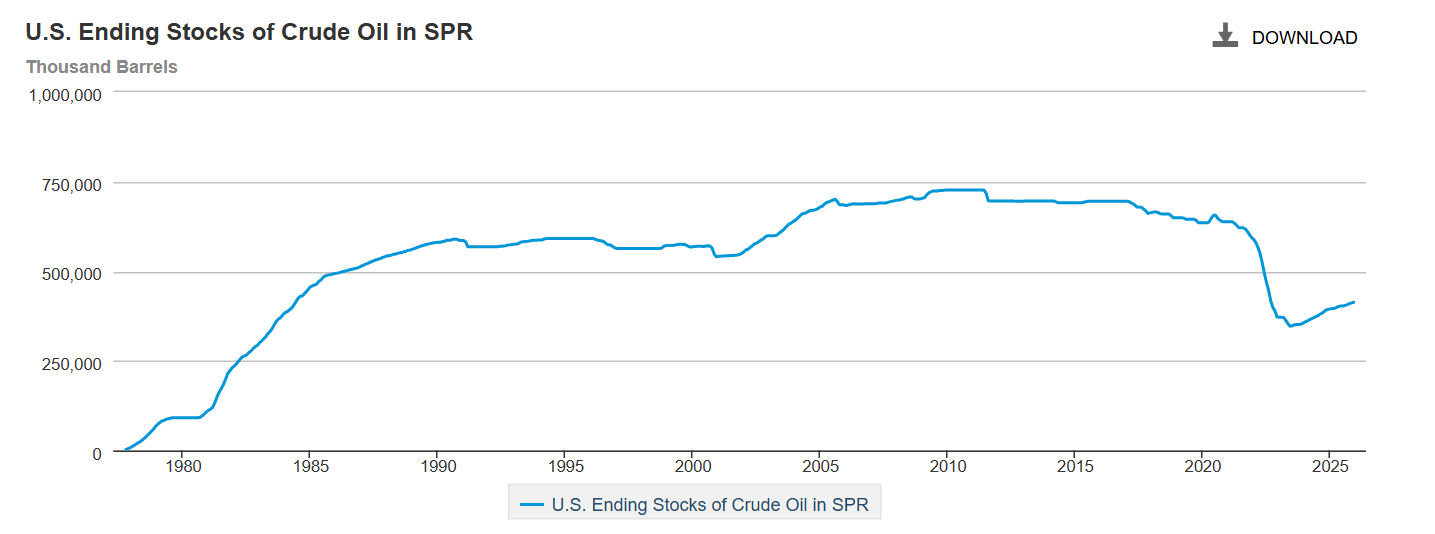
What happened after Trump was replaced by Team Smart (Biden-Harris)? The SPR was drained to its lowest level since 1985:
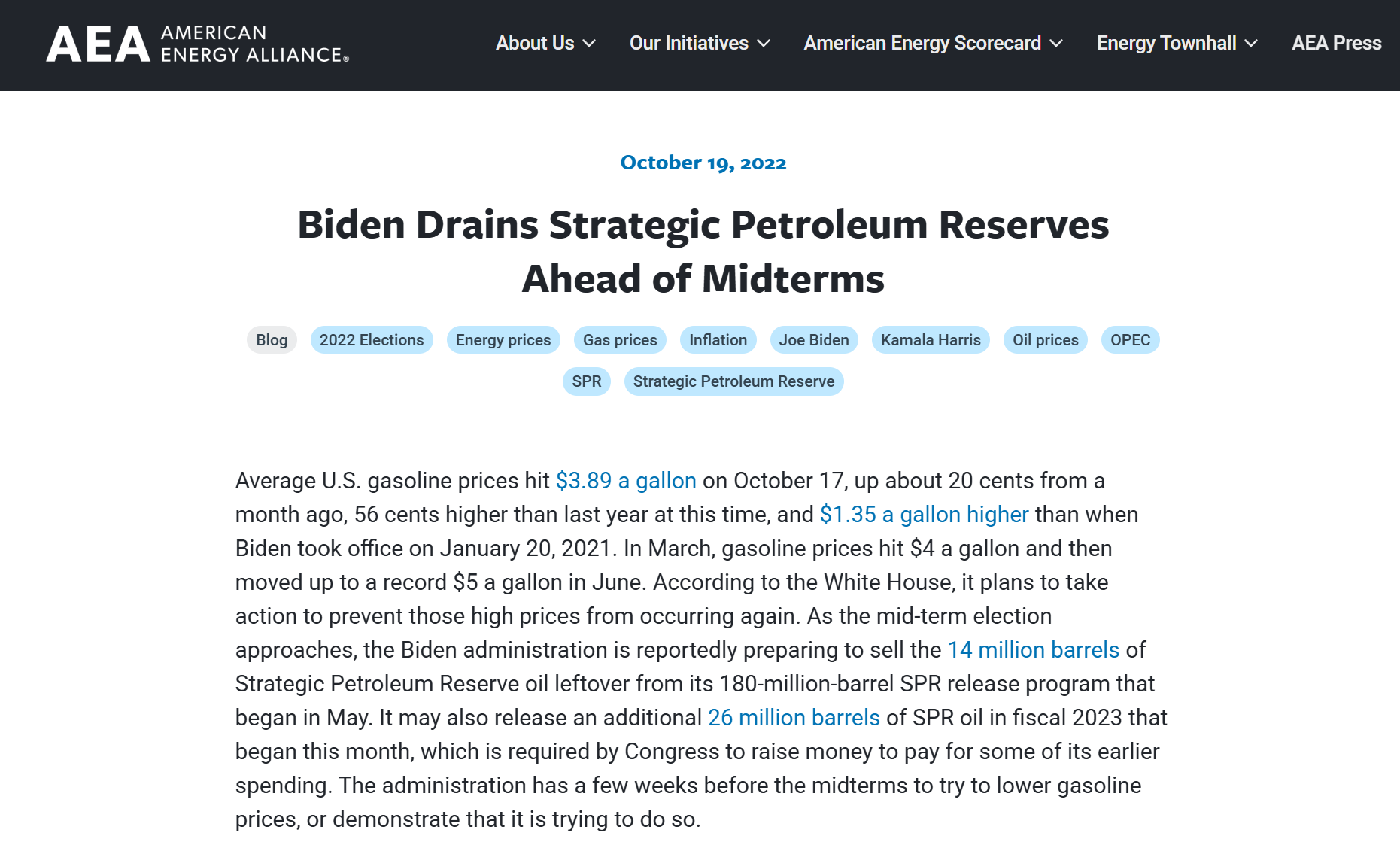
AEA… “Biden Drains Strategic Petroleum Reserves Ahead of Midterms”:
As the mid-term election approaches, the Biden administration is reportedly preparing to sell the 14 million barrels of Strategic Petroleum Reserve oil leftover from its 180-million-barrel SPR release program that began in May. It may also release an additional 26 million barrels of SPR oil in fiscal 2023 that began this month, which is required by Congress to raise money to pay for some of its earlier spending. The administration has a few weeks before the midterms to try to lower gasoline prices, or demonstrate that it is trying to do so.
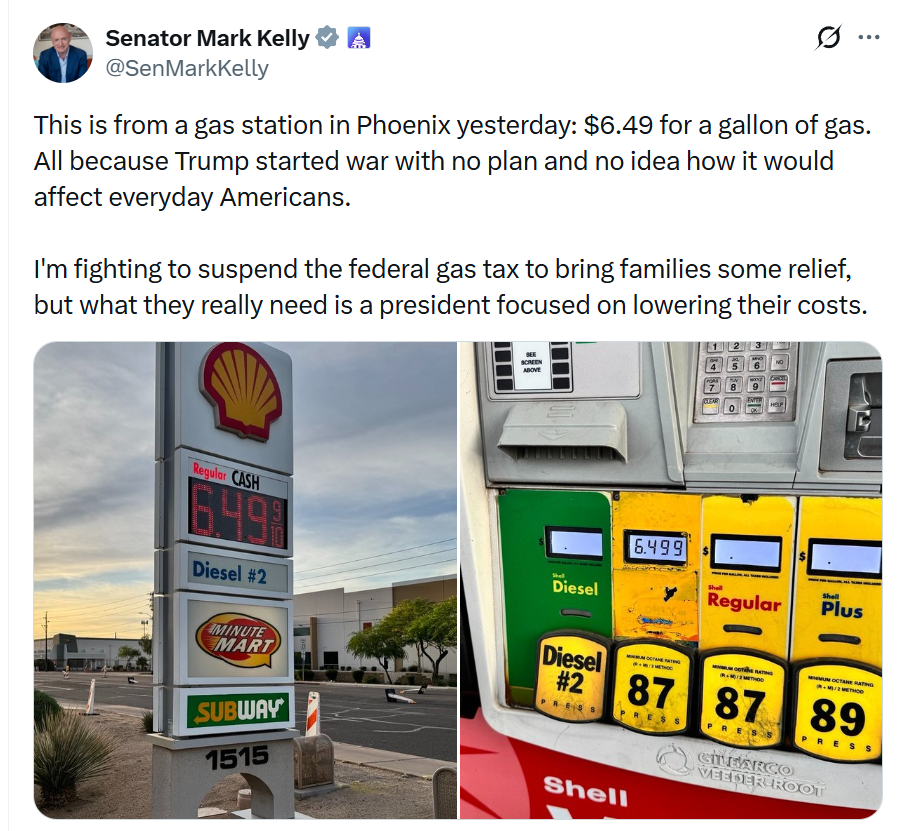
The same Democrat, March 24, 2026, demands low gasoline prices so that Americans will be encouraged to buy 12 mpg SUVs and drive in circles. The most obvious way to reduce carbon emissions is a carbon tax, but Sen. Mark Kelly here advocates removing a carbon tax (that also pays to maintain the roads, thus shifting the tax burden for road maintenance from car owners to people who virtuously live in walkable neighborhoods and don’t use cars):
The standard expression “You can vote your way into socialism, but you have to shoot your way out” could be adjusted for recent events in Iran, where a popular uprising doesn’t seem practical: “You can vote your way into Islamic Theocracy, but you have to shoot your way out”.
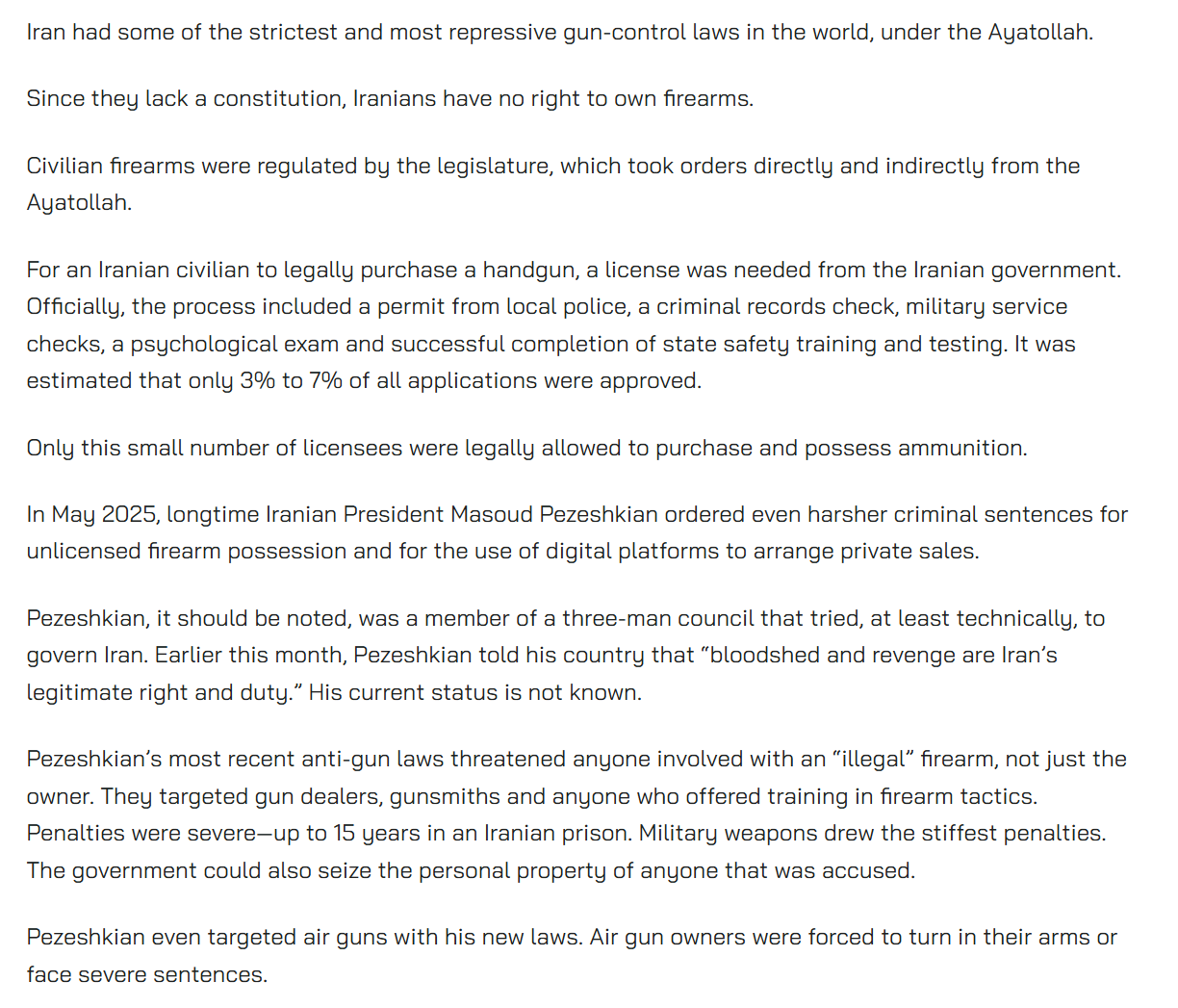
It seems that very few Iranians could shoot their way out even if motivated to do so. The Islamic Republic has a near-monopoly on gun ownership that is enforced by a Chicago or New York Democrat’s dream common sense gun control system:
The Islamic Republic purportedly has only about 20 percent support (poll), but could probably have stayed in power forever if not for its nuclear weapons, ballistic missiles, Hezbollah, Houthi, and Hamas programs.
Could the divergence between what the Iranian people supposedly want (to the extent that can be measured accurately) and what the Iranian government does lead some Americans to reconsider their goals of eliminating private gun ownership in the U.S.?
(Note that I personally believe that Americans’ right to own guns will disappear within the next few decades, a casualty of our immigration system and the consequent creation of a society that is a random assemblage of humans without any common values. When shooting jihads such as Ndiaga Diagne‘s become weekly events, Americans will gladly surrender their rights in exchange for a perceived safety advantage, just as Americans meekly surrendered their First Amendment right to assemble during coronapanic.)
Friends have been asking how the LaGuardia airplane-fire truck crash could have happened.
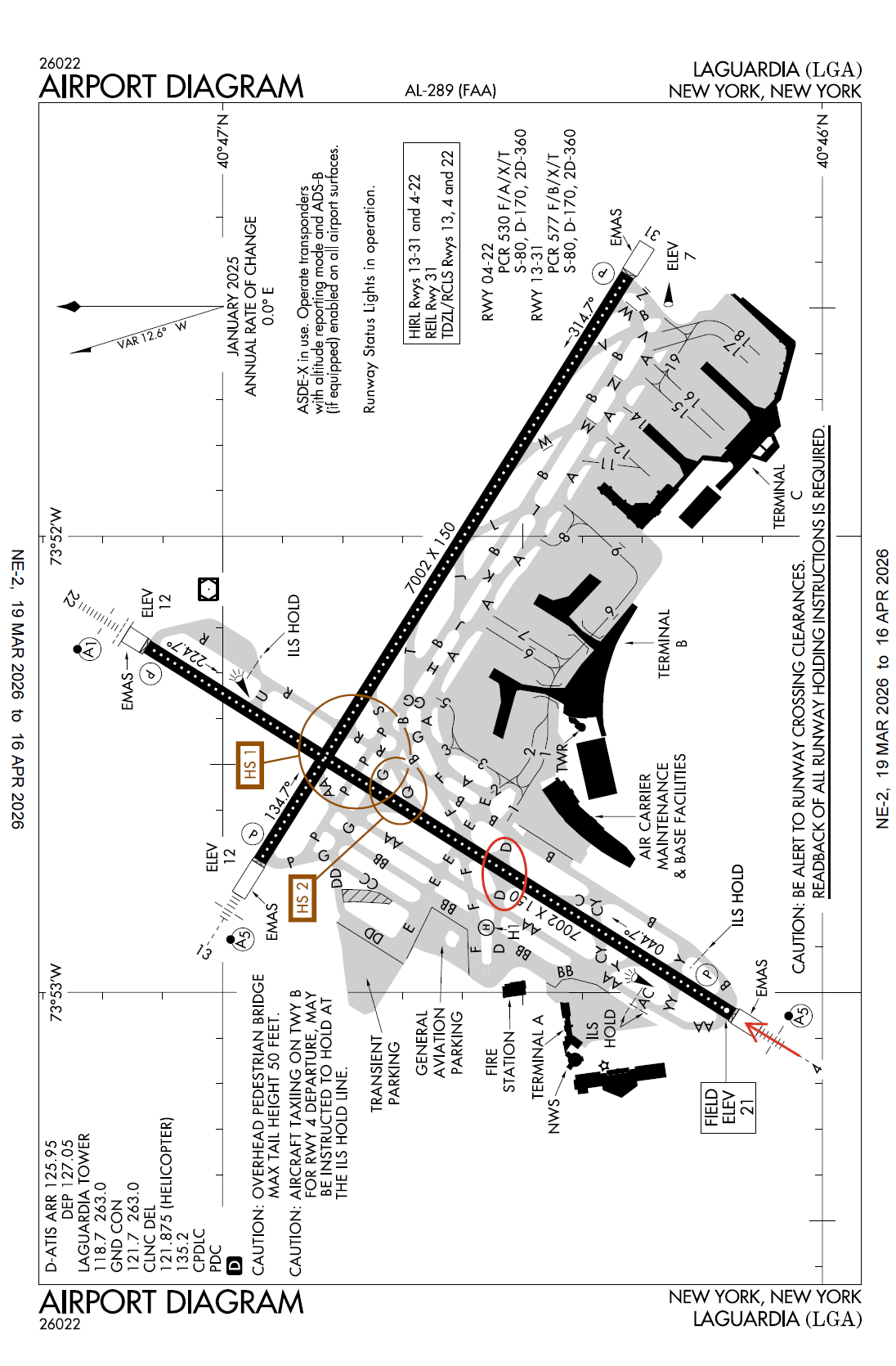
Before reviewing any audio, my first guess was “Might be a controller error. Clear plane to land and someone else clears fire truck across runway.” That shouldn’t happen in general. Even if there are multiple Tower frequencies, there is typically one controller who is solely responsible for a given runway. Based on news reports thus far, it looks like my first guess was partially correct, but it was the same person who cleared a plane to land and a fire truck to cross. Here’s the airport diagram:
The crash apparently occurred at the intersection of Runway 4 and taxiway Delta (D), marked with a red oval below. The plane was moving in the direction of the red arrow.
Note that a jet doesn’t try to land right at the beginning of the runway, but rather 1000′ down the runway (out of 7002′ total here). Because of inertia due to weight and the slow-ish spool-up time of a big jet engine, it’s tough to adjust approach angle/position near the ground in the event the wind changes. If the airplane is going to come up a little short, therefore, the 1000′ marker target enables the short landing to still happen on the runway surface. The airplane would have been rolling/braking for perhaps only 1500-2000′ before the crash.
Based on an air traffic control recording, the truck had requested permission and had been cleared by the air traffic controller to cross Runway 4 at taxiway Delta. Shortly after, the air traffic controller tells the vehicle to stop several times right before the collision.
“Stop, Truck 1. Stop,” the transmission says. The controller can then be heard frantically diverting an incoming aircraft from landing.
Michael McCormick is the former vice president of the FAA and was once in charge of all of the airspace in the Tri-State.
He wants to know how many people were in the control tower, because initially it sounds like one person could have been doing the work of two people.
“What we’ve heard from that control tape, is it’s the same voice that is clearing the aircraft to land and clearing the vehicles across the runway and a normal tower scenario it would be ground control working the surface traffic and tower control just working arrivals and departures,” McCormick said.
Michael McCormick sounds much more qualified than I, but I think that he is incorrect regarding what’s conventional for Tower vs. Ground responsibility. In my experience, any vehicle or aircraft that wants to cross an active runway usually deals with Tower, i.e., the same person on the same frequency. This is substantially safer than two people issuing instructions on two frequencies because it gives pilots the chance to hear that a vehicle has been cleared across the runway that they were expecting to use and also concentrates control into one brain rather than requiring coordination among multiple brains.
It’s super sad to reflect on the deaths and injuries caused by what seems to be human error, especially since there was no need for the humans in the fire truck to be on their own. An AI in the fire truck could have been monitoring both Tower and Ground frequencies and also looking around at vehicles and aircraft on the field. The AI could easily have said “Don’t move! There’s a plane landing!” to the truck driver who’d been cleared across.
Has anything like this happened to me, you might ask? Yes. I won’t rat out the airport and controller, but I was holding short of a runway at a towered general aviation airport with a fair amount of flight school traffic. Tower cleared me for takeoff. I looked left and noticed a piston-powered airplane on short final and decided not to move into the runway. At a normal taxi speed, I think that the landing aircraft might have gone past by the time I was in the middle of the runway, but it was surely a controller mistake (at the point that I was cleared for takeoff nobody could have had any idea how long it would take for the landing airplane to clear the runway).
(For what it’s worth, our AI overlord (ChatGPT) says “Runway = Tower’s jurisdiction … No one—aircraft or vehicle—may enter or cross a runway without: … Explicit clearance from Tower” and that only rarely might a Ground controller relay a Tower controller’s clearance to cross a runway.)
Don’t take this post as a criticism of LaGuardia ATC. In my experience, New York controllers in all positions are some of the best in the U.S. I’ve talked to LaGuardia Tower while flying a helicopter around the East River and while flying a CRJ into and out of LGA. One really can’t get better humans and, therefore, improved safety will come only from improved systems, such as AI assistance in ground vehicles and, maybe, an AI assistant in the Tower.
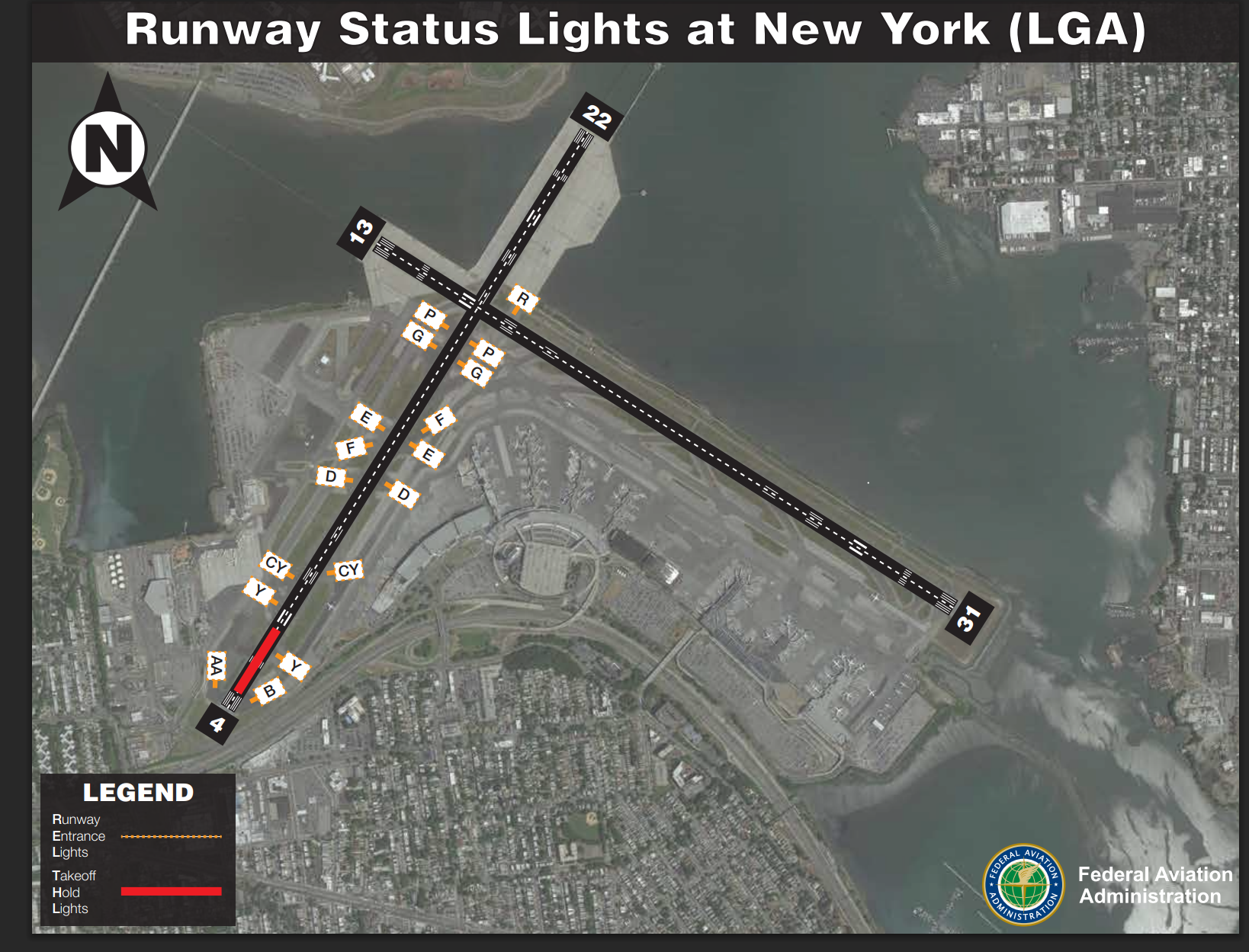
One big question: why didn’t the fire truck personnel notice the CRJ’s insanely bright landing lights or get warned by the runway status lights that are supposed to prevent runway incursions even when a human makes a mistake? Pilots are trained to look both ways when entering a taxiway or runway so presumably the airport fire truck drivers are too. According to the FAA, there should have been a “stop” indication to the fire truck that the runway was in use (another easy thing for an AI to warn out: “STOP! Look at the red lights!”):
It will certainly be worth investigating whether this failsafe system was operating correctly at the time of the accident and also what kind of training fire truck drivers receive. For pilots in a two-pilot crew, the captain (left seat) is supposed to look and say “clear left” while the first officer (right seat) is supposed to look and say “clear right” before making a turn.
We took the kids to see Hoppers, the latest Pixar movie. It has some spiritual similarities to The Population Bomb (1968), whose author recently died. Stanford University prof. and Ivy League graduate Paul R. Ehrlich was famously wrong about human population growth leading to famine within his lifetime, but Hoppers shows that his philosophy remains alive.
The movie opens with a noble Japanese-American girl visiting with her grandmother at a single-family house with immediate access to an unspoiled natural area (i.e., something that is impossible for the average person who lives in a heavily populated country). It is access to nature, we’re told, that enables a human to be calm (urban “teens” who can’t access nature, thus, are guaranteed to be violent).
Population pressure and growth, as Prof. Ehrlich described, drive the plot of the movie. The humans are working to take away all of the animals’ habitat, something that they might not have done if the U.S. had stopped growing after reaching 150 million circa 1950.
Was Ehrlich actually wrong? He did say that we might “stretch” and increase food production by trashing the Earth and that is kind of what we’ve done here in the U.S., e.g., heavily fertilizing the Midwest and dumping runoff into the Gulf of America, thus creating dead zones:
The Dead Zone develops, somewhat ironically, as a result of the nutrients that fuel the high productivity in the Gulf’s surface waters. As dead plant material falls from the surface through the water column deeper into the Gulf, bacteria consume it using oxygen. This lack of oxygen creates the Dead Zone in bottom waters on the Texas-Louisiana shelf throughout warm summer months. This occurs when there are fewer storms and strong winds to mix the warm, oxygenated surface waters and the cooler, deeper waters. At other times during the year, winds, weather fronts and storms in the area mix the water, replenishing the oxygen used by the bacteria in the deeper water.
Nutrients, such as nitrogen and phosphorous, are essential for an abundant food supply, but crops take up on average just 40% of the nitrogen that is applied each season. The excess can run off into waterways, leading to a high nutrient load in the Mississippi River. Many efforts are underway throughout the Corn Belt to improve fertilizer efficiency and increase adoption of practices like cover crops and buffer strips that protect water quality.
See Book that explores the biggest issue of our age for a discussion of the tension between those who think we need six Earths total for the current batch of humans and those who think we can innovate enough to use just one Earth.
How was the movie? The boys (10 and 12) didn’t love it. Maybe because they don’t identify as either female or Black, the only two kinds of humans who are smart enough to be scientists and engineers. There is, of course, one white male character and he occupies the environment-destroying villain role. The movie involves mobile robots that are created by the intelligent female scientists. Said robots have no apparent solar cells and yet never run out of power. Speaking of miracles, the population in the unnamed U.S. city (Pacific Northwest?) is booming, which is why the humans want to take all of the animals’ habitat. The humans come in a rainbow of skin colors, consistent with U.S. population growth being entirely driven by immigration. And yet… nobody in the movie speaks with a foreign accent.
"Humanity is not sustainable. To maintain our lifestyle (yours and mine, basically) for the entire planet, you'd need five more Earths," biologist Paul R. Ehrlich told 60 Minutes in 2023.
Ehrlich, who died Friday at 93, became a doomsday celebrity after his 1968 bestseller,… pic.twitter.com/l1dwFeLPh1
A couple of days ago, Donald Trump said that we would start doing to Iran what FDR and Truman did to Germany and Japan, i.e., attack the electric power generation that allows an enemy nation to run its weapons industry. Today, however, we learn that the U.S. is actually planning to surrender to Iran. “Trump Says U.S. Will Postpone Strikes on Iranian Energy Infrastructure” (WSJ):
President Trump said the U.S. military would postpone strikes on Iranian power plants and energy infrastructure for five days following “productive” talks between Washington and Tehran.
In a Truth Social post written in all caps, Trump said the two countries had “very good and productive conversations regarding a complete and total resolution of our hostilities in the Middle East.” Trump said that based on those discussions, which he said would continue this week, he had asked the Pentagon to hold off on energy-related strikes that he had threatened. U.S. stock indexes jumped after markets opened and Brent crude futures dropped nearly 10%.
Iran’s Foreign Ministry denied Tehran was in talks with the U.S., according to state media, saying there was “no dialogue” with Washington.
Earlier, Iran threatened wider attacks on infrastructure—including fuel, tech and desalination facilities—used by the U.S. in the region if its energy sites were hit. Iran also warned it would lay mines across the entire Persian Gulf if its coasts or islands were attacked. The escalation of threats came after Trump demanded at the weekend that Iran fully open the Strait of Hormuz, saying in a social-media post late Saturday that the U.S. would “obliterate” Iranian power plants if the regime failed to act within 48 hours.
This wouldn’t be the first time that we’ve paid $1 trillion/year to run our military and also surrendered, but some of the above is confusing. We’ve been told that the Iranian navy was sunk and that we control the airspace over and around Iran. Boats capable of laying mines would seem to be too big to hide anywhere. How would the Iranians have the ability to “lay mines across the entire Persian Gulf” if our claims of having destroyed their navy are true? If there are a few small boats left, why can’t the planes and drones flying over the Iranian coastline find and destroy them?
There is also, of course, the obvious inconsistency of us saying that we’ve negotiated our surrender with the Iranian government and the government of Iran saying that the U.S. hasn’t yet surrendered to them.
Presumably any proposed agreement would (1) leave the current Islamic Republic officials in charge of Iran, just as they have been for 47 years, (2) leave Iran with its oil production infrastructure intact so that it can keep funding its weapons production, and (3) leave Iran with its electric power infrastructure intact so that it can keep running all of the weapons factories that it wants to run, including uranium enrichment, short-range ballistic missile (that can reach the Islamic Republic of London), and peaceful nuclear weapons factories. I can’t think of a way to summarize this other than “U.S. surrenders.” Maybe the Iranians will provide a paper promise not to build nuclear weapons or longer-range ballistic missiles, but what good would that be from a regime that has promised and sworn “Death to America”?
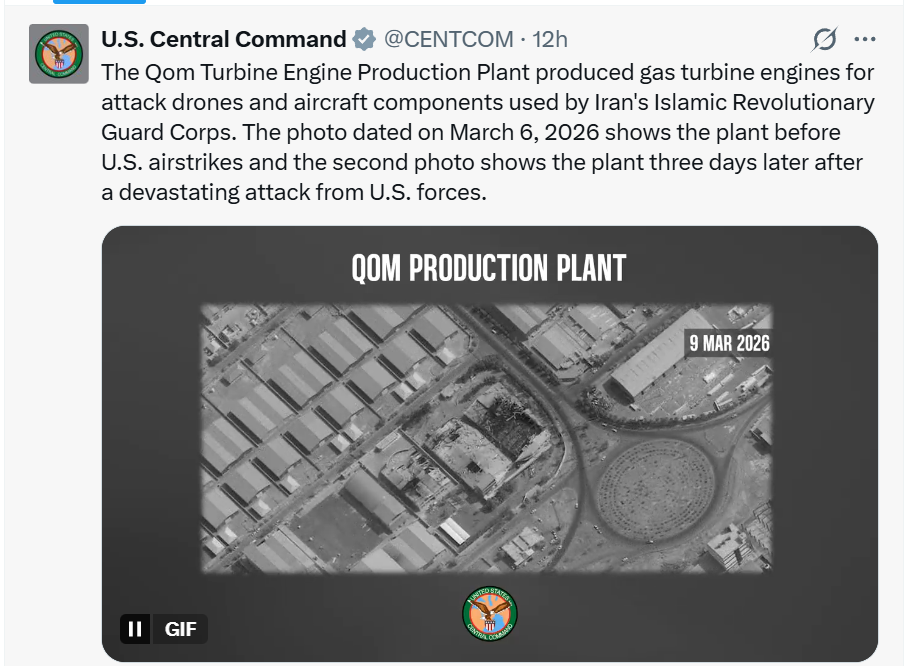
There is no way to learn about any U.S. military successes from reading our media (see We are being absolutely crushed by Iran (NYT)). The U.S. military itself doesn’t seem to have a lot of recent success to report. Here’s a tweet from last night that describes an attack from earlier in March:
If we are currently doing some damage to the Islamic Republic’s military capabilities shouldn’t CENTCOM be able to report more recent strikes?
Readers: What can we make of the above other than “U.S. surrenders”? And if we are forced to surrender, what is the point of paying $1 trillion/year for our military?
I’ve been trying to help our HOA (right there you can stop reading if you want to know the definition of a thankless effort) deal with our bulk cable TV contract and establish a bulk fiber Internet contract. I hit Consumer Reports for their survey of providers. For pure cable TV, here’s something remarkable: all of the companies are rated 1/5 for “value”. If we can all agree, which we apparently do, that cable/satellite TV is a terrible value, why do roughly 70 million of us subscribe?
(Bulk is much cheaper than retail, incidentally. We pay about $55/house per month for a decent slate of channels, 20 hours of DVR, up to three cable boxes per household, and Xfinity’s famously awesome customer service (rated 1/5).)
me: if I’m using AOL dialup aren’t I on a “hybrid fiber” network? The computer that answers my 56K modem’s phone call is connected via fiber, right?
Readers: Anyone have experience with TV from FiberNow, Blue Stream, or Hotwire?
Note that the 1/5 value rating for cable TV isn’t because they surveyed 73,000 sourpusses. The same people rated their Internet providers at 4/5 or 5/5 for “value”:
How did Elon’s company do?
I’m not sure why Starlink was perceived to be mediocre in value. The only people who would buy it are those who can’t get fiber or good cable modem service, right? The alternative is LTE or smoke signals?