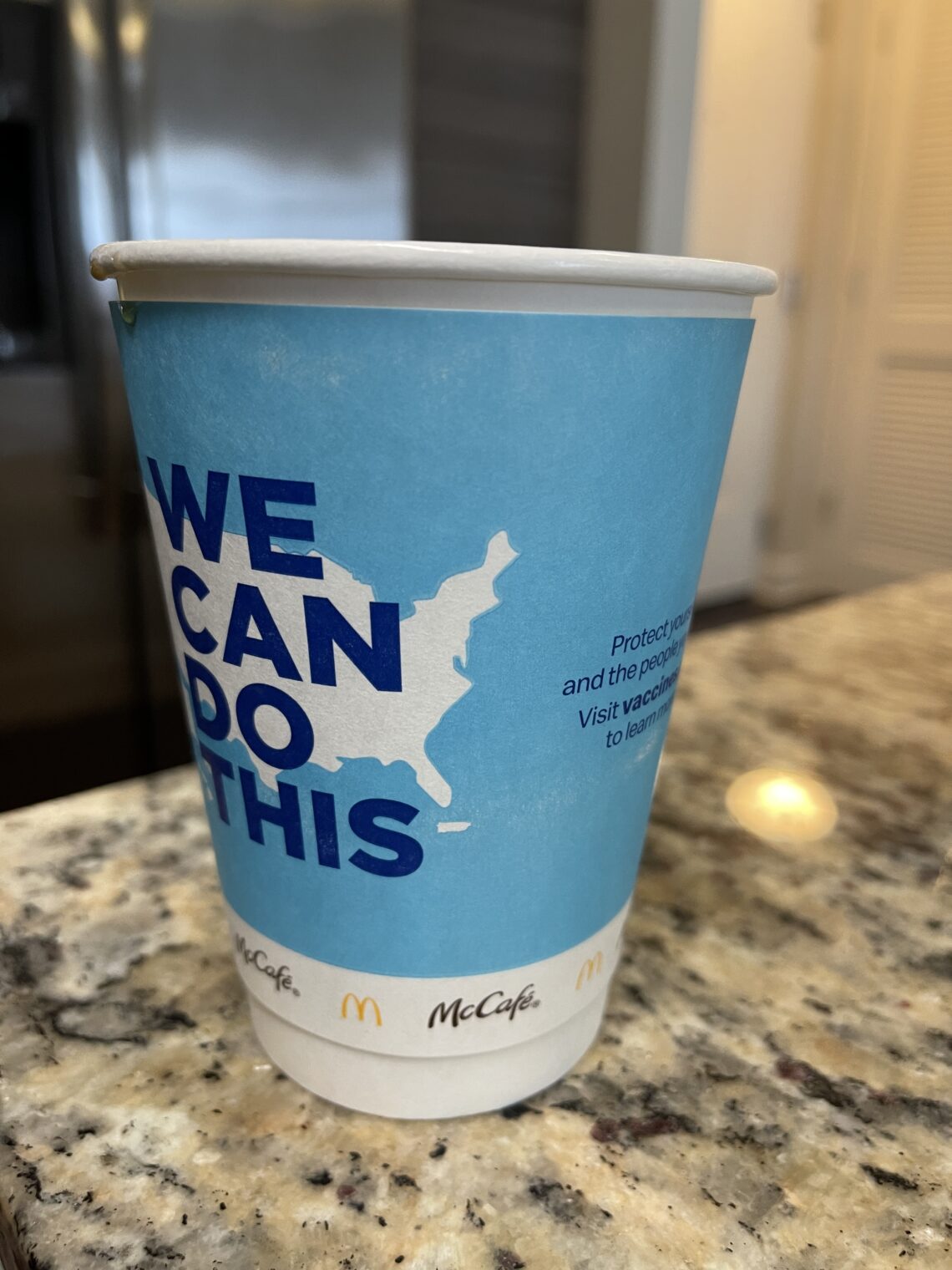
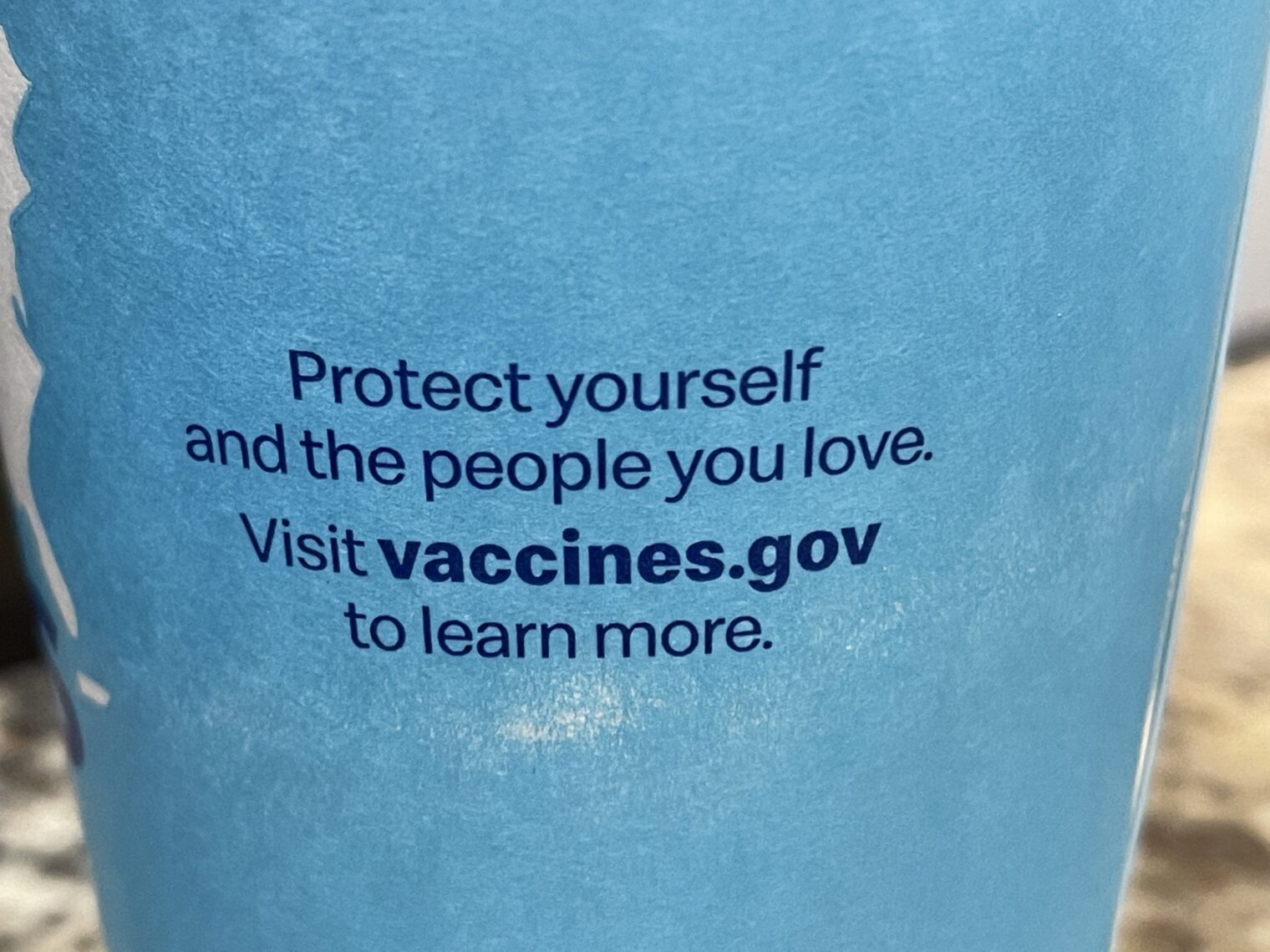
A coffee cup from a McDonald’s in Jupiter, Florida (August 15):
(Since I am vaccinated and therefore don’t have to worry about COVID-19 attacking me via obesity, I enjoyed this coffee with an apple fritter and two cinnamon rolls. #TrustScience )
On arrival in Florida, which coincided with a (presumably typical going forward) summer COVID-19 case peak, I noticed that the wearing of face masks was actually more common than in Maskachusetts. This surprised me a little, given that MA has been the land of ordering people to wear masks and FL has been notable for its lack of mask orders. But, of course, given the hysterical media stories about Florida as the worst-afflicted state in the nation (except for all of the other states where the death rate has been much higher (and the COVID Olympics score would be even more in FL’s favor if you adjusted for percentage of population over 65)), it is natural that the more fearful residents and visitors would wish to protect themselves from a raging plague.
What was interesting was how the fearful had chosen to protect themselves. Instead of wearing N95 and P100 masks, as you might expect for people concerned about an aerosol virus, they were wearing simple cloth and paper masks, about as effective as a chain link fence against sand. I wonder if this is partly due to the media and government telling us that bandanas, paper surgical masks, and stylish cloth masks are “protective”. (I am aware that the theory is that if 100 percent of people wear such masks that transmission will be reduced (such that everyone gets COVID a few weeks later than otherwise? What is the point if R0 is not reduced below 1?), but this is seldom explained clearly. Certainly no public health official says, in public, “it is pointless for you to wear a mask if nobody else is.” (though sometimes they say that in private; see “Fauci Said Masks ‘Not Really Effective in Keeping Out Virus,’ Email Reveals” (Newsweek))
For the purposes of this discussion, let’s assume that, unlike most new pharma (see Book review: Bad Pharma), Regeneron is actually helpful to humans trying to fight off coronavirus.
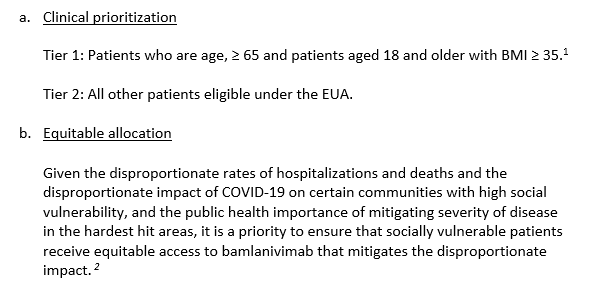
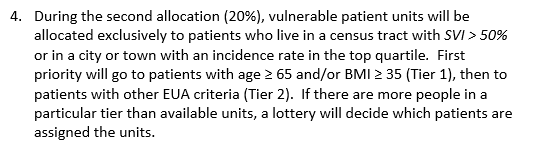
The technocrats in Massachusetts, on the other hand, reserve Regeneron for those with a BMI over 35 (“way fat”) and those who are collecting welfare. From the guidelines (from last November, but they haven’t been updated and hospital web pages repeat the same info):
We are informed that COVID-19 is coming for most of us. Maybe Massachusetts is trying to ensue that all future non-immigrant Americans are descended from the obese and those on welfare?
(How is “social vulnerability” defined? Being on welfare is a plus, but the CDC page on the subject says that “race/ethnicity” are also factored in. So, depending on your neighborhood’s prevailing skin color, you could be left to die and tossed on the body heap at the back of the hospital or saved via this miracle drug. (If you want to be treated equally with other state residents, you need to move to Florida!))
Separately, if we are masking kindergarteners and keeping them pinned to desks 6′ apart in school (rather than letting them socialize/play) because it might save just one life, wouldn’t it make sense to go get Regeneron treatment every week? You never know if you’ve been infected with coronavirus or not (friends who’ve had COVID-19 often did not test PCR-positive until they were nearly fully recovered, so daily PCR testing wouldn’t be sufficient). #AbundanceOfCaution
Eighteen Orthodox Jewish girls were barred from boarding a Delta flight from Amsterdam to New York on Thursday because of a dispute on a KLM flight about COVID-19 protocols, according to reports.
The passengers breached the protocols by taking their masks off to eat their own food outside of the designated mealtimes, The Jerusalem Post reported.
Despite my general adherence to the Swedish level of coronapanic, if I could take over as dictator of the U.S. and issue executive orders, my first order to would to make it illegal for airlines to sell the middle seat, except to families traveling together.
We started the war in Afghanistan in 2001. The country’s total population then was 21.6 million (Google). The estimated 2021 population is 40 million (source). If roughly half of Afghans don’t like the current government, i.e., a similar level of political division to what we have here in the U.S., that means the potential number of refugees seeking to leave could be more than than the total number of people in Afghanistan when we invaded.
If only 20 million want to leave for political reasons, how can the refugee pool expand to 21.6 million? Let’s assume at least a small percentage of people will seek to leave for economic reasons, on top of those who don’t support the Taliban; among nations, Afghanistan is ranked #213 out of 228 in income per person (CIA). Afghans are only 1/4 as successful economically as Guatemalans, for example, whom we are told are “fleeing” poverty when they show up at our open-to-anyone-claiming-abuse southern border. (Once in the U.S., Afghans are the least likely to work of any immigrant group. See “Challenges to the economic integration of Afghan refugees in the U.S.”:
Among adults ages 18–64, Afghans have the lowest rate of employment (59%) among the comparison groups. This is due primarily to the very low rate of employment of Afghan women (46%). The latter is low regardless of how long they have been in the U.S., but it is particularly low among recent arrivals (23% among those in the U.S. for 0–5 years) and those with the lowest and highest levels of education. Further, when controlling for education, Afghan men with a college degree or higher have the lowest levels of employment.
The righteous academics who wrote the above explain why Afghan-Americans don’t work: “we hypothesise that anti-Muslim discrimination is an important unmeasured explanatory factor” (citing white Americans’ support for Donald Trump). Maybe if an Afghan wore a rainbow flag burqa, he/she/ze/they could get a job in San Francisco, despite the postulated anti-Muslim discrimination?)
Is it fair to say that the U.S. will have created a second Afghanistan by invading the first? The second Afghanistan will have the same population as 2001 Afghanistan, but it will be a virtual and distributed country of Afghans in the U.S., Europe, etc.
NIAID director Anthony Fauci told CNN on Monday the U.S. could “start getting back to a degree of normality” by next spring [of 2022] if more Americans are vaccinated against COVID-19.
Yes but: “There’s no guarantee, because it’s up to us,” Fauci said in his interview with CNN’s Anderson Cooper, noting that another variant could emerge unless the current surge is brought under control.
Fauci told Cooper that the U.S. should get “some good control in the spring of 2022” if “we can get through this winter and get really the overwhelming majority of the 90 million people who have not been vaccinated.”
Separately, I am curious about the #Science. If we host a raging a coronaplague, won’t most of those who are currently unvaccinated get infected and develop a similar immunity to what they would have received via vaccination? And aren’t we told by the media that the U.S. is currently suffering from Third Wave coronaplague? Why does it matter, therefore, if some people remain unvaccinated?
Same question on the variants… we’ve told that vaccinated people are still getting infected and becoming contagious, but are less likely to be hospitalized. If this is true, why would the production of variants be tightly correlated to the percentage of Americans who are vaccinated? (And even if we could get God to shut down domestic production of variants, wouldn’t variant coronavirus arrive in the U.S. from other countries? We don’t have a more or less sealed border like the COVID-free paradise islands of Australia and New Zealand.)
What if you don’t want to wait 7 months to see if Fauci’s fairy tale comes true? Move to Florida! There is plant growth all the time here, whether you want it or not. By the time you get your move organized, the current COVID-19 wave should be over.
And then a 5.25″ floppy! (“Mini” because it isn’t 8″ in diameter)
Two baby carriages (our youngest is almost 6)
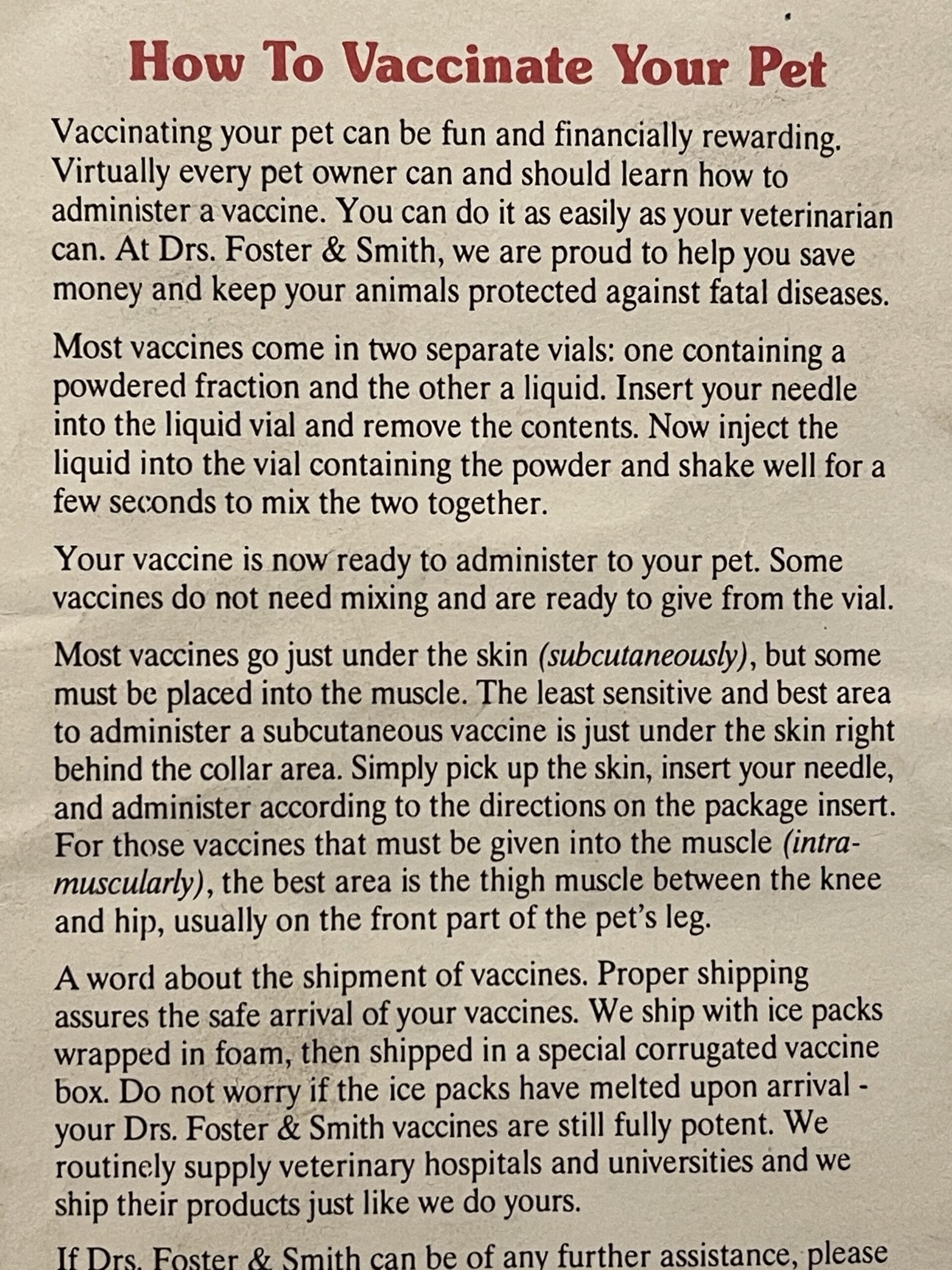
Inch-thick folder of vet documents for Alex the Samoyed, who died in 2009, including instructions on how to inject a dog or cat with an intramuscular vaccine (but we’re told to worship the health care professionals who stick us with COVID-19 vaccines?):
Cleaning the dog’s teeth was $700 back in 2005. Lately the same place has been charging closer to $3,000.
Windows XP “Start Here” booklet. (Plus a bunch of accessories to go with a PC that was running XP. Which reminds me… who can think of a truly important Windows 10 feature that wasn’t also there on XP?)
Chinese pumpkin seeds that expired in 2018 (hiding behind some batteries in a kitchen drawer):
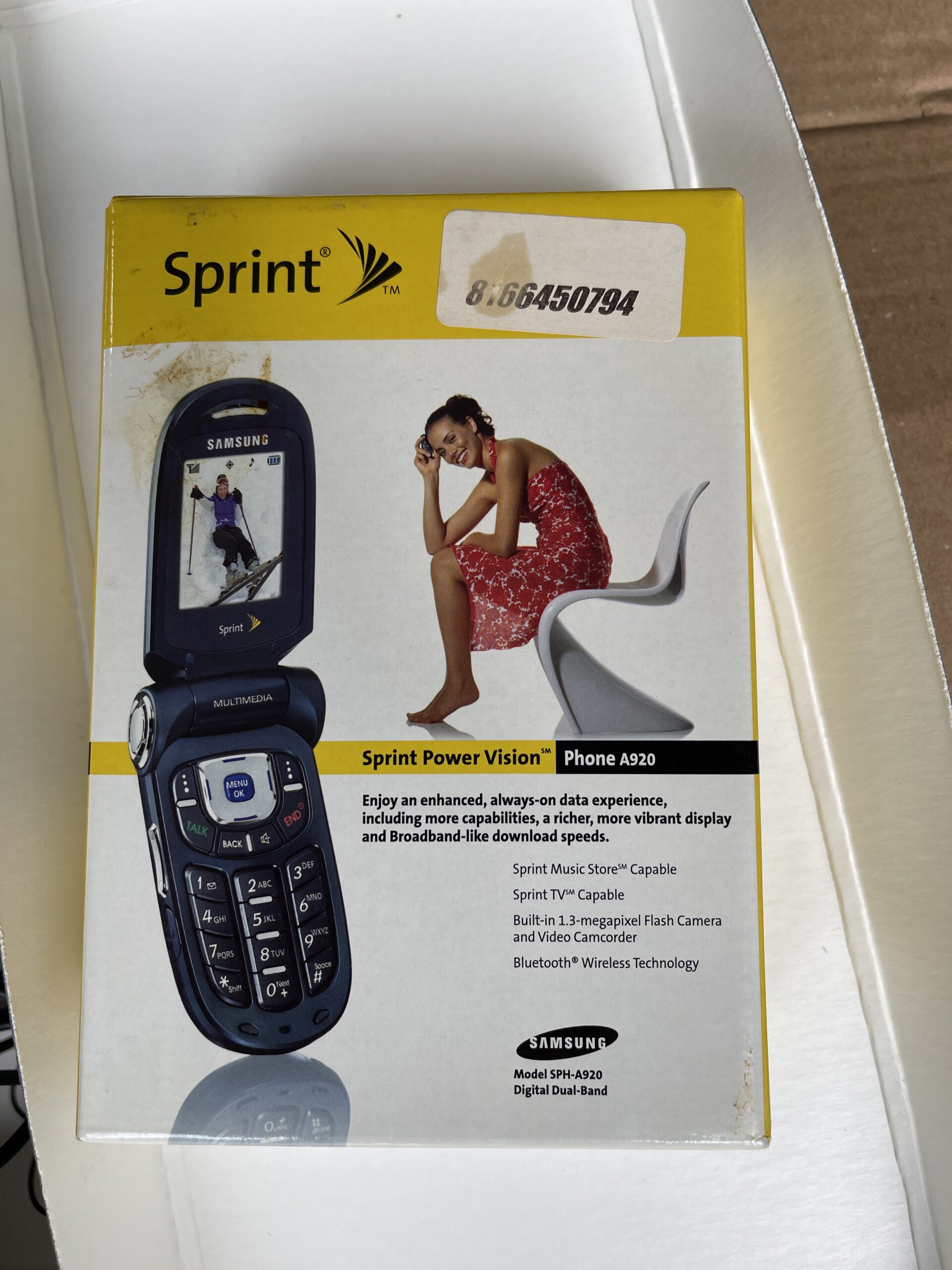
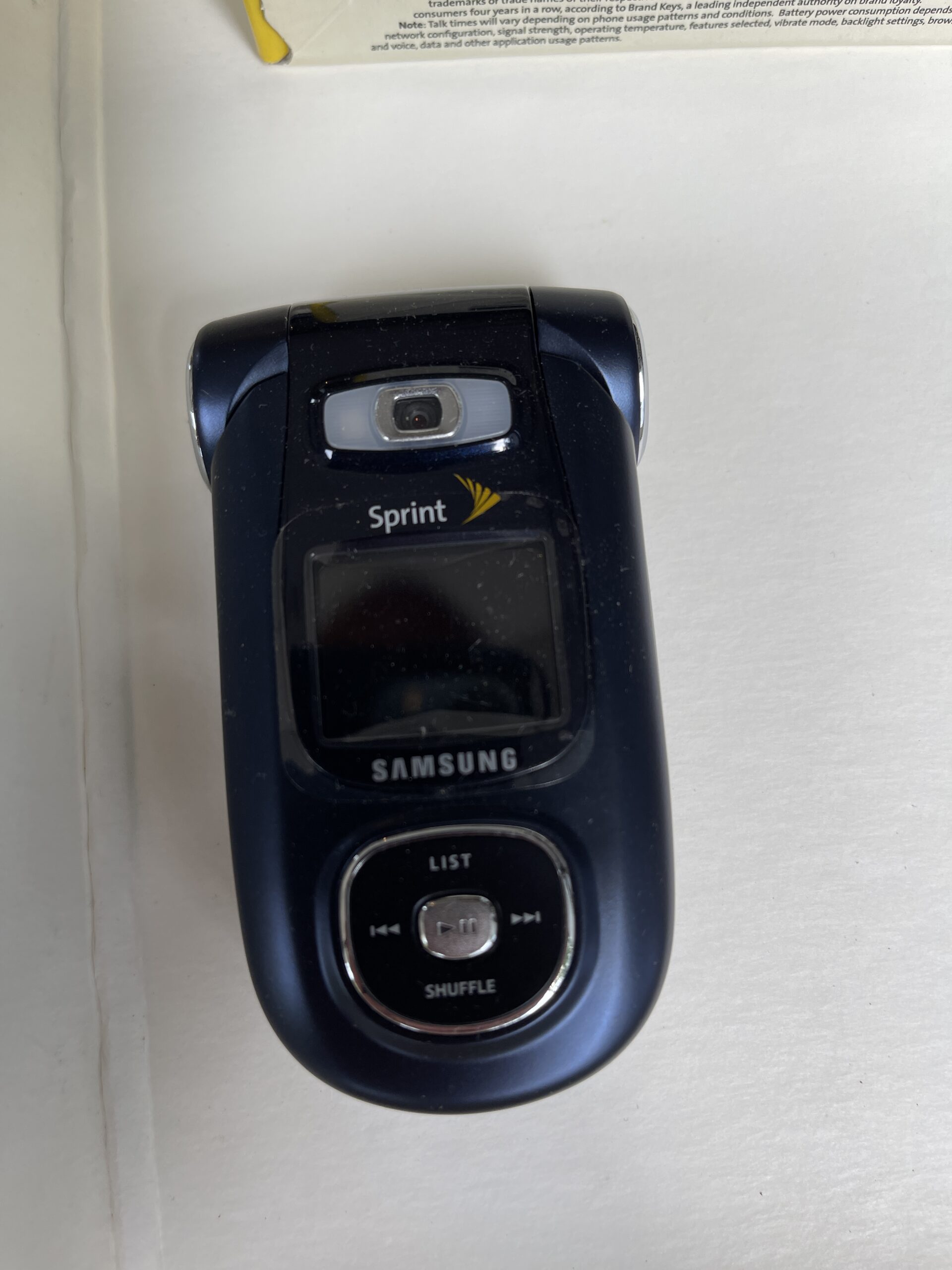
Multiple flip-phones, still a better design in my opinion!
A cleaning system for those valuable CDs:
An amazing Nakamichi clock radio with a long wire so that a second speaker can be placed on the opposing night table. Wake up to NPR and hear some more about January 6!
Deeply buried in a box of clutter that hadn’t been opened since at least 2014:
Printed tables of function values that were too tedious to compute:
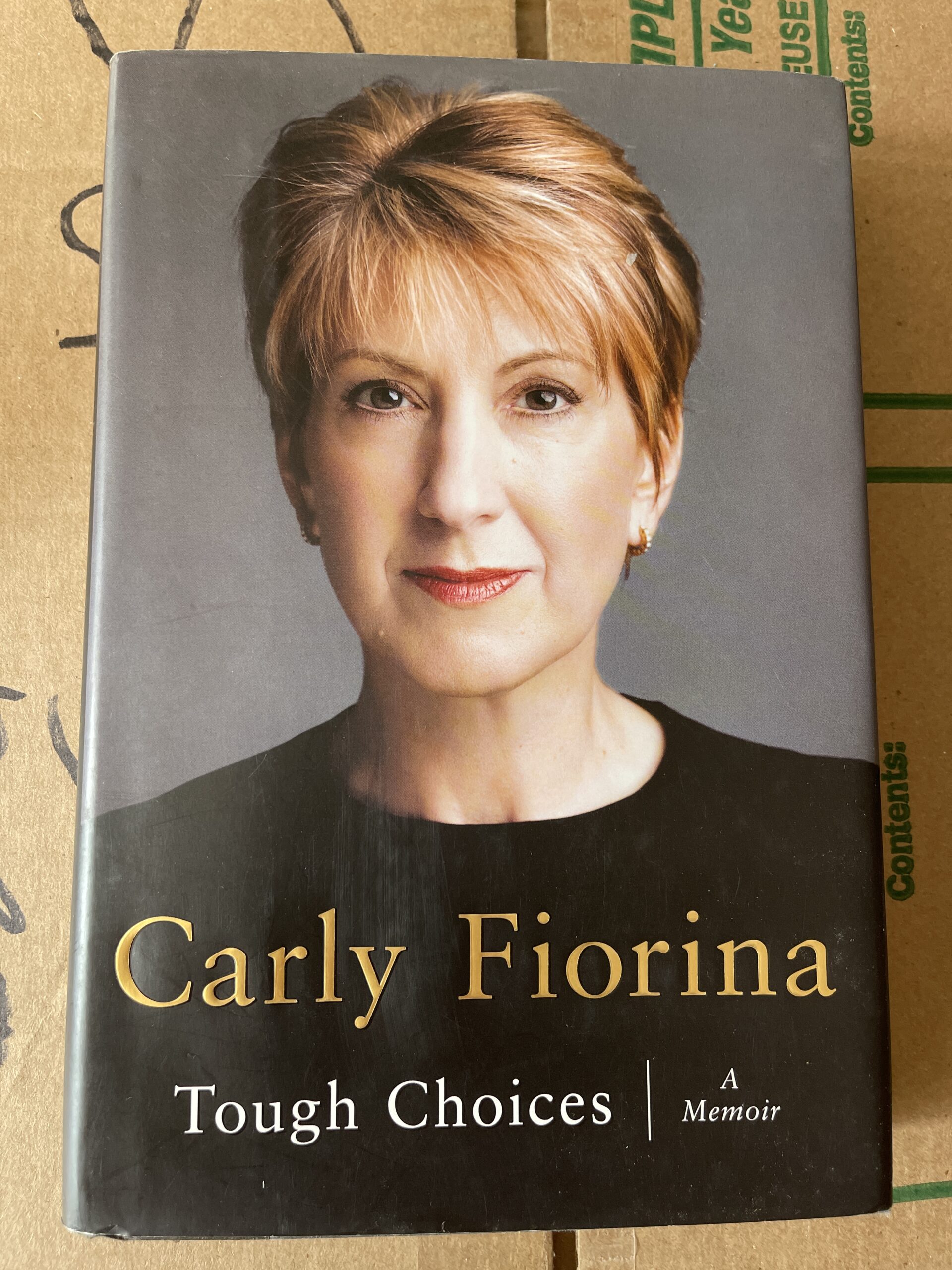
A businessperson-turned-politician that we laughed at (but at age 66, wouldn’t she likely do a better job than Uncle Joe?):
It was not a “tough choice” to discard Tough Choices.
Kodak Carousel projector, improved with a Schneider lens, and accessories.
Decommissioned (I hope!) EPIRBs/PLBs.
“The unexamined life is not worth living” certainly applies to boxes in the garage!
Where could our former leader find like-minded folks who might host him in a sovereign jurisdiction where he could be free from politically-motivated prosecution?
Greece has finished building a 40-kilometer (25-mile) wall along its border with Turkey, amid concerns in parts of Europe that the Taliban’s takeover of Afghanistan could cause an influx of people seeking asylum.
Greek government ministers toured the fence on Friday and said the overthrow of Afghanistan’s government gave greater urgency to their effort to reduce the flow of migrants across its borders.
“The Afghan crisis is creating new facts in the geopolitical sphere and at the same time it is creating possibilities for migrant flows,” Greece’s Citizens’ Protection Minister Michalis Chrisochoidis said in a government statement after touring the completed border wall on Friday. “As a country we cannot remain passive to the possible consequences.”
“It is our decision… to defend and secure our borders,” Chrisochoidis said. “Our borders will remain secure and inviolable. We will not allow uncontrolled and erratic movements and we will not allow any attempt to violate them.”
This raises the question… where in Greece would The Donald most likely live if he did request and receive asylum there? My vote is Meteora, in the old monastery at the top. To get to their prey, Cyrus R. Vance Jr. and fellow Democrats would have to scale the cliff as James Bond did.
“Afghan Refugees Find a Firm and Unfriendly Border in Turkey” (NYT, 8/23/2021): In recent months, as the NATO-led mission in Afghanistan was collapsing, 30,000 Afghans were leaving Afghanistan every week, not all but many across the Iranian border, according to the International Organization for Migration. They have moved to the top of the list of asylum seekers trying to make their way to Turkey, and then to Europe, supplanting Syrians as the largest group of new migrants arriving, …
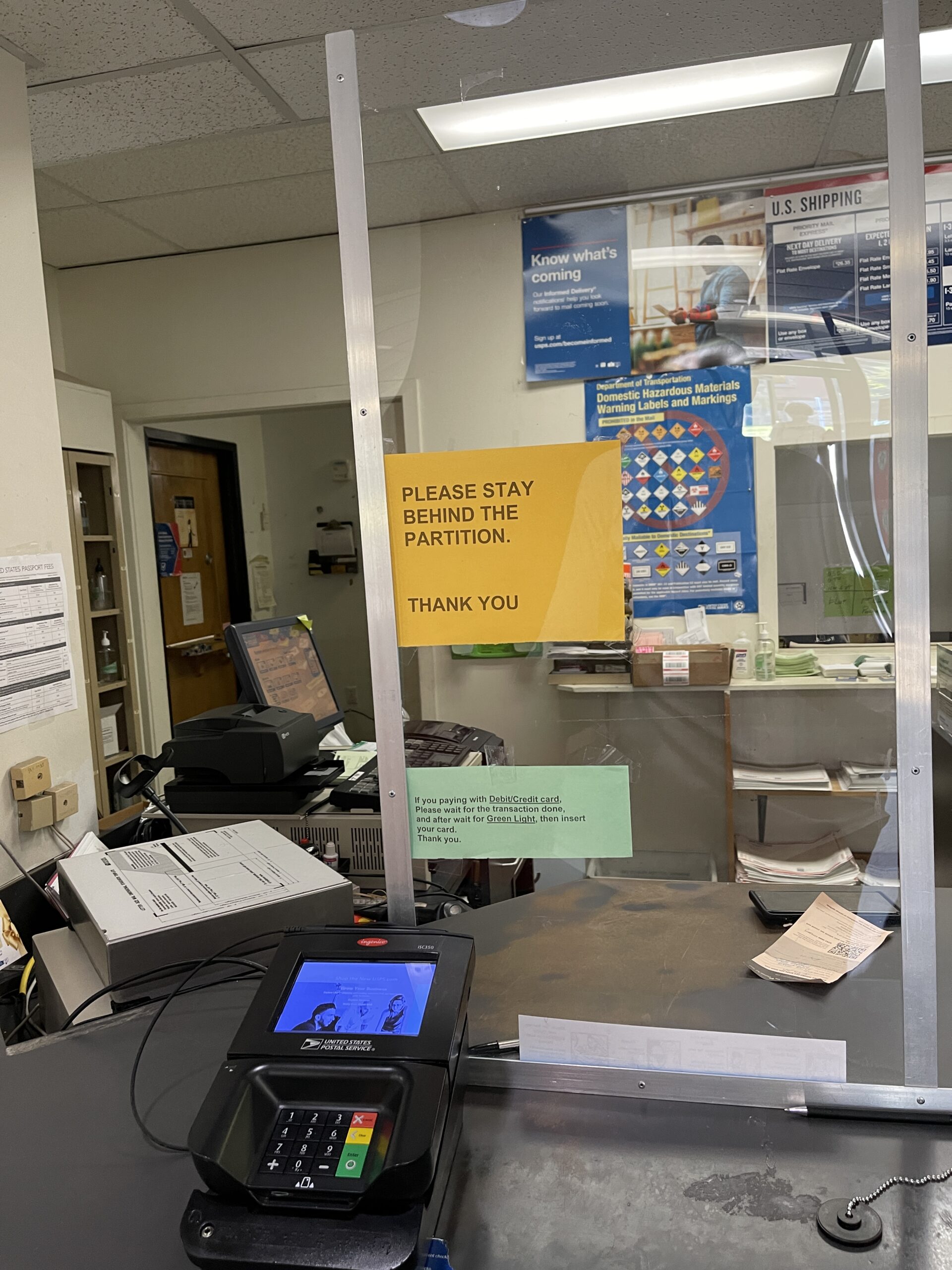
Covid precautions have turned many parts of our world into a giant salad bar, with plastic barriers separating sales clerks from shoppers, dividing customers at nail salons and shielding students from their classmates.
Intuition tells us a plastic shield would be protective against germs. But scientists who study aerosols, air flow and ventilation say that much of the time, the barriers don’t help and probably give people a false sense of security. And sometimes the barriers can make things worse.
Research suggests that in some instances, a barrier protecting a clerk behind a checkout counter may redirect the germs to another worker or customer. Rows of clear plastic shields, like those you might find in a nail salon or classroom, can also impede normal air flow and ventilation.
(Note the “false sense of security”, which is why the Swedish MD/PhDs didn’t want to order residents to wear bandanas and paper/cloth masks. Masked humans would be more comfortable crowding together and the vulnerable would feel comfortable entering indoor public environments that, in fact, could not be made safe with these primitive tools.)
At the end of May, the Centers for Disease Control and Prevention published a notable, yet mostly ignored, large-scale study of COVID transmission in American schools. A few major news outlets covered its release by briefly reiterating the study’s summary: that masking then-unvaccinated teachers and improving ventilation with more fresh air were associated with a lower incidence of the virus in schools. Those are common-sense measures, and the fact that they seem to work is reassuring but not surprising. Other findings of equal importance in the study, however, were absent from the summary and not widely reported. These findings cast doubt on the impact of many of the most common mitigation measures in American schools. Distancing, hybrid models, classroom barriers, HEPA filters, and, most notably, requiring student masking were each found to not have a statistically significant benefit. In other words, these measures could not be said to be effective.
#Science did not evaluate my downdraft paint booth idea, sadly. From the Watertown, Maskchusetts central post office, August 27, 2021:
Related:
“The 60-Year-Old Scientific Screwup That Helped Covid Kill” (WIRED, 5/13/2021): “The distinction between droplet and airborne transmission has enormous consequences. To combat droplets, a leading precaution is to wash hands frequently with soap and water. To fight infectious aerosols, the air itself is the enemy. In hospitals, that means expensive isolation wards and N95 masks for all medical staff. … An indoor-air researcher at the University of Hong Kong, Li had made a name for himself during the first SARS outbreak, in 2003. His investigation of an outbreak at the Amoy Gardens apartment complex provided the strongest evidence that a coronavirus could be airborne. But in the intervening decades, he’d also struggled to convince the public health community that their risk calculus was off. Eventually, he decided to work out the math. Li’s elegant simulations showed that when a person coughed or sneezed, the heavy droplets were too few and the targets—an open mouth, nostrils, eyes—too small to account for much infection. Li’s team had concluded, therefore, that the public health establishment had it backward and that most colds, flu, and other respiratory illnesses must spread through aerosols instead.”
Someone earning $700,000 over a 6-year period seeks alimony from a spinal surgeon spouse earning substantially more over the same period ($3 million in one year alone). For purposes of calculating alimony, does the court assume that $700,000 will be earned over the next 6 years by the lower-income spouse? The U.S. Sun raises what is perhaps a novel question. (Thanks to four separate readers who emailed this to me!)
Kim claimed in the documents for years he didn’t know that Turner was working as a high-priced call girl.
The divorce papers, which were filed in Manhattan Supreme Court in July, reportedly allege that Turner earned nearly $700,000 in cash from her clients.
They go on to claim that Turner had clients including a New Jersey-based real estate executive and an award-winning lighting designer, New York Daily News reported.
Dr. Kim only first became aware of his wife’s double life in December 2020 when he came across an explicit iMessage intended for Turner, which detailed a sexual encounter between her and another man, the court papers reportedly state.
“Not to belabor the obvious but the defendant clearly committed material fraud upon Dr. Kim by concealing her sale of sexual services in exchange for money prior to the marriage,” Dr. Kim reportedly states in the court documents.
This particular case was settled so we’ll never find out, but it would be interesting to see if a court would allow expert testimony on the question of what the future earnings of a prostitute might be.