Two out of three children did not meet the standards for reading proficiency set by the National Assessment of Educational Progress, a test administered by the National Center for Education Statistics, the research arm of the Education Department.
The dismal results reflected the performance of about 600,000 students in reading and math, whose scores made up what is called the “nation’s report card.” The average eighth-grade reading score declined in more than half of the states compared with 2017, the last time the test was given. The average score in fourth-grade reading declined in 17 states. Math scores remained relatively flat in most states.
I was praying that this was statistical noise and we would find the the scores went up in half the states. But “Washington, D.C., was the only city or state to have significant improvement in eighth-grade reading, according to a federal analysis of the data.”
[Separately, looks as though Harvard will need to continue its program of race discrimination for at least another 4 years:
White, black, Hispanic, Native American and multiracial students all lost ground in eighth-grade reading, while there was no significant change for Asian students.
(Note how people with heritage from India, Burma, Indonesia, Philippines, Cambodia, Laos, Thailand, Vietnam, China, Korea, and Japan are lumped together by the Diversity VirtueCorps as “Asians”.)]
Schools are consuming more taxpayer cash than ever. To what can we attribute the decline in performance? Some theories..
Maybe there is no decline in school performance, but the student population has changed as the academically successful have fewer children and the academically unsuccessful have a high fertility rate. Eventually most Americans will be descended from people who did not do well in school and who did not work or worked at jobs that did not require reading. If the parents did not like to read, why would the kids?
iPads, videogames, and smartphones are to blame. As in Being There, students liked to watch TV, but they love to play with tablets, smartphones, and Xbox.
The assigned books are less interesting. Our local K-8 school, soon to be in its $250,000/student new building, has adopted a reading list that concentrates on victimhood. Students are supposed to learn about the struggles of immigrants, people of color, women, etc. Maybe K-8 Americans just don’t care about these particular victims in the way that their adult teachers thought they would.
Readers: What do you think could account for this slide?
Dr. Tina (a real doctor of aeronautical engineering) and I are teaching an FAA ground school at MIT in January once again. The course is free and open to anyone, though only MIT students get credit.
What could be scarier than (a) coming to Boston in mid-January, (b) suffering through one of my lectures?
(If you can’t make it, all of the materials can be downloaded from the course web site, which also links to YouTube videos that were captured by MIT Video Productions during the 2019 class.)
In the last two years, the new FAA attitude toward avionics in light aircraft has resulted in what looks to pilots like a revolution (ordinary consumers, though, will say “You mean it couldn’t already do that?”).
Here’s the latest: Garmin Autoland. After the elderly classic GA pilot has a heart attack from reading one Trump tweet too many, the Cirrus Jet will land itself, corrected for any crosswinds, and hit its own brakes:
Well, now, with certification pending for Autoland on the M600 SLS and shortly thereafter on the Cirrus SF50 Vision Jet, the Garmin panel goes to the next step of beginning an automated sequence of events that results in a safe touchdown on a runway, where it rolls the airplane to a stop, shuts down the engine, broadcasts a message on the local frequency that the airport is closed because of a disabled aircraft on the runway, and plays a video on the multifunction display that instructs the passengers how to open the door and get out.
Of course, that is not a requirement because the Autoland system would have already (although not in our demonstration) begun transmitting on the tuned frequency and the emergency frequency of 121.5 MHz a message telling anyone listening that N60HL, in this case, had a possibly incapacitated pilot and that it would be landing at New Century AirCenter in six minutes. It would update and broadcast that message every 30 seconds—listening to make sure that it didn’t transmit over any other radio calls. Once near the Class D airspace of the tower, it would have changed one of the radios to the tower frequency and kept the other on the emergency frequency. The system also would have changed the squawk code to 7700, the emergency code.
During those first few seconds after I hit the Autoland button, the system went through a series of complex calculations and decision-making processes to determine the nearest suitable runway based on runway length, width, and surface; fuel remaining; crosswind component; terrain; obstacles; and general weather information. The system requires an RNAV approach, but beyond that, the runway and weather criteria can be decided by the airframe manufacturer.
Like a chess grandmaster, we certificate holders can now proudly say that we’re able to do what an inexpensive microprocessor can do!
Of course the $2 microprocessor can’t exercise the kind of judgment that an experienced pilot would, right?
The system even forecasts its own weather if the nearest suitable runway is a significant distance away, long enough that the current ADS-B or SiriusXM weather may not be valid. It uses the latest weather trend information, for example, to determine if a thunderstorm might move into the runway environment where it intends to land. It will route the airplane around thunderstorms as well as terrain and obstacles, all of which it gets from its internal databases. If en route to a runway it determines, because of changing weather conditions, that another runway is closer or more suitable, it will change its destination. It can even estimate changing barometric conditions and adjust the altimeter—using algorithms. Garmin engineers say the calculated barometric readings are within 0.01 inches of mercury of actual ambient conditions.
Time for the single pilot plus dog crew! (the dog bites the pilot if he/she/they/ze tries to touch anything)
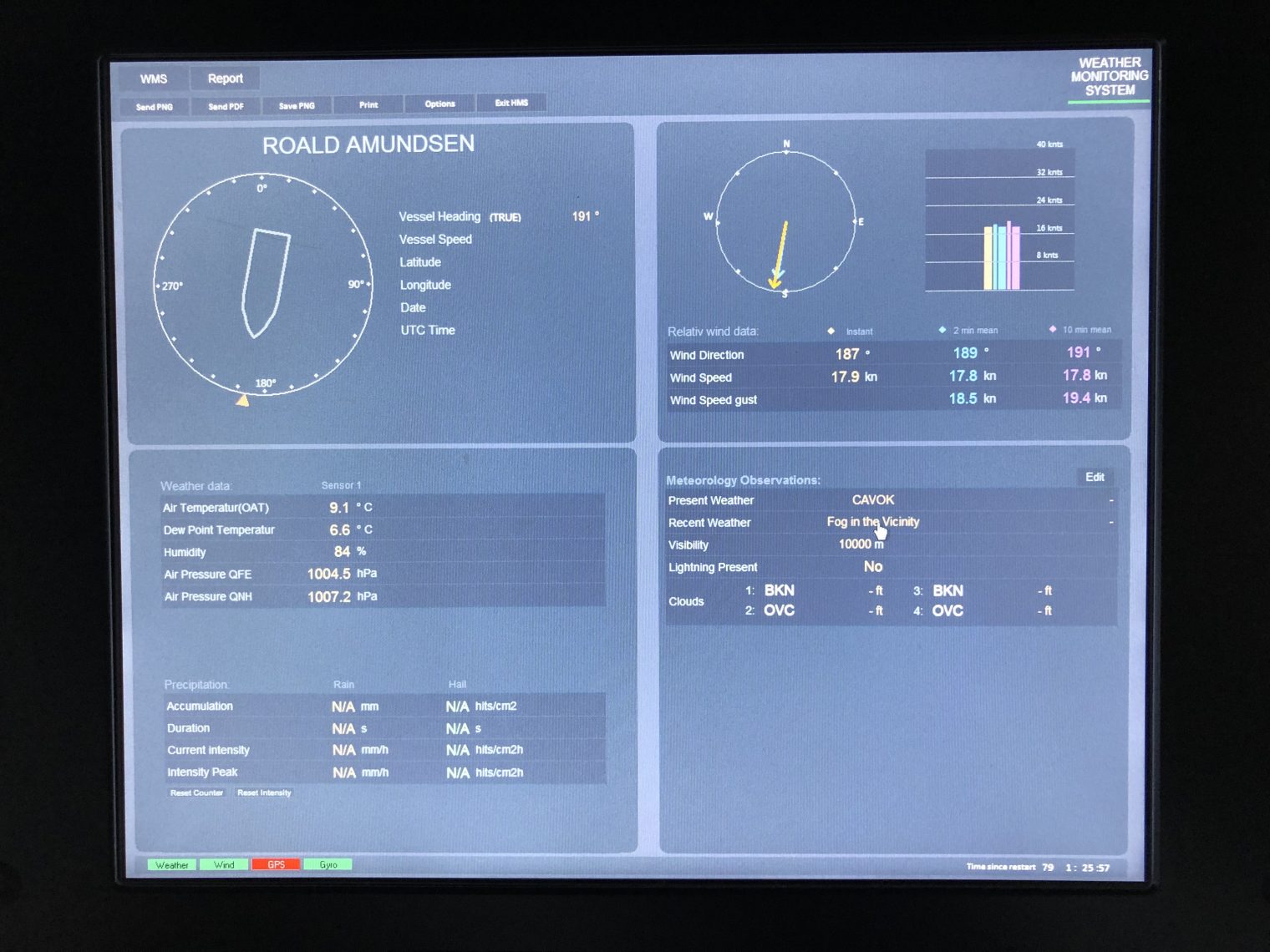
This is a review of the MS Roald Amundsen based on a three-week Northwest Passage cruise in 2019.
photo: Karsten Bidstrup, one of the ship’s staff photographers
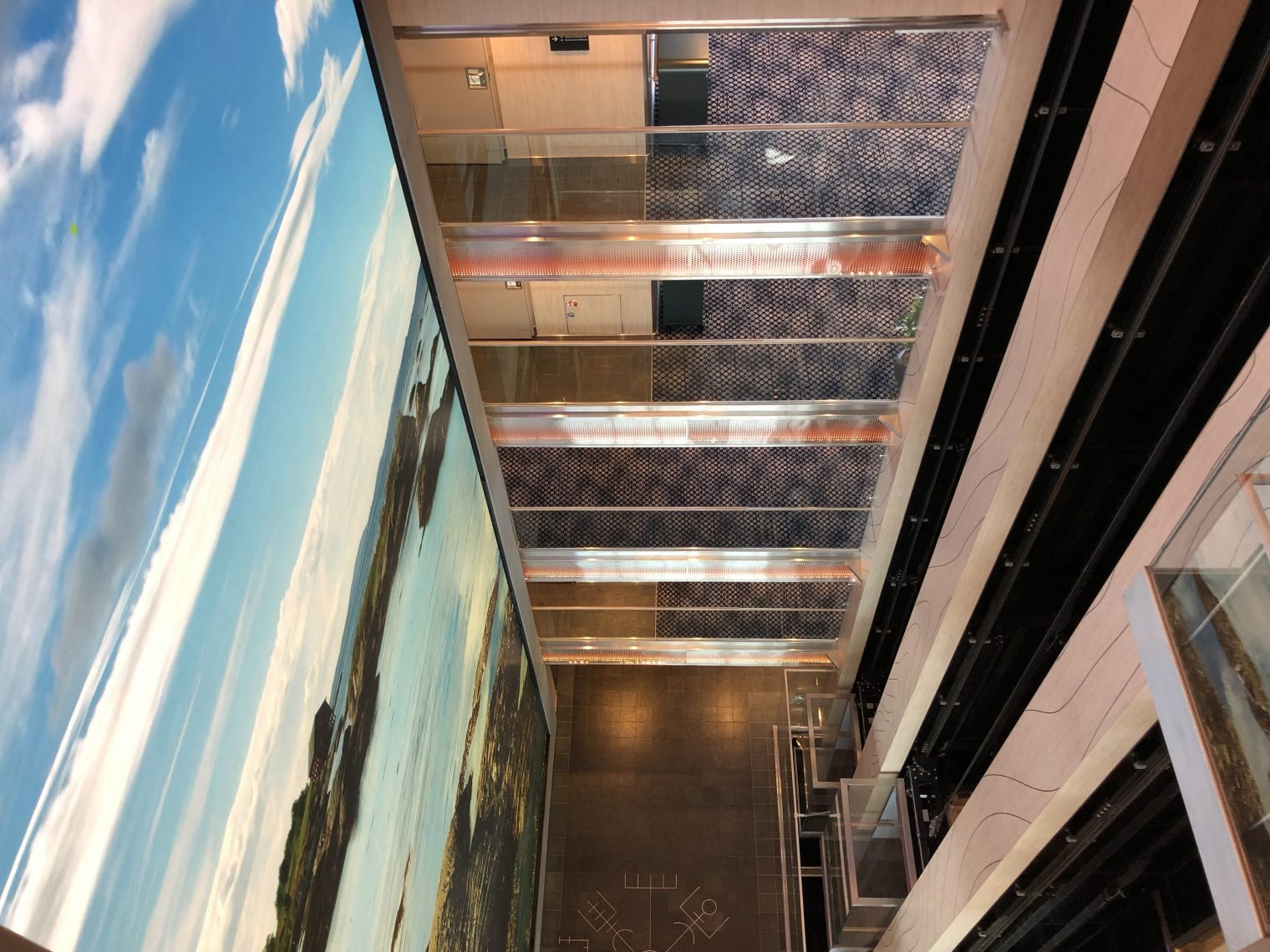
Our cruise was during the ship’s first season, so everything was in beautiful condition. Royal Caribbean, along with a lot of other cruise lines, is firmly in the “brass and glass” McMansion style of decor. The Roald Amundsen, on the other hand, is more like an architect-designed modern house (see Hurtigruten’s site for interiors of the staterooms).
The officers, nearly all of whom are Norwegian, are confidence-inspiring. Hurtigruten (“Express Route”; pronouncing the G is for amateurs) has been running up and down the coast of Norway since 1893. Getting stuck in the ice, running aground, or blundering into weather that cannot be managed does not seem likely. The ship seemed quite stable, but we did not hit any significant wind or waves during our voyage so it is tough to say how it will handle the Drake Passage.
How about the people? Whom will you be with for several weeks in remote corners of the planet? Guests were of the same composition as in an American suburb in which people constantly express their passion for diversity, inclusion, and social justice. I.e., 100% white European and Asian. Out of 472 passengers, just 22 were American. The most common places of origin were Germany (157), UK (136), and Scandinavia (83 plus 2 Finns). [Europeans have some shocking views on current events!] Median age was around 65. A Danish couple brought their 13- and 15-year-old sons.
Weight control will be an issue on the ship. Despite severe challenges of resupply in the Canadian Arctic, the French chef Julien Screve managed to create tempting cuisine far above the Royal Caribbean standard. He was assisted by a pastry chef who made bread comparable to what you’d get in a European neighborhood bakery. Screve and the restaurant manager Nicolas Longin raided a supermarket to get the ingredients for poutine after I said that no trip to Canada could be considered complete without poutine. Real maple syrup is served with breakfast. Unlike on a typical cruise line, there is essentially no food available except during the set meal times.
Department of High Praise: One passenger is a regular speaker on Cunard’s Queen Mary. He said that Julien’s creations in the high Arctic using ingredients sourced in Iceland and Greenland were comparable in quality, if not variety, to what is served on Cunard.
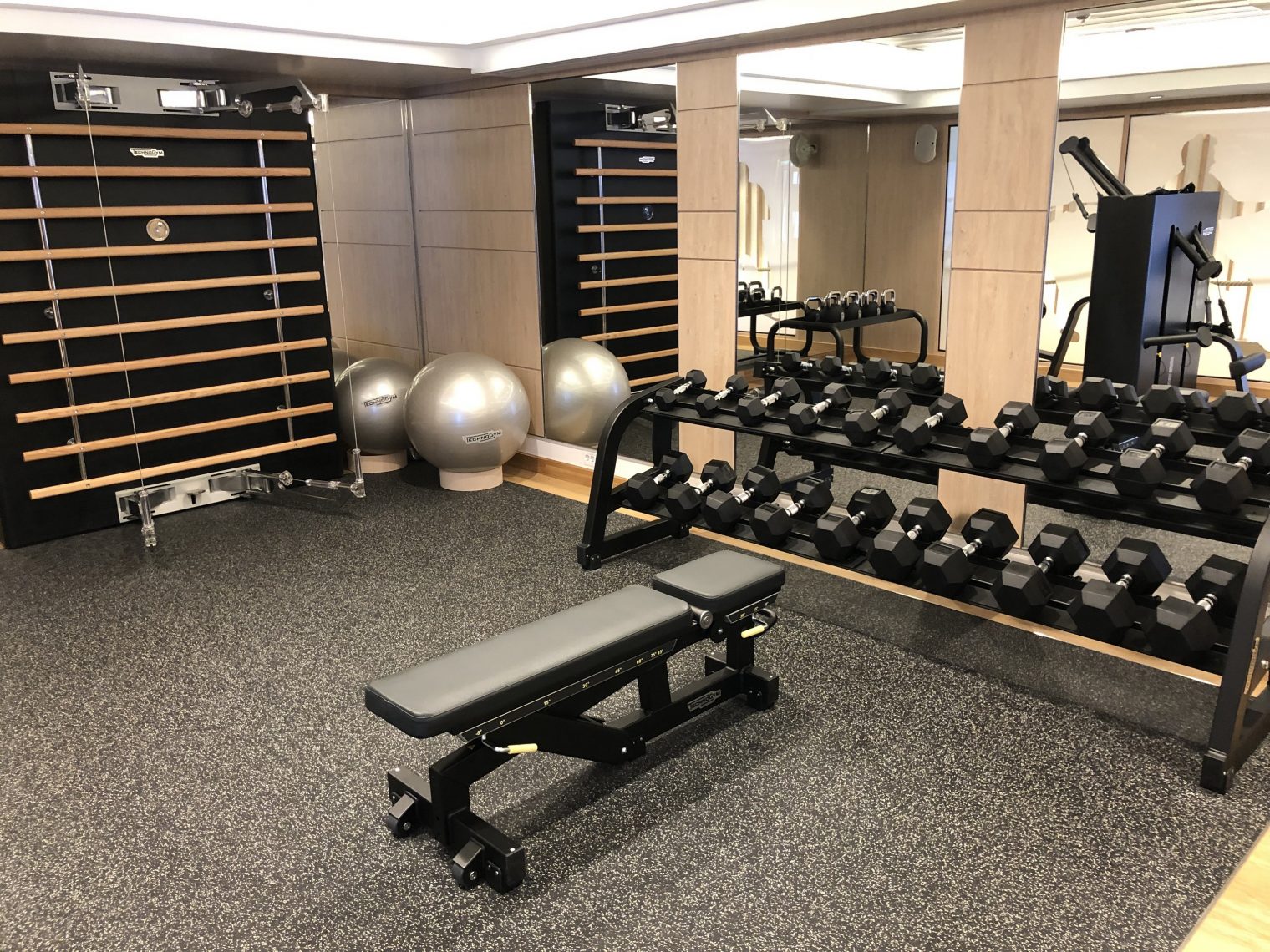
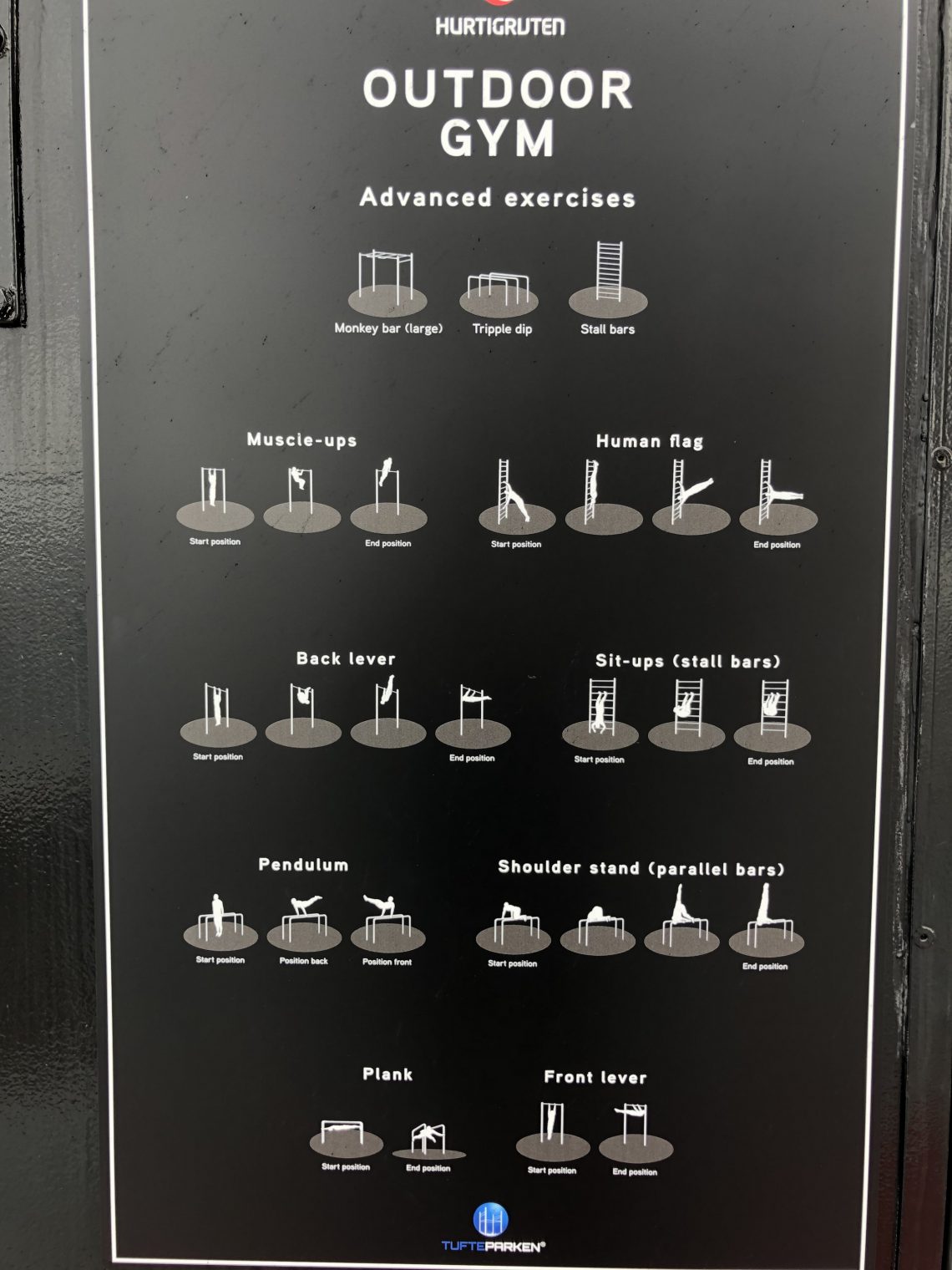
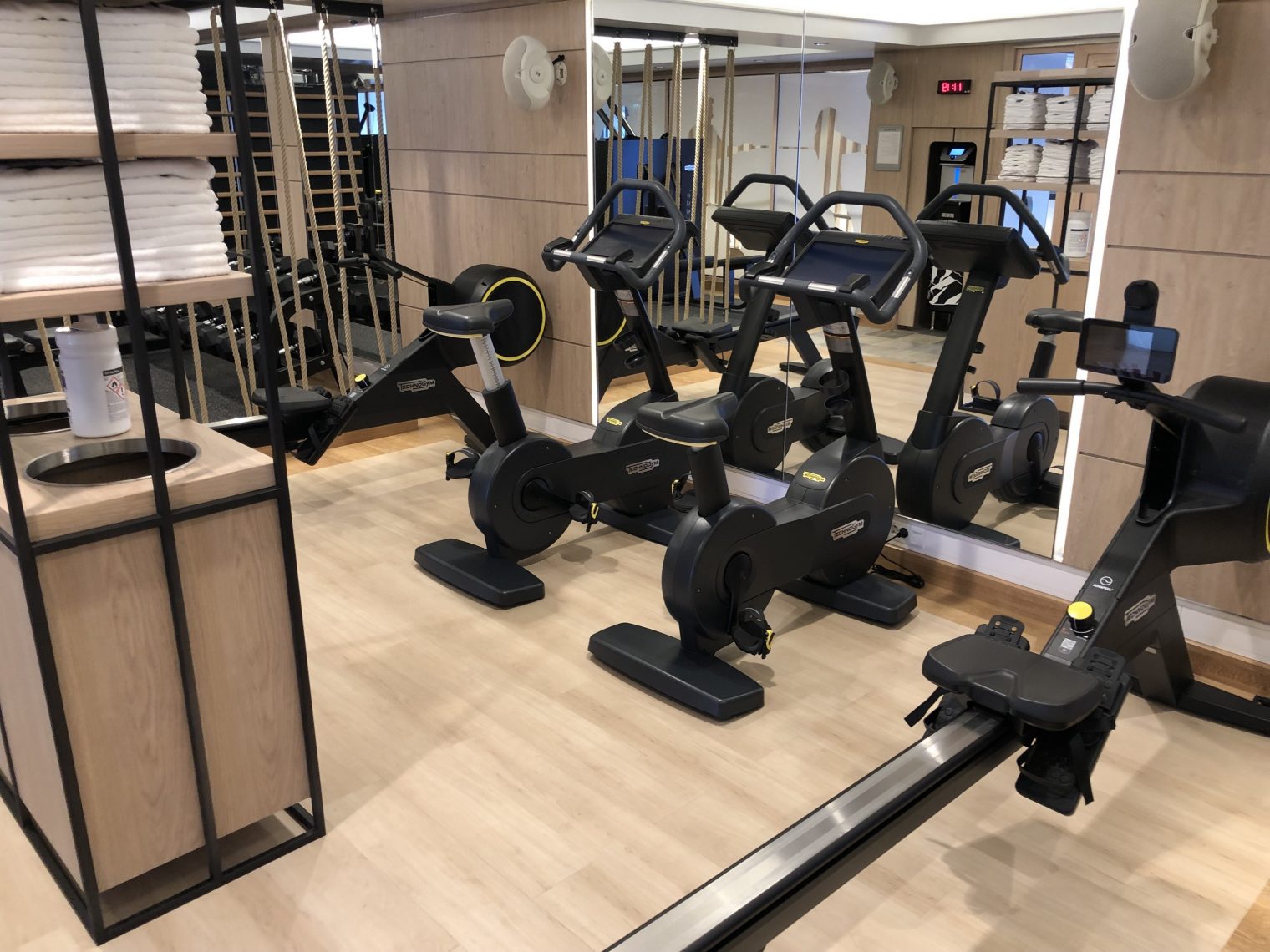
Although the ship is sizable, it is not spacious enough that you can easily burn off calories by walking. The top deck is supposedly where the walking will happen, and it has bars for “outdoor gym” exercises that a fit 22-year-old might be able to accomplish, but the ship tends to go through some pretty cold regions and it is only 460′ long, about half the length of an ordinary cruise ship. The gym is small, windowless, and often a bit crowded (the Royal Caribbean Serenade of the Seas, by contrast, had a huge usually-empty gym with windows all around the bow from the 11th floor).
There is a pool, but it is tiny and does not have an artificial current. There are two outdoor hot tubs, but both are kept at 37C, about 2 degrees cooler than what an American would call “hot”. The sauna, on the other hand, is hotter than what an American health club would set.
How to keep busy when cruising through the high Arctic? Internet was not an option. It worked for about half of the days of our trip and the definition of “work” was 20-50 kbits/second. The only applications that were usable were data-based text messaging services, such as iMessage and WhatsApp. Everything else seems to assume that you have at least 1 Mbit of connectivity and a lot of patience.
The ship carried a lot of lecturers with a rich knowledge of biology, ecology, geology, and anthropology. However, the lack of a nightly Broadway-style show (who wants to hear “New York, New York” again?) means that the ship has no theater. No theater for a nightly Broadway show also means no comfy theater for daytime lectures (on Royal Caribbean, the theater chairs are larger and more comfortable than anything we have in our house).
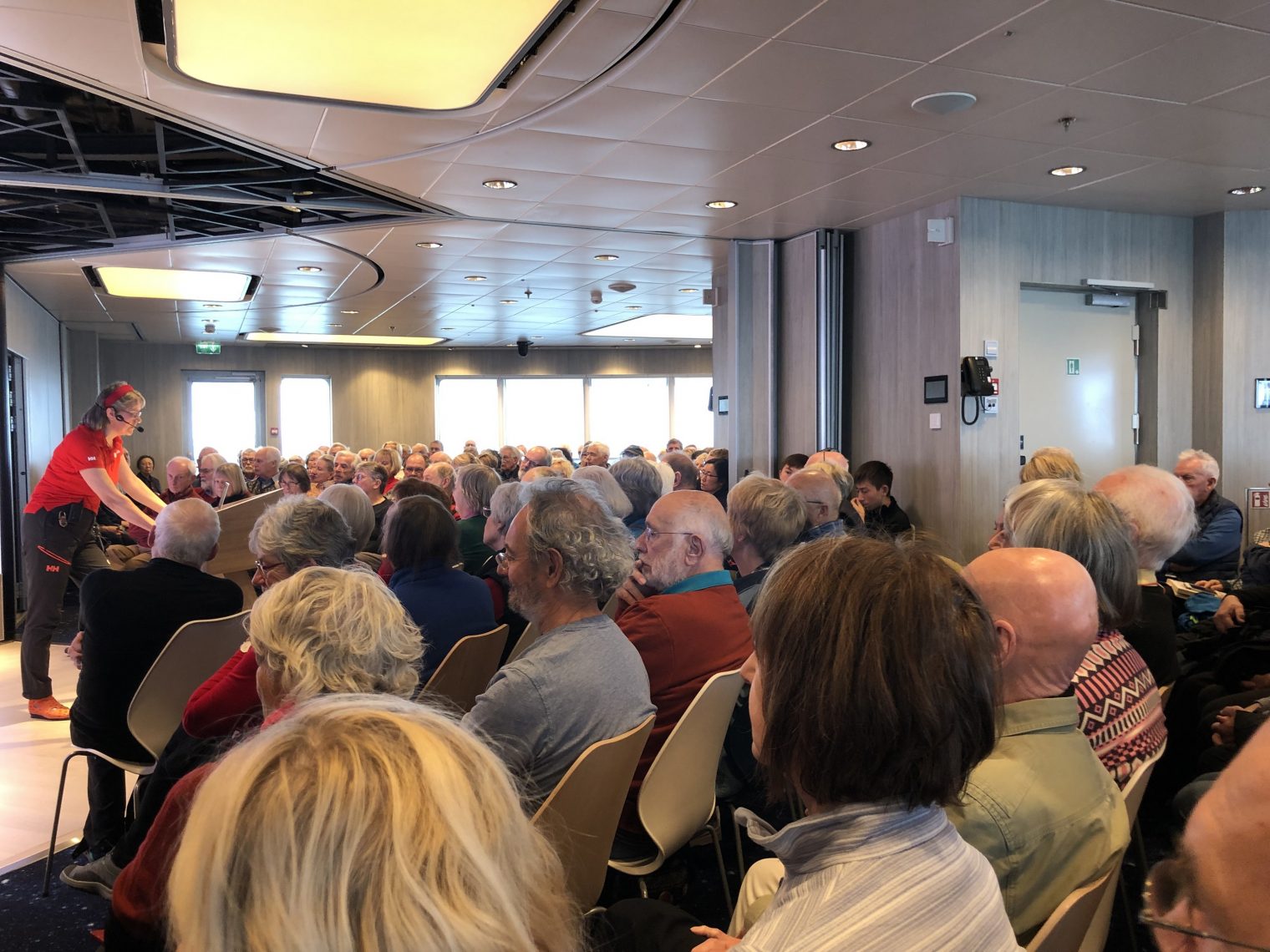
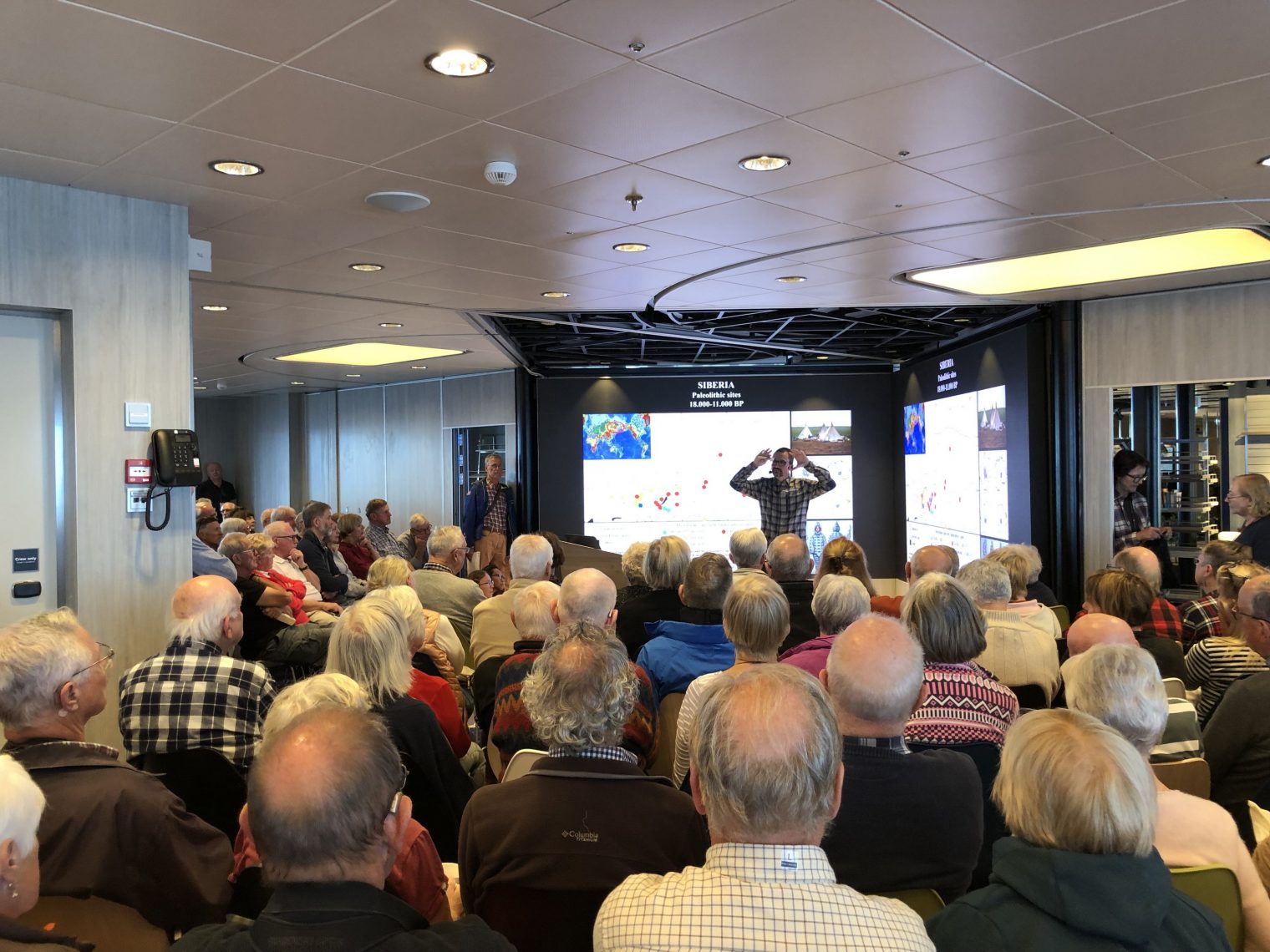
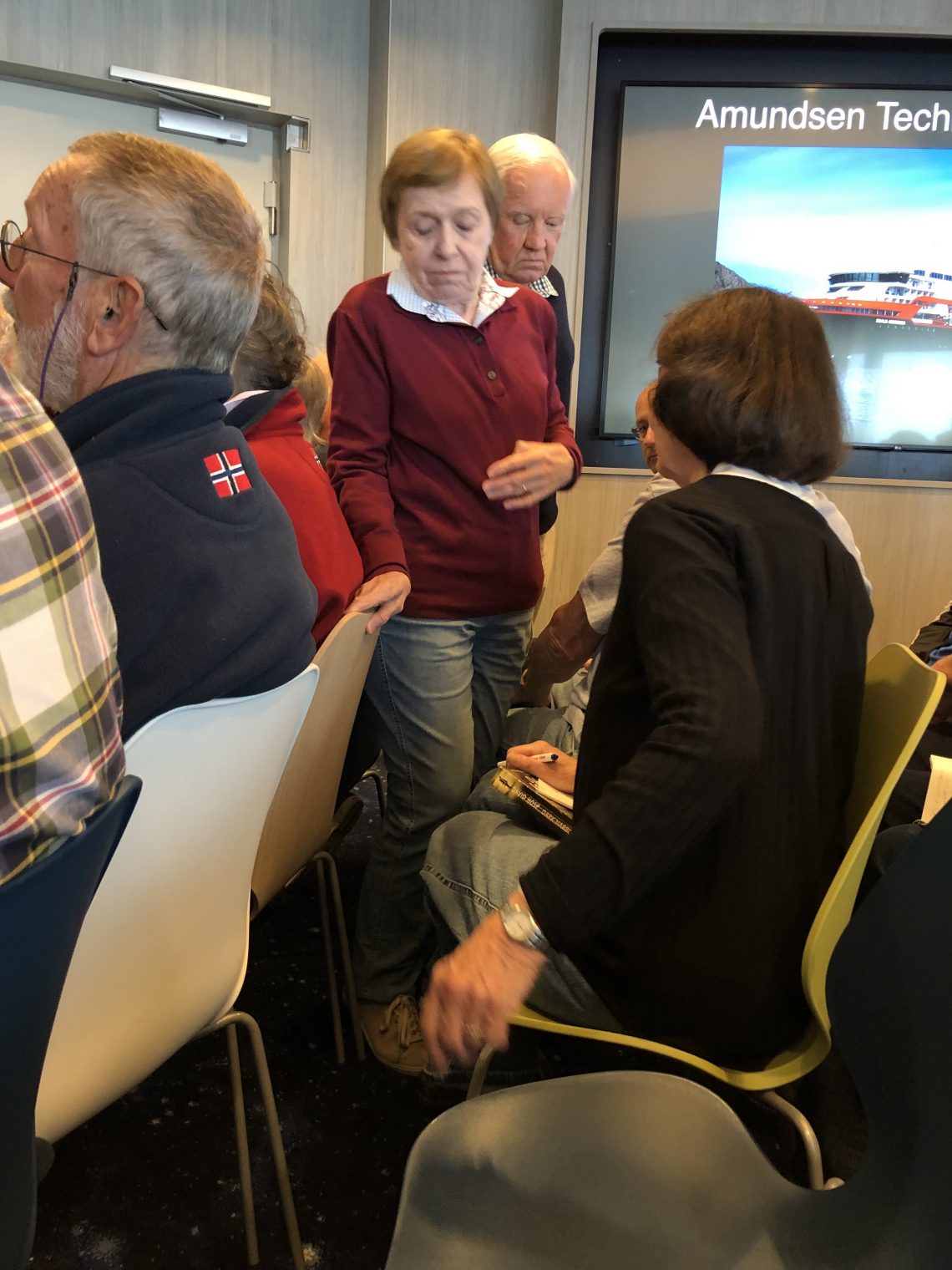
What does the Roald Amundsen have to support lectures? A classroom. It is nowhere near big enough for half the passengers, even with narrow hard chairs sized and spaced for 7th graders. The floor is flat, so anyone shorter than 6’6″ tall is unlikely to be able to see the screen if seated in the third row or beyond (I’m 6′ tall and could see about half the screen, typically). The guests are older and less nimble than typical 7th graders so I kept expecting someone to break a leg while trying to navigate through a row to a seat. I observed several trips and falls.
The crowding in the classroom carries over into other public spaces of the ship. It feels much more crowded than the Royal Caribbean cruises I have been on. Here’s the “Explorer Lounge” up on the top interior deck, with folks waiting for a presentation.
Passengers complained that there was often a line at the buffet and it was sometimes challenging to get coffee.
For a theoretical capacity of 530 passengers, this is a 460′ ship of 21,000 gross tons. The Crystal Endeavor is 541′ long and displaces roughly 20,000 tons… for 200 guests, but at double the nightly price. Don’t expect solitude unless you’re in your cabin!
The crew is efficient at getting people in and out of Zodiacs for landings. Nonetheless, with 500ish people on board, it takes a minimum of 3-4 hours to get everyone off the ship and back on. The time that each person can spend at a destination will be shorter than if the destination were visited in an 80-passenger ship.
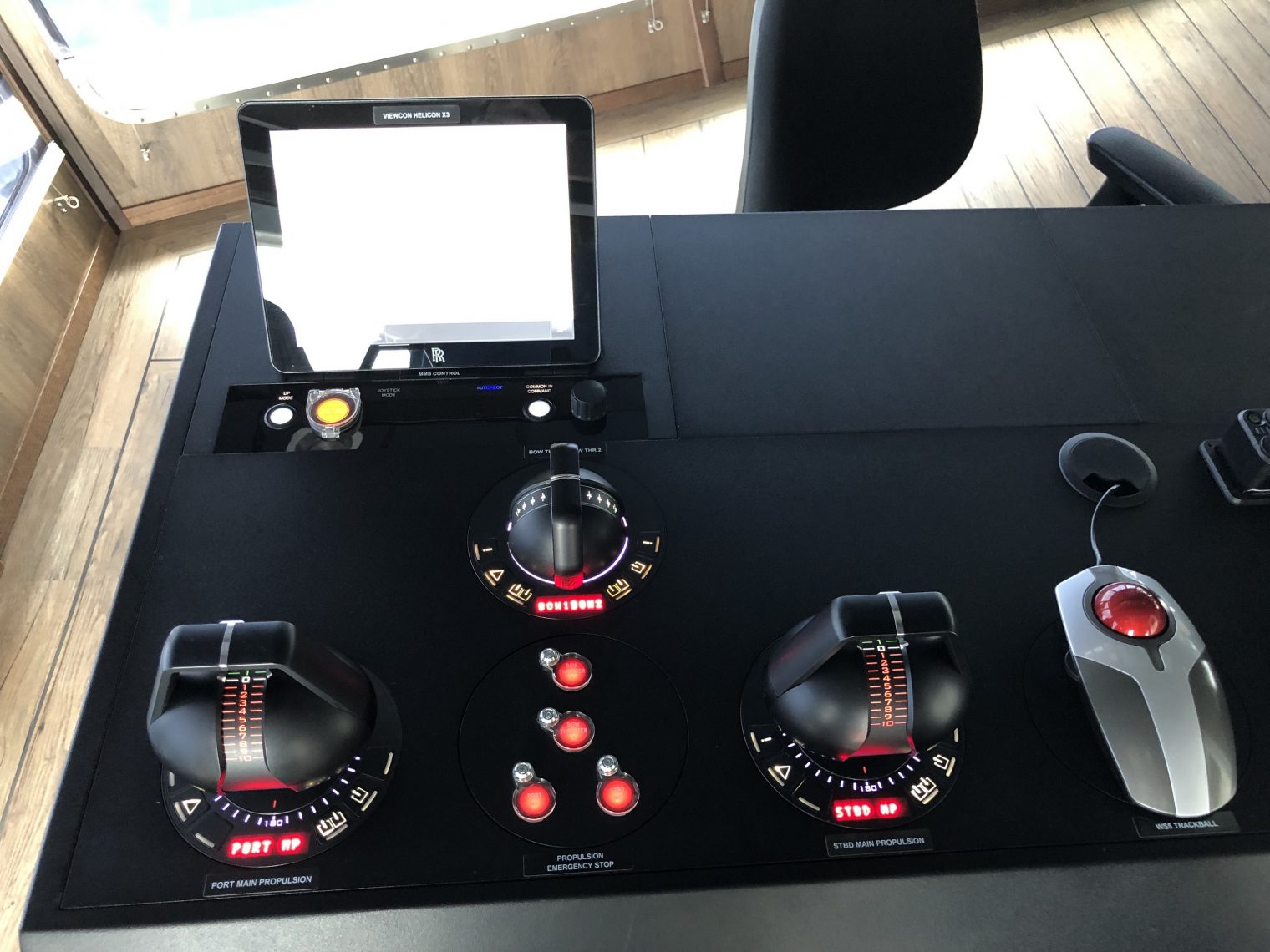
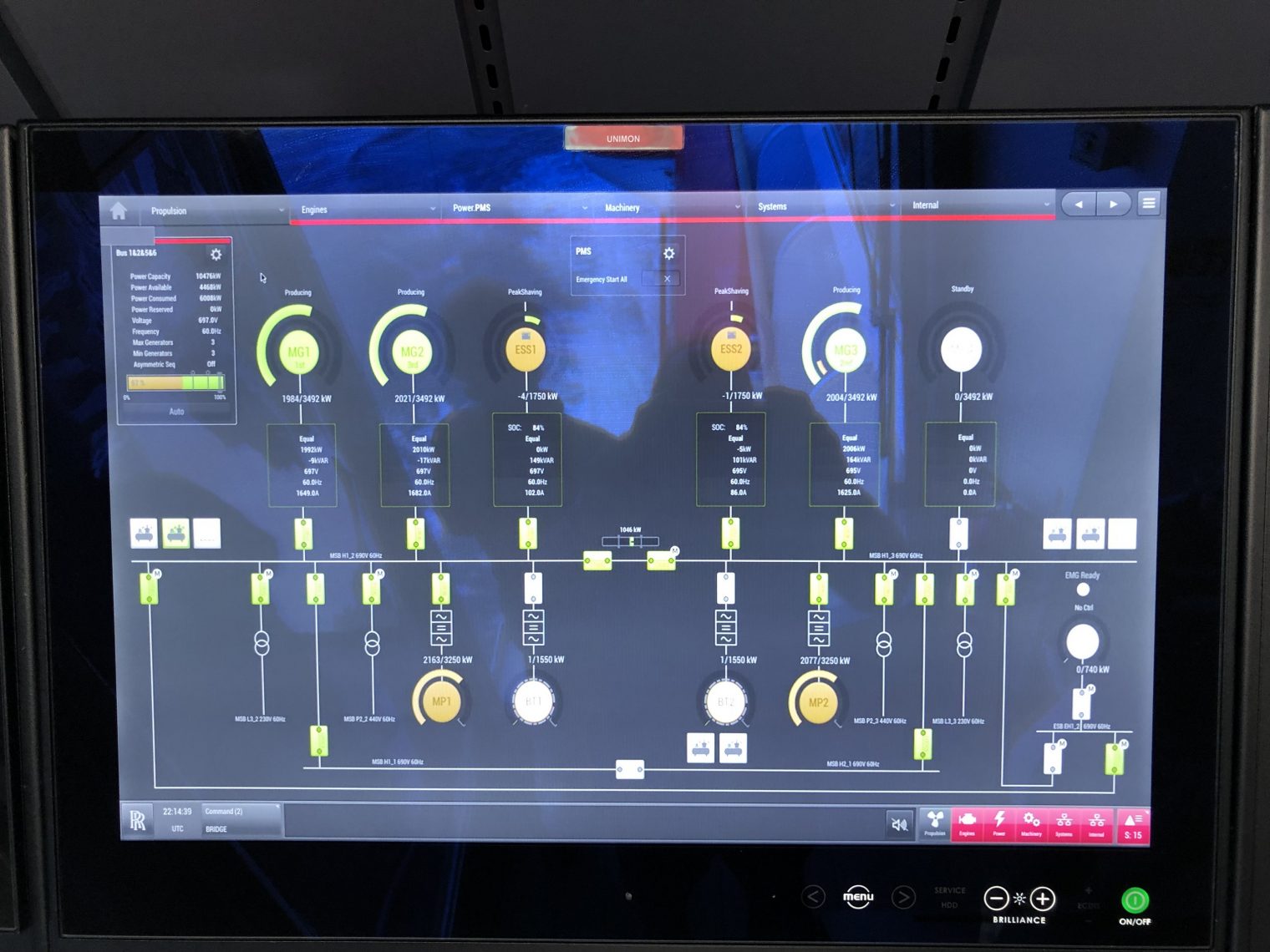
The bridge is a huge working environment and remained reasonably quiet and calm even when invaded by tourists.
Hurtigruten is not great at communication. There was an update to the itinerary that the land-based staff said had been communicated by email or phone to all of the passengers. Nobody knew about it. Their online packing list says “You will receive a wind and water resistant parka“. Sounds warm, right? In fact, we got what I would call a “rain jacket”. Unlike on Royal Caribbean where you could buy an extra layer for mall-style prices, interpreting “parka” as not requiring packing a heavy fleece layer for underneath would cost at least $350. The news in the shop was not all bad though…
Passengers expressed unhappiness at the difficulty in socializing at meal times. The dining room is set up with a lot of 2- and 4-seat tables. Our Cuba cruise with Royal Caribbean was greatly enhanced by big tables and no permanently assigned seats (previous post). The good news is that, if you’re lonely, the ship has a great library of polar literature and an even greater swap shelf:
If you love technology, you’ll be dismayed at how it is used on the ship. There are no local apps or web servers for distributing information, chatting, etc. That’s a problem on a ship whose total Internet connectivity (for 500+ people) is about the same as a single 3G cell phone. How about a feed from cameras around the ship into the room TV, as is conventional on Royal Caribbean? No. The system that delivers a moving map to the in-room TVs seems to depend on connectivity to an Internet server, which we had only intermittently. Why not a self-contained system as on an airliner or traditional cruise ship? In general, it seemed as though all of the tech that the ship did have was dependent on an Internet connection that the ship seldom had.
Tips: Pay up for a balcony room. The climate control system on the ship is not very effective and if the room is too hot it is great to be able to open the balcony doors.
Many have characterized the competition between these two giants as a clash between democracy and authoritarianism. But this is false. America and China view their political systems in fundamentally different ways: whereas America sees democratic government as an end in itself, China sees its current form of government, or any political system for that matter, merely as a means to achieving larger national ends.
The fundamental difference between Washington’s view and Beijing’s is whether political rights are considered God-given and therefore absolute or whether they should be seen as privileges to be negotiated based on the needs and conditions of the nation.
The West seems incapable of becoming less democratic even when its survival may depend on such a shift. In this sense, America today is similar to the old Soviet Union, which also viewed its political system as the ultimate end.
Certainly the elites would be happier today if they’d remembered to take voting rights away from anyone who doesn’t live in a coastal city, thus making the U.S. “less democratic” if not “less Democratic”!
(Regarding the similarity to the Soviet system, Russian immigrant friends say that a big difference is “Back in Russia, we didn’t believe the propaganda.”)
I wonder if this article could get published today, now that the NYT tells us that we have an unbalanced strongman in the White House.
While Americans argue about how much teachers should get paid, people in China are teaching and studying…
Predictably, this was not appreciated by the righteous. Striking workers, even when they’re avoiding teaching American children, are a beautiful sight. They said that it was irrelevant that Chinese students are studying because Chinese schools are of low quality. This was also a good chance to bash Chinese society:
I don’t think we typically hold China as our human rights/equity model.
Are you aware that China is a dictatorship with one official political party?
I replied wondering if China’s political system at the municipal level is that different from what Chicago has. Both Shanghai and Chicago will have one political party, but multiple candidates in elections. I pointed out despite the lack of any partisan division, the Americans in all-Democrat Chicago could not reach a consensus on appropriate pay and the result was an interruption in their children’s education. In China, by contrast, the divisions among people are not so great that it prevents them from continuing to operate schools.
I do wonder why it is socially acceptable for Americans to whitesplain the inferiority of nearly everything that happens in China. Most of the whitesplaining is contradicted by recent GDP growth data and a history of thousands of years of stable government within China (the Ming dynasty alone lasted for longer than the U.S. thus far). But even without these data, why is it always okay to bash China? Whatever the merits of their political system might be, China has not sent its military halfway across the planet to start wars. American Freedom (TM) means an imprisonment rate that is 5X as high as China’s. Whatever the system is for compensating teachers in China, the work is voluntary (i.e., teachers could quit if they don’t like it, just as a schoolteacher in the U.S. could quit (though American teachers are only 1/4 as likely to quit as American workers on average (Fortune)).
The average Chinese citizen does not have a huge say in how government operates, but the same can be said for the average U.S. citizen.
(Separately, I wonder if the fight around teacher salary is China-related. The average teacher in Chicago under the city’s latest offer will be earning over $100,000 per year within a few years, plus a guaranteed pension and other benefits worth another $100,000/year or so. Yet in a globalized economy with a growing population, including a rapidly growing Chinese middle class, $200,000/year in total compensation isn’t sufficient to command what would be an acceptable (to the teacher) share of resources.)
At 7:15 pm on Sunday, October 20 I checked the JetBlue web site for fares to Las Vegas. They were showing a flight leaving in approximately two hours at a fairly high price (roughly double what Spirit charges):
The Mint ticket is especially costly, $1,104, given that there are two seats left and only two hours to go.
Maybe the “Even More Space” seats are not truly empty because JetBlue has sold a bunch of regular price tickets and will have to allocate these at the gate to people who did not pay extra.
But that leaves the mystery of why not sell the Mint seats for closer to the next night’s price of $604. Are two people likely to buy those last two seats at $1,104?
Is this evidence of lack of competition in the airline market? In an Econ 101 competitive marketplace, JetBlue should be happy to sell these last seats at any price above marginal cost (essentially $0 on top of the taxes, TSA, and airport fees).
I visited a group house in which the students attending this Ivy League university vow “We reject systems that create and reinforce inequality” as a “guiding principle”.
I visited the FBO at the nearby airport, whose ramp was groaning with private jets that had arrived for Parents’ Weekend. Sometimes it is only by spinning three turbojet engines that one can reject inequality…
I had a sandwich at U Melt, which welcomes everyone except those without money:
from Travel and Leisure magazine: “Within an hour of landing in China, there will be malware on your mobile device,” says Dave Anderson, a senior director at Voltage Security in Cupertino, Calif
Is the situation truly riskier than in the U.S.? What special tools do attackers in China have that couldn’t be deployed at a Starbucks in Peoria?
I’m not worried about someone from the Chinese government reading all of my email. Any opinions that I have about China and the Chinese government are already published here on this blog (and they’re mostly wrong! In 2003, I predicted that the Chinese would be able to make and export a basic automobile for $2,000 to $3,000 (at most $4,200 in today’s mini-dollars). As of 2016, there was a $2,400 Chinese four-seat car, but it lacks A/C and other “basics”. Today there is a $9,000 Chinese made four-door electric car.)
I wouldn’t want someone transferring money out of my online banking accounts, using my credit cards, etc., however. Given two-factor authentication with text messages to my phone, can people truly do that without having control of my mobile number?
Update: Based on Denis’s comment below, I updated the “SIM PIN” on my iPhone away from the Verizon factory default. I hope that is what he meant by “Make sure your sim is locked.”
On a typical cruise, passengers hand over their passports at the beginning of the trip and the ship’s staff handles any and all immigration bureaucracy. The countries being visited rely on the cruise line to authenticate people and to take at least most of the visitors away.
When we arrived in Canada this standard practice was observed. The Canadians presumably had an opportunity to inspect a list of people on board, but they didn’t invest time and money to talk to each tourist and/or crew member.
It was a different story coming into U.S. waters. A group of immigration officials were flown up from Anchorage to Barrow, one of the most remote towns on our planet. They proceeded by tender boat to join us on board. The ship set up an assembly line so that La Migra could talk to each passenger at least briefly, scan and offer to stamp passports, and then go back to Anchorage by tender boat, taxi, and airplane. It was a huge waste of time and money for everyone involved.
This “screen everyone” practice might have made sense 30 years ago. But with families stepping over the southern border of the U.S. and saying “I am entitled to asylum because I live in a place that is almost as violent as Baltimore or New Orleans,” what is the point? Anyone willing to spin a yarn of violence and suffering can get set up for three generations of public housing, free health care via Medicaid, food stamps, and free smartphone. So the point of the passport check cannot be to make sure that people will go home. Anyone from our cruise could have asked for asylum just the same as someone who migrated up from Central America.
Since 9/11, a good catch-all explanation for apparently wasteful government spending is “because terrorism”. I don’t think that is the reason for screening every passenger on a cruise visiting a U.S. port, though. German senior citizens do not fit the profile of a typical terrorist. The agents who see people face to face do not seem more likely to spot a terrorist than a person with a computer looking at all of the passport data provided by the cruise line.
Readers: Now that there are so many ways to stay in the U.S. forever (and at taxpayer expense for multiple decades), is this screening process obsolete? If complete face-to-face screening is a such a good idea, why don’t the Canadians do it?
Wikipedia says “Sociobiology is a field of biology that aims to examine and explain social behavior in terms of evolution.”
One of the things that we learned about on our Northwest Passage cruise was the historical practice of female infanticide among Eskimos/Inuits. When food got scarce, female infants were at risk. The explanation given in museums and by guides was that boys would grow up into adult male hunters who could take care of their elderly parents.
The difficulty of procuring nourishment frequently induces the women of this tribe to destroy their female children. Two pregnant women of the party then at the fort, made known their intention of acting on this inhuman custom, though Mr. Dease threatened them with our heaviest displeasure if they put it into execution: we learned that, after they left us, one actually did destroy her child; the infant of the other woman proved to be a boy.
If the goal of an animal is propagating his/her/zir genes, this does not seem to make sense. A typical human female reproduces, thus passing on her parents’ genes. A typical human male has no offspring (polygamy is the natural human state, it seems; see “The era of monogamous long-term marriage was a brief interruption” within Real World Divorce).
The period of life in which the son will be potentially useful won’t likely start until after the parents are beyond reproductive age (and therefore whether they live or die has minimal effect on their reproductive success).
Readers: Is the existence of female infanticide across a range of cultures a simple proof that sociobiology is wrong?