Rating Homer
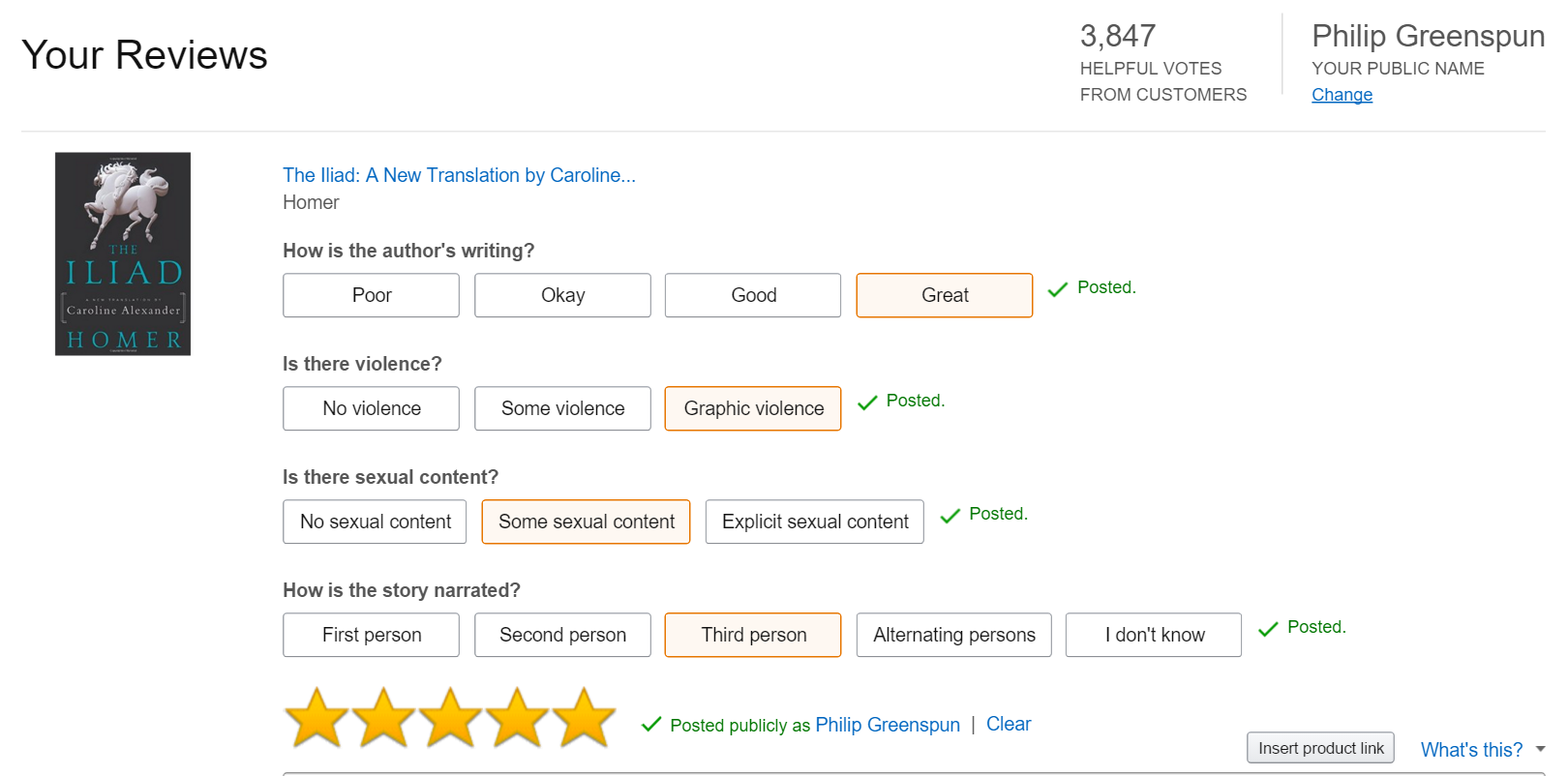
Amazon’s new book review interface results in a rather strange user experience when the original author is Homer (though of course scholars now recognize that Homer was not the author of The Iliad
A posting every day; an interesting idea every three months…
Amazon’s new book review interface results in a rather strange user experience when the original author is Homer (though of course scholars now recognize that Homer was not the author of The Iliad
Roughly every year it is time for me to ask readers what kind of accounting software they like. I’m advising a small LLC. Here are the characteristics:
I’ve used QuickBooks Online for an LLC that I used to run. The main hassle was typically re-connecting with the online banking service of the small bank that the LLC used. Hold times for help could be epic, e.g., 30 minutes, but once connected the people seemed to know what they were doing. I can’t figure out how to use 99% of the system and it is fairly costly considering that it is maintaining a handful of database tables. Is there anything better out there? (An advantage of QuickBooks Online is that the accountant could also log in and pull down what he needed for doing taxes, fix any chart of accounts problems, enter capital equipment for depreciation, etc.)
This LLC has the flexibility right now to select a new bank for its checking account. Are there any that people especially like? Other than Bank of America, are some better for debit card fraud protection? Are there any where customers can send physical checks directly to the bank? (“lockbox” service, but not with the crazy fees that the big banks have for this and for only a handful of payments per month; it is really about making sure that important checks don’t get lost or buried)
What about an online accounting and/or bookkeeping service? Are there any that will do all of the invoicing and following up? Categorizing the comparative handful of expenses for this company (“bookkeeping” per se) doesn’t seem like a huge task once software such as Quickbooks Online is in place.
Thanks in advance for any help.
Related:
Full post, including commentsIt is common in our media and on Facebook to see analogies drawn between migrants from Syria, Afghanistan, and other war-torn regions and Jewish refugees from Germany in the 1930s. Initially the analogy seems apt. After the National Socialists were elected to power, Germany became a dangerous place for Jews, though the full scope of the danger wasn’t clear until the 1940s. For at least the 500,000 Jews who lived in Germany prior to the electoral victories of Hitler (or the roughly 250,000 who were still there just prior to World War II), in retrospect it seems to at least some Americans that we should have accepted them as refugees. People who live in Syria today are also in danger. Therefore we should accept them as refugees because we might regret it 70 years later if we do not.
If we are going to look back to the World War II era in Europe, are Jews the correct group to serve as an analogy and talking point? Jews constituted just one percent of the German population and were a minority group elsewhere in Europe. They were being targeted for discrimination, random violence, and ultimately institutional death camps due to their ethnicity/religion. Most of the migrants seeking admission to Europe and the U.S., however, don’t fit this description. Perhaps Christians who have remained in Muslim countries would be analogous to the Jews of Europe circa 1935 or 1940 (depending on whether there is an active shooting war near their home), but a Muslim citizen of a Muslim country that has become a war zone? Wouldn’t the more appropriate analogy be to a Christian living in a war-torn part of France, Germany, Poland, Ukraine, or Russia? Or to a Christian living in London during the German bombing campaigns? Or even to a soldier in any of the armies fighting during World War II? The average soldier certainly did not choose to go to war and would have preferred to be resettled in Minnesota.
This doesn’t necessarily affect the question of whether or not it makes sense to offer U.S. or EU citizenship to anyone currently living in a war zone. Perhaps it would have made sense to bring 50, 75, or even 100 percent of the European and Russian population in the 1940s in order to protect them from World War II (i.e., potentially hundreds of millions of people). If there are only a handful of places on Planet Earth where people can live without killing each other, why not have everyone live in those places? However, people keep saying “Jews” and “Holocaust” in the context of “Should we accept a refugee who is of the same religion and ethnicity as most other people in a country having a civil war?” If the analogy is inapt then presumably the conclusions that people are drawing are wrong.
[Separately, if Americans are in fact enthusiastic about Jewish refugees, we could take in the entire population of Israel under the proposed new standards for migrants/refugees. The states of the Arab League declared war on Israel in 1948 and only Jordan and Egypt have subsequently agreed to peace treaties. Thus Israel is an official war zone and everyone there is theoretically subject to the risk of violent conflict at any time the Arab countries (plus Iran as a new belligerent) feel strong enough to initiate new battles. (Arab citizens of Israel and Arabs living in the adjacent territories are equally at risk from any conflict, so they would qualify as refugees entitled to U.S. residency as well.)]
Full post, including comments“Islamic State’s Authentic-Looking Fake Passports Pose Threat” (WSJ, December 23, 2015):
Islamic State has likely obtained equipment and blank passport books needed to make Syrian passports when the group took control of the Syrian cities of Raqqa and Deir Ezzour, those officials said. It has also gained control of materials to make Iraqi passports when it occupied the Iraqi city of Mosul, a Belgian counterterrorism official disclosed for the first time.
Frontex, the European Union’s border agency, has recently sent document experts to Leros and other Greek islands to pick out fake passports. But there are now only 10 experts, and identifying a fake that has been printed on real Syrian passport books with real equipment is very difficult, a Frontex spokeswoman said.
It seems strange that in our electronic age paper passports are still in use. The U.S. passport is an electronic device with a paper cover (source), but other countries are apparently still relying primarily on paper (which means that we who accept travelers or immigrants from those countries are also relying on paper). Biometric passports are apparently in the far distant future for most countries.
Given the amount of time and energy that goes into fretting about people who move from one country to another, why isn’t there more discussion of biometric passports?
Full post, including commentsWho has predictions for 2016 to share? I’ll go first…
Software: the iPhone will continue moving in the direction of Android and Windows. More capability, but also more crashes and unpredictable behavior such as slow response time.
Hardware: the beginning of the end of Intel’s dominance? As the desktop continues to die and the newest chips aren’t that much faster than the old chips (just more cores), why should anyone know or care what the CPU is inside a tablet or notebook computer?
Televisions: the premature death of OLED? Could it be that LCDs with higher dynamic range and/or ridiculously low prices will strangle OLED in its crib?
Politics: Hillary Clinton wins the presidential election by the same margin that Barack Obama had in 2012. Does it matter who is unfortunate enough to win the booby prize of the Republican nomination (previous posting on the unwinnability of this one for Republicans)? I don’t think so, but I will guess that it will be Ted Cruz based on the fact that he is a professional politician, unlike Donald Trump. With government spending now at roughly 50 percent of GDP, the election is important. As the government has grown (chart) people are more passionate about getting on the right side of this rich entity. The vote should basically come down to people who benefit from a big government (either they collect welfare, free housing, etc., work for the government, or have a close family member who works for the government, or work for a government contractor or crony (e.g., health care)) versus people who are economically disadvantaged by the government growing larger (e.g., people who pay taxes but don’t have an obvious way to collect a lot of benefits in return).
Economics: As predicted by Mancur Olson, the U.S. economy continues its stagnation, with per-capita GDP growing only slightly (of course the total GDP can still grow robustly if the U.S. population grows larger, e.g., through immigration). If we model the half of the U.S. economy that is now centrally planned by government as being like the former Soviet Union, we would expect half the economy to grow at an annual rate of between 0 and 0.75 percent. If we model the other half as being like a modern high-income free-market economy, such as Singapore or Hong Kong, that half could grow at a 3-4 percent rate (maybe at the higher end of this range due to the dead cat bounce that we’re probably still in following the Collapse of 2008). That leads to a maximum potential long-term average per capita GDP growth of about 2.4 percent, but let’s assume that the tangle of regulations imposed by the planned portion of the economy drags this down to 1-1.5 percent. If you live in one of the handful of desirable cities in the U.S. the result of this “growth” will be a reduction in your spending power due to (a) higher taxes, and (b) inflation in the cost of housing and services.
Work: The growth of the American welfare state will continue with higher minimum wages and other regulations discouraging companies from hiring the least-able Americans (see also “Can Puerto Rico be a laboratory for the future of the rest of the U.S.?” and “unemployed = 21st century draft horse?”). Higher tax rates and more lucrative child support guidelines in some states (e.g., Kansas), plus the message from politicians and meida to women that they can’t get fairly compensated in the workforce, will contribute to a continuation of the 15-year slide in the labor force participation rate of women. An increasing percentage of young women will be primarily stay-at-home wives (The inquisitive gender studies student and Sheryl Sandberg) or profit from their fertility without being married (chart showing a peak shortly after the Federal mandate for states to develop guidelines that made it easy to calculate the profits from a casual sexual encounter or short-term marriage (History); see also divorce litigators’ analysis of Ellen Pao’s career options)).
Leisure: With fewer people working and higher costs for employers making hotel rates grow faster than official inflation there will be a lot of demand for fun stuff that Americans can do from home, e.g., streaming video, video games, etc. I predict that the first virtual reality headsets will arrive in 2016 as planned but that consumers will be slow to adopt these innovations.
Health care: With no changes in financial incentives, I expect no changes in this sector (nearly 20 percent) of the U.S. economy. Due to the fact that viruses are smarter than humans, I expect no major breakthroughs in treatments.
Government: More outsourcing to cronies. From a bureaucrat’s point of view, a contract with a crony provides a great way to say “no” to the public. Instead of “We don’t want to give you that service,” a bureaucrat can say “We contracted out that function for five years to Vendor X and the contract doesn’t require them to give you that service. It is a great idea, though, and I’m sorry that they aren’t doing it.”
Businesses: Big companies will manage to work around new regulations and taxes. The keys to continued profits will include a combination of purchasing political influence, turning U.S. operations into a subsidiary of a foreign corporation headquartered in a country with lower tax rates (e.g., via an inversion), and expanding in growing markets overseas. Operating a small company in the U.S. will be increasingly untenable, unless it is a startup that can expect to be acquired fairly quickly. “Go big or go home” will continue be the message, e.g., communicated with double the effective tax rates on small corporations compared to large ones with their crews of full-time tax attorneys, offshore subsidiaries holding patents, etc.
Stocks: Due to the above, the S&P 500 should continue to grow in after-tax value at the same rate as world GDP (about 3 percent), even if the U.S. economy stagnates. (i.e., I am predicting that the S&P 500 will be approximately 60 points higher a year from now.)
Education: Mediocrity will continue to be accepted by Americans at all levels of the educational system. The U.S. will continue to spend more on this sector than all but a handful of countries (OECD chart), but most people in the education industry won’t have any incentive to achieve high performance. Incumbent nonprofit colleges will keep fighting back against for-profit colleges and increase their share of government handouts.
Cars: Innovations in self-driving and electric-powered cars will be significant and heavily publicized, but hard to deliver. Thus by the end of 2016 consumers will try to avoid buying a new car and/or enter into short-term leases in hopes that by 2017 or 2018 there will be mass-market cars with dramatic innovations.
Internet: Continued slide in readership and participation for anything that isn’t Facebook.
Income Inequality: Will continue to widen. Politicians who get a boost from complaining about income/wealth inequality will open the doors to a lot of immigrants with zero income and zero wealth, thus immediately worsening the statistics. Population growth from this immigration combined with the obstacles to building in the U.S. will favor existing owners of real property (i.e., Americans who are richer than the median). Increased complexity from regulations, taxes, and tax differentials from place to place and from company to company (e.g., depending on political connections) will favor the cleverest and best-educated (i.e., Americans who are probably richer than the median).
ISIS prediction: We won’t hear too much about ISIS in Syria by the end of 2016. Backed by the Russian military (will they trademark the phrase “What a real ally looks like”?), the Syrian government should be able to get its territory back under control. So ISIS will contract to almost nothing in Syria and grow in Iraq.
Migration into Europe: Every current migrant will tell 10 friends or family members about how well it is working out. Roughly one third of the friends/family will act on the advice. Thus there will be approximately three times as many migrants coming into the EU at the end of 2016 compared to now.
Readers: Your turn now!
Full post, including commentsHappy New Year to all of my readers (except of course Jews, Chinese, and anyone else who has not succumbed to the hegemony of the Gregorian calendar)!
2016 will be the 26th year of the World Wide Web. There were a lot of competing wide-area hypertext system back in the late 1980s and early 1990s, but Tim Berners-Lee had the simplest idea and it has come to define “the Internet” for many people (Facebook being the definition for the newest users!).
The microprocessor and network switch folks probably deserve more of the credit for enabling server-mediated collaboration, but we can still celebrate the standards that were successful.
As an example of just how revolutionary this world is, according to The Invention of Nature: Alexander von Humboldt’s New World
[Born into wealth,] Humboldt desperately needed the money from his annual stipend because the cost of his publications had left him, he admitted, ‘ poor as a church mouse’. He had to live on what he earned but he was useless when it came to his finances. ‘The only thing in heaven or earth that M. Humboldt does not understand,’ his English translator had remarked, ‘is business.’
Just imagine if the Web had existed 200 years ago. Humboldt could have put his results out on a free weblog site or pushed them into the old Los Alamos preprint server (now arXiv.org). Perhaps he would have gone insane from trying to format everything in TeX, though…
Readers: If you’re an example of the triumph of hope over experience and therefore still making New Year’s resolutions, please share them in the comments section!
Full post, including commentsSo we finally managed to escape the house/kids/dog to see Star Wars the Force Awakens.
Here are some questions about the economy of the past/future/whatever….
In some of the early scenes the scavenger girl is polishing up space junk before selling it to a dealer. In a world full of intelligent robots (“droids”), why are there any humans (or human-like creatures) performing manual labor and living far below the standard of an American classified as “impoverished”?
The planets depicted don’t seem heavily populated. Thus it would seem that there has been no Malthusian expansion of population such that everyone is down to a subsistence level. If there are whole planets full of resources and the possibility of droid labor, why wouldn’t everyone be living large, e.g., in a plush McMansion built by local droids?
Interplanetary/interstellar travel seems to be pretty cheap, as evidenced by the existence of bars catering to people from all around the galaxy. If it is affordable to go inter-stellar to get a drink with friends, it should be affordable to transport otherwise scarce materials from one planet to another. Therefore the existence of poverty can’t be explained by a shortage of a particular material. (And where was the parking lot for that bar, by the way? Why didn’t we see the ships in which the customers had arrived? Were they all using an Uber-like service?)
Can it be that having enough wars to fill up nine movies has destroyed most accumulated wealth?
Why are they bothering to wage these wars? Are there massive tariffs to be collected from trade? (Thus giving rise to Han Solo’s smuggling career.) We don’t see anyone paying sales tax or income tax in the movies. What’s the point of owning a planet if you don’t get tax revenue?
Readers: What is the explanation? (And, separately, has everyone recovered from the emotional trauma of not being reunited with Jar Jar Binks?)
Related:
Goebbels: A Biography
“I lack a great love in my life,” wrote Goebbels in December. “That’s why all my love goes to the great cause.” At the end of 1924 he got to know Elisabeth Gensicke: “A bit old, but nice and affectionate. Reminds me very much of Anka.” A little affair developed: “Why don’t I feel any inner conflict when I leave Elisabeth to go to Else,” he asked himself when he set off for Rheydt just before Christmas. But he quickly dispelled such pangs of conscience: “My heart is big enough to hold two women at once.” So he spent Christmas and New Year’s with Else, and in between a long evening in Elberfeld with Elisabeth. “Tomorrow I’m seeing little Else! Elisabeth on Friday!” he exulted. “Both are looking forward to seeing me, and I’m equally eager to see them! Am I a cheat?
In July he spent a night with Alma Kuppe, Else’s best friend, who was on a visit to Elberfeld. Later, his great fear was that the two women would exchange notes.74 “Is it possible to love two women at the same time?” he asked himself.
Short-term marriage was a much better way to make some cash 100 years ago in Germany:
Magda Quandt, twenty-nine years old at this point, was a cultivated and well-educated young woman of elegant appearance, self-assured and completely independent. Her mother had divorced her husband, the Berlin building developer Oskar Ritschel, in 1905, and married the leather-goods magnate Richard Friedländer, who adopted Magda. In 1920 Magda met the industrialist Günther Quandt, who was nearly twice her age. The ill-matched pair were married in 1921. At the end of 1921 her son Harald was born. But the couple soon drifted apart. Quandt was interested in little but the expansion of his business empire, and he neglected his young wife, who was left with the household to run as well as no fewer than six children to bring up. Apart from Harald, there were two sons from Quandt’s previous marriage, and he had also taken in the three children of a friend who had died. Overburdened, Magda yearned in vain to play an active part in the cultural and social life of 1920s Berlin. After Quandt discovered that Magda was having an affair with a student, he separated from her, and in 1929 she succeeded in obtaining a financially advantageous divorce. It was agreed that Harald should live with his mother until he was fourteen, and then—as the future heir to a business empire—live with his father.
[See the International chapter of Real World Divorce for how a child in Germany may have only 1/20th the cash value of the same child in Massachusetts or California and how a German plaintiff could only dream of the “permanent alimony” available in Florida.]
Goebbels apparently thought that what had happened to Rich Guy Quandt could never happen to him…
Goebbels and Magda spent July 1931 as guests of Magda’s grandmother at her house in the Schleswig-Holstein seaside resort of St. Peter-Ording.1 “Magda is like a mother and a lover to me,” he wrote. “She loves as only a great woman can.” He was enjoying himself: “Work, love, sun, and happiness. What more do I want?” But there was a “shadow” over all of this happiness: “Magda loved somebody else before me. That pains me and tortures me.” The man in question was certainly not her ex-husband, Günther Quandt, but Magda’s lover from the last years of her marriage. When Magda told him about her past love life, he found her “heartless” and was regularly overcome by fits of jealousy: an argument always ensued.
Goebbels is not the only admirer of the hot rich divorcee:
Hitler took a liking to Magda. Though Goebbels was pleased to hear Hitler’s “fabulous verdict” on her, he was less pleased to note that his interest in Magda did not stop there. … To Goebbels’s great annoyance, during this visit there was some flirting between Magda and Hitler: “Magda is letting herself down somewhat with the boss. It’s making me suffer a lot. She’s not quite a lady. Didn’t sleep a wink all night. I must do something about it. I’m afraid I can’t be quite sure of her faithfulness. That would be terrible.” Goebbels didn’t extend his judgments to Hitler himself: “However, I don’t begrudge the boss a little heart and charm. They are so lacking in his life.”
Running the Third Reich can be lonely:
In the evening, at a private reception, Hitler “conversed about questions of marriage”: “He feels very lonely. Yearning for the woman he can’t find. Moving and touching. He likes Magda very much. We must find him a good wife. Someone like Magda. Then he’ll have a counterweight to all these men. …
He also worried once more about Hitler’s private life. At the end of January he stayed in his apartment in the Reich Chancellery until 3 A.M.: “He tells me about his lonely, joyless private life. Without women, without love, always full of memories of Geli.” A few days later Hitler came back to the topic: “Women, marriage, love, and loneliness.” And with obvious pride Goebbels remarked: “It’s only me he talks to like this.”
Hitler has a reputation for making war, but in the domestic realm he also made peace:
The argument continued the next day, and Magda refused to go with him to the Bayreuth Festival as planned. So Goebbels went to Bayreuth alone. Hitler, whom he met there for lunch, was “appalled that Magda isn’t with me” and arranged for a plane to bring her from Berlin. … After the performance Hitler invited them in for coffee in the little house he used when in Bayreuth: “He makes peace between Magda and me. A true friend. He backs me up, too: There’s no place for women in political life.
“A good lawyer knows the law; a great lawyer knows the judge” was also the rule back then (well, maybe “a great lawyer knows the Fuhrer”):
At this time Hitler helped with another piece of Goebbels family business. According to the divorce settlement between Magda and her first husband, on completing his fourteenth year their son Harald was supposed to move from his mother’s household to that of his father. With this deadline approaching, Goebbels made every effort to annul the agreement. To this end, he applied massive pressure in his dealings with Quandt’s lawyer. He prevailed without too much difficulty—after all, a few days after the birth of Hilde, Hitler had promised him his full support.
A successful custody litigant can have additional issues:
His relationship with Magda was constantly marred by intense arguments, as for example in May 1936, when after a daylong argument Goebbels was contemplating moving out of the villa on Schwanenwerder, which Magda had just finished lavishly decorating. … Around this time, in August 1936, it was from Rosenberg of all people that Goebbels learned of an “unpleasant business with Lüdecke.” Quite evidently this was one of Magda’s affairs, which she initially denied and then confessed to him.
It will be interesting to see if the romance, squabbling, and custody litigation subsides as World War II picks up…
Full post, including comments
Goebbels: A Biography
Full post, including comments“Eventually there will be an alliance of the two Germanic peoples,” was Goebbels’s summary of Hitler’s views in May 1936. This hope seemed to be reinforced when Mussolini annexed Abyssinia in May and proclaimed the Italian king emperor of Ethiopia: “The Führer’s alliance with England will now be almost automatic.” For Goebbels’s benefit, at the end of May Hitler put a name to the prospect he visualized coming out of an alliance of this kind: the “United States of Europe under German leadership. That would be the solution.”
Goebbels noted that while attending a small soirée in January—Magda was also among the guests—Hitler had indicated that he was “determined on a major war with England”: “England must be swept out of Europe and France must be deposed as a great power. Then Germany will be dominant and Europe will have peace. That is our great, our eternal goal.”
I was on the phone with our little company’s little bank, wondering why a $5000 charge had been declined. The banker explained that the limit on our card was $3000 per day. “It is to protect you,” he said. “Federal law makes banks liable for fraud on consumer cards, but for business cards we are not responsible.”
Bank of America explains in large print that they offer a $0 Liability Guarantee under Fraud Protection. How about the fine print? “The $0 Liability Guarantee covers fraudulent transactions made by others using your Bank of America consumer credit cards and consumer and small business debit and ATM cards.” (emphasis added)
Could this be a significant difference between the monster banks that we all love to hate and the little banks for which we have nostalgia? And what about BofA’s “small business debit” note? Does that mean a “big business debit” card opens a company to unlimited fraud liability? How about the limit to “consumer credit cards”? Are all business credit cards a potentially serious liability for the company?
[In fairness to the little bank, the phone was answered by a human and I was connected to a banker who could solve our problem within 10 seconds. That doesn’t happen too often at one of the megabanks!]
Full post, including comments