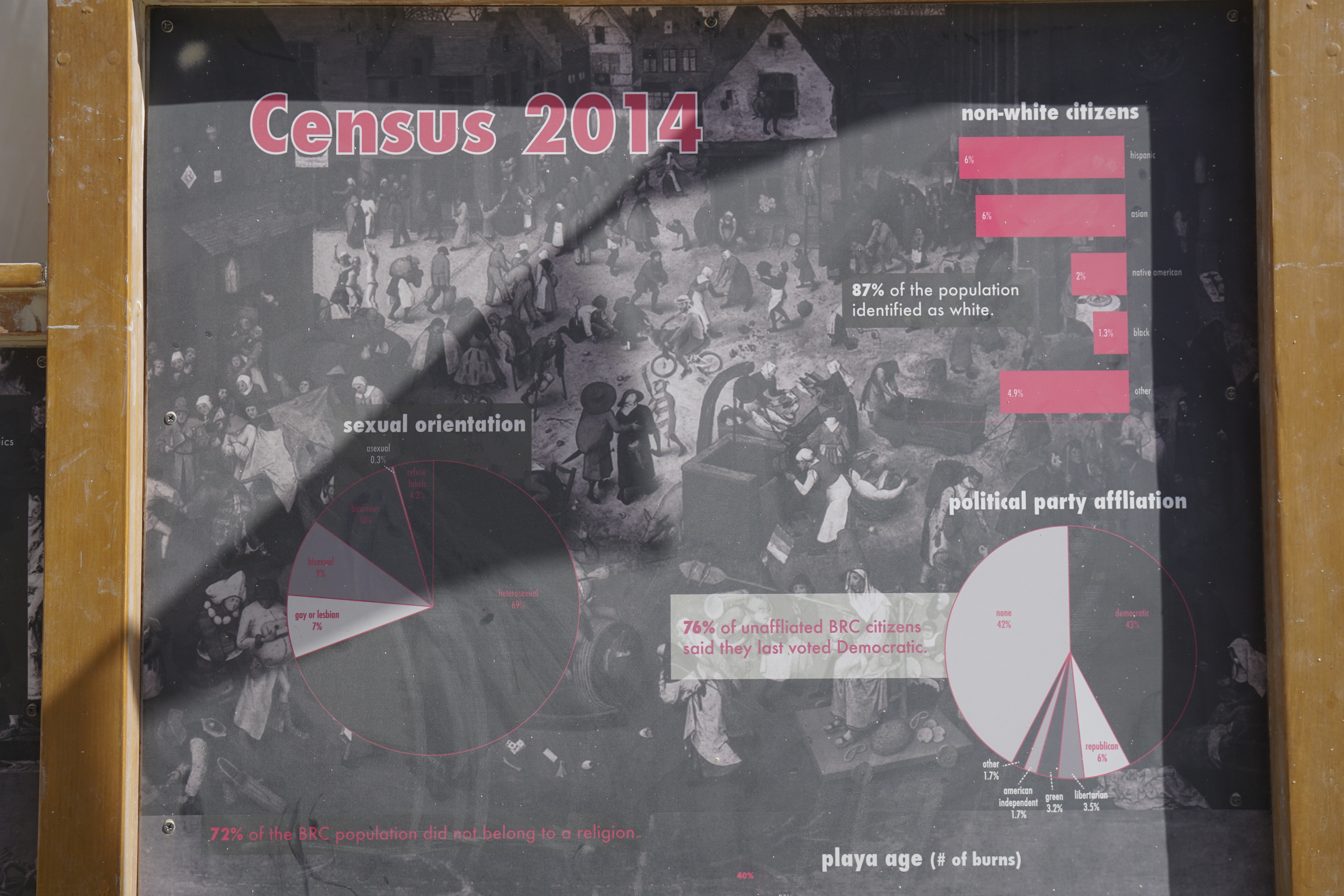
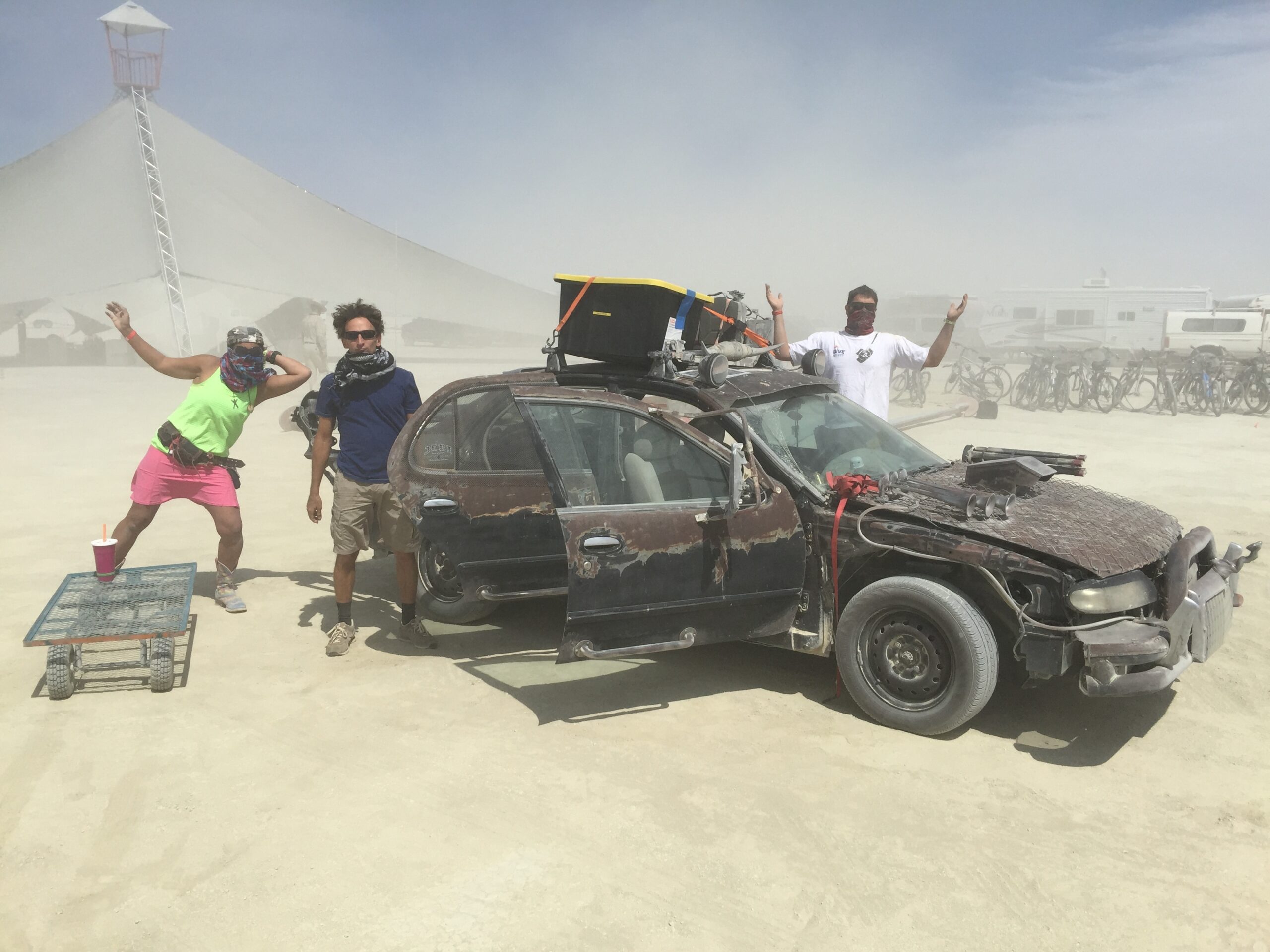
Following every Burning Man, the organization conducts a census. Here are some highlights from the 2014 numbers:
the male/female ratio is 58/41 (plus 0.9% “fluid”)
69 percent of Burners identify as “heterosexual”
47 percent of Burners are from California and roughly 13 percent come from outside of the US/Canada
Democrats outnumber Republicans in a 43:6 ratio with “76% of unaffiliated BRC citizens [saying] they last voted Democratic”.
median income is about $55,000 per year
median age is 34
The media has been excited lately about the racial composition of attendees at Burning Man. Larry Harvey, the founder of Burning Man, was asked a question about the overall whiteness of Burners at a press conference during the event. He responded “We are not a Utopian society. I will believe in Utopia when I meet my first perfect person. Unlike our liberal critics, half of my family is black. We’re not going to set racial quotas or judge people by wealth. I’m unwilling to impose change from outside. We have to generate change from the inside.”
[My own explanation? A plurality of Burners come from Silicon Valley or the East Bay, plus some techies who live in San Francisco proper. Mother Jones says that the Silicon Valley workforce is approximately 1.8 percent black. It should not be a surprise that Burning Man reflects the mixture of people you’d find in Silicon Valley. If Silicon Valley employers ever decide to offer wages high enough to recruit and retain qualified black employees then presumably Burning Man will become less white/Asian.]
The Playa is too harsh for the typical dog. But if others in the family get to go there, shouldn’t the dog also have a Playa name? What do readers think a good Playa name for Mindy the Crippler would be? “Sirius” is one idea. (After watching this video I can’t get “Moon Pony” out of my head.)
New Yorker magazine has an extensive profile of Dzhokhar Tsarnaev‘s lead defense attorney, Judy Clarke. She is apparently one of the nation’s leading criminal defense lawyers, whose fees were paid by your tax dollars (the woman who writes those checks, from her desk at the Justice Department in Washington, was actually at Burning Man this year!).
Amidst the puffery about how great this woman’s career has been (and Sheryl Sandberg would no doubt want us to point out that, had Judy Clarke been a man, she could have truly been successful) are a lot of interesting details regarding the defense strategy. Sadly for this graduate of the Cambridge Public Schools tolerance and diversity programs, it seems that nothing works well when you are a young jihadi and every member of the jury is wearing a “Boston Strong” T-shirt.
Our local public housing authority puts out some figures in its draft FY15 annual report. It looks as though there is a huge amount of inequality. The “about page” says that 5,500 families and individuals receive government-paid-for, government-built-and-operated, or government-subsidized housing in Cambridge, Massachusetts. These housing units include luxury rental apartments with a market value of up to about $60,000 per year (equivalent to more than $100,000/year in pre-tax income).
The annual report (page 36), however, shows that there are 10,442 distinct families and individuals on the waiting list. Thus out of about 16,000 people, approximately one-third receive something worth, on average, perhaps $50,000 per year pre-tax. The remaining two-thirds receive $0.
It is annoying to pay the nation’s highest taxi fares here in Boston, which is why we love Uber so much. But it is presumably even more annoying to pay 6 percent to a realtor to sell a condo in Cambridge that, thanks to the Federal Government’s free money policies and the traffic gridlock that makes commuting from the suburbs ever more possible, will be gone within a few days.
There are a limited number of dwellings in the U.S. Zillow and Google already pretty much have complete databases of where dwellings are. Why do realtors still exist?
The New York Times ran an editorial yesterday “How Segregation Destroys Black Wealth” about how realtors, in addition to driving up our housing costs by 6 percent, also discriminate on the basis of skin color (but not in the positive right-thinking way that the New York Times suggests in other situations). The wise members of the Times Editorial Board (themselves nearly all white, but of course that is not a sign of discrimination) suggest that relief from this pernicious discrimination will come via the intervention of the Great Father in Washington following a “federal housing discrimination complaint.” There was no suggestion of simply banning realtors. If Amazon.com (happy to sell to everyone, regardless of race, but the Times still hates them) or a similar neutral server farm were doing the selling instead of prone-to-bias humans, wouldn’t that help us achieve racial justice? (and also save us about 5 percent!)
Does it make sense to fly a turboprop into Burning Man? No. Can it be done safely? Yes.
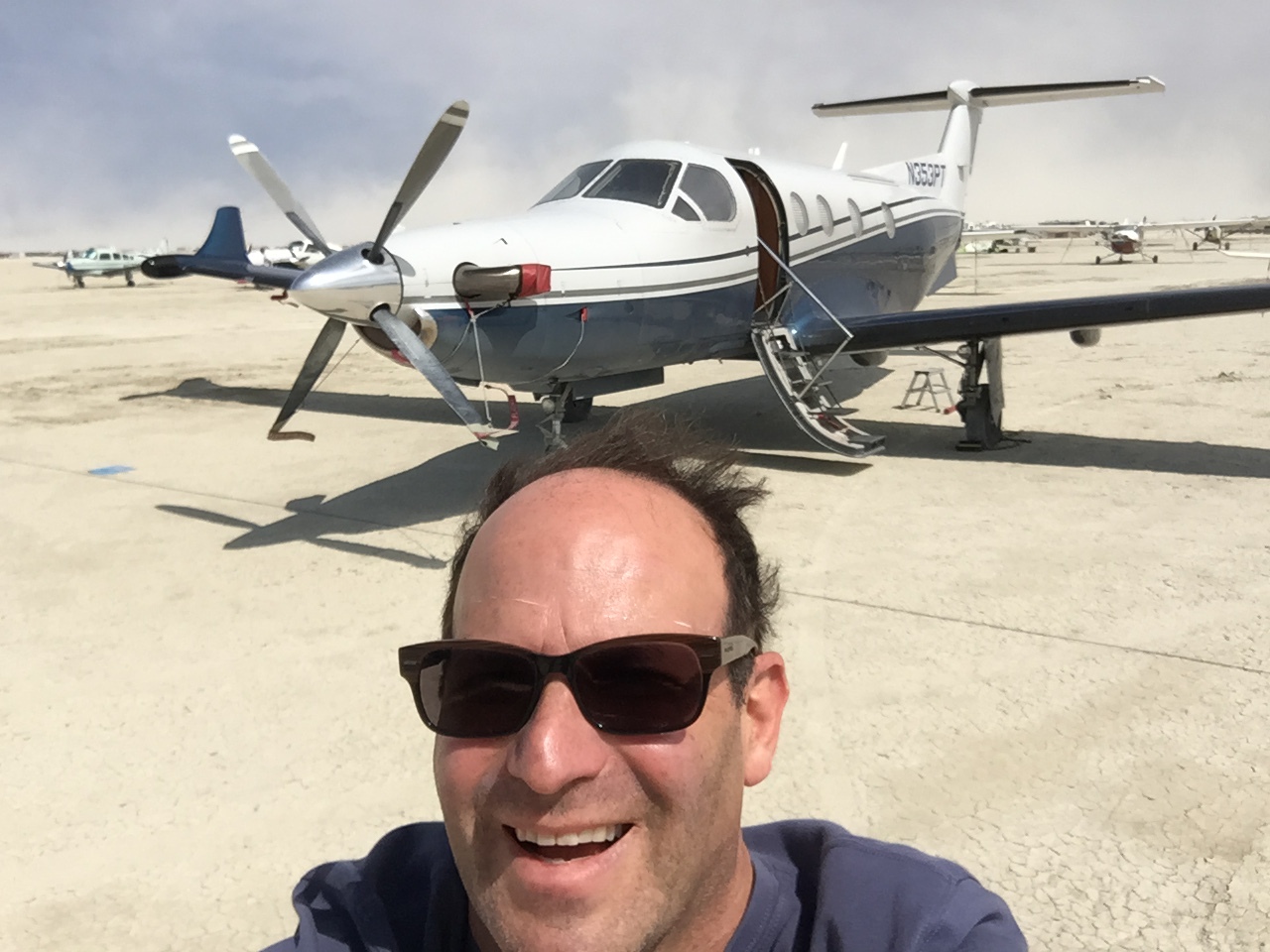
A friend’s dream was to land an airplane at Black Rock City Municipal Airport (88NV; see also Airnav). Starting from Boston and with lines of thunderstorms in the middle of the country, the sensible choice for the cross-country trip was a Pilatus PC-12. We were able to climb to FL260 (“26,000 feet” if you’re sitting in the back, but probably closer to 27,000′ above the Earth’s surface in the summer time when the atmosphere expands) to get over the weather.
Mindy helps pack up the plane.
We departed Boston late in the afternoon, stopped to fuel in Lincoln, Nebraska, and stopped for the night in Salt Lake City. Being tired flatlanders, unwilling to mix night flying with mountain flying, we requested an ILS approach into KSLC. The glorious plan to get up at first light and land at 88NV before the winds picked up was derailed by my friend’s admission that he had packed just two thin blankets into the Boston Burners shipping container that would be waiting for us upon arrival. (If you affiliate with your local Burners you can probably fly into Burning Man carrying next to nothing in the plane itself. Containers are dropped into Burning Man from all around the U.S.) We took an UberX to Target and picked up sleeping bags rated for 40 degrees. (It seems as though the temperature ratings are designed for people who share their sleeping bags with Newfoundland dogs; my friend was freezing in long underwear inside his bag while the overnight low was between 35 and 40 degrees .)
During the 1-hour leg from Salt Lake City we reviewed the extensive-yet-incomplete (no instructions regarding a go-around) materials that pilots are required to read in advance from http://88nv.burningman.com/ . About 10 miles away from “Frog Pond” we called the Unicom at this private airport, were asked if we had the manifest that we were required to obtain after taking a quiz on the site, and then were given permission to land. There is no control tower at Burning Man despite there being as many as 40 operations per hour (more than many towered airports; an “operation” could be a takeoff or a landing and most are short sightseeing loops around Black Rock City that are gifted by Burners who bring in small aircraft and order 100LL in barrels).
The challenges of landing a turboprop at Burning Man include the following:
by design, traffic converges from three different directions at Frog Pond: (1) from Reno, (2) from Winnemucca, (3) from the sightseeing loop; this is madness in my opinion and your traffic warning system will be constantly screaming at you
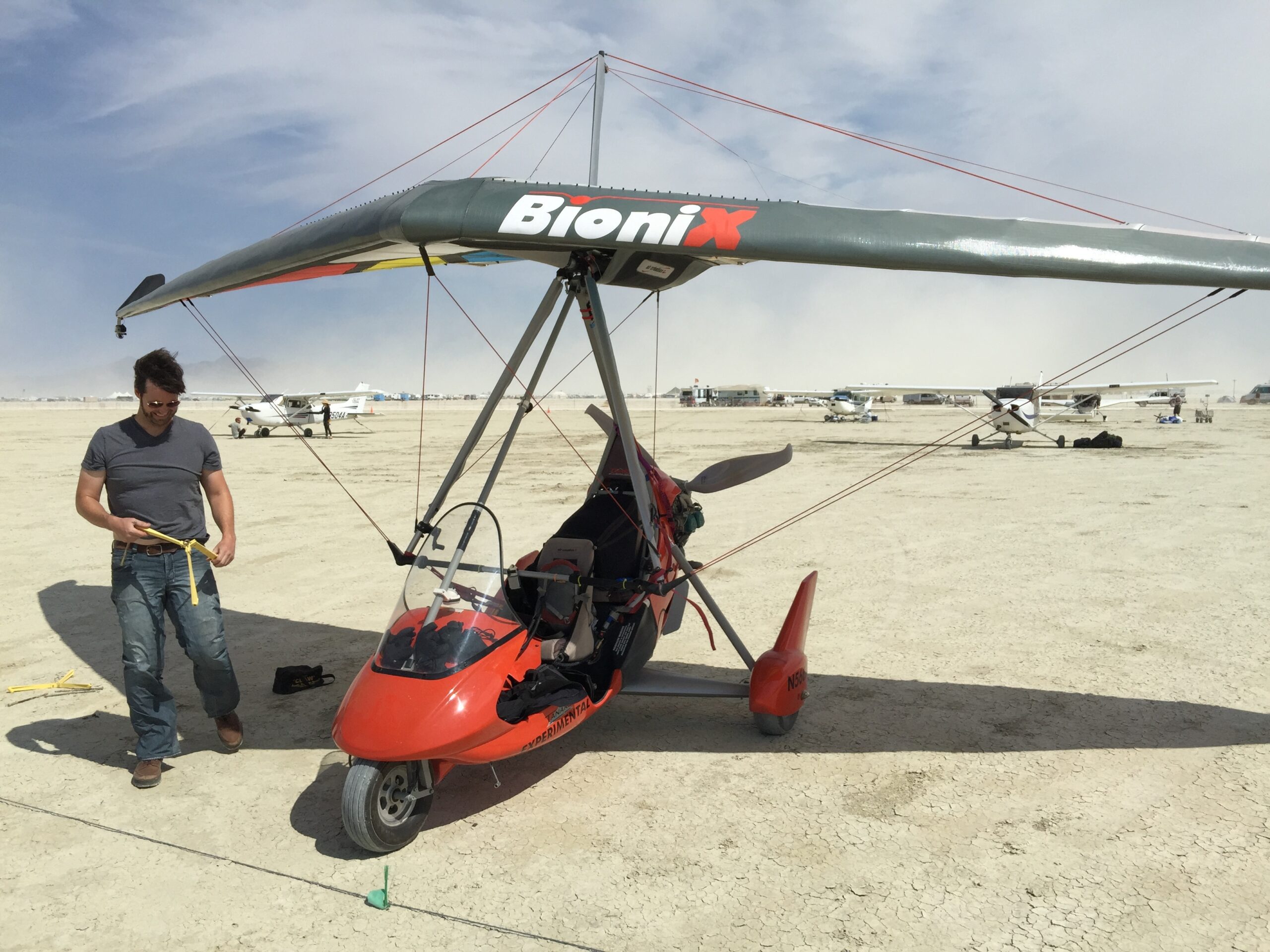
the range of aircraft speeds is wide; your turboprop that is comfortable at 120 knots in the pattern will be sharing with 60-knot two-seaters and 40-knot ultralights
the pattern to be flown from Frog Pond is tight and designed for slow piston aircraft, e.g., with an 800′ AGL pattern height
88NV will not be in your terrain warning system’s database. Passengers will be treated to “Terrain! Terrain! Pull Up! Pull Up!” as you turn Base to Final (make sure that you know where the “mute” button is!)
By the time that we got to Burning Man it was 11:15 am and there was a gusty 20-knot crosswind. Due to the long-for-a-PC-12 runway (5000′) it was easy to land with flaps 30 (40 is the max/standard) and no braking. It was only when we opened the door and were practically blown off our feet that we realized how strong the wind was. We couldn’t figure out if there were any intermediate taxiways so we just rolled to the end of the runway and followed a marked taxiway from there to the ramp. Parking is simple. All of the admin effort that you’d expect to be put into running a control tower is put into assigning parking spaces and directing pilots to parking.
We landed on the Playa and then parked for a week. Black Rock City Municipal Airport.The airport has a wide range of aircraft types and speeds.
Officially you’re supposed to tie down your airplane against the possibility of 100 mph winds. We used FlyTies successfully though presumably if an 8000 lb. airplane is being picked up by the wind it will also bring the stakes with it (FlyTies claims a “1200 lb. holding strength per stake” so that provides an extra 3600 lbs. of theoretical weight.) Hammers can be tough to borrow so if you have a heavy airplane also consider packing a stake-driving hammer. And don’t forget the ropes!
Standard turboprop covers should be augmented with 3M blue painter’s tape over static ports and any other points of potential dust ingress. I would recommend that the pilot apply the tape personally so that he or she will have a memory of what has been taped. Then do a couple of extra walk-arounds from a 10′ distance prior to departure to make sure that all of the blue tape has been removed. Don’t tape over fuel vents! (See these photos of a Cessna Mustang for inspiration.) The general wisdom seems to be not to cover the plane, but rather to rely on interior sun-blocking shades. The dust per se won’t scratch windows but after it gets under a cover it might be ground into the windows. Unless you are 12′ tall good luck getting a canopy cover on a PC-12.
If paid in advance, Playa Bike Repair will have a bicycle waiting for you at the airport. There was a rack of Giant hybrids and I was able to pick one in XL frame size, unlock it with an emailed combination, and go. There are hand-tow wagons that you can use to get luggage from the plane to the airport gate.
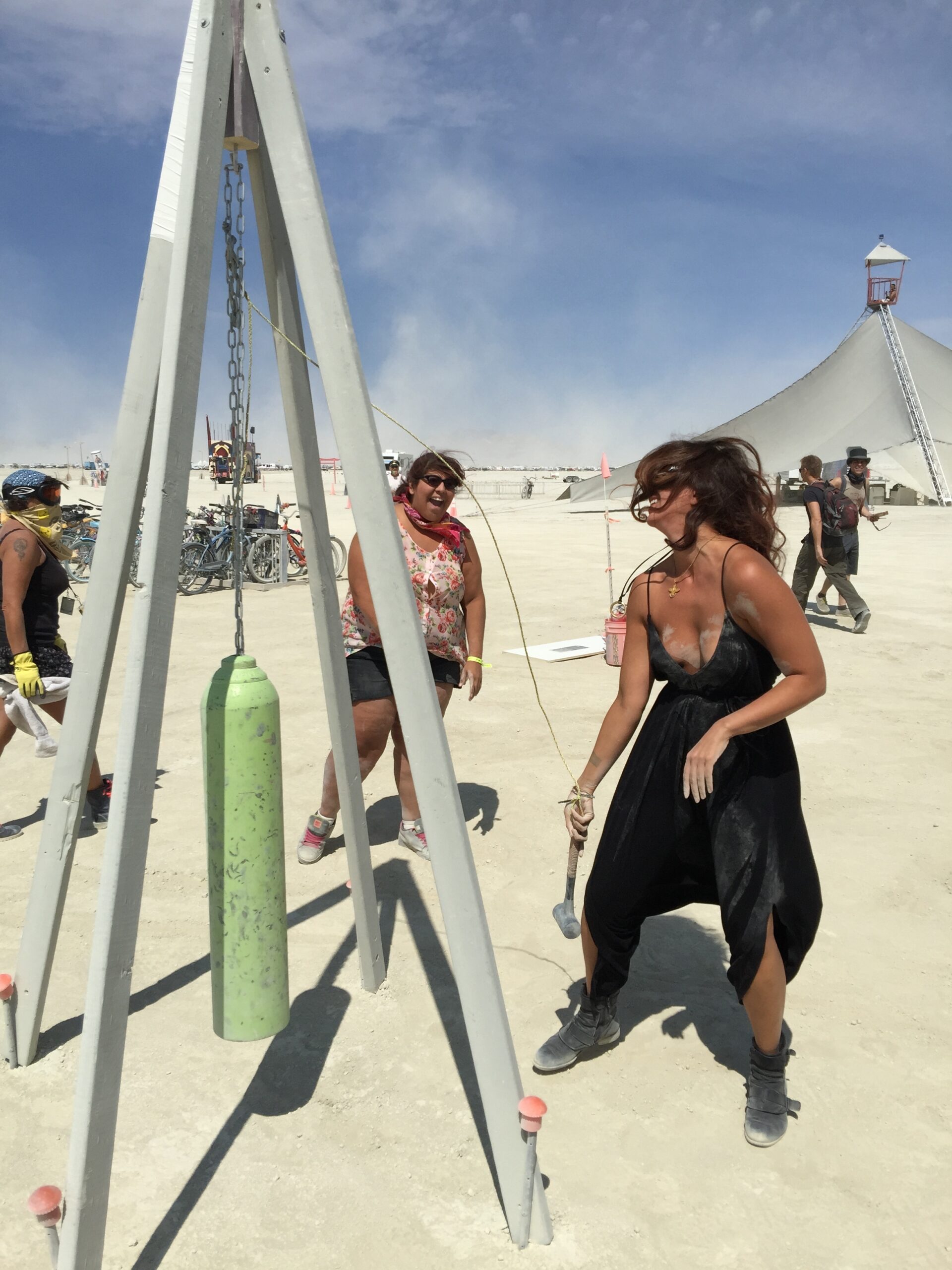
New Burner gongs in at the airport.
There is a periodic shuttle tractor from the airport into BRC, about a one-mile journey. A friend of ours has an unofficial art car and came to pick us up (text messages worked at nearly all times in BRC in 2015, at least on Verizon; 3G mobile Internet worked well at 0900 when all of the true Burners were asleep).
Burning Man Airport Uber
What happened during Burning Man per se?
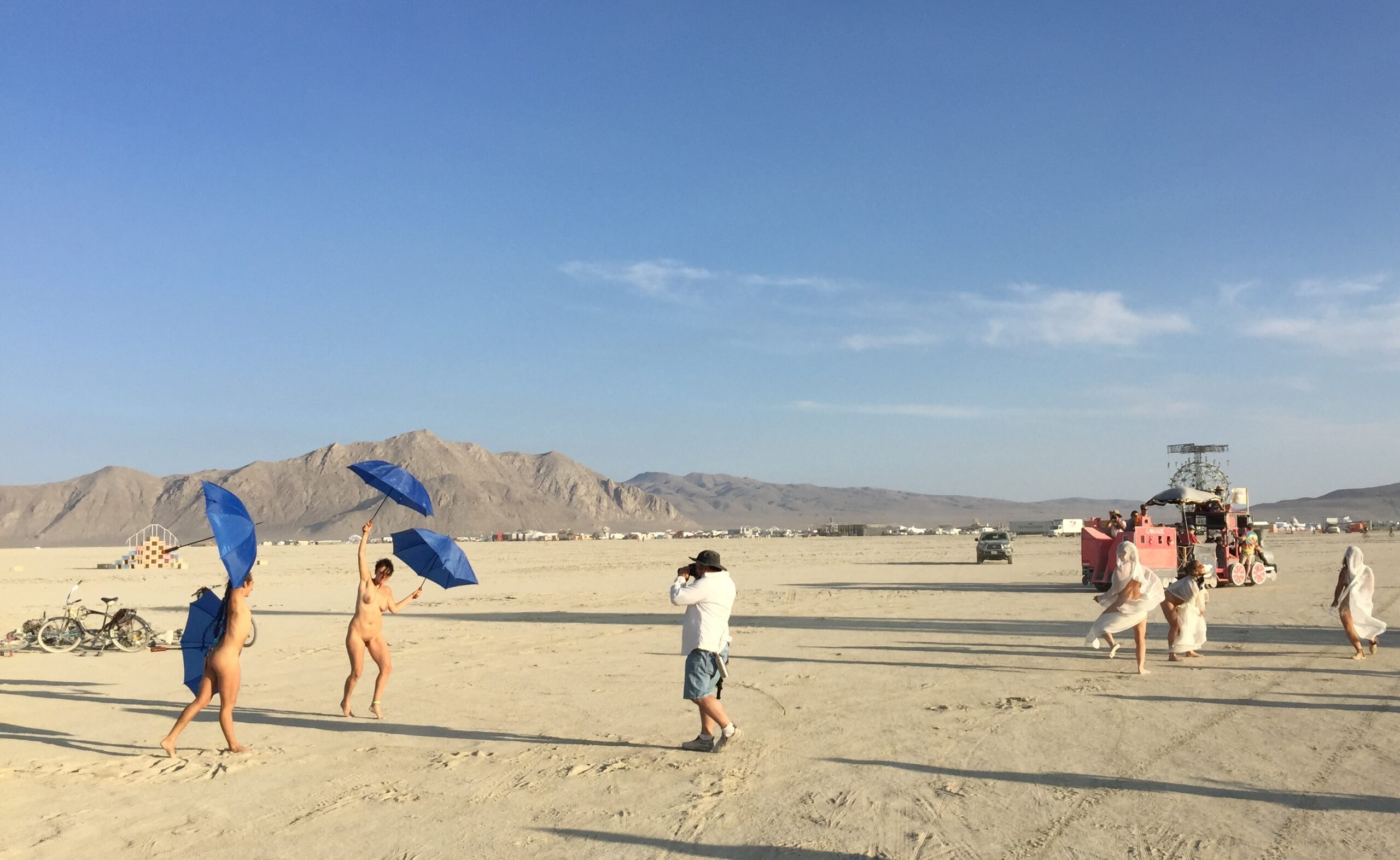
“Celebrating life” is how the dancers explained their activities on the Playa at sunset.
Keep a 5-gallon jug of water and some paper towels in the plane for departure. You’ll need to douse the windshield with water to get the dust off. Also the top of the cowl so the propwash doesn’t simply blow the dust right back onto the windshield. Also keep a bunch of large plastic trash bags and put anything that you’re going to carry in the airplane into the trash bags before loading. This will minimize Playa dust in the interior. As I was de-staking in preparation for departure, a PC-12 pilot and the director of maintenance for STAjets happened to stroll by. They had an hour to kill between flights (they do about 3 daily round-trips from the Los Angeles area) and gifted me some of their time and expertise.
If you’re a flatlander and have an engine that costs $1 million but whose manufacturer can’t be bothered to include FADEC, keep in mind that Burning Man will qualify as a hot-and-high departure. In the PC-12 that means manually limiting torque to about 38 psi rather than relying on the torque limiter to protect the Pratt & Whitney PT6. Departure is 500′ AGL straight out for three miles, to avoid people coming from Reno and entering the sightseeing loop.
The true fun starts when you get back. Pratt & Whitney says that you need to wait 40 minutes for engine cool-down before a compressor wash can be done. So in theory you could have it done at your first stop, assuming the place was experienced with PC-12s and had the right tools. But you’ll probably be leaving either on a Sunday or on Labor Day and therefore shops won’t be open. If you don’t have on-field maintenance, plan to spend a full day post-Burning Man flying somewhere to get a compressor wash done and an exterior wash at the same time. Also budget for an interior detail. By the time that you’re done cleaning up you will have spent far more time on plane maintenance/housekeeping than you saved not waiting in line at the car gate. And you will have spent more money just on airplane cleaning than it would cost to buy two round-trip airline tickets to Reno and a week of rental car. (See above for “Does it make sense?”)
So… if you’re going to do it:
Brief in advance on the airport web site
Pack: FlyTies, rope, hammer, trash bags, water jugs, soft paper towels, 3M blue painter’s tape, bag of clean clothes to leave in the airplane and change into
Schedule your trip and maintenance so that you are due for a compressor wash in early September anyway
How about turbojets? One sometimes sees fake photos mocking the arrival of a Silicon Valley billionaire in a Gulfstream. My understanding is that a Learjet with a gravel kit landed in 2015 and some Citation jets also have gravel kits that should make it possible. Certainly the Black Rock Desert does have a rich history of turbojet-powered land vehicles (Wikipedia). The slower the jet the easier it would be to make this work given the traffic patterns and procedures published by the 88NV folks.
Mr. Trump’s father, Fred C. Trump, built a real-estate empire after World War II and in 1999 left an estimated $250 million estate. One of his success secrets was taking advantage of Federal Housing Administration financing to build cheap houses in Brooklyn and Queens. The golden government apple didn’t fall far from the tree.
In the 1980s Donald Trump bankrolled people campaigning for seats on the New York City Board of Estimate. Surprise: The board decided land-use matters. Mr. Trump is one of the top political donors in New York state, according to the New York Public Interest Research Group, and Democratic Gov. Andrew Cuomo, who received $64,000, is one happy recipient. Mr. Trump said in a July interview that “when you give, they do whatever the hell you want them to do. As a businessman, I need that.”
Mr. Trump’s first big real-estate win in the 1970s was converting New York’s old Commodore Hotel into a Grand Hyatt. His dad’s friend Mayor Beame kindly extended a 40-year tax abatement worth $60 million in its first decade. In 2011 Mr. Trump told the Los Angeles Times that someone had once asked him how he had finagled a 40-year abatement, and Mr. Trump said he replied: “Because I didn’t ask for 50.”
“The Rise of Victimhood Culture” is an Atlantic magazine piece about an email tiff between two Oberlin College students. Here are some choice phrases from folks who probably each had $500,000 of education, mostly at U.S. taxpayer expense (K-12):
“Your not latino, call it soccer.”
“Technically their my god-family but for all intensive purposes they are my family”
“SO YOUR NOT RACIST”
From an investor’s point of view the issue of “microaggression” is not very interesting. What would be interesting, though, is if one could figure out a way to go short on this whole generation of American liberal arts graduates and simultaneously go long on a similar-sized group of engineering graduates in Shanghai.
Back in 2011, the Wall Street Journal ran “California Prison Academy: Better Than a Harvard Degree” in which journalist Allysia Finley ran the numbers to determine that, at least on an economic basis, it made more sense to become a California prison guard than a Harvard grad working at a median wage.
The Federal Government’s new web site shows that Finley’s calculations remain relevant. The median pre-tax income of a Harvard graduate, ten years after enrollment, is $87,200. Harvard is big on making public school graduates take a gap year so let’s assume this person is earning $87,200. In Massachusetts, according to the ADP paycheck calculator, that’s $60,350 per year after taxes.
[Note that a superior spending power could also be obtained via the Massachusetts child support system. If instead of going to Harvard, a young person had sex with a dermatologist or Medicaid dentist and obtained custody of the resulting child, the child support revenue for a single child would likely exceed the median Harvard graduate’s spending power. In New York City, the same income would result in $56,740 per year of spending power. That amount of tax-free child support revenue could be obtained by having sex with someone earning $333,764 (NY chapter).]
Separately, note that the U.S. failed to accomplish what Chile has done, i.e., limiting the student loans available depending on the historical return on investment from a degree (see previous posting). The New York Times has an article on how the government’s cronies managed to block a Chile-like ranking (a Chilean-style hard limit on $$ was never contemplated, apparently).
“Airline Consolidation Hits Smaller Cities Hardest” is a Wall Street Journal article about the recent wave of airline mergers has resulted in cuts to service and increases in fares in smaller American cities. “Rising house prices may be chiefly responsible for rising inequality” is an Economist story about research by Matthew Rognlie who found that owning desirable real estate was the principal driver of the wealth inequality statistics that are motivating our current politics of envy (and who among is not envious of those who bought Brooklyn brownstones 30 years ago?).
Everything that airlines do is a result of government regulation, starting from the fact that there is a U.S. airline industry at all (foreign competitors, e.g., Ryanair, who are more efficient, are excluded from the U.S. domestic market). Now it seems that airline regulation is exacerbating the disparity in real estate values. In a globalized world, being stuck three airline legs away from London or Shanghai makes a house or an office building worth a lot less. Letting a handful of U.S. airlines enjoy an oligopoly also exacerbates wealth inequality due to the fact that airline shareholders, executives, and many employees earn more the median.
Presumably this won’t change. The U.S. government is not going to disappoint its cronies by allowing Ryanair to fly from Boston to Detroit for $40 (see this page for just how little Europeans may pay). But at the same time we shouldn’t express surprise that the long-term trend for Detroit real estate is downward.