New York City (the “Mamdani Caliphate”) is not the only American city with a Socialist mayor. Katie Wilson has been running Seattle ($9 billion/year budget) for six months now. How’s socialist governance working out? It will be ironic if she does a better job than her liberal Democrat predecessors! During our recent visit (links below), we learned that property crime, e.g., car break-ins, is rampant even in upper-middle-class neighborhoods, and that the places where drug addicts get into fights are just a few blocks from the tourist hotspots (which, of course, we were not allowed to stray from under a directive from Senior Management).
(Note that American-style socialism is the opposite of classic Lenin-Marx society, in which every able-bodied adult had to work. In what Americans call “socialism” nobody is required to work because money can be transferred from the working to the nonworking via taxation. Instead of seizing the NVIDIA’s means of production (over in Taiwan?), the NVIDIA receptionist is taxed to pay a family to relax in its 4th generation on welfare. The U.S. system is properly characterized as transferism, not socialism.)
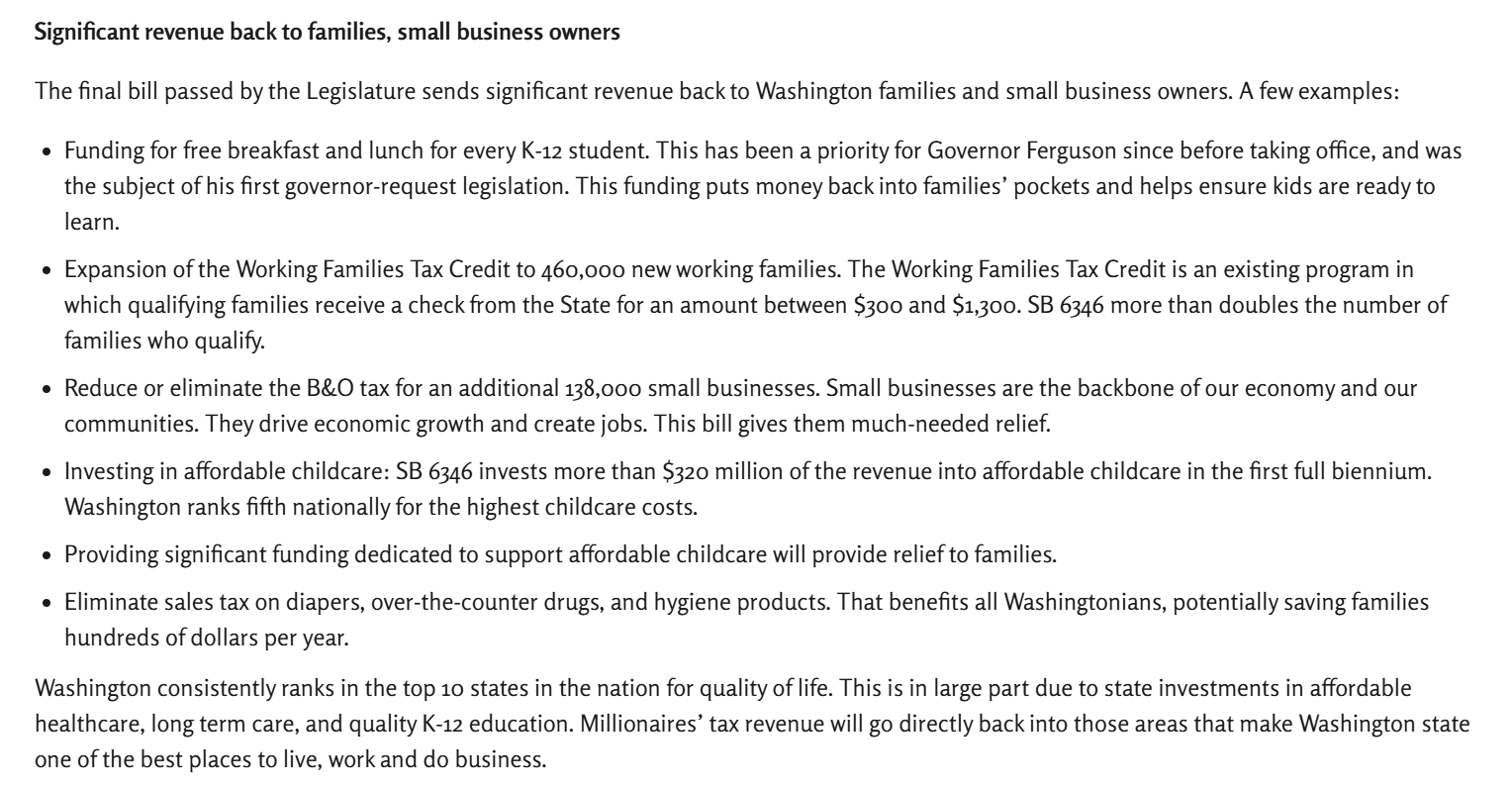
She should have been given a lift by the Millionaires’ Tax, signed a few months ago, which funds all of these great things:
But apparently not, because it seems that the pre-“socialist” tax rate structure isn’t sufficient to fund the socialist dream. “New taxes on the table as Mayor Wilson looks to balance budget deficit” (Fox 13, 6/22/2026):
Seattle’s projected budget deficit has grown to approximately $488 million over the next three years due to inflation and lower-than-expected property and sales tax revenues. To balance the budget, Mayor Wilson is exploring both spending cuts and new revenue options—such as a local capital gains tax or an expansion of the “JumpStart” payroll tax—noting that “nothing is off the table” ahead of her September budget proposal. The budget deficit has grown about $100 million more than initial projections, now standing around $488 million over the next three years. She could ask for spending cuts, but Wilson indicated that cuts alone will not be her strategy. Taxes are also on the table, including a capital gains tax. Right now, there is a statewide capital gains tax, but not a local one.
(Consistent with American innumeracy, the professional journalists don’t tell us what the city’s total budget is and, therefore, the readers has no way of understanding whether a $488 million deficit is a lot or a little. The city proper has a population of about 800,000 and about 380,000 households. So the deficit could be closed if each household contributed $1,300. There are an estimated 21,000 undocumented migrants in Seattle. Yale says that, in fact, we cannot estimate this population accurately and the real number is likely around 2X whatever we’re told by the media. Anyway, those noble enrichers presumably aren’t going to pay (nor should they, since they built Seattle in the first place). ChatGPT estimates roughly 55,000 households on what used to be called “welfare” so they’re not going to pay. Maybe 200,000 households (“the chumps”) would bear the burden? Each one needs to cough up closer to $2,500 if we assume the tax base doesn’t further deteriorate.)
Katie Wilson herself seems to be working on creating larger concentrations of those who are completely dependent on taxpayers:
The mayor’s package of legislation will take Seattle several big steps closer to opening 1,000 new units of shelter and emergency housing this year by treating this emergency like an actual emergency. … Even the most successful shelters that do the best work and have the best relationships in their communities are currently limited to serve only 100 people. … The mayor’s proposal would increase this limit to 150 people per site on an interim basis, provide support to address any potential public safety impacts, and additionally allow one location in each district to serve up to 250 people in cases where it makes sense.
Among her official news items, I couldn’t find anything about initiatives to attract productive business. The closest thing that I found was a proposed one-year moratorium on data centers, which later passed.
Starbucks decided to spend more than $100 million to move a lot of corporate functions to Nashville, where 2,000 people will work (US News). Right now, about 3,000 people work at Starbucks HQ in Seattle, but perhaps the number will be roughly equal to the Nashville cohort eventually because some employees are moving. (The best-known former employee already moved out: Starbucks billionaire advocates for higher tax rates and moves to Florida)
Amazon has been moving east, away from any taxes Katie Porter might try to collect, such as the city payroll tax that started in 2021 (passed during coronapanic when it might have been illegal for anyone to come into the city and work!), and toward Microsoft’s traditional stomping ground. (March 2026 article: “Amazon is abandoning offices near its headquarters in downtown Seattle.”)
Related:
- Ed Murray, mayor from 2014-2017: “A Democrat, he was previously a state legislator, first with the Washington State House of Representatives from 1996 to 2007, then the Washington State Senate from 2007 to 2013. In 2017, Murray faced multiple allegations of child abuse, rape and sexual molestation, including from a family member and his adopted son. … He is gay, and came out in 1980. In 2013, he married Michael Shiosaki…”
- Seattle Trip Report (minus Seattle per se), Part I
- Seattle Trip Report (minus Seattle per se), Part II
- Seattle Trip Report (minus Seattle per se), Part III
- the 16′-high statute of Lenin, who can’t be credited as an inspiration for American “socialists” because Lenin envisioned a society in which every able-bodied adult had to work:

Unlike her friends in New York she doesn’t have a benefit of river and distance to capture in people and businesses. Seattle proper is just a part of larger continuous Seattle metro area and other towns, which are way more business friendly, are actively competing for fleeing Seattle businesses, Bellevue being the largest receiver – entire area of former warehouses is rebuilt into new offices (Spring District).
I play poker with bunch of realtors, and they are telling me there is a lot of offloading of high-bracket properties going on, so it seems that high networth people are moving out of the state ahead of potential income and wealth taxes. Wealthy friend of mine just moved to Florida last summer. I have 30 year fixed on my house, so I’m not rich enough to move myself lol.
SK: That’s a good point. Someone who moves a few miles away from the City proper can’t be mocked as a “bridge and tunnel person” as he/she/ze/they would be in the good old Manhattan days (I guess now Brooklyn is just as good as Manhattan for the hip/rich and they need to take a bridge into the city, but also maybe they aren’t bridge and tunnel people because they never need to leave Brooklyn for any reason).