Friends have been asking me to help them understand the recent Boeing 767 crash at KMIA (see “5 dead, 5 injured after Amazon cargo plane overruns runway at MIA, sheriff says” (NBC)).
The plane is reported to have crashed at 1758Z, two minutes before 2 pm Eastern time. Based on recordings at liveatc.net, however, it seems that the crash was closer to 1753Z. Here are the weather reports before and after:
METAR KMIA 061853Z 00000KT 10SM TS SCT025CB SCT070 SCT170 BKN250 29/24 A2993
SPECI KMIA 061813Z 20012G17KT 10SM TS SCT025CB BKN048 BKN100 BKN250 30/23 A2992
METAR KMIA 061753Z 19017G26KT 10SM TS SCT020CB BKN048 BKN150 BKN250 30/22 A2994 RMK AO2 PK WND 18026/1752 WSHFT 1737 SLP137 TSB12 OCNL LTGICCG E-S TS E-S MOV E CB DSNT NW
SPECI KMIA 061713Z VRB03KT 10SM TS SCT030CB BKN050 BKN250 32/22 A2992 RMK AO2 TSB12 OCNL LTGICCG S TS S MOV E
Although the closest report to the crash is the 1753Z METAR and the wind was 19017G26KT (from 190 true at 17 knots, gusting 26), shortly after the crash the ATC Tower is heard telling listeners that the wind was only 190 at 8 (source: ATC app, an interesting new service). Depending on which weather report we think was applicable at the moment of the landing, there was a tailwind component of somewhere between 3 and 8 knots on Runway 30 (magnetic 304; true heading of about 300 (Miami magnetic variation is 5W)).
It is unclear why the heavy Boeing was assigned Runway 30, which is only 9360′ long and, due partly to a displaced threshold, has a “landing distance available” (LDA) of 7913′. That’s enough to allow a B767 to land in 60% of the available runway, but doesn’t leave a lot of additional room for error considering the typical final approach speed of 130-140 knots. Runway 27, by contrast, offers nearly 13,000′ of LDA and has more favorable alignment with wind coming from 190.
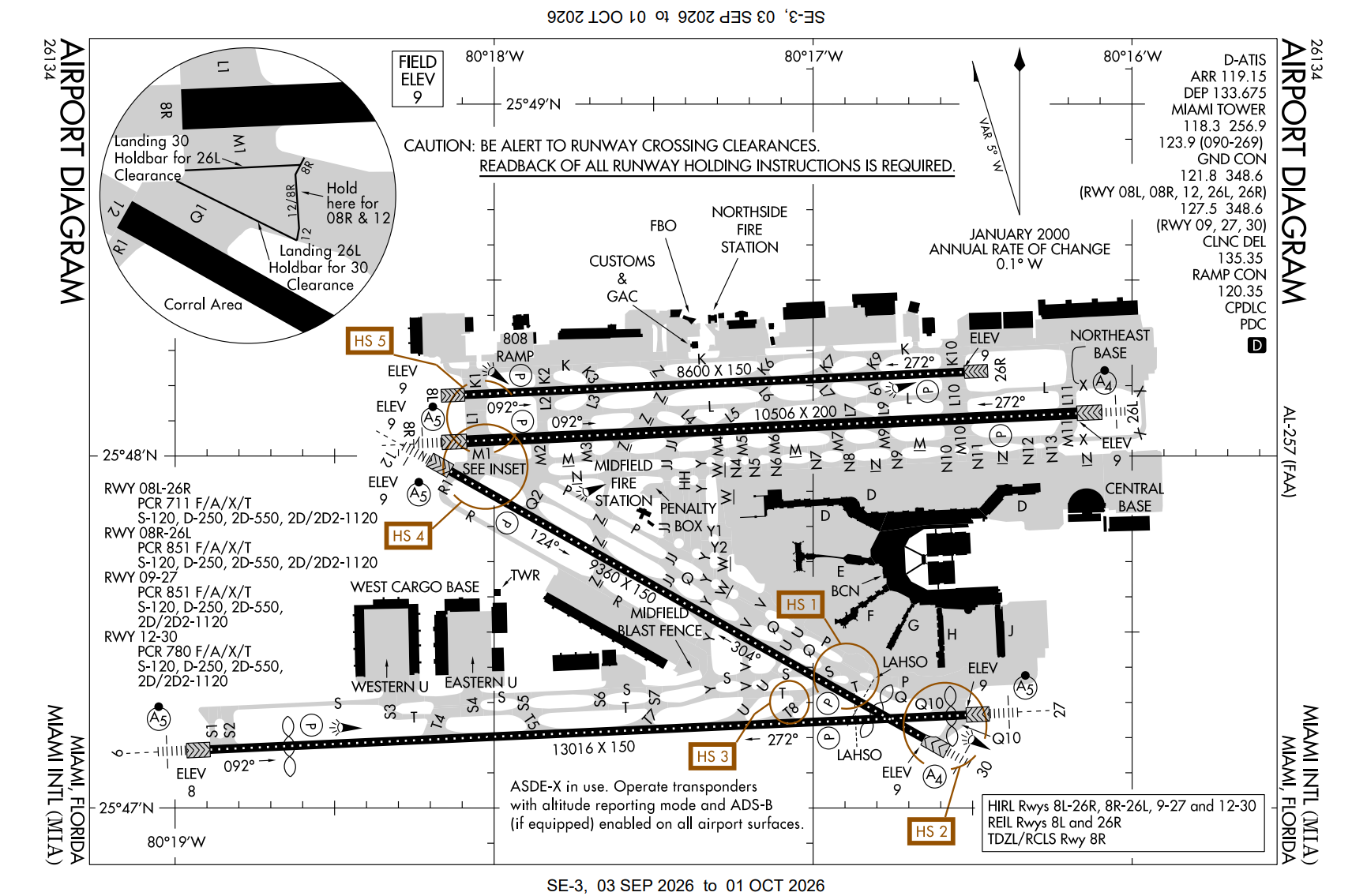
Typical Florida summertime heavy rain does not seem to have been a factor in this accident, but in any case all of the runways at KMIA are grooved and that’s supposed to prevent hydroplaning (the “dry” braking distance is used for planning even if the runway is actually wet). ATC communications with other aircraft before the accident don’t reveal anything out of the ordinary. The accident aircraft did not declare an emergency or report any issues prior to the accident.
Most runway overruns are caused by excessive energy: too much airspeed and too much altitude. It is tough to dissipate this energy if one lands halfway down the runway at a higher-than-standard groundspeed (remember that kinetic energy varies as speed squared). Why isn’t there a computer in an expensive jet that looks at the GPS position relative to the runway and the groundspeed and shouts “Go Around!” if an overrun seems likely? There is, but not for the typical jet. Airbus ROPS (Runway Overrun Prevention System) was introduced in 2009 on the A380 and has now been extended to the entire family of idiot-proof airliners. It says “Runway Too Short!” if it expects an overrun. Embraer has something similar called Runway Overrun Awareness and Alerting System and deploys it on airliners as well as on the single-pilot Phenom 100 and Phenom 300 personal jets (where “personal” means “affordable for Nvidia and AI company employees”). The Embraer system arrived on the Phenom 300E in 2020 and has a clearer warning: “Overrun; Go Around”. The Europeans are supposedly trying to require that all newly registered airliners have something like this.
Not a great day for aviation and, so far, not enough information to begin to guess at the cause of the accident.
Update (attempted go-around after touching down, which was abandoned four seconds later):
Update 9/9/2026, from the NTSB:


A sad reminder of part of my 2022 NBAA Report:
I learned that only 1% of unstable approaches result in a go-around (it should be closer to 100%).
Related:
- “Pilot in Amazon Cargo Plane Crash Repeatedly Flunked Flight Tests” (TIME 2019, regarding a B767 crash into the water near Houston)
- Amazon cargo 767 runway overrun at Vancouver in 2024: after some mechanical problems, which they knew would require a higher approach speed (no slats), the crew ran off the end of 08L, 9,940′ long. The same airport has an 11,500′ runway, 08R, but it was closed for maintenance at the time (on the third hand, it was immediately opened for use after the overrun so presumably the airport could have cleared the maintenance personnel and made 08R available). They had enough fuel to go to Sea-Tac, only 110 nm away. That has an 11,901′ runway. Lesson: if you know you’re in trouble, go to the biggest airport you can reach!
analysis by 767 pilot https://youtu.be/u2oVWUZ6Qww
Thanks, Steve. He highlights the higher-than-standard height of the flare. That reminded me of a section in https://philip.greenspun.com/blog/2013/07/07/my-visual-approach-and-asianas/ …
At about 200′ above the ground, Captain Mark disconnected the autopilot and transitioned to hand-flying. Somehow he ended up a little fast and also flared a bit too high. The CRJ is a very efficient glider and spooled down jet engines don’t supply the kind of drag that props would. The CRJ entered a shockingly efficient glide in ground effect at 10-15′ above the runway. We weren’t descending. We weren’t slowing down. The 7500′ runway was slipping away beneath us.
It is unclear how one would fix a situation like this. [In a piston airplane the best and easiest fix is to add power, retract the flaps, and climb away from the runway in order to try again; this can’t be done in an airliner due to the long spool-up time of the engines.] In a piston airplane you’d add a touch of power and pull back for a slower and less efficient airspeed. The airplane would sink due to loss of efficiency and the power would slow the vertical speed. In the jet, once the thrust levers are back it takes 3 or more seconds to get any significant power from the engine. Nosing the airplane forward would result in hitting the nose gear, which isn’t any better on a jet than on a piston four-seater.
After we had sailed over approximately half the runway, the airplane finally started to settle towards the surface. We touched with about 3000′ remaining [i.e., 4500′ down the runway, 2000′ more float than I experienced at LGA]. Captain Mark slammed hard on the brakes, to the point where the passengers probably would have said “ouch!”, and applied full reverse thrust. Tower called and asked “Are you going to be able to make Foxtrot?” This was the second-to-last taxiway and only about 500′ from the end of the runway. In fact, we did make Foxtrot, but only barely. We used just about a full 7000′ of runway. [I.e., at LGA we would have been nose-to-nose with the boats.]
(Same issue in the CRJ as the Boeing. If you don’t get weight on wheels you don’t have the ground spoilers popping up and the brakes aren’t designed to be able to stop the airplane by themselves (runway length planning assumes that reverse thrust fails, but that the spoilers work).)
The NTSB is holding a press conference at the airport at 4 P.M. ET today. It will be carried live on the PBS YouTube channel. The title at the moment is: WATCH LIVE: NTSB holds initial briefing on Amazon Air crash at Miami International Airport
Blancoliro has attributed the recent abundance of unstabilized, YOLO landings to human factors. The humans are just trying to hit too many home runs instead of going around.
I have a few comments from my perspective as a 20 year A320/321 pilot and current Check Airman:
1) US Airline FOQA data routinely shows a vast majority of “unstable” approaches are continued to a landing – sometimes on the order of 90% of the time, or more. Not shocking, but just to validate the other comment above. Granted the “stabilized” criteria are quite conservative, and being a “little fast” or a “little high” is usually correctable, but the parameters are there to keep crews far away from ultimate limits, and to prevent the normalization of deviance.
2) My airline’s fleet of A321LR’s has the ROPS installed and we use it. I don’t think it’s ever been triggered yet, as far as I know. Just FYI. The bigger question is if a pilot would listen to the system, if it was triggered…
3) 10+ years ago I recall using “dry” performance data for “wet but grooved” runways. However since adopting the AeroData centralized computer system for performance, we use “wet for wet” and “dry for dry” for both takeoff and landing. I’ve tested both wet and dry settings for a grooved concrete runway, and the “wet” data does show longer takeoff and landing distances. Just as a side note to Philip.
As far as this Amazon crash goes: I agree that this accident “appears” to be a grossly unstable approach from which they did not go-around as they should have, but the deeper question is, “why didn’t they…?” A crash like this can start with a poor approach setup and briefing before top of descent, or further back with poor cockpit professionalism and tone as set by the Captain’s attitude during preflight, or on the previous layover due to poor sleep/fatigue, or even further back in the case of a pilot experiencing significant personal or financial hardships that affects their performance and fitness for duty. These inputs to the investigation are as important as the weather and status of aircraft systems. The NTSB usually does an excellent job investigating all factors, so I’ll be curious to read the eventual final report.