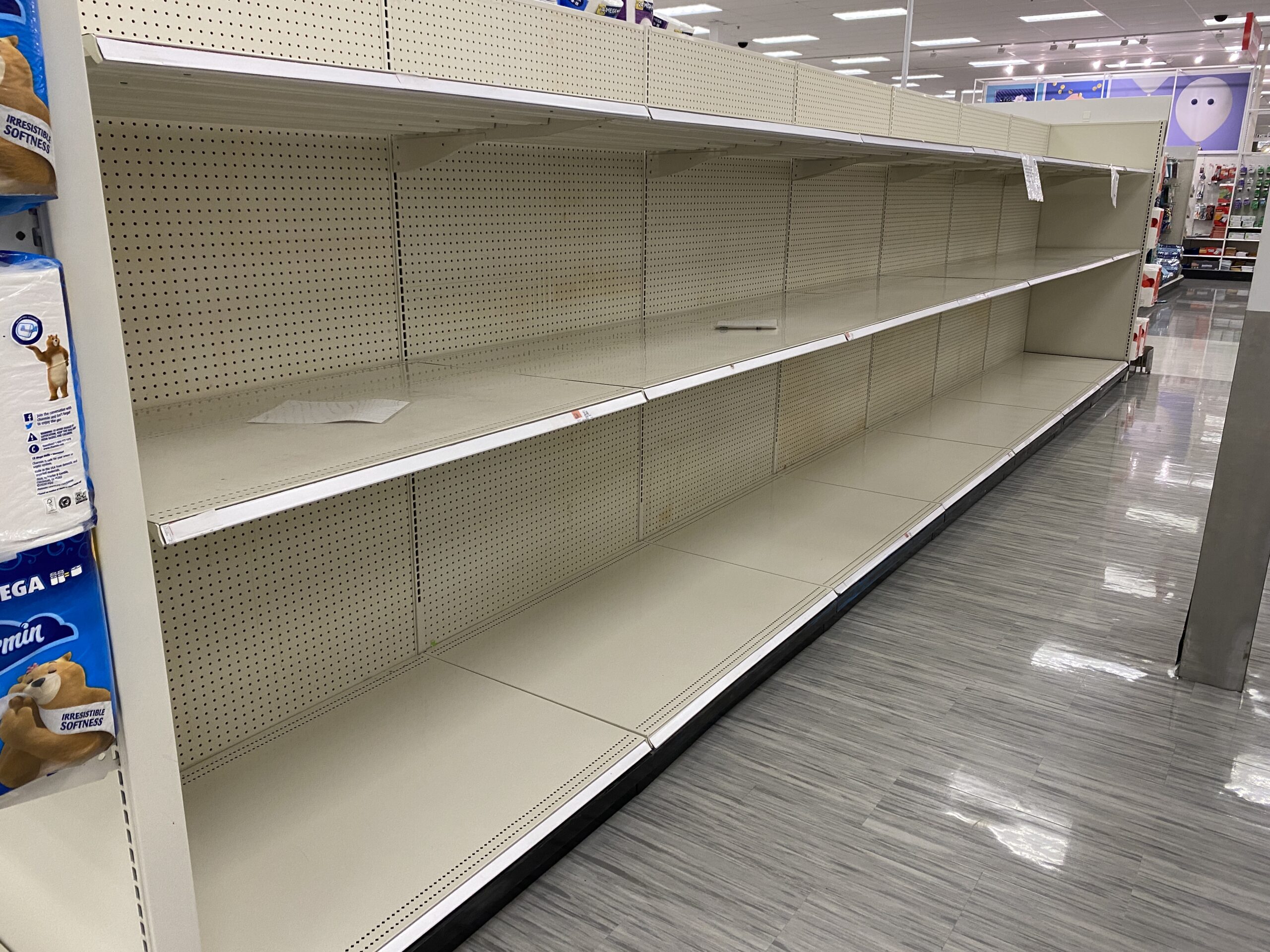
With tens of millions of Americans on the “$600 per week and chill” plan, a lot of retailers shortened their hours. In theory, things should be getting back to normal (it was a brief shutdown to “flatten the curve,” right?), but at least our local supermarkets seem to have kept their new shorter hours.
Are we on track to become more like Europe, where if you don’t want to conform to the standard hours you won’t be able to get meals, food, etc.? (walk around Paris and see if you can find a 24-hour CVS!)
Readers: What have you seen in your regions of the country? Are hours still curtailed?
Some of our recent helicopter flying has been with a photographer tasked with getting pictures of shopping malls in the context of highways, cities, etc. What are these for? “Everything is for sale now,” he said. “They’re all going bankrupt.”
Is it actually too late for these spaces? If schools need more square footage to do in-person learning, why not rent the vast department stores to local school districts? Because the schools aren’t actually willing to pay? In Shanghai, a typical mall might have half the space devoted to after-school programs for children, e.g., dance or English-language instruction. Perhaps that can’t work in the U.S. because at any time a governor can make it illegal to operate the after-school program.
Readers: What else can be done with these spaces? If retail and most other forms of gathering are outlawed, what is the value of a lot of climate-controlled space?
Just as the Swedes said back in March and April (interview with an MD/PhD), since coronavirus is now a permanent companion for humankind, if ye seek ye shall find. American universities have embarked on massive testing programs and are discovering that young humans can be and are infected with coronaplague. To protect our delicate society, they’re virtuously shutting down.
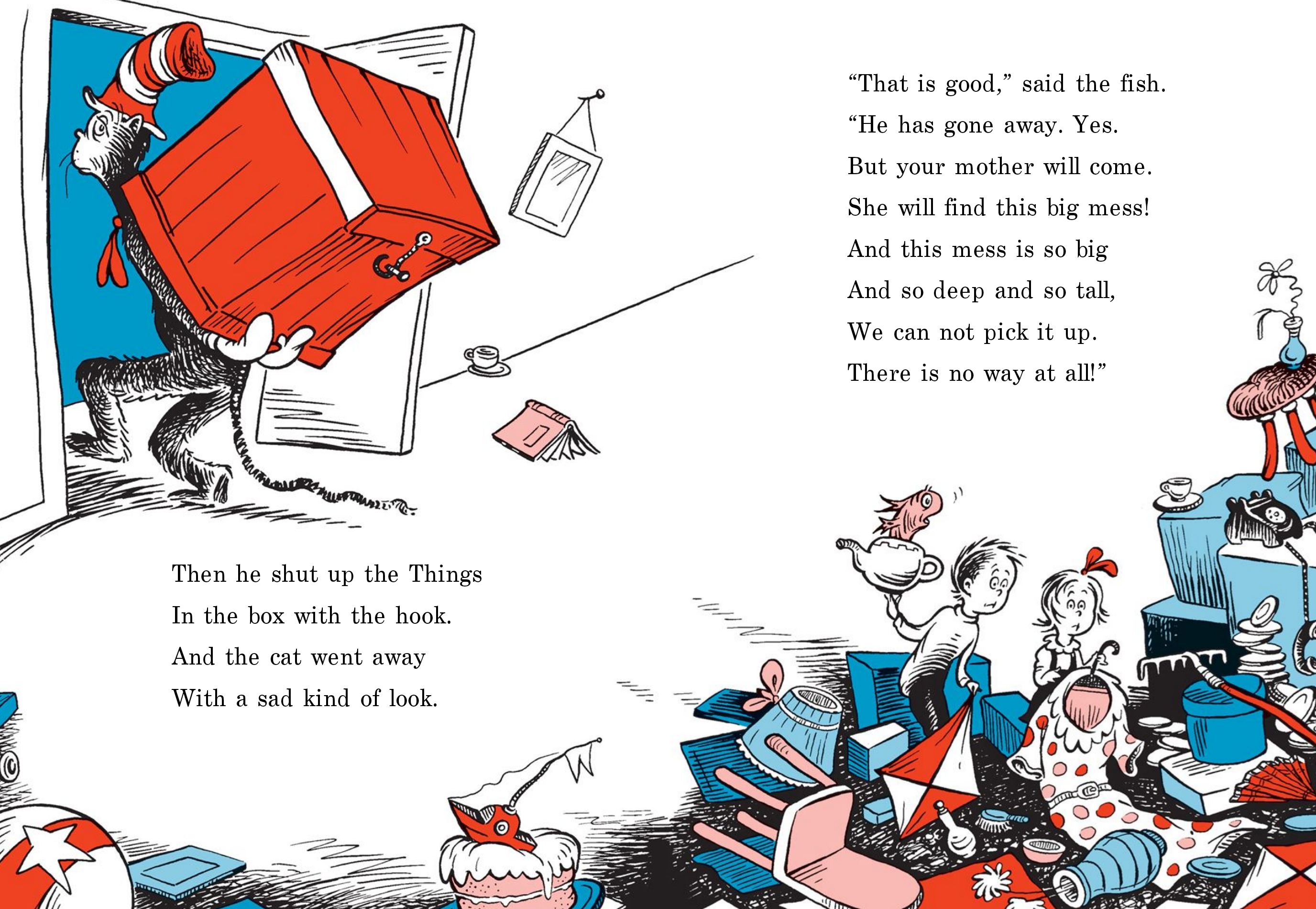
‘that is good,’ said the fish. ‘he has gone away. yes. but your mother will come. she will find this big mess! and this mess is so big and so deep and so tall, we can not pick it up. there is no way at all!’
If the students are sent home, yes, why won’t we find a big mess of coronaplague wherever they decide to live? Instead of gathering with fellow students at College A and possibly infecting middle-aged Professor B, they’ll gather with their high school friends and possibly infect their middle-aged parents, with whom they will be stuck living indefinitely. Is it plausible that the net result will be reduced overall plague?
Evidence in favor of shutdown: the Swedes closed their universities back in March, one of only a handful of things that they did other than simply giving the finger to the virus. But the idea there was to slow down the virus and avoid overwhelming the medical system (the Swedish government overestimated the need for ICU beds by more than 3X). The Swedes never said that closing universities would make the virus go away or keep young people from spreading it to each other within a few months.
Evidence against the effectiveness of any shutdown: “‘Do you really need to party?’ WHO asks world’s youth” (if old people are telling young people to do something “for their own good” we can almost always win by betting against, right?)
Turbine-powered Shutdown Karens: “A Vaccine That Stops Covid-19 Won’t Be Enough” (New York Times). Even if we have a vaccine that prevents coronavirus infection from turning into COVID-19 disease, it won’t be safe to leave our bunkers:
But even if one, or more, of those [vaccine development] efforts succeeds, a vaccine might not end the pandemic. This is partly because we seem to be focused at the moment on developing the kind of vaccine that may well prevent Covid-19, the disease, but that wouldn’t do enough to stop the transmission of SARS-CoV-2, the virus that causes Covid-19.
A vaccine’s ability to forestall a disease is also how vaccine developers typically design — and how regulators typically evaluate — Phase 3 clinical trials for vaccine candidates.
Yet the best vaccines also serve another, critical, function: They block a pathogen’s transmission from one person to another. And this result, often called an “indirect” effect of vaccination, is no less important than the direct effect of preventing the disease caused by that pathogen. In fact, during a pandemic, it probably is even more important.
That’s what we should be focusing on right now. And yet we are not.
Stopping a virus’s transmission reduces the entire population’s overall exposure to the virus. It protects people who may be too frail to respond to a vaccine, who do not have access to the vaccine, who refuse to be immunized and whose immune response might wane over time.
Preventing the very transmission of SARS-CoV-2, no less than stopping it from turning into Covid-19, should be a main priority of current efforts to develop the vaccines to end this pandemic.
So… the shutdowns will continue even after people stop getting sick and/or dying from COVID-19.
Franklin Templeton manages about $700 billion in assets. What does their Chief Investment Officer for Fixed Income think Covid-19 will lead to? Inflation!
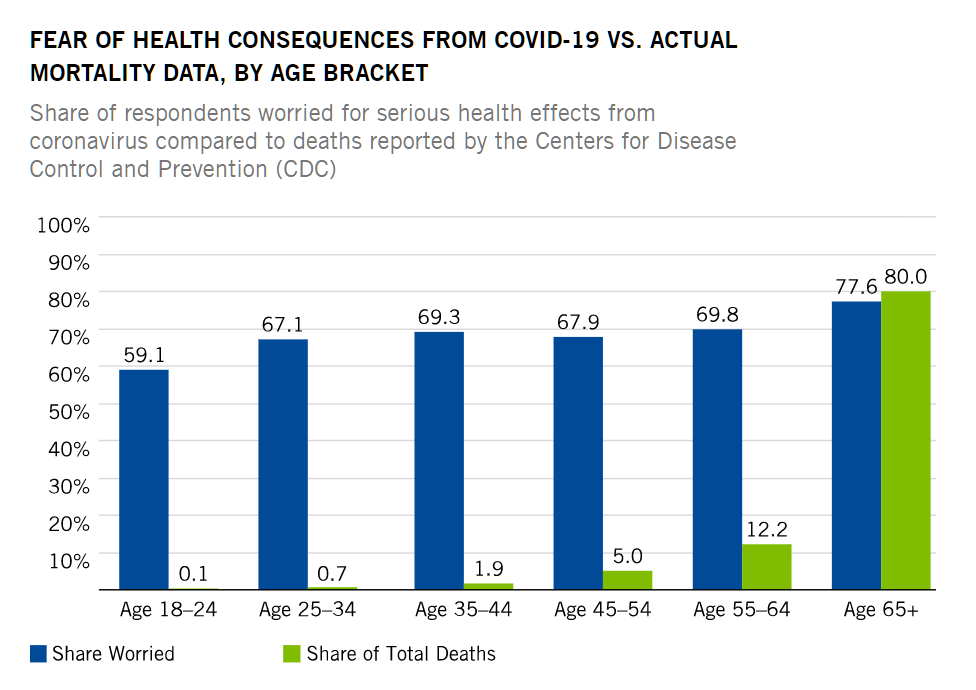
Americans still misperceive the risks of death from COVID-19 for different age cohorts—to a shocking extent;
The misperception is greater for those who identify as Democrats, and for those who rely more on social media for information; partisanship and misinformation, to misquote Thomas Dolby, are blinding us from science; and
We find a sizable “safety premium” that could become a significant driver of inflation as the recovery gets underway.
How can a virus drive inflation? I think that her argument is that Americans with money will spend like crazy to protect themselves from the virus, e.g., buying first class airline seats or choosing airlines with blocked middle seats. Meanwhile there will be contraction in supply. We’ve already seen this in real estate. The rich are spending even more for country estates and for fixing up country estates. It is impossible to get a contractor because they’re already hired and the additional workers they might want to hire are relaxing on $600/week (but maybe that will change soon?).
These misperceptions are destroying our economy:
This misinformation has a very concrete adverse impact. Our study results show that those who overstate deaths among young people are more cautious about making purchases, more reluctant to travel, and favor keeping businesses and schools shut.
I.e., the Swedes who gave the finger to the virus are likely to do relatively better than Americans (but we stole a bigger piece of land from the Native Americans than they did, so we might still be richer).
What does the cower-in-place nation look like, emotionally?
How did the misperceptions arise? Facebook Shutdown and Mask Karens: “People who get their information predominantly from social media have the most erroneous and distorted perception of risk.” Traditional media was also responsible, says Desai:
Fear and anger are the most reliable drivers of engagement; scary tales of young victims of the pandemic, intimating that we are all at risk of dying, quickly go viral; so do stories that blame everything on your political adversaries. Both social and traditional media have been churning out both types of narratives in order to generate more clicks and increase their audience.
Stories that emphasize the dangers of the pandemic to all age cohorts and tie the risk to the Administration’s handling of the crisis likely tend to resonate much more with Democrats than Republicans. This might be a contributing factor to why, in our survey results, Democrats tend to overestimate the risk of dying from COVID-19 for different age cohorts to a greater extent than Republicans do.
How about in Desai’s native land? “One in four Indians may have Covid antibodies, show tests” (“57% in slum areas”) The doctors quoted in this Times of India piece aren’t too worried about coronaplague, the polar opposite of what you’d find in a U.S. newspaper (they’d find the most fearful doctors in the country to quote!).
Does this make sense? What if Covid-19 tests actually accelerate the transmission of coronaplague? Consider that a swab from an infected person who is asymptomatic or mildly symptomatic is unlikely to contain any virus. Even with perfect machines and technicians, therefore, any test will return a false negative. (perhaps about 70 percent of tests on the infected, but not-sick or not-very-sick, will be false negatives)
Suppose that we enter the American technocrats’ dream world. We have unlimited testing capacity with the current testing technology. The person who doesn’t feel 100% goes in for a test. It comes back negative a day later. Buoyed by the test result, even though the person feels a little worse, he/she/ze/they decide to go shopping, go to work, etc. Thanks to the negative test result, this person can be fairly sure he/she/ze/they is suffering from a cold or some other minor virus, not the dreaded Covid-19.
Imagine a world in which no testing is available. Fever or just not feeling well? Stay home in isolation because there is no way to know whether it is Covid-19 or not.
Readers: What do you think? Is all of the testing not only a waste of time and money, but actually counterproductive if the goal is to slow down the spread of coronaplague?
Potential evidence: A bunch of American universities were reopened recently. This was partly due to faith in (a) masks, and (b) testing. Some of them have already shut down for in-person instruction. The explanations in the media that I have seen are that not every student wore a mask at all times and that not enough testing was done. It could have worked if only mask habits had been better and perhaps if testing had been stepped up to every day instead of every three days. These media articles are typically accompanied by a photo of students wearing masks and standing or sitting fairly far apart.
Related (sort of): if cowbell isn’t working… More Cowbell
Related:
Stockholm University: “The Public Health Authority urges everyone with symptoms of a respiratory infection, even a mild one, to avoid social contact, as they pose a risk of spreading infection. Everyone with symptoms of illness should stay at home.” (i.e., don’t come out coughing even if you have a negative test result to show!)
Shocking incompetence has unnecessarily wiped billions of pounds from the UK economy
So now we know: Sweden got it largely right, and the British establishment catastrophically wrong. Anders Tegnell, Stockholm’s epidemiologist-king, has pulled off a remarkable triple whammy: far fewer deaths per capita than Britain, a maintenance of basic freedoms and opportunities, including schooling, and, most strikingly, a recession less than half as severe as our own.
Our arrogant quangocrats and state “experts” should hang their heads in shame: their reaction to coronavirus was one of the greatest public policy blunders in modern history, more severe even than Iraq, Afghanistan, the financial crisis, Suez or the ERM fiasco. Millions will lose their jobs when furlough ends; tens of thousands of small businesses are failing; schooling is in chaos, with A-level grades all over the place; vast numbers are likely to die from untreated or undetected illnesses; and we have seen the first exodus of foreigners in years, with the labour market survey suggesting a decline in non-UK born adults.
Tegnell is one of the few genuine heroes of this crisis: he identified the correct trade-offs.
Good news: Britain has no “systemic racism”; bad news: it does have “systemic incompetence”.
This is a catastrophically high price tag for the British state’s systemic incompetence, the uselessness of Public Health England, the deep, structural failings of the NHS, the influence of modelers rather than proper scientists, the complacency, the delusion, the refusal to acknowledge that the quality of the British state and bureaucracy are abysmally poor.
The author notes that “panic and hysteria were the only possible outcome.”
(Coronavirus hasn’t been a problem for people who live on alimony and/or child support, but the article describes “cancelled weddings” and therefore a delay in being able to file a divorce lawsuit in one of the world’s most lucrative jurisdictions. (see “International Divorce, Custody, and Child Support Systems” for how profitable a short-term marriage in the U.K. can be).)
Tough to imagine an editorial this harsh in a major U.S. paper! The NYT might publish something that attacks Donald Trump, but not an attack like this on the competence of the federal and state governments!
The article is paywalled, but I uploaded a PDF that a reader graciously created.
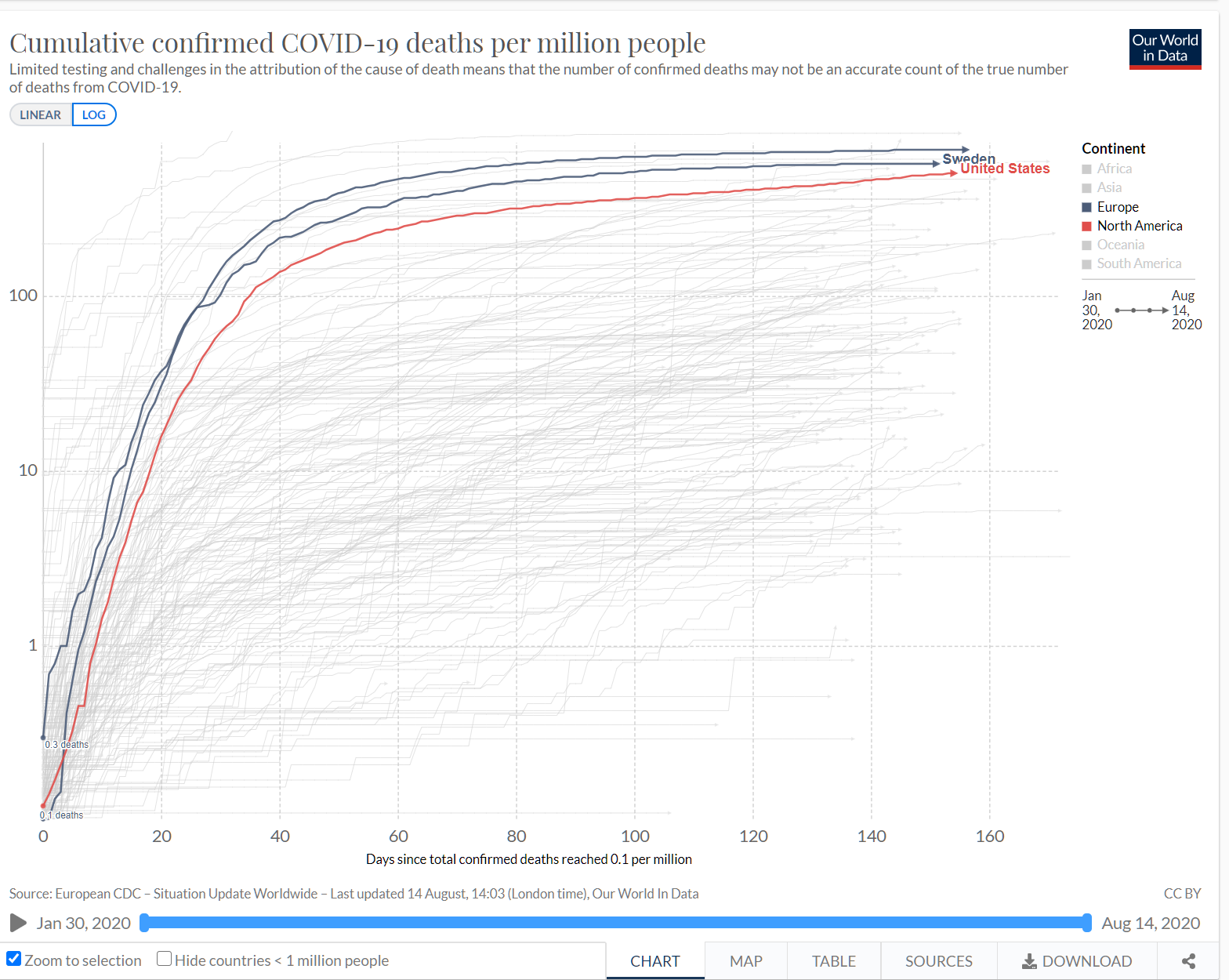
What are the numbers? The U.K. has a higher death rate than Sweden or the U.S., but it would appear that the U.K. and the U.S. will converge. In other words, both panic-stricken and shut-down-for-months countries will end up with more deaths per capita than never-shut Sweden. The U.K. line is the top of the chart below.
One of the things that I have learned in meetings with a big health insurance company whose claims data we use in the classroom: emergency room (“ED”) visits are expensive. A long wait followed by a temperature and pulse ox test then advice to take two Tylenols will cost the employer who sponsors a health plan at least $1,000.
One idea that I came up with around a conference table with the insurance folks was to put a doctor and nurse in a motorhome crammed with all of the stuff that one would typically find in a primary care clinic. Tell folks enrolled in the plan “You can go to the hospital and wait two hours to be seen and pay a $125 co-pay. Or you can stay comfortably at home and the doctor will be there in four hours.”
This is plainly a bad idea because it is obvious and yet no insurance company is doing it. Maybe it is bad because the U.S. is so short of physicians that it is intolerably inefficient to have the physician idle when driving from one house to another. France has a lot of doctors per capita and they do still make house calls (see this 2009 article).
Perhaps the idea is a little less bad in the Covid-19 age. Do we want people congregating in hospital waiting areas now that we can be pretty sure that at least one of the waiting patients is plagued? If the patients are seen at home, at least there is no patient-to-patient contact/transmission.
We already have the technology and skills to build the motorhome-based clinics. Matthews Specialty Vehicles seems to have built a bunch, for example. Odulair in Wyoming has everything up to mobile CT and mobile MRI (these are perhaps overengineered for checking on a person who has flu-like symptoms). Laboit says that they can fit a primary care clinic with a single exam room into a 28 ft. Class C RV:
Massachusetts’ education department is reportedly issuing guidance on the amount of remote learning schools should use based on the coronavirus risk level in their communities.
As school districts scramble to submit reopening plans to the Department of Elementary and Secondary Education by Friday, superintendents received a memo from Commissioner Jeffrey Riley Tuesday night that would limit the use of online learning, according to The Boston Globe.
Here’s the map….
From a linked page:
Chelsea, Everett, Lynn and Revere are included in the high risk category, meaning they have over eight cases per 100,000 residents. Twenty-nine other communities, including Auburn, Belchertown, Boston, Brockton, Charlton, Chicopee, Fall River, Framingham, Georgetown, Granby, Holyoke, Hull, Lawrence, Longmeadow, Malden, Marlborough, Maynard, Middleton, Northampton, Peabody, Salem, Saugus, Springfield, Quincy, Randolph, Taunton, Winthrop Worcester, Wrentham, are in the moderate risk category, meaning they have between four and eight cases per 100,000.
In other words, if your town is packed with welfare-dependent People of Color and migrants… no school (“remote learning” in your crowded public housing apartment). The rich white kids in Wellesley and Dover can go back to school, though!
I spent some time recently with two Harvard undergraduates who are camped out in a Cambridge apartment. I’m the oldest person that they’ll have any contact with for the foreseeable future, yet these 20-year-olds behave as though they either worked or lived in a nursing home for 90-year-olds. Asked why they put so much effort into mask-wearing and deny themselves so many social opportunities that they would previous have jumped at, they say that they are personally afraid of getting coronavirus. They’re not obese or chronically ill, so their statistical risk of being felled by Covid-19 is low (see
from mass.gov, statistics that have now been removed), but they seem to perceive Covid-19 as the main risk to their lives and health. They won’t take off their masks, for example, even when outside in mostly-deserted Cambridge. After talking to and observing them, I concluded that, at least for young Americans, Covid-19 is now primarily a disease of the mind. Support for my theory: “We’ve Hit a Pandemic Wall” (NYT, August 5)?
New data show that Americans are suffering from record levels of mental distress.
Let’s start with the numbers. According to the National Center for Health Statistics, roughly one in 12 American adults reported symptoms of an anxiety disorder at this time last year; now it’s more than one in three. Last week, the Kaiser Family Foundation released a tracking poll showing that for the first time, a majority of American adults — 53 percent — believes that the pandemic is taking a toll on their mental health.
This number climbs to 68 percent if you look solely at African-Americans. The disproportionate toll the pandemic has taken on Black lives and livelihoods — made possible by centuries of structural disparities, compounded by the corrosive psychological effect of everyday racism — is appearing, starkly, in our mental health data.
Turns out the extra ten extra pounds around my middle have moved in and unpacked, though I’d initially hoped they were on a month-to-month lease.
The newspaper that has been cheerleading for Shutdown now is surprised that there are some negative consequences? How did the coastal elites not figure out that not everyone’s shutdown experience would be positive? A friend in the Boston suburbs, who was a work-from-home consultant long before the Age of Shutdown, was telling me that his 8th grader hadn’t minded being at home for three months with minimal instruction being provided by the lavishly funded public school. Therefore, he concluded, shutdown was not a big deal, and if the school shutdown lasted another year that was okay too. His son would do fine practicing on the grand piano, learning from Ph.D. Dad and super smart stay-at-home Mom, etc.
I pointed out that not every American child lived in a 6,000 square foot $2 million house with two biological parents who get along at least reasonably well. Would he acknowledge that an inner-city child crammed into a two-bedroom public housing unit with mom, a step-sibling, and mom’s latest boyfriend might have a less favorable view of school shutdown? (he did!)
This is like the Twin Towers imploding all over again – except this time, one story collapses each day, and there is no ground floor.
The pandemic in and of itself is stressful but then add the stress of Trump’s daily tweets. The thought that he might get re-elected makes the stress almost unbearable.
What I think has caused the national stress-out, Ms. Senior, is that America now knows that it’s on its own. We don’t have a president who actually understands and cares about us.
I stress over the corrupt Republican leadership, so unconcerned for 99.9% of Americans that they let a a spoiled child throw our health, education, and welfare out the window, …
A coworker yesterday confided that about 15 of her relatives are COVID positive after a big family graduation party 10 days ago. I couldn’t hide my disgust. She is a very highly paid executive. We work for a research university health system!!! My neighbors just had a 40-person party for their 9-year-old. And seemed miffed and befuddled that many of us on the block declined to attend. They were all crammed under a tent shoulder to shoulder. Nary a mask in sight.
Maria from Maryland: The thing is, a lot of us are coming to the conclusion that all our problems are the same problem. Botched coronavirus response? Republicans. Insisting on doing things that spread the disease? Same. Economic deprivation? Republicans again. Two generations of failing to address racial issues? Again. Two generations of banging our heads against the same gender barriers? You guessed it. Failure to deal with climate change? Do you need to ask? Guns? Infrastructure? Science? Arts? They’ve been at it my whole adults life, ruining everything. And at their apex, they produced the very worst man in the world. There will be a vaccine for the virus, but what about the humans who are ruining our lives?
Coronaplague wouldn’t bother them at all, apparently, if Joe Biden were the Great Father in Washington right now!
Coronaplague obviously is a real problem for the elderly/vulnerable. And in societies where it is allowed to run wild, e.g., Sweden, it will kill approximately 0.05 percent of the population within a few painful months. But will readers agree with me that if young people are afraid of getting the disease personally, despite having no actual or planned contact with the old/vulnerable, then coronavirus has mutated into something whose main effect is mental illness?