Entrepreneur vs. government worker perspectives on Coronaplague

A serial entrepreneur friend forwarded an email from a local 8th grade teacher:

I have decided to take up a new hobby as a way to get outside and stay healthy and I thought why not try to run again?! I ran a half marathon 5 years ago and have tried to avoid running since because I didn’t train properly and hurt my foot. Now I know to stretch before and after so I figured now’s the time!! It’s been nice yesterday and today and I hope the nice weather continues!!

I have also been doing a lot of “virtual” time with my family and friends. It is very hard not to see anyone but this makes it feel a little easier for me. As an update, my dog no longer barks at people when we go on walks so she is getting better behaved which is also a positive!!

I miss you all very much, it makes me realize how much I love my job (which I already knew!!) and how important you are all to me. I hope you’re all taking care and finding ways to stay busy!

His commentary:

I’d love that fucking job too.

(Our teachers are still getting paid at 100 percent, but need not provide online instruction; see “The economic inequality of coronavirus”)

Full post, including comments

Let’s ask again: Number of new COVID-19 cases worldwide is declining now?

On March 26, I asked “Number of new COVID-19 cases worldwide is declining now?”

I’ve been updating that post daily with numbers from WHO and Massachusetts. Neither sequence seems consistent with frightening exponential growth (maybe the worldwide data shows an exponent larger than 1, but not all that much larger). Massachusetts does seem to be experiencing a flat-to-down trend in new cases, though without the strong upward trend in testing that I would have expected.

Maybe this is because all of the world’s governments had the foresight to put everyone into “lockdown”? (Exchanging germs only when at essential jobs, when at essential shops (such as liquor and marijuana stores), when at the laundromat, when on a Tinder date, etc.) The WHO data don’t show a dramatic difference between otherwise comparable countries that have radically different rules (Sweden has fewer cases per capita than Denmark, for example, despite Sweden being open for business while Denmark is purportedly locked down. Norway has twice as many cases per capita than Sweden, albeit fewer deaths so maybe they are just testing more of the mild cases) . More importantly, the WHO data don’t seem to show coronavirus burning exponentially through any country, regardless of what the policy might be (even Brazil, which has chosen “immunity via sewage”).

(This is not to suggest that a declining number of cases will cheer anyone up. On March 17, we were looking at the potential for 2.2 million Americans to die from coronaplague (Business Insider), based on Imperial College forecasts. Now a forecast of 100,000 to 200,000 deaths is “grim”, “stark”, and “dire” (Associated Press). Nobody will say “That’s fewer than are killed by medical errors each year and we don’t bother taking any action to reduce those.” Nobody will say “We’ve killed way more than that with taxpayer-funded Medicaid-reimbursed opioids.”)

Readers: What do you think? Given the increased testing capability that countries have been building and the numbers from the WHO, it is possible that the number of new daily coronavirus cases is actually on the decline?

Related:

Full post, including comments

Time for caravans of Americans to flee to Honduras?

How are things looking in https://www.who.int/emergencies/diseases/novel-coronavirus-2019/situation-reports ? Should caravans of Americans be heading south? A pillar of our political faith is that everyone who lives in Honduras (139 cases), Guatemala (36 cases), or El Salvador (30 cases) needs to come to El Norte (140,640 cases) for safety (once established here, the purported “gangs” that fought each other down there will never start up another fight?).

Does coronaplague change anything? Might it be smart for Americans to flee south in caravans (“Coronavans”?) to Central America? If so, which country looks like the best option?

(Or how about Haiti? Our Deplorable President famously disparaged this fine nation of hard-working efficient well-organized citizens. But right now, with 15 cases, it looks like a safe haven, no?)

An image from Guatemala, part of my Mamiya 7 camera review:

Related:

Full post, including comments

Will convicted felons still get gold-plated health care in the plague times?

The U.S. is #1 when it comes to running prison colonies (countries ranked by incarceration rate), which just happen to be ideal environments for spreading coronavirus. Pre-plague, a convicted felon, no matter how heinous the crime, had the same right to services in the world’s most expensive health care system as anyone else. If it cost $10 million and a bunch of donated organs to keep a drug abuse-damaged murderer serving 15-20 years alive for another few years, the taxpayer was there to step up and the hospital was there to collect the revenue. If Harvey Weinstein is short of breath while serving his 23-year sentence, under the old rules he gets a ventilator with the same priority as someone who didn’t enjoy sex with a lot of aspiring actresses (and, in fact, if one of his former shower buddies or sex partners falls ill, she might have to wait in line behind her abuser to get the ventilator and ICU bed).

Now that it is obvious that the system doesn’t have enough capacity for the U.S. population, what will happen?

  • half the prisoners will get released under a “social criminal distancing” policy?
  • convicted criminals will get services with the same priority as everyone else, resulting in the deaths of Americans who haven’t been convicted of any crimes?
  • we write down a triage plan where we give an explicit priority to those convicted of crimes (but what should the priority be? Given that criminality is at least partially genetic and released criminals are likely to re-offend, does it make sense to save a 25-year-old who is in prison and from whom we expected 40 more years of crime rather than a 75-year-old in the general population from whom we expect 5 more years in a retirement home?)
  • something else?

Readers: Will this crisis break our commitment to giving convicted criminals unlimited health care?

Related:

Full post, including comments

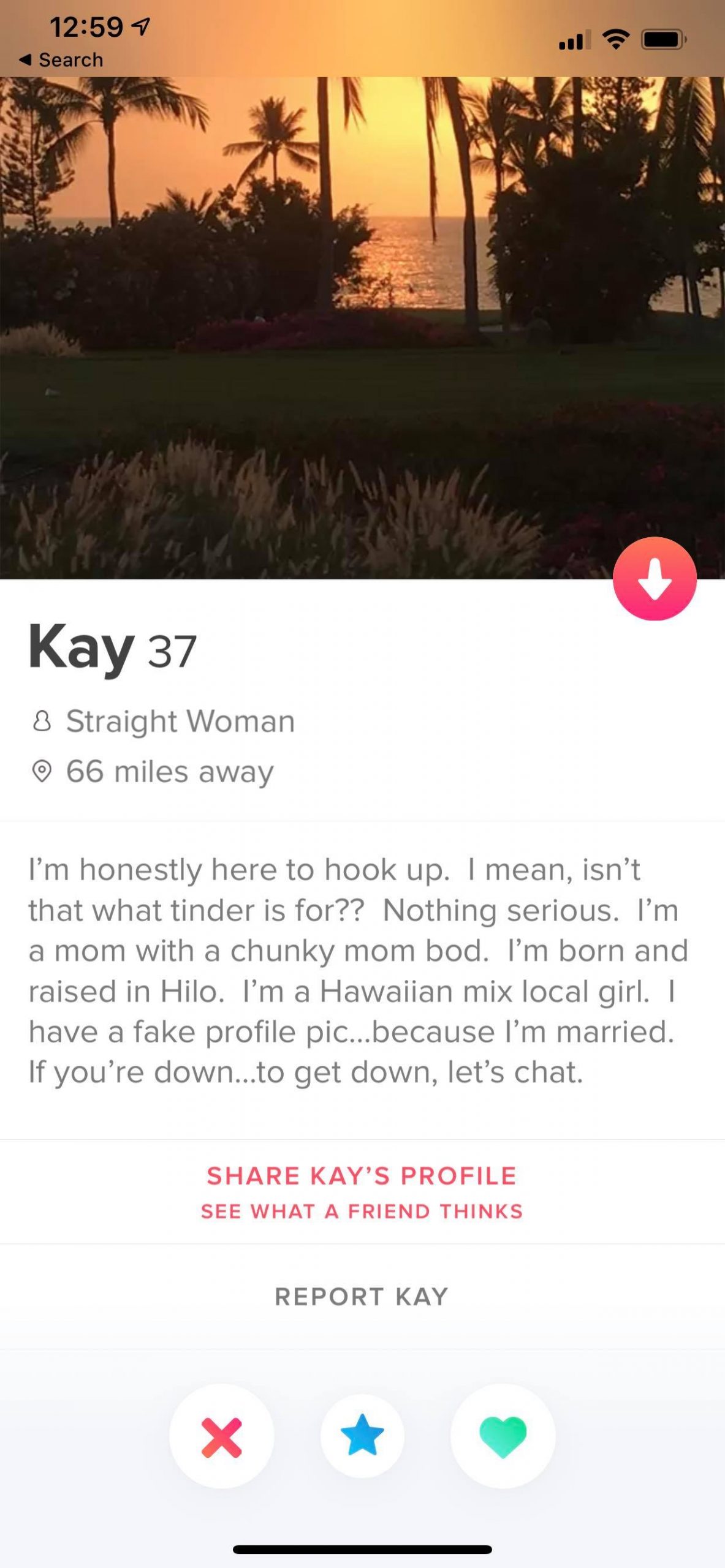
Coronatinder

A friend visiting Hawaii found this on his phone on March 20:

Looks as though her family’s potential exposure to coronavirus is higher than might be expected by the husband/wife/whatever else she might be married to.

Time for an emergency order to shut down all dating/hookup sites? Even with “shelter in place” orders, people on their way to meet new friends can simply say “I was headed to the grocery store,” right?

[Let’s assume that the spouse is a “husband.” What if the man wants to cut his coronarisk? If he’s typically at work earning to support the family while the wife is with her new friends, suing this “mom with a chunky mom bod” will be pretty costly under Hawaii family law.]

Related:

Full post, including comments

Coronaplague cannot stop the marijuana industry

Email received by a friend who runs a retail business (or what’s left of it) from the Massachusetts Department of Revenue:

830 CMR 62C.16.2: Sales and Use Tax Returns and Payments

Status: Emergency Regulation Promulgated 3/19/2020

Tax Type: Sales (including Sales tax on meals) and Use Tax

Summary: This emergency regulation amendment adds a new section (7) which suspends return filing and payment remittance obligations for certain vendors during the COVID-19 State of Emergency declared by the Governor. Specifically, the sales and use tax filing and payment schedule for vendors, whose cumulative sales and use tax liability in the 12-month period ending February 29, 2020 is less than $150,000, shall be as follows. Returns and payments due during the period beginning March 20, 2020 and ending May 31, 2020, inclusive, shall be suspended. All such returns and payments shall be due on June 20, 2020. This suspension does not apply to marijuana retailers as defined in M.G.L. c. 94G, § 1, marketplace facilitators or vendors selling motor vehicles. Such vendors shall continue to file returns and make payments in accordance with the rules set forth in 830 CMR 62C.16.2(3)-(6).

Full post, including comments

First friend with COVID-19: mild symptoms for 5 weeks

I’ve heard of a few friends of friends with COVID-19. One of my students at Harvard Medical School believes that he had it, but was unable to get tested. Last night I learned, for the first time, of a friend who almost surely has COVID-19. His wife is the only one who has actually been tested (via lung scan; the RNA test won’t be back until Wednesday). They’re in Michigan and, like Massachusetts, tests are mostly for those who are hospitalized. She is 50 and has suffered from a variety of health conditions, unfortunately, for the past 15 years, that include diabetes and a heart infection. She gets sicker than the rest of the family when there is a cold or flu going around and has had pneumonia a couple of times in recent years. She hasn’t needed oxygen or a ventilator yet.

He thinks that he got the disease on February 19th in New York City. Since then he’s had a cough, occasional chills at night, intermittent fever (never over 100). He’s 56.

Due to living together in a small house, their teenage children must have gotten coronavirus as well. A son was asymptomatic. The daughter experienced it as a cold.

He’s a university professor and has been able to work through all of this, never taking a day off.

So… if you cough and your friends shout out “Coronavirus!” as a joke… they might be right.

Full post, including comments

State-by-state model of hospital bed and ICU demand

Some data nerds at University of Washington, specifically within the Institute for Health Metrics and Evaluation, have prepared a state-by-state forecast of coronaplague peak and hospital bed/ICU demand/shortage. (See previous post: “Will New York run out of hospital beds?”)

They’re projecting roughly 80,000 deaths in the U.S. through August 4, 2020, with a range of 40,000 to 160,000. In other words, about as bad as four years of easily preventable deaths due to driving (assuming that half of driving-related deaths could be prevented with improved infrastructure and technology). The peak will be April 14, 2020, just in time for taxes. We will need roughly 1.2X as many ICU beds as we had before any ramp-up (shortfall of 14,000+ ICU beds divided by about 80,000 total ICU beds in 2018). We need only about 19,000 ventilators nationwide (this is completely inconsistent with New York Governor Cuomo’s statement that his state alone needs 30,000; the “experts” say New York will need closer to 4,000 and, in a worst-case scenario, no more than 10,000 (this is a situation in which we should listen to politicians rather than “experts”?)).

If you’re a New York elite, is it rational to limo out to Teterboro and get into a Gulfstream headed to Florida? Absolutely, says this model. New York has 13,000 hospital beds available and will need 48,000+ on April 6, 2020. The state has 10% of the available ICU beds that it needs. 1/8th of the Americans who are going to die from COVID-19 live in New York (which contains roughly 1/17th of the U.S. population) and presumably the majority of these will be from New York City.

What about Florida, whose tax burden is dramatically lower than New York’s (highest taxed state in the union). In this land of minimal government, they will have 4X as many hospital beds as they need, 2X as many ICU beds. Nobody in Florida is going to die from COVID-19 due to lack of health care availability. With a larger population than New York’s, Florida will suffer only about 3,300 COVID-19 deaths (not everyone can be saved, unfortunately, even with unlimited health care). The peak in Florida won’t come until May 14, 2020 (tough to square with exponential growth).

How about the second- and third-highest tax burden states in the union, Connecticut and New Jersey? Both will be disaster areas, project the data nerds, with demand for ICU beds being 5-7X the supply.

How about Massachusetts, where we pride ourselves on science-informed laws made by a legislature untainted by Republicans (the “science-denial party”)? Demand for beds will be 2X supply. Demand for ICU beds will be more than 5X the supply. Nearly as many people in Massachusetts will die as in Florida, despite that sun-drenched state having a much larger population.

An associated paper explains the model. What’s even worse than 80,000+ Americans biting the dust, many because their state’s government-directed health care system was pushed over by a slight breeze of excess demand?

State governments have cancelled elective procedures (and many hospitals but not all have followed suit). However, this decision has significant financial implications for health systems, as elective procedures are a major source of revenue for hospitals.

The biggest question mark for me is their forecast of ventilator usage (19,000 best-estimate for peak; 40,000 worst-case). If the data nerds are right, we have way more ventilators in the U.S. than we need to handle this challenge. We had at least 62,000 ventilators in service back in 2009 (source), plus another 100,000 older models in storage. Presumably a lot of the in-service ones are tied up with people who are sick with chronic conditions, but all of the older models should be available and that is a more than adequate resource. If these folks are right, everyone who is freaking out about ventilator supply is wrong.

Full post, including comments

Oregon redefines “Abundance of Caution” by shutting down online schools

“Oregon’s Virtual Charter Schools Are the Definition of Social Distancing. The State Shut Them Down Anyway.” (Willamette Week) is kind of spectacular.

One potential concern for school districts: Because online charter schools already have fully developed curricula that can serve idle students right away, parents of children who attend brick-and-mortar schools might be inclined to transfer their students to the virtual schools.

“Enrollment of new students to virtual public charter schools during the closure would impact school funding for districts across Oregon and therefore may impact the distribution of state school funds and delivery of services as directed under the executive order,” the [Oregon Department of Education] said in its guidance to districts.

An abundance of caution!

Full post, including comments