Will New York run out of hospital beds?

As noted in “About 2.5 percent of Boston hospital beds occupied by COVID-19 patients”, it is tough to find out the information that is most relevant to a worried individual, i.e., how full are the hospitals? (and, therefore, will they run out of space/beds before I need one?).

New York is the epicenter of the U.S. epidemic. The “how full” percentage can be teased out of a CNBC article from yesterday:

New York coronavirus cases continue to surge, topping 37,258 on Thursday as the state scrambles to find enough hospital beds and ventilators to handle the coming onslaught of patients, Gov. Andrew Cuomo said.

More than 5,300 residents have already been hospitalized and the state is projecting that will climb to 140,000 over the next two to three weeks, he said. At least 1,517 people have been discharged, he added.

In other words, there are about 3,800 COVID-19 patients in New York hospitals right now. What’s the capacity? A separate web search yields the answer: 57,261. So roughly 6.6 percent of New York’s hospital beds are occupied by COVID-19 patients.

The situation is described in our media as a crisis, e.g., “13 Deaths in a Day: An ‘Apocalyptic’ Coronavirus Surge at an N.Y.C. Hospital”. Maybe that’s not an exaggeration, though. If the system into which we pour 17 percent of GDP (maybe more like 25 percent in 2020!) was already stretched, perhaps the breeze of 6.6 percent additional demand blew it over.

Will the surge of 140,000 show up? If these are mostly in the same week that would certainly be ugly in a state with 57,261 hospital beds (the president that New Yorkers hate is sending one of the Navy’s two hospital ships to NYC, but that will add only 1,000 beds). But why do they have to stay in New York? U.S. case statistics show that Pennsylvania has only 2,218 cases (1/20th as many as New York) and 42,817 beds. Even if coronavirus were to affect all states equally it won’t affect them all at the same time, right? Could this be a case where diversity is our strength? Prepare some ambulance buses to take 10-20 patients at a time to wherever there is significant excess capacity, even if that is across a state line. If Pennsylvania ever does get into a Wuhan-on-the-Hudson scenario, New York’s peak demand will be over at that point and New York hospitals can return the favor by taking Pennsylvania residents in.

Related

  • World Bank data on hospital beds per 1,000 people (Japan and Korea at more than 13; Germany at 8.3; France at 6.5; Spain, Italy, and the U.S. around 3)
  • As of today, we have no idea what the prevalence of coronavirus infection is in the U.S. Out of every 100,000 people we have tested fewer than 600 (nytimes). This is not a random sample either, but typically people who are hospitalized (or elites with the sniffles!).
Full post, including comments

Tokyo Olympics 2020 T-shirts will be discounted or valuable collector’s items?

Tokyo 2020 has fallen victim to coronavirus. What happens to all of the T-shirts and other gear printed with “Tokyo 2020”? Will these be valuable collector’s items for those with a black sense of humor? Or discounted and/or shredded in favor of “Tokyo 2020 in 2021” (they’re still trying to call it “Tokyo 2020”?)?

Full post, including comments

Invest in Estonian-style e-governance to be ready for the next plague?

Quite a few Boston-area businesses have shut down their physical offices. Employees of Amazon, for example, are working from home. Towns and cities, however, can’t close down their respective Town Halls and City Halls because the only way to access quite a few government services is to show up in person. The same enterprise of state/local government that tries, via its public health department, to get everyone to stay home, may ironically end up being one of the only information processing operations that insists that everyone show up and get within contagious distance.

Supposedly Estonia allows citizens to do almost anything that they’d do at a city hall from the disease-free safety of their own homes.

The U.S. track record for government-run IT is admittedly mixed, e.g., with the $1 billion healthcare.gov insurance site. But maybe if we could adopt the Estonian system unmodified for state and local transactions we would be able to save time in non-plague periods and save lives in plague periods.

Readers: What do you think? Should people have to brave coronavirus to get (or issue) a building permit?

Related:

  • “Estonia, the Digital Republic” (New Yorker, 2017)
  • e-Estonia (Wikipedia)
  • e-governance (from Estonians themselves): “Estonia is probably the only country in the world where 99% of the public services are available online 24/7. E-services are only impossible for marriages, divorces and real-estate transactions – you still have to get out of the house for those.” (don’t get too excited about those family law transactions; they are not as lucrative as in the U.S. From a 2017 post: “In all three Baltic countries I learned that having sex with the richest person in the country would yield only about 200 euros per month in child support” (similar to nearby Sweden))
  • “Estonia: Tough campaign stop for Bernie Sanders”
Full post, including comments

Number of new COVID-19 cases worldwide is declining now?

The last four World Health Organization Coronavirus disease situation reports, 63-66, show an almost flat number of new tested-and-reported COVID-19 cases worldwide each day:

  • 40,788
  • 39,825
  • 40,712
  • 49,219
  • 46,484 (report 67; March 27; bold face because added as an update)
  • 62,514 (report 68; March 28)
  • 63,159 (report 69; March 29)
  • 58,411 (report 70; March 30)
  • 57,610 (report 71; March 31)
  • 72,736 (report 72; April 1)
  • 72,839 (report 73; April 2)
  • 75,853 (report 74; April 3)
  • 79,332 (report 75; April 4)
  • 82,061 (report 76; April 5)
  • 77,200 (report 77; April 6)
  • 68,766 (report 78; April 7)
  • 73,639 (report 79; April 8)
  • 82,837 (report 80; April 9)
  • 85,054 (report 81; April 10)
  • 89,657 (report 82; April 11)
  • 85,679 (report 83; April 12)
  • 76,498 (report 84; April 13)
  • 71,779 (report 85; April 14)
  • 70,082 (report 86; April 15)
  • 76,647 (report 87; April 16)
  • 82,967 (report 88; April 17)
  • 85,678 (report 89; April 18)
  • 81,153 (report 90; April 19)
  • 72,846 (report 91; April 20)
  • 83,007 (report 92; April 21)
  • 73,920 (report 93; April 22)
  • 73,657 (report 94; April 23)
  • 81,529 (report 95; April 24)
  • 93,715 (report 96; April 25)
  • 84,900 (report 97; April 26)
  • 85,530 (report 98; April 27)
  • 76,026 (report 99; April 28)
  • 66,276 (report 100; April 29)
  • 71,839 (report 101; April 30)
  • 84,771 (report 102; May 1)
  • 91,977 (report 103; Saturday, May 2)
  • 82,763 (report 104; May 3)
  • 86,108 (report 105; May 4)
  • 81,454 (report 106; May 5)
  • 71,463 (report 107; May 6)
  • 83,465 (report 108; May 7)
  • 87,729 (report 109; May 8)
  • 95,866 (report 110; Saturday, May 9)
  • 61,563 (report 111; May 10)
  • 88,891 (report 112; May 11)
  • 82,591 (report 113; May 12)
  • 81,577 (report 114; May 13)
  • ….
  • 100,284 (report 123; May 22)
  • 118,526 (report 137; June 5)

Original text, before the data points in bold were added: Almost, but not quite flat, right? After four days it grew from around 40,000 to around 50,000. But consider these data against the background of a rapidly ramping up testing infrastructure. More people are being tested, not just celebrities and political elites with mild symptoms and peasant hospital inpatients. If dramatically more people are being tested every few days (and therefore fewer mild cases never get noticed/recorded as COVID-19), don’t the above data suggest that the actual number of new cases (humans actually infected as opposed to the proper subset of humans tested and reported as infected) is going down?

Massachusetts Update:

3/27 analysis: Not an obvious exponential growth process and, even if it were, patients aren’t generally tested until admitted to a hospital (i.e., current growth in cases reflects a growth in infections that happened 1-2 weeks ago)

[Update, evening 3/27, text message from friend: “I asked [physician wife] how her nurse friend is doing at the hospital. She said she has not worked in a week because the ER is so dead she can’t get hours. The hospitals are empty.”]

3/28 analysis: The Massachusetts data are worrisome. The number of reported tests stayed constant from March 27-28, but the percentage of positives grew. We have no information about when samples were taken, however, so this growth could have occurred several days earlier. (Test results show up in this report on the day that the tests are completed.) The WHO data suggest that the answer to the question posted in the headline is “no” (though it is tough to say given that the WHO situation report does not say how many tests are being performed worldwide).

3/29 analysis: Massachusetts testing actually fell. Only 17 percent of tests were positive, about the same as the average of the two previous days. Linear growth is a better fit than exponential growth. The WHO data suggest weak exponential growth.

3/30 analysis: Massachusetts testing fell again, but 21 percent tested positive. Suggests that doctors are now better at figuring out who needs to be hospitalized (since it is hospitalization that leads to being tested). WHO data show a slightly reduced number of both cases and deaths.

3/31 comment: Where’s the exponential growth?

4/1 comment: Okay, maybe we do have (slow) exponential growth in both worldwide and Massachusetts cases.

4/2 comment: The world is doing better than Massachusetts, but if Farr’s law is in operation, it is tough to guess the top of the bell curve.

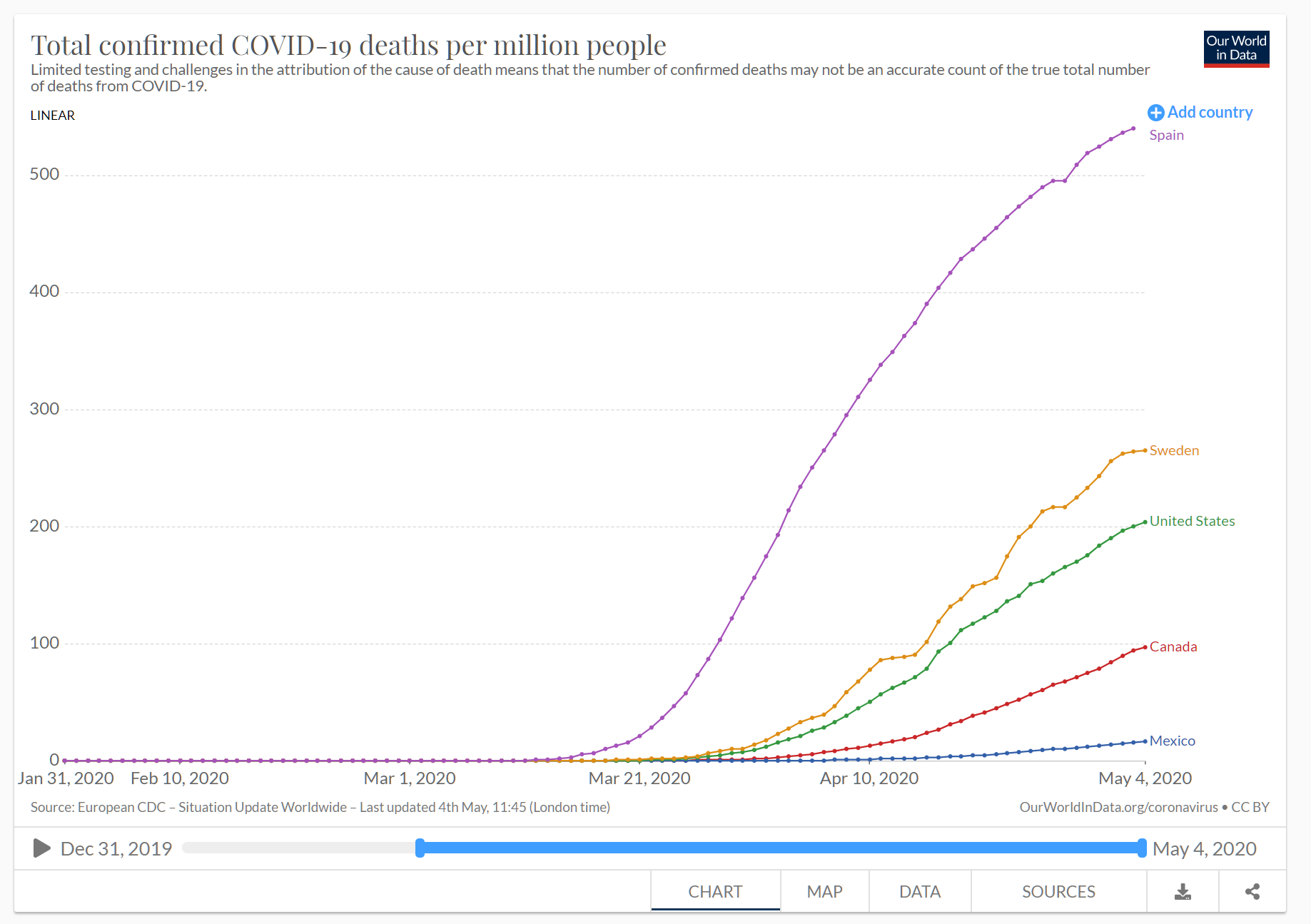
4/3 comment: Sweden (open) has 2X the population of Denmark (locked down), so the 519:279 ratio of new cases works out to roughly the same as the population. The ratio of deaths (43:19) is also roughly the same as population ratio. So it looks as though the Swedish epidemiologist’s prediction that government policy would have a minimal effect is proving correct. For the world overall, it has been 11 days and still the number of new cases has not doubled. WHO is still not publishing data regarding how many tests are being performed, so there is no way to know if this slow doubling corresponds to a 4X increase in testing and a falling number of actual new infections or a steady rate of testing and a doubling-every-two-weeks rate of actual new infections. Massachusetts data suggest doubling every 8-9 days. They also confirm the wisdom of the New Yorkers who fled via Gulfstream to their Nantucket mansions: only 9 cases on the island.

4/4 comment: Sweden continues to have roughly the same number of new cases, per capita, as Norway and Denmark, and Swedish hospital/ICU capacity remains sufficient (and public). It seems to be essentially impossible to die from COVID-19 in Norway. Do they have a better treatment that they’re not sharing? Or do they record the death of someone with underlying conditions differently? Or are they keeping people on ventilators beyond the point at which the Swedes would have given up hope?

4/5 comment: Sweden has 365 new cases; Denmark has 320. Keeping in mind that Sweden has 2X the population, this suggests that the Danish “lockdown” is not “making a difference” as rich Americans like to say. Massachusetts is back to the same number of new cases as 9 days ago. Farr’s law, but with an extremely poor fit to a Gaussian?

Monday, 4/6 comment: Sweden has 387 new cases; Denmark has 292. I.e., Sweden continues to have a lower per-capita new-case rate despite the lack of a lockdown. Sweden even has a lower per-capita death rate, 28:18. Spain and the UK are contributing hugely to the world total of new cases, each with roughly 6,000. Massachusetts numbers are back where we’d expect them to be, perhaps due to reduced lab activity on Sunday.

4/7 comment: Sweden has 376 new cases; Denmark has 312. The per capita new death ratio is no longer favorable to Sweden, however, at 4.75X (small sample, however; Denmark had only 8 deaths). Globally, COVID-19 has killed more than 72,000 people, i.e., about the same as the number of Americans killed each year by taxpayer-funded (via Medicaid) opioid addiction and overdose. But the new case count seems to be declining in accordance with Farr’s law. The Massachusetts numbers are worrisome. New cases are stubbornly high and 356 people have died so far (roughly the same, per capita as in Sweden; i.e., a poor argument for our state’s school closure and other shutdown efforts).

4/8 comment: Sweden has 487 new cases; Denmark has 390 (i.e., more per capita in the locked-down country). Worldwide new cases are still on a plateau. Massachusetts cases continue to grow, consistent with a doom-and-gloom forecast from University of Washington that Massachusetts will end up worse than New York, adjusted for population. Fully 2.6 percent of people in Massachusetts with confirmed cases are already dead, suggesting that we are not better at caring for patients than were the doctors working in Wuhan (death rate roughly 1.4 percent). As in China, though, our data are skewed by limited testing.

4/9 comment: Sweden is at 726 new cases; Denmark 331 (comparable when adjusted for population size). Worldwide new cases continue on a plateau. Massachusetts in shutdown seems to delivering the exponential growth that the media was hoping to see from wide open Sweden.

4/10 comment: Sweden has 722 new cases; Denmark 233. Sweden has more new cases adjusted for population, but Massachusetts, with more than 2,000 new cases, is a dramatically higher rate (roughly 4X). Deaths in Massachusetts, 96, represent a higher rate, adjusted for population, than Sweden’s, at 106.

4/11 comment: Let-it-burn Sweden has 544 new cases; lock-it-down Denmark has 184. Sweden is 1.5X the rate, adjusted for population. Sweden had 77 deaths versus 87 in shutdown Massachusetts (i.e., MA residents are dying at 1.6X the rate when adjusted for population).

4/12 comment: Sweden has 466 new cases; locked-down Denmark has 177. Sweden suffered 17 deaths; Denmark 13. I.e., adjusted for its 2X population, wide-open Sweden has a higher rate of new cases and a lower rate of deaths. Massachusetts has gone off the rails compared to Sweden. With 2,615 new cases, Massachusetts has 8X the new case rate of Sweden’s. With 70 deaths, locked-down Massachusetts has 6X the death rate of Sweden.

4/13 comment: Sweden at 332/12; Denmark at 178/13. Massachusetts at 1392/88.

4/14 comment: Sweden at 465/20; Denmark at 144/12; Massachusetts at 1296/113. Adjusted for population, Massachusetts has 4X the new cases and 8X the deaths.

4/15 comment: Sweden at 497/114; Denmark at 193/14; Massachusetts at 1,755/151. It seems that there

Full post, including comments

Update on the coronapanic fueled by Imperial College

Previously from the U.K.:

Yesterday: “UK has enough intensive care units for coronavirus, expert predicts” (New Scientist)

[the expert[ said that expected increases in National Health Service capacity and ongoing restrictions to people’s movements make him “reasonably confident” the health service can cope when the predicted peak of the epidemic arrives in two or three weeks. UK deaths from the disease are now unlikely to exceed 20,000, he said, and could be much lower.

New data from the rest of Europe suggests that the outbreak is running faster than expected, said [expert]. As a result, epidemiologists have revised their estimate of the reproduction number (R0) of the virus. This measure of how many other people a carrier usually infects is now believed to be just over three, he said, up from 2.5. “That adds more evidence to support the more intensive social distancing measures,” he said.

Who is this “expert” telling the Brits to chill out? Neil Ferguson, the lead author of the March 16 Imperial College paper that told the British to freak out.

(Professor Ferguson doesn’t explicitly say “my Oxford competitors are right and I was wrong”, but upping R0 to “just over three” supports the Oxford theory. Let’s assume “just over 3” is about 3.4. He previously was thinking 2.5. How do these compare? If we just do the simple exponential and don’t bother to consider people meeting the already-infected, after 8 exchanges of germs, the disease has spread 12X more widely under this quietly buried tweak. That’s the difference between 5% of the population and 60% that are infected and, by inference (since 60% of Britons aren’t dead), a huge difference in the lethality of COVID-19.)

How about the peak? The Imperial College model has a chart showing mid-May, without mitigation attempts and June with even the most basic actions, such as isolating sick people. Most of the Britons who need “critical care” won’t be able to get it.

Now it seems that the peak will arrive in “two or three weeks,” i.e., no later than Easter(!) and, as noted above, nearly everyone who needs critical care will get it (but, unfortunately, 20,000 will still die).

The text of the March 16 paper is just as inconsistent with the latest statement as the graphs. On page 16 of that paper, he says that “even if all patients were able to be treated, we predict there would still be in the order of 250,000 deaths in GB”. So in a perfect world where the UK never ran out of critical care capacity and therefore every patient had access to all useful medical interventions, 250,000 would die just in Great Britain (not including Northern Ireland). He is saying now that, in an imperfect world where the hospitals are hanging on the hairy edge of figuring it out, 20,000 will die in the entire UK (including Northern Ireland). [see comments below for some discussion]

‘I am surprised that there has been such unqualified acceptance of the Imperial model,’ Professor Gupta [of Oxford] told the Financial Times.

Perhaps Imperial College professors don’t accept the Imperial model!

(And what does 20,000 deaths actually mean? Are they people who would have lived another 50 years in great health? Or mostly people who would have died within a year or two from an underlying condition?)

What does this mean for the U.S.? Unclear. The “chill out” opinion assumes a competently run health care system that already has policies in place for rationing care (i.e., super old/sick people that were in the ICU in the U.S. in 2019 would have been unplugged and buried in the U.K.). “In the UK’s health system, rationing isn’t a dirty word” says that the U.K. won’t spend more than $40,000 to keep someone alive for another year in good health. That’s the cost of a handful of ED visits here in the U.S., without even being admitted! If we used U.K. standards, half of the older people who are admitted to a hospital would be given three ibuprofen and sent home in an Uber Comfort.

[March 28, 2020 update, from “As the rest of Europe lives under lockdown, Sweden keeps calm and carries on” (Guardian):

Anders Tegnell, Sweden’s state epidemiologist, believes it is counterproductive to bring in the tightest restrictions at too early a stage. … His team at the Public Health Agency of Sweden is critical of the Imperial College paper that warned this month that 250,000 people in the UK would die if the government failed to introduce more draconian measures. A week later Johnson ordered the police to implement a partial lockdown to combat the virus, telling people they “must stay at home”.

“We have had a fair amount of people looking at it and they are sceptical,” says Tegnell. “They think Imperial chose a number of variables that gave a prognosis that was quite pessimistic, and that you could just as easily have chosen other variables that gave you another outcome. It’s not a peer-reviewed paper. It might be right, but it might also be terribly wrong. In Sweden, we are a bit surprised that it’s had such an impact.”

]

Full post, including comments

Why do we care about COVID-19 deaths more than driving-related deaths?

Working with third-year medical students involves much struggling with SQL, R, and data, but also chatting about the topics of the day. This year it is coronavirus, of course. Of the nine M3s that I work with most commonly, at least one believes that he has already had COVID-19 and recovered. Absent significant testing capability for infection or antibodies, however, these bright young people are as much in the dark as anyone else.

Leaving aside the true alarmists, estimates of likely U.S. deaths from COVID-19 seem to range from 50,000 to 500,000 in a “life goes on” scenario. The prospect of this many deaths has motivated us to shut down society and mobilize for what people say is a “war” (let’s hope it isn’t like any of the wars that the U.S. has fought and lost since 1960, e.g., Vietnam War, War on Cancer, War on Poverty, Iraq War, Afghanistan War, etc.).

This is as it should be, right? Let’s take a mid-range estimate. The prospect of 275,000 people dying is terrible and should motivate us to bold action. Yet roughly 36,500 Americans die every year in motor vehicle-related accidents (NHTSA data from 2018, the latest available).

This led to a discussion regarding human psychology. We are pretty confident that there will be more than 275,000 car-related deaths over the next 8 years in the U.S. Maybe this should motivate us to bold action, but it actually does motivate us to do almost nothing.

In the 24th year of the smartphone, we don’t bother with a car-to-smartphone communication system, for example, that would reduce pedestrian fatalities (since the car would know where all of the pedestrians were; I wrote about this in 2016; ordinary Bluetooth range seems to be roughly 100 meters outdoors). Considering the nation as a whole, we don’t invest much in separated (e.g., with a curb) bike lanes like they do in Denmark and Holland. We don’t cut the speed limit on the Interstate back to 55 or lower. We don’t say that cars have to have electronic governors so that it simply is impossible to speed (“I’m sorry, Dave, I feel you pressing the accelerator, but I can’t go faster than 35 mph on this stretch of road”). We don’t re-engineer the road network to eliminate traffic lights in favor of (a) traffic circles, and (b) overpasses. We don’t put in a car-to-traffic light communication system so that the car knows when the light is red and will hit the brakes before we inadvertently drive through an intersection (imagine a traffic light that broadcasts in Bluetooth “I am the light at Massachusetts Avenue and Vassar St. and am currently green for Vassar St.”). We don’t ask America’s nerds to stop working on clever Internet ad technology and try to come up with innovative ideas for reducing the carnage on our roads. We’re willing to invest $trillions to reduce the death toll from coronaplague, but hardly a dime to build centerline dividers on more of our two-lane roads so as to eliminate head-on collisions.

As with most discussions about psychology, we came to no conclusion!

Readers: What is the answer? Why do we accept that hundreds of thousands of Americans will die in the next 10-20 years because of our failure to invest in engineering and infrastructure today, but we can’t accept that up to hundreds of thousands of Americans will die in the next year because we didn’t do a sufficiently thorough shutdown?

Related:

  • Sweden’s Vision Zero, kicked off in 1997, which worked to reduce fatalities until it stopped working in 2013.
Full post, including comments

Move to avoid estate tax before coronavirus kills us?

Now that the grim reaper seems to be among us, is it time to move away from the 12 states that assess estate taxes? Massachusetts, for example, deprives heirs of 10-16 percent of the value of their inheritance, for estates valued at over $1 million (i.e., for anyone who dies while owning a decent apartment or house in the Boston area). The highest state tax rate is reached even for those whose estates aren’t worth enough to be taxed at all by the Federales.

What about income tax? A lot of us will have to work from home for the next two years. Why not do this from the Ritz Dorado Beach in Puerto Rico and cut income tax to 4 percent via Act 22? Puerto Rico seems to have eliminated its estate and gift taxes in 2017 so even if 183 days per year of heat and humidity don’t protect you from coronavirus your savings will be protected.

Full post, including comments

About 2.5 percent of Boston hospital beds occupied by COVID-19 patients

Friends who work at Boston’s biggest hospitals (MGH and Brigham and Women’s) get the information that the public would surely love to have, i.e., what percentage of hospital beds are occupied by patients stricken with COVID-19. The answer as of this morning? About 2.5 percent, with perhaps an additional 2-4 percent “under investigation” (can’t get test results even for inpatients?).

Is that good news for those worried about contracting the coronavirus? Maybe not. The LA Times says that ICU beds at their hospitals were already full with non-COVID-19 patients. As you might expect from the three-month wait that was required for a non-elite to see a doctor in the U.S. in 2019, the health care system as experienced by the 99.8% did not have any headroom.

And, of course, if we believe that hospitalization follows infection by at least two weeks (but does it, on average?), the surge may be yet to come. The folks who heeded New York City Mayor Bill de Blasio’s March 2 call to join him in a crowded movie theater “despite Coronavirus”, and their new Tinder friends, and the new Tinder friends of those Tinder friends, may yet arrive in the ED.

Readers: Has anyone found a good source for mean time from infection to hospitalization and/or mean time from infection to requiring a ventilator? Dyson will begin cranking out ventilators by “early April” (CNN).

[Update: I talked to a physician at Emerson Hospital in Concord, Massachusetts. This serves Middlesex County, the hardest hit county in Massachusetts (a profitable place to be a family court plaintiff though; having sex with an already-married medical specialist will pay about as well as going to medical school and working as a primary care doctor). There are 179 beds, 6 of which are occupied by victims of the coronaplague (3.34 percent).]

[Update, evening 3/27, text message from friend: “I asked [physician wife] how her nurse friend is doing at the hospital. She said she has not worked in a week because the ER is so dead she can’t get hours. The hospitals are empty.”]

Full post, including comments

Are celebrities jumping the coronavirus testing queues doing us a favor?

From yesterday: “Elite versus Non-Elite access to COVID-19 testing”.

On further reflection, however, maybe celebrities jumping the queue are doing us a favor. We’ve learned that Harvey Weinstein (68), Jackson Browne (71), and Prince Charles (also 71) have tested positive for coronavirus and are recovering at home from their flu-type symptoms.

These guys are not examples of youth, vibrant health, or genetic diversity, right? They probably wouldn’t have been tested if they’d been ordinary peasants. Can we relax a bit knowing that (a) their positive diagnoses suggest that a reasonably high percentage of the population has already been exposed (consistent with the Oxford epidemiologists who may never be interviewed by America’s hysteria-dependent media), and (b) their mild symptoms suggest a lower-than-expected percentage of the infected need medical intervention?

[Ironic: Jackson Browne was infected in Wuhan on the Hudson at a concert to benefit victims of a different virus: HIV (New York Post). He came out of an “anti-Trump” concert in 2017 unscathed, fortunately, and also a crowded event in Los Angeles: “Trump loathing unifies the diverse crowd at the massive L.A. women’s march”. If Jackson Browne’s case had become serious, his life might have been saved by the president he loathes, since Trump sent one of the Navy’s two hospital ships to Browne’s home city of Los Angeles (the other one is going to New York City). Trump could certainly have sent the ships to Florida and Texas, right? Or addressed the inequality that New Yorkers and Californians decry by sending the ships to lower-income states such as Mississippi, Louisiana, Alabama, and South Carolina. Will Democrats in LA and NYC at least send a thank-you note to Trump even if they will never vote for him?]

Meanwhile, in Massachusetts we have limited information on the non-celebrities. The March 25 update says that there are 1838 “confirmed cases”. Are they watching Netflix at home? Or near death on a ventilator in an ICU? For 1385 the answer is “Under investigation”. 103 are known to be hospitalized and 350 are known to be “not hospitalized”. Is it truly impossible for our state public health officials to call up the hospitals and ask “How many COVID-19 inpatients do you have right now?” (Contrast to Texas, where the governor has ordered daily reports on bed availability. (with hundreds of billions of dollars invested in health care IT, why aren’t these data already streamed up to each state’s department of health?).)

Related:

Full post, including comments

Full range of coronaplague opinions

From Sunetra Gupta, professor of theoretical epidemiology at Oxford, via the Daily Mail:

Coronavirus could already have infected HALF the British population and been spreading in the UK since JANUARY, Oxford University study claims

‘We need immediately to begin large-scale serological surveys – antibody testing – to assess what stage of the epidemic we are in now,’ she said.

The Oxford university research offers a contrasting view on the disease to the study that is informing government policy. It was carried out by experts at Imperial College London.

‘I am surprised that there has been such unqualified acceptance of the Imperial model,’ Professor Gupta told the Financial Times.

The Imperial study has led to the Government imposing the extraordinary shutdown on the basis that, without such rules, the disease could claim up to 250,000 lives.

Who wants to bet whether these “Oxford experts” get interviewed by the folks at the New York Times who say that Donald Trump should let the “experts” speak?

From Wuhan on the Hudson, on the other hand, “Coronavirus: New York Infection Rate Is ‘Doubling About Every 3 Days,’ Cuomo Says” (NPR):

The rate of new coronavirus cases in New York is “doubling about every three days” and is speeding up even more, Gov. Andrew Cuomo said Tuesday. “That is a dramatic increase in the rate of infection.”

The new estimates are “troubling and astronomical numbers,” the governor said. He added that the apex of the curve of rising coronavirus cases in New York is still 14 to 21 days away, according to the latest projections. The governor also said New York is in urgent need of ventilators and other vital resources.

“We need the federal help, and we need the federal help now,” Cuomo said.

(If Federal help is critical and Trump has the discretion to allocate that help among states, perhaps Cuomo now regrets telling Donald Trump “good riddance” when he moved to Florida, thus escaping New York State and City taxes? When one quarter of the economy is the Federal government, is it helpful to state residents to pick a fight with the guy who has some amount of control over the $5 trillion?)

Facebook friends who voted for Hillary love Governor Cuomo, by the way. A sampling of perspectives:

Gov. Andrew Cuomo. For all his state’s problems, and they are life and death problems….he still inspires, like a true leader does. No childish name calling. No race baiting. No ignorant rants. Just inspiration

Sick of the administration’s sideshow “press conferences?” This is what leadership looks like: honest, tough, authoritative, reassuring.

I am falling in love with Andrew Cuomo🥰🥰🥰 [The previous governor got/purchased some love from female Democrats as well, no?]

[Did Cuomo do anything tangible in terms of preparing hospitals, obtaining masks, ventilators, and PPE, starting social distancing before New York’s caseload blew up, etc., or has he been able to win hearts and minds with fine words only?]

COVID Denier Aaron Ginn needed to be kicked off Medium partly for spreading the heresy that coronavirus did not spread well in heat and humidity. Now there are heretics at M.I.T. New York Post:

Scientists at the Massachusetts Institute of Technology found that 90 percent of COVID-19 transmissions that occurred until Sunday happened in regions with low temperatures — between 37.4 and 62.6 degrees Fahrenheit.

“Wherever the temperatures were colder, the number of the cases started increasing quickly,” Qasim Bukhari, a computational scientist at the university who co-authored the study, told the New York Times. “You see this in Europe, even though the health care there is among the world’s best.”

That pattern applies in the US too, Bukhari told the paper.

The outbreak has developed more slowly in Southern states like Arizona, Florida and Texas compared to New York, Washington state and Colorado, for example, according to Bukhari.

In California, the rate is somewhere in the middle.

Epidemiologists have seen a similar pattern with other viruses — including the flu, which generally follows a November-to-April trend in the Northern Hemisphere, Dr. Deborah Birx, a member of the White House’s coronavirus task force, said during a recent briefing, according to the Times.

The four types of coronavirus that cause the common cold also pick up in the winter and drop off in the summer.

At least two other studies have come to similar conclusions — including one conducted by Chinese researchers at Beihang University and Tsinghua University.

There you have it! Maybe it will kill most of us (Professor Cuomo). Maybe it has already done most of whatever it is going to do (Professors at Oxford). Maybe it will taper down to a manageable burn by June (MIT).

(Meantime, if we believe MIT, move to Florida, Texas, or Las Vegas and then leave the air conditioning off? Check the family law situation in those states before agreeing to any move, though! Florida offers “permanent alimony” while Texas offers “no alimony”. Texas and Nevada cap child support profits, unlike most states in the frigid COVID belt.)

Related: A February 9 tweet from New York City’s top public health official

Full post, including comments