Hillary Clinton’s election will worsen the gender pay gap?

One of Hillary Clinton’s main campaign points is that women don’t get paid, on average, as much as men. She’s about to make the “gender gap” stat worse, though, by quitting a $20 million/year job giving talks to Goldman Sachs et al. and taking a $400,000/year government job (President of the United States). So Hillary will be taking dramatic action, once in office, to address a problem that she herself exacerbated!

Full post, including comments

Who wants to help Mexican children by spending $68?

“Save the children… from having to use Windows 10.” What if you were a schoolkid in rural Oaxaca (about an hour’s drive from the part the tourists enjoy) without Internet and wanted to learn from Wikipedia, Khan Academy, etc.? Kids on Computers has figured out how to set up labs in schools with a Raspberry Pi driving each child’s monitor. The Raspberry Pi runs a version of Unix, a web browser, a video player, etc.

Do you want to be a hero to some young Mexicans? Instead of spending time expressing righteous anger on Facebook regarding Donald Trump’s existence, you could work long enough to earn $68 pre-tax dollars and then make a tax-deductible purchase of a Raspberry Pi and have it shipped to my house or Avni Khatri’s. Email me (philg@mit.edu) if you need the address. Avni can send you a letter for the IRS. Look on the bright side of spendthrift government: With Bernie’s new tax rates, maybe you’ll get 90 percent of the $68 back!

[You might ask why I’m not buying a huge stack of these myself. It seems that there is a limit to how many a single individual can purchase.]

Full post, including comments

Can women be superior human beings in a transgender age?

A friend who constantly advocates for Bernie Sanders, higher taxes, solar power, government-set wages for women, bigger government, etc. posted the following on Facebook:

… it is a sense of “female social superiority” as in, females generally speaking are more community oriented, more nurturing and more considerate of others.

I responded with

If you changed gender and became a female, Q, would you then become more nurturing and considerate of others? If Bernie Sanders became Bernice Sanders would she be more community-oriented?

That lead to the following exchange:

  • Him: I have no idea. If I were a bird I would be able to fly, but currently we have no way to effect such a transformation. We do know that there are gender differences that affect behavior; there was a recent article about gender differences in stress response that I thought was an interesting example.
  • Me: I don’t know of an available procedure for you to become a bird, Q. But isn’t it possible for you to identify as a woman starting tomorrow?
  • Him: Possibly, but we have no reason to believe that my self-identification as a woman would sufficiently alter my behavior
  • Me: So you’re saying that a transgender woman would not share these positive characteristics with a cisgender woman?
  • Him: It is an unknowable question since two natural women may not share these properties or possess them in equal measure smile emoticon
Full post, including comments

Why Johnny Can’t Think: AP Statistics Version

I’ve spend part of this school year tutoring a student in AP Statistics. The course seems to be designed to help reinforce the classic paper “Why Most Published Research Findings Are False”. If the goal of high school is to prepare young people for citizenship and making decisions at work, AP Statistics seems like a spectacular failure. If the goal were to help people make decisions, wouldn’t the core of the class be hypothesis testing? People who take high school stats aren’t necessarily going to become professional statisticians but at least if hypothesis testing were the core they could be appropriately skeptical with regard to claims regarding, e.g., the efficacy of a new drug that taxpayers were being asked to pay for.

Hypothesis testing, however, is relegated to the end of the class/textbook/prep books. Thus for most of the class students have little context for why they are learning most of the material. Is it critically important to know what percentage of people think X based on a survey? Maybe for political pollsters who can then tell candidates how to pander to voters, but the most interesting uses of statistics seem generally to involve answering a question about whether an intervention was effective or not.

What do readers who are stats experts say? Would it make sense to weave hypothesis testing into the entire course?

Related:

Full post, including comments

Massachusetts residents on Hillary Clinton

At a business/social gathering following Super Tuesday I heard from a variety of Massachusetts residents regarding Hillary Clinton and other politicians:

  • (from a Bernie supporter) it would be nice to have a president who didn’t actually have an office at Goldman Sachs
  • (from a Trump Supporter) I’m sick of working to support people who don’t work. (Her after-tax income was definitely less than value of housing, food stamps, and health insurance received by a successful Boston-area welfare family. Sadly she was past her child-bearing years and would not have been able to go down the most reliable Massachusetts road for getting cash without working.)
  • Hillary and Congress will be making laws that benefit their friends in ways that I won’t even be able to understand. But I know that I’ll be paying for this.
  • Ronald Reagan ruined American politics by introducing religion. I can never forgive him for not mentioning the word “AIDS” until after more than 22,000 Americans had died, including a lot of my friends. (This statement regarding Reagan may not be accurate. This article says Reagan talked AIDS in 1985  (same year that a blood test was approved for HIV) and so does this organization, which also notes that about 13,000 Americans had died to that point.)
  • (from a Bernie supporter) At least Trump probably won’t try to do that much once he is in office except enjoy being President.
  • If Hillary gets elected we should buy stock in Goldman Sachs and Berkshire Hathaway and other companies to which she is connected. We know that they’re going to do great for the next eight years. [See “Warren Buffett’s Nifty Tax Loophole” (Barron’s) for the complexity of Berkshire Hathaway’s relationship with the tax code.]

[Funniest statement of the evening, from a travel industry executive: “We’ve been advertising on PBS…”]

There was no affection expressed for Hillary, even among those who said that they voted for her. The kindest thing that was said that she would be more likely to get legislation passed with Congress than would Bernie Sanders be (hardly anyone was willing to admit to supporting Trump).

With support for Hillary this weak in a passionately Democrat state just one night after Super Tuesday I wonder if she will have a tough time in November. But on the other hand other recent U.S. presidents have been elected without charming everyone. Nixon, for example. George H.W.? George W?

Readers: What do you hear in your neighborhoods? Are voters excited about Hillary or just voting for her because they like other candidates even less?

Full post, including comments

Why is it a moral imperative to pay attention to the prospect of a Donald Trump presidency?

The tone of this election year seems to be more feverish than in previous elections. Mitt Romney was quite calm when he said that 47 percent of Americans wouldn’t vote for him because they paid no income tax and/or received a lot of government handouts. He didn’t say that those voters were immoral. He recognized that they could legitimately perceive that it wasn’t in their interest to vote for him.

People today seem to be taking the opposite tack compared to Romney:

  • Paul Krugman in the New York Times says that electing Trump will melt the planet
  • “GOP must confront Trump nightmare” says the editorial staff of the Boston Globe (same folks portrayed in the movie Spotlight as not bothering for about 10 years to pursue a story about child sexual abuse in churches… but Trump is urgent!). The article concludes with “There’s only one right answer.”

Is there in fact only one right answer? Start with a voter who perceives her job being at risk due to immigration and therefore votes for Donald Trump. According to the current thinking among Democrats, she is “wrong” and/or “evil” and/or “supports fascism/racism/etc.” I haven’t heard anyone say “Well, she is differently situated than I am and therefore naturally would have different interests and vote for a different candidate.” An environmentalist friend says that Donald Trump is an evil populist and that the entire planet will be put at risk if he is elected. Bernie Sanders, on the other hand, not the same kind of “populist” due to his experience in Washington. A Sanders victory will ensure that Planet Earth heals.

Some Facebookers are essentially demanding that all of their friends stop whatever they are doing to pay attention more or less full-time to the Great Cause of preventing Donald Trump from becoming a Hitler-style dictator.

I’m wondering why it wouldn’t be legitimate for a person to say that state or local laws were of more interest and that, to the extent political energy was available, he or she was concentrating attention on those laws. Let’s go through some examples.

  • Consider a parent with a child who is not being challenged in a public school. That’s a 7-year-old mind going to waste for six hours per day. The federal government and the President have essentially nothing to do with what happens in this school. Would it be wrong for that parent to say “I don’t care if Trump, Bernie, or Hillary wins because I’m working on getting individual assignments for children at Johnnie’s school”?
  • How about a Minnesotan who had sex with a successful married dentist and is collecting $22,596 per year in tax-free child support under Minnesota family law. The same child could yield $100,000 per year under Wisconsin law. Would it be unreasonable for the Minnesotan to say “I’m more interested in getting Minnesota to remove the cap on child support so that I can quadruple my spending power than in who occupies the White House”?
  • Alfred A. Stoner needs his glaucoma meds every morning, but his state criminalizes marijuana possession. If his state law were changed so that marijuana were legal, as it is in Colorado, for example, he wouldn’t have to worry about being imprisoned. Is Mr. Stoner a bad person because he says “I am putting all of my political effort into marijuana legalization because I would rather be at home with President Trump in the White House than be in prison with Hillary Clinton in the White House”?
  • Melissa Labralover wants to take her dog to a neighborhood field to run every morning and every evening with other dogs, but it is illegal to have an off-leash dog in her town and this field is covered in weeds and broken glass (due to teenagers who were forced to turn to beer after being unable to get the glaucoma medication that they required). She wants to see her town budget to clean up the field and to amend its laws so that dogs can be off-leash within the confines of the field. Is she allowed to say “My income is modest so my tax rate is low and I really don’t care what they do 3000 miles away in Washington because what would make the most difference to Rover and me is a dog park”?

Readers: In terms of things that would have a direct impact on your life or your family members’ lives, are you most interested in seeing changes at the federal, state, or local level?

Full post, including comments
Ski resorts are fat targets for employment litigation?

One thing that I noticed during my sojourn in Vail Valley was that the ski resorts seem to have a lot of volunteer labor. Beaver Creek has greeters everywhere to answer questions, hand out tissues, hand out postcards, etc. One volunteer said that she does it for the annual pass. I asked “How often do you ski?” and she replied that she doesn’t ski at all, but likes the ride the lifts in the summer for hiking. Presumably this relationship is mutually satisfactory but a mutually satisfactory employment relationship can give rise to a profitable lawsuit.

I found Winter Park’s ad for ski patrol volunteers, for example. The volunteer must work for 17 days and pay $90. In exchange he or she receives an annual ski pass that retails for $400-600. If a “day” is 8 hours, that’s as little as $2.25 per hour in net compensation and the government did not receive Social Security or Medicare payroll taxes on this wage.

Why isn’t ski country also an employment litigator’s paradise?

[Despite state laws that absolve ski resort operators from most liability on the “you were falling down a goddamn mountain” theory, a prominent skilaw.com billboard on I-70 shows that litigation and skiing can be mixed.]

Full post, including comments

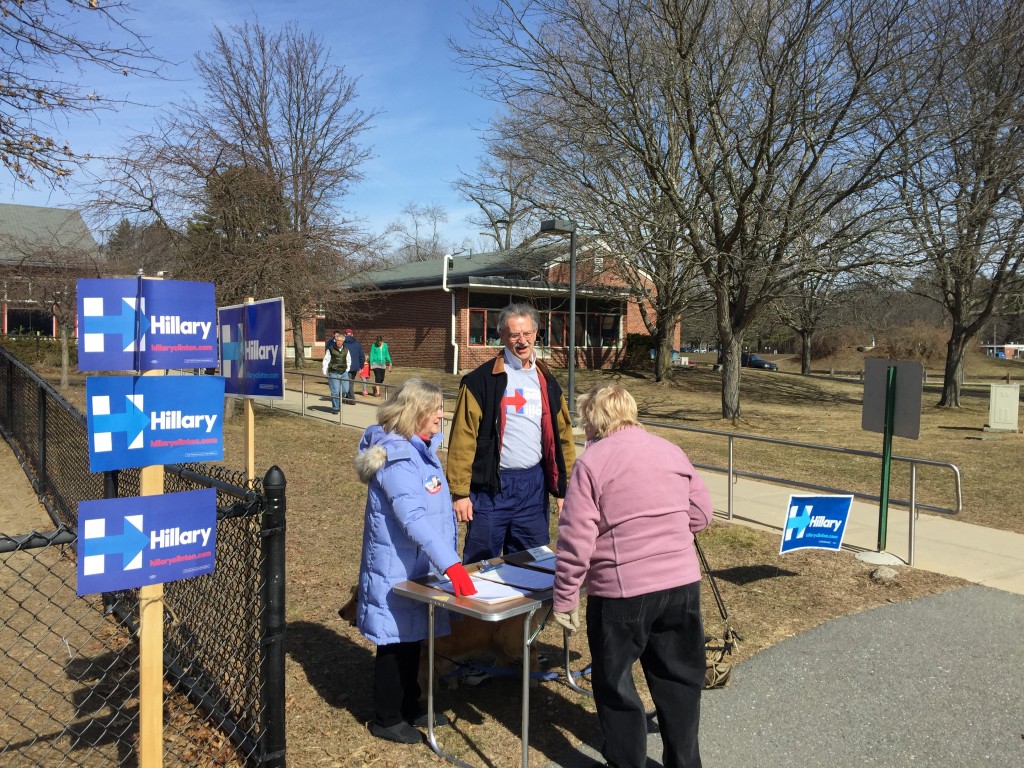
Prediction: Hillary Clinton wins Massachusetts due to being the only socially acceptable candidate

If we model voting as a social phenomenon, this image shows why Hillary Clinton wins the Massachusetts primary:

2016-03-01 12.31.50

There was not a single other candidate that anyone in our town was willing to be seen supporting. (Maybe I will go down there at 5 pm with a “Jesus Loves Trump” sign and a blood pressure meter to see what happens!)

(As per usual, most of the ballot was taken up by candidates running unopposed. One interesting item is that the Democrats in Massachusetts have positions titled “State Committee Man” and “State Committee Woman” for which there is a gender ID requirement. There was not an interesting electoral contest for these positions, as each one had a single unopposed candidate. But the existence of these positions raises the question: what if a successful “State Committee Man” decides to identify as a “woman” at some point subsequent to his/her election? How are these positions meaningful in a transgender age?)

Full post, including comments

How to reduce inequality without higher tax rates?

A cornerstone of the Democrats’ plan to reduce American inequality is higher tax rates. Rich people will keep working, not move taxable activities offshore and/or pursue other tax avoidance strategies, and the government’s coffers will fill up like Pharaoh’s grain warehouses during the seven fat years. Wise officials will then ladle out the cash to the deserving poor and inequality will be reduced.

Is there any alternative to this approach, I was asked at a dinner party by some rich government-connected residents of Cambridge? (they support Bernie Sanders, of course!)

My answer was that a big element of inequality in the U.S. involves real estate. Start with the government’s decision to double the population compared to the “good old equal” days of the 1950s (paying Americans to have children; encouraging immigration both legal and illegal). Add our spectacular failure in all aspects of urban planning and you get the inevitable outcome of only a handful of Americans being able to afford market-rate housing in places where anyone would actually want to live. We have added 150 million people but hardly any new cities or towns that have the features that most people desire. So you need to have a great job and/or be favored by a government ministry that hands out free housing in elite neighborhoods such as Manhattan, Cambridge, San Francisco, etc.

What if we took some of the effort and money that we currently invest in government handouts and used that to create additional attractive cities and towns? (I proposed this idea for an evil billionaire back in 2007, but the evil billionaires are obsessed with saving the rest of the planet instead.) We have a lot of land in the U.S. so there is no reason for land per se to be out of reach for a lower-middle-class American.

[Of course the standard approach to reducing inequality would be to improve public education, but Americans have rejected the Finland-style system in which only successful students can become teachers (see “Smartest Kids in the World Review”) and there doesn’t seem to be any other proven formula.]

Full post, including comments