Data on nationwide excess deaths

An interesting work of journalism from the Washington Post: “U.S. deaths soared in early weeks of pandemic, far exceeding number attributed to covid-19”

The analysis is similar to the New York Times effort that was the basis of “Infidels in Sweden are refusing to die” (at the time, Sweden in its refusal to shut down had 1/25th the percentage of “excess deaths” compared to the shut-down-for-a-month New York City). The authors take a deeper look at the U.S. overall.

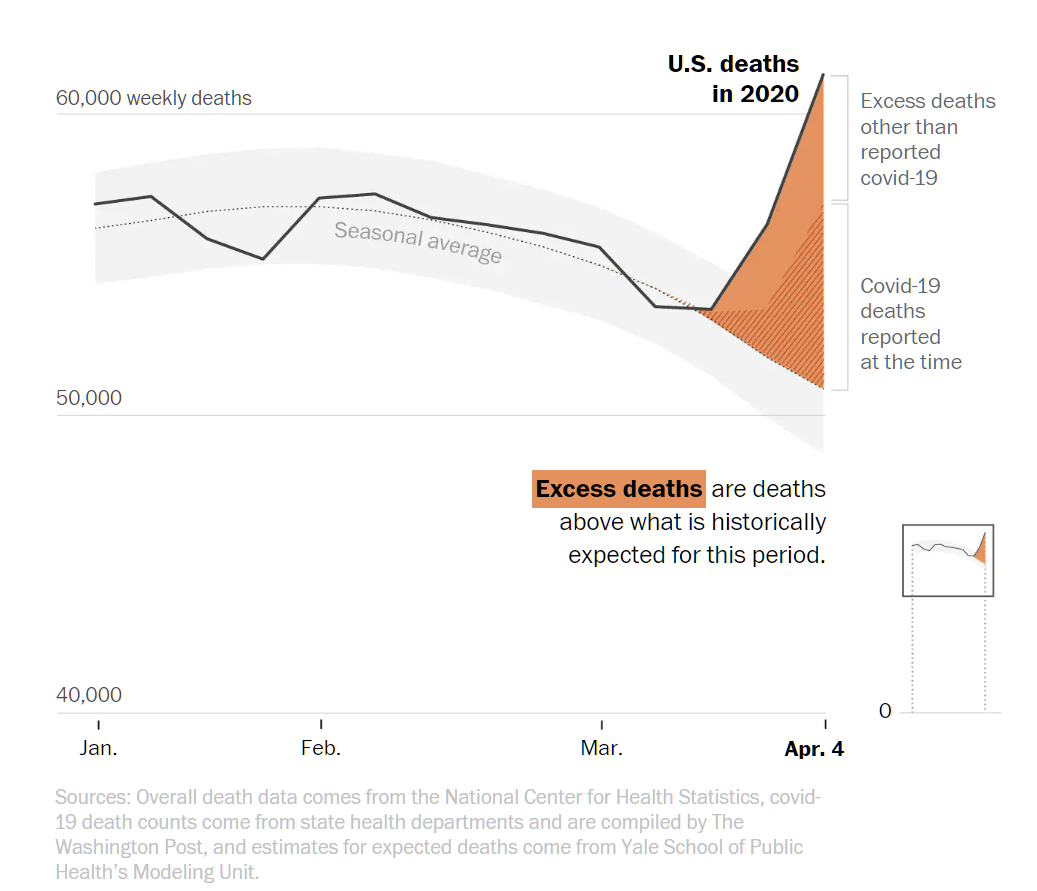
Let’s start by trying to raise everyone’s coronapanic with a chart that starts at 40,000 rather than 0. This makes the recent rise in overall deaths look a lot more scary:

Americans are dropping dead at an alarming rate, either from Covid-19 or from the shutdown of the regular health care system or maybe from eating too much while lying on the couch! (to the newspaper’s credit, a tiny zero-based chart is presented at the bottom right of the above figure)

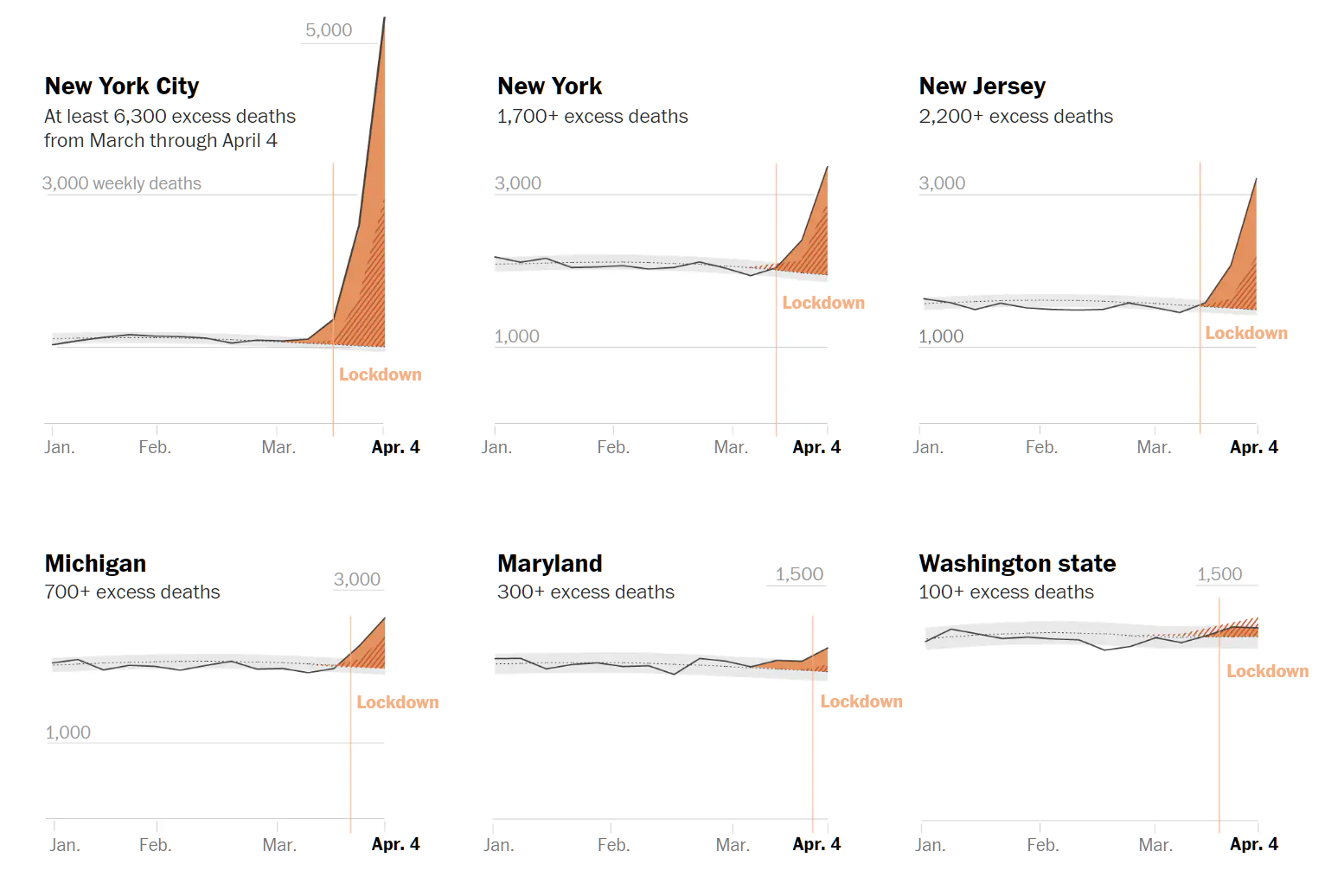
Almost all of these excess deaths are from one place: the New York metro area. And it is difficult to know whether their Covid-19 death numbers are comparable to other parts of the U.S.:

No jurisdiction has been as aggressive as New York City, the U.S. epicenter of the epidemic, in revising its death counts from those early weeks. As of Saturday, the city had added 2,542 covid-19 deaths to those figures, driving the total from that period up to 5,085. The newly added deaths were almost equally split between cases that were confirmed through lab testing and cases that were deemed “probable” covid-19 deaths based only on symptoms and exposure.

How does it look around the bad parts of the U.S.?

(By applying the miracle of begging the question, the above charts, with their dramatic increases in deaths after the shutdown began, actually support continued faith in the Church of Shutdown. Asked how they know that shutdown works, the faithful in the Religion of Shutdown generally respond with “the high number of deaths shows that it would have been far worse if we hadn’t shut down.”)

Is the headline a good summary of the article? Are U.S. deaths soaring? We are all in this together, right?

But in dozens of states, the Yale analysis shows that the reported number of overall deaths are either unchanged or even slightly down compared with historical patterns.

Should we suspect from these data that the problems NYC has had with Covid-19 are idiosyncratic? Some other cities and regions also had exposure starting at roughly the same time (mid-January?) and those places locked down within a few days of the NYC shutdown. Yet excess deaths are fairly low (or actually negative) almost everywhere other than NYC.

Is it possible that we’re fighting a nationwide war against a virus that is attacking only a handful of cities for reasons that are peculiar to those cities? Or possibly peculiar to the strain of the virus that has been circulating in those cities? If we take out metro NYC, Detroit, New Orleans (they’re not going to have a second Mardi Gras this year, right?), and Boston, does the “U.S.” actually have excess deaths or any kind of problem with Covid-19 that couldn’t be handled with the most basic precautions?

(And how would we handle the apparently idiosyncratic problems with these cities? Tell New Orleans that Mardi Gras is henceforth restricted to the sober (90% reduction in crowding?). Reopen the United States economy and use the money to pay roughly half of NYC residents to move out to suburbs and other states. The super high density plainly has made NYC a breeding ground for any enterprising virus. Run more subway trains in Boston so that people aren’t jammed in like sardines and/or pay people to leave the city, as in New York. I’m at at loss to know what to do about Detroit, I must confess!)

In the meantime, we’ve got healthy young people in North Carolina who are under a stay-at-home order. Their personal risk from Covid-19 may be smaller than their risk of being hit by debris from the International Space Station. Have these young people lost their freedom and jobs (and their children their education for this spring) merely because of an accident of political geography, i.e., that they’re inside the same nation-state as plague-ridden New York City and Boston?

Full post, including comments

Tax revenue shortfall for New York, New Jersey, and Connecticut from rich people escaping coronaplague?

The richest NYC-area folks whom I know have moved away to escape coronaplague and the associated lockdown. Why be in an apartment, even a $10 million one, if restaurants, museums, theaters, and offices are shut down? The refugees from Covid-19 have washed up in large oceanfront mansions, all of which are outside of NYC and most of which are outside of New York State.

If they decide to stay away for the entire summer and into the fall, coinciding with the minimum expected period of quasi-shutdown they will hit the magic 183 days for 2020. At that point, why will they pay NYC and New York State taxes on income derived from interest and dividends, for example? Haven’t they inadvertently accomplished what 183-day Florida or Puerto Rico residents have previously done intentionally?

This has happened to a lesser extent for my Massachusetts friends during coronapanic (many of whom actually turned into Florida or Texas residents starting in 2018 when the new tax law went into effect).

States can’t print money so they need to borrow, cut spending (hah!), or default (as they did in the 19th century). What happens to New York if their richest taxpayers aren’t around for enough days in 2020 to be hit?

Related:

Full post, including comments

Coronascreening of passengers arriving in California from India

From a neighbor:

I reached home last night (April 23) about 12:30. Nine hours of road
transport was followed by a three hour flight to Delhi, then a fifteen hour flight to San Francisco. and finally six hour flight to Boston in two legs (Delta via Atlanta) … i reached San Francisco about 5:30 AM yesterday. They said that the Customs would not open till 6 AM and we lingered on the runway. Coming to the terminal, the luggage did not show up for
two hours. Nobody explained. Then we were led to go to other terminal for our domestic flight. No testing or health checking was done. None of the airport employees (Police, TSA and Customs) had masks and nobody was enforcing anything. It was very different from Delhi where Corona warning was everywhere.

Californians pride themselves on having a lower rate of plague than New York, Massachusetts, and other parts of the U.S. They attribute this to their superior political leadership (yet the University of Washington prophets show that they shut down schools a little later than Massachusetts and non-essential businesses a little earlier; maybe they have a different strain of the virus?). But if they don’t at least pick up some masks and forehead thermometers for people arriving from the plague lands, won’t they just catch coronavirus as soon as they emerge from their bunkers?

Full post, including comments

Coronapoetry

As a measure of how desperate things have become, I’ve taken to reading poetry to the kids (denied their precious and wholesome screen time due to a cruel policy of the local dictatorship).

Here’s “Happy Thought” by Robert Louis Stevenson:

The world is so full of a number of things,
I’m sure we should all be as happy as kings.

Helpful adjustment for those whose lockdown is urban:

The world apartment is so full of a number of things,
I’m sure we should all be as happy as kings.

You’re welcome!

Separately, I have composed some original haiku:

Looked up from my phone
Who’re these people in the house?
Coronavirus

Students stare closely
Zoom lecture is spellbinding
Retriever in frame

You’re double-welcome!

Full post, including comments

What home security cameras for impending collapse of Massachusetts?

Governor Baker has now announced that schools in Massachusetts will be closed through June (i.e., until September). There was a hint at the briefing that businesses would also be ordered closed through June in that the order to close daycare for non-essential workers would be closed through June was explained with”to align reopening of child care with the reopening of businesses.”

We have friends who say that Massachusetts has a reasonable chance of descending into looting, home invasions, ATM kidnappings, etc. They’re not very tech-savvy, but they want some outdoor home security cameras that will at least discourage the roaming criminal gangs. What’s a good solution to secure the four corners of a suburban house? It has to be something easy for non-technical people to set up themselves. (And do cameras actually discourage criminals enough to motivate them to move to the next house that doesn’t have them?)

(Are their fears justified? There are a lot of programs for government hand-outs, but the free cash is limited to people who are great at filling out paperwork. That could leave a substantial portion of the population in desperate straits. Venezuela went from pleasant to lawless after a severe economic downturn. Why not the U.S.? I guess that is why everyone was buying guns and ammo until the gun shops ran out.)

Related:

  • Wirecutter recommends the Google Nest Outdoor Security Camera, but it doesn’t seem like it is intended for people who want to cover the entire perimeter of a suburban house (more like monitor the front door and driveway)
Full post, including comments

Paper titled “Stockpiling Ventilators for Influenza Pandemics” (2017)

Here are some folks who, had they been listened to, could have saved Americans, or at least Texans, a lot of anxiety… “Stockpiling Ventilators for Influenza Pandemics” (Emerg Infect Dis. 2017 Jun; 23(6)) by Hsin-Chan Huang, Ozgur M. Araz, David P. Morton, Gregory P. Johnson, Paul Damien, Bruce Clements, and Lauren Ancel Meyers.

Some excerpts:

In preparing for influenza pandemics, public health agencies stockpile critical medical resources. [except for masks?]

When severe influenza outbreaks cause high rates of hospitalization, a surge of medical resources is required, including critical care supplies, antiviral medications, and personal protection equipment. Given uncertainty in the timing and severity of the next pandemic, as well as the time required to manufacture medical countermeasures, stockpiling is central to influenza preparedness. However, difficulty in forecasting and limited public health budgets often constrain decisions about sizes, locations, and deployment of such stockpiles.

Mechanical ventilators are essential for treating influenza patients in severe acute respiratory failure. Substantial concern exists that intensive care units (ICUs) might have insufficient resources to treat all persons requiring ventilator support. Prior studies argue that current capacities are insufficient to handle even moderately severe pandemics

The Centers for Disease Control and Prevention (CDC) manages this Strategic National Stockpile (SNS) and has plans for rapid deployment to states during critical events … However, SNS ventilators might not suffice to meet demand during a severe public health emergency. In 2002, the SNS included ≈4,400 ventilators, and 4,500 SNS ventilators were added during 2009 and 2010. The American Association for Respiratory Care suggested the SNS inventory should increase to at least 11,000–16,000 ventilators in preparation for a severe influenza pandemic.

Our retrospective analysis of the 2009 influenza A(H1N1) pandemic in Texas suggests that hospitals had enough ventilators on hand to treat all patients requiring mechanical ventilation throughout the pandemic. Although these quantities are expected to suffice for a moderate (1957- and 1968-like) pandemic, in which hospitalization rates roughly triple, they would fall far short in a severe (1918-like) pandemic. If we optimistically assume perfect deployment, that is, 0 wastage, by assuming timely delivery, adequately trained and available staff (respiratory therapists, nurses, and physicians), sufficient space to care for a potentially large number of patients, and requisite ancillary equipment and supplies, then even a central stockpile of 8,900 ventilators in Texas—the total number of SNS ventilators in 2010—would fall short, with an expected unmet demand of 576 patients.

Who will vote with me to put these folks in charge of the next plan to fight the last war? And who will bet that if we’d ordered ventilators in 2017 for delivery in 2018-2019 it would have been a lot cheaper?

Note: I found this paper while trying to search for what it might cost to treat a COVID-19 patient in a U.S. hospital ICU with ventilator support. Of course, that was a question that was impossible to answer.

Was this knowledge new in 2017? Has anyone done a study of what it would look like to prepare on a national level, not just in Texas? The Texas paper provides references back to 2006, all coming to the same conclusion: we need to stockpile a bunch of stuff if we want to be ready for a flu or flu-like pandemic.

One of the references from 2015 is “Estimates of the Demand for Mechanical Ventilation in the United States During an Influenza Pandemic”. It is authored by five government workers, four of whom were at the CDC (during the sorely missed administration of Barack Obama!). The authors suggest that more than 60,000 additional ventilators to provide a reasonable assurance of nobody dying for want of a ventilator. What was their conclusion for the administration and Congress of 2015?

The challenge for public health authorities is to plan and prepare how to best respond to the next pandemic that will cause such a rapid and large demand for mechanical ventilation in critically ill patients. Ventilator preparedness planning has to be prioritized against competing influenza pandemic preparedness planning efforts. The time to start planning is now, and the results presented here may help guide such efforts.

What did Barack Obama do in response to the authors’, all of whom worked for him, projection that 308,000 Americans would die if a flu pandemic hit and the ventilators weren’t stockpiled? A month after the paper:

President Obama on Friday hailed a Supreme Court decision legalizing same-sex marriage nationwide, saying justice has arrived “like a thunderbolt” for gay and lesbian couples.

Obama opposed same-sex marriage when he was first elected president in 2008. He backed it before the 2012 election, saying his views had been “evolving” during his time in the White House.

“Today, we can say in no uncertain terms that we have made our union a little more perfect,” Obama said from the Rose Garden.

From July 2015:

“What I found during the course of the presidency, and I suppose this is true in life, is that investments and work that you make back here sometimes take a little longer than the 24-hour news cycle to bear fruit.”

Well, he was right about this particular investment decision! (to not purchase PPE)

He had developed clairvoyance by November 2015:

“There’s no doubt that the longer I’m in this job, the more confident I am about the decisions I’m making and more knowledgeable about the responses I can expect. And as a consequence, you end up being looser. There’s not much I have not seen at this point, and I know what to expect, and I can anticipate more than I did before.”

Was there any politician that saw this coming? George W. Bush!

Full post, including comments
How much of the country-to-country difference in COVID-19 is simply random variation?

Some countries are suffering more from the coronaplague than others. Italy, for example, is a hotspot while Greece is scarcely touched. Parishioners in the worldwide Church of Shutdown would say that this shows the excellence of the Greek government’s early and eager shutdown (they are not afraid to relax at home and borrow some more money that the Germans can work extra hours to pay off?).

What if we are celebrating the lucky rather than those with special insight?

A map of influenza in Europe for 2015-2016 shows apparently similar countries with radically different levels of flu. Greece was slammed while Italy was barely scratched. Portugal was flu-free compared to adjacent Spain. Ireland suffered much more than adjacent Wales/England/Scotland. Finland had more flu than adjacent Sweden.

The 2016-2017 map, on the other hand, shows no difference between Portugal and Spain. France was hit hard. Greece was hit hard again.

If we step back one year, to 2014-2015, we find that Sweden and Finland have swapped places. Germany and Italy are hit hard while Greece is comparatively better off.

How about within the U.S. states? The CDC offers a map of “Influenza/Pneumonia Mortality by State”, adjustable by year. North Dakota and South Dakota may have dramatically different rates, despite being similarly situated. Vermont is always lower than New Hampshire, despite the geographic and demographic similarities (maybe southern NH gets infected by commuting into Boston?). Nevada is bad in most years, but not all. Florida seems never to be touched by flu and Colorado hardly ever. (It can’t be Florida’s tropical climate that saves it, however, because Hawaii usually has a high prevalence.) It seems that there is a significant amount of random variation and also a consistent pattern for some states. We could certainly look at this map and say that Florida, Vermont, and Colorado are examples of superb governance. Washington and Oregon are always much better off than California. What are they doing right?

If COVID-19 behaves like the flu, are a lot of the policy attributions that we’re making the result of accidents of fate?

Related:

Full post, including comments

The disappointing results of hydroxychloroquine for covid-19 patients

“Study finds no benefit, higher death rate in patients taking hydroxychloroquine for Covid-19” (CNN) is discouraging. We’re apparently not on track to have a better drug treatment for coronavirus infections any time soon, thus potentially casting doubt on the value of “flatten the curve”. If we should be unfortunate enough to get seriously ill from COVID-19, we’ll get the same drugs next month that we would have gotten last month.

(Maybe flattening the curve is still worthwhile because then everyone can get onto a ventilator if necessary? “Nearly all Covid-19 patients put on ventilators in New York’s largest health system died, study finds” (CNN) says that 88 percent of patients on ventilators died. The true number is probably higher, since a lot of patients suffer so much organ damage that they die after being discharged from the hospital where they were on the ventilator. This number is consistent with what my physician friends had told me and what the Chinese found; see April 2 post.)

Should we abandon hope for hydroxychloroquine? A doctor friend responded to my questions with, essentially, “not on the basis of this VA study”:

  • It didn’t fail for indication / mechanism of its action
  • It’s a study done at the wrong stage of disease for the drug to work
  • So much garbage published
  • It works at very early stage of disease to block viral replication
  • If you give it to people who are dying in icu from cytokines storm it’s useless
  • They didn’t separate the patients

(she had only skimmed the paper, so might be wrong about some details)

Not everyone is upset at the failed outcome of this study. My Facebook feed has been alive with glee that the drug does not help people who are suffering and dying from covid-19. They write posts highlighting Donald Trump’s expressed enthusiasm about the drug back in March and then linking to articles about the VA study. Oddly, these expressions of delight come from the same people who are most vocal in their demands for additional shutdown because suffering and dying from covid-19 must be avoided at all costs. This is consistent with my April 7 post:

As much as I want this whole Covid-19 thing to be over, my biggest fear is that it will abate and the stock market/economy will rebound in time for the November election and Trump will claim credit and be re-elected.

Yet I was still unable to think of any situation in which so many people have been happy about a failed drug trial.

Readers who know more about medicine and pharma: Based on the trials that have been done, do we know whether hydroxychloroquine helps covid-19 patients? Anything else that seems promising for the near-term?

Related:

Full post, including comments

From mass.gov: Guide to whether you should join an anti-lockdown protest

Considering joining an anti-lockdown protest? The official Massachusetts coronaplague report is now in a new format that is much more helpful.

Although it is heretical Sweden that is featured in our media for having a “high” death rate, the Church of Shutdown Massachusetts death rate is yet higher (about 1.7X; see tracking post). This is unfortunate, but it gives us enough data to produce statistically interesting charts. The average age of a COVID-19 victim is 81. Just one (1) person in Massachusetts under the age of 30 has perished from COVID-19. Twenty one out of 1,809 have been under age 50:

You’ve heard that it is people who identify as “men” who are more likely to be killed? (I heard that too and have been identifying as a “woman” since mid-March.)

Wrong, then! There was no need for me to change my gender ID in order to survive this pandemic. Or was there? COVID-19 is primarily targeting Massachusetts residents age 70-100+. There are more elderly people who identify as women than who identify as men. So, in a pie chart of 50+ gender IDs, we would expect to see more “women” than “men” if the death rate is uniform among gender IDs.

The heart-wrenching U.S. media story of a young fit completely healthy person who failed to social distance and was dead from COVID-19 three days later? That story seems not to have come from Massachusetts:

So… should you have been persuaded by the Swedish infidels, call up Masterpiece Cakeshop to buy a T-shirt, put on your MAGA hat, and drive your planet-destroying negatively-priced-gasoline-burning Toyota Camry down to the State House for the next anti-lockdown event (as explicitly not seen on Facebook) iff you’re under age 50 with no underlying health conditions.

[Separately, the new report format shows hospital utilization. We had approximately 15,000 hospital beds before coronaplague descended on us. For the past week, roughly 3,800 of those beds have been occupied by COVID-19 patients.

In other words, locals shouldn’t worry about not finding a place in a hospital should one be required.]

Related:

  • “Two E.R. Workers Worry: If They Died, Who’d Take Care of Their Son?” (New York Times): A few nights ago, after their 18-month-old son, Nolan, went to sleep, Dr. Adam Hill and Neena Budhraja sat down on the living room couch in their apartment in Greenpoint, Brooklyn. Pen and paper in hand, they turned their attention to a pressing need: figuring out who would be Nolan’s legal guardian if the coronavirus swept them away. They aren’t just anxious parents. Adam, 37, is an emergency room doctor at Elmhurst Hospital Center in Queens. Neena, 39, is a physician assistant in the emergency room at Woodhull Medical and Mental Health Center in Brooklyn. [Not-very-empathetic friend’s comment on the article: “They are not even fat. What’s the probability they both die from COVID-19? Should we plan now in case we win the Mega Millions lottery?” What would the probability be, you might ask (if you are similarly lacking empathy)? They fall into an age range with roughly 12 deaths per 100,000 people within NYC. They’re slender and health, which is in their favor, but they get more exposure to coronavirus than the typical New Yorker and, once one is infected the other would have exposure at home. Let’s assume these factors wash out. So we just divide 12 by 100,000 and square it. The chance that the child becomes an orphan due to COVID-19 is therefore 1 in 70 million. You’d have to buy roughly four Mega Millions tickets to get to the same probability event. Compare to the child’s 1 in 15,000 lifetime risk of being struck by lightning.]
Full post, including comments