American “experts” agree with the Swedish MD/PhDs… 15 months later

From today’s New York Times, “Reaching ‘Herd Immunity’ Is Unlikely in the U.S., Experts Now Believe”:

Early in the pandemic, when vaccines for the coronavirus were still just a glimmer on the horizon, the term “herd immunity” came to signify the endgame: the point when enough Americans would be protected from the virus so we could be rid of the pathogen and reclaim our lives.

Now, more than half of adults in the United States have been inoculated with at least one dose of a vaccine. But daily vaccination rates are slipping, and there is widespread consensus among scientists and public health experts that the herd immunity threshold is not attainable — at least not in the foreseeable future, and perhaps not ever.

Instead, they are coming to the conclusion that rather than making a long-promised exit, the virus will most likely become a manageable threat that will continue to circulate in the United States for years to come, still causing hospitalizations and deaths but in much smaller numbers.

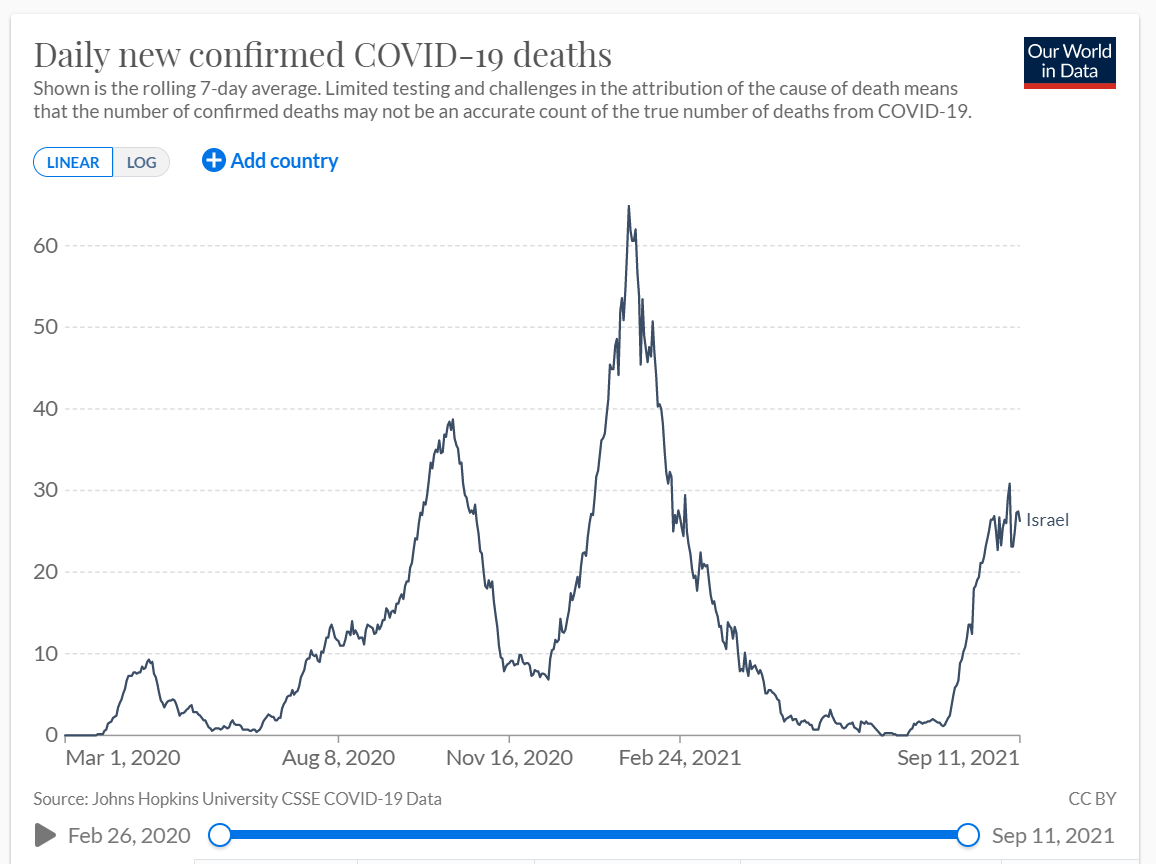
This is exactly what the Swedish MD/PhDs said 15 months ago, i.e., that coronavirus would be with us forever so it wouldn’t make sense to do anything that you wouldn’t be willing to do forever (e.g., close schools).

Let’s look at Sweden versus the eager mask-and-lockdown adopters such as the Czech Republic and the U.S. (varies by state):

Note that New Jersey, if it were its own country, would be #1 worldwide in COVID-19 death rate. New York and Maskachusetts are just behind NJ (chart). The front page of the NYT reminds me, based on IP geolocation, that right now is a great time to panic:

Everyone old/vulnerable is vaccinated and yet there is a “very high risk”?

Related:

Full post, including comments

Cost of being continuously stoned: $7,400 per year

From “Medical marijuana patients just got huge win as N.J. court says company must pay injured worker’s bills” (nj.com):

The New Jersey Supreme Court dealt medical marijuana patients a big victory Tuesday, ruling unanimously that a construction company must pay for an injured employer’s medical cannabis bills.

The decision upheld an Appellate Division ruling from January 2020. That court said Vincent Hager’s former employer, M&K Construction, must foot the monthly bill for medical marijuana he uses to treat injuries he sustained on the job in 2001. As of early 2020, those costs were about $616 a month, according to court documents.

New Jersey’s medical marijuana patients have long complained of high costs. Prices have averaged between $350 to $500 an ounce. The law allows them to purchase up to 3 ounces each month, though most use less.

Only in America could we figure out a way for a literal “weed” to cost $7,400 per year per person!

Full post, including comments

Hang out together at Oshkosh this year?

Supposedly Sun n Fun was busy in 2021 (see “Sun ‘n Fun Aerospace Expo ticket pre-sales soar to record highs despite COVID”, for example). EAA AirVenture (“Oshkosh”) should also be packed. Folks who love aviation are apparently willing to accept the additional risk of leaving the house.

We’re staying on the field at the Hilton Garden Inn this year (“I know some people that know some people that robbed some people”), attending the Cirrus pilots’ dinner Monday evening (July 26), and bought a full-week pass to the EAA Aviators Club (chairs, A/C, food, phone charging, etc., right on the flight line for airshow viewing).

It would be great to see readers/commenters there! (sign up for the Cirrus dinner and Aviators Club now if you want to join; they both will probably sell out)

Note that EAA AirVenture is currently scheduled as a mask-optional event (EAA coronapanic page).

From 2019…

Related:

Full post, including comments

Coronapanic: When does country get “back to normal”?

A month ago a friend bet me that, due to vaccines, Maskachusetts would be “back to normal” today and that the governor repealing his mask order (from among at least 66 total orders issued under a state of emergency) would be the determinant of normality and who would buy lunch at his favorite COVID-unsafe indoor Thai restaurant.

In taking the “this is normal going forward” side of the bet, I pointed out that a mutual friend had said the same thing back in March, i.e., that the vaccine would get us back to normal soon. He’d been hiding in his suburban bunker for over a year when he said that. I said “You believed them when they told you it would be 14 days to flatten the curve and then you could go back to normal. You believed them when they said if people would wear masks for a couple of months that would end coronaplague. You believed them when they told you we just needed one more shutdown. Now you believe them when they say that the restrictions will end once everyone is vaccinated?”

My primary evidence against residents of Massachusetts wanting to be unlocked is observing rich suburbanites, i.e., the folks who have enough money to support politicians with donations. They’d been fully vaccinated weeks earlier and were still wearing masks when walking outside at least 100′ from the nearest human. When queried (at a masked distance) they expressed a personal fear of contracting COVID-19, since they’d heard that the vaccines are not 100 percent effective. I ran into a (masked) mom who was walking her dog. She’s been a Shutdown and Mask Karen from Day 1, but complained that her son, enrolled in an elite private high school, wasn’t allowed to participate in crew because he is also in drama and the drama teacher did not want him exposed to additional COVID risk.

Maybe young people living in crummy apartments in poor neighborhoods wanted to be unlocked, I argued, but they have no political voice.

Meanwhile, the local economy is plainly very different from what it was. A lot of small businesses remain closed (as of October 2020, 33% of Boston’s small businesses were shut, 42% of those in hospitality; overall number of people employed is down about 15 percent in Boston versus 0 percent in Miami and actually up in Tampa (click on “Metros”)). The ones that are left are usually too short-handed to serve customers in what we would have considered a proper manner. There are no Ubers, something I also noticed in other cities, but only higher-cost Uber XLs. When queried, an Uber XL driver said “a lot of people can make more on unemployment so it isn’t worth driving regular Uber anymore.”

Most of the “experts” quoted by the New York Times and similar have been spectacularly wrong regarding COVID-19. But we make no claim to expert credentials and it is fun to try prophecy. What are folks’ predictions regarding state shutdown and mask levels over the coming 12 months?

I’ll go first: My best guess regarding the future is that it looks like the past. So the states that are masked and shut now will be masked and shut going forward while the states that are unmasked and open now will be unmasked and open going forward. Due to the fact that coronavirus is seasonal (and a med school professor friend reminds me that we don’t know why flu is seasonal so we probably won’t figure out why COVID comes in waves either), I expect variations around this theme. Summer 2020 was a quiet time here in MA (see NYT chart below) so I would expect the virus and restrictions to relax in summer 2021 and both to come back in the late fall.

Masks are advertised as a cost-free intervention, so I’m thinking that Maskachusetts, for example, might have a “mask mandate” (it’s been a year and the Legislature cannot get organized to pass a “law”?) through at least 2022, though the previous statewide unconditional outdoor mask requirement has just recently been relaxed to “when you’re not able to maintain a 6′ distance”. Masks will be sold as a cost-free way to prevent the virus from returning. When the virus actually does return, the Mask Believers will say that the masks delayed the return and/or reduced the peak of the return.

(From a physician friend: “The flu is gone because everyone is sticking to the rules but COVID is rising because no one is sticking to the rules.”)

Let’s put our predictions here and check them at 3, 6, 9, and 12 months from now! Bragging rights for whoever gets closest!

Update: At a Bat Mitzvah today (about 15 people in a room designed to hold 100+), a photographer wanted to get a picture of four 13-year-old healthy slender girls. They refused to take off their masks for an indoor photo. He managed to get them outside. They refused to take off their masks for an outdoor photo.

Related:

  • A Silicon Valley friend: “I am so Woke that I want to change my pronouns to Karen/Karen.”
Full post, including comments

To cut interactions between the police and the public, should cars restrict speed to the published speed limit?

Every time there is an interaction between an American subject and an American police officer or officers there is a chance that the police will shoot and kill or cripple the subject. In addition to the loss of life, other subjects may lose tens of millions of dollars per incident when the city has to pay civil damages to the survivors of the person who was killed.

Our beloved 2021 Honda Odyssey (“like a Tesla, but spacious, quiet, and smooth over bumps; lacks Dog Mode”), at least when a phone is plugged in (haven’t checked, but maybe it is getting it from Google Maps?), displays the current speed limit. The engine is controlled electronically. If I mash down the accelerator, it could certainly say “I’m afraid I can’t do that Dave” and accelerate only to, e.g., 55 mph. If nobody can speed, nobody can be pulled over for speeding. This wouldn’t eliminate potentially deadly interactions between the police and the general public, but it certainly would reduce them.

Maybe have a single exception: passing another car that is going more than 10 mph slower than the speed limit on a two-lane road. The Odyssey already has all of the hardware and 99 percent of the software necessary to detect this situation (the adaptive cruise control has a radar to see how fast cars in front are going and the lane-departure and lane-keeping systems (the latter adds some steering inputs) use a camera to see if you’re staying in your lane.

Readers: Stupid or Clever?

Related:

  • Save lives by limiting cars to 35 mph? (if we look at what we’ve done out of coronapanic, it is irrational not to eliminate most driving-related deaths, which kill far younger people (more life-years lost) and which are far easier to prevent)
Full post, including comments

Economic wisdom from MIT (David Autor)

Notes from a Zoom talk today by David Autor, an economics professor at MIT. Whenever Democrats are in charge of the economy, I think it is worth listening to the “experts” at Harvard and MIT because that’s where the policy justifications come from.

Inequality is extreme in the U.S. and harmful, according to Autor. He did not explicitly say how he is measuring inequality, though. The charts that he presented seemed to show wages. But a previous slide showed the low and falling rate of labor force participation in the U.S. In other words, a lot of adults live in the U.S. despite $0 in earnings. What if he looked at spending power and lifestyle? Much of the U.S. welfare system is directed toward non-cash benefits, e.g., a free or low-cost apartment in public housing, a $3/month family subscription to MassHealth (Medicaid) that would be $20,000/year at market rates, SNAP (food stamps), Obamaphone, etc.. The non-working folks whom I know here in Massachusetts have a lifestyle that would cost $80-100,000 per year (after tax) to purchase at market rates (apartment in Cambridge or Boston, health insurance, etc.).

[See this Wall Street Journal piece: “The census fails to account for taxes and most welfare payments, painting a distorted picture. … In all, leaving out taxes and most transfers overstates inequality by more than 300%, as measured by the ratio of the top quintile’s income to the bottom quintile’s. More than 80% of all taxes are paid by the top two quintiles, and more than 70% of all government transfer payments go to the bottom two quintiles. … Today government redistributes sufficient resources to elevate the average household in the bottom quintile to a net income, after transfers and taxes, of $50,901—well within the range of American middle-class earnings.” See also the Work Versus Welfare Trade-Off, in which we learn that poor people are not stupid and Fast-food economics in Massachusetts: Higher minimum wage leads to a shorter work week, not fewer people on welfare, in which employees cut their hours to be sure to maintain eligibility for free housing, health care, etc.]

Minimum wage should be much higher, according to Autor. What about the fact that employers won’t want to pay people way more than they’re worth? A friend’s Spanish language tutor, sitting at home in Guatemala with only a high school degree, on hearing about the proposed $15/year minimum wage, said “Won’t that mean a lot more unemployment since many people aren’t worth $15/hour?” Autor says that the government will invest in educating Americans to the point that they’re worth more. On a per-pupil basis and as a percentage of GDP, we already spend more than almost any other country on K-12 education; why aren’t American high school graduates already worth a lot to employers? Autor points out that the average American high school graduate is way less skilled than a high school graduate in other developed economies. “We should fix that.” Autor’s big solution for 13 years of government-run education that he says are generally ineffective is to add one more year: “universal pre-K”. With 14 years of pre-K through 12 and maybe another 5 years of taxpayer-funded college, a worker will surely find employers delighted to hire him/her/zir/them at $15/hour. (Autor also notes that many of today’s college graduates are going into personal service jobs at low wages.)

Borrowing is free. Interest rates have never been lower. We will grow our way out of any amount of borrowing that we do and, after paying back whatever we borrowed, be richer than if we hadn’t borrowed.

Apparently contradicting the above point, he says that successful Americans should pay vastly more in taxes than they’re currently paying. (Why does the government need all of this current tax revenue if borrowing is, in fact, free?) The capital gains tax rate should be much higher (but still not adjusted for inflation, so actually it would be more than 100 percent in a lot of situations, as it is already (if you bought an asset for $10,000 in 2000, for example, the BLS says you spent $15,700 in today’s mini-dollars; if you sell it for $15,000 in 2021 you’ve actually suffered a loss, but will owe capital gains tax nonetheless).

Estate taxes should be higher and there should be no step-up basis for the assets inherited.

Everything that Joe Biden is doing and has proposed is awesome and will propel the U.S. forward toward a dreamland of prosperity. “The Biden Administration is right to go all in rather than nibbling around the edges.” Can all of our dreams be achieved via bigger government? Autor would rather the government “create” better quality jobs than address inequality through the tax code. (i.e., what we really need is a planned economy, a point made by an emeritus professor and former senior MIT administrator, who asked whether Capitalism wasn’t the real source of inequality).

Autor was in sync with the folks at New Yorker magazine: “The President, channelling his inner Elizabeth Warren, pitches an American utopia after a dystopian plague year.”

(Trump’s fantasy was that Americans might not be rich enough to afford the work-free utopia that we desire; Biden is grounded enough to realize that utopia can be ours if we tax and borrow a little more.)

Readers: Have you been following Biden’s latest proposals, e.g., in last night’s speech? Are you as excited about bigger government as Professor Autor?

Related:

Full post, including comments

Will people who get paid in cryptocurrency share with the IRS?

A friend has been selling NFTs and getting paid in cryptocurrency. He thought that he didn’t have to pay tax on this income until the cryptocurrency was finally cashed in for dollars. I did a bit of searching and told him that the IRS wants him to pay tax in the year that the cryptocoins were received. I directed him to “Virtual Currencies” and an IRS FAQ from 2014:

Q–3: Must a taxpayer who receives virtual currency as payment for goods or services include in computing gross income the fair market value of the virtual currency?

A–3: Yes. A taxpayer who receives virtual currency as payment for goods or services must, in computing gross income, include the fair market value of the virtual currency, measured in U.S. dollars, as of the date that the virtual currency was received. See Publication 525, Taxable and Nontaxable Income, for more information on miscellaneous income from exchanges involving property or services.

How many people will do this? Maybe there will be a 1099 when coins are exchanged for cash and then the holder will be motivated to declare this as a capital gain (at President Harris’s new 75 percent rate plus 13.3 percent California tax?). But if there is no reporting to the IRS of any of the flows that stay in the crypto world, isn’t there a high likelihood that people won’t pay tax either because they don’t know that they should or because they don’t think they’ll get caught?

What’s the percentage of income received in cash that gets reported to the IRS? If Hunter Biden put a $100 bill into the hands of a hard-working dancer, for example, what is the chance that she reported that $100 and paid income tax on it? (Of course, when a friend said that the Daily Mail figured out that Hunter Biden’s laptop showed epic spending on hookers and booze, I responded “And he wasted the rest of his money?”)

From Tampa, 2014:

Disclaimer: I own no cryptocurrency and am bitterly envious of all of the people who were smarter than I!

Full post, including comments

Massachusetts Democrat: the government arresting the political opposition is a step forward for the U.S.

I’ve been mostly in a news vacuum for the past couple of weeks (family trip to D.C. (grandma), Atlanta (aquarium, zoo, botanical garden, World of Coca Cola), Jupiter, Florida (beach, mini golf), and Asheville (Biltmore mansion)). I returned to my labors at the local flight school today and a Massachusetts Democrat related his elation regarding the F.B.I. search and seizure of Rudy Giuliani’s office and computer gear (see “F.B.I. Searches Giuliani’s Home and Office, Seizing Phones and Computers”).

Typically when we read about a government that arrests the political opposition we don’t see that as a positive step for a country, but this guy didn’t see any downside to an affiliate of the former president being prosecuted by the current one.

On the plus side, nobody can take away our big flags (from Chimney Rock State Park, North Carolina):

And another photo for scale:

Related:

Full post, including comments

Software ideas for a Web archive?

A friend’s daughter is tasked with developing a Web-accessible archive for a multi-year collection of material that has been generated by an organization within a university. All of the material will be public, so there are no security issues and everything can be indexed by search engines. Ideally all of this can be maintained by non-programmers from Web browsers and minimal technical effort will be required for setup (though perhaps some programming would be useful/needed for an ingestion step).

The material is a mixture of PDFs, images, text, etc. She found some interesting software targeted at this very problem. Examples:

All of these provide for comprehensive tagging of each item, boolean searches, etc. But I wonder/worry that these are overkill. The collection is not especially valuable and I don’t know if people want to take the trouble to craft elaborate queries.

I was thinking that she might be better off using standard WordPress. Every item that is in the archive can become a WordPress post dated whenever the item was created (maybe this can be done via a batch process inserting things into the WordPress tables). She and anyone else involved in the project can tag items with however many tags make sense. At that point users can

  1. search with Google
  2. search by date (WordPress lets you go back and look at posts by date)
  3. search by tag

One advantage for WordPress over the above systems that are built for archiving is that WordPress is much more popular and constantly being improved (changed, anyway!). There are plugin modules available, e.g., to improve full-text searching through PDFs. For those who already have a museum collection organized, there is even a “Culture Object” plugin that is designed to import a collection into WordPress.

Readers: Better ideas?

Full post, including comments

New York Times: Experts as prophets

“Parents, Stop Talking About the ‘Lost Year’” (NYT, April 11, 2021) contains 7 occurrences of the word “experts”

Teenagers and tweens will be fine, experts say — if adults model resilience.

Experts say some of their worries are justified — but only up to a point. There’s no doubt that the pandemic has taken a major toll on many adolescents’ emotional well-being. According to a much-cited report from the Centers for Disease Control and Prevention, the proportion of emergency room visits that were mental health-related for 12 to 17 year olds increased by 31 percent from April to October 2020 compared with the same period in 2019. And there’s no question that witnessing their loneliness, difficulties with online learning and seemingly endless hours on social media has been enormously stressful for the adults who care about them the most.

Yet, as the nation begins to pivot from trauma to recovery, many mental-health experts and educators are trying to spread the message that parents, too, need a reset. If adults want to guide their children toward resilience, these experts say, then they need to get their own minds out of crisis mode.

Despite all of this, Ms. Fagell, much like the dozen-plus other experts in adolescent development who were interviewed for this article, was adamant that parents should not panic — and that, furthermore, the spread of the “lost year” narrative needed to stop. Getting a full picture of what’s going on with middle schoolers — and being ready to help them — they agreed, requires holding two seemingly contradictory ideas simultaneously in mind: The past year has been terrible. And most middle schoolers will be fine.

What factors keep adolescents from tipping from one state to the other? Mental health experts point to a few: their connection to at least one good friend; any underlying vulnerabilities like mood disorders;the adversity in their daily lives; the availability of adults to help them cope with hardship — and whether their parents are keeping it together.

“Social media is mitigating some of the effects of isolation,” he said.

That message, frequently repeated by experts and educators, should offer some relief to the many parents who feel guilty about the amount of screen time they’ve allowed their children this past year.

So much great stuff in here! Facebook, formerly associated with making adolescents (and everyone else) worse off mentally, is now recommended. But that’s a minor joy compared to the idea that people can be “expert” in predicting the effect of something that had never previously happened, i.e., coronapanic and associated mass school closure, the shutdown of social life, travel, jobs, gyms, etc.

Credentials are a big help in prophecy as in other areas. One of Dr. Jill Biden’s colleagues:

Rabiah Harris, a public middle-school science teacher in Washington, has a doctorate in education, which permits her, as the mother of an almost 12-year-old, to take a philosophical view.

(If it is “Dr. Jill Biden,” why isn’t it “Dr. Rabiah Harris”? Her LinkedIn page shows that she has the same Ed.D. degree as Dr. Biden.)

Even more interesting to me than the editors of the NYT thinking that readers would buy into the idea that experts could predict the long-term effects of the Great Panic of 2020-2021-2022-…(?): the experts’ idea that teenagers listen to their parents.

Full post, including comments