California: Masks will stop a viral epidemic, but won’t help with smoke

“Bay Area smoke: To breathe safely, stay inside and don’t count on masks” (Mercury News):

Don’t count on masks to help with bad air, experts say

But people shouldn’t expect much protection from the bandanas or surgical masks they have become accustomed to wearing in public to prevent the transmission of COVID-19. Experts also caution against relying on the more sought-after N95 respirator masks because they are in short supply.

With wildfire smoke, microscopic soot particles, about 2.5 microns in size, can be inhaled and cause inflammation, explained John Balmes, a professor of medicine at UC San Francisco, in an article published on the university’s website.

There also is concern that poor air quality from the wildfires could increase the severity of COVID-19 symptoms. Dr. Stephanie Christenson, an assistant professor of pulmonology at UC San Francisco, said this concern is based on preliminary research linking air pollution to increased COVID-19 susceptibility, severity and death.

Because of the pandemic, people should continue to wear cloth and surgical masks in public, because they block respiratory droplets and help slow the spread of the coronavirus, Christenson said. Unfortunately, these masks don’t block out the “very, very small” toxic particles from wildfire smoke, she said.

So the coronavirus is smaller than 2.5 microns?

Back in February, in “Can Masks Capture Coronavirus Particles?”, our big enemy was “spheres with diameters of approximately 0.125 microns (125 nm). The smallest particles are 0.06 microns, and the largest are 0.14 microns.”

As of July, the coronavirus was still 0.125 microns in size, according to “Can HEPA Air Purifiers Capture the Coronavirus?” (Wirecutter).

The McKinsey folks responsible for Enron’s success, in “Can HVAC systems help prevent the transmission of COVID-19?”, describe humans being victimized by particles as small as 0.1 microns.

Science tells us that masks are useless against smoke particles that are 2.5 microns in size and also that masks will stop a 0.125-micron coronaplague dead in its tracks. #FollowScience !

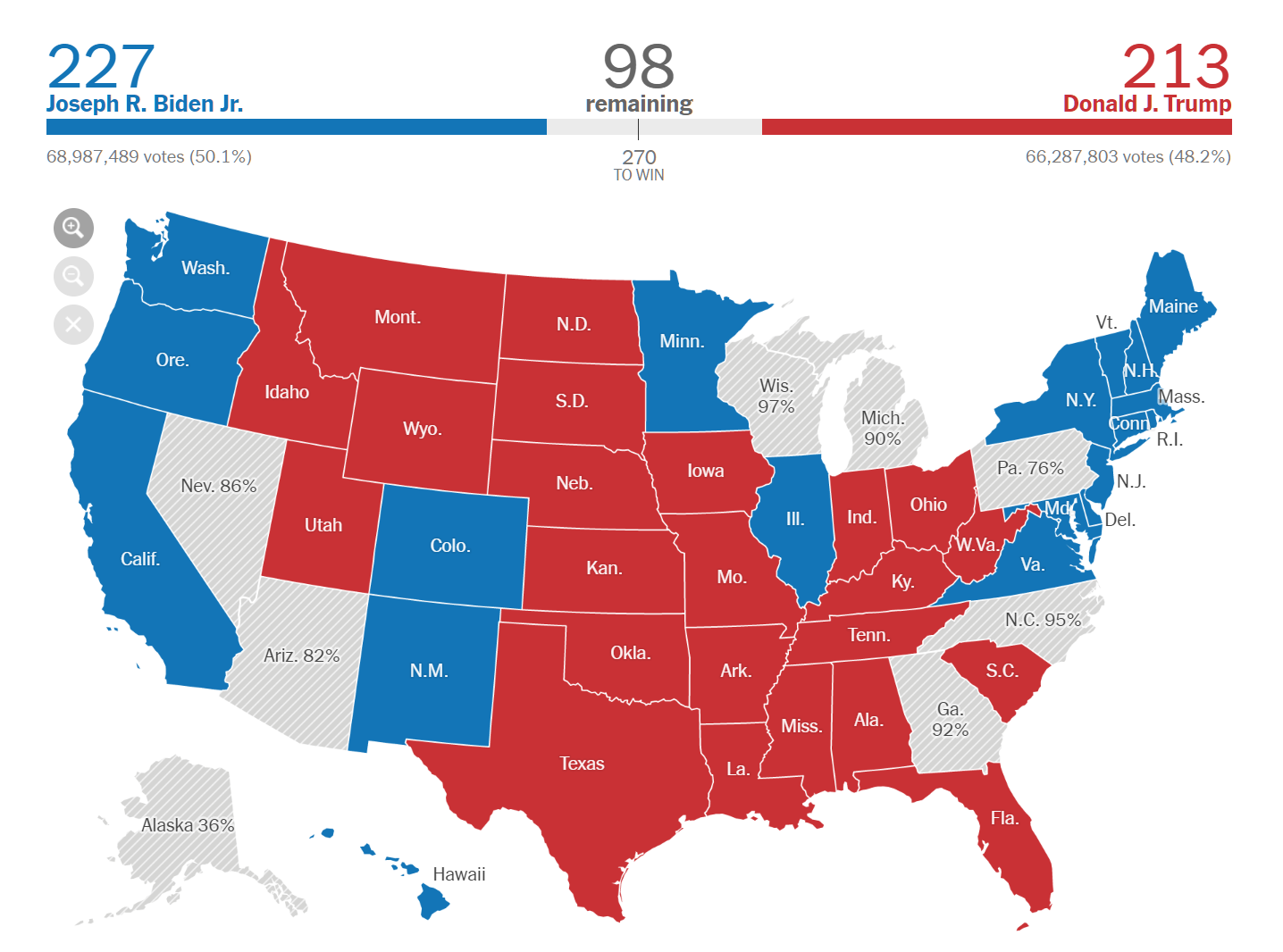
(From the New York Times, the progress of coronavirus in a state under a universal mask order and blessed with science-informed leadership:

)

See also the higher rates of coronavirus infections in masked U.S. and France compared to never-masked Sweden and barely-masked Netherlands:

From Bar Harbor, Maine:

Related:

Full post, including comments

Landline cordless phones with call blocking?

Given that the U.S. phone system has been taken over by spammers (unintended consequence of what we expected to be the boon of free unlimited calls), you’d think that the core feature of any landline cordless phone system would be intelligent call screening and call blocking.

Panasonic has always been my favorite brand of phone (e.g., this five-handset system), but their call blocking system seems to rely on ringing the phone, having the owner answer, and then having the user press the “Call Block” button (plus some additional keys, I think) to store the caller ID in a small local database. When spammers can generate any caller ID that they want (thank you, American phone system engineers for ignoring 40 years of public-key cryptography!), including the phone number for the local public school, what is the value in this?

Given the low cost of computing hardware, why wouldn’t cordless phones (a) connect to WiFi and then communicate amongst themselves a known list of spam caller IDs that don’t correspond to real numbers, (b) do a “hello, may I help you?” interaction with callers whose IDs are not in the contacts directory?

“AT&T” brand phones (are these actually from AT&T or is it like “GE Appliances” that are run by Haier in China?) seem to have a partial solution, which they call “Smart Call Blocking”. From the manual:

If the call is not in the directory, essentially, the caller is prompted to speak a name and type #. One issue with this is that automated calls from organizations that don’t use email, e.g., pharmacies and hospitals, won’t get through. But maybe the solution there is to always provide one’s mobile phone number to these enterprises.

Presumably it is necessary for sanity to purchase a “Connect to Cell” AT&T model so that the directory can be preloaded from one’s mobile phone instead of manually populated. Bizarrely, though, there seems to be only one AT&T model that has both the cell phone connection and the smart call blocker: DL72310 (the three-handset version).

Given that Americans have been going crazy for years being bothered by these calls, how is it possible that there are so few home defense solutions?

Full post, including comments

BLM theme meals at fast food restaurants?

Stopping alongside one of the elegant restaurants that the Maskachusetts License Raj hasn’t managed to shut down, I was offered a gourmet meal:

If there can be a “Travis Scott Meal”, why not a “Jacob Blake Meal” for those who want to demonstrate their commitment to the Black Lives Matter movement? For those who never think about anything other than COVID-19, a “Dr. Fauci Meal” whose contents may change from day to day? For the politically oriented, a “President Harris Meal”?

Full post, including comments

Nancy Pelosi writes me a letter

Although politicians don’t generally campaign here in Maskachusetts (the outcome of almost every election is predetermined and, in fact, most candidates run unopposed), they do sometimes favor us with letters. Let me share one from Nancy Pelosi!

People tell me it must be a tough job to be Speaker of the House when the president belongs to the opposite party, lives in a world without facts or decency, and has nearly every Republican in Congress marching in unthinking lockstep behind him.

I’ve had a tougher one. I raised five kids born in six years. It taught me that children deserve our love and our caring.

What else did Mom Pelosi learn about children while the five brats milled around her ankles?

Trump and his followers on Capitol Hill want to take away women’s most fundamental rights.

Your generous contribution of $15, $25, $35 or more to the DCCC’s Headquarters Account will help the DCCC sustain and expand Battlestations across the country.

We will not let them end the right to choose in America.

Take it from a mom: We can’t do this alone. Together there’s no limit to what we can achieve.

Then there is a postscript:

The most formative experience in my life has been being a mother to five children.

So half the letter is about how being a mom makes a person (not to foment anti-LGBTQIA+ hatred by saying “makes a woman“, since men can also be moms) better. And the other half is about how babies should be aborted.

Presumably this was tested and actually did result in recipients getting out their checkbooks.

Full post, including comments

Join the teachers union if you don’t want the government sticking needles in your arm

One of the latest orders from the Maskachusetts governor is that children will be denied a K-12 education if they don’t submit to a flu vaccination. (In ancient times, of course, this could be conveniently obtained at the school itself in about 30 seconds, from a public health nurse with a gun, but today this will involve more than 20 minutes of paperwork at a CVS or similar.)

So everyone in the school building will have a reduced chance of getting the flu? There was a discussion about this on the town mailing list. The righteous who attended a School Committee meeting reported that the bureaucrats concluded that they lacked the power to force the teachers to accept the needle.

(How effective is the flu vaccine? Not effective enough for the British medical technocrats to recommend it for those between 11 and 65 years of age (Oxford; NHS), perhaps partly because “Over time, protection from the injected flu vaccine gradually decreases and flu strains often change.” (NHS). If the Brits are correct, perhaps the current American zeal for flu shots will lead to a lot of flu deaths among the elderly 10-20 years from now. See “Repeated flu shots may blunt effectiveness” (CMAJ, 2015))

In other coronaplague news, the town decided not to defer construction of what seems to be, on a per-student basis, the most expensive school ever built in the United States. They started demolishing the old building in June, as planned. Instead of the old building plus the temporary trailers, therefore, the school will try to operate within half of the old building and the trailers. In other words, they affirmatively decided to reduce the square footage per student in the middle of a raging viral epidemic.

Related:

  • “Brazil’s Bolsonaro says COVID-19 vaccinations will not be mandatory” (Reuters): “Many people want the vaccine to be applied in a coercive way, but there is no law that provides for that,” Bolsonaro said in a Facebook live chat with his supporters. … “There is no way for the government – unless we live in a dictatorship – to force everyone to get vaccinated,” Mourão said in a radio interview.
Full post, including comments

Demand for cars is UP, not DOWN

It looks as though I actually can be wrong about everything.

From March 25, When do car makers cut prices?

Shouldn’t the car manufacturers be having coronavirus special deals? A car plainly isn’t worth as much as it was two months ago. Why are the prices mostly the same? Are people actually buying cars at a similar rate to what it was a year ago? Is the shutdown of car factories roughly balancing the collapse of demand? Even with the U.S. and Europe paralyzed, Japan and China are open for business, right? They can produce a ton of cars, can’t they?

We still don’t have that new car, but it looks as though I was dead wrong as usual: “Looking to Buy a Used Car in the Pandemic? So Is Everyone Else” (nytimes, yesterday). Excerpts:

Eager to avoid public transit and Uber, and to save money, buyers are emptying dealerships.

“Used cars are supposed to depreciate, but I’d look up the book value of a car on the lot and see it was higher than at the beginning of the month,” said Adam Silverleib, president of Silko Honda in Raynham, Mass. “I’ve never seen that before.”

Early in the pandemic, when many people avoided leaving home for all but the most pressing needs, carmakers offered no-interest loans for as long as 84 months to lure buyers. With new-car inventories low, such generous incentives have mostly disappeared.

I was only 90 percent wrong about new car demand:

Those fears might be overdone. Buying a used car does not increase the number of cars on the road, of course. And sales of new cars are not taking off. If anything, part of the sudden mania for used cars stems from the yearslong rise in the price of new cars and trucks. On average, new vehicles now sell for about $38,000, more than many consumers can afford or are willing to pay.

Speaking of wrong about everything, Senior Management likes the idea of a station wagon. These are rare birds on our Planet of the SUVs and I am seriously averse to the Karenmobile (Volvo). That leaves “How Subarus Came to Be Seen as Cars for Lesbians” (Atlantic: “it’s the result of a calculated, highly progressive ad campaign launched 20 years ago.”) and… what else? We saw an interesting looking car the other day, a Buick Regal TourX:

1.4 billion Chinese consumers can’t be wrong about Buick, can they?

Related:

Full post, including comments

Finally a good argument for buying a Cirrus?

“The Looming Mechanic Shortage: What If Your Airplane Breaks And There’s No One To Fix It?” (AOPA) is by Mike Busch, who helps a lot of owners of piston-driver airplanes manage maintenance.

Good old days:

When my Skylane needed maintenance, I took it to the Cessna dealership on the field, which employed a half-dozen factory-trained airframe and powerplant mechanics who worked on nothing but single-engine Cessnas all day long. The Cessna dealership also had a parts room to die for, so when my airplane needed some component to be replaced it was likely to be in stock. Owners of Pipers and Beechcraft on the field enjoyed the same happy circumstance at their factory dealerships.

Today:

Sadly, those days are gone. The Cessna and Beechcraft dealerships at John Wayne Airport are long gone, and the old Piper dealership now exists primarily as a shop catering to bizjets and turboprops. If you base a Cessna single at John Wayne and need maintenance done, the Cessna authorized service center on the field is Jay’s Aircraft Maintenance Inc. It’s a good shop, but the fact that it’s an authorized service center doesn’t mean that it only works on Cessnas the way it used to. According to Jay’s website, “We are equipped to perform maintenance on any aircraft under 12,000 lbs., including but not limited to those manufactured by Cessna, Piper, Beechcraft, Cirrus, and Socata.”

So, the A&P/IA who starts the annual inspection of your Skylane might well have just finished working on a Comanche or a Baron or a Cub. He’s most likely a generalist, not a specialist. Instead of knowing a lot about a few aircraft models, he knows a little about a lot of aircraft models—occasionally just enough to be dangerous. That’s not good.

Tomorrow:

The COVID-19 lockdowns have been a disaster for A&P schools. According to the Aviation Technician Education Council, one in five A&P schools has suspended operations, with many other schools voicing concern over their long-term viability. Forty percent of the schools expect a decline in 2020 graduates averaging 28 percent. Half expect that enrollment will decline in 2020 and 2021 by 31 percent.

Perhaps electric airplanes, with their minimal powerplant maintenance needs, will save recreational pilots. Or maybe the collapse of the airlines will deliver mechanics back to the small shops.

But I wonder if this is an argument for getting a Cirrus, the most popular of today’s little airplanes. With about 8,000 of these in the field and the fleet getting regular use by owners, perhaps that creates enough of a critical mass for a real support network. Of course, there are a larger number of Cessna, Piper, and Beechcraft planes out there, but the ones that get high utilization tend to be in flight schools that do their own maintenance.

Related:

Full post, including comments

Coronapanic lockdowns will devalue independent living retirement homes?

The elderly folks whom I know that live in “independent living” retirement homes have now been locked down for six months. They can’t socialize, which was their motivation for moving into the dorm-style environment. The dining rooms are closed and meals are brought to their apartments. The shared athletic and activity facilities have been closed. Many are widows who are essentially locked into solitary confinement.

For folks who had only 4 years of life expectancy remaining, in order to protect them from a 5-20 percent chance of dying from coronaplague, they have now had a 100 percent chance of losing out on most of the things that they valued for 12 percent of their life expectancy.

(A friend’s mom has actually lost nearly 100 percent of the things that she enjoys for 100 percent of what turned out to be her remaining life. This widow was locked down in March, giving up her four weekly exercise classes and her multiple hours per day of socializing and excursions. She was feeling worse and worse. Eventually she got to see a doctor and was diagnosed with stage 4 pancreatic cancer. She is almost certain to die befor the lockdown is lifted.)

On the other hand, the elderly folks that are living in regular houses or apartment buildings are free to visit family members, free to socialize with each other, free to go out to stores (whichever ones the governors and state license rajs will permit to open!), free to go to the beach, etc.

Independent living facilities are fairly expensive. Hundreds of thousands of dollars to buy in (co-op or condo) and then thousands of dollars per month for services, most of which are now shut down. Why spend this money and put oneself at risk of a multi-month or multi-year lockdown, whatever the state governor feels like ordering? Why not instead stay in an ordinary house or apartment building and hire a helper for a few hours per day if needed?

Full post, including comments

Harvard hires for the Department of Ethnicity, Indigeneity, and Migration

“[Faculty of Arts and Sciences] unveils anti-racism agenda” (Harvard Gazette, August 20, 2020):

Calling on the FAS community to be “relentless, constructively critical, and action-oriented,” Gay said that she would: restart the search for four new senior faculty in ethnicity, indigeneity, and migration (EIM); establish a new visiting professorship in EIM; appoint an inaugural associate dean of diversity, inclusion and belonging; expand the Inequality in American postdoctoral fellows program; initiate a study of racial diversity among senior staff; and create a task force to examine the FAS visual culture.

What happens when you kick everyone off campus five months earlier?

“The calls for racial justice heard on our streets also echo on our campus, as we reckon with our individual and institutional shortcomings and with our faculty’s shared responsibility to bring truth to bear on the pernicious effects of structural inequality,” she said. “I am clear-eyed that the work of real change will be difficult, and for many it will be uncomfortable. Change is messy work. Institutional inertia will threaten to overwhelm even our best efforts. If we are to succeed, we must challenge a status quo that is comfortable and convenient for many.”

A lot of echoes in those empty buildings! The mostly-empty campus will have some new signs:

Finally, Gay outlined the charge for her new Task Force for Visual Culture and Signage. Led by Dean of Arts and Humanities Robin Kelsey, the group will be comprised of faculty, students, and staff, and will pursue a comprehensive study of FAS’s visual culture and articulate guidelines for evolving imagery across campus.

What if the new professors of Indigeneity suggest giving the campus back to the rightful owners of the real estate, i.e., perhaps the Wampanoags or the Massachusetts (the tribe, not to be confused with the current Commonwealth of Maskachusetts)? Will Harvard dip into its $40+ billion (thanks, Donald Trump!) endowment to pay rent on the Native American-owned campus?

Related:

  • Not everyone at Harvard got the memo regarding the benefits to natives of migration. From a Harvard economics professor: “Yes, Immigration Hurts American Workers”
  • also from Harvard’s econ nerds, “Effects of Immigration on African-American Employment and Incarceration” (NBER): For white men, an immigration boost of 10 percent caused their employment rate to fall just 0.7 percentage points; for black men, it fell 2.4 percentage points. That same immigration rise was also correlated with a rise in incarceration rates. For white men, a 10 percent rise in immigration appeared to cause a 0.1 percentage point increase in the incarceration rate for white men. But for black men, it meant a nearly 1 percentage-point rise.
Full post, including comments

What happens when cold season starts?

I’ve been in a bunch of masked-up environments recently. People have their masks off to take a sip of a beverage or a bite of a sandwich. What would happen if someone took off the mask in order to sneeze and wipe his/her/zer/their nose? Pandemonium, panic, and violence?

Are we going to end up with a society more like Japan, in which it is rude to be out in public while coughing or sneezing? (this does not seem to have helped with virus control there; the death rate from flu in Japan has been 2.5X the death rate in the U.S.)

Full post, including comments