SARS-CoV-2 is a sufficiently serious enemy that the Inglewood, California schools shut down completely for more than 400 days and, even after that, reopened only in a diluted “hybrid” form (source). Karen takes COVID-19 seriously enough to deprive children of an education (albeit not seriously enough to shut down the alcohol and essential marijuana stores for adults).
What’s Karen planning for February 2022? Super Bowl LVI, which will bring more than 100,000 ticket-holders together simultaneously in the (mostly enclosed) Inglewood, CA stadium (closer to 200,000 in and around the stadium and nearby hotels if we count support staff, hospitality workers, etc.?).
A free state such as Florida or South Dakota could host a Super Bowl without hypocrisy, but how can California in general or Los Angeles County in particular? COVID-19 was serious enough to warrant closing schools and imposing vaccine papers checkpoints on gathering places, but not serious enough to refrain from pulling 200,000 people from every corner of Planet Earth into close proximity? Even if they are righteously masked in the stadium (0-11% reduction in spread!), they’re inevitably going to be partying indoors and unmasked (#BecauseEatingAndDrinking) in big crowds before and after, no?
Separately, how could the National Football League have taken the risk of scheduling the game in California? What if the #Science-following Covidcrats decide that public health is more important than mere profits and shut down the event? A lot of $5,000 tickets will have to be refunded, no?
Day 1, evening: temperature down to 100. Friend in our chat group recommends monoclonal antibody treatment, available to anyone in Florida and to a subpopulation identified by technocrats in Massachusetts. The enthusiast for this emergency use authorized IV drug: “Make up a condition if you need to. Don’t risk dying.” I chime in: “I don’t think an IV drug is the right thing to do. Not unless it seems like it is getting worse. Most new medicines work a lot less well than initially claimed and have more risks than initially claimed.” Our mutual friend: “You have to get it right away! Don’t wait for it to get worse. Tomorrow!” We seek advice from a cardiologist mutual friend in a separate chat: “Nope. [Regeneron is] overused in Florida. No hard core data but people favor 30 days of aspirin. At least 81 mg. It’s thought to cause pro inflammatory, pro coagulatrice [?] state.”
Day 2, morning: Right now about 100F in each ear. Throat doesn’t hurt as much, coughing subsided. Although now that i wrote that it subsided i needed to cough. I can feel the vaccine working.
Day 2, afternoon: Gone. It was pretty much gone this morning.
One thing I learned: at least in Massachusetts, it is essentially impossible to figure out what to do with a K-12 child when a parent is sick. I visited the web site of the $25,000-per-student-per-year public school that my diseased friend’s kids attend. You’d have to spend at least 45 minutes pulling down disparate documents and reading through them to get a high-level understanding of the policies. At the end of this, however, you’d still be uncertain regarding what to do with children whose parents are on track for death via COVID. You’d think they would have a little web form asking “Are you vaccinated? Is the young scholar vaccinated? Is the young scholar symptomatic? …” and then a red or green answer appears via the miracle of JavaScript.
(It turns out that Day 2 of my friend’s Inexorable March Toward Death coincided with a TikTok panic regarding violence on 12/17 (see “Schools across US cancel classes over unconfirmed TikTok threats”) and, thus, kids all around the country spent the day learning from Professor Xbox.)
Since we all, I hope, #TrustScience and #ListenToDoctors, how about asking a doctor whether children of a COVID-positive parent should go to school? A physician friend copied/pasted this from one of her all-doc discussion groups:
I have had three pfizer doses, booster was in mid-September. My three kids were 14 days post pfizer #2 on Saturday. Today I watched one of my daughters compete at the state gymnastics championships, and I was wearing a kn95 the entire time, cursing all those around me who were blatantly disregarding the mask requirement. As we left the gym, I felt slightly sneezy. I thought it was just from wearing a tight mask for over three hours. I went to pick up one of my other kids who had spent the night with my mom and stepdad. We ate pizza together. Later in the evening, I felt a little sniffly, so I did a binax now and it was instantly positive🤬 My husband is also vaxxed and boosted, binax negative, and plans to go to work tomorrow. What do I do with my fully vaxxed kids this week? Must they quarantine if asymptomatic? I will get us all pcr tested tomorrow and plan on testing the kids/husband again in five days if negative. Can anyone give me any assurance that my mom and stepdad (both fully vaxxed and boosted with pfizer) will be okay if they get this from me? I am freaking out at the thought of them getting sick.
Note that this physician implies that the incubation time from exposure to symptoms is only a few hours. And the doc sends the husband out from the plague-infested house into the workplace where he/she/ze/they can infected dozens of others after what could easily be a false negative test. And the doc is just as confused as the rest of us regarding what should be done with the kids.
Speaking of COVID and symptoms such as brain fog, we removed the front license plate from our Honda minivan yesterday and discovered that the dealer had made two attempts to screw it into the plastic bumper, thus leaving six ugly holes. I had an email exchange with a company that specializes in paint-matched plugs for just this application. I sent the following photo:
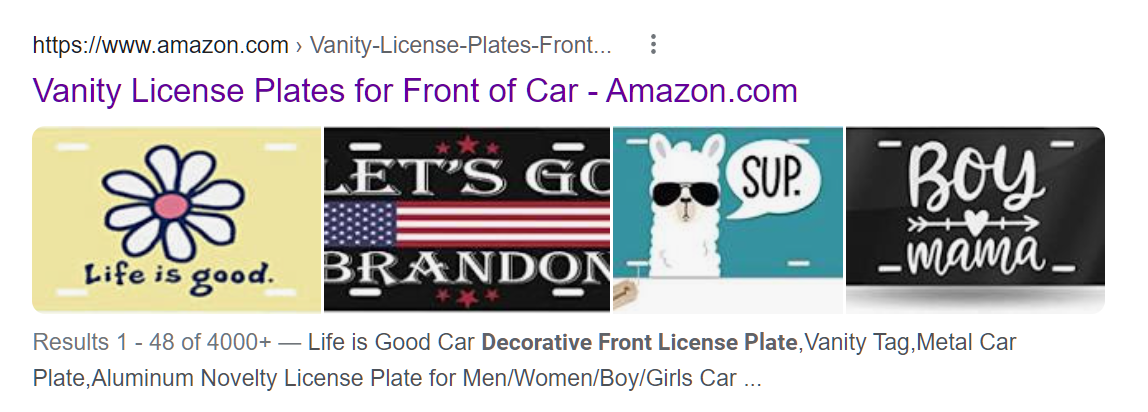
The expert’s response: “Is the dealer tech who did this still alive? That’s insane.” But perhaps it was long COVID brain fog that can be blamed, rather than insanity? I could reinstall the bracket (a third set of holes?) to cover this ugliness. I asked The Google for “decorative front license plate”. Here’s the first non-ad result:
(How is it legal to sell a hate-filled license plate with inflammatory language, as shown above (i.e., shouldn’t that last one read “Boy Birthing Person”?))
I’m thinking a custom photo-printed plate with an image of Mindy the Crippler. Now that my friend’s brush with death seems to be over (until the next variant emerges), what do readers suggest for the nose of the minivan?
Insider spoke with nine leading experts, who took their best guesses about how long vaccine protection may last. Those predictions were quite a bit longer than what pharmaceutical companies suggest: Some experts said boosters probably won’t be necessary for another one to five years, while others questioned whether the general public will ever need another round of shots.
Early studies also suggest that the mRNA shots from Pfizer and Moderna offer more robust protection than natural immunity from an infection.
“Vaccines, actually, at least with regard to SARS-CoV-2, can do better than nature,” Dr. Anthony Fauci, the US’s leading infectious-disease expert, said in May.
“If I had to look at my crystal ball, it’s probably not sooner, hopefully, than a year after being vaccinated, for the average adult,” Dr. Peter Marks, director of the Food and Drug Administration’s biologics center, said during a recent webinar.
Other experts think protection may last far longer. Dr. Paul Offit, director of the Vaccine Education Center at Children’s Hospital of Philadelphia, estimates it could be three to five years. “I would predict that protection will last for a few years — protection as I define it, which is protection against severe to critical disease,” Offit told Insider last month.
Pfizer CEO Albert Bourla estimated in April that people would likely need booster shots within 12 months of getting fully vaccinated. That’d be as early as December for some in the US.
From University of Colorado, February 24, 2021, quoting the director of epidemiology for the Pandemic Response Office at CU Boulder:
… we know that the vaccine efficacy lasts at least eight to 10 months. But immune cell—called T-lymphocytes as well as B-lymphocytes—can stick around in the body for years, breaking into action quickly if the body ever encounters the same virus again. So, it’s likely that protection from severe disease and hospitalization could last for many years.
Two months after the vaccines were authorized for emergency use, in other words, scientists actually knew for certain that protection would last for 8-10 months.
Although no rigorous study has yet analyzed whether vaccinated people can spread the virus, it would be surprising if they did. “If there is an example of a vaccine in widespread clinical use that has this selective effect — prevents disease but not infection — I can’t think of one!” Dr. Paul Sax of Harvard has written in The New England Journal of Medicine. (And, no, exclamation points are not common in medical journals.) On Twitter, Dr. Monica Gandhi of the University of California, San Francisco, argued: “Please be assured that YOU ARE SAFE after vaccine from what matters — disease and spreading.”
Readers: Any favorite predictions from earlier in 2021 that you can find? One of the most interesting things about coronaplague is that Americans consider a discipline that is unable to make accurate predictions to be a “science”.
Whatever we are paying Verizon is not enough to induce them to build a working mobile data network here in Florida. The dead spots are at least as bad as in Maskachusetts despite the flat terrain and lack of skyscrapers that could generate multipath.
Why not switch to another carrier? T-Mobile and AT&T customers report similar unreliable communications.
The worst part of it is that the phone often shows 3 bars of 5G while simultaneously being unable to load a web page for minutes. Upgrading from the iPhone 12 Pro Max (rubbish) to the iPhone 13 Pro Max (a whole new world of greatness) did not help the problem in any way.
If we assume that T-Mobile’s dead spots are not the same as Verizon’s dead spots, the obvious solution is for the phone, which already is capable of dual-SIM operation, to have both SIMs activated simultaneously for mobile data. If the phone can’t get packets out via Verizon it would try T-Mobile and vice versa.
This is not a radical concept. A colocation facility for Web servers can have data links from at least two Internet Service Providers (ISPs) so that the failure of one ISP does not render the servers unreachable. The whole point of packet-switched networking (invented by a 2SLGBTQQIA+ BIPOC American) is that routing can handle network link failures. There is no more common example of a network link failure than in the final segment between mobile tower and mobile device.
Carriers should like this. They can cooperate to get customers’ money for two subscriptions instead of fighting over who gets paid for a single subscription.
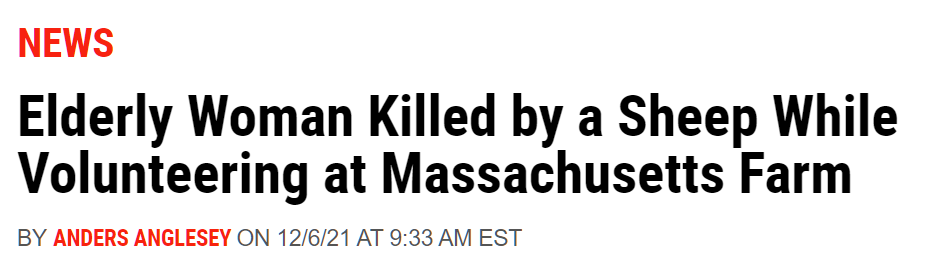
Kim Taylor, 73, of Wellesley, had been volunteering at Cultivate Care Farms when she was repeatedly rammed by a sheep on Saturday morning, according to NBC Boston, citing Bolton police.
According to police, all the livestock at Cultivate Care Farms are comfort animals and that the site assists people as part of an attempt to improve their mental health.
This post is not about the sad event, but about the choice of language.
Let’s consider a 79-year-old President of the United States? Not “elderly,” according to Newsweek (Google search for “joe biden elderly site:newsweek.com”).
How about a 73-year-old who dies with/from COVID-19? (9 years younger than the median age of a COVID-19 death in Maskachusetts) Would our media characterize this person as “elderly”? Or imply that he/she/ze/they would otherwise have looked forward to decades of health and vigor?
A friend woke up this morning with a 102-degree fever. He asked our chat group what the procedure was for getting a COVID-19 test in suburban Boston. Keep in mind that this is one of the epicenters of COVID-19 Karenhood. To minimize deaths tagged to COVID-19, no price is too high to pay in dollars, deaths due to shutdown non-COVID health care, inconvenience, and long-term deaths due to lockdown-related obesity, lack of education, poor mental health, etc. Healthy college and K-12 students are tested weekly, for example. Vaccine papers are checked in numerous situations, e.g., to attend college or a concert (folks say that preventing COVID-19 is their #1 priority and then crowd into a 2,700-person concert hall, relying on proven-ineffective cloth masks for protection). Schools in Boston were closed for more than a year. Certainly a big slice of the $10 trillion that the Feds have spent on coronapanic has been spent in Maskachusetts.
If we intersect the above two paragraphs, shouldn’t the result be a computer system that can tell a Massachusetts resident where to get a Covid test today? If not from the government (healthcare.gov was a rough development project!) then from a righteous private company?
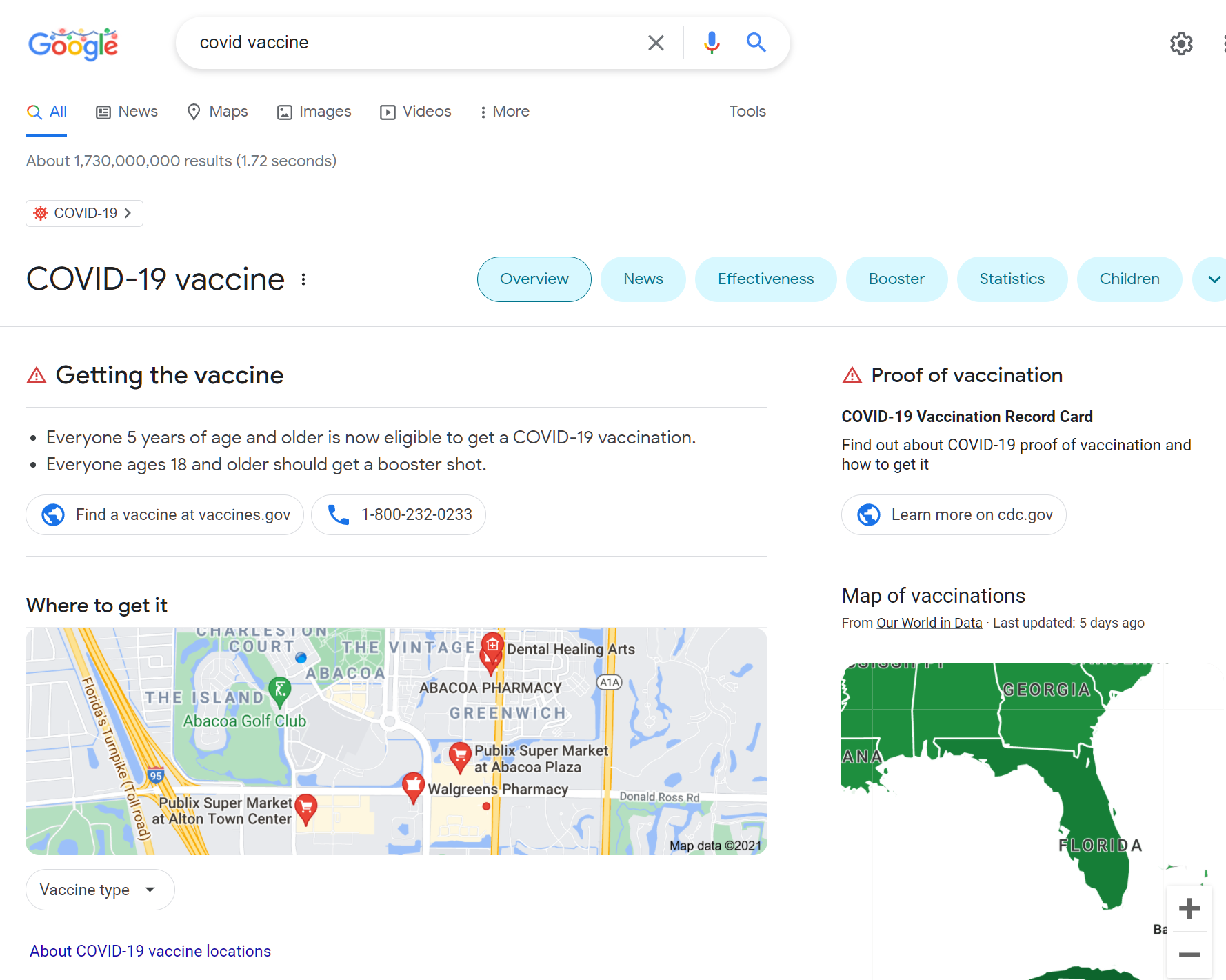
We’re now nearly 2 years into 14 days to flatten the curve. The health care industry is fully computerized. The Internet monopolies such as Google and Facebook devote considerable effort to Karen’s propaganda campaign. Searching for “covid vaccine” in The Google:
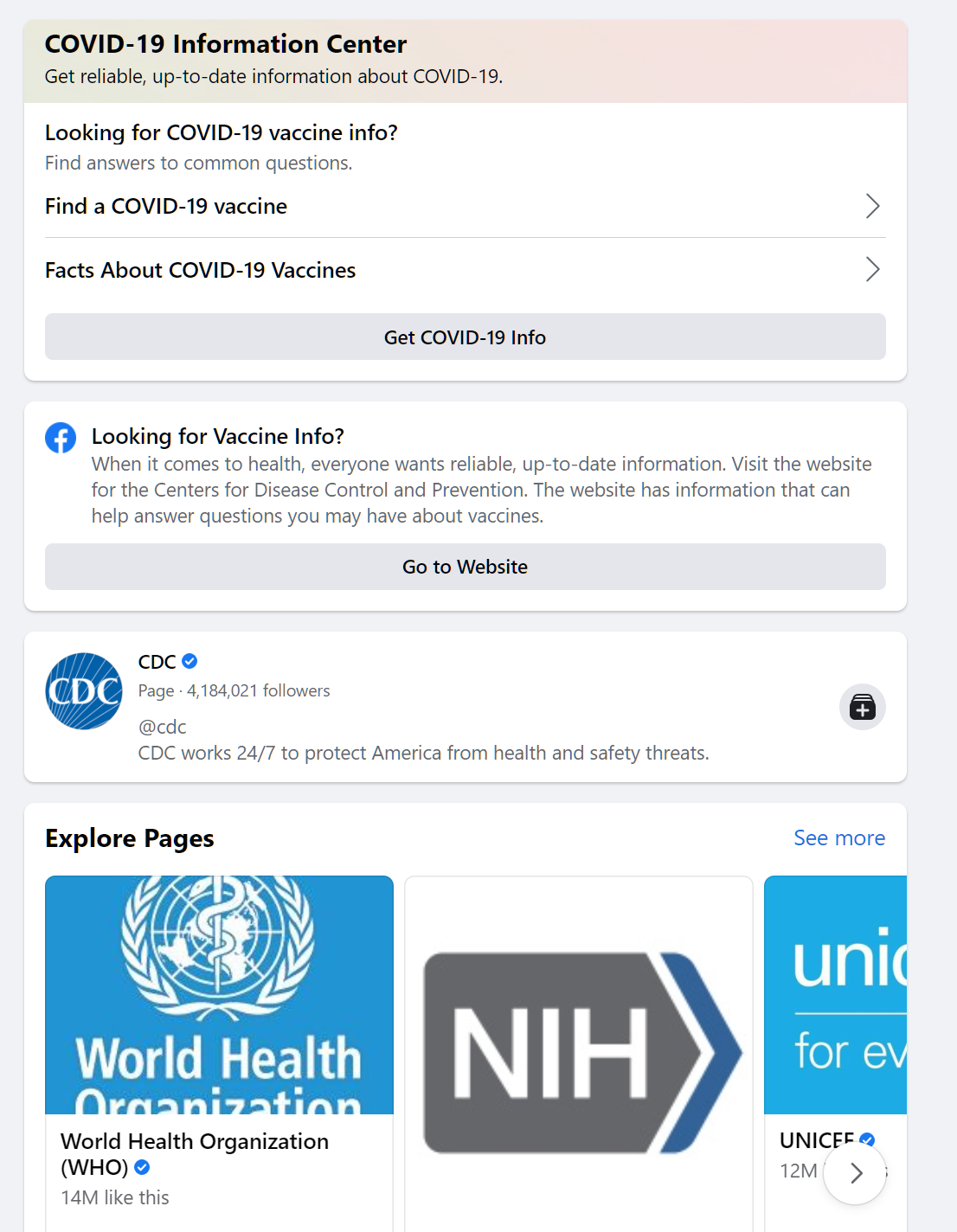
Searching for “vaccine” in Facebook:
Facebook corrects vaccine misinformation. A physician friend posted “Flu variants yearly warrant new vax; yet #CDC pushes Covid “booster” -retreads”. A pilot friend posted “Mengele is admitting that these vaccines are not working. He knows something is coming, and he tries to protect his ass.” over a video of Saint Fauci. A physicist posts European data: “I had more than a year ago posted a study by the Italian ISS, published in August 2019, on those recurring peaks of excessive mortality in the previous decade. It showed that the magnitude of excessive deaths, among the same statistical population (over 65) and in most cases even with geographical correlations (areas of northern Italy) were comparable with COVID mortality. In my view, whoever is intellectually honest will admit from these data that lockdowns, vaccine mandates, etcetera, were and are not justified by the numbers.” An attorney: “My wife is a nurse in a hospital here in the Boise area. Not only are they letting nurses go for not having the vax, and bringing in travelling nurses who are not vaxxed, but they are paying the travellers more than twice as much as their full-time nurses. It is freaking insanity”.
Underneath all of these Facebook adds the following:
What if you try to use these titans of information technology to find a Covid test? Searching for “covid test” in Facebook yields instructions to wear a mask and an ad for CVS. Search for “covid test” in Google Maps yields nearby facilities that might do tests, but with no information about whether they have availability, require appointments, charge money, etc.
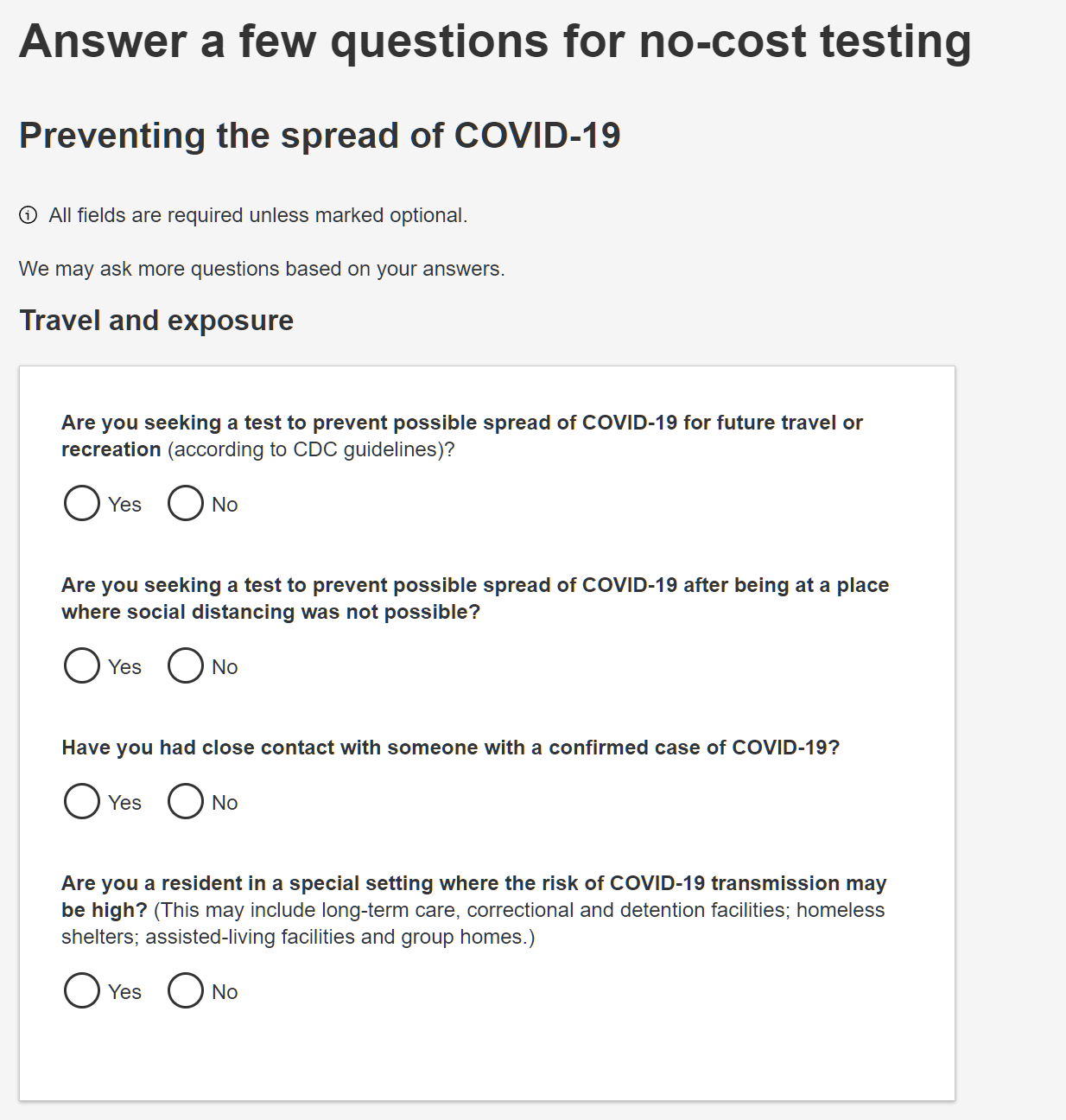
Since my friend isn’t feeling well, I tried to find him a test appointment. The various CVS stores are prominent in search results. When you follow the link from Google Maps it takes three clicks and typing in a ZIP code to get to a questionnaire:
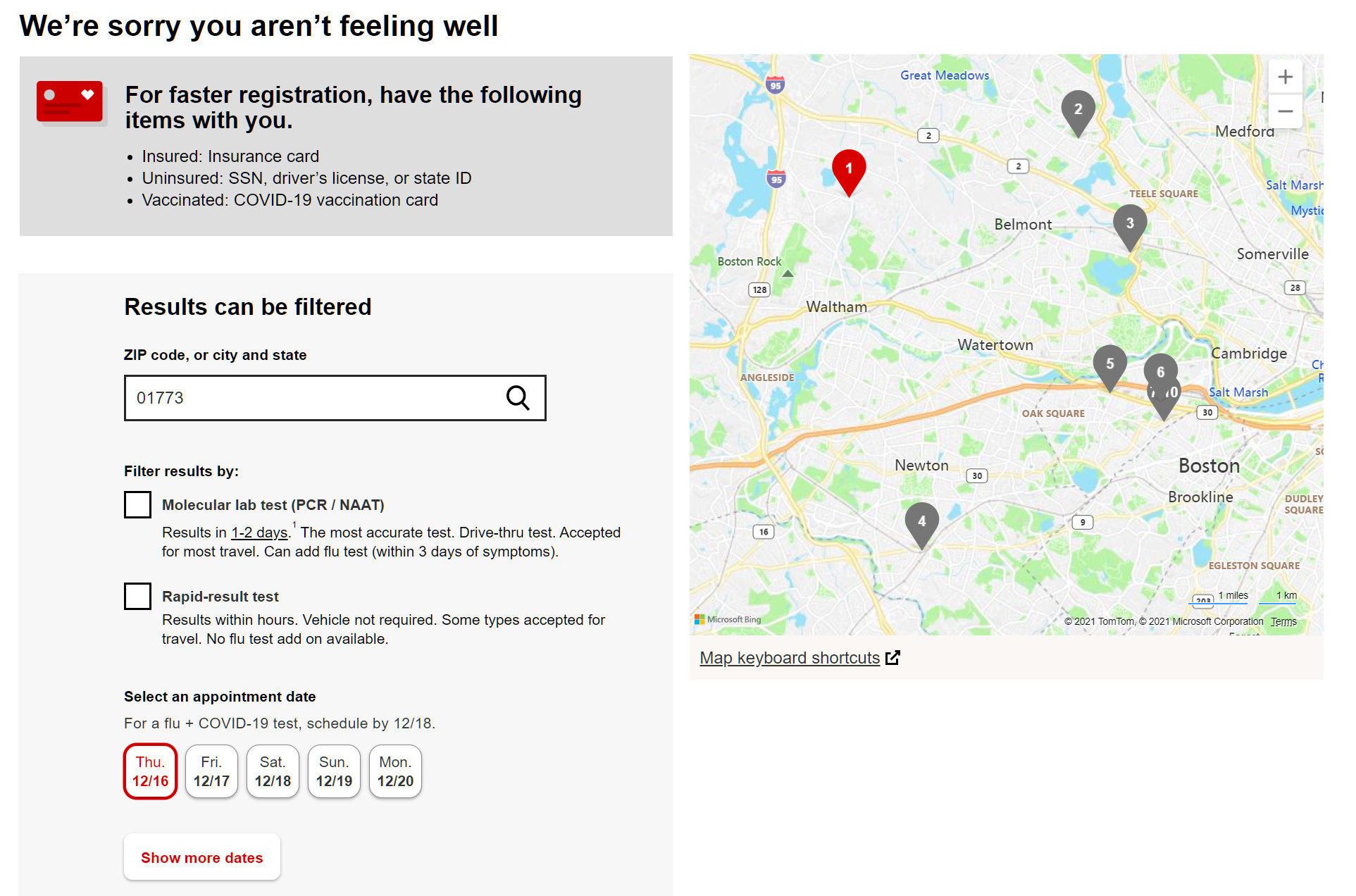
I type fairly fast, but it took me roughly 2 minutes to get to a page of available locations:
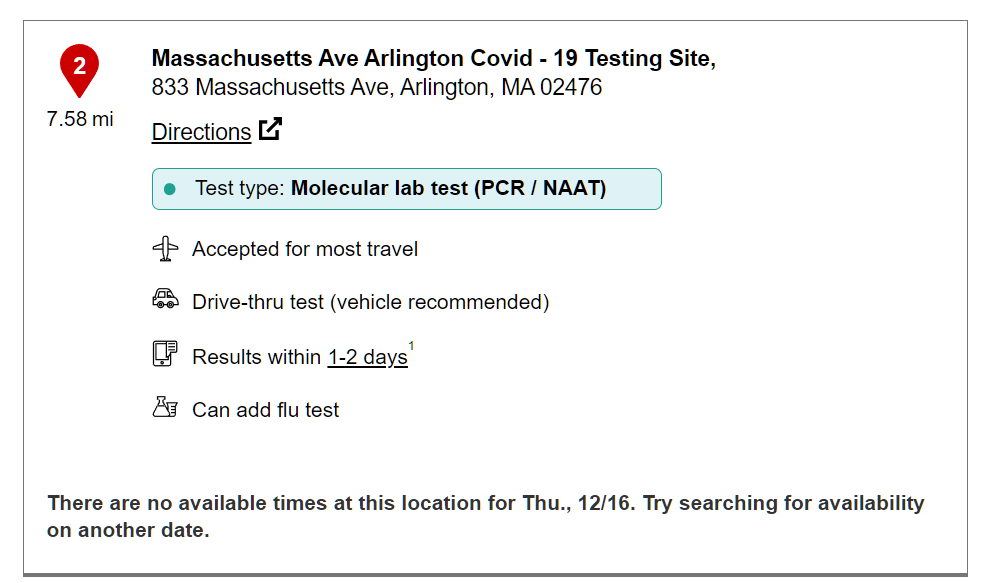
The CVS site showed availability for today at various stores, inviting me to click on “Check for available times” but the result of the click was always “no available times”:
In Florida, it should be a lot simpler for Google and Facebook. They can highlight the government-run drive-through free testing centers that never seem to have a line and that don’t require any appointments. Yet this isn’t done. Instead, Google Maps shows urgent care clinics, pharmacies, etc. that may require appointments, payment, etc.
After $10 trillion has been spent, why should a person with a 102-degree fever have to spend more than 2 minutes on the Web to find a reasonably close and convenient COVID testing option?
Update: After a full day of web-searching and driving around, my friend scored a Binax rapid test kit (one-hour round-trip drive). Verdict: POSITIVE. Another success story for Moderna! (second shot six months ago) I think it is safe to assume that, without the vaccine, my friend would now be dead.
Vito Corleone’s funeral (I asked, in the chat, “What size grave would you like us to dig for you?” and the feverish guy responded “I want a nice hardwood coffin with brass handles and a lot of flowers.”)
“Demand for COVID-19 testing, booster shots high as Christmas approaches” (WCVB (Boston), 12/16)): Near the Square One Mall in Saugus, a long line of cars snaked through a parking lot Thursday evening. The drivers and passengers were waiting for their chance to get tested in a scene reminiscent of the long lines seen last year before vaccines were widely available.
Maybe things are better in Maryland, close to the Vatican (St. Fauci’s office)? “COVID surge calls for more testing, but options are now more difficult to come by in Maryland” (Baltimore Sun, 12/14): As Maryland experiences the first signs of another winter surge, COVID-19 tests are now more difficult to come by. … The pharmacy chains also offer in-person test appointments, but scheduling one often has to be done days in advance to reserve a spot….
How about in New York, where Emmy Award-winner Andrew Cuomo’s wise decisions continue to keep people safe? “Testing Demand Has Doubled in NYC Over Omicron Fears” (New York, 12/15): With the Omicron variant expected to bring a surge of U.S. cases, socially distant lines snaked outside many coronavirus testing sites throughout the city this week. Anecdotes spilled in across the city of waiting hours to get swabbed.
We’ve hit mid-December, historically a time when a lot of flight students in Maskachusetts would give up, at least until the spring. They wouldn’t schedule lessons due to Christmas parties, Christmas shopping, holiday trips, etc. And then it would be January and the idea of being out on the ramp was not appealing. Perhaps things will be better this year due to coronapanic. There are fewer in-person parties. People who travel internationally risk getting stuck due to a false or true positive COVID-19 test.
Here’s some inspiration for sticking to those flight lessons, whether you’re in a frigid slave state or a sunny free state…
Let’s back up to a flight that I did in the Cirrus with a helicopter student and her boyfriend, a non-pilot business manager. At the end of the day, which I thought would have impressed him with (a) the awesomeness of the Cirrus, (b) the awesomeness of his girlfriend as a fixed-wing pilot, and (c) the awesomeness of me as an instructor (sage advice from the right seat, checklist discipline, etc.), he said “It seems like the goal is to do everything like a robot. If that’s the goal, why not just get a robot to do it all?”
I have been a pet behaviourist for more than 25 years and have also worked for the film industry, helping animals to “perform” on camera. I have trained a 190kg boar to pretend to attack an actor, a cat to plunge shoulder-deep into water as if catching a fish and a cockatoo to winch up a bucket, take out a coin and drop it into a piggy bank. But when a TV company asked if I could teach a dog to fly a plane, I faced the toughest challenge of my career.
Initially I was hesitant about the project, which involved taking 12 carefully selected rescue dogs through a training regime that would ultimately allow three of them to take the controls of a Cessna light aircraft. I wondered if the idea was in the animals’ best interests, but was won over by the programme’s aim: to prove that an abandoned dog, given enough love and attention, is capable of far more than people might expect.
We had only six weeks to turn the three finalists into pilots. The Civil Aviation Authority had issued guidelines: the dogs had to be secured while in flight, and we couldn’t make any alterations to the aircraft. I had a simple rig built to mimic the plane’s seat and controls. After making sure the dogs could be seated comfortably, we used a broom handle and a cutout piece of plywood to represent the plane’s steering yoke.
During the flight, they would be sitting in the pilot’s seat, facing forward with their trainers behind them, so we had to come up with a way to give them steering directions. I designed a second rig, which could be placed in front of the dogs and included an arrangement of lights – red to veer right, blue for left and white for straight ahead. Each light also made a distinctive sound. We operated this system from the back seat via a controller.
All three of them performed admirably, flying the plane for minutes at a time, but it was Shadow who ultimately got the bit between his teeth and successfully completed the final figure of eight.
If the dog could do it, maybe there is hope for us humans!
Separately, ground school is ON for January 3-7. It’s an MIT course, but on Zoom for 2022 as it was in 2021. No need to wear a mask or try to survive Boston winter weather!
Loyal readers will remember that, ever since January 2021, I’ve considered the Vietnam War to be the best analogy to American efforts in the fight against SARS-CoV-2 (see Lockdown is our Vietnam War so it will end gradually? and Vietnam War analogy for COVID-19 holding up?). As bad an idea as the Vietnam War might have been, from an economic point of view, this comparison is unfair to the folks who supported the Vietnam War for 15 years because coronapanic spending in the U.S. has been roughly 2X the cost of all U.S. wars combined and vastly more than what the U.S. spent on the Vietnam War (the spending on which was blamed for the massive inflation of the 1970s).
In the United States, during the Cold War, the missile gap was the perceived superiority of the number and power of the USSR’s missiles in comparison with those of the U.S. (a lack of military parity). The gap in the ballistic missile arsenals did not exist except in exaggerated estimates, made by the Gaither Committee in 1957 and in United States Air Force (USAF) figures. Even the contradictory CIA figures for the USSR’s weaponry, which showed a clear advantage for the US, were far above the actual count. Like the bomber gap of only a few years earlier, it was soon demonstrated that the gap was entirely fictional.
John F. Kennedy is credited with inventing the term in 1958 as part of the ongoing election campaign in which a primary plank of his rhetoric was that the Eisenhower administration was weak on defense. It was later learned that Kennedy was apprised of the actual situation during the campaign, which has led scholars to question what Kennedy knew and when he knew it. There has been some speculation that he was aware of the illusory nature of the missile gap from the start and that he was using it solely as a political tool, an example of policy by press release.
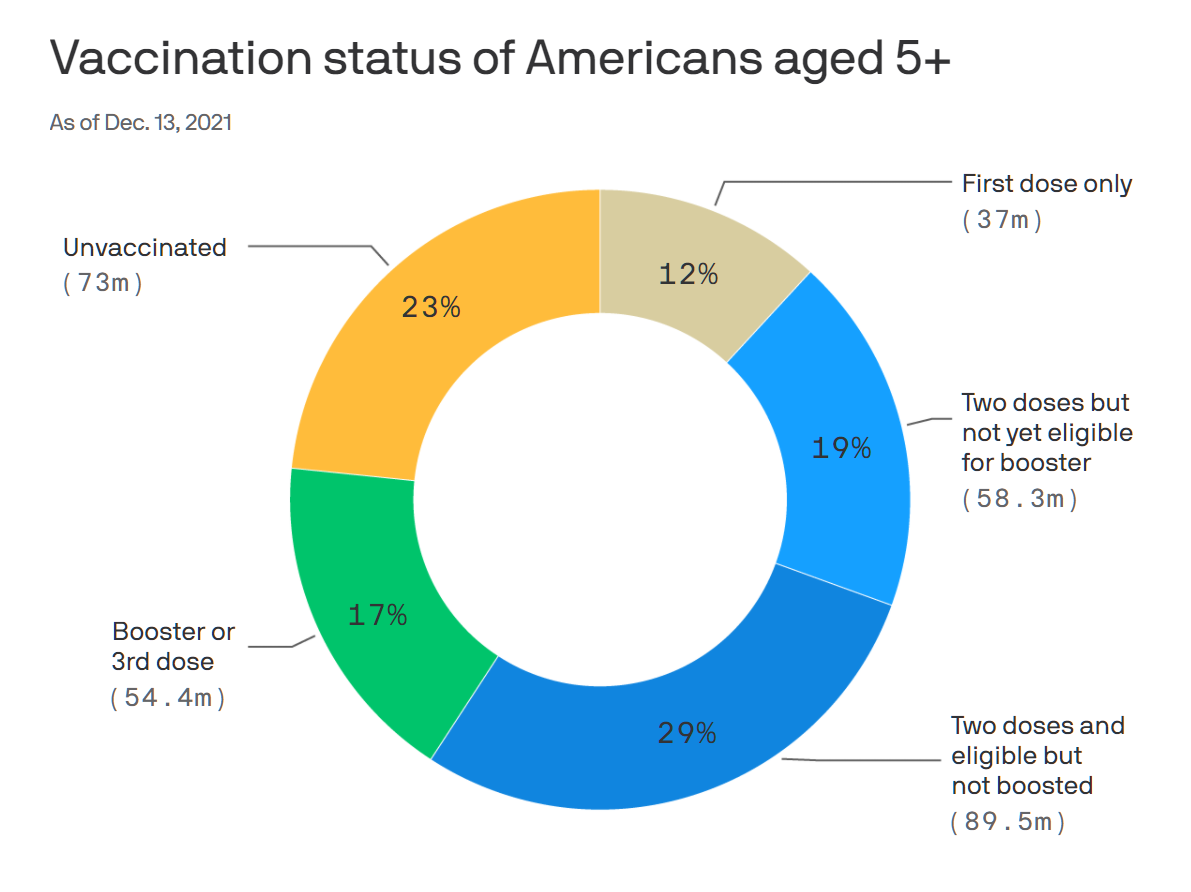
Look at the suffering reflected in the chart below. Fully 58 million of our brothers, sisters, and binary-resisters have had two vaccine shots, but are not eligible for the emergency use authorized sacrament of boosting.
The Axios article quotes someone who seems unsuited to leadership in the American public health priesthood:
“The question is, what is the goal of this vaccine?” said Paul Offit, director of the Vaccine Education Center at Children’s Hospital of Philadelphia.
“Naming Elon Musk person of the year is Time’s ‘worst choice ever’, say critics” (Guardian, today) ranks Elon Musk at least one notch below Adolf Hitler (Man of the Year in 1938). My hatred for Tesla isn’t quite that severe, and it is primarily based on the insufferable smugness of early adopters of the cars rather than the company or its founder per se, but this is still a tough week for someone who wakes up every morning to see whether Honda and Toyota (big press conference today, but no cars yet!) are ready to deliver what I just know will be a far superior vehicle to anything that Tesla could make at the same price. I dream of the day when Mindy the Crippler can relax in an all-electric Honda Odyssey set for “Canine in Car” (TM) and I will be reunited with her via a door that slides back rather than one that swings up to hit me in the forehead (Tesla X).
Who shares my outrage and pain? A Native American elder:
Let’s change the rigged tax code so The Person of the Year will actually pay taxes and stop freeloading off everyone else. https://t.co/jqQxL9Run6
(Musk responded that he will pay $15 billion in personal income tax for 2021, then added “Don’t spend it all at once … oh wait you did already.”)
It is a little strange that a U.S. Senator hates Musk this much, considering that SpaceX saves the taxpayers a ton of money (wouldn’t the government missions done via SpaceX cost $billions more if done by NASA employees and the usual contractor suspects?). Also, since Tesla employees earn far above the median U.S. wage, even if Musk never paid a dime of tax himself, the company that he started would be an enormous indirect contributor to the U.S. Treasury (the employees will pay income tax, payroll tax, property tax, sales tax, etc.) in addition to the company’s own direct contributions (employer’s share of payroll tax at least).
Elon Musk does seem deserving in some ways. Tesla is the only car company that enables dogs to spend full days with their humans (“dog mode”).
"Since COVID-19 operates in a highly age specific manner, mandated counter measures must also be age specific. If not, lives will be unnecessarily lost." https://t.co/M0FQOVgQZypic.twitter.com/8XR9869fHe
Note that Bill Gates’s beliefs regarding SARS-CoV-2 that led to the “knucklehead” label proved insignificant compared to his unwise decision to get married (Melinda Gates sued Bill for tens of $billions just a few months after Musk called Bill a “knucklehead”).)
Elon Musk set an example to every American who loves liberty by moving from the slave state of California to the (mostly) free state of Texas. (The majority of Californians who recently voted themselves into slavery are no doubt cheered by the latest governor’s mask order.) A reader emailed me to help regarding a plan to move from the Seattle area to Florida. He was dithering because he wasn’t sure that a public school in Florida would provide everything that his kids could get in Washington State. From October 2021:
As one illustration of where we are going, the next week King County will go to requiring 72 hour old tests or proof of vaccination if you want to go to restaurant or gym etc etc
My response:
Think about what your kids are learning if you DON’T move to a freedom-oriented state (e.g., Florida or South Dakota). They’re learning that when the government orders the sheep to jump through a bunch of new hoops, the correct response is to ask “How high, sir?” We can tell our kids that when Massachusetts shut down their schools, sports, etc., and ordered them to wear masks all the time, we picked them up and moved them to a place where people value freedom and education for all children. I think that might be a more valuable lesson than whatever they might have learned in their old schools.
Musk showed Americans that, while moving is inconvenient, now that government is bigger than ever, the willingness and ability to move is critical. (The same would be true for a Floridian who loves lockdown, mask orders, vaccine papers checks, and essential marijuana. He/she/ze/they should pick up in Palm Beach and move to San Francisco or Boston.)
While Americans trip over each other in a frenzy to buy houses that they’ll have to spend 10-20 hours/week maintaining, burying themselves in debt in the process, Musk unloaded all of his residential property. A great example to young people that the best way to stay creative is not to burden oneself with the job of amateur property manager and handypersonx.
I think it might have been better to give the award to SARS-CoV-2, which is often personified as an enemy. SARS-CoV-2 has achieved more mindshare and influence over human lives than any other person or personified entity.
Readers: If not Musk, who should have been TIME’s Person of the Year?
How about this as a business idea: a travel site that answers the question “Where can I go conveniently and safely in the age of COVID-19 and restrictions imposed in the name of preventing COVID-19?”
You go to the site and say roughly what kind of trip you want to take (culture, ski, beach, etc.), where you live, what kind of vaccination papers you are willing and able to show, and whether you’re a Karen or a Deplorable. The site then comes back with proposed trips based on the following:
current Covid lockdown situation at the destination (will it be legal to go out and do stuff?)
current mask order situation at the destination (if you’re upper-middle-class and wear a mask 15 minutes/day to go into stores (or 0 minutes if you live in FL and choose not to), do you want to take a European vacation where it will be 14 hours/day of indoor and outdoor masks?)
quarantine requirements (Australia and some Asian countries would be excluded)
ease of meeting outbound and inbound required medical tests (maybe it is smarter to stay domestic depending on what Uncle Joe has ordered; if the U.S. demands an inbound negative test, how challenging is it to get one done at the destination? (Mexican resort hotels are great for this, since they’ll do them at the hotel))
are they checking vaccine papers at restaurants and other venues? (a plus for the Karens because #TrustVaccines and a minus for the Deplorables)
Readers: Does anything remotely like this already exist?
Note that I’m personally staying domestic because the idea of finishing up a vacation with a 14-day hotel quarantine in a foreign land (due to a false or true positive Covid test) is not appealing to me. And I won’t fly commercial for leisure anymore due to to the prison galley atmosphere (people fighting about masks, etc.). But the above-proposed site could work for people who travel by minivan and/or Cirrus. Suggest Orlando and mask-free Universal to a Deplorable in Jacksonville. For the Pennsylvania Karen, suggest injecting the 5-year-old with an experimental non-FDA-approved medicine so as to get around NYC’s new exclusion order for unvaccinated children(effective today) and head to NYC to crowd into a theater with 2,000 other people wearing bandana-grade cloth masks.
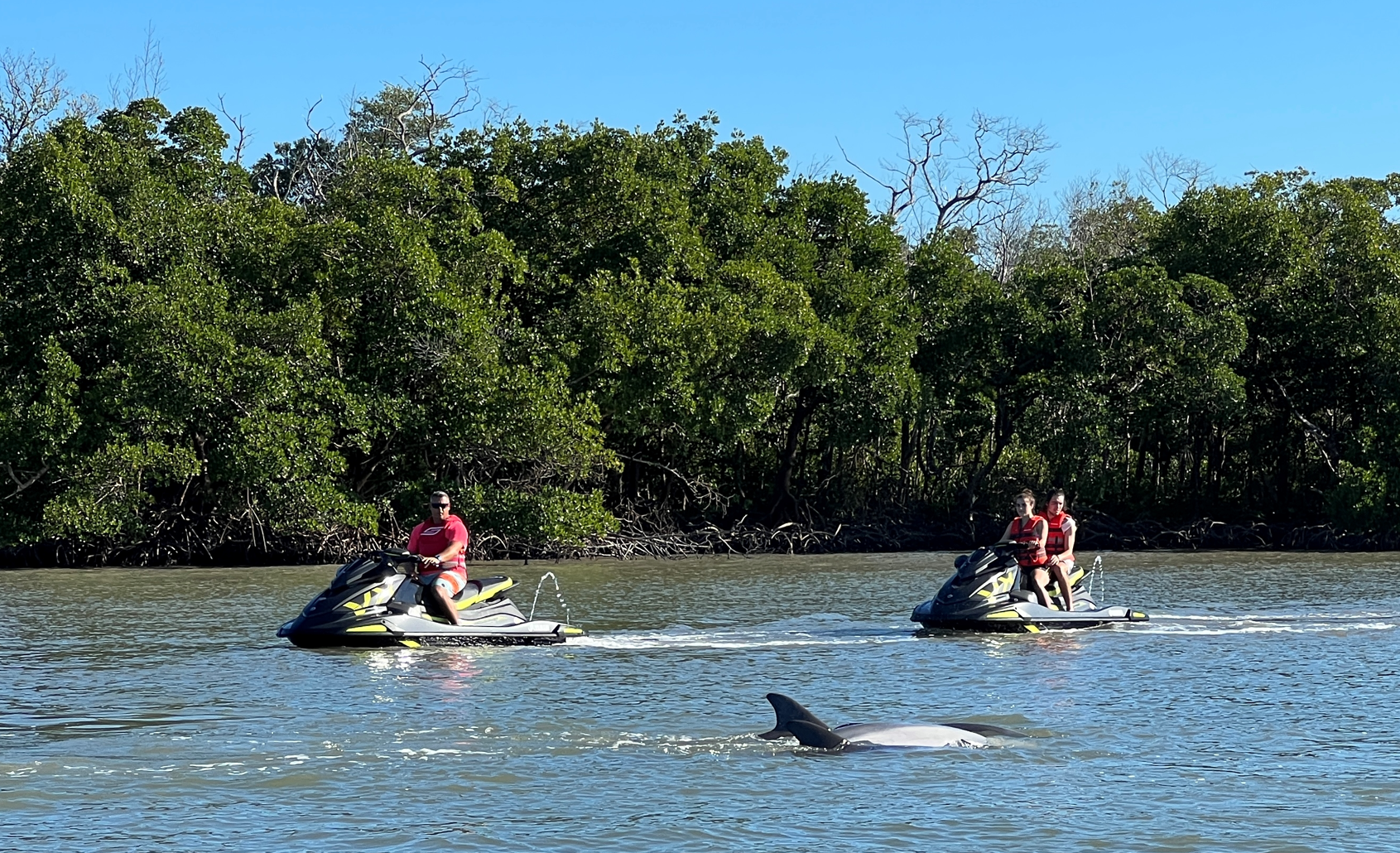
Inspiration to go to Marco Island, Florida:
(I was in a small boat and we had encounters with at least 20 friendly dolphins within minutes of leaving the dock (cut the engine to idle and the dolphins approached to within about 5′ at which point, of course, I yelled at them for not wearing surgical masks over their blowholes).)