First published in 1937, And to Think That I Saw It on Mulberry Street is the book that propelled Theodor Seuss Geisel’s career to new heights, as he pivoted from working in advertising to writing children’s books as Dr. Seuss.
I’ve been referring to everything that happened prior to March 2020 as “BC” (Before Corona, not to be confused with “BCE” for years prior to Jesus’s birth). We’re just beginning Year 2 “AC”, therefore. Public sector workers have been mostly relaxing at home for a year, still drawing full paychecks, e.g., Boston Public School teachers. Should one of these folks fall ill due to COVID-19 or any other cause, he/she/ze/they will be paid via disability insurance.
What’s it like in the private sector? A housecleaner I know had to continue working, accepting whatever risk of COVID-19 was entailed, if she wanted to be paid. She’s around 60 years old and therefore has more age-related COIVD-19 risk than the average public sector worker (many of whom are eligible to retire at 50 or younger). She recently suffered a fall on a narrow staircase in a Beacon Hill home (these structures are fully compliant with all building and safety codes… of the early 1800s; see “For $20.5 million, Beacon Hill town house next to John Kerry” for an example) and broke both radius bones in her forearms. She’s unable to work, of course, and won’t be receiving payments from a disability policy. She’s expected to recover and has a lot of support from family (Brazilian immigrants), but the story made me reflect on the precariousness of a lot of folks’ existence.
(The teachers aren’t “relaxing at home,” you say, because they have to be present on Zoom for some hours each week? While down in Florida in January, I met a Massachusetts public school system employee nearing full retirement (early 60s). She didn’t enjoy being on Zoom so she began to use the months of sick leave she’d accumulated over the years. “It will run out by next fall,” she explained, “but the union says that I’ll be able to use days from the sick bank until I’m eligible for maximum retirement benefits in November.” In other words, she will have been paid in full for 1.5 years without having to get closer to the Massachusetts school than Florida and without having to appear on Zoom.)
Now that economic opportunities exist only when governors give permission, is it more important than ever to prepare young people for careers as government workers?
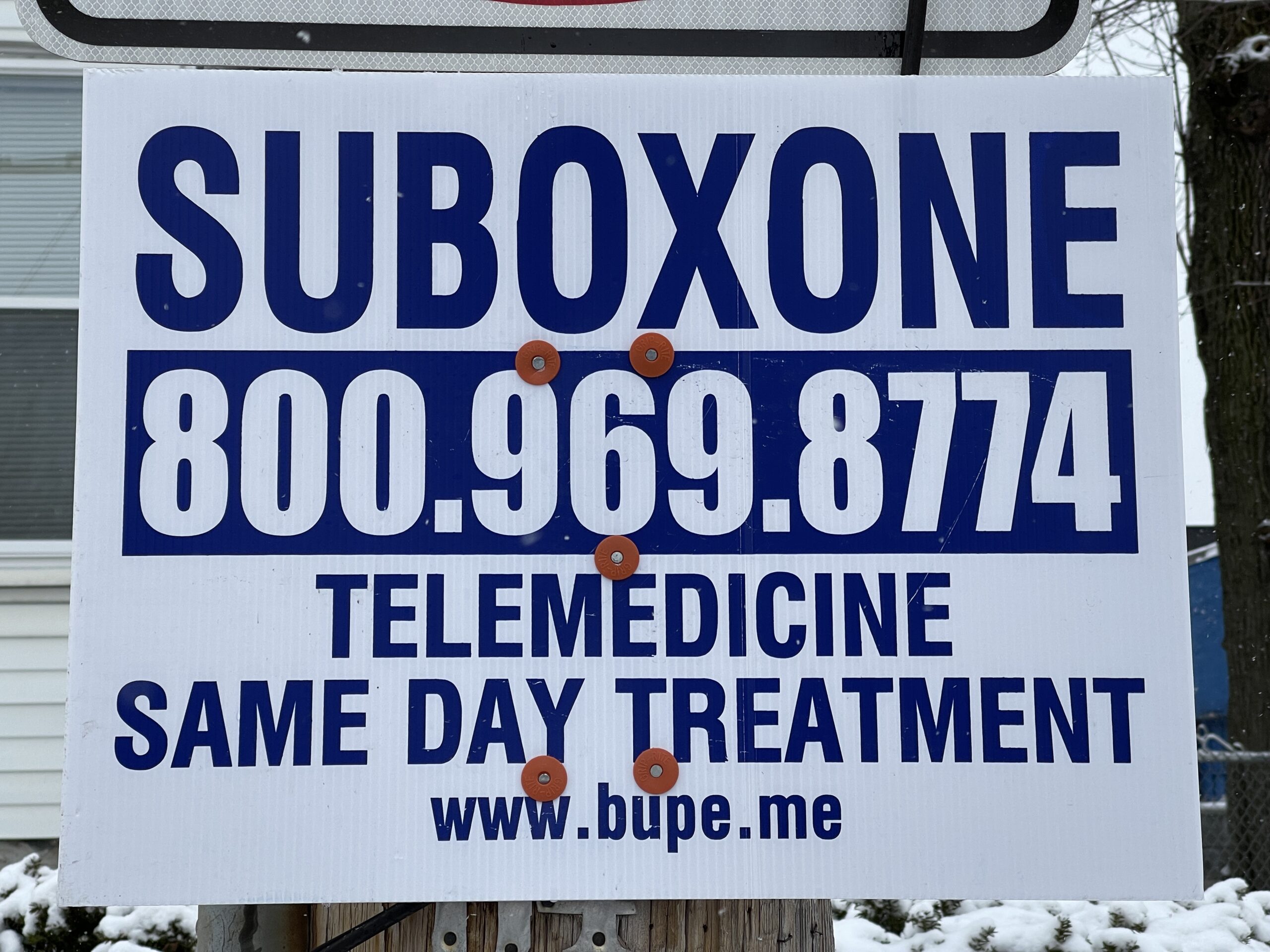
Loosely related, from February 19, 2021 in Waltham, Massachusetts:
We still have plenty of opioids for anyone who is depressed about losing a private sector job!
A Floridian’s Facebook post today, updated for her by Facebook’s team of scientific experts:
(Disclaimer: I was not one of the Deplorables who “liked” this post!)
Facebook implies that COVID-19 vaccines are “approved“. As noted in We love our children so much we will give them an investigational vaccine, the manufacturers themselves are careful to disclose that their products are not approved. Moderna, for example, says “The Moderna COVID‑19 Vaccine has not been approved or licensed by the US Food and Drug Administration (FDA) … There is no FDA-approved vaccine to prevent COVID‑19.” and that the vaccine is “investigational”:
What does Johnson and Johnson say? “The Janssen COVID-19 vaccine has not been approved or licensed by the U.S. Food and Drug Administration (FDA), … There is no FDA-approved vaccine to prevent COVID-19.”
How about Pfizer? “The Pfizer-BioNTech COVID-19 vaccine has not been approved or licensed by the U.S. Food and Drug Administration (FDA), but has been authorized for emergency use by FDA under an Emergency Use Authorization (EUA) to prevent Coronavirus Disease 2019 (COVID-19) for use in individuals 16 years of age and older. The emergency use of this product is only authorized for the duration of the declaration that circumstances exist justifying the authorization of emergency use of the medical product under Section 564(b)(1) of the FD&C Act unless the declaration is terminated or authorization revoked sooner.”
Related:
“Fact Check: Did India Ban the Pfizer COVID-19 Vaccine?” (Newsweek): Conspiracy theory website Infowars claimed on February 14, 2021, that India had banned the Pfizer-BioNTech vaccine due to safety concerns. … On February 3, 2021, India’s Subject Expert Committee (SEC), a panel that advises the nation’s Central Drugs Standard Control Organisation (CDSCO), a national regulatory body focused on pharmaceuticals and devices, ruled that the Pfizer-BioNTech vaccine should not be recommended for an EUA in the country “at this stage.” … India has not banned the Pfizer vaccine. However, it has turned down its request for an emergency use authorization “at this stage.” … The Ruling: Mostly False. [I.e., the vaccine is not “banned” in India; it is simply illegal to inject]
Coronapanic has shut down America’s schools and/or turned them into pale online shadows of their former selves. It is now exactly one year since unionized public schools in Maskachusetts shut down, for example, and they’re not back to fully open. Many colleges remain shut.
Our MIT ground school moved from a three-day in-person class to a five-day online class. We have an objective measurement of student learning: the FAA knowledge test and/or the practice tests offered by companies such as King. Educational outcomes as measured by these tests were lower compared to when the class was in person. Apparently it is not compelling to stare at a screen for hour after hours.
Given that nobody can tell who has learned what anymore, could this be the time to develop and market neutral third-party assessments. From “Universities and Economic Growth”:
I once asked a group of professors at Makerere University in Uganda “How come more people fail the Microsoft Certified Systems Engineer test than your most advanced computer science course?” It would seem that the answer is that the MCSE, which tests the ability to do basic Windows administration, is graded by an impartial computer system.
For young people who want to prove that, contrary to appearances, they actually learned something during the Age of Panic and Shutdown, why not a test of the stuff that high schools and/or colleges are supposed to teach?
For high schools, I guess one could argue that we already have AP tests. But not every high school student takes AP classes. The book Academically Adrift describes the use of the Collegiate Learning Assessment. New York State has the Regents exams. Perhaps these could be adapted for nationwide use?
Readers: What do you think? Has the shutdown produced enough uncertainty that this old idea can thrive?
We received a copy of Bowdoin magazine, the official publication of the liberal arts college in Brunswick, Maine featured in these aerial photos. I emailed the intended recipient, an alumna of this $72,000/year school:
From reading your alumni magazine and looking at the photos, I learned that Bowdoin has 0% white male students, graduates, and faculty.
The front and back covers:
There is a white person among the illustrator’s conception of students at elite schools, but the gender ID is unclear (big earring in one ear; female fashion model-style legs?):
No better place to learn about Africa than the central Maine coast:
Choosing to live in an all-white state means that you can “fight for [racial inequity] causes” by putting a sign on your lawn (text at top left):
William R. Horton (born August 12, 1951) is an American convicted felon who, while serving a life sentence for murder (without the possibility of parole), was the beneficiary of a Massachusetts weekend furlough program. He did not return from his furlough, and ultimately committed assault, armed robbery, and rape before being captured and sentenced in Maryland where he remains incarcerated.
What else is in here? Alumni created a “beer celebrating racial justice” (but where does racial justice exist?). “Maine outlawed racial slurs as place names in 1977,” but five Maine islands were only renamed in 2020 (43 years after the law was passed). “In 2019, Maine passed a law banning Native American mascots” (e.g., a school with a sports team named after a tribe).
Wanting to see what the fuss was about, as soon as the book made it into the news, I reserved the not-banned If I Ran the Zoo from the local public library. A few days later, a librarian called. My reservation would be honored, of course, but the book could not be removed from the library. “You can make a reservation to come in and look at the book here,” she explained. “That’s the guidance we’ve gotten from the Minuteman Library Network.”
As the process of evaluating (not banning) older books continues, I wonder if it will make sense for libraries to set up forbidden books rooms, each of which could be named for a generous patron. (The rooms could also be used for viewing works in which Gina Carano appears.)
How is that racist? Here’s the next page, objected to for its use of the word “Eskimo”:
Related:
“Chicago Public Library removing 6 Dr. Seuss books from the shelves while it determines long-term options” (Chicago Tribune): “Library staff encourage patrons of all ages to engage critically with our materials, but materials that become dated or that foster inaccurate, culturally harmful stereotypes are removed to make space for more current, comprehensive materials. … Staff will continue to evaluate all Library resources and consider bias, prejudice, and racism when making decisions about our programming, services and recommendations, in addition to our collections,” Molloy said.
We’re now at the one-year anniversary of when the governor here in Maskachusetts declared a state of emergency and began to tell healthy young people that they needed to give up what turned out to be at least a year of their lives (education, social activity, building work experience, maintaining fitness via sports/gym, etc.) in hopes of extending the lives of folks with a median age of 82.
The logic of lockdown is that young people are required by law to sacrifice if there is an old person whose life could possibly be extended via that sacrifice.
What if we applied the same logic to organ harvesting? No young person actually needs two kidneys nor a full-size liver. Removing a kidney or part of a liver from a young person wouldn’t cost the young person a full year of life expectancy and it could save the life of an older person.
We were comfortable with taking what has turned out to be a year of life away from the young. Why aren’t we comfortable imposing on them a slight inconvenience (only 4 to 6 days in the hospital) in order to get organs that they don’t need and that could help save lives among the old/sick?
Related (Department of Old v. Young):
“Hundreds of rowdy revelers throw out-of-control street party near University of Colorado, Boulder, campus” (ABC): … up to 800 people, most appearing to be college-aged, prompting violent clashes with SWAT police who deployed at least one armored vehicle to disperse the crowd, according to authorities. … Boulder County District Attorney Michael Dougherty released a statement on Sunday, saying his office is working with police detectives to identify suspects who “should be held fully responsible for their outrageous actions.” “Our community was put at risk last night by the individuals involved in the incident in the Hill area. Their callous disregard for our community’s safety and well-being is shameful,” Dougherty’s statement said. “There is no excuse for this conduct, especially while the people of this community endure the pandemic.”
Clubhouse users seem to care primarily about three things:
Bitcoin
Venture capital
Self-improvement
I don’t own any Bitcoin. I am completely unimproved (some might say “a throwback”!). That leaves Topic #2: venture capital. I will interview Alexander Lloyd this evening at 10 pm Eastern on the subject of early-stage investing.
If you have an iPhone or iPad, but aren’t a Clubhouse member, text me from your Apple device at +1 617-864-6832 with your full name. I’ll add you to my contacts list and then invite you (one can invite only those who are in one’s contact list and it all seems to be based on phone number).