A University for the People becomes an Apple Store

During a recent trip to Washington, D.C., I worked near the Carnegie Library, dedicated in 1903 as “A University for the People” and engraved with the names of authors such as Shakespeare and Plato. Today it is a place for people who prefer to read Facebook posts on their iPhones…

In my own Facebook post at the time of encountering this mixture of private philanthropy, government administration, and conspicuous consumption, I wrote

it is a shame that the Republicans who control the DC local government could not resist becoming stooges for Corporate America.

Are the minds of District residents being elevated by this repurposed temple to reading? Here’s a sticker from a nearby lamppost:

(I saw these in multiple location around the city; see also https://philip.greenspun.com/blog/2019/07/01/resist-permanently-on-a-d-c-public-sidewalk/)

Who is excited to order an iPhone 11?

Also, from the nearby Smithsonian American Art Museum, a 1905 portrait of Andrew Carnegie:

Related:

  • https://philip.greenspun.com/blog/2007/03/03/andrew-carnegie/ Carnegie was the Bill Gates of his day. Carnegie became the richest man in the world through a combination of intelligence, hard work at an early age, a certain amount of what we today would regard as illegal insider trading, and connections. Once he was the richest guy in the world, everyone listened to everything he said very carefully. He looked around and decided that the greatest evil facing the world was war. War did not provide who was right, only who was stronger. After concluding that he was, in addition to being the richest guy in the world, probably one of the smartest, he invested much of his money and most of his energy in achieving peace among nations. Folks such as Teddy Roosevelt privately thought that he was an old fool, but nobody would say it to his face. Carnegie pushed for peace and mediation among nations and spent four of the last five years of his life watching World War I sweep through Europe. [The analogy with Bill Gates is that, after becoming both the richest and smartest guy in the world, he decided that he could solve the problems of poverty and disease in Africa that had defied attempts by the world’s biggest governments and NGOs.]
Full post, including comments

1500-hour airline pilot minimum increases inequality?

Regional airlines were recruiting desperately at Oshkosh (EAA AirVenture) this year. It occurred to me that the newish 1500-hour hour minimum imposed by Congress for airline pilots imposes an access barrier to this high-paying career. In Europe, for example, a young person of modest means can pay for 140 flight hours, plus some sim time, and begin his or her career in the right seat of a Boeing 737 (see previous post on a flight school in Ireland).

In the U.S., however, the aspiring airline pilot has to somehow tough it out through 1500 hours of starvation wage flying, which could take years. The American child whose parents are financially comfortable, on the other hand, can build 1500 hours in the family Cessna or Cirrus, can relocate to a busy flight school and work happily for $15-20/hour, etc.

Thus we have politicians claiming that they’re passionate about reducing inequality, but meanwhile they are writing regulations that ensure its persistence. Intensive regulation has always favored those with the most resources, e.g., big companies or rich individuals.

Full post, including comments
How to steal $billions

Billion Dollar Whale is an instructive tutorial from two Wall Street Journal reporters. The “whale” is a pudgy Malaysian-Chinese guy named Jho Low who managed to steal billions of dollars from Malaysians and Arabs via diverting money from a sovereign wealth fund that he created and controlled.

One critical part of the scheme was setting up companies, and therefore bank accounts, that had the same names as legitimate cash destination firms, but that were incorporated in a different country and that were controlled by Jho Low:

For the next step of his scheme, Low set up two shell companies in the Seychelles. The firms—ADIA Investment Corporation and KIA Investment Corporation—appeared, given their names, to be related to the Abu Dhabi Investment Authority, or ADIA, and Kuwait Investment Authority, or KIA, two of the most famous, multi-billion-dollar sovereign wealth funds in the world. But the look-alike companies were purely Low’s creation, with no links to Abu Dhabi or Kuwait. In setting up ADIA Investment Corporation, Low experimented with another financial trick that he would add to his repertoire. The company issued just one unregistered share, valued at $1, and it was controlled by whoever physically held the stock certificate. These “bearer shares” were banned in many jurisdictions, including Great Britain and the United States—Nevada and Wyoming in 2007 became the last states to abolish their use—because they allowed owners of companies to hide behind layers of secrecy and made it nearly impossible for regulators to determine the owner of an asset at a given point in time. Seeking to find tax cheats in the early 2000s, the United States started to pressure offshore centers to hand over details of the beneficial owners of companies and accounts. Even the British Virgin Islands had recently outlawed the practice of bearer shares. But in the Seychelles, Low learned, they were still permitted.

The second element was an association with Mohammad Najib bin Tun Haji Abdul Razak, the Prime Minister of Malaysia, and his diamond-seeking wife.

The third element for getting money was Goldman Sachs, which was more flexible than other banks:

The 1MDB fund had agreed to pay $2.7 billion for power plants owned by Malaysian billionaire Ananda Krishnan’s Tanjong Energy Holdings, the first of a series of acquisitions it planned to make in the sector. To give the deal a veneer of authenticity, 1MDB needed an independent valuation of the plants. Leissner stepped in, asking Lazard if it could oblige. The U.S. bank agreed to take a look, but its bankers crunched the numbers and couldn’t figure out why 1MDB was willing to pay $2.7 billion for the suite of plants, which were located in Malaysia, as well as Egypt, Bangladesh, Pakistan, and the UAE. The deal seemed favorable to Tanjong, especially given that its power-sale agreement with the Malaysian state would soon run out, handing the government leverage to achieve a bargain price. Lazard believed the whole deal smelled of political corruption. It was common in Malaysia for the government to award sweetheart deals to companies in return for kickbacks and political financing; that was what Lazard thought was going on, and so it pulled out. With no other choice, Goldman instead became an adviser to 1MDB on the purchase, as well as helping the fund raise the capital. The bank provided a valuation range that justified 1MDB paying $2.7 billion for the plants.

In return for this flexibility, Goldman earned 100-200X standard investment banking fees:

Goldman was preparing to launch what it internally dubbed Project Magnolia, a plan to sell $1.75 billion in ten-year bonds for the 1MDB fund. But some board members were alarmed by what Leissner had informed them: Goldman would likely make $190 million from its part in the deal, or 11 percent of the bond’s value. This was an outrageous sum, even more than Goldman had made on the Sarawak transaction the year before, and way above the normal fee of $1 million for such work.

[Of course, some of the deals were made on the global douchebag circuit, i.e., at Davos:

The World Economic Forum, held each year in the Swiss ski village of Davos, is a microcosm of elite networks that span the globe, attracting world leaders, Wall Street titans, and chief executives of Fortune 500 companies. The events, in which panels of experts debate high-minded topics like radical Islam or the “democratic deficit” in front of audiences, is only the public face of Davos. In rooms open only to the chosen few with special white VIP passes—the highest in a color-graded hierarchy—the real deal making occurs. In late January, Michael Evans, a Goldman vice chairman in New York overseeing “growth markets,” had an important person to see on the sidelines of Davos: the prime minister of Malaysia. Evans’s audience was with Prime Minister Najib, brokered by Tim Leissner—just the kind of meeting between a Wall Street banker and a world leader that was typical at the event in the Swiss Alps. In public appearances at Davos, Najib was in his element, deepening the impression of Malaysia as a beacon of democracy in the Islamic world, and himself as an urbane technocrat. “We have to take care of the young people, we have to give them jobs,” he told Fareed Zakaria of CNN during an interview on the sidelines of Davos. But here, with Evans and Leissner, Najib had a strikingly different agenda. After pleasantries with the two bankers, Najib brought up the role Goldman had played selling bonds for 1MDB in 2012, and asked if the bank was willing to do so again, getting the money to the fund quickly and quietly, just like before. Goldman’s top management, advised by Leissner, had been expecting more 1MDB business. But Najib’s demand, less than three months since the fund last tapped the market for almost $1.75 billion, was almost too good to be true. The prime minister said the fund wanted to raise a further $3 billion. Such a staggering sum would mean another major payday for Goldman.

Goldman earned $600 million within 12 months, which the authors say is 200X the standard fee.]

The fourth element for avoiding scrutiny was to get auditors such as KPMG to sign off on the sovereign wealth fund’s books, using a fictitious investment in the Cayman Islands to show that the fund hadn’t been looted out.

For spending money, a big part of the key turned out to be working through a big American law firm:

But it was one thing to take money from a Malaysian fund and funnel it to Swiss bank accounts under the guise of a sovereign investment, using friends in official positions to address any concerns of compliance executives at banks. Now, Low wanted to get the money into the United States so he could spend it on luxuries and begin building his empire. That was risky, because the United States had started clamping down on corrupt foreign officials buying assets in Western nations. To do so, Low turned to Shearman & Sterling. Founded in 1873, with its headquarters at 599 Lexington Avenue in Midtown Manhattan, Shearman was as white-shoe a law firm as they came, an organization more suited to handling major mergers and acquisitions than dealing with the likes of Low.

Low informed his new legal team that he would be making a sequence of major investments, but he was very concerned about privacy. He opted to use the firm’s Interest On Lawyer Trust Accounts, or IOLTAs, to help distribute the money. These trust accounts are typically formed by U.S. law firms to pool clients’ money, say, when they are holding short-term funds for business deals or property purchases. This arcane corner of the financial world came into existence three decades ago as a way for law firms to earn short-term interest on client money to finance legal aid for the poor, but over time the accounts developed a reputation for shielding the identity of clients in transactions and helping to hide the origin of funds. Some states mandate that law firms set them up. IOLTAs are at once good for society and a powerful tool for crime. Lawyers, unlike bankers, don’t have to conduct due diligence on a client. Details of transfers through IOLTAs, meanwhile, are protected by lawyer-client privilege. While it is illegal for lawyers to abet money laundering, they are not required to report suspicious activity to regulators. The Financial Action Task Force, a Paris-based intergovernmental group that sets standards for stopping fraudulent use of the global finance system, has highlighted the United States’s poor oversight of lawyers as a weak spot in its defenses against money launderers.

Low pushed $369 million through the law firm. How much did the guy spend?

Between October 2009 and June 2010—a period of only eight months—Low and his entourage spent $85 million on alcohol, gambling in Vegas, private jets, renting superyachts, and to pay Playmates and Hollywood celebrities to hang out with them.

Despite connections to the Obama White House, things do begin to unravel for Mr. Low. I don’t want to spoil the suspense, though. The worldwide civil and criminal litigation is ongoing, but it seems safe to say that Goldman gets to keep all of its fees!

More: Read Billion Dollar Whale.

Full post, including comments
Social justice at Oshkosh (EAA AirVenture)

Like seemingly every other American enterprise these days, the Experimental Aircraft Association (EAA) has added social justice to its mission. Thus, at least a portion of its time and effort is devoted to highlighting the achievements of members of victim groups. The largest group of victims to be celebrated at Oshkosh is women. Each person who shows up at Oshkosh identifying as female is given a free T-shirt and asked to pose for a group photo:

Anyone whose parents own an airplane can learn to fly easily. Anyone whose credit card has an ample limit can learn to fly easily (flight schools are not so flush with cash that they would turn away someone based on race, gender ID, or LGBTQIA status). Thus, the group victim photo (above) turns out to be a photo of wealthy white women and girls.

A 1:00 PM P-51 “Warbirds in Review” talk involved towing a vintage $3 million P-51 in front of some bleachers and seating two P-51 combat veterans next to an interviewer. A standing-room-only audience assembled in the hot Wisconsin mid-day sun. One pilot had flown roughly 100 combat missions in the P-51. The other had flown a combined total of more than 400 combat missions in World War II, the Korean War, and the Vietnam War. With the perfectly restored airworthy P-51 airplane in front of the crowd and these two guys who could tell us about their combat experience, what questions were asked? “What was it like to be black in 1940 when segregation prevailed?” (Answer from Charles McGee, Tuskegee Airman: “I went to high school in the North and we didn’t have segregation.”) By the time we bailed out at 1:35 PM, not a single question had been asked about aviation and we hadn’t gotten to the aviators’ first flying lesson, much less learned anything about the fire-breathing P-51. These guys were not experts on being black in the U.S. in the bad old days, any more than any other African-American of the same age.

Boeing still hasn’t fixed the 737 MAX system design and software, but they were all-in on diversity at their Oshkosh pavilion:

Full post, including comments

Icon A5 demo flight

One of my personal highlights at Oshkosh this year was a demo flight in the Icon A5.

I’ve been something of a skeptic regarding Icon at its $400,000-ish price (but the company has been making a lot of changes recently, so perhaps it will be re-priced soon?). But there is no way to justify any airplane as a rational purchase. A $30,000 Honda Accord is a much better machine for transportation, and generally quicker (when you subtract out all of the required training time, currency time, hanging out with friends at the airport time, and waiting out the weather time) than a $1 million Cirrus. The Icon is not “more irrational” than the Cirrus. They’re both simply “irrational” and, if someone has the money and enjoys the toy, why not?

First, the summary: the A5 is actually a great airplane for the owner of a lake house who wants to use it like a Jetski and zip around for 20 minutes before returning to base. The airframe, designed by Rutan alum Jon Karkow (who received a posthumous shout-out from Burt Rutan at Oshkosh this year), seems to have met all of the design goals. There are no sponsons underneath the wingtips to catch in the water and thereby capsize the aircraft while taxiing (see Lake Amphibian!). The plane seems to be quite forgiving in terms of landing attitude. It would be difficult to dig in and flip as is straightforward to accomplish with a Cessna on floats. As discussed below, the avionics should be more advanced.

Why does anyone care about a two-seat amphib? It seems that those who are jaded regarding small planes on wheels still love the idea of a seaplane. I posted some photos from the Icon A5 demo flight on Facebook and watched the Likes pile up. A comparable post regarding the Cirrus SR20 would have elicited only yawns.

Considering how few two-seat amphibious seaplanes are out there, this is a surprisingly active corner of the airplane industry. In addition to Icon, there is the Searey, the ATOL (a wooden design from Finland whose executives were at Oshkosh talking about how it will soon be certified in Europe and will have more payload than the Icon (but can wood hold up as well as the solid block of carbon fiber and plastic that is the Icon?)), and the Brazilian Petrel, plus probably a few more purely experimental designs.

Life is a lot simpler if you can set up Icon’s special dock (my video):

(This is why the Alaskans love their Cessnas on floats; pull up to any boat dock.)

After we left the dock, some water came into the cabin through the air vents, presumably due to the 8-12″ waves (close to the limit of what is reasonable). This is a non-issue as the Icon is at least half watercraft. A bilge pump will move the water overboard.

It is easy to maintain directional control at low speeds thanks to water rudders. Unfortunately, the pilot needs to remember to extend these below 10 knots (via a panel switch) and then retract them or risk them being ripped off during a high-speed taxi. Given that the GPS knows the aircraft’s ground speed, why can’t this be automatic?

With two average sized American guys on board, staying under gross weight is possible only with one hour of fuel and some prayer. Despite being right at gross weight, on a hot day, and in rough water, the A5 had a reasonable take-off run and climb performance. Getting up on the step is much simpler than in a conventional plane on floats.

Cruising around in the pattern with the side windows removed, the experience is noisy, even with Bose noise-canceling headsets. This is definitely not going to be comfortable for a long trip. But, again, if the mission is “take a weekend guest up for a unique and fun experience,” fatigue from the noise is not an issue.

Landing is almost idiot-proof (though, despite being a legal seaplane CFI, I was happy to have the Icon factory CFI sitting in the right seat!).

What didn’t I love? The gear handle and gear lights are not in the primary instrument cluster. They are down and to the right. A pilot with tunnel vision won’t find these in his or her scan. Absent avionics smart enough to say “Your wheels are down and yet you aren’t headed for a runway in the GPS database. Remember not to land wheels-down in the water,” there is a risk of landing wheels-up on a runway or wheels-down in the water.

Is this a real-world risk? With only a handful of planes delivered to customers, we already have “Icon A5 Flips On Water Landing” (June 25, 2019):

Both pilot and passenger suffered minor injuries after their Icon A5 flipped on landing at Okanagan Lake, West Kelowna, British Columbia. Police reports and post-crash video suggest that the Icon’s gear was extended for the water landing, likely to be the cause of the flip-over.

Rumor has it that at least a couple of owners have landed gear up on runways (oftentimes not reported to the NTSB and not in the accident database).

The Garmin portable GPS that is mounted in the center of the panel is the opposite of smart. It shows runways and water. Apparently running the stock Garmin software for a plane on wheels, it shows a red warning every time the Icon A5 is properly configured for a normal wheels-up landing in the water (that’s an impact with terrain as far as the Garmin knows!).

Summary again: If I had a lake house, I would seriously consider buying one! It is a reasonable value and a great achievement in terms of airframe design. Evaluating the Icon A5 against a Cessna on floats is an apples to oranges comparison that doesn’t make sense. The Icon is its own thing and the airframe is a huge improvement over the competition.

Related:


Full post, including comments

Factory farms may be killing coral reefs, not a warming planet

Interesting article from the nerds at phys.org:

A study published in the international journal Marine Biology, reveals what’s really killing coral reefs. With 30 years of unique data from Looe Key Reef in the lower Florida Keys, researchers from Florida Atlantic University’s Harbor Branch Oceanographic Institute and collaborators have discovered that the problem of coral bleaching is not just due to a warming planet, but also a planet that is simultaneously being enriched with reactive nitrogen from multiple sources.

Improperly treated sewage, fertilizers and top soil are elevating nitrogen levels, which are causing phosphorus starvation in the corals, reducing their temperature threshold for “bleaching.” These coral reefs were dying off long before they were impacted by rising water temperatures. This study represents the longest record of reactive nutrients and algae concentrations for coral reefs anywhere in the world.

In other words, the same factory/industrial farming that creates massive dead zones in oceans worldwide (including the Gulf of Mexico) is also at least partially responsible for killing the coral reefs, not a rise in sea temperature.

Will Earth support a human population of 10 billion or more? Yes, but maybe without any animals, including coral.

Full post, including comments

Low fertility among middle-class whites explained…

…. by a white middle-class American. A Facebook post from a woman in her 30s who was last seen (by me) thoroughly enjoying Burning Man:

I decided recently to get clear on what my future self would like to create now for my life. Though I’ve enjoyed the wild ride of the single life and being foot loose and fancy free most of my adult life. I decided that slowing down to focus on building a relationship with my life partner was going to be my biggest priority. I definitely had to do some internal housekeeping to create space for this person to show up in my life and he sure did! I’m so happy to have found this man and our time together has been nothing short of awesome! He’s not on social media (which I find refreshing) so he will never see this, but I’m so thankful to have met him and I’m so excited for the life we plan to build together and I look forward to sharing this journey with you all. 💕

I.e., in her 20s she did not have the idea of an enduring partnership with a man and therefore, presumably, no children were planned (not sure she realized that having sex with an already-married dentist in Massachusetts would have paid a lot better than her job in education!)

If children are the outcome of this “life partnership,” the first won’t arrive until mom is at what biologists would say is the sunset of her fertility. We have the cold data on the low fertility of middle-income white Americans:

But via Facebook we have an explanation of how this occurs. (Remember that there are few Americans with incomes of $200,000+/year and therefore, despite what you might infer from a casual glance at the chart, the future population will be increasingly descended from people earning less than $50,000/year.)

Full post, including comments
Harvard not worried about accepting a student who scored 1270 on the SAT

Harvard starts the fall semester today.

From “Racist Comments Cost Conservative Parkland Student a Place at Harvard” (NYT, back in June):

Two other prominent Parkland student activists, Jaclyn Corin and David Hogg, both of them vocal proponents of tighter gun restrictions, are headed to Harvard this fall. Mr. Hogg, who is completing a gap year, garnered attention when he announced his acceptance last year after being rejected from other schools, including from California State University at Long Beach. On Monday, Mr. Kashuv’s defenders noted that Mr. Hogg had a 4.2 grade point average and scored 1270 on the SAT test, while Mr. Kashuv said in the interview that he had a 5.4 G.P.A., and a 1550 SAT score.

Leaving aside the rest of the story, it is interesting that Harvard isn’t concerned that someone with a mediocre SAT score of 1270 will have trouble with the academics.

[Separately, I wonder if the NYT can legitimately say that this teenager’s hyperbolic throwing around of some words for shock value is “racist”. It is the NYT itself that is constantly running stories on academic underachievement by Americans of one particular race.]

Related:

  • my review of Academically Adrift: colleges are, for the most part, indifferent to whether or not professors are effective teachers. To the extent that colleges work teaching quality into decisions about promotion and pay they do so by considering student evaluations. Which professors do students evaluate highest? Those who assign the least reading and give the highest grades (researched by Valen Johnson is cited). So every professor has a big incentive to make his or her class easy and to give every student an A.
  • my review of Higher Education?: Harvard undergrads give their professors C- on “classroom performance” and D on “outside-of-class availability”. Upset by the evidence that it was delivering a poor quality product, Harvard appointed a committee: “All but one of its members held endowed chairs … No junior faculty, no teaching assistants, and notably no students were invited to serve.”
Full post, including comments
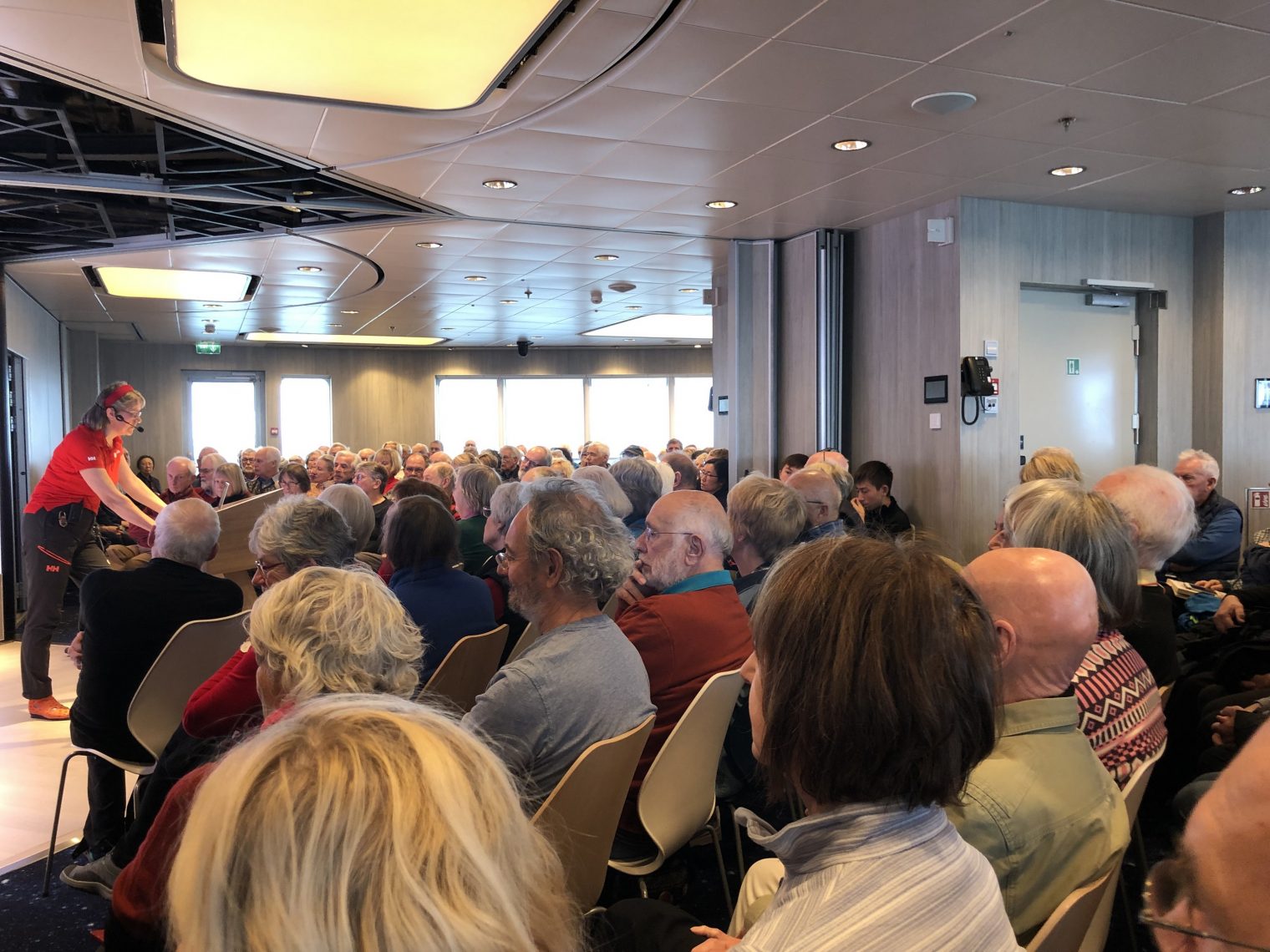
Southwest 1380 crew speaks at Oshkosh

During lunch at EAA AirVenture, I encouraged my companions to accompany me to a talk by the crew of Southwest 1380 regarding their emergency landing following an uncontained engine failure during a flight from New York to Dallas. “So what,” was one GA pilot’s response. “They ran a checklist.”

It is Labor Day, however. Maybe we can celebrate people who simply show up to work and do whatever it is they were trained to do in the sim.

Was the Southwest 1380 incident truly just like an engine failure in a sim, with the remaining working components of the airliner adding up to a much better aircraft than 99 percent of the planes parked at Oshkosh?

The question was answered by Tammie Jo Shults and Darren Ellisor, captain and first officer appearing side-by-side on stage (see “Captain Tammie is the anti-Sully”).

First officer Darren was the pilot flying when the incident began. He described the autopilot quitting and the airplane rolling to roughly 41 degrees left. He responded by grabbing the yoke and pulling back thrust levers to stop the asymmetric thrust. “I knew we had some kind of engine problem and that we had to start down.”

Captain Tammie said that she remembered the Air France 447 crash in which two pilots gave the plane opposite inputs. The roaring noise from the decompression prevented oral communication, but once she saw that Darren was on the controls, she used hand signals to show that she was taking her hands off. Both pilots described vibration severe enough to make it difficult to read instruments or checklists.

Tammie continued to display her anti-Sully personality by explaining that the only reason she took over the controls was that Southwest requires captains to land emergency aircraft. She credited Darren with being perfectly competent to fly the plane and also with identifying Philadelphia as the best destination. She took over after most of the descent was complete and that left her to fly and handle radio calls while he ran the checklists.

The pilots noted that tasks in the cockpit kept them too busy to contact the flight attendants and explain what was going to happen. “Our first contact with the flight attendants was at 8,000’ [after coming down from 32,500’].” That meant roughly 15 minutes in which folks in the back had no idea whether they were going to walk down stairs at an airport or land in a cornfield. (See “Southwest 1380: think about the flight attendants”)

In addition to highlighting the efforts of the cabin crew, Captain Tammie recognized two passengers for heroism. “These guys left their oxygen masks and families to try to try to pull Jennifer [Riordan] back into the plane,” she said. “They took the risk of being pulled out themselves in the event of additional structural failure, which they had no way of predicting.”

(The passengers were able to get Ms. Riordan back into the plane after the airliner had slowed down and turned base, but unfortunately she died from her injuries.)

Once the oxygen masks were on and the plane was slowed down, did it fly like the sim then? No. There was a lot of extra drag on the left side. Darren explained that the failed engine’s cowling had spread out “like a thrust reverse” and that fragments had damaged the leading edge of the wing. It was difficult to make right turns and he later said that he wasn’t sure if the plane could have held altitude on one engine, even at 200 knots.

Partly due to the circumstances and partly due to Air Traffic Control’s repeated requests for the same information after every frequency change (e.g., souls and fuel on board), the crew finished only 1 checklist (“severe damage”) out of 7 that Darren thought should have been run.

The landing was uneventful despite the fueled-for-Dallas plane being 10,000 lbs over max landing weight. In keeping with the U.S. love for security and bureaucracy, Tammie said “the first person to come onboard the aircraft was FBI.” (i.e., the first people to enter the landed plane were not EMTs to help Jennifer Riordan).

Asked by an audience member why they didn’t ignore ATC’s requests for information after the first answered one, Tammie explained that they were afraid being intercepted by fighters.

There was continued confusion after landing regarding which frequencies to use to talk to the fire and rescue personnel at the Philadelphia airport.

Sidenote: both pilots are huge fans of Boeing and consider the 737 MAX to be perfectly safe. “I’d put him on it any time,” said Darren regarding the young son who’d accompanied him to Oshkosh. Boeing desperately needs to hire these two!

Both pilots are back at Southwest. Darren has completed the upgrade to captain that had been scheduled for shortly after the 1380 incident. Captain Tammie went back to work 3.5 weeks after the engine failure “because I wanted a little slice of normal. Getting back and getting to fly again was great.” She hand flies to 18,000’ for proficiency.

Jeff Skiles, first officer of “Miracle on the Hudson” US Airways 1549, was in the audience, attending Oshkosh mostly for the same reasons as everyone else.

Related:

  • Nerves of Steel (remember that publishers choose the title, not authors!) comes out in October. Darren Ellisor is mentioned even in the Amazon blurb on the book, so I don’t think this can be said to be an attempt to turn this into a single-pilot incident.
Full post, including comments
Ten years since Deepwater Horizon set a depth record

This month marks the 10th anniversary of Deepwater Horizon setting a record by drilling a 35,000′-deep hole (a few months later, of course, we got to see the unfortunate flip side of the edge of engineering success).

I’ll use the occasion to relate some notes from reading The Gulf: The Making of An American Sea, a book that isn’t a single narrative story, but contains some interesting facts across a range of domains.

The Gulf is the origin of the Gulf Stream:

The Stream builds from a vigorous loop current in the Gulf, formed from the heat and energy of the Yucatán and Caribbean currents and the sun. … “Christopher Columbus found the way to the New World, but Ponce de León found the way back.”

Florida is named for a Spanish “feast of flowers”:

Present-day Floridians prefer to think of the Spaniard as coming upon a land that spoke to him with the colors, fragrance, and, indeed, flowers of subtropical exuberance. It’s a quaint notion that says less about a conquistador’s inclinations than about a contemporary people who use the orderly landscaping around their homes and in their parks to picture early Florida, and know little of the harsh wildness that the Spanish often engaged in North America. Ponce de León’s view of the shore would have taken in dune grass, vine-tangled forests, and long stretches of scrubland of virtually impassable saw palmettos. There would have been few flowers. As devout Roman Catholics, the Spanish often named a place for the religious day on which they discovered it. If the expedition had made landfall farther north, then Delaware or New Jersey, still waiting for spring flowers, might be known today as Florida.

Native Americans knew about the invaders, but apparently could not get organized to stop them, even though the Spanish were generally clueless (they did not find the mouth of the Mississippi River for many decades after one would have expected them to).

Thousands of natives lived on the Gulf coast at the time, with strong defenses and effective communication networks that reached great distances across land and water. Seafaring people, they did not live in primitive isolation, as the Spanish assumed. Their world reached beyond horizons. Indeed, they knew of the Spanish before the Spanish knew of them. They were aware of the enslaving and killing of Indians in the Bahamas, Hispaniola, and Cuba. Shipwrecks, too, so common in the age, gave away the presence of others. Flotsam had been washing onto Indian shores around the Gulf since the early days of European exploration, and the “gear of foreign dead men,” to quote T. S. Eliot, sometimes included dead men themselves, their faces oddly covered with hair and their bodies weighted with clothing. On occasion, a live one crawled onto the beach, revealing even more about the foreigners. The first time Ponce de León met the Calusa, whom he knew nothing about, a native greeted his expedition with Spanish words.

The natives, fed on oysters, were taller and healthier than the Spanish, who initially starved on the Gulf coast due to their inability to harvest the resources. (Watermelon was among the crops being grown by Indians.) Industrial fishing by Europeans peaked circa 1900 and the fish population has never recovered. Rich men and women (no other gender IDs are mentioned) came down from the Northeast on the new railroads and hunted for 200+ lb. tarpon in the Gulf. These fish were becoming “scarce and shy” by 1895.

Between 1880 and 1933, Louisiana surrendered 3.5 million alligators to the market; Florida, twice as many. The alligator and egret populations went into tailspins simultaneously. The difference was that hardly anyone cared about the welfare of alligators; their one salvation was the plume market. … The Great War between nations redirected resources away from civilian markets and fashion. Women’s outfits shed several yards of cloth, and hats grew smaller, in part to complement the latest bobbed hairstyle and accommodate new enclosed automobile designs. When women working the red-light districts, which were booming around military installations, took a fancy to feather-wear, women of proper society boxed up their plume hats for fear of mistaken identity. Vanity once again succeeded where moral persuasion had not.

The origins of modern beachfront high-rise development on the Gulf dates to the 1928 opening of the Don CeSar Hotel on “deep-set concrete pyramid footings” in St. Pete Beach, Florida. The wind-filled enemies of these buildings are named after the Mayan god Huracan. (Hurricane Ike did $50 billion of damage to Galveston and surrounding areas in 2008.) Despite the hurricanes, the population of Florida has grown from 3 million in 1950 to more than 20 million today. The author says that mosquito control, notably from DDT, was critical for this expansion.

How did the practice of flying into hurricanes originate?

Airborne weather chasers were invaluable for tracking hurricanes. The first storm cowboy in history lifted off from Bryan Field in Texas during World War II. His name was Joseph Duckworth, a flight instructor in the US Army Air Corps. The storm that earned him recognition as the original hurricane hunter was another Gulf native. It organized on a July day in 1943, one hundred miles south of the Mississippi coast. At the time, Duckworth was training British airmen in instrument flight using the AT-6 Texan single-engine trainer. Experienced combat pilots, the Brits hated the Texan, a decrepit airplane beneath their expertise. When the July hurricane prompted an order to evacuate the planes from Bryan Field, their disdain for the aircraft deepened. The AT-6 wasn’t worth saving at the risk of British lives, the trainees said. Coming to its defense, Duckworth set out to prove both the plane’s sturdiness and the merits of instrument navigation. He wagered a highball with the Brits that he could fly the AT-6 into the hurricane and live to tell about it. Without official permission, he and a navigator, Lieutenant Colonel Ralph O’Hair, belted in, took off, and bored into the black wall of the storm, where, O’Hair later said, they were “tossed about like a stick in a dog’s mouth.” They discovered the eye—calm and quiet, ten miles across—and saw the ground below. After circling inside, they plunged back through the wild darkness.

It was Lyndon Johnson who transferred responsibility for dealing with the Mississippi and the New Orleans levees from the state to the Federal government:

When Katrina hurled its way through New Orleans forty years from the day Betsy was identified as a hurricane, bureaucracy, scandals, and insufficient funds had left the Corps’s levee project a work still in progress.

Shipwreck was a constant hazard:

The Coast Survey’s Ferdinand Gerdes reported bitterly that within fifteen minutes of a ship’s running up on a reef, “five or six vessels under the denomination of wreckers” would converge on it like ants at a June picnic. In turn, making navigation safer jeopardized the wreckers’ lucrative vocation. Legend has it that these “honest-looking men” tore down the Survey’s beacons and markers, and lit phony lighthouse signals to abet disaster.

Thanks to the miracle of immigration (from other U.S. states as well as from foreign countries), Floridians today live in Puerto Ricans of the 1950s:

As buildings, modern-day condominiums became attractive in places where the population had outgrown the availability of land, … Puerto Rico, where condominiums had served the crowded island commonwealth since the 1950s, exported its building ideas to south Florida. When Congress allowed the Federal Housing Administration to insure mortgages on condominiums, construction took off. By the late 1960s, so-called supertowers were stacking humanity as high as fifty stories. To Florida developers, condominiums were an ingenious way to sell a single waterfront lot to fifty, a hundred, or more buyers. … At the millennium, Cape Coral was the fastest growing US city, with a population of 100,000 or more. Pricey Sanibel had an untaxing population density of 356 people per square mile, allowing the coexistence of human and wildlife habitation. Affordable Fort Myers had 2,065 people per square mile and Sarasota 3,540, allowing little more than the coexistence of humans and concrete.

I had hoped to get a definitive explanation of the red tide phenomenon that renders Gulf Coast beaches noxious for quite a few weeks per year. Red tide seems to be fueled by human discharges, but the precise mechanism does not seem to be understood.

A map in the 1954 Gulf study conducted by the US Public Health Service uses building-shaped icons to show the placement of wastewater treatment plants in the region. They’re all on bays and rivers. Black icons indicate plants dumping poorly treated waste, and from Corpus Christi to Naples, they are bunched up like flies on an outhouse.17 The study also mentions red tides, natural warm-water algal blooms that discolor the surface with a veneer of red, brown, or green. In that pivotal decade of the 1950s, scientists were noticing more of these noxious events in the Gulf. Red tides irritate people’s eyes and lungs and leave heaps of dead sea life on the beach. Manatees are especially hard-hit. Cabeza de Vaca may have seen outbreaks in Texas, and Diego Lopez de Collogudo, a Franciscan monk, chronicled what was likely a red tide striking Yucatán in 1648: a “foul odor” and “mountain of dead fish.” Experts regard an 1844 event on the Florida panhandle, near where Leonard Destin fished, as the first documented red tide, although no one knew what it was. “Poison water,” people called the events. A 1935 outbreak off South Padre Island that killed two-inch mullet, eight-foot tarpon, and everything in between left researchers flummoxed.18 Then, after a 1947 red tide devastated most of the sponge beds, from which Tarpon Springs never fully recovered, microscope-peering scientists determined that the malicious rafts of algae discharge a toxin that paralyzes the respiratory system of marine life. But they didn’t know how or why, or from where exactly the red tides originate. To control red tides, scientists tried dousing a few with copper sulfate. This only killed more fish. In the 1980s and ’90s, off the south Florida and south Texas coasts, red tides bloomed in higher numbers. As it happened, ranchers in Texas were raising more cattle than ever, and slaughterhouse capacity doubled. In Florida, the exploding residential population ignited a chain reaction in lawn fertilizer use, facilitated by ambrosial garden centers at big-box stores like Home Depot, Lowe’s, and Wal-Mart and monthly lawn treatment service provided by companies like TruGreen and Scotts. Some scientists were connecting the intensity of red tides to green grass, purgative cows, and gushing sewer pipes, vexing some of their colleagues, who claimed that evidence didn’t exist to confirm the connections. The press reported algal blooms as one of nature’s cruel mysteries, and sometimes falsely identified pollution-induced fish kills as red tide, incriminating nature instead of the actual offender.

The author characterizes humans as generally trashing the Gulf. The author says that a Proctor & Gamble (owners of Gillette!) diaper factory in Florida has done far more damage to the Gulf than Deepwater Horizon, but nobody seems to care. In addition to the obvious pollution, agricultural runoff from the Midwest creates massive dead zones within the gulf.

TIME’S 1988 “FILTHY SEAS” cover story noted what it called dead zones. There were a few in nearshore waters around the US, all modest in size compared with one, which was three hundred miles long and ten wide and “adrift in the Gulf of Mexico.” Over the next few years, this lifeless region, fronting the coast of Louisiana, reaching to eastern Texas in one direction and to Alabama in the other, would grow to the size of New Jersey. It lingered as more or less a giant underwater vacuum chamber sucked clean of dissolved oxygen.

All manner of sea life that didn’t get out when conditions turned stale met the same suffocating fate. The bottom was littered with the dead—a tragic wasteland of crab, mollusk, and sea worm remains. It was

Full post, including comments