Robert DeLaurentis did this trip in a 1983 Twin Commander, N29GA (made by Gulfstream at the time! Compare to the latest G700 if you want to see how inequality has grown and how much richer the richest rich bastards are today!), pulled by two Garrett/Honeywell TPE331 engines (jet engines that spin propellers, i.e., turboprops).
Navigating the coronapanic restrictions turned out to be more challenging than navigating the globe/poles.
Presumably Joe Biden will expire by early 2021, thus turning a vote for Biden into a vote for President Kamala Harris. What are President Harris’s weak and strong points?
As Attorney General of California, Harris denied gender affirmation surgery to transgender inmates, claiming in a state brief that “any “disappointment” Ms. Norsworthy might feel at the denial could be assuaged with psychotherapy.”
Harris opposed California’s ban on affirmative action. She asked the Supreme Court to “reaffirm its decision that public colleges and universities may consider race as one factor in admissions decisions.” Harris filed legal papers in the Supreme Court case supporting race as an admissions factor at the University of Texas. She also filed papers supporting affirmative action in a different Supreme Court case involving the University of Michigan.
How about immigration, the policy that economists say has the largest effect on the Black Americans whom President Harris promises to assist? (see NBER, for example) From archive.org, May 8, 2020:
As president, Kamala will fight to pass immigration reform with a pathway to citizenship for the 11 million people living in our communities and contributing to our economy. While she wages that fight, she will immediately reinstate DACA and expand the program to ensure more DREAMers feel safe and secure in the only country they call home. She’ll protect parents of American citizens and legal permanent residents, as well as other law-abiding immigrants with ties to our communities, from the prospect of deportation. She will also restore and expand Temporary Protected Status for hundreds of thousands of immigrants who would face war or catastrophe if forced to return home.
Kamala also believes we must fundamentally overhaul our immigration enforcement policies and practices—they are cruel and out of control. As president, she’ll close private immigrant detention centers, increase oversight of agencies like Customs and Border Protection, and focus enforcement on increasing public safety, not on tearing apart immigrant families.
For Kamala, this is about making America a place that welcomes immigrants searching for a better life. It’s why she’ll reverse President Trump’s Muslim Ban on Day One and fix the family visa backlog.
Kamala also will immediately change course on President Trump’s disastrous and cruel border strategy. She understands that for many immigrant families, leaving home and arriving at our Southern border is not a choice.
So… open borders for anyone who can recite a tale of abuse.
“My heart aches for those who have lost loved ones to this horrific illness,” she wrote. “As we remember the more than 100,000 people in the United States who we have lost to COVID-19, we must recognize that much of this suffering was preventable and commit to speaking the truth about what we face in the months to come.”
“This administration’s glaring failures made this pandemic worse than it had to be. They downplayed the threat and failed to secure the testing kits, supplies, and personal protective equipment needed to save lives,” she wrote. “The president himself has spread dangerous misinformation and conflicting messages; and has made clear that he is more concerned with deflecting blame and scoring political points than fulfilling his responsibility to protect public health. The Trump administration must start listening to the experts and following the science. Lives depend on it.”
So good news for “scientists” (except the MD/PhDs in Sweden who are “not scientists” and “not experts” and should not be followed; also, don’t follow the Dutch MD/PhDs who say not to wear masks). Also, good news for humans. Under President Harris’s administration, we will get the opportunity to choose how many of us are killed by any given virus, including coronavirus.
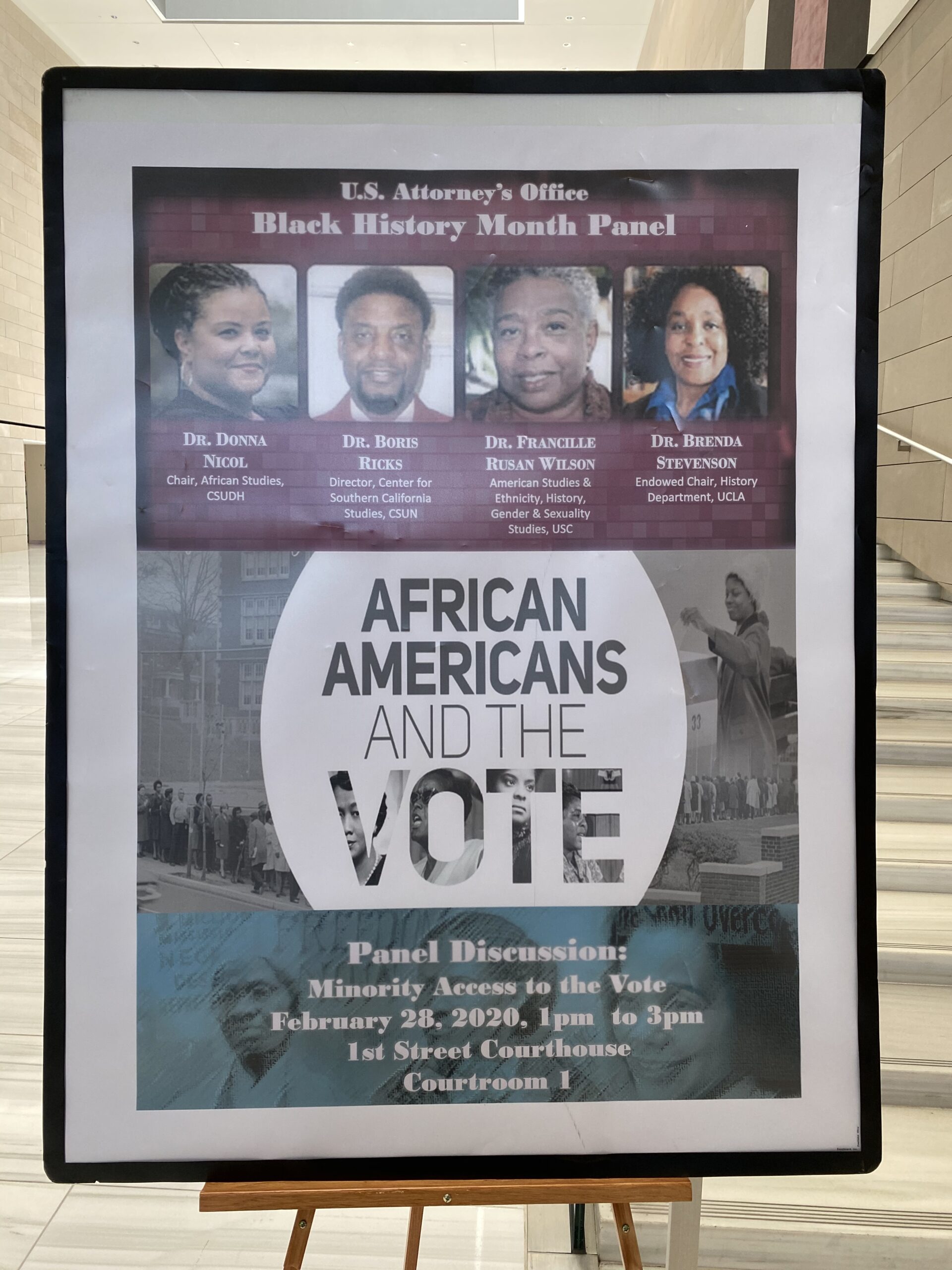
From a late February trip (!) to Los Angeles. In the Federal Courthouse, a celebration of African Americans being able to vote. Just outside, a residence occupied by an African American.
Related:
“Former S.F. Mayor Willie Brown writes about dating Kamala Harris, appointing her to posts” (USA Today, January 2019): “Brown was married at the time he and Harris dated … When they met, she was 29 and Brown was 60. … ‘Yes, I may have influenced her career by appointing her to two state commissions when I was Assembly speaker,’ Brown wrote Saturday. Brown was the speaker from 1980 to 1995, prior to his stint as San Francisco mayor.”
Of Ark Restaurants’ five Manhattan restaurants, only two have reopened, while its properties in Florida — where the virus is far worse — have expanded outdoor seating with tents and tables into their parking lots, serving almost as many guests as they had indoors.
“There’s no reason to do business in New York,” Mr. Weinstein said. “I can do the same volume in Florida in the same square feet as I would have in New York, with my expenses being much less. The idea was that branding and locations were important, but the expense of being in this city has overtaken the marketing group that says you have to be there.”
But New York today looks nothing like it did just a few months ago.
In Manhattan’s major retail corridors, from SoHo to Fifth Avenue to Madison Avenue, once packed sidewalks are now nearly empty. A fraction of the usual army of office workers goes into work every day, and many wealthy residents have left the city for second homes.
For four months, the Victoria’s Secret flagship store at Herald Square in Manhattan has been closed and not paying its $937,000 monthly rent. “It will be years before retail has even a chance of returning to New York City in its pre-Covid form,” the retailer’s parent company recently told its landlord in a legal document.
Faith in human action:
New York’s stringent lockdown and methodical reopening may have brought the virus to heel, Mr. McCann said, but it is also wreaking havoc on businesses with so few people going to work, virtually no visitors and many residents “a little loath to go out” and worried for their health.
It can’t be that the virus ran out of suitable hosts in NYC! Bold action by the governor and mayor defeated the virus.
Democrats in New York assert that Donald Trump is corrupt and acts out of personal financial interest. Donald Trump is known to own a lot of real estate in NYC that would get a big lift from a federal bailout of NYC. Putting these things together, wouldn’t it therefore make sense for New Yorkers to rally behind Donald Trump for the 2020 election? What other politician is certain to divert rivers of federal cash in New York’s direction?
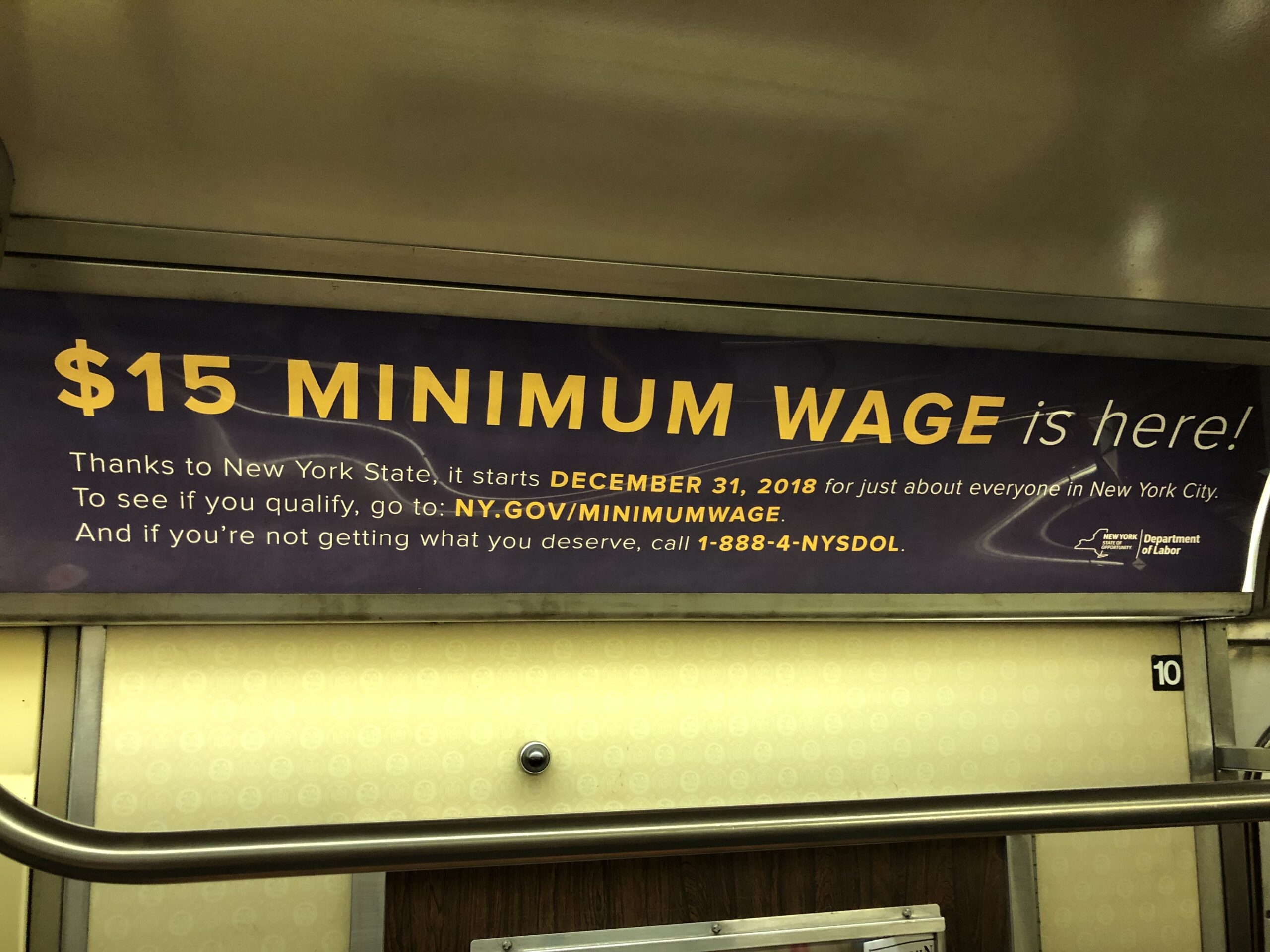
From January 2019, NYC subway:
Now they know that the real minimum wage is actually $0 and/or $600/week…
I have been asking Harvard undergraduates how their online learning experience was. “Terrible,” was a typical response. “I stopped watching after a month or so.” I asked a math major if she had been able to get help with proofs from teaching assistants during the purported virtual learning portion of last semester. “Only if I knew someone and arranged it privately,” she answered. “There was no structured tutoring provided.”
Asking around the rest of the U.S., the consensus seems to be that the bricks and mortar universities are nowhere near as good at delivering online education as the schools that have been doing it for decades, e.g., Western Governors University. Occasionally a student will praise an individual professor for being good at delivering an online experience, but that was never due to any institutional commitment.
How about for the fall? What have the brilliant administrative minds backed up by multi-$billion endowments managed to arrange? An Oberlin professor told me that the school was switching to trimesters and telling students to show up for only two out of three. He complained that it was a lot of work to redesign the curriculum, but said it was necessary due to a lack of dorm space. “We want every student to have a single room,” he explained.
Now that I’ve been defriended for heresy by everyone on Facebook I need to offend people before we are even friends. So, on this group video chat I said “The Chinese built a hospital for 5,000 patients in 10 days. Oberlin is sitting in the middle of farms and can’t set up a few extra dorm rooms in six months?” This was, I learned, a completely unfair comparison.
How about other schools? Most of them seem unable to come up with the idea of renting out blocks of hotel rooms to serve as dormitories (has there ever been a better time to get a long-term lease on a 400-room hotel?). Harvard, for example, is telling most undergraduates that they can’t return to campus (but the ones with a compelling victimhood narrative are welcome!). So the undergrads will meekly isolate in mom and dad’s house (well, actually mom’s house under most U.S. states’ family law systems, even if dad may not realize it yet)? No! Boston-area landlords are now besieged by groups of 6 Harvard undergraduates seeking to crowd into 2BR apartments. So they’ll be in Boston and they’ll get infected with coronaplague, but Harvard can argue that their infections occurred off campus. (See “12 People in a 3-Bedroom House, Then the Virus Entered the Equation”: “Overcrowding, not density, has defined many coronavirus hot spots. Service workers’ quarters skirting Silicon Valley are no exception.”)
From Harvard Yard in March:
Answer: 4 of them are in a 1BR apartment in Porter Square.
I know every family is doing something different in terms of house rules with Covid, but I’m curious to know what those who are pregnant or with newborn are asking of their au pair. I’m due 9/1 and as things open up and 9/1 approaches we want to institute stricter rules. It would be helpful to know what others are doing especially if pregnant/with newborn.
For example, does it seem reasonable to say only building you can enter is our house, no public transit or anyone’s car? Tell us anytime you are leaving house where you’re going? We want to track your phone?
The other Karens in the au pair host mom group approve:
we are in the same boat! Good to hear other families are doing similar things
think that’s reasonable given your situation. AP might not but I would have an honest conversation. Also does she have access to your car? [Answer from Original Karen: “she doesn’t have access to our car. She doesn’t need it for her job and tbh I don’t want her driving it”]
How do these au pairs even get to the U.S. anymore? They can’t, which has led to “The Great Au Pair Rush” (NYT). Exactly when Government Daycare (i.e., K-12) shut down, the cruel Trump Administration also shut down the supply of foreign daycare labor.
Our national strategy for dealing with a virus that attacks fat people has been to order everyone to stay home and make trips to the fridge every 15 minutes since mid-March.
Since our coronapanic lifestyle shows signs of becoming permanent, how about the following: timelocks on the refrigerator and/or kitchen doors so that cower-at-home Americans can hit the fridge only at mealtimes? No more midnight snacking. No more second breakfast.
Readers: Would this be a good strategy for minimizing the Covid-19 death rate going forward (a thinner population is a safer population!) and also for minimizing the deaths associated with our shutdown?
If you want to know how much profit there is in the non-profit world… a friend who works at Partners told me that the enterprise will be spending more than $100 million to rebrand back to what is essentially their old names: “Mass General Brigham” (combination of Massachusetts General Hospital, a.k.a., “the Massive Genital”, and Brigham and Women’s Hospital). That’s confirmed by this article.
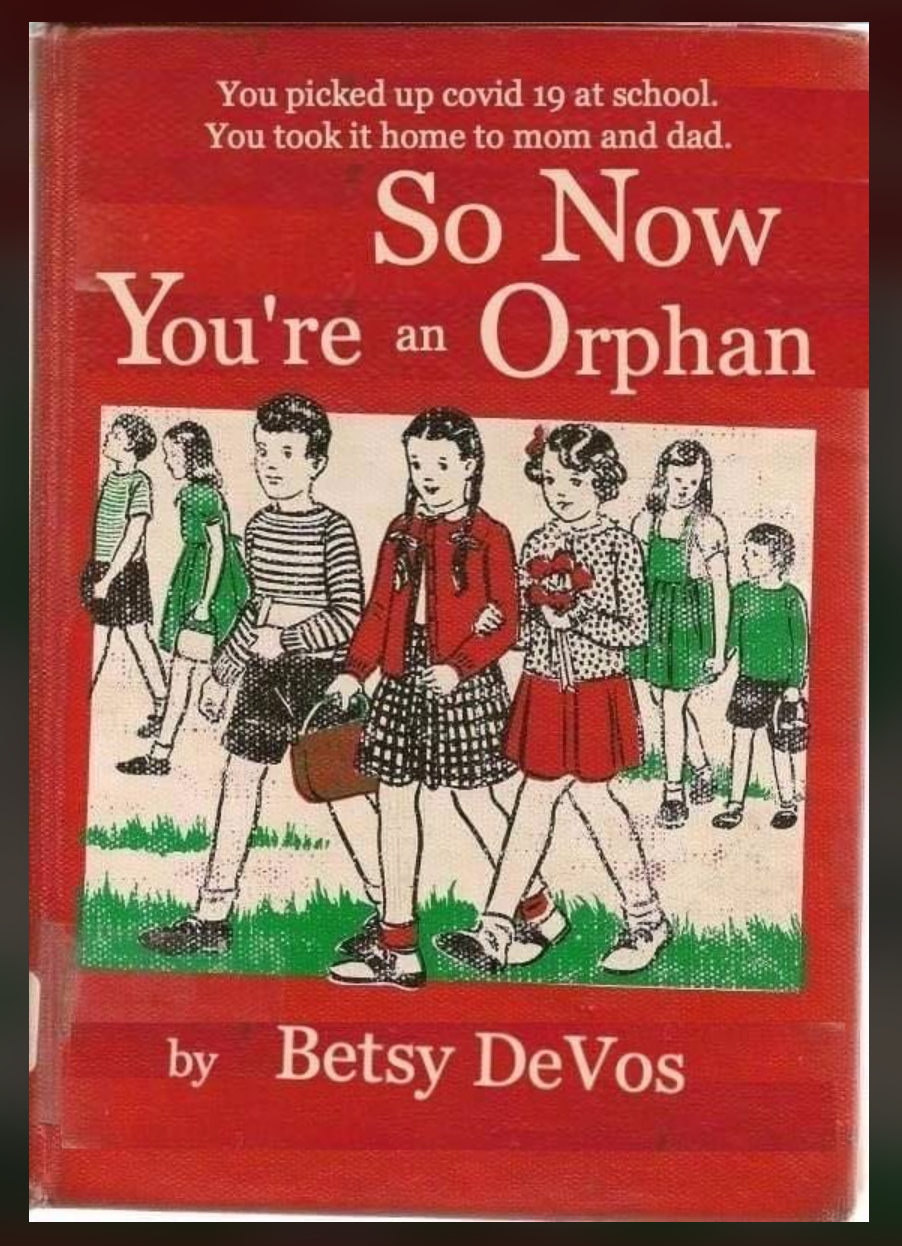
Certainly this is potentially relevant for elementary school children whose parents are 82-year-olds with underlying health conditions (Maskachusetts statistics). And, if this were a realistic scenario for more than a handful of children on Planet Earth, we could make a lot of money building orphanages in Sweden, since their schools never closed, even in the midst of a raging coronaplague. We could also make money building orphanages in most of Europe, since their schools reopened in April or May while coronaplague at least simmered.
The image made me wonder if we already have a solution to (a) protecting American Karens from the viral monster under their beds, while (b) educating American children: ἀγωγή (agōgē). This was the system set up by Sparta in which all state-run schools for children were residential schools. Boys lived in the school from age 7-21 and thus wouldn’t be able to spread any viruses to their parents. Of course, today we would not limit the agōgē to children who identify as “boys”, but would instead host a full rainbow of gender IDs.
As an added bonus “in these times” (my favorite expression!), the Spartan system promoted the LGBTQIA+ lifestyle and most boys were ultimately persuaded of the shortcomings of cisgender heterosexuality (see “Status of homosexuality in ancient Sparta?”).
Readers: What do you think? Time for residential schools for every American K-12er? For extra protection we can limit teachers to those under age 50 and also have the teachers live in the school.
Mystras, 2004, near the site of ancient Sparta:
Related:
Twitter post by a law professor regarding the Arlington County Public Schools: “My wife, who is apparently a glutton for punishment, listened to an entire Arlington County school board meeting last night. She reports there was great concern expressed about, and discussion of how to help: (1) the teachers, especially those who will have kids at home; (2) the staff, as the county wants to avoid layoffs even for those who will have nothing to do with school online, such as extended day staff; (3) poor kids who rely on school lunches; and (4) poor kids who have trouble accessing the internet. Other than (4), there was essentially no discussion how educating students, which is indefinitely online (and was a disaster in the Spring), nor concern expressed for parents who can’t afford childcare, can’t afford tutors to help their kids, and who are otherwise experiencing a looming disaster with indefinite school closure. The way at least my county school system has reacted to this crisis would have been considered outrageous ideological propaganda if a libertarian-oriented public choice scholar had predicted it.” (Due to being next to Washington, D.C., the source of much wealth in a mostly-planned economy, this is one of the richest counties in the U.S.)
Hundreds of thousands of motorcyclists will gather starting today in Sturgis, South Dakota. SD was the only state that did not attempt to lock its residents down (though unionized schoolteachers were protected from potential harm via a public school shutdown!).
it might be time to deliver some unsolicited Covid-19 education, perhaps quoting from the twin saints Fauci and Cuomo. And to gently suggest a mask to match the following more traditional Harley-rider T-shirt:
I would pay to watch a Bay Area or Maskachusetts Shutdown Karen trying to re-educate a group of Harley riders!
Maybe EAA AirVenture needs to be moved to South Dakota where it can be safe from the Wisconsin governor’s whims! Call it “Oshkosh in Sturgis”? The 5100′ runway of 49B would not support a lot of the aircraft that come into KOSH. Maybe come to an arrangement with Sioux Falls? Two huge runways, just like KOSH (though, unfortunately, intersecting). My personal favorite airport in SD is the “Philip Airport”, and I have actually landed there and purchased self-serve fuel. But the 4000′ runway will never work.
Related:
“‘If We Get It, We Chose to Be Here’: Despite Virus, Thousands Converge on Sturgis for Huge Rally” (NYT): Attendance on Friday was on par with previous years, said Dan Ainslie, City Manager for Sturgis. … The rally, which has taken place every summer in Sturgis since 1938, commenced amid strong objections from residents. In a city-sponsored survey, more than 60 percent of the nearly 7,000 residents favored postponing the event. … Little could be done to stop the event, said Doreen Allison Creed, the Meade County commissioner who represents Sturgis. Ms. Creed said the county lacked the authority to shut down the rally because much of it takes place on state-licensed campgrounds. When it became clear that it would go on as planned, the city said in a news release that changes would be made to safeguard residents from the coronavirus, including adding hand-sanitizing stations to the downtown area. The city plans to offer coronavirus testing for its residents once the rally concludes on Aug. 16. (This puts South Dakota/Sturgis on the same level as never-shut Belarus! Sweden’s rules, in place since March, wouldn’t allow a gathering of more than 50 people. So the U.S. has whipsawed through ordering people to stay at home to gathering by the hundreds of thousands.)
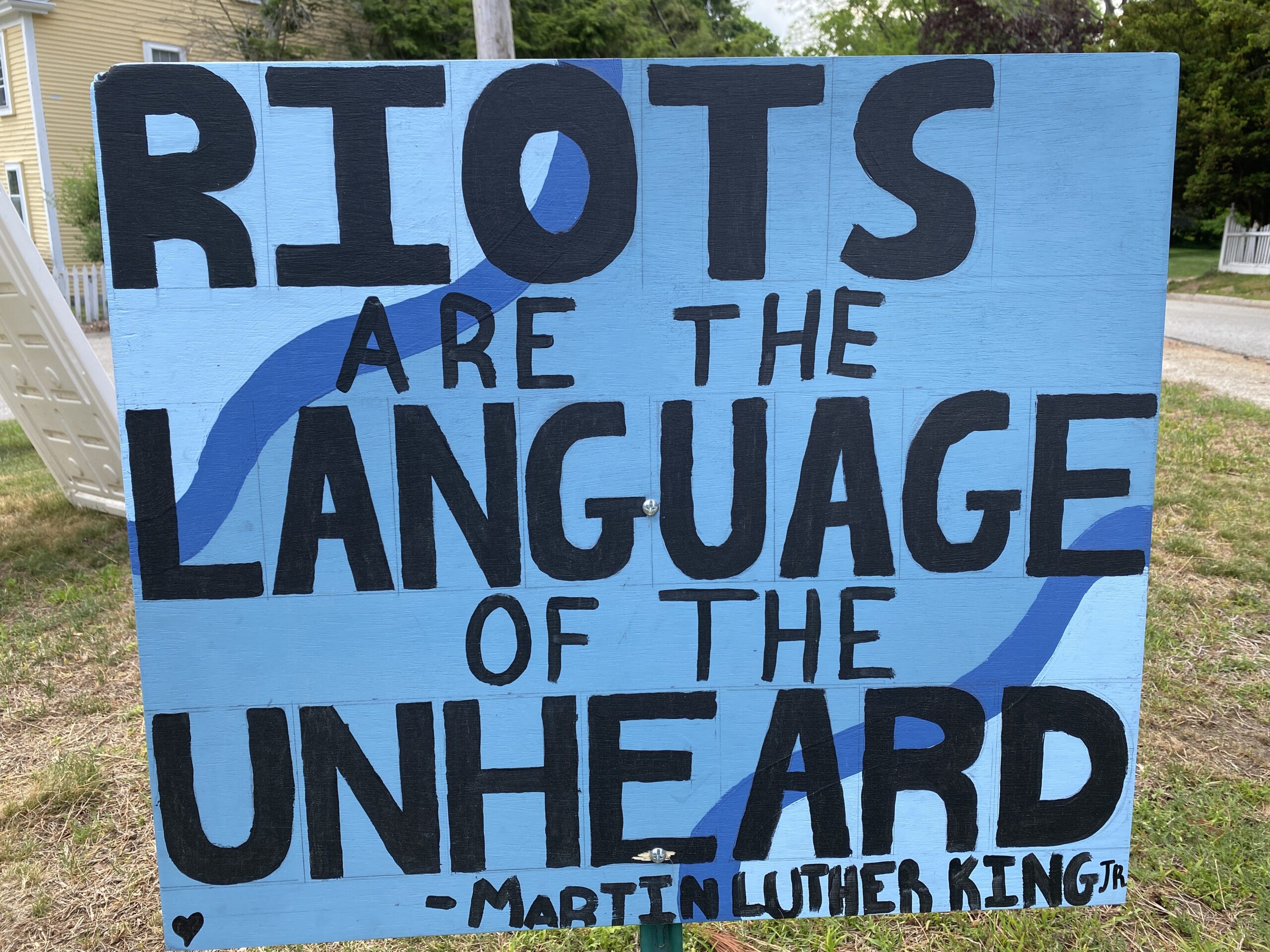
Deplorable 1: Protesting is awesome because it is virtue signaling, a great place to meet other woke people, good for anti Trump news media, and it is not working but entertainment; what is not to love?
Deplorable Dad: Yes. I was driving [teenage son] through [town in Maskachusetts] and saw about 10 high school girls holding BLM signs. I offered to drop him off and told him it was ok to pretend to be liberal to get chicks. These girls would love to date a minority to prove they are woke.
(His son has at least as strong a claim to identifying as a person of color as Elizabeth Warren does!)
(On the subject of meeting people while protesting… a friend met a woman half his age while protesting Donald Trump’s inauguration at the first San Francisco Women’s March. To demonstrate her opposition to the white patriarchy, she moved into his multi-$million house for a year or two…)