The new religion on display in Cambridge, Maskachusetts

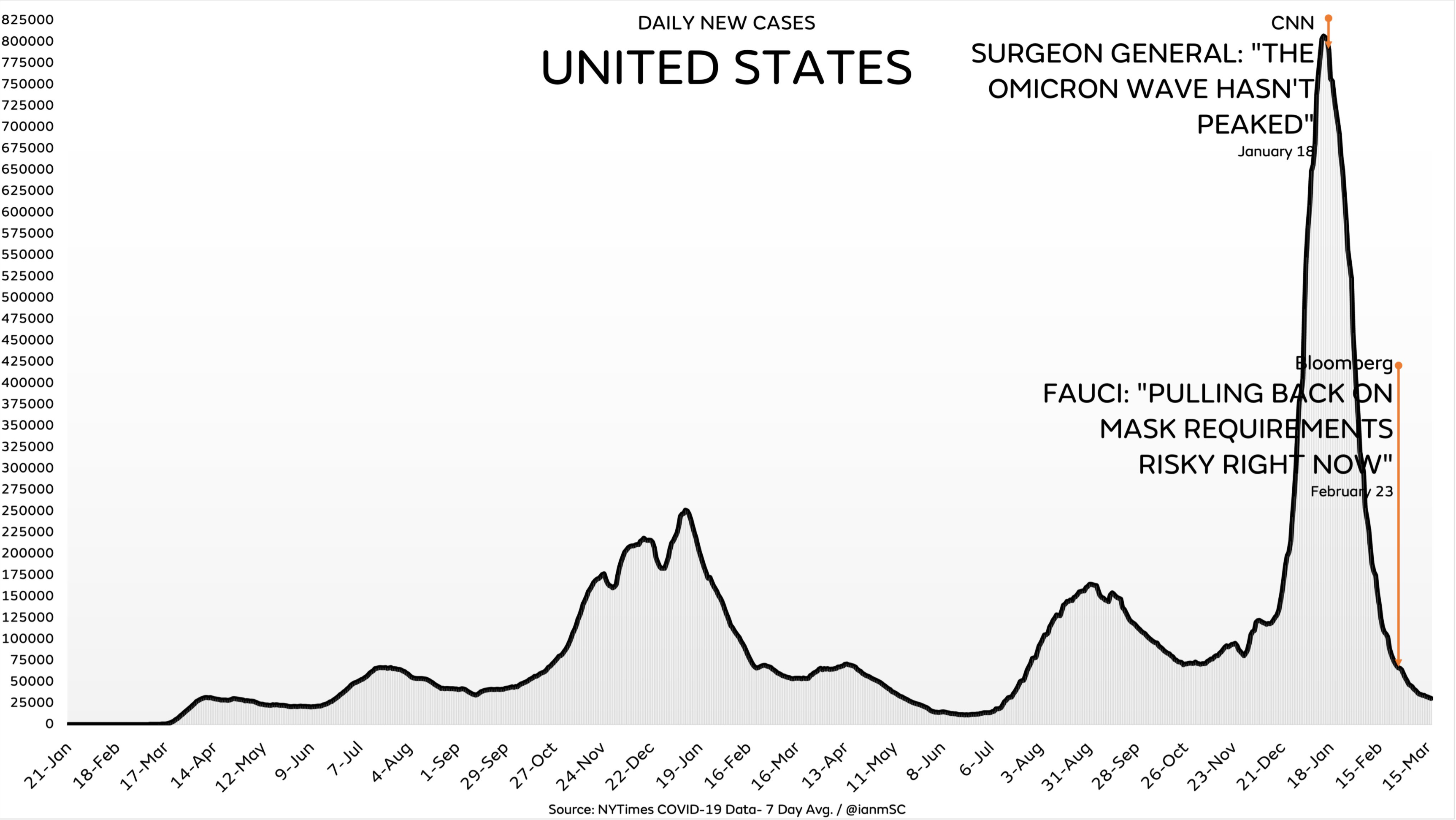
Our new religion, in which God is replaced (“In Fauci We Trust”):

Source: A Deplorable immigrant friend (Joe Biden couldn’t bundle him onto one of the Haitian deportation flights, but would surely love to!). Location: Cambridge, Maskachusetts (a $5 million house as measured in Bidie Bucks?).

Related:

Full post, including comments

MIT’s president weighs in on the shunned heretic

MIT’s President weighs in on the situation previously covered here in Corpus Juris Canonici for academic cancellations (MIT). A follower of the Climate Change Alarmism religion held a heretical belief that universities should not admit or hire people based on skin color. He was, appropriately in my view, shunned. (Why “appropriately”? If you’re going to run a religion, you should do it right!)

Apparently it is extremely rare for a group at MIT to develop something new and useful because the only subjects on which the president of MIT sends out emails are social justice-related (Donald Trump bad, low-skill immigrants good, our former best friend and major donor Jeffrey Epstein bad, coronapanic good, etc.). Continuing in that tradition, an email from yesterday….


To the members of the MIT community,

You may have heard about a situation centered on our Department of Earth, Atmospheric and Planetary Sciences (EAPS) regarding an invited speaker, Professor Dorian Abbot.

In a recent letter to the faculty, Provost Marty Schmidt lays out the facts, some of which have not come through clearly in the media and on social media. I encourage you to read his letter. You will also find thorough coverage in The Tech.

The controversy around this situation has caused great distress for many members of our community, in many quarters. It has also uncovered significant differences within the Institute on several issues.

I would like to reflect on what happened and set us on a path forward. But let me address the human questions first.

To the members of the EAPS community: I am deeply disturbed that as a direct result of this situation, many of you – students, postdocs, faculty and young alumni – have suffered a tide of online targeting and hate mail from outside MIT. This conduct is reprehensible and utterly unacceptable. For members of the MIT community, where we value treating one another with decency and respect, this feels especially jarring.

I encourage anyone who is subjected to harassing or threatening behavior or language to reach out for support and guidance to the Institute Discrimination and Harassment Response (IDHR) office.

I also want to express my tremendous respect for Professor Rob van der Hilst, department head in EAPS, who faced a difficult situation. I know Rob as a person of the highest integrity and character. We are fortunate to have his leadership in EAPS. In this case, when Rob concluded, after consulting broadly, that EAPS could not host an effective public outreach event centered around Professor Abbot, he chose to extend instead an invitation for an on-campus lecture; Rob took this step deliberately to preserve the opportunity for free dialogue and open scientific exchange.

Professor Abbot is a distinguished scientist who remains welcome to speak on the MIT campus, and he has been working with EAPS to confirm the event details.

Nevertheless, there is no doubt that this matter has caused many people inside and outside our community to question the Institute’s commitment to free expression. Some report feeling that certain topics are now off limits at MIT. I have heard these concerns directly from faculty colleagues, alumni and others who care deeply about the Institute.

Let me say clearly what I have observed through more than 40 years at MIT:

Freedom of expression is a fundamental value of the Institute.

I believe that, as an institution of higher learning, we must ensure that different points of view – even views that some or all of us may reject – are allowed to be heard and debated at MIT. Open dialogue is how we make each other wiser and smarter.

This commitment to free expression can carry a human cost. The speech of those we strongly disagree with can anger us. It can disgust us. It can even make members of our own community feel unwelcome and illegitimate on our campus or in their field of study.

I am convinced that, as an institution, we must be prepared to endure such painful outcomes as the price of protecting free expression – the principle is that important.

I am equally certain, however, that when members of our community must bear the cost of other people’s free expression, they deserve our understanding and support. We need to ensure that they, too, have the opportunity to express their own views.

A path forward [emphasis in original]

The issues this situation has brought to the surface are complex. No unilateral declaration on behalf of MIT could either resolve them in the moment or prevent future controversies. So I believe it is vital now that we engage in serious, open discussion together.

As the provost’s letter described, we will begin with a faculty forum, being planned for the last week of October. Discussion in this working session might address questions like these: Given our shared commitment to open inquiry and free expression, are there further steps we should take to practice it consistently? Should we develop guidelines to help groups in their own decision making? Does the concept need more prominence in our curriculum? How should we respond when members of our community bear the disproportionate cost of other people’s speech?

It will be essential in this overall process to include the perspective and experience of graduate and undergraduate students; I have asked Chancellor Melissa Nobles to work with student leaders to decide the best way to do so.

I have also asked Provost Marty Schmidt, Chancellor Nobles and Chair of the Faculty Lily Tsai to begin immediately assembling a special ad hoc working group to consider the insights and lessons we should take away from this situation. I believe this extremely important topic deserves and will benefit from this kind of thoughtful, deliberative, nuanced approach, perhaps including experts from outside MIT. The themes that emerge from the initial faculty forum will help inform the working group’s charge.

From the comments that have come to me directly, I can attest that our community encompasses a wide spectrum of very strong views about what has transpired in these last weeks.

As we cope with the aftermath of this public controversy here at home, let us hold ourselves to the same standards in our interactions with each other as in our intellectual work: To learn more, assume less and ask more – and listen as closely as we can to each other’s ideas, perspectives and experiences.

I hope that, in this moment and always, we will all continue to value and respect each other as fellow members of one community, united in a single great mission.

Sincerely,

L. Rafael Reif


Speech generates an externality (“cost” repeatedly mentioned above). Thus, the sensible way to deal with it, according to Econ 101, is to charge people every time that they speak and distribute the funds received (minus an administration fee) to the BIPOC and 2SLGBTQQIA+ members of the community who currently “bear the cost” of this externality. There is already a “Institute Discrimination and Harassment Response (IDHR) office,” according to the above. This office could be tasked with running the tax-and-spend system.

(Note that the above email is self-contradicctory. President Reif says that expression is costing for those who hear it. Yet he says “I believe it is vital now that we engage in serious, open discussion together.” If “open” means that people are going to say things along the lines of what the heretic Dorian Abbot said in Newsweek, i.e., that universities shouldn’t consider skin color in admissions and hiring, won’t that generate a huge cost to be borne by “members of our community”? Wouldn’t this actually be worse than the lecture Professor Abbot was going to give? (the canceled lecture was not on the subject of skin-color-based university policies))

Related:

  • “Male Workers Allowed Into Baldwin, Unsettling Residents” (Oberlin Review): Baldwin Cottage is the home of the Women and Trans Collective. The College website describes the dorm as “a close-knit community that provides women and transgendered persons with a safe space for discussion, communal living, and personal development.” Cisgender men are not allowed to live on the second and third floors, and many residents choose not to invite cisgender men to that space. I was angry, scared, and confused. Why didn’t the College complete the installation over the summer, when the building was empty? Why couldn’t they tell us precisely when the workers would be there? Why were they only notifying us the day before the installation was due to begin?
Full post, including comments

$112/month to live in a brand-new house in Bowie, Maryland

As part of our move to the Florida Free State, I had Everpresent scan a photo album that my mom made in 1966 (she didn’t use acid-free paper so there was no practical way to preserve it other than scanning).

Here’s the air-conditioned brand-new house that my parents purchased in Bowie, Maryland (my father was working as an economist for Census Bureau): $15,990 with $590 down and $112/month ongoing. (Deal was arranged in 1961, but the house was completed and they moved in 1962. It might have been the Cape Cod, actually, which was slightly cheaper.)

Zillow says that the median price of a single family home today in Bowie is about $500,000.

How does that compare to official inflation? $15,990 in June 1962 is worth about $145,000 today says the BLS. So a house is more than 3X as expensive in real dollars, despite the fact that the above (air-conditioned!) house was brand new. (Would $15,990 in today’s Bidie Bucks even pay for a central air-conditioning system (installed)?)

Related:

Full post, including comments

If Zillow is right about inflation, is everyone who rents stupid?

The Zillow August 2021-August 22 forecast:

Zillow expects home values to grow 11.7% between August 2021 and August 2022, and to end 2021 up 19.9% from December 2020.

The September 2021-Sep 22 forecast:

Zillow expects home values to grow 13.6% between September 2021 and September 2022, and to end 2021 up 19.5% from December 2020.

The 10-year mortgage rate is about 2 percent. If Zillow is right, even for someone who wanted to live in a place for only one year, it would be cheaper to buy a house, pay the cost of capital, pay property tax and insurance, and pay a realtor 5 percent at the end of the year to sell the house than to pay rent (since the preceding scenario will yield at least a small cash profit).

So…. either (1) everyone who rents is stupid, (2) nobody who rents can qualify for a mortgage, or (3) Zillow is wrong about where the price of a house to purchase is going.

(Since we are renters and I am stupid, I am going to bet on Explanation 1!)

Note the pasted-on price adjustment in the chocolate alligator for sale below (PBI):

Related:

Full post, including comments

Who watched the Dave Chappelle special on Netflix?

I didn’t know who Dave Chappelle was, but the protests against his latest show made me curious. See “Netflix Loses Its Glow as Critics Target Chappelle Special” (NYT), for example:

Internally, the tech company that revolutionized Hollywood is now in an uproar as employees challenge the executives responsible for its success and accuse the streaming service of facilitating the spread of hate speech and perhaps inciting violence. At the center of the unrest is “The Closer,” the much-anticipated special from the Emmy-winning comedian Dave Chappelle, which debuted on Oct. 5 and was the fourth-most-watched program on Netflix in the United States on Thursday. In the show, Mr. Chappelle comments mockingly on transgender people and aligns himself with the author J.K. Rowling as “Team TERF,” an acronym for trans-exclusionary radical feminist, a term used for a group of people who argue that a transgender woman’s biological sex determines her gender and can’t be changed.

Complaints like the above made me violate my rule of watching only content targeted at 6-year-olds.

I’m not sure that Chappelle is specifically anti-2SLGBTQQIA+. Much of what he said seemed to fall under the general category of mocking white people who don the victim mantle and demand favorable treatment, e.g., being hired for a job. Chappelle doesn’t say whether or not he believes that Americans should be sorted by victimhood, e.g., in university admissions and hiring, but if Americans are going to be sorted by victimhood he doesn’t think that a white woman is more entitled than a Black man nor that a white person who spends his/her/zir/their evenings having 2SLGBTQQIA+ sex is entitled to special treatment when applying for jobs during the daylight hours.

I wonder if part of the reason that white saviors are upset by this show is that Chappelle explicitly pushes back on the value of white saviors. He quotes a Black woman writer friend who, asked whether she was going to knit a pink pussyhat and join the Women’s March of 2017, responded “I hope those white bitches get teargassed.”

Trigger warning: He uses the N-word a lot.

Loosely related… “This Is What Will Make Sex Work in New York Safer” (NYT, 10/17):

When I took my first client as a sex worker in the 1980s, I had no other choice. It was right after the fall of the dictatorship in Argentina. As a young trans woman, I found that sex work was the only way for me to survive, but I faced constant harassment and violence, especially from la policía. So, I left my home to come to the United States, thinking things would be different.

But when I got here, I had no more luck. On top of being trans, now I also struggled with being undocumented and learning English. Once again, I turned to sex work to stay afloat.

Chappelle might point out that an article like this, on the victimhood of a white 2SLGBTQQIA+ migrant sex worker, takes up space and attention that, if one were going to dwell on victimhood, would properly belong to Black Americans. But he wouldn’t say it that way. He would instead mock the interest that white say-gooding Americans have in this kind of story.

Readers: Did you see this show? What did you think of Mr. Chappelle?

Full post, including comments

How to stop Asian hate for $12

If you’re passionate about #StopAsianHate, you’ll probably want to invest $11.99 in a “Tolerant” wok from IKEA. Photographed October 3, 2021 in Sunrise, Florida:

#ProblemSolved

I proudly showed a Korean-American friend the above photo and told him of my sincere intention to spend $11.99 plus applicable Florida sales tax on this aluminum pan as part of my personal #StopAsianHate plan. His response to my SayGooding? “If it’s not carbon steel, it’s garbage.”

Separately, it would be good to get an FBI investigation going into IKEA’s ties to Vladimir Putin. Note the “Made in Russia” on this entryway table:

Full post, including comments

Portuguese stock picks

If you want some insurance against future Europe-US travel restrictions, want your children to have the flexibility to study/work/live in the EU, or just want to be like Eric Schmidt (support Biden and the Democrats’ plan to re-make U.S. society and the U.S. economy, but have the Gulfstream fueled and that second passport handy just in case!), the Portuguese Golden Visa program is an inexpensive path to an EU passport (less than $100,000 in fees and travel expenses). One requirement of the program is investing in real estate, which the Portuguese love and which I personally hate, or stocks, which the Portuguese hate and I love. The stock purchase approach requires more capital (1 million euro, versus as little as 280,000 for real estate that needs renovation), but is virtually guaranteed to be liquid.

(see Portuguese stocks or Lisbon real estate for the next five years? for some backgrond)

Friends of friends manage money or work in investment banking over in Europe. The general consensus was that Portuguese stocks aren’t mispriced and therefore there is no reason to expect them to do worse (or better) than German or U.S. stocks. That said, the stock market isn’t very developed in Portugal and it is perhaps easier for a management team to loot from shareholders.

Here are some notes from a guy who grew up in Portugal, but has spent his career as an investment banker in London and Spain….

Don’t buy real estate unless you want to use it. He bought in the center because he is fanatical about capital preservation. It took a long time to unload an apartment in Lisbon after the last crash.

Why has PSI-20 done so badly? Had same problems in 2001 and 2008 as everyone else. Bank blew up in 2014. Should be correctly priced now. They’ve survived hell and high water.

The PSI-20 has more exposure to Poland than Brazil or Angola, e.g., through JMT.

You’re in great shape with the large liquid components of the PSI-20.

  • JMT (10, great management, high growth) [the number is a rating from 1 to 10]
  • EDPR (world’s leading wind farm developer, incredibly management)
  • EDP (owns 65% of EDPR, cheapest right way right now to own EDPR)
  • GALP (4, local distribution company for oil, invested some into oil fields in Brazil, Angola, Mozambique, not especially well-managed)
  • BCP (6, only remaining bank, not especially well-managed, dirt cheap, too big to fail for system, largest shareholder is Chinese)
  • RENE (5, just the grid, regulated business, natural monopoly for electricity and gas, yield play)
  • SON (1, conglomerate, screw the minorities every single time, subsidiary is NOS and own that)
  • NVG (integrated paper manufacturer, Europe’s leader, very good management, very well run)
  • COR (10, one of the best companies I’ve ever come across, 50% of good wine[ry?])
  • ALTR (8, indirect way of owning, one of Europe’s most efficient [… something?])
  • CTT (6, post office)
  • SEM (85% of value is navigator, forget about them)
  • EGL (avoid)
  • PHR (avoid)
  • IBS (very nice company, KFC and Pizza Hut, they can grow)
  • Novabase NBA (great company, small IT provider, all software for Vodaphone, half of market cap is cash)
  • RAM (specialized steel and have a forest, properly managed and managed for you).

What if the Portuguese bank holding one’s securities fails? It is just like in the U.S. and the bank is only a custodian.


What did I decide to buy?

CompanySymbolWeight PSI-20Percent portfolio
J. MartinsJMT1325
EDPEDP1220
CorticeiraCOR417
NavigatorNVG610
AltriALTR410
IbersolIBS110
NovabaseNBA0.55
RamadaRAM0.33

The above is based on personal prejudice against banks (ruled out BCP), enthusiasm for Poland (overweight JMT), enthusiasm for electricity (overweight EDP; think of all the European douchebags needing to charge their Teslas!), belief that people are too lazy to cook and that table-service restaurants are unsustainable in a world of COVID-19 plus high labor costs (IBS).

Due to prejudice (observing the USPS!), I didn’t buy the post office, which is sad because they have great-looking trucks:

(2017 photo from the Azores)

Readers: Let me know if you need an introduction to attorneys and bankers over there.

Full post, including comments

Restaurants need to shift to electronic menus for real-time price adjustments?

From a barbecue joint in Boynton Beach, Florida: “due to the shortages of commodities within the market such as chicken wings, pork and also beef we must increase the prices from what the menu prices reflect until the market begins to normalize. … we hope to retain you as a customer as we navigate these unchartered waters.” [sic]

I find it fascinating that the folks who run this restaurant imagine that their costs will come back down (“normalize”) at some point in the reasonably near future. For places that aren’t as optimistic about our economic future, should they all switch to big screen TVs for menu display? Prices will need to be adjusted every month or two at the current rate of inflation, right?

Related:

Full post, including comments
How did you end up celebrating Latinx Heritage Month?

The Federal government says that today is the last day of National Hispanic American Heritage Month”. What did you do to celebrate?

Why doesn’t the post headline agree with the government’s web site? A TV show from state-sponsored media corrects the name of this celebration to “Latinx Heritage Month”:

(Most of the government-run events linked to from the government’s official site do use the term “Latinx” rather than “Hispanic”. Example:

)

Full post, including comments
Folks who refuse to follow Dr. Biden’s vaccine orders are weakly hesitating (not boldly “Resisting”)

During four years of tyranny, anyone who posted a criticism of Donald Trump on Facebook or Twitter was boldly #Resisting. Example from my late friend Mike Hawley (the below was liked and loved 119 times by the righteous):

Successful alimony and child support plaintiffs relaxing in our old Maskachusetts neighborhood displayed lawn signs kind of like the below (“A Woman’s Place is in the Resistance”).

Before we moved to Florida, it was common to see cars with “RESIST” bumper stickers amidst the overall forest of social justice and political bumper stickers.

By contrast, how do we characterize those who refuse to follow orders from Dr. Joe Biden, M.D., and state governors to get vaccinated against COVID-19? In addition to being Deplorable (obviously), are these people bold examples of resistance? After all, those who merely disagreed with Donald Trump’s words were bravely resisting. Actually…. no. It seems that refusing to do what the government tells you to do is an example of weak hesitation. Google returns 152,000 results for “vaccine hesistant” within News and only 23,500 for “vaccine resistant” (most of which relate to the muscular SARS-CoV-2 virus itself, not to any humans).

Examples:

Full post, including comments